Analysis shows 45 of Kenneth Hayne’s 76 recommendations have yet to be implemented and four have been abandoned
More than half of the recommendations made by the banking royal commissioner, Kenneth Hayne, have either been abandoned or are yet to be fully implemented, almost two years after the treasurer received the inquiry’s final report and vowed to take action on all recommendations.
Regulators put implementation of some recommendations on hold during the peak of the coronavirus crisis, but consumer groups fear Josh Frydenberg has taken advantage of the delay to undermine the pro-regulation consensus established by the royal commission, which followed more than five years of scandal in the financial services industry.
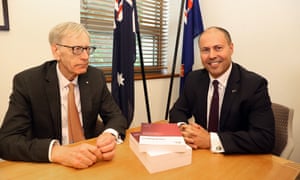
Frydenberg said that despite the coronavirus crisis more than 70% of the royal commission’s recommendations requiring action by the executive government had been implemented since he received the report from Hayne at a frosty handover meeting in Canberra on 1 February 2019.
However, an analysis by Guardian Australia of all 76 of Hayne’s recommendations shows that 45 have yet to be implemented and four have been abandoned.
Three, which involve reviews of progress in making changes, are not yet due.
Recommendations ditched include Hayne’s very first: that laws requiring banks to lend responsibly not be changed.
Instead, Frydenberg in September announced that the laws, which had been attacked by the banks in a lobbying campaign and in parliament by government backbenchers, would be repealed entirely to remove “unnecessary barriers to the flow of credit to households and small businesses”.
Gerard Brody, the chief executive of the Consumer Action Law Centre, which provided the royal commission with some of the case studies it examined during hearings, said the government was “just walking away from some of the core recommendations”.
“Covid is part of it but there are some very important recommendations that have just fallen aside,” he said.
These included a recommendation banning retailers from selling loans to customers at the point of sale, which was supposed to be in place by the end of 2020.
“At the moment they act entirely outside of regulation,” he said. “It hasn’t happened.”
“Responsible lending, the government has walked that one backwards.”
Frydenberg also rejected Hayne’s recommendations that mortgage brokers be banned from receiving commissions over the life of a home loan, and be treated in the same way as financial advisers.
And the banks rebuffed Hayne’s recommendation that the banking code be changed to broaden the definition of small business, although the idea is to be considered again during a review this year.
Many of the recommendations that are yet to be implemented relate to cleaning up financial advice and superannuation, two of the most troubled parts of the financial services industry.
The exposure in the media of widespread malpractice in the financial planning industry, including poor quality advice and fee gouging, was one of the main drivers behind calls for a royal commission.
Superannuation was a late addition to the inquiry, but the hearings exposed bad behaviour among bank-run funds that included high fees and poor performance, while largely giving the union-and-employer-controlled industry funds a clean bill of health.
Laws bringing into force many of the recommendations in these areas are due to come into force this year, following legislation that passed parliament in December.
However, several other important recommendations, including the establishment of a compensation scheme of last resort that would provide payments to consumers who have been ripped off by a financial adviser who then goes broke, have yet to be legislated.
Also making slow progress is a national mediation scheme for farm debt – a response to horror stories of heavy-handed action by banks that were aired at the commission’s hearings and by farmers through the media.
The agriculture minister, David Littleproud, said the government was still committed to the idea but it required the cooperation of states and territories.
“It is disappointing that a national scheme is being stalled by a couple of states and the territories,” he said.
The Northern Territory does not have a scheme, Western Australia has a voluntary scheme and until legislation was passed this month Tasmania did not have a scheme.
A spokeswoman said the NT’s minister for agriculture, Nicole Manison, was “supportive of a national approach” but this would require consultation with stakeholders and “no formal process has commenced”.
Brody said he thought the government had dropped anchors on implementing Hayne’s agenda in full for the same reason it quashed the responsible lending law.
“They are wanting a credit-fuelled recovery,” he said. “They don’t want restraints or oversight on credit at the moment, and they’re not concerned at the harm that risks consumers.”
Last year, both the corporate regulator, the Australian Securities and Investments Commission, and the prudential regulator, the Australian Prudential Regulation Authority, delayed implementation of the Hayne recommendations for which they are responsible for periods of up to six months, citing the coronavirus crisis.
The crisis also made it impossible for parliament to sit for long periods last year, delaying the progress of legislation.
However, Frydenberg told Guardian Australia that despite the pandemic, “the Morrison government has made substantial progress in implementing recommendations arising from the Hayne royal commission”.
“In December alone, the government introduced and passed legislation addressing more than 20 recommendations and introduced new legislation seeking to implement a further four recommendations,” he said.
“The government remains focussed on completing implementation of the remaining recommendations of the Hayne royal commission.”
This story was updated on 19 January 2021 to correct the status of one recommendation from “abandoned” to “yet to be implemented”.
No comments:
Post a Comment