Contemporary politics,local and international current affairs, science, music and extracts from the Queensland Newspaper "THE WORKER" documenting the proud history of the Labour Movement.
MAHATMA GANDHI ~ Truth never damages a cause that is just.
Wednesday, 17 May 2017
Trump: I shared information with Russia and I had 'absolute right' to do so
President defiant over sharing information with Russian officials
Politicians and intelligence officials concerned information put sources at risk
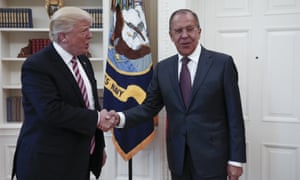
Trump with the Russian foreign minister, Sergei Lavrov, in the Oval
Office last week. Trump’s Tuesday tweets contradicted flat denials
issued by senior officials on Monday night.
Photograph: Tass/Barcroft
Donald Trump has admitted that he shared information on terrorism with Russia, asserting he has an “absolute right” to do so.
The US president was responding to reports in the Washington Post
and elsewhere alleging that he had revealed “highly classified” details
about a threat from Isis during a meeting last week with the Russian
foreign minister, Sergei Lavrov, and the Russian ambassador to the US,
Sergey Kislyak.
The president is allowed to declassify and share classified information at any moment he chooses. Trump’s Tuesday morning tweets did not specify whether the information he shared with Russia was classified.
“As president, I wanted to share with Russia (at an openly scheduled
WH meeting) which I have the absolute right to do, facts pertaining to
terrorism and airline flight safety,” Trump wrote. “Humanitarian reasons, plus I want Russia to greatly step up their fight against Isis and terrorism.”
Trump’s tweets contradicted flat denials issued by senior officials
on Monday night. One of them was from the national security adviser, HR
McMaster, who declared the Washington Post report to be false. On
Tuesday, he offered a more calibrated response.
Trumps’ comments to Russian officials ‘appropriate to the conversation’ says HR McMaster
“What I’m saying is that the premise of the article was false – that
in any way the president had a conversation that was inappropriate or
that resulted in any kind of lapse in national security,” McMaster said.
He argued that the real threat came from the leaks to the press.
McMaster
refused to confirm or deny whether Trump had shared classified
information with Lavrov and Kislyak, repeatedly describing what Trump
had revealed as being “appropriate to the conversation” and saying that
the president had decided to release it “in the context of the
conversation”.
McMaster did tacitly confirm that the president had named the Syrian
city in which the intelligence had been collected. “It was nothing you
wouldn’t know from open source,” he said. He also confirmed that the
president’s counter-terrorism adviser, Tom Bossert, had called the
intelligence agencies to let them know about the incident “out of an
abundance of caution”.
The affair has sparked an uproar over whether Trump compromised
national security. It also cast greater scrutiny on the president’s
closeness to Russia, which the US government has long considered a hostile actor.
Top administration officials who had attended the 10 May meeting said
on Monday night that the president did not disclose intelligence
sources or methods to the Russian officials, but fell short of denying
that Trump had shared classified information.
McMaster said on Monday night that the president and Russian foreign
minister “reviewed common threats from terrorist organisations to
include threats to aviation”.
“At no time were any intelligence sources or methods discussed and no
military operations were disclosed that were not already known
publicly,” McMaster said. Speaking to reporters later at the White
House, McMaster added to his statement by saying: “I was in the room. It
didn’t happen.”
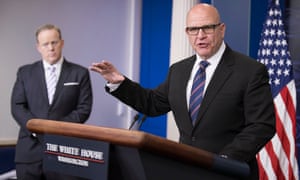
The national security adviser, HR McMaster, takes
questions from the press, as Sean Spicer looks on. McMaster said the
real threat came from leaks to the press. Photograph: Shawn Thew/EPA
The original report did not suggest Trump had discussed sources and
methods. The allegation is that Trump shared some information about
laptops on planes, which potentially put a source at risk and was given
to the US by an ally who did not give consent for it to be shared with
Russia.
Russia’s
foreign ministry spokesperson, Maria Zakharova, said on Facebook on
Tuesday said the reports were “yet another fake” – and advised people not to read American newspapers.
Top politicians and intelligence officials said they were concerned
the information potentially put a source at risk and was given to the US
by an ally who did not give consent for it to be shared with Russia. Such a move could jeopardize existing relationships with allies familiar with Isis operations.
Trump was due to call King Abdullah of Jordan on Tuesday morning amid
speculation that the information he shared with Russia could have been
provided by Jordanian intelligence.
“The main sources of intelligence on what Isis, [also known as]
Daesh, is plotting include British, French, and Israeli [agents]. But
the strongest source of intel from inside Syria seems to be Jordan,”
said Dan Raviv, a journalist and author of several books on espionage in
the Middle East.
“Jordan has been out to impress the new US administration – and Trump
seems to have been duly impressed by King Abdullah. Trump will be
speaking by phone with the Jordanian monarch this morning,” Raviv said.
“As for the Israeli view on this, the Israelis can’t avoid seeing a
delicious irony. US intelligence agencies, for decades, have suspected
that Israel sometimes passes information to Russia – as part of trading
intelligence – and that was the CIA’s reason to be reluctant in sharing
everything with the Israelis. Now, America’s allies seem concerned that
Trump himself might be passing sensitive intel to the Russians.”
Burkhard Lischka, a senior German lawmaker, told the Associated Press
that the reports were concerning. “If it proves to be true that the
American president passed on internal intelligence matters, that would
be highly worrying,” Lischka said.
An official from an unnamed European country told the Associated
Press that the country might stop sharing intelligence with the US in
light of Trump’s disclosures to Russia.
Mitch McConnell, the Senate majority leader, lamented what he deemed to be a distraction from the Republican policy agenda.
“I think we could do with a little less drama from the White House on
a lot of things,” McConnell told Bloomberg TV on Tuesday, “so that we
can focus on our agenda, which is deregulation, tax reform, and
repealing and replacing Obamacare.”
Other Republicans were more outspoken in their criticism of the
president. Arizona senator John McCain said the reports were “deeply
disturbing” and sent “a troubling signal to America’s allies and
partners around the world and may impair their willingness to share
intelligence with us in the future”.
McCain
said: “Regrettably, the time President Trump spent sharing sensitive
information with the Russians was time he did not spend focusing on
Russia’s aggressive behavior, including its interference in American and
European elections, its illegal invasion of Ukraine and annexation of
Crimea, its other destabilizing activities across Europe, and the slaughter of innocent civilians and targeting of hospitals in Syria.”
Senator Bob Corker, the chair of the Senate foreign relations
committee, warned that Trump’s White House must urgently reverse the
“downward spiral” it finds itself in. “The White House has got to do
something soon to bring itself under control and in order,” he said.
“It’s got to happen.”
The Washington Post’s reporting cited current and former US
officials. The allegations were confirmed by several other US news
outlets on Monday night.
The FBI and the Senate and House intelligence committees are
conducting separate investigations into Russian interference in the
presidential election, which the US government has said was designed to
boost Trump’s candidacy.
As president, Trump has continued to downplay the threat posed by
Russia while lavishing praise on Vladimir Putin. He has dismissed the
inquiries into his potential links to Russia as “fake news” – even as a
number of his former campaign aides have had contacts with Russian
operatives.
Trump’s former national security adviser, Michael Flynn, was forced
to resign in February for secretly discussing US sanctions against
Russia with Kislyak, and then misleading the vice-president, Mike Pence,
about the nature of his conversations. Jeff Sessions, the attorney
general and a vocal surrogate of Trump’s during the campaign, recused
himself from the FBI investigation into Russia after failing to disclose
his own meeting with Kislyak in his confirmation hearing before the US
Senate.
Two former Trump aides, his former campaign manager Paul Manafort and
informal adviser Carter Page, have had ties to Russia and pro-Kremlin
operatives.

No comments:
Post a Comment