Contemporary politics,local and international current affairs, science, music and extracts from the Queensland Newspaper "THE WORKER" documenting the proud history of the Labour Movement.
MAHATMA GANDHI ~ Truth never damages a cause that is just.
One hundred years ago, Lenin’s Bolshevik uprising overturned centuries
of feudalism in Russia. But what does it mean for the world today?
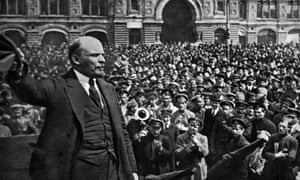
Vladimir Lenin addresses the crowd in Red Square in 1919.
Photograph: Heritage Images/Getty Images
Besides anything else, the socialist uprising in Russia
in October 1917 is an extraordinary story. The culmination of the
transformative months of that year, beginning with February and the
abrupt popular overthrow of tsar Nicholas II and his regime, it’s all
intrigue and violence and loyalty and treachery and courage.
But what of that prevailing sense that these giant events occurred
worlds away and eras ago? Since 1989 and the downfall of Stalinism,
mainstream culture has consigned the revolution to the tomb and
celebrated its interment – thereby concurring with the spurious claim of
those sclerotic, despotic regimes draping themselves in its mantle that
they represent something other than the revolution’s defeat. Are these
giant events now just baleful warnings? Something else? Does the
revolution even matter?
It matters. Because things were different once. Why could they not be
again? Even as someone fascinated and inspired by the Russian
revolution, of which this year is the centenary, when I am asked why it
still matters, what comes to me first is hesitation. A silence. But as
well as words, a key to understanding October 1917 is a certain
wordlessness.
We may know in our marrow that it matters, but it feels defensive,
sententious, dogmatic to glibly “explain” the revolution’s “relevance”: a
too-quick-off-the-mark propensity to “explain” everything is not a
problem of the left alone, but it’s particularly galling when coming
from radicals committed, at least in principle, to rubbing history
against the grain, counter-narratives, the questioning of received
opinions, including their own. (One salutary impact of recent
extraordinary political upsets – Corbyn, Sanders, Trump, the French
presidential election, with more to come – has been the carnage of
political givens, the humbling of the know-it-all.)
In Russia, Putin’s state knows that the revolution matters, which
puts it in an odd position. Committed to capitalism (gangster capitalism
is still capitalism), it can hardly pitch itself as an inheritor of an
uprising against that system: at the same time, official and
semi-official nostalgia for the symbolic bric-a-brac of Great Russia,
including that of Stalinist vintage, precludes banishing the memory. It
risks being, as historian Boris Kolonitsky has put it, “a very
unpredictable past”.
On
a recent trip to St Petersburg, I asked Russian friends how the
government would negotiate that, if it had to. Would it remember the
centenary with celebration or anathema? “They will say there was a
struggle,” I was told, “and that eventually, Russia won.”
Another of the revolution’s many tragedies: its pertinence asserted
while its substance is evacuated. A vision of global emancipation
deployed as one warble in a long chauvinist blare.
In one sense it’s uncontroversial that 1917 matters. After all, it is
recent history, and there’s no arena of the modern world not touched by
its shadow. Not only in the social democratic parties, shaped in
opposition to revolutionary approaches, and their opponents of course,
but at the grand scale of geopolitics, where the world’s patterns of
allegiance and rivalry and the states that make up the system bear the
clear traces of the revolution, its degeneration and decades of
standoff. Equally, a long way from the austere realms of statecraft, the
Russian avant-garde artists Malevich, Popova, Rodchenko and others
remain inextricable from the revolution that so many of them embraced.
Their influence is incalculable: the cultural critic Owen Hatherley
calls constructivism “probably the most intensive and creative art and
architectural movement of the 20th century”, which influenced or
anticipated “abstraction, pop art, op art, minimalism, abstract
expressionism, the graphic style of punk and post-punk … brutalism,
postmodernism, hi-tech and deconstructivism”. We can trace the
revolution in cinema and sociology, theatre and theology, realpolitik
and fashion. So of course the revolution matters. As Lenin may or may
not have said: “Everything is related to everything else.”
But here comes hesitation again, a sense that this approach, vital as
it is, is to orbit rather than interrogate the fundamental issue. Why,
to put it another way, does the discussion make people angry?
China Miéville: ‘Without hope there’s no drive to overturn an ugly world.’ Photograph: Sarah Lee for the Guardian
It has become commonplace to admit that history was more tenacious than Francis Fukuyama
suggested, but this is, after all, still meant to be the post-Thatcher
era of TINA – there is no alternative – in which but perhaps for
a diminishing tinkering space, fundamentals are not to be challenged. To
even moot a system predicated on something other than profit, of
grassroots control, is supposed to provoke eye-rolling, despite the
increasingly sadistic deployment of austerity. So it’s precisely as a
vision of an alternative, and one that had the temerity, at the start,
to be successful, to overthrow the un- or not-yet assailable, that
October matters. That’s why there’s anger, on all sides, rather than
mere exasperation or amusement. Because what’s at stake isn’t the
interpretation just of history but of the present. The question of
whether it had and has to be this way.
What
is shared by most of those who are opposed to anything but regret for
1917 is the conviction that the later excrescence of Stalinism was the
inevitable outcome of the revolution. Certainly this can be argued: for
the most part, however, it is taken as more or less self-evident. Not
that there’s anything approaching one monolithic anti- or
pro-revolutionary perspective, which encompasses socialists of various
stamps, liberals, conservatives, fascists and others.
Some may even consider the Bolsheviks misguided and tragic, though
wicked and power hungry is more common. There is a pull towards a crude
morality tale. One can disagree with, say, historian Orlando Figes’s
conclusions without querying the seriousness of his research, but his
assertion in A People’s Tragedy
that “hatred and indifference to human suffering were to varying
degrees ingrained in the minds of all the Bolshevik leaders” is simply
absurd (and his disapproving fascination with their leather jackets
curious).
On the other side, there are some true believers such as the minute
and grotesque Stalin Society. For the most part, however, the question
for those who find cause for celebration in the revolution is, from what
date do we start mourning? If an emancipatory tradition was broken,
when was the break? 1921? 1924? 1928? 1930? What combination of factors
lies behind the degeneration? The carnage of the civil war? Allied
interventions, including, enthusiastically, on the side of the
antisemitic pogromists? The failure of revolutions in Europe?
What’s shared is a sense of rupture, of break and loss, where
liberalism and the right see inevitability. “It is often said that ‘the
germ of all Stalinism was in Bolshevism at its beginning’,” wrote the
dissident Bolshevik Victor Serge in 1937. “Well, I have no objection.
Only, Bolshevism also contained many other germs, a mass of other germs,
and those who lived through the enthusiasm of the first years of the
first victorious socialist revolution ought not to forget it. To judge
the living man by the death germs which the autopsy reveals in the
corpse – and which he may have carried in him since his birth – is that
very sensible?”
That
excellent quote has become something of a cliche of anti-Stalinist
socialism. What sometimes escapes its enthusiasts is that Serge clears
Bolshevism of inevitably leading to Stalinism, not of all
responsibility. Any movement that avoids hagiography, that critically
evaluates its own traditions, is healthy and confident. This means
accounting not only for the civil war and the regime’s enforced
isolation, the famine, the industrial and agricultural and social
collapse, but the political degeneration within the Bolsheviks, too, in
the parlous months and years after taking power.
Whatever the lessons and inspiration the revolution offers, one
occasionally sees a foolish kind of cosplay in the refusal to gauge all
this unflinchingly, and in the desire to treat Lenin’s party of 1917 as a
paradigm for today. In the discussions of some radical groups, one can
even discern the influence of the eccentric cadences and vocabulary of
century-old translated socialist literature. This is not to allow the
revolution to matter too much, but to matter for the wrong reasons. No
such special pleading or fawning re-enactment is necessary: that isn’t
fidelity. Whatever the particularities of Russia 1917, the revolution
resonates now not only for the analytical insights it offers but as a
horizon, the sheer fact, both bathetic and momentous, that things were
other, it could be so again. That’s what connects to today’s indignities
and violence and inequality and oppression and to what they bring
forth, as in very different circumstances they did a century ago: an
ache for a radical reconfiguration.
So to go back to the question: why does the revolution matter?
Because of what was right about it, and what went wrong. It matters
because it shows the necessity not only of hope but of appropriate
pessimism, and the interrelation of the two. Without hope, that
millennial drive, there’s no drive to overturn an ugly world. Without
pessimism, a frank evaluation of the scale of difficulties, necessities
can all too easily be recast as virtues.
Thus after Lenin’s death the party’s adoption of Stalin’s 1924 theory
of “socialism in one country”. This overturned a long commitment to
internationalism, the certainty that the Russian revolution could not
survive in isolation. The failure of the European revolutions provoked
this – it was a shift born of despair. But announcing, ultimately
celebrating an autarchic socialism was a catastrophe. A hard-headed
pessimism would have been less damaging than this bad hope.
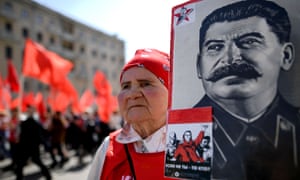
A Communist party activist with a banner of Joseph Stalin
at a May Day rally in Moscow. Photograph: Kirill Kudryavtsev/AFP/Getty
Images
The revolution also matters because it was, quite properly,
millennial. Its opponents regularly charge socialism with being a
religion. The claim, of course, is hypocritical: anti-communism is just
as often infused with the cultish fervour of the exorcist. And more
importantly, it’s no weakness that alongside and informing their
analysis, the partisans of 1917 were driven by a utopian urge, the
hunger for a new and better world, to become people capable of
inhabiting it.
All
these reasons are pertinent and crucial. And all together they remain
inadequate. Still there’s that frozen moment, that sense of unsayable
excess. Again and again, in the revolution’s aspirations, its
apocalyptic circumstances, its mistakes and successes, words fail. They
fail in the near-glossolalic letters sent by soldiers to the press as
the year wore on, despairing that their February revolution had been
apocalypse without renewal. They fail in the equivocal leaflets of
the Bolsheviks of July 1917, when they struggled to restrain restive
streets. They fail spectacularly when the party understood that its plea
not to demonstrate on the streets, which they had already prepared for
their paper, would be widely ignored. So late at night, to avoid
embarrassment, the lines are simply cut and Pravda appears on 4 July
with a blank white space in the centre of its front page.
This wasn’t the first printed silence on the Russian left. Almost 60
years before the revolution, the radical writer Nikolay Chernyshevsky
published What Is to Be Done?, a long political novel with an
immense impact on the socialist movement, especially on Lenin, who, in
1902, named his own seminal tract on organisation after the book.
Chernyshevsky’s depiction of the hinge point, a fulcrum from history to
future possibility, comprises in its entirety two rows of dots. Informed
readers would understand that behind the extended ellipsis was
revolution. Thus Chernyshevsky evaded the censor, but there’s something
religious, too, eschatological, in this unwriting, from this atheist son
of a priest. Apophatic theology is that which focuses on what cannot be
said of God: an apophatic revolutionism, unashamed to go beyond words.
In Russia, Virginia Woolf wrote in Orlando, “sentences are
often left unfinished from doubt as how to best end them”. Of course
this is a literary flourish, a common and unsustainable romanticised
Russian essentialism. But even so, the formulation feels prophetic for
this particular Russian story. Chernyshevsky’s dots describe the
revolution itself. Pravda’s blank hole contains tactics. Unsayables are
by no means all there is to this strange story, but they are central to
it.
They are key to why it matters. Because that which we can’t speak we
might experience, instead. Which is why with the hesitation to answer
comes a yearning. Not to say but to do and be. Not to struggle and fail
to explain or to speak an October, but to be part of one. October: The Story of the Russian Revolution by China Miéville is published by Verso.


No comments:
Post a Comment