Monday, 3 April 2017

Adani plans to export low quality, high ash coal to India, court told

Updated about an hour ago

The ABC has unearthed previously unreported evidence that shows Adani plans to export a low-quality coal product to India — coal with a high ash content that could cause deadly air pollution.

Key points:

  • Supporters say Adani's coal would improve air quality, lower greenhouse gases
  • But report says Carmichael mine would produce "two coal products"
  • Coal bound for India could be a low-grade product

Supporters of the Indian conglomerate's planned giant coal mine in Queensland claim it will improve air quality and lower greenhouse gases, because it would supply India with "high quality" Australian coal.
The Minister for Resources, Matthew Canavan, recently said if Australia did not supply India with coal from Queensland, "they will get that coal elsewhere — which they are doing right now".
"Generally speaking that coal is of lower quality than what we have in Queensland," he said.
But whether the coal from Adani's Carmichael mine would be better quality has not been made clear.
According to sworn evidence to the Land Court in Queensland, Adani plans to ship polluting, low-energy coal to India.
A report to the court made on its behalf said the Carmichael mine would produce "two coal products".
"Product one, a low ash/moderate energy product most suitable for Asian premium markets," the report said.
"And product two, a high ash/lower energy product most suitable for non-premium markets, particularly India."
So the coal bound for India could be a fairly low-grade product.
Mr Canavan said while it might not be the highest quality coal in Australia, "it's still much much higher than the coal quality in India".
When asked about whether he was aware of the plan to produce two different coal quality products, Mr Canavan said "different coal companies create different products for different circumstances".
"There is also the opportunity to blend and then officiate that coal at the other end. That's a commercial decision for themselves," he said.
Mr Canavan said it was not just the Government who thought it would be better for the environment if India used Australian coal.
"The Queensland Supreme Court itself also made the point that the Adani Carmichael coal mine itself won't increase greenhouse gas emissions, if it displaces coal from other sources," he said.
"That's exactly what it will do, because India will get coal from somewhere, [and] as I say, their own coal is generally lower quality than ours."

'Poor quality coal' at Galilee Basin

Associate Professor Gavin Mudd, from RMIT University, has mapped the quality of coal deposits across Australia.
"If you look at the Galilee Basin coal, there's a reason why it hasn't been developed — it's poorer quality coal, compared to other places of Australia," Dr Mudd said.
"It's certainly not as bad as brown coal from an energy point of view, but from an ash point of view it's almost 10 times more ash content."
The average energy content of coal at Adani's planned mine is about 18 per cent below benchmark Australian coal.
Adani conceded in court the ash content was about 26 per cent, roughly double the Australian benchmark.
Keep in mind the best coal from the mine will not go to India — it will get unwashed, high-ash coal.
Associate Professor Mudd said that raised serious health concerns.
"Major issues with respiratory illness — so asthma and all sorts of related things, heart disease increases in things like lung cancer and so on as well," he said.
"So we need to make sure that when we're using such quality coal we have really rigorous pollution control."
India's air quality rivals China as the worst in the world, with air pollution accounting for more than one million deaths a year.

Carmichael mine will reduce Indian plants' carbon footprint: Adani

Despite the sworn court evidence, Adani has publicly maintained that coal exports from the Carmichael mine will cut greenhouse gas emissions.
"The thing about Carmichael is, it will reduce the carbon footprint of existing [Indian] plants, which are using Indonesian or Indian coal today, by say 30 to 40 per cent," Adani Australia's CEO Jeyakumar Janakara told a forum in Brisbane last week.
Adani has repeatedly declined requests by the ABC for an interview about the Carmichael mine and the company's corporate structure in Australia.

Immigration, fake news and terror: Rushdie and experts on a dangerous moment for the US

In event hosted by the Ethics Centre and sponsored by the Guardian, the author joined analysts and academics to discuss key issues in Trump’s America

The New York Public Library on 42nd Street in Manhattan hosted Saturday’s event.
The New York Public Library on 42nd Street in Manhattan hosted Saturday’s event. Photograph: Max Touhey Photography/NYPL
Activists, political analysts and writers including the author Salman Rushdie, foreign policy expert Anne-Marie Slaughter and Columbia University president Lee Bollinger appeared in New York on Saturday, at an event that aimed to look past partisan squabbling over immigration, “fake news” and the threat of terrorism.
The event, A Dangerous Moment: Shades of Red and Blue, was hosted by the The Ethics Centre, an Australian organization, and sponsored by the Guardian. In a series of discussions at the New York Public Library on 42nd Street, speakers addressed the rise of Donald Trump and the divided country he now leads.
Here’s a rundown of how the day’s panels panned out:

The State of the Union: Watergate or witch-hunt?

This panel featured John W Dean, a White House counsel in the Nixon administration; Hendrik Hertzberg, a speechwriter for President Carter and a New Yorker staff writer; and John Podhoretz, a conservative columnist for Fox News and the New York Post. The discussion focused on misunderstandings between left and right, and comparisons between Trump and Richard Nixon.
“It’s not really known what Trump is doing,” said Dean. “It’s very Nixonian.”
In contrast to the era of Watergate, Dean said, the New York Times and the Washington Post are in battle with each other, a situation which encourages good reporting and close coverage of the Trump administration.
Podhoretz said that in the early 1970s, the church would speak out on moral issues facing the government and people. It would have criticized a candidate like Trump, he said, because of his multiple marriages and comments about women. “Those institutions no longer have the moral veto they once did,” he said.
Podhoretz added that an issue facing Trump as president is that “it’s clear he didn’t want the job”.
“Nixon wanted to be president but he hated campaigning,” said Hertzberg. “Just the opposite from Trump.”

The Problem with Strangers

Trump’s travel ban and attitudes towards immigrants as terrorists dominated a conversation between Jamil Dakwar, director of the American Civil Liberties Union human rights program; Oz Sultan, a strategist at Big Data and a Republican Muslim-American; Sana Mustafa, a 25-year-old Syrian who moved to the US after she was imprisoned by the Assad regime; and Yael Eisenstat, a diplomat and national security advisor to former vice-president Joe Biden.
Sultan spoke in favor of Trump’s attempts at curtailing Muslim immigration and refugees through tighter vetting and a focus on national security, saying that though such moves were “a little wonky, a little cumbersome … I think the policy will find its way through”.
As someone who has gone through the refugee visa process, Mustafa criticized Sultan. “We are vetted a lot,” she said, noting it would be impossible to ask the Assad regime if she had been a “good citizen” because “I protested that government”.
She also said her 16-year-old sister had gone through three and a half years of security screening, including interviews that went on for nine hours, and had recently been rejected for a US visa, even though she had used the same evidence and argument for refugee status that secured a visa for Mustafa. “This is a discriminatory order,” she said, referring to the travel ban.
Eisenstat in turn questioned the logic of Trump’s travel bans because “I want to base everything on fact”. She added that “the vast majority of international leaders say banning people from these countries is not going to help our national security”, because such a ban would not be created because of any specific threat from those countries.
Eisenstat said she believed Trump’s laptop and electronic ban came directly from intelligence information that revealed a risk of bombs being hidden in laptop computers. “No doubt in my mind,” she said.
Dakwar, a Palestinian Israeli, spoke about the risk of increased deportations of undocumented immigrants by Immigration and Customs agents, which, she said, were “just going to make this country worse”.
“It’s not just about the labor force,” she said, “it’s about how people feel, how they relate to each other in this country.”

Global Security

This panel was made up by Slaughter, CEO of New America, a foreign policy thinktank; Thomas M Nichols, professor of national security affairs at the US Naval War College; Elmira Bayrasli, cofounder of thinktank startup Foreign Policy Interrupted; and Walter Russell Mead, professor of foreign affairs at Bard College. It focused heavily on American issues, particularly in light of the election.
“There’s no longer division between foreign and national politics,” said Slaughter, who said she had cancelled four planned trips to Europe since the election. “Why am I spending my time talking to people like me in watering holes in Europe, rather than reading about or traveling in this country?” she asked.
The most educated Americans are not encouraged to move to declining manufacturing towns or rural areas in order to help them, Mead said, because “the elites have stopped teaching that kind of patriotism”. He added that he supports some protectionist trade laws.
“Protectionism didn’t work well for the Soviets, it did not well for Latin America,” countered Bayrasli, who noted one reason working class Americans are frustrated is that as jobs have moved overseas, they have seen the rise of a middle class in Brazil, China and India and “feel left behind”.
Regarding the rise of extremist Islamic terrorism, Slaughter said the US needed to change its mentality that it alone can end it.
“I don’t think we’re going to defeat them,” she said.
“The way we triumph is endure,” replied Nichols.

Race, religion and immigration

The pros and cons of affirmative action – and the impact race and religion have on a person’s individual experience – dominated the conversation between Jelani Cobb, a staff writer at the New Yorker; Bollinger of Columbia University; Paola Mendoza, artistic director for the Women’s March on Washington; and the writer Derryck Green.
Women’s March on Washington: ‘We’ll see who’s on the right side of history’
Green argued against affirmative action, which he believes halts growth by offering a “false safety net”. If a black doctor was available to perform surgery, he said, people wouldn’t want to pick him or her out of fear he or she was only in the job because of affirmative action.
“It just has a very negative way of stigmatizing black achievement and accomplishment,” he said.
But that, said Cobb, was the problem. “What if that doctor were white … why is the white person not stigmatized?”
Asian students, Cobb said, generally outperform white students but that does not make us look negatively upon white students and question their upbringing.
Bollinger said at Columbia, African-American students are the very “top top” in quality – but people presume they are there because of affirmative action. “The stigma is the result of racism,” he said.
The Women’s March didn’t just focus on “women’s” issue such as reproductive rights, said Mendoza, but its organisers found that “pushback was very severe because people want women in this moment of time to be put in a box”.
“You can’t make me choose between being an immigrant and being a woman, or being a Muslim and being a woman,” she said. “I am the one and the same and I can’t choose.”
Muslims in America often have to renounce acts of terror even though the only connection between them and the terrorist is a shared religion, Cobb said. After the Pulse nightclub shooting in Orlando last June, in which 49 people were killed, Donald Trump tweeted about “radical Islamic terrorism”.
“He’s also from Queens,” Cobb said of the gunman. “As is Donald Trump. As am I.”

Fake News, free speech and the media

Distrust of the media because of its political coverage during the campaign was the hot topic between Rushdie; president of Bard College Leon Botstein; Lachlan Markay, a White House reporter for the Daily Beast; MZ Hemingway, a senior editor at the Federalist; and the Washington Free Beacon’s editor-in-chief, Matthew Continetti.
“Through this campaign year, the media was openly oppositional,” said Hemingway. “The media were not sceptical of Obama for eight years. Now they want to do journalism now Trump is president.”
Except, said Botstein, “you don’t expect the leader of a country to lie in such a bold faced manner”. He noted that retractions, fact checks or clarifications do not get as much traction with the reading and watching public as the original lie.
Partly that’s because people want to exist in their own ideological bubble, Markay said, adding: “I live in Washington DC and everyone has an opinion and everyone thinks they’re right, and no one cares about your opinion.”
Rushdie pointed out the meaning of the term “fake news” has changed, from “malicious stuff on the internet deliberately put there by Russians, specifically targeting Bernie Sanders voters in order to detach them from Hillary” to the White House using the term, “flipping it and accusing its … opponents in the mainstream media of being liars”.
Facebook is trying to stop the proliferation of fake news, noted Continetti, by trying to fact check stories and change its algorithm accordingly. But tech companies are not journalistic organizations.
“At the end of the day, they’re also looking to make a buck,” he said.

There was also a discussion about the “liberal elite”. Instead of using the word “elite” to refer to journalists, Rushdie said, “the term elite should apply to a government of billionaires”.

Former Obama staffers run for office to protect the progressive policies they built

Obama alums who started as college kids on his campaign or his administration are running for office or helping others run in the aftermath of Trump’s election

Ronnie Cho, who served as Obama’s director of youth affairs, is running for New York city council.
Ronnie Cho, who served as Obama’s director of youth affairs, is running for New York city council. Photograph: Courtesy of Ronnie Cho
Ronnie Cho got the name nickname “Chobama” while knocking on doors in Iowa in 2007, and then followed the president to the White House as a youth affairs aide call-to-arms from his commander in chief is not something he can ignore.
“Barack Obama, I never want to disappoint,” Cho said.
On 10 January he stood among the thousands gathered in McCormick Place, Chicago, for Obama’s final speech as president. Cho’s mother, originally from South Korea and now a retired customer service worker, flew out from Phoenix to be there with her son.
So when Obama told the crowd that if they were disappointed with their elected officials, “grab a clipboard, get some signatures, and run for office yourself”, that was it.
Cho turned to his mother and his 2008 campaign and White House cohorts and announced he would run for New York city council in 2017.
“He challenged us: if you really believe in the work we did and what we fought for, let’s keep working for this and I’m counting on you. If it weren’t for that, how many of us would have the courage?” said Cho, 34, speaking to the Guardian at a Puerto Rican restaurant in his East Village neighborhood, in the council district 2 seat he’s hoping to win.
His campaign manager is Frankie Martinez Blanco, who worked for Obama during the 2008 campaign and later for Obama’s education secretary.
Cho is one of a handful of Obama alums who started as fresh-faced college kids working on his campaign or in his administration and have now decided to run for office or help others run in the aftermath of Donald Trump’s election. They’re responding to Obama’s call – and their own desire to protect and support the progressive policies they built.
Obama, Cho recalled, used to regularly tell staff that people on school boards and local councils had more impact on citizens’ day-to-day lives than what they were doing in the White House.
Before Obama left office and Trump won, only a few of them ran for public office – such as Michael Blake, the New York state assembly member and new vice-chair of the DNC who started with the Obama camp in Iowa 2007; White House aide turned Massachusetts state senator Eric Lesser; and mayor of Stockton, California, Michael Tubbs, who was a White House intern in 2010 and got an endorsement from Obama for his mayoral race last year.
Barack Obama says goodbye: ‘Yes we did. Yes we can’
Part of the reason, says Ravi Gupta – who worked as an assistant to David Axelrod during the 2008 election – is that Obama alums know how terrible running for office can be. And thanks to working for Obama, most of them have good jobs and lead comfortable, successful lives.
“You’re going to quit your job, spend less time with your family, go into an effort that requires you to expose every mistake you’ve ever made to a group of political hitmen on the other side and run ads where you grew up about what a terrible person you are, raise money full time, if you’re successful, you get to spend time in Washington DC, largely away from your family, with a group of sociopaths? Up until Trump, most people looked at that and said ‘no, thank you’,” Gupta said.
“Now, people look at that and say ‘all right’. My grandfather fought in Korea, my great-grandfather fought in world war one and two. If they would go out of their country and do that and expose themselves to bodily harm, years away from their families, to protect their country, I think our generation can go to DC and take on this group that’s been stealing our democracy.”
After his time with Obama, Gupta, 33, set up a network of charter schools in the southern US. His students spoke at a town hall meeting about their fears of a Donald Trump presidency just after the election. Would they be deported? Would Mike Pence make them do conversion therapy?
“I left that room and started calling Obama colleagues: ‘What are we going to do right now? Not for midterms, not 2020, now’,” Gupta said.
Gupta, with the help of several Obama mates, launched The Arena, an organization that holds summits across the country to teach progressive candidates how to run for office – how to raise money, how to launch social media campaigns. At their first event in Nashville last November, 400 attendees turned up and 150 pledged to run for office in the next five years.
“You’re going to see an explosion in 2018 [midterm elections] of candidates that are alumni of the ’08 campaign and probably even the 2012 campaign,” Gupta said.
He noted that Staten Island, where he grew up, has the only Republican member of Congress in New York City and a state senator who is conservatively aligned.
“They should expect energized challengers in 2018 and, if need be, 2020,” Gupta hinted.
Amanda Litman, who founded a political action committee to support progressive candidates after Trump’s win, said the former president has been an inspiration for many doubting they should run, since “the system would never have chosen him to run, the party would never have recruited him and that’s the kind of person that should be in charge and serving”.

Ronnie Cho worked on Barack Obama’s 2008 campaign.
Ronnie Cho worked on Barack Obama’s 2008 campaign. Photograph: Courtesy of Ronnie Cho
Litman, who worked on Obama’s 2012 re-election and as email director for Hillary Clinton’s 2016 run, hoped 100 people would sign up when she launched Run For Something, an organization she runs with the help of many other Obama and Clinton veterans.
More than 8,000 people have pledged to run for office, and already around 40 are on ballots – from school boards in Pennsylvania to local councils in Michigan, Virginia and Kansas.
Alejandra Campoverdi is running as a Democratic candidate for Congress in California this year.
Raised in Los Angeles by her mother and grandmother, both Mexican immigrants, Campoverdi dabbled in modeling and reality TV before graduating from Harvard’s Kennedy School of Government. Campoverdi turned down a business school scholarship to join Obama’s ’08 campaign, racking up $16,000 in credit card debt while working as an unpaid volunteer before joining the Obama White House and becoming the first-ever deputy director of Hispanic media.
“This is the moment for those who don’t have the cookie cutter background, because the experience of those of us in the Obama family is that running sometimes improbably could be the way to make the biggest change possible,” said Campoverdi, 37.
Campoverdi said her own race is as much about who she is as what policies she supports.
“I want to protect the progress we’ve made but I also want to shine a light on the personal side of issues as much as possible,” she said, referring to her public announcement that she will undergo a double mastectomy because she carries a family genetic mutation that often leads to breast cancer.
Campoverdi is on the ballot for the 4 April election. Cho’s primary election is in September, but he’s already quit his job as vice-president of public affairs at MTV to focus on the race. Gupta expects many more candidates to come forward as the midterm elections approach.

“You’re going to see the legs of this in 2018 election. It’s a little too early now probably, but I feel confident you’re going to see the ripples of this for a generation,” Gupta said.

Sydney Observatory: the dome that brings the stars to Australians

Extract from The Guardian

A site once used to guide ships and tell the time focused its attention on the skies in the latter part of the 19th century – and hasn’t looked back

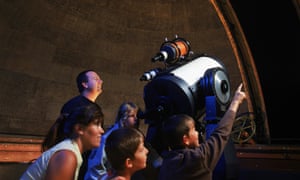
A night tour at Sydney Observatory
A night tour at Sydney Observatory, which sell out weeks and months in advance. Photograph: Powerhouse Museum


Paul Farrell
Sunday 2 April 2017 10.45 AEST

When Australia’s first government astronomer, William Scott, took up his posting in 1858 in Sydney, his equipment was so defective that, according to his diary records, it “destroyed all confidence in the result furnished by it”. And the shutters that were supposed to protect the finely calibrated instruments within the dome let in “a considerable quantity of rain” when the wind was high.
It was an uneasy start to an important mission. But Scott would probably be pleased to learn that the observatory he built in Sydney still stands. And more than 150 years later the dome that looks over the city is continuing to fulfil the role Scott envisioned of opening the stars to all Australians.
“I think people are more engaged than ever,” says Sydney Observatory’s manager, Marnie Ogg. “I think they’re hungry to learn. It’s a science people can get their heads into and it’s a pretty science.
“Even as we lose our dark skies people are getting more interested in the stars.”
For more than 30 years, ever since it became part of the Museum of Applied Arts and Sciences, the observatory has been hosting night tours.
Scott’s records suggest he wanted to build an observatory that was expansive – that was more than just expensive equipment. He wrote that he set out out “to erect an observatory sufficiently comprehensive and commodious to satisfy all the astronomical requirements of the colony for the next century”.
Its construction was approved in 1855 when the government of New South Wales decided it would establish an astronomical observatory; it commissioned a building and salaries for “an astronomer and one computer, and for the purchase of meteorological instruments to be used at various stations in connexion with the proposed observatory”.

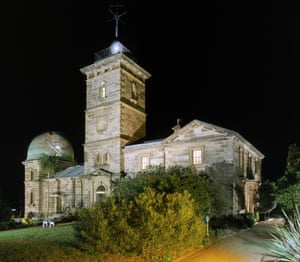
Sydney Observatory at night. Photograph: Powerhouse Museum

The budget Scott was allocated to build the observatory and run it was just 7,000 pounds. The imposing stone walls were inspired in part by Italian villas, according to some architects.Scott submitted his first annual report to the observatory board in 1858. His first recordings show that Sydney Observatory may not have even been in the city, had his own vision been realised.
“For purely astronomical purposes I should have preferred a position farther inland, and at a distance from any town,” he wrote, “but as it appeared desirable, for various reasons, that the observatory should be in the immediate neighbourhood of Sydney, I could find no spot more suitable than that recommended by the governor-general, close to the Signal Station at Fort Philip, on which the observatory now stands.
“It possessed the advantages of a good foundation on the sandstone rock of which the hill is composed, an unimpeded view, and a considerable exemption from smoke and dust; moreover, from the extent of the government reserve on which it stands, there will be no difficulty in protecting it from the encroachments of neighbouring buildings.”
Initially the signal station at the site of the observatory guided ships through the weather. As Sydney continued to grow, it realised it needed a way to tell the time. Every day at 1pm a timeball would drop down from the hill, allowing the city to set its clocks. The observatory was also used to predict the weather. The place became the pulse, the heartbeat that kept Sydney alive.
Its role began to turn increasingly to the stars in the latter part of the 19th century. It went from being a local tool to part of a global movement to map the stars.
This vast undertaking was sparked by the development of photography, which opened up an entirely new dimension in the art of astronomy.
“Astronomers, as they always do, jump on that new technology,” says the curator of astronomy at Sydney Observatory, Andrew Jacob. “The idea was to take a photograph of the entire sky. You ended up with an everlasting resource of permanently recorded stars, all objectively taken.”
Each little section of the sky was captured with photography but they needed to be painstakingly transcribed on to tiny plates. This critical role was almost exclusively undertaken by women, according to Jacob, “because they were considered to be much more reliable than the men”.

"There’s observatories all around the world but they might host one night a month and pray for good weather"
Marnie Ogg
Sydney had an enormous section of the sky, he says, and it was one of the most densely filled. So vast was the project that the imaging alone took from 1891 to the 1920s. But the measuring was not completed until the 1970s.
Over a century, nine government astronomers lived and worked there. The final astronomer, William Humphrey Robertson, oversaw the observatory until 1982 when it became a museum..
From that point the observatory changed once more; it became a place of education. It is this role, arguably, that has been the most significant in bringing the stars to everyday Australians.
The level of interest in the observatory is higher than it has ever been. Some 3,000 schoolchildren visit it each month.
But the biggest drawcard has been the night tours. These visits, open to the public, sell out weeks and months in advance. Almost every evening 100 people will spend an evening in the room, hoping to get a glimpse of the stars.
“Sydney’s very unique in that we’ve got an observatory right in the middle of a city with a dark enough sky that we can actually see things,” Ogg said.
“There’s observatories all around the world but they might host one night a month and pray for good weather, so we’re pretty lucky. There a constant interest. Our issue is that our venue can’t expand to meet the demand.”
The observatory’s story is a part of Australia’s colonial history. But in a Dreamtime astronomy program, started in 2003, stories of the emu in the sky are told.
“It’s a different way of being connected to the sky, and we really like to stress that we’ve lost that connection when Indigenous Australians have not,” Ogg says.
Sydney is brighter now, lights shine all through the night, and the stars get a little harder to see each year. But it is still dark enough to look up in the observatory and peer through the lens of an antique telescope, the latest in a long line of stargazers past.

Labor to drop renewable energy target in favour of emissions scheme

RET will come to a natural end as emissions intensity scheme can reach goal of 50% renewable energy by 2030, says Andrew Leigh

windfarm
Australia’s shadow assistant treasurer said renewables accounted for the majority of new investment in electricity generation in the last decade. Photograph: Tim Phillips Photos/Getty Images

Labor will abandon the renewable energy target after 2020 because an emissions intensity scheme will be sufficient to reach the goal of 50% renewable energy by 2030, Andrew Leigh has said.
On Sky News on Sunday the shadow assistant treasurer firmed the opposition’s plan to reach the 50% goal without a hard target in comments that appeared to rule out extending the existing renewable energy target (RET).
“We’ve committed to getting 50% renewables but the mechanism that we’ve used in the past has been a renewable energy target. That comes to an end and we believe an [emissions intensity scheme] EIS can take us to the point of having 50% renewables ... without the RET,” Leigh said.
Asked to confirm that meant Labor would not support the RET when it expired in 2020, Leigh responded: “We believe that the emissions intensity scheme does that job ... without a RET.”
The environment minister, Josh Frydenberg, seized on the remarks, saying they “injected more confusion” into Labor’s policy.
“It is already apparent that Labor doesn’t know what its policy is called, whether it will be legislated, how much it costs or what impact it will have on power prices and energy security,” he said.
Frydenberg said Leigh’s comments were in contradiction to an adjournment speech on Tuesday by the shadow assistant minister for treasury, Matt Thistlethwaite, in which he said Labor intended to “boost the RET”.
When Labor announced its policy for emissions trading in the electricity sector and for heavy industries before the 2016 election, the opposition said it would consult on what extra policies might be needed to achieve the 50% renewables goal, with a further RET not the favoured option.
As Labor faced pressure on the cost of sourcing 50% of electricity from renewables, Bill Shorten clarified the figure is an “aspiration” and not a hard target to be achieved through an RET.
Leigh’s pronouncement echoes Malcolm Turnbull’s statement that the RET was “never intended to be perpetual”, indicating there could be bipartisan support to abandon it after 2020.
But unlike Labor, the Turnbull government has ruled out a carbon price or EIS to achieve Australia’s Paris targets of reducing emissions by 26-28% on 2005 levels by 2030.
Pressure has been mounting on the Finkel review to recommend a market mechanism. A string of peak bodies have already called for market mechanisms, including the National Farmers’ Federation, the Investor Group on Climate Change and the Business Council of Australia, which explicitly called for an EIS.
Leigh noted that an EIS was supported by experts across the field, including the Business Council of Australia and many energy regulators. He noted renewables account for the majority of new investment in electricity generation in the last decade.
“One of the government’s favourite backers, Bjørn Lomborg, not somebody Labor would usually support, says that every $1 invested in renewables gives you a pay back of $11.”
Leigh said that Nick Xenophon, who abandoned his demand for an EIS in return for support for company tax cuts in favour of a payment to pensioners and a number of energy measures, had been “sold a pup”.
The measures include fast-tracking a solar-thermal plant in South Australia already promised, a study of a gas pipeline connecting the state with the Northern Territory, and a new national energy policy.
“[Xenophon] said he could get an EIS, which would bring down household power prices by $200, instead he’s got yet another report, yet another study,” Leigh said.
Leigh said the government had “absolutely” conned Xenophon, because the deal would not bring down emissions and energy prices.
On an earlier interview on Sky News, the Business Council of Australia’s chief executive, Jennifer Westacott, called for an end to state renewable energy targets and moratoriums on gas exploration and production.
Westacott said the RET had been introduced at a time when energy demand was falling, causing prices to increase, and the energy mix had not balanced renewables with base load power.
Bipartisanship was needed to give business a signal to invest in electricity production and extracting gas resources, she said.
“Most companies are not going to be willing to put very large licks of money, billions of dollars for projects that will go for 30 years, if they do not have a sense of the policy environment they are facing,” she said.
“Everybody knows that at some point, because of the global agreements we’ve done, some kind of price signal is likely to be put into the market.”

One Nation former candidates, party insiders reveal Pauline Hanson's 'brutal dictatorship'

Extract from ABC News
Posted 31 minutes ago


Pauline Hanson's One Nation party has been accused of intimidating and financially pressuring its own candidates and senior staffers.
Party insiders, candidates and long-term One Nation loyalists told Four Corners they had been used and discarded by Senator Hanson — the losers of a bitter internal power struggle now engulfing the party.
A string of former One Nation members also said they felt intimidated by Senator Hanson's powerful chief of staff James Ashby, and that bizarre levels of control were used on candidates once they were inside the One Nation tent.
They said they were often issued directives from head office, banning them from speaking to party dissidents and the media.
Four Corners has also been told Mr Ashby keeps "dirt files" on politicians and people as a way of intimidating and silencing them.
Information obtained by Four Corners about the internal operations of the party raise serious questions about financial affairs and record keeping.


'Just another grubby, dirty bloody political party'

Before the March Western Australian state election, a string of candidates quit One Nation or were dis-endorsed by the party.
Several of them have spoken to Four Corners about the high cost of standing for One Nation.


Former One Nation candidate for the rural seat of North West Central, Dane Sorensen, revealed a copy of the party's Western Australian "candidate agreement" form.
All candidates had to sign it before they would be officially accepted by One Nation as a candidate.
The contract includes a financial penalty described as an "administration fee" of $250,000 payable to One Nation if any elected candidate quits the party.
Mr Sorensen said he refused to sign the agreement, writing letters of complaint to the party's head office.
"It doesn't bear any relationship to the costs of you being elected, it's a punitive measure designed purely to intimidate and frighten people," he said.
The candidate agreement also required candidates to pay upfront fees as well as a quarterly donation if elected, and imposed a 75 per cent cap on the amount of expenses they would be reimbursed from the party, with One Nation keeping the other 25 per cent.
Mr Sorensen also said he complained about the shambolic way party officials were running the election campaign and One Nation's surprise preference deal with the Liberal Party.
"If the public knew what went on in the party I don't think they'd have anything to do with One Nation," he said.
"They're just another grubby, dirty bloody political party that are out to serve their own ends, their own interests."
He was eventually disendorsed by Senator Hanson by letter, for refusing to comply with party policy and for being "belligerent and abusive".
Four Corners understands the $250,000 "administration fee" was eventually removed from later versions of the candidate agreement form.

'Hanson promised us: no preference deal with anyone'

One Nation's preference deal with the Liberal Party in Western Australia, announced in the media in February before candidates were told about it, was a lightning rod for growing dissatisfaction within the party.


The party's candidate for the Perth seat of Thornlie Sandy Baraiolo told Four Corners Senator Hanson had told her and other candidates at a meeting in January 2017 that there would be no preference deal with anyone, including the Liberal Party.
She said, when she took to her Facebook page to complain about the preference deal after news of it broke in the media, she was disendorsed by Senator Hanson and Mr Ashby over the phone.
"You can't trust Pauline Hanson … She'll sell you one thing and she'll do something completely different," Ms Baraiolo said.
"Pauline Hanson is all about Pauline Hanson."
One Nation's highest-profile candidate, justice campaigner Margaret Dodd, also quit the party in the wake of the preference deal.


She said the party was chaotic and wasteful, with vast amounts of invalid printed election material sent to candidates.
"It is not what I thought it was. I thought Pauline was this ordinary person, fighting for the battlers," Ms Dodd said.
"She is a populist, she goes on things that will get her the attention that she wants, get her in that power position that she wants.
"It's about power for Pauline."

ABC accused of using 'Nazi-style mind-control games'

While candidates have been sacked from the party for not paying money and for criticising the preference deal, other candidates have remained endorsed by Senator Hanson despite publicly calling for the return of apartheid, promoting white supremacy, making offensive and disparaging remarks about various groups.
The offensive comments posted by various One Nation candidates on social media included degrading degrading single mothers as "too lazy to attract and hold a mate" and saying the gay community uses mind control to make the community support same-sex marriage.
When asked whether One Nation believed the gay community used "Nazi-style mind-control" techniques, as suggested by former candidate Richard Eldridge, Senator Malcolm Roberts responded:
"If you're talking about propaganda, the ABC also uses Nazi-style mind-control."
Senator Roberts also told Four Corners One Nation was not afraid to offend.
"We bring a fearlessness, we don't care what people think. We just speak the facts," he said.
Senator Hanson and Mr Ashby did not respond to the ABC's questions.
Watch Four Corner's story Please Explain at 8:30pm on ABC TV or online.

Scientist Brian Cox on Trump's America, that Q&A episode and mankind leaving Earth

              Extract from ABC News

Updated yesterday at 4:22pm


Physicist and presenter Professor Brian Cox discusses how to fight scientific ignorance, where we are heading as a species and who will get us to Mars.

We're 'on the verge' of becoming a multi-planet species


Humanity will develop a more collaborative mindset when it starts to reach to Mars and beyond, Professor Cox says.
"I think spaceflight can do more. It's not just planting a flag on a planet and it's not just sending rich tourists into space. It's actually the next step on the road to making us a multi-planet civilisation."
"I genuinely think that we are on the verge of doing that.
"We now have the means to do it. And for the first time in a long time, we have the will do to it.
"It's not actually governments now. But it's companies like Blue Origin, SpaceX and Virgin Galactic. These companies have ambition."

The first mission to Mars might be a public-private collaboration


The mission to land people on Mars will be "a very different thing from the Apollo program," Professor Cox says.
"I suspect that the first missions to Mars will be some kind of public-private partnership that'll be partly funded by private money."

ABC and iview April 4-6


Professor Brian Cox and Julia Zemiro will be joined by scientists and personalities to inspire Australia to explore our solar system. Live from Siding Spring Observatory they will tackle astronomy's most intriguing questions.


The emergence of commercial spaceflight companies means expensive space travel will become less about taxpayer money, he says.
Although Elon Musk's SpaceX still gets taxpayer money via its contract with NASA to supply the space station, its satellite launch business is making strides, Professor Cox says.
"Access [to low-Earth orbit] has got incredibly cheap since companies like SpaceX, Blue Origin and Virgin Galactic," he says.
"The idea that space-faring is a demand on taxpayers is becoming a thing of the past.
"Part of that is the reduction in cost, but a great deal of it is that space is already profitable, that's why there are a lot of satellites up there.
"So I think we're moving into a different phase of space exploration."

Coming head-to-head with Senator Malcolm Roberts on Q&A


In August last year Professor Cox made headlines when he brought climate graphs onto the ABC's Q&A program to show to One Nation senator Malcolm Roberts.
Senator Roberts, a climate change sceptic, questioned scientific consensus and argued that NASA had corrupted climate data.
Professor Cox now tells ABC News the best way to tackle people who reject the science might be to not engage them at all.
"In general, it's not a good idea to engage in people who are obstinate in that way," he says.
"There's a debate that goes on in the scientific community about this."


Professor Cox says one view is that it can be counterproductive to try to argue with people who disregard the scientific consensus.
"You essentially elevate them to a level they should not be at. You present to the public the impression that there is a legitimate debate to be had," he says.
"However, some of these people, certainly in Australia and the US, not so much in Europe these days, but some of these people are politicians. So they have a platform. So what do you do?"
"I'm two minds.
"Programs like Q&A, they're almost pantomime in a sense. There's clearly no time to debate the detail of a complex idea such as climate change.
"So really it comes down to an impressionistic game. Who do the viewers trust, who appears more plausible? It's a difficult position to be in actually.
"I don't know the answer really. I can see both sides of the argument [on whether you should debate these people]."

Is NASA and climate science under threat in Trump's America?

"Yep."
"We have a set of people who for their own ends have tried to discredit science," Professor Cox says.
Science is the study of nature and process by which people understand the natural world, he says, "so it's the best we can do essentially".
"So when we reach a consensus view, that's essentially a snapshot of our best knowledge of a particular process or phenomenon at any given time."


Professor Cox says scientists refine their understanding when new knowledge is acquired, so there is no "dogma" or "truths" in science.
He says it is "ludicrous" for people to dismiss scientific consensus.
"We're talking about blustering people, people who are overconfident and have no humility, who don't think. That's the sort of person who says 'I know better than these people who study these things'. It's nonsensical."
"Imagine that we're flying on a plane, and imagine that the passengers decide that they think they can fly the plane better than the captain. So they say 'come on, we've had a vote and we all think that it's our right as a citizen to land this plane rather than you. It doesn't matter that you've studied it for 20 years'.
"That's what we're dealing with when we're dealing with these people who are in powerful positions in certain countries.
"What you're saying is, I don't believe the best that we can do as a human race at a particular time. It's nonsensical to me."
The answer to the threat of scientific ignorance is education, he says.
"It's making sure we invest in education so the citizens in our democratic societies can take sensible decisions and see these people for the charlatans that they are."
Professor Cox is in Australia ahead of ABC TV's Stargazing Live on April 4-6.