Tuesday, 1 January 2019

Your guide to the best meteor showers of 2019

Analysis

Posted about 5 hours ago


The year starts with a bang with the Quadrantids, the first of the annual big three meteor showers. Active while the Moon is new, it gives northern hemisphere observers a show to enjoy during the cold nights of winter. Sadly, the shower is not visible from southern skies.
The other two members of the big three — the Perseids and Geminids — are not so fortunate this year, with moonlight set to interfere and reduce their spectacle.
So, with that in mind, where and when should you observe the best of 2019's meteoric offerings? Here we present the highlights anticipated for this year — the showers most likely to put on a good show.

Things to keep in mind

We provide details of the full forecast activity period for each shower, and the forecast time of maximum. We also give sky charts, showing you where's best to look, and give the theoretical peak rates that could be seen under ideal observing conditions — a number known as the Zenithal Hourly Rate, or ZHR.
It is important to note that the ZHR is the theoretical maximum number of meteors you would expect to see per hour for a given shower, unless it were to catch us by surprise with an unexpected outburst!
In reality, the rates you observe will be lower than the ZHR — but the clearer and darker your skies, and the higher the shower's radiant in the sky, the closer you will come to this ideal value.
For any shower, to see the best rates, it is worth trying to find a good dark site (the darker the better) — far from streetlights and other illuminations.
Once you're outside, give your eyes plenty of time to adapt to the dark — half an hour should do the trick.
Showers that can only really be seen from one hemisphere or the other are denoted by either [N] or [S], while those that can be seen globally are marked as [N/S].
You can download this ics file and add to your calendar to stay informed on when the meteor showers are due.

Quadrantids [N]

Active: December 28 to January 12
Maximum: January 4, 2:20am UT (2:20am GMT; 3:20am CET)
ZHR: 120 (variable, can reach ~200)
Parent: It's complicated (comet 96P/Macholz and asteroid 2003 EH1)
Despite being one of this year's three most active annual showers, the Quadrantids are often overlooked and under-observed. This is probably the result of their peak falling during the depths of the northern hemisphere winter, when the weather is often less than ideal for meteor observations.
For most of the fortnight they are active, Quadrantid rates are very low (less than five per hour). The peak itself is very short and sharp, far more so than for the year's other major showers. As a result, rates exceed a quarter of the maximum ZHR for a period of just eight hours, centred on the peak time.

The Quadrantid radiant lies in the northern constellation Boötes, the Herdsman, and is circumpolar (never sets) for observers poleward of 40 degrees north. As a result, observers in northern Europe and Canada can see Quadrantids at any time of night. The radiant is highest in the sky (and the rates are best) in the hours after midnight.
For this reason, this year's peak (at 2:20am UT) is best suited for observers in northern Europe — and given that peak rates can exceed 100 per hour, it is certainly worth setting the alarm for, to get up in the cold early hours, and watch the spectacle unfold.

Alpha Centaurids [S]

Active: January 31 to February 20
Maximum: February 8, 1:00pm UT (WA: February 8, 9pm; QLD: February 8, 11pm; NSW/ACT/Vic/Tas: February 9, 12am )
ZHR: Variable; typically 6, but can exceed 25
Parent: Unknown
The Alpha Centaurids are a minor meteor shower, producing typical rates of just a few meteors per hour. But they are famed as a source of spectacular fireballs for southern hemisphere observers and so are worth keeping an eye out for in southern summer skies.
Alpha Centaurids are fast meteors, and are often bright. As with most showers that are only visible from the southern hemisphere, they remain poorly studied. Though typically yielding low rates, several outbursts have occurred where rates reached or exceeded 25 per hour.

The shower's radiant lies close to the bright star Alpha Centauri — the closest naked-eye star to the Solar System and the third brightest star in the night sky.
Alpha Centauri is just 30 degrees from the south celestial pole. As a result, the radiant essentially never sets for observers across Australia. The best rates will be seen from late evening onward, as the radiant rises higher into the southern sky.
This year, the peak of the Alpha Centaurids coincides with the New Moon, making it an ideal time to check out this minor but fascinating shower.

Eta Aquariids [S preferred]

Active: April 19 to May 28
Maximum: May 6, 2pm UT (WA: May 6, 10pm; QLD/NSW/ACT/Vic/Tas May 7, 12am)
ZHR: 40+
Parent: Comet 1P/Halley
The Eta Aquariids are possibly the year's most overlooked treat, particularly for observers in the southern hemisphere. The first of two annual showers produced by comet 1P/Halley, the Eta Aquariids produce excellent rates for a whole week around their peak.
The radiant rises in the early hours of the morning, after the forecast maximum time, and best rates are seen just as the sky starts to brighten with the light of dawn. It can be well worth rising early to observe them, as rates can climb as high as 40 to 50 meteors per hour before the brightening sky truncates the display.

Eta Aquariid meteors are fast and often bright, and the shower regularly rewards those who are willing to rise early. Spectacular Earth-grazing meteors that tear from one side of the sky to the other can be seen shortly after the radiant rises above the horizon.
This year, conditions are ideal to observe the shower, with New Moon falling on May 4, just two days before the forecast maximum. As a result, the whole week around the peak will be suitable for morning observing sessions, giving observers plenty of opportunity to see the fall of tiny fragments of the most famous of comets.

Southern Delta Aquariids, Piscis Austrinids and Alpha Capricornids [N/S; S favoured]

Active: Early-July to mid-August
Maximum: July 28 to 30
Combined ZHR: 35
Parent: Comet 96P/Macholz (Southern Delta Aquariids); Unknown (Piscis Austrinids); Comet 169P/NEAT (Alpha Capricornids)
In most years, the approach of August is heralded by keen meteor observers as the build up to the Perseids — the second of the year's big three showers. This year, moonlight will interfere, spoiling them for most observers.
But this cloud comes with a silver lining. A fortnight or so before the peak of the Perseids, three relatively minor showers come together to provide an excellent mid-winter show for southern hemisphere observers. This year, the Moon is perfectly placed to allow their observation.
These three showers — the Southern Delta Aquariids, Alpha Capricornids and Pisces Austrinids — favour observers in the southern hemisphere, though they can also be observed from northern latitudes.
Regardless of your location, the best rates for these showers are seen in the hours after midnight. Reasonable rates begin to be visible for southern hemisphere observers as early as 10pm local time.


The Southern Delta Aquariids are the most active of the three, producing up to 25 fast, bright meteors per hour at their peak, which spans the five days centred on July 30.
The Alpha Capricornids, by contrast, produce lower rates typically contributing just five meteors per hour. But where the Southern Delta Aquariids are fast, the Alpha Capricornids are very slow meteors and are often spectacular.
Like the Alpha Centaurids, in February, they have a reputation for producing large numbers of spectacular fireballs. This tendency to produce meteors that are both very bright and also slow-moving makes them an excellent target for astrophotographers, as well as naked-eye observers.

Taurids [N/S]

Active: September 10 to December 10
Maxima: October 10 (Southern Taurids); November 13 (Northern Taurids)
ZHR: 5 + 5
Parent: Comet 2P/Encke
The Taurids are probably the most fascinating of all the annual meteor showers. Though they only deliver relatively low rates (approximately five per hour from each of the two streams, north and south), they do so over an incredibly long period — three full months of activity.
In other words, the Earth spends a quarter of a year passing through the Taurid stream. In fact, we cross the stream again in June, when the meteors from the shower are lost due to it being exclusively visible in daylight.


So a third of our planet's orbit is spent ploughing through a broad stream of debris, known as the Taurid stream. In total, the Taurid stream deposits more mass of meteoric material to our planet's atmosphere than all of the other annual meteor showers combined.
So vast is the Taurid stream that there is speculation it originated with the cataclysmic disintegration of a super-sized comet, thousands or tens of thousands of years in the past, and that the current shower is a relic of that ancient event.
Taurid meteors are slow, and are often spectacularly bright. Like the Alpha Capricornids, they have a reputation for producing regular fireballs, making them another good target for the budding astrophotographer.
Rather than having a single, sharp peak, Taurid activity stays at, or close to, peak rates for the best part of a month, between the maxima of the northern and southern streams, meaning that it is always possible to find some time when moonlight does not interfere to observe the shower.

Geminids [N/S]

Active: December 4 to December 17
Maximum: December 14, 6:40pm UT (QLD: December 15, 4:40am; NSW/ACT/Vic/Tas: December 15, 5:40am)
ZHR: 140+
Parent: Asteroid 3200 Phaethon
Another of the big three annual meteor showers, the Geminids are probably the best, with peak rates in recent years exceeding 140 meteors per hour.

The Geminids are visible from both hemispheres — although the radiant rises markedly earlier for northern observers. Even in the south of Australia, the radiant rises well before midnight, giving all observers the rest of the night to enjoy the spectacle.

Moonlight will seriously interfere with the peak of the shower this year, washing out the fainter meteors, with the result that observed rates will be lower than the ZHR might otherwise suggest.
But the shower regularly produces abundant bright meteors, and yields such high rates that it is still well worth checking out, even through the glare of the full Moon.

Ursids [N]

Active: December 17 to December 26
Maximum: December 23, 3:00am UT
ZHR: 10+
Parent: Comet 8P/Tuttle
The final shower of the year — the Ursids — is a treat for northern hemisphere observers alone. Much like the shower that started our journey through the year, the Quadrantids, the Ursids remain poorly observed, often lost to the bleak midwinter weather that plagues many northern latitudes.
But if skies are clear, the Ursids are visible throughout the night, as their radiant lies just 12 degrees from the north celestial pole. As such, they make a tempting target for observers to check out in the evening, even if the radiant is at its highest in the early hours of the morning.
Most years, the Ursids are a relatively minor shower, with peak rates rarely exceeding ten meteors per hour. They have thrown up a few surprises over the past century, with occasional outbursts of moderately-fast meteors yielding rates up to, and in excess of, a hundred meteors per hour.

While no such outburst is predicted for 2019, the Ursids have proven to be a shower with a surprise or two left to show and so may just prove to be an exciting way to end the meteoric year.
Jonti Horner is professor of astrophysics at University of Southern Queensland and Tanya Hill is an honorary fellow of the University of Melbourne and senior curator (Astronomy) at Museums Victoria. This piece first appeared on The Conversation.

Cabinet papers show how Queensland premier Mike Ahern struggled to move on from Sir Joh era

Updated 30 minutes ago

"The new Government in Queensland will be a government that puts people first" — those were among the first words spoken by Mike Ahern when he took over from Queensland's longest-serving premier, Sir Joh Bjelke-Petersen.
Mr Ahern's reign in 1988 sat between two powerful eras in Queensland politics — Sir Joh and Labor's Wayne Goss.
Sir Joh resigned in 1987 after widespread allegations of bribery and corruption, which engulfed parts of Queensland's Parliament and police force.
Cabinet documents held secret for 30 years, revealed Mr Ahern's first decision in 1988 was to implement a Public Accounts Committee, to record and examine ministers' spending.
"It told Queensland that there had been a change, " Mr Ahern recalls.
But Mr Ahern's regime of reform to rebuild public trust was not always given the full support of the National Party — with many of whom were unimpressed with Sir Joh's treatment.

Mr Ahern also clashed with his cabinet over the ongoing Fitzgerald Inquiry and his decision to widen the terms of reference of the inquiry to outside the police force.
"I went into cabinet and they were all looking at me silently not liking it, but these things had to be done and they were necessary as soon as possible," Mr Ahern said.
But he persevered, and the documents show Mr Ahern's cabinet made dozens of decisions to increase accountability, many of which set the tone for the state's political future and are still part of modern politics.

Cabinet also voted to force ministers to table their spending in Parliament for public scrutiny.
Three of Mr Ahern's ministers were then imprisoned for misappropriating public money.
He made further enemies when his cabinet agreed to block the pension for disgraced former police commissioner Terry Lewis.
Lewis later spent a decade in jail for taking $700,000 in bribes.
However, Mr Ahern's hard line did not satisfy his party, who overthrew him just two months before the 1989 election.

South Bank celebrates with Expo 88

While State Parliament was in crisis, the state of Queensland was being celebrated on the world stage with Expo 88.


The extravaganza attracted 15 million guests from across the world, including international dignitaries like the Queen and then-UK prime minister Margaret Thatcher.
But cabinet was grappling with Parliament to make future use of the land at South Bank.

Without any consultation, it initially approved a private development including an artificial island in the Brisbane River for a world trade centre and plans for a casino.
But public backlash forced the State Government to reverse its decision, writing off $150 million in the process — though also guaranteeing the public parkland for future generations.
Political scientist Anthony Marinac said most Queenslanders do not realise how close they came to having the famed South Bank parklands completely blocked off.
"It came very close to being sold off to private developers and there would have been a negligible amount of public space," Dr Marinac said.

Prisoners forced to use buckets for toilets sparked inquiry


Corruption in Queensland prisons was also exposed when cabinet approved the Kennedy Inquiry, which would lead to sweeping corrections reforms.
The inquiry revealed shocking treatment of prisoners at the infamous Boggo Road jail in Brisbane, including an entire block of inmates using buckets for toileting overnight because there was no plumbing to the cells.
But the clean-up on corruption angered some corrections officers, who helped five prisoners escape from jail, using 70 bed sheets tied together.
The next year Boggo Road was shut down, as a result of scathing findings from the inquiry.

Bid to block forests to be World Heritage listed

The documents reveal a surprising amount of time and money was spent trying to block a Federal Government bid to list north Queensland's forests as a World Heritage Area.
Government delegations were approved to go overseas to fight against the proposal.
But the Queensland Government lost — and in 1988, the Wet Tropics World Heritage Area was established.

The uncontacted tribes of Brazil face genocide under Jair Bolsonaro

Brazil’s indigenous peoples, already targeted by loggers, face a powerful foe in the new president. We must protect them
On 1 January, Jair Bolsonaro will be sworn in as Brazil’s 38th president. He has expressed open disdain for the indigenous peoples of Brazil, and it is no exaggeration to say that some of the world’s most unique and diverse tribes are facing annihilation. Genocide is defined by the UN as “the intent to destroy, in whole or in part, a national, ethnical, racial or religious group”. Large-scale mass genocides rightly receive global attention, yet countless others go unreported and unpunished because the victims number only a few hundred, or even a few dozen.
Right now, deep in the Amazon rainforest, a small tribe of survivors is on the run. They are the Kawahiva, an uncontacted tribe of just a few dozen people, the victims of waves of horrific attacks which have pushed them to the brink of extinction. We know almost nothing about them, except that they are fleeing chainsaws in a region with the highest rate of deforestation in the Amazon. Brazil’s first ever investigation into the genocide of an uncontacted tribe was launched in 2005, and 29 people suspected of involvement in killing Kawahiva were detained but later released, including a former state governor and a senior policeman. The case stalled for lack of evidence.
The Kawahiva’s territory lies near the town of Colniza, one of the most violent areas in Brazil, where 90% of income is from illegal logging. Survival International, the global movement fighting for the rights of tribal people, has recently called for increased police protection for the team responsible for protecting the Kawahiva’s land. FUNAI, Brazil’s Indian Affairs Department, has been prevented from properly carrying out its work in the area due to violence from illegal loggers and ranchers, leaving the tribe exposed.
Preventing a genocide of uncontacted people is not a priority for Bolsonaro. He once said: “There is no indigenous territory where there aren’t minerals. Gold, tin and magnesium are in these lands, especially in the Amazon, the richest area in the world. I’m not getting into this nonsense of defending land for Indians.”
Indigenous peoples are frequently regarded as obstacles to the advance of agribusiness, extractive industries, roads and dams. As more rainforest is invaded and destroyed in the name of economic “progress” and personal profit, uncontacted tribes become targets – massacred over resources because greedy outsiders know they can literally get away with murder. These are silent, invisible genocides, with few if any witnesses. The news often only emerges months, if not years, later.

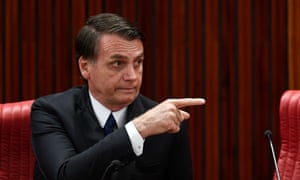
Jair Bolsonaro
‘Jair Bolsonaro himself has declared: ‘It’s a shame that the Brazilian cavalry wasn’t as efficient as the Americans, who exterminated the Indians.’’ Photograph: Evaristo Sa/AFP/Getty Images

The UN convention on genocide came into force 70 years ago, yet entire tribes continue to be exterminated by the dominant society in order to steal their land and resources. Symbolic of this is the “last of his tribe”, a lone man living in a patch of forest in Brazil’s western Amazon region. We know nothing about him except that he rejects all contact, and survived waves of attacks carried out in the 1970s and 80s against his people and his neighbours, the Akuntsu tribe – of whom just four survive. No one has ever been prosecuted for these genocides. This impervious mentality harks back to the wild west of the 18th and 19th centuries, when Native Americans in the US were slaughtered by the colonists. Indeed, Bolsonaro himself has declared: “It’s a shame that the Brazilian cavalry wasn’t as efficient as the Americans, who exterminated the Indians.”
The majority of the world’s 100 or so uncontacted tribes live in the Brazilian Amazon. They are aware of the outside world, use and adapt outside goods for their own purposes and may engage sporadically with contacted tribes nearby. Their hunter-gatherer lifestyles require vast and acute botanical and zoological knowledge. With this unique understanding of sustainable living, they protect some of the largest and most biodiverse forests on Earth.
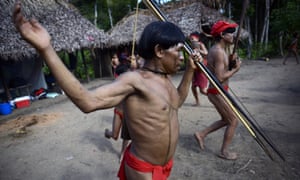
The largest area of primary rainforest under indigenous control is the Yanomami territory, which straddles part of the Brazilian border with Venezuela. It is home to around 32,000 Yanomami, including some groups who are uncontacted. A “epidemic” of goldminers have illegally invaded the territory to pillage its riches, bringing disease and death to the tribe.
In May, Yanomami reported that two uncontacted members of the tribe had been murdered by miners. FUNAI had closed its protection post in the area due to a lack of funds and, while prosecutors have ordered the post to be reopened, the authorities have not yet investigated the killings.
Bolsonaro opposed the creation of the Yanomami territory in the 1980s, calling it a “crime against the motherland”, and a “scandal”. He affirmed his beliefs in 2017, saying he regarded the creation of the reserve as “high treason”, and there are murmurs that this is an area already in the crosshairs of the new administration.

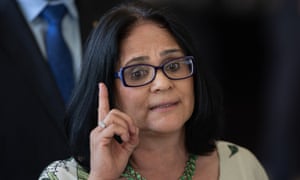
Damares Alves, Brazil’s new human rights minister
‘Damares Alves, Brazil’s new human rights minister, has already questioned Brazil’s landmark policy to respect tribes’ choice to remain uncontacted.’ Photograph: Sergio Lima/AFP/Getty Images

Bolsonaro intends to take FUNAI out of the justice ministry and into a newly created ministry for women, family and human rights. This is a move sure to weaken the department’s efficacy and clout – it has already been undermined by huge budget cuts. Bolsonaro has appointed Damares Alves as the new minister, an evangelical preacher and congressional aide who co-founded Atini, a controversial group that evangelises in indigenous communities and is subject to an investigation by public prosecutors for inciting racial hatred against indigenous peoples.
“We are afraid of a new genocide against the indigenous population and we are not going to wait for it to happen. We will resist. We will defend our territories, and our lives,” said Sônia Guajajara, a leader of Articulação dos Povos Indígenas do Brasil, which represents more than 300 Brazilian indigenous peoples.
Tribes are mobilising themselves to protect their territories using satellite technology and drones to monitor invasions. In the Araribóia reserve in Maranhão state, a group of men from the same tribe as Sônia, the Guajajara, have embarked on a desperate struggle to protect the forests they share with several dozen uncontacted Awá. A spokesman from these “Guardians of the Amazon” explains: “Our forest is being invaded by illegal loggers, right now. It’s an emergency. We patrol, we find the loggers, we destroy their equipment and we send them away. We constantly receive death threats from the logging gangs. But we continue, as our forest is our life. Our uncontacted Awá relatives also live in the forest. They cannot survive if it’s destroyed. As long as we live, we will fight for the uncontacted Indians, for all of us, and for nature.”
Solidarity with the indigenous peoples of Brazil can change the world in their favour. Survival International was founded 50 years ago, following the publication of Norman Lewis’s article Genocide in the Sunday Times in 1969, which revealed some of the atrocities suffered by Brazil’s indigenous peoples last century. We are the only organisation fighting worldwide to stop the extermination of uncontacted tribes. Now, more than ever, we must mobilise our collective power to expose and put an end to these hidden genocides.


• Fiona Watson is director of research and advocacy at Survival International

In 2018 the Australian government chased its energy tail. Here's a more hopeful story

While the government continued to trash Australia’s international reputation by reaffirming allegiance to coal on the global stage, lying about progress on our climate commitments and dismissing the findings of the landmark IPCC report, the transformation in our electricity sector tells a different and hopeful story.
Attacks by the former prime minister Tony Abbott and his environment minister Greg Hunt on the renewable energy target, and the investment strike that followed, are a fading memory. Momentum is now unstoppable.
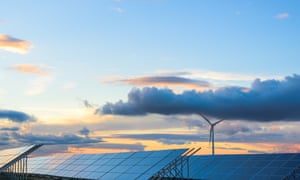
In the three years from 2018 Australia will install a little over 12 gigawatts of renewables, as much as was installed in the 30 years after the country’s first wind farm opened at Salmon Beach in Western Australia in 1987.
Since 2017, 19 new wind farms and 30 new solar farms have been registered and in early December the two millionth Australian household went solar. Once derided as insignificant, solar supplied more than 7% of Australia’s power over the past three months.
A little over a decade ago, when just 5.2% of our power was from renewables, the Rudd government was swept into power with an aspirational pledge of “20% by 2020”. That target has been met two years early, and analysts Green Energy Markets predict one-third of our power will be from clean energy by 2021.
The transformation of the national electricity market over the decade has been stunning. Highly polluting brown coal use is down 36.6% and black coal (still dirty!) has fallen 9.4%, mostly replaced by wind and solar. Surprising to many, we burn less gas in the NEM now than we did a decade ago.

Businesses on board

Increasingly businesses are taking energy matters into their own hands. Sun Metals, a zinc refinery in George Christensen’s Queensland electorate, installed 1m solar panels to lower their power costs.
The Commonwealth Bank became the first Australian company to join the RE100, a group of 156 global companies committed to 100% renewable power in the coming years. Much of the bank’s power will be supplied by the Sapphire wind farm, which incidentally will be partly financed by a community investment project. The project, one of 105 of its kind around the country, has been overwhelmed with $7.5m pledges from locals keen to get in on the action.
The South Australian chamber of mines and energy secured a renewable energy deal that will save its members 20-50% on their power bills.
Macquarie Bank has joined a consortium developing a wind and solar farm bigger than every existing wind and solar farm in the country combined. The Asia Renewable Energy Hub, to be located in the Pilbara region of WA, is backed by Vestas, the world’s largest wind turbine manufacturer. The project will connect by sub-sea cable to Indonesia, supply processors in WA’s north west and generate “green” hydrogen.

"Consumers are starting to see a welcome, albeit modest, retreat in power prices"

Modest price falls for consumers

Almost everyone in the energy sector now accepts that renewables are cheaper than building new coal capacity, including the CSIRO and the country’s largest power companies, Origin and AGL. The latter pushed back against extraordinary pressure from the government and announced that its Liddell power station will close in 2022, to be replaced with a portfolio of projects delivering cheaper, more reliable and cleaner power.
And consumers are starting to see a welcome, albeit modest, retreat in power prices. Retailer Powershop led with a 5% price reduction attributed to new renewables investment. The Australian Energy Market Commission announced that most consumers would soon receive price reductions largely thanks to increased wind and solar generation – South Australians can expect to see falls of 6.5%.
More than a dozen large wind and solar farms contracted at prices well below $60MWh – below the market prices for coal and gas – in arrangements that involve little or no subsidies.

Coal – our fleet is showing its age

The average Australian coal power station is 31 years old – five years older in NSW – and with an average age at retirement of 41, our fleet is showing its age. The Australia Institute tracked 108 coal unit “trips” during the year. In each case hundreds of megawatts of generation instantly and unexpectedly disappeared, stressing the network.
The Australian Energy Market Operator produced the most rigorous study of the possible future of our grid and determined that on the least-cost path – with no new policy – the would grid reach 47% renewables in 2030 and 72% in 2040, while keeping the lights on. As each coal power station falls over it will be replaced by renewables and storage.

States go their own way

Feeling the heat from the Victorian experience, the NSW Coalition government sought to distance itself from the trashed Liberal brand, with energy minister Don Harwin calling out his federal counterparts as out of touch on energy and climate. With little progress to show for the last eight years in office and the state lagging on almost every energy indicator, Harwin has much work to do before the March election.
A change of government in South Australia had many worried that the Weatherill government’s energy initiatives would be derailed, but the new Liberal government has embraced the state’s leadership position. Former coal town Port Augusta has bounced back with 13 clean energy projects under development, and the state is rolling out a virtual power plant project that will allow 50,000 households (starting with those on lower incomes) to be fitted with solar and batteries, saving on power bills and working in unison in much the same way as the mega-battery.
In Tasmania, the Liberal party pledged 100% renewables and their Labor counterparts responded with a 120% target. The ACT moved closer to its net 100% renewables target, Queensland oversaw the start of a construction boom of impressive scale, while Western Australia continued to muddle along without any real policy.

Federal fire-fighting

Meanwhile, the federal government spent 2018 chasing its tail. Former energy minister Josh Frydenberg attempted to put out the Coalition’s smouldering energy policy with a national energy guarantee that would not have reduced emissions by a single tonne. The backbench “Monash Forum”, whom it was written to appease, instead chose to fan the flames and sacrifice yet another prime minister on the ensuing fire.
For good measure, Scott Morrison threw petrol on the fire by appointing Tony Abbott’s energy man Angus Taylor to the energy ministry. Taylor has been flailing about ever since. His plan to set a cap on energy prices was soundly rejected by his states colleagues in a particularly angry Coag meeting. His legislation to give him a “big stick” to beat investors until confidence improves has been pushed off to a Senate committee and is unlikely to see the light of day.

Batteries supplied

Four other megabatteries have been commissioned – at Alice Springs, Ballarat, Dalrymple and Gannawarra. The Snowy 2.0 pumped hydro storage project moved a step closer with board approval, at least 10 other pumped hydro projects have been announced and the NSW government launched a roadmap identifying 24 potential pumped hydro projects leveraging existing state-owned reservoirs.
Energy market analysts SunWiz estimate that 25,000 households installed small-scale battery systems in 2018, collectively matching the combined capacity of the country’s grid-scale megabatteries. On the back of solid growth, three battery storage companies set up in South Australia.

A referendum on climate

As in 2007, the looming federal election is shaping up to be a referendum on climate – a choice between action and denial. The public, businesses and states, having learnt from the climate and energy wars of the past 10 years, are now savvier and better prepared. The increasingly desperate coal lobby looks weak compared with 15,000 striking schoolchildren, many of whom will soon be voters.
We’re making great progress on the electricity sector, but much more needs to be done across the economy – locally and globally – if we’re to have a fighting chance of passing a safe climate to the next generation.
MPs valuing survival might want to heed the advice of energy thinker Michael Liebreich: “Face the direction of travel!”

• Simon Holmes à Court is senior adviser to the Climate and Energy College at Melbourne University

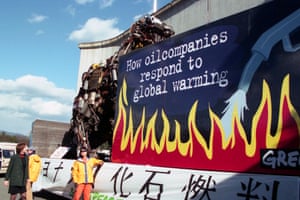
Cabinet papers 1996-1997: how Australia worked to water down Kyoto climate targets

Like the Keating government before it, the Howard government of 1996 and 1997 was deeply resistant to taking any action on climate change that could harm the Australian economy.
But by 1996, John Howard was facing intense international pressure to step up Australia’s commitments as his government prepared for the meeting to discuss the protocol to the United Nations Framework on Climate Change to be adopted at a meeting in Kyoto in December 1997.
Australia had adopted a “no regrets” policy towards tackling climate change under Keating. This meant it would consider only measures that involved cutting emissions without any adverse impact on the economy or trade competitiveness, leaving it largely reliant on on tree-planting and limiting clearing for its response.
The Howard government clung to that negotiating position, despite growing evidence that Australia’s greenhouse gas emissions were rising quickly.
By 1996 Australia was facing a new dynamic: the European Union and the US had both proposed legally binding targets as part of the Kyoto discussions.
The cabinet papers of 1996 and 1997, released by the National Archives of Australia on Tuesday, reveal Australia’s increasing isolation on the international stage.
In June 1996, cabinet agreed that “Australia’s overall objective in climate change negotiations should be to safeguard our national trade and economic interests while advancing compatible outcomes that are environmentally and economically effective”.
While Australia recognised “the need for effective global action on climate change”, it vowed to pursue an international agreement that “does not contain targets which are legally binding” and argued for differentiated, rather than uniform, reduction targets.
The then environment minister, Robert Hill, reported to cabinet that for the first time the Intergovernmental Panel on Climate Change scientific report had said that the balance of scientific evidence supported the view that the changes in climate and greenhouse gas concentrations were due to human activity.
Small island states were proposing a 20% reduction in carbon dioxide emissions from 1990 levels by 2005. While other time frames were being discussed, all were potentially problematic for Australia because of its carbon-intensive economy.
Hill told the cabinet that modelling showed Australia’s emissions from the energy sector – accounting for half of national emissions – were projected to be 30% above 1990 levels by 2010.
The Geneva conference of parties, held in June 1996 in the lead-up to Kyoto, intensified government anxiety.
Hill, who led the Australian delegation at Geneva, told the cabinet it had “proved a difficult and complex meeting for Australia” and that Australia had been singled out for criticism by environmental organisations and by the UK environment minister in an “ill-considered attack”.
There was a perception that Australia was isolated in its position, he said.
“The emergence of a US-EU alliance on legally binding targets was one of the most significant developments and served to shift the debate beyond the position held by Australia,” he said.
Australia found few allies for its proposal for variable emission reduction targets and it had attracted criticism for being one of “very few “ to publicly articulate its concerns about defining a dangerous greenhouse gas concentration level in the atmosphere.
Cabinet agreed it had to beef up its domestic greenhouse gas response policy before the Kyoto meeting if was to have any chance of convincing the international community that it should have differentiated targets.
The consternation grew further by mid-1997. A joint submission to cabinet warned of the prospect of an “EU–US bilateral understanding for progressing climate change” at a forthcoming G7 summit.
Australia worried a deal at G7 could provide the basis for the UN special session adopting a position “which narrows down our [negotiating] options” in the lead-up to Kyoto.
The cabinet actively considered walking away from Kyoto altogether.
It was facing publishing its future emissions as part of the Kyoto process but modelling was now showing that emissions from the energy sector would be 40% to 50% above 1990 levels by 2010.
Options included arguing it was premature to agree to targets, or for a longer time frame.
“Australia’s strategy should be to ensure that we are seen to be excluded from an agreement by the international community rather than having Australia reject agreement … we should be seen to be ‘pushed off the cliff’ rather than ‘walking away’,” the submission advised.
But by July 1997, Hill and other ministers reported the G7 meeting had not produced a deal between the EU and US, and had instead exposed differences.
The memorandum particularly highlighted Howard’s international advocacy with “Australia’s opposition to legally binding uniform targets” having “figured prominently in the prime minister’s [recent] discussions in Washington and London”.
The cabinet also agreed in July to establish a climate change taskforce to advance Australia’s domestic greenhouse gas strategies, to strengthen its bargaining stance. One option to be explored was “domestic and international emissions trading”.
In the following months, Treasury modelled various measures for reducing domestic emissions.
The memorandum warned that none of its scenarios would cap carbon emissions at 1990 levels but would achieve potential cuts of 22%.
And so began Australia’s long and tortured debate over carbon trading schemes.
A proposal was put forward by the Australian Greenhouse Office in 2000, but was scuttled in cabinet; another came forward in 2003, but was vetoed by Howard.
Finally, in the dying days of his government in December 2006, Howard announced an emissions trading scheme, after bureaucrats convinced him it was the most efficient way to meet Australia’s commitments.
Both parties went to the 2007 election promising to implement such a scheme. It would prove no easier for Kevin Rudd, or Julia Gillard.

Or for Malcolm Turnbull.

Cabinet papers show Australia seen as 'free rider' during global climate talks

    Extract from The Guardian
    Updated about an hour ago

    Declassified documents reveal the Coalition has been wrestling with climate change policy for more than two decades, including perceptions it is a global "free rider".

    Key points:

    • Howard government considered new climate change policies to improve international reputation
    • Other nations accused Australia of being a "free rider" and taking no action to deal with climate change
    • Environment minister told cabinet Australia found few like-minded nations at climate meetings

    Shortly after Malcolm Turnbull lost his prime ministership in August — in part due to a divisive energy policy debate — he claimed a "significant percentage" of his colleagues did not believe climate change was real.
    Cabinet documents from 1996-97 show the Howard government was warned it was isolated on climate change, prompting consideration of new policies and a media campaign to improve its reputation.
    Environment minister Robert Hill told cabinet that Australia's ability to influence global events would be constrained unless an effective domestic response to global warming was developed.
    At the time, Australia was one of few nations to campaign against legally binding, uniform emission reduction targets in the Kyoto Protocol.
    Australian negotiators would eventually convince other nations, but cabinet papers show their advocacy would expose a divergence with other nations.
    After negotiations in Geneva, Mr Hill told cabinet that meetings were "difficult" and that Australia found few like-minded allies.
    "Australia was singled out for criticism from environmental NGOs and some national delegations, notably through an ill-considered attack from the UK environment minister," Mr Hill said in a submission.
    "Overall, there was a general perception of Australia being isolated."

    'We need to make a fair contribution'

    Cabinet papers show the Howard government was aware its own response to climate change may be limiting its influence abroad.
    "In the lead-up to Kyoto, ministers will need to consider the role of strengthened adoption of domestic policies and a focused media strategy in countering international perceptions that Australia is 'free riding' and taking no action domestically," Mr Hill said.
    "We will need to clearly demonstrate that we are making a fair contribution to the global effort."
    The "free rider" warning prompted the government to consider new policies, including an emissions trading scheme that would not be announced for another decade.
    When uniform targets were eventually dropped, cabinet praised the prime minister's negotiating strategy.
    "The prime minister's advocacy to key world leaders of Australia's case on climate change has been influential.
    "International advocacy by the prime minister and the government of Australia's case on climate change, arguing for realism and equity through differentiated targets, has had considerable impact.
    "Australia is in a special position," Mr Howard said.
    "We are a developed country that is a major exporter of energy and there are not too many other countries like that."