Thursday, 3 January 2019

Being homeless is not a crime, so why are so many jailed?

Extract from The Guardian

You cannot solve social problems like homelessness, mental illness and substance dependence with the heavy hand of law enforcement
From 2012 to 2017, the number of people imprisoned in Australia grew by a third. This wasn’t in response to any crime wave, or any increase in crime at all. Over that same period, the United States has seen their prison rates fall.
What has been on the rise alongside this alarming trend is homelessness. Homelessness sits at the centre of a complex web of major social problems, including family violence, mental illness, racism, substance dependence and imprisonment.
Every day we see men and women facing a system that seems designed to drive them into homelessness. When we first spoke with Madeleine*, a young Aboriginal woman in prison, she was frantic. She had received a letter from the Director of Housing telling her that she had been absent from her property for more than the allowed six month period and would need to vacate the property immediately.
Madeleine had been in public housing for 10 years and had never had any issues as a tenant. She was eligible for parole in three weeks and her parole officer was upbeat about her chances, but both knew there was no chance of it being granted if she had no home to go to.
An Aboriginal woman in her 30s with substantial mental and physical health issues, a Centrelink income that wouldn’t cover private rental and no family she could stay with, Madeleine was at risk of homelessness and desperate to avoid it.
Shortly after Madeleine was given an eviction notice. Fortunately, she was in contact with us at Justice Connect and due to our intervention her application for parole was successful and she was able to go home to build a new life.
But Madeleine’s story is not the norm. The raw numbers tell the story – one in four people currently in prison were homeless in the month leading up to their incarceration. Being in prison is a very real risk to secure housing – one in three people exiting prison do so without a home to return to. The rate of prisoners exiting into homelessness has risen by 188% in the last five years.
Homelessness is more common, lasts longer and is more likely to reoccur for people with a history of imprisonment, and former prisoners are twice as likely to return to prison within nine months if they are homeless.
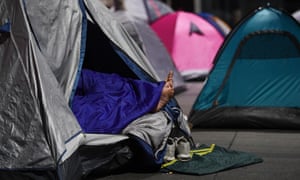
The litany of statistics goes on. Since 2011, the number of female prisoners has nearly doubled, with Aboriginal women being massively overrepresented. The common experience among this group? The huge prevalence of family violence. Women fleeing violent partners are frequently forced into homelessness – at first sleeping on couches, then in cars and potentially winding up in parks or on the street.
If prison increases the odds of homelessness, and homelessness increases the odds of future imprisonment, we must acknowledge the disproportionate and devastating impact of imprisonment on Aboriginal people. The number of Aboriginal and Torres Strait Islander people in Victorian prisons has increased by 200% in the last decade, making up 9% of overall prison population. At the same time, Aboriginal and Torres Strait Islanders now make up 20% of the homeless population.
The interconnected nature of all of these problems highlights the need for government to do better in providing housing and integrated services. Supporting people in times of great vulnerability with legal help, social work and access to healthcare plays a vital role in reducing homelessness and recidivism. Increasingly punitive behaviour from governments, trying to solve social problems like homelessness, mental illness and substance dependence with the heavy hand of law enforcement clearly only exacerbates these same problems.
Not only is housing central to keeping people out of prison, it’s crucial for helping people dealing with problems like substance dependence and and family violence. Likewise, making sure people can exit prison into a safe home is vital for their ability to reintegrate post release.
There is a compelling economic argument too. Ensuring prisoners exit prison into housing has never been more necessary, with recidivism rates reaching all-time highs and incarceration costing around $111,000 per person every year. Reducing re-offending is good for everyone, and housing is an obvious way to do it. It’s cheaper too.
Prison is expensive, breaks up families, adds to social harm, and exacerbates people’s existing problems. Access to housing is a crucial – perhaps the crucial – component of tackling Australia’s growing, costly imprisonment problem.

*name has been changed

  • Samantha Sowerwine is principal lawyer with Justice Connect’s homeless law service.

Chang'e 4 spacecraft sends images after landing on far side of the Moon in world first for China

Updated 11 minutes ago


A Chinese spacecraft has made the first landing on the far side of the Moon, sending back images of a crater in the latest achievement for the country's growing space program.

Key points:

  • China becomes the first country to complete a soft landing on the Moon's far side
  • The Chang'e 4 will investigate the Moon's potential to support future space travellers
  • The mission is part of China's ambitious push to explore the Moon's resources

The Chang'e-4 probe successfully performed the first soft landing on the Moon's far side on Thursday, the Chinese National Space Agency said.
One image, taken from the south side of the landing site, was relayed back via a relay satellite, according to state-owned television network CGTN.
Black and white images taken by the probe before and after its landing where also shared by Chinese news agencies.
It is the first time a soft landing has been performed on the Moon's far side — also known as the dark side because it faces away from Earth and remains comparatively unknown — due to challenges relaying signals.
Chang'e 4 is a lander-rover combination and will explore both above and below the lunar surface.

Chang'e Moon missions

  • Chang'e 1: China's first lunar mission launched in 2007. It orbited the Moon and created a topographical map of the surface
  • Chang'e 2: A second orbiting mission in 2011 to scout for future landing sites as well as take high-resolution photos
  • Chang'e 3: First unmanned Moon landing of the Chang'e effort. The lander with Jade Rabbit touched down in 2013, making it the first soft landing on the Moon since 1976. Despite some technical issues, the rover functioned until 2016 when it was officially declared dead
  • Chang'e 4: China's current mission to explore and research the far side of the Moon
  • Chang'e 5: Future mission slated for 2019 to collect and return lunar rocks and soil

Some of the experiments aboard will investigate the Moon's potential to support future space travellers.
One of those experiments is a biosphere project, which includes silkworm eggs, thale cress and potato seeds.
If it goes to plan, the ecosystem would be self-sustaining, with the silkworms germinating the potatoes and popping out caterpillars. These would in turn produce carbon dioxide, helping the plants grow as a food source.
Because the far side faces away from Earth, it is also shielded from radio transmissions — making it the perfect place from which to study the universe.
The mission is part of China's ambitious push to explore the Moon's resources and potential as a space base.
China landed its Yutu, or 'Jade Rabbit' rover on the Moon five years ago and plans to have Chang'e 5 return to earth with samples — the first time that will have been done since 1976.
A crewed lunar mission is also under consideration.

The Moon's not-so-dark side

While in popular culture the far side of the Moon is often called the "dark side", the far side is not dark in the sense that it does get exposed to sunlight.
It is known as the far side because only the near side of the Moon can be seen from Earth, as the Moon takes the same time to spin on its axis as it takes to complete one full orbit.
The far side has been mapped by several orbiting craft over the years.
The dominant feature is the 2,500km-wide South Pole-Aitken basin, the Moon's oldest and deepest crater.
Scientists are particularly interested in the geology of the basin as it may help explain how the Moon formed.

Jair Bolsonaro launches assault on Amazon rainforest protections

Executive order transfers regulation and creation of indigenous reserves to agriculture ministry controlled by agribusiness lobby
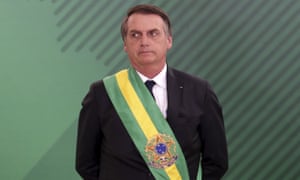
Hours after taking office, Brazil’s new president, Jair Bolsonaro, has launched an assault on environmental and Amazon protections with an executive order transferring the regulation and creation of new indigenous reserves to the agriculture ministry – which is controlled by the powerful agribusiness lobby.
The move sparked outcry from indigenous leaders, who said it threatened their reserves, which make up about 13% of Brazilian territory, and marked a symbolic concession to farming interests at a time when deforestation is rising again.
“There will be an increase in deforestation and violence against indigenous people,” said Dinaman Tuxá, executive coordinator of the Articulation of Indigenous People of Brazil (Apib). “Indigenous people are defenders and protectors of the environment.”
Bolsonaro defended the measure in a tweet on Wednesday. “More than 15% of national territory is demarcated as indigenous land and quilombos. Less than a million people live in these places, isolated from true Brazil, exploited and manipulated by NGOs. Together we will integrate these citizens,” he posted.
Previously, demarcation of indigenous reserves was controlled by the indigenous agency Funai, which has been moved from the justice ministry to a new ministry of women, family and human rights controlled by an evangelical pastor.
Separately, the incoming health minister, Luiz Henrique Mandetta, suggested on Wednesday that there would be spending cuts on healthcare for indigenous people. “We have figures for the general public that are much below what is spent on healthcare for the indigenous,” he said, without providing details.
During last year’s election campaign, Bolsonaro promised to end demarcation of new indigenous lands, reduce the power of environmental agencies and free up mining and commercial farming on indigenous reserves. His measure also gave the agriculture ministry power over new quilombos – rural settlements inhabited by descendants of former slaves.
“We have to take out the ideology and look wisely at how we discuss global warming,” the new agriculture minister, Tereza Dias, told the Guardian.
Silas Malafia, an influential televangelist and close friend of Bolsonaro, said developed countries who centuries ago cut down their own forests should pay if they wanted Brazil to preserve the Amazon.
“We’re going to preserve everything because the gringos destroyed what they had?” he said.

Tuxá, the indigenous leader, said: “We will go through another colonisation process, this is what they want.”

Wednesday, 2 January 2019

One person’s recycling won’t stop climate change in itself. We must act collectively

Climate change is happening now and it’s happening faster and much worse than predicted. It’s threatening to the world we know and everything in it. It’s already killing people. This is beyond doubt or argument.
We have just years to change course. If we manage it, we could save the world, at least the one we recognise. Realistically, the prognosis at the moment is that we won’t manage to steer the ship around in time.
So why have we, as people with everything to lose, not acted sooner?
We have a global climate agreement and we know what needs to happen. This is a problem we know how to solve. But we aren’t acting with anywhere close to the urgency fit for the situation. Renewable energy is cheaper than the bad stuff anyway. Australia is a rich country with the means and the smarts to take on big challenges, so why aren’t we doing it? What will it take to get people to respond in a fitting way?
It’s not surprising that in response to a problem this huge, this existential, people seek out something they can do, from using a keep cup to being fastidious with the recycling. It makes us feel better, it gives us something tangible to do, it stops us from despairing. But we need to admit that even if every plastic bottle and tin can ever produced was recycled, we’d still be on track for catastrophic climate change. No matter how many plastic straws are declined or ocean plastic turned into shoes, every indication points to our children never knowing coral reefs, the Arctic melting and the seas rising.
So what should we be doing?
Stop Adani. Do not let that mine go ahead. My baby who has not figured out that a triangle block goes through the triangle hole could probably figure this one out. We need less pollution in order to keep the world’s ecosystems functional. Digging more new coal to burn is bad maths. We cannot let new coalmines happen. Join a local action group, meet your MP, flick some cash to the people working on this full-time, lock yourself to a bulldozer – this one is really important and there’s a movement set up ready for people to join in and get involved.
More important than any one person’s composting is government policy. Shortly after Australia signed the Paris agreement, Queensland relaxed its land-clearing laws, wiping out any reduction in our pollution that we had committed to in front of the world.
We have a coal-smooching, wilfully ignorant prime minister and a government refusing to take on any climate leadership because it doesn’t fit in with their ideology. Conservatives began the conservation movement, but this current crop of conservative politicians are trying to keep coal plants like Liddell open that even the coal companies want closed.
Australia does not have an energy policy. This is not due to lack of knowledge or understanding. It’s due to lack of leadership and the influence of people who stand to make a buck now and will probably not be alive to see the worst of catastrophic climate change.
That’s not something you can reason with. They’re simply not up to the job.
So people need to act collectively. The first step is getting involved in this year’s election, when governments are most susceptible to influence. The most important thing we can do is try and influence government decisions. We urgently need to stem the flow of climate pollution into the atmosphere and absorb the pollution already out there on a scale that individuals can’t muster.
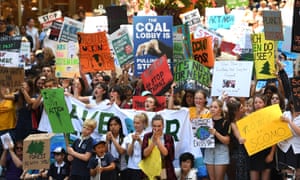
When we sort our waste in our homes or remember our reusable shopping bags it’s helpful, but in itself it is not up to the challenge of stopping climate change. If we are going to respond to the problem at the scale and urgency that reality demands, we need to do more. School children going on strike demanding climate action provide a shining example of disruptive, urgent, agenda-setting activism. They acted like their lives depend on it – we all should.

• Emily Mulligan is head of campaigns at GetUp

Deputy PM rejects fresh Liberal push to scrap university student service fees

Extract from The Guardian

Labor and the university sector have blasted a push by a Liberal senator to scrap tertiary student amenity fees, while the deputy prime minister has warned the Nationals will prevent any move that hurts regional universities.
In December the Liberal senator James McGrath quietly gave notice in the Senate that when parliament returns in February he will introduce a bill to prevent higher education providers charging a mandatory student services and amenities fee, the last vestige of compulsory student unionism.
Tertiary education institutions raise more than $100m a year by charging students a fee of up to $303 which they then distribute to bodies such as student representative councils, student unions and sports clubs.
Although McGrath’s is a private senator’s bill, the fresh push could spark tension in the Coalition between Liberals, who have have consistently opposed amenities fees, and the Nationals.
The acting education minister, Simon Birmingham, and the deputy prime minister, Michael McCormack, both distanced themselves from McGrath’s position, noting the “proposed legislation is a private member’s bill”.
McCormack told Guardian Australia: “My position remains unchanged and as with all other members of the Nationals, I will always stand and fight against any proposed change which would see regional Australians disadvantaged or short-changed.”

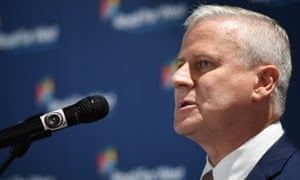
Deputy prime minister and Nationals leader Michael McCormack.
Deputy prime minister and Nationals leader Michael McCormack. Photograph: Joel Carrett/AAP

The Universities Australia chief executive, Catriona Jackson, urged McGrath to reconsider, arguing that universities – especially in regional Australia - would “want common sense to prevail”.
“These fees fund crucial student services across the country including medical and counselling facilities, online and in-person study support to help students at risk of dropping out, and crucial student career preparation and advice services,” she said.
“They also fund essential sports, recreation and cultural facilities and events that foster campus life.”
Labor’s education spokeswoman, Tanya Plibersek, told Guardian Australia: “It’s time for the Liberals to grow up – they think they’re back in student politics.
“Labor believes students deserve good support services and representation at uni.”
National Union of Students’ outgoing president Mark Pace said the peak representative body is “very much against any attempt to cut or reduce [the student amenities fee]”.
He said the fee “provides vital services to Australia’s one million university students” including emergency loans, student welfare officers and free legal services such as tax help.
“The fee supports clubs and broader student life – it funds a wide range of facilities and student representation, because students have a right to quality, equitable and accessible education.”
Higher education is set to be one of the key battlegrounds of the 2019 election, after Labor promised to reverse cuts to universities worth more than $2bn.
The Morrison government has also announced a review of freedom of speech on Australian campuses lead by former high court chief justice Robert French and is considering how to introduce performance funding for universities.
The Howard government abolished compulsory student unionism in 2005 despite the opposition of then senator Barnaby Joyce, but it was partially revived in 2011 by the Gillard government in the form of amenities fees.
In 2013 Tony Abbott was forced to shelve a plan to abolish the fee in part due to public criticism from Nationals MP Michael McCormack.
In October 2017 the Young Liberals cheered government senators for joining Cory Bernardi in backing an unsuccessful Senate motion criticising the fee.

“From day one, the Young Liberal movement has opposed this student tax and been leading the charge in advocating for its repeal,” then federal president Aiden Depiazzi said.

The rise of Russia's oligarchs — and their bid for legitimacy

Updated about 8 hours ago


Roman Abramovich is the owner of the Eclipse, which, at 162.5 metres in length, is the world's second largest privately-owned yacht.
The $500 million boat sits alongside a list of possessions that include a multi-million-dollar art collection, a Boeing 767 plane, and the English Premier League football club Chelsea.
Mr Abramovich, like most Russian oligarchs, found his billions in the carve-up of the Soviet Union's industrial assets in the early '90s, through his connections to the Kremlin.

The oligarchs, sitting atop the most unequal economy in the developed world, can seem almost comical to observers in the West.
But beyond their glitzy extravagance, a complex social transformation is taking place, according to sociologist Elisabeth Schimpfossl.
Dr Schimpfossl, who travelled Russia interviewing oligarchs for a recent book, says the elite are working to legitimise their monied status.
They are, she says, moulding into a class akin to the Soviet intelligentsia or Tsarist aristocracy, using cultural patronage to disguise the often-murky origins of their wealth.

A happy break-up — for some

The Russian ultra-rich amassed their wealth during the economic and social turmoil following the collapse of the Soviet Union, and the introduction of the market economy.
Many had ventured into commerce in the 1980s, unaware they were positioning themselves to benefit unimaginably from one of the fastest redistribution of assets in history.
Russia's early post-Soviet elite were from modest social backgrounds who had genuinely benefited from the Soviet education system.
Mr Abramovich, for example, grew up in poverty.
Over the course of the 1990s, a group of bankers and tycoons appeared at the top of the new rich stratum by seamlessly turning their political clout into wealth.
"The early Russian oligarchs seemed to have appeared from nowhere and got their hands on the driving wheel of government," Dr Schimpfossl says.


During the oil price boom that helped fuel President Vladimir Putin's resurgence in the 2000s, Moscow regularly topped rankings of cities with the most billionaires.
"A whole new layer joined them getting rich on the back of the high oil price which lasted until 2008," Dr Schimpfossl says.
"It was almost as important as the first round of privatisation in the '90s."
Mr Putin eventually brought economic liberalisation under his personal control and significantly reined in the oligarchs.
"If they didn't fall out with Vladimir Putin shortly after he came to power, they now prop up his kleptocracy with injections of cash whenever he asks them to," Dr Schimpfossl says.

And while living abroad is popular for many, Russia's oligarchs are being forced to keep a foothold at home regardless of their position in the state apparatus.
A 2013 law forced government officials, their spouses, and children under 18 to divest themselves of foreign stocks and bank accounts.

From yachts to paintings

Inequality in Russia is at staggering levels.
In 2013, the country had one billionaire for every $11 billion of household wealth, a ratio more than 15 times less equitable than the global average.

In a society that is still acclimatising to the idea of private property, these levels pose some challenges for the oligarchs, who are trying to legitimise their extraordinary wealth.
"The oligarchs are usually hated, and the re-shift of wealth in the population is resented by a population who trace their power directly to corruption during the '90s," Dr Schimpfossl says.
"When this first post-Soviet generation passes its wealth on, it will be the single biggest transfer of assets within the smallest group of people ever to have occurred."
Russian oligarchs have now set out to develop more cultured tastes, rediscover their family histories, and actively engage in philanthropy in order to justify their position in society.

According to Dr Schimpfossl, wealthy Russians are seeking to situate themselves in the tradition of the Soviet, and even Tsarist, intelligentsia.
"They may imagine themselves to be living like the Tsarist aristocrats in a Tolstoy novel, and they're brilliant at constructing narratives of their past," she says.
"This allows them to say they are not random people that made it to the top, but they actually have an obligation to be there, even a moral duty."
Key to this is their involvement in culture and philanthropy, reinvigorating the Soviet concept of 'kulturnost' which prescribed that social elites were versed in Russian music and literature.
Igor Tsukanov, for example, is a successful banker who frequently lends pieces of his world-class post-war Russian art collection to museum exhibitions.

The Tsukanov Family Foundation, run with his well-connected wife Natasha Tsukanov, is a London-based charity supporting education, arts and culture in Russia and the UK.
"My art is not for myself. My dream is to have a museum, for the best Russian collection outside Russia," he told the Financial Times in 2016.
It is hard to judge whether the ultra-rich of today's Russia will be able to find the social legitimacy Dr Schimpfossl believes they are seeking.
But as the country plans for a new wave of privatisations, they can probably count on getting richer.

Nasa's New Horizons spacecraft 'phones home' after flyby of Ultima Thule

Extract from The Guardian

Scientists celebrate probe’s successful completion of most distant space flyby in history
Nasa scientists are celebrating after a spacecraft “phoned home” to confirm it had successfully performed the most distant space flyby in history in the early hours of New Year’s Day.
Thousands of photographs of the dark, icy space rock called Ultima Thule were snapped by the New Horizons probe as it barrelled past it on the outer edge of the solar system at 0533 GMT.
After being out of contact for 10 hours, anxious staff at the mission’s control centre at Johns Hopkins University in Maryland broke out in applause on Tuesday after confirmation signals were received from the probe, which could have been seriously damaged by even the smallest particles.
“We have a healthy spacecraft. We’ve just accomplished the most distant flyby,” said Alice Bowman, mission operations manager for New Horizons. “We are ready for Ultima Thule’s science transmission, science to help us understand the origins of our solar system.”

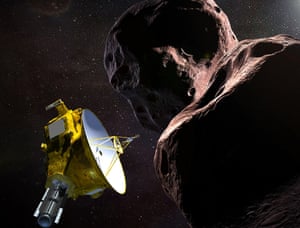
Artist’s impression of the New Horizons spacecraft encountering Ultima Thule
Artist’s impression of the New Horizons spacecraft encountering Ultima Thule. Photograph: AFP/Getty Images

Ultima Thule lies 4bn miles (6.5bn km) from Earth in the Kuiper belt, a band of dwarf planets, space rocks and icy debris left over from the formation of the solar system 4.6bn years ago. Because of the distance, scientists had to wait 10 hours to learn whether the flyby had been successful.
From being a small dot only known in the form of a number of pixels, Ultima Thule will soon be viewed as an “entirely new world”, according to Nasa, as further images are beamed back. The first pictures are expected to be published later this week, but the full download of the data will take 20 months to complete.
Alan Stern, principal investigator of the New Horizons mission, said images taken during the spacecraft’s approach suggested Ultima Thule is probably shaped like a bowling pin, with two bulbous ends. However, he said a possibility remained that it may be two separate objects locked in a tight orbit.
New Horizons is so distant that mission scientists had no way of helping out with any last-minute glitches. Instead any final troubleshooting will have to have been handled by the probe’s onboard software.
Jim Bridenstine, Nasa’s chief administrator, said in a tweeted statement: “In addition to being the first to explore Pluto, today New Horizons flew by the most distant object ever visited by a spacecraft and became the first to directly explore an object that holds remnants from the birth of our solar system.
“This is what leadership in space exploration is all about.”
Hal Weaver, a research professor at Johns Hopkins University and a project scientist on the New Horizons mission, called the flyby a “once-in-a-lifetime opportunity”.
“This is another great step in the exploration of our solar system,” he said.
Revealed: Pluto’s surface in high resolution
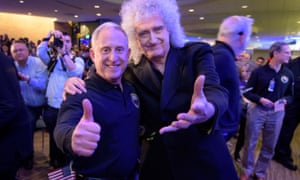
After the Pluto encounter, Stern asked Brian May, the Queen guitarist and astrophysicist, if he would compose a track to celebrate the Ultima Thule flyby.
“I did scratch my head for a while,” said May. “The name is quite hard to conjure with. But then it came to me that this is about man’s desire to reach out into the universe and explore, and see things that have never been seen before.”

New Horizons principal investigator Alan Stern (left) with Queen’s Brian May.
The New Horizons principal investigator, Alan Stern, left, with Queen’s Brian May. Photograph: Bill Ingalls/Nasa/EPA

The New Horizons track, May’s first solo single for two decades, included a message from Stephen Hawking and was premiered at the control centre shortly before the flyby. “It’s been very exciting. I feel like I’m on that thing,” May said. “To me, it’s about the human spirit and reaching out to discover where we are and why we are here.”
Little is known about Ultima Thule, or 2014 MU69, to use its official name. But based on preliminary observations, scientists think it may resemble a giant peanut with two large lobes fused together. The dark rock may contain frozen carbon monoxide, carbon dioxide, molecular nitrogen and methane, which may be exposed by impact craters on the surface.
While some comets that streak through the solar system are thought to have originated in the Kuiper belt, space rocks as distant as Ultima Thule have remained on the outer edges of the solar system since birth. For this reason it is thought that objects such as Ultima Thule, the so-called cold classical Kuiper belt objects, look the same today as they did at the dawn of the solar system.
“We’ve never explored a body as primordial or as far away from the sun as Ultima Thule,” said Mohamed Ramy El Maarry, a New Horizons science team collaborator and lecturer at Birkbeck, University of London. “This gives us a chance to look at what comets are like before they enter the inner solar system. They’ve been in deep freeze since they formed 4.6bn years ago.”
He added: “What’s really exciting is we expect to see surprises. We are really looking at the basic ingredients of the solar system. This can tell us a lot about the building blocks of the solar system, about the conditions when the solar system formed, and about other solar systems as well.”
The first images to be beamed home from Ultima Thule will be small and grainy, but a day or two after the encounter, Nasa hopes to have more impressive pictures from the probe. “This is the first time we’ll fly past a cold classical Kuiper belt object and really see what it looks like,” said Weaver. “We’re taking our first steps into this whole new zone of the solar system. We’re on our way.”
Bowman said: “We can build a spacecraft on Earth, and we send it out billions of miles away from Earth, and it sends us back all this wonderful data that we get to look at and learn more about our world, our solar system.

“There’s a bit of all of us on that spacecraft that will just continue after we’re long gone here on Earth.”