Friday, 2 April 2021

Morrison government guilty of 'absolute failure' in electric vehicles policy.

Extract from The Guardian

Electric, hybrid and low-emission cars

Independent senator Rex Patrick says the prime minister broke a 2019 promise to support the rollout of EVs.
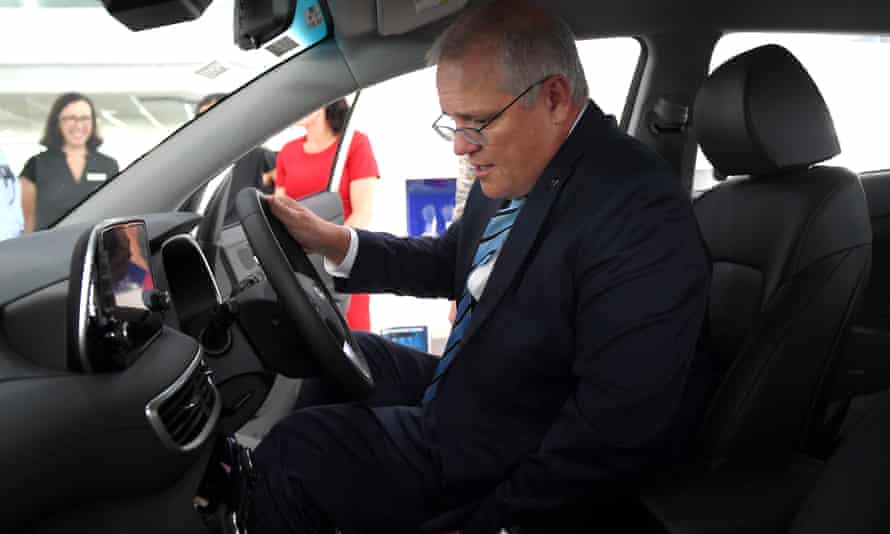
Scott Morrison in a non-electric car.

Prime minister Scott Morrison in a non-electric vehicle. Independent senator Rex Patrick has accused him of breaking a promise over an EV strategy.

Last modified on Thu 1 Apr 2021 14.09 AEDT

Independent senator Rex Patrick has taken a swipe at the federal government for its “absolute failure” on electric vehicles and says the prime minister, Scott Morrison, has broken a promise to make progress on their adoption.

Patrick, who was a member of the Senate inquiry investigating how best to support the rollout of EVs in Australia, said when the committee had made its recommendations in 2019 Morrison had promised to act.

“The prime minister promised us a national EV strategy to ‘ensure the transition to new vehicle technology and infrastructure is carefully planned and managed’. We all felt like we’d made a difference, the PM was on board.

“It is now 1 April 2021. So where are we at?”

Patrick was speaking at a meeting of electric vehicle engineers, local government officials and car manufacturers on Thursday morning in Adelaide.

“It being April Fools’ Day, I was going to stand up and say I will be speaking on behalf of the federal government, then have a minute’s silence,” he said. “Unfortunately there are many around who are in denial of electric vehicles, putting every argument you can think of – you know, it’s going to ruin your weekend.

“Well at the federal level, outside a couple of trial EVs for the Comcar fleet, there’s not much to report. There’s definitely no national EV strategy.”

The federal Labor party announced on Tuesday that if elected it would introduce an exemption to the import tariff of EVs worth less than $77,565 and exempt them from the fringe benefits tax.

Behyad Jafari, chair of the Electric Vehicle Council, said Labor’s policy would lower the cost of EVs across the country, but not in Victoria, where a new EV road tax would add $5,175 to the cost.

“That’s based on the average costs that the government have themselves said, so it may increase if they decide to increase the 2.5c per kilometre charge,” he said.

Jafari said that in the face of federal inaction, state and territory governments could do much more, especially as momentum is picking up in other jurisdictions.

The UK has said it would end the sale of petrol vehicles by 2030 and US president Joe Biden has promised a massive infrastructure spend and larger tax breaks to EV owners to ensure a faster transition that promise to unleash a “green tidal wave”.

“The role of government isn’t to sit around and be excited by what might happen. It’s to do something,” Jafari said. “States need to look at stamp duty and the charges they apply to EV owners, then remove them.

“The other thing they can do, that the federal government has refused to do, is implement their own fuel efficiency standard. Based on legal advice we’ve provided to the states, they can introduce a vehicle emissions standard if the federal government does not.

“The other thing they should get legal advice on is whether they can ban petrol vehicle sales. That’s what places like California do. They say: ‘We won’t let you register a new petrol or diesel vehicle made after a certain day.’ ”

However, Jafari said catching up to the rest of the world will not be easy as no state or territory government has a good framework for helping to support people making the switch to electric.

“The rather mischievous thing we’re seeing now is people saying these targets we’re setting are 10 years from now, so we’re not going to do anything about it until then,” he said.

“You can’t sit on your hands and say in 10 years’ time we’re going to ban petrol vehicles. You have to be doing the work to prepare for it now.”

Scott Morrison is facing three major problems — but one is more elusive and difficult.

Extract from ABC News 

Analysis

By Michelle Grattan
, Prime Minister Scott Morrison speaking in front of a lectrern with two Australian flags behind him.
Prime Minister Scott Morrison speaks at a press conference at Parliament House about the workplace culture of Parliament House.
(ABC News: Ian Cutmore)

COVID-19 has an evil sense of humour. Despite Australia being mostly free of community transmission, it managed to spoil Christmas for quite a few Sydneysiders and their families and now it's struck just before the Easter holidays.

The Brisbane lockdown was lifted but many people cancelled plans, and the Byron Bay Bluesfest was called off.

The latest disruption, though limited, reinforced the importance of rolling out the vaccine as fast as possible.

If you believe Health Minister Greg Hunt, that's going fabulously — even though we're way behind the original targets. If you believe the NSW and Queensland governments, and many people's lived experience, it's another story.

NSW reacted furiously to Wednesday's News Corps tabloid report, sheeted home to Hunt, that focused on states failing to get enough shots into arms. Queensland was riled when senior Nationals minister David Littleproud condemned the states for doing "three-fifths of bugger all".

Play Video. Duration: 2 minutes 19 seconds

States and the Federal Government battle over vaccine rollout.

Red rags to the states

Federal "spin" and blame shifting were red rags to the two states; NSW Health Minister Brad Hazzard declared "I'm as angry as I have ever been in this 15 months of war against this virus". The federal government was criticised for the lumpy and unpredictable distribution of vaccine supplies.

Hunt and Scott Morrison sought to soothe; things calmed somewhat.

Morrison didn't hide his anger at Hunt and Littleproud for their provocation.

The feds like to say the rollout is "not a race," because we don't have a "burning platform" like many countries.

But — apart from the risk of bigger breakouts — the slower the rollout, the longer we endure spot lockdowns, a closed international border, and a brake on the economy.

Queenslanders wait in line at Centrelink.

With JobKeeper ended, and people on JobSeeker receiving less money than before, there are big unknowns.
(ABC News: Chris Gillette)

Rollout is just the start

In the coming weeks and months, Morrison will be grappling with two very tangible issues and another which is much more elusive and for him, especially difficult. They are the rollout, ensuring the economic settings are optimal, and the "women problem".

The rollout is basically about administration. It should get better. The vaccine shortages will ease with the ramp up of local production. The efficiency on the ground will presumably improve but how fast and to what extent remain open questions. The job will get done, but the October deadline for jabs all round looks beyond reach.

Behind the scenes, another job is in full swing — work on next month's budget; like the rollout it is complex, albeit in a completely different and much more familiar way.

This budget, like its October predecessor, is being crafted against a backdrop of high uncertainty.

The Australian economy is recovering remarkably well from the COVID recession, climbing back up that V shape. But with JobKeeper ended, and people on JobSeeker receiving less money than before, there are big unknowns. How many businesses will close? How many workers will lose jobs? What will be the economy-wide effect on spending?

The government gets "real time" information; even so, it is framing the budget in rapidly changing conditions. On the positive side, the latest numbers indicate a better fiscal position than at the December update, which had a deficit forecast of just under $200 billion for this financial year.

Economist Chris Richardson, from Deloitte Access Economics, says in preparing the budget the government will need to consider where more "sticky tape" is required (like that already applied to the aviation and tourism industries), and what should be done about the failed JobMaker scheme (which was designed to encourage the employment of younger people).

Richardson also argues the government needs to move towards the Reserve Bank's position in what it says about unemployment. It has said it won't make budget repair a priority until unemployment, presently 5.8 per cent, is "comfortably" under 6 per cent. But the bank wants to see unemployment down to 4.5 per cent, which Richardson maintains is the rate the government should be embracing.

The big new spending will be on aged care, with its huge challenges. Hunt took on major responsibility for this in the December reshuffle — the rollout problem must be eating into the attention he can devote to the policy drafting.

Composite image of Grace Tame, Scott Morrison and Brittany Higgins

Morrison is under pressure to take action on harassment, thanks to campaigners like Grace Tame and Brittany Higgins.
(ABC News, AAP)

There are budget expectations

The October budget was criticised for not containing enough for women; now Morrison has his new "lens" on them. That comes with the danger of disappointing expectations.

One of Morrison's many problems in dealing with the women's issue is that it extends beyond policy, although good policies, such as initiatives addressing workplace sexual harassment, are vital.

Since Brittany Higgins' allegation she was raped by a colleague in a minister's office, the country has seen the eruption of a social movement that is about feelings, perceptions and attitudes as much as about specific policies.

It is about the behaviour of men — in Parliament House, and everywhere else.

While bad behaviour exists on all sides of politics, the recent revelations have mainly been about the Coalition.

Last week saw the spotlight turned on Liberal MP Andrew Laming, accused of trolling constituents and taking an inappropriate photo of a woman. Laming says he won't seek another term, but Morrison isn't wanting to banish him to the crossbench, which would wipe out the government's majority.

Although the allegations against him are far less serious, trenchant critics would say he should follow the example of NSW Nationals MP Michael Johnsen, who has resigned from state parliament after an accusation (which he vehemently denies) that he raped a sex worker.

Another bad week for Morrison could have been worse if Parliament had been sitting, when Laming would have been front and centre. But this is only a temporary reprieve: if Laming is still on the government benches come budget week, he'll be a distraction.

The national debate sparked by Higgins and escalated by the historical rape allegation against Christian Porter — strenuously denied by him — is seeing tough conversations in many Australian households.

It would be fascinating to know what impact it is having on Morrison's own close-knit family, which is mostly female, including his wife, two young daughters and his mother. We heard early on about Jenny's advice, but how's the kitchen table discussion going?

Michelle Grattan is a professorial fellow at the University of Canberra and chief political correspondent at The Conversation, where this article first appeared.

Thursday, 1 April 2021

Destruction of world's forests increased sharply in 2020.

Extract from The Guardian

Trees and forests

Calls for forests to be high on Cop26 agenda after loss of 42,000 sq km of tree cover in key tropical regions.

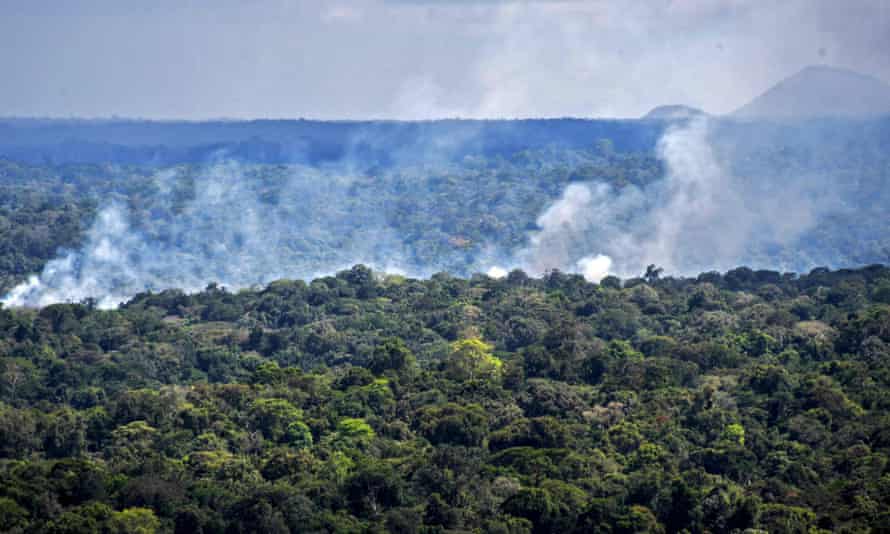
Smoke billows from a fire in the Amazon rainforest in Oiapoque, Amapa state, Brazil, last October.

Smoke billows from a fire in the Amazon rainforest in Oiapoque, Amapa state, Brazil, last October.

Environment correspondent

Last modified on Wed 31 Mar 2021 15.01 AEDT

The rate at which the world’s forests are being destroyed increased sharply last year, with at least 42,000 sq km of tree cover lost in key tropical regions.

According to data from the University of Maryland and the online monitoring platform Global Forest Watch, the loss was well above the average for the last 20 years, with 2020 the third worst year for forest destruction since 2002 when comparable monitoring began.

The losses were particularly severe in humid tropical primary forests, such as the Amazon, the Congo and south-east Asia. These forests are vital as carbon sinks in the regulating the global climate, as well as for their irreplaceable ecosystems. Losses from this type of forest alone amounted to 4.2m hectares (10.4m acres), equivalent to the annual carbon dioxide emissions of more than 575m cars, according to the World Resources Institute (WRI), which compiled the report.

Altogether, 12.2m hectares of tree cover were lost in the tropics in 2020, an increase of 12% on 2019.

Brazil’s forested areas fared the worst, with 1.7m hectares destroyed, an increase of about a quarter on the previous year. Fires swept through the Amazon at a greater rate than in the previous year, despite the government imposing a ban on the use of fires to clear trees and deploying soldiers to curb the practice. The government of Jair Bolsonaro has presided over a massive increase in deforestation, after a long period of improvements in reducing the destruction.

Frances Seymour, a distinguished senior fellow at WRI, said: “Brazil had achieved a huge reduction in deforestation, but we are now seeing the unravelling of that success, and it is heartbreaking.”

While the Amazon region has grabbed attention, scientists are also increasingly concerned about Brazil’s Pantanal, the world’s biggest tropical wetland. About a third is estimated to have been hit by fires last year, with devastating effects on biodiversity. Most of the fires were started by people to manage land for agriculture, but the region has also had its worst droughts in more than 40 years, and many fires continued to burn out of control. The areas affected by these unprecedented fires will take decades to recover.

The Covid-19 pandemic and lockdowns around the world did not have a clear impact on forest loss patterns, according to Rod Taylor, the global director of the forests programme at WRI. “The data does not show a systematic shift,” he said.

However, there has been anecdotal evidence of people forced to return to rural areas by lockdowns and the worsening economic situation in cities, and that this could have greater impact in future, he said.

Seymour said countries that faced high levels of debt owing to the economic fallout from the pandemic could be tempted to give in to commercial interests to exploit their forests unsustainably, or could be forced to reduce resources for forest protection.

“Unless we offer alternatives, it is likely that governments will try to recover on the back of forest loss, [particularly] governments facing high levels of debt,” she said. “The longer we wait to tackle deforestation, the more likely it is that these carbon sinks will go up in smoke.”

Seymour pointed to some success stories in tackling deforestation as proof that strong policies accompanied by the needed finance and government enforcement could reduce the rate of forest loss.

Deforestation is decreasing in Indonesia, which has dropped out of the WRI’s list of top three countries for primary forest loss for the first time. Tree loss in Indonesia in 2020 fell for the fourth year in a row, down from a peak in 2016 after devastating forest and peat fires led the government to place a moratorium on the cutting down of primary forest and converting peatland to agriculture while restricting licensing for palm oil plantations.

Malaysia, which has lost about a third of its primary forest since the 1970s, has also recently succeeded in reducing deforestation, with tougher laws on illegal logging.

Wealthier countries are not immune to forest loss. In Germany there was a threefold increase in forest loss in 2020 compared with 2018. The increase was largely due to damage from bark beetles feasting on trees made vulnerable by the hot and dry weather brought by global heating. Australia had a ninefold increase in tree cover loss over the past two years, largely owing to extreme weather and forest fires.

Climate breakdown is also making forest loss worse, with humid forests drying out, causing trees to die off and fires to burn for longer, in a vicious cycle.

On Wednesday, the UK, which will host the vital UN Cop26 talks this November, is holding a conference on climate and development at which wealthy nations will be asked to come up with plans to help the most vulnerable countries cut emissions and cope with the effects of climate breakdown. Campaigners hope to raise the issue of forest funding there.

“Forests need to be on the agenda for Cop26,” said Seymour. “The world’s forests are still an enormous carbon sink, and we need to keep that carbon sequestered to avert catastrophic climate change.”

Alok Sharma, the president of Cop26, said wealthy countries must step up to help poor nations bearing the brunt of climate breakdown: “The people who have done the least to cause the climate crisis are suffering the most. This is a searing injustice. And so developed countries have a particular responsibility to support the response of communities which are most vulnerable to climate change. We are running out of time.”

Grace Tame expresses incredulity at PM's choice of Amanda Stoker as assistant minister for women.

Scott Morrison either ignorant of issues or making calculated moves, Australian of the Year says.

Grace Tame at Griffith University
Grace Tame condemns appointment of Amanda Stoker as assistant minister for women – video
Political editor

Last modified on Wed 31 Mar 2021 18.46 AEDT

The Australian of the Year, Grace Tame, has criticised Scott Morrison for elevating Amanda Stoker as the new assistant minister for women, declaring that the Queensland senator had supported a “fake rape crisis tour” that inflicted great suffering on survivors.

Tame said Morrison had exhibited either very poor judgment, or cultural calculation, when he elevated the Liberal National party conservative who had conducted public advocacy “aimed at falsifying all counts of sexual abuse on campuses across the nation”.

“Needless to say that came at great expense to the student survivors who were already traumatised,” Tame told an event on Tuesday night.

Tame also turned her sights on Morrison in social media posts after the event at Griffith University. She said when she met the prime minister at morning tea on 25 January, “I spoke directly of the need for a permanent taskforce to tackle issues pertaining to sexual abuse.

“He dismissively insisted that such infrastructure already existed and functioned well.

“Two months later, in an attempt to repair his political standing following explosive allegations of sexual assault, discrimination and misconduct in parliament, he has rearranged his cabinet and created a taskforce on women’s equality, safety, economic security, health and wellbeing.”

Tame said it was possible to respond to a pandemic with funding “but we can’t fix morals with money and masking [and] we can’t boost humanity with stunts and stimulus packages.

“Now that our collective focus has extended beyond economic disruption to issues of morality, we are seeing leaders for who they really are.”

During the event, Tame criticised Stoker for an association with the men’s rights activist Bettina Arndt. She said Arndt had given “a platform to the paedophile who abused me”.

After Arndt was given an Australia Day award for services to gender equity, Stoker backed the sex therapist when she faced an avalanche of criticism.

Tame expressed incredulity that Stoker had been given a women’s ministry in this week’s reshuffle. “That is a woman who has been put into a position of great power – she has been given this new portfolio.”

Tame said on social media that Morrison appointing Stoker to the position demonstrated he either was “ignorant of the cultural issues at hand, or he understands them completely, and is making calculated moves to perpetrate them.

“If the latter is true, then what we are seeing is further abuse of power, masterfully disguised as progress – the very same psychological manipulation at the heart of these recently exposed evils.”

In response to Tame’s comments, Stoker said in a statement: “I’ve spent my career as a prosecutor and barrister working for justice for women and children who are victims of sexual crimes and unconscionable exploitation.

“As a barrister, I provided countless hours of pro bono support to women dealing with sexual harassment.”

Stoker said she would “endeavour to make contact” with Tame in an effort to resolve their differences. “Ms Tame’s comments are passionate but not informed and they do not correspond with my longer history of work in this area, of which Ms Tame must be unaware.

“I hope that she and I can work together to advance our many shared goals.”

The prime minister told reporters in Adelaide he respected Tame and congratulated her “on her strong advocacy on the issues”. But he said he didn’t agree with her negative assessment of Stoker.

Morrison embarked in the reshuffle in an attempt to circumvent the political crisis engulfing the Coalition over its treatment of women. The prime minister unveiled a new frontbench aimed at elevating the female “perspective”.

He established a new taskforce for women, while restoring the number of women in cabinet to seven out of 23. The taskforce will deal with women’s equality, safety and economic wellbeing, and will be chaired by Morrison and the minister for women, Marise Payne. It will include all of the government’s female ministers.

The latest Guardian Essential poll shows that Morrison’s standing with women has slumped by 16 points since the former Liberal staffer Brittany Higgins generated the federal parliament’s #MeToo moment by alleging she had been raped by a colleague in March 2019.

But while unveiling the reshuffle in an attempt to reset the government’s political fortunes, Morrison has been battling criticism over the rogue MP Andrew Laming, who has been forced to undertake empathy training after complaints he abused his constituents online and taking an inappropriate photo of a woman. Laming denies there was anything untoward in taking the photograph.

Queensland police have confirmed that a formal complaint has been lodged by a 29-year-old woman regarding the allegedly inappropriate photograph.

The Guardian view on Myanmar’s generals: impunity has bred this ruthlessness.

Extract from The Guardian

Opinion Myanmar

Hundreds have died since February’s coup. Civilians are defiant – but while their resistance persists, so does the military’s bloody grip on power.

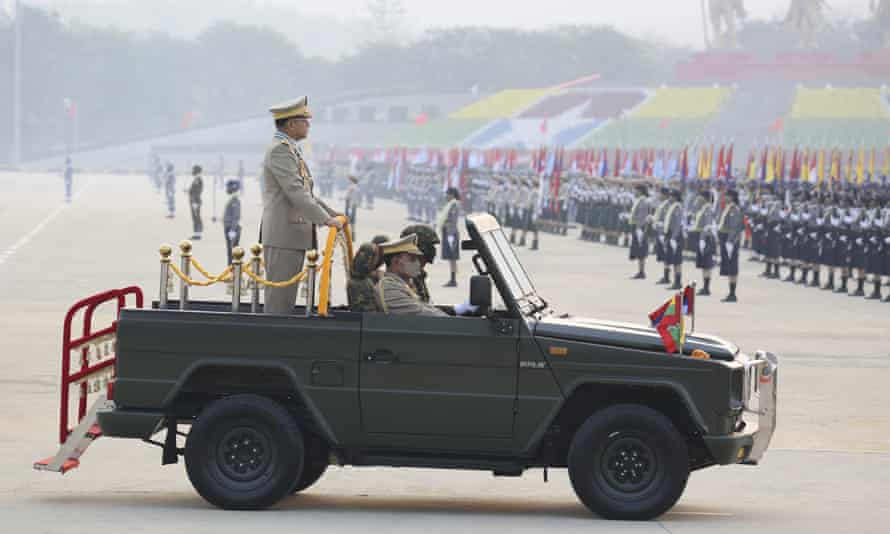
Min Aung Hlaing, the chief of Myanmar’s armed forces, at an army parade in Naypyitaw on 27 March.

Min Aung Hlaing, the head of the military junta, at an army parade in Naypyitaw, Myanmar, on 27 March.

Last modified on Wed 31 Mar 2021 15.53 AEDT

Eleven-year-old Aye Myat Thu was buried with her dolls at the weekend, hours after she was killed by security forces in Myanmar. The horror of her death is far from unique: more than 30 children have reportedly died in the brutal crackdown on protests against last month’s coup, including a five-year-old boy and a seven-year-old girl who was shot dead in her home.

More than 100 people were killed on Saturday alone. More than 500 have died since the military seized control, arresting the civilian leader, Aung San Suu Kyi, and other elected politicians from her National League for Democracy (NLD), and wresting back what power they had allowed the people. The deaths and arrests are only part of the damage. The economy of one of Asia’s poorest countries is now in desperate straits, with the coup’s fallout compounding the pandemic’s impact.

The ruthlessness of the Tatmadaw is no surprise. What is more startling – perhaps to the military most of all – has been the defiance of the civil disobedience movement. The younger generation did not grow up under military rule, in constant fear. They have drawn inspiration from activists in Hong Kong and Thailand. While previous pro-democracy movements were rapidly extinguished with the gun, thousands took to the streets again on Monday.

The Tatmadaw’s response has been to intensify its violence, fuelling the anger. While the protests have overwhelmingly been peaceful, some activists are turning to armed struggle. Myanmar’s ethnic minorities have long suffered at the hands of the military – the weekend saw punishing airstrikes near the Thai border after Karen fighters captured an army outpost – and several armed groups have said that they are on the side of the democracy movement. But while there is talk of unprecedented unity and even a “federal army”, ethnic minorities have been promised solidarity before, only to be abandoned later. And the military is large, well funded, well armed and utterly relentless.

The generals designed the constitution so that they retained control over the military budget and other key areas, with the NLD kept on a tight leash; the party’s second electoral landslide was not going to change that. Many suspect that Min Aung Hlaing’s wish to remain in charge after his time was up as chief of the armed forces led to a miscalculation. But the military would not have grabbed back power were it unduly concerned about the response. The generals have enjoyed impunity for decades. They continued bombing ethnic groups as sanctions were lifted. When a 2019 UN fact-finding mission urged the international community to cut ties with the military and the companies it controls, warning that its revenues were increasing its ability to carry out horrifying abuses against groups including the Rohingya, no one listened. A speedier reaction to the coup itself might perhaps have done something to curb the armed forces’ bloodier impulses. But late is better than never.

The US has now suspended all trade until the return of a democratically elected government. The UK has partially cut off its dealings with military businesses, but the EU has held off: it must act. Businesses, especially the oil and gas giants, should make sure that their money does not flow to the military. Countries should also press Myanmar’s neighbours not to repatriate those who have fled. There will be no knockout blows against the Tatmadaw. But there can be no indifference to its crimes.

European Union official sounds alarm over threats to Great Barrier Reef.

Extract from The Guardian 

Great Barrier Reef

EU commissioner Virginijus Sinkevičius urges Australia to sign Leaders’ Pledge for Nature that promotes a green recovery from Covid crisis.

Clownfish, blue tang and sea turtle on the Great Barrier Reef, Australia
The EU’s Virginijus Sinkevičius hopes concerns about the Great Barrier Reef will help motivate countries to make more ambitious cuts to greenhouse gas emissions.

Last modified on Thu 1 Apr 2021 03.31 AEDT

A senior European Union official has sounded the alarm over the rapid decline of Australia’s Great Barrier Reef while backing calls for all countries to make more ambitious cuts to greenhouse gas emissions.

The EU’s commissioner for environment, oceans and fisheries, Virginijus Sinkevičius, told Guardian Australia he was deeply concerned by the threats facing the Great Barrier Reef. “As long as we do not change our behaviours, things will not improve,” he said.

Sinkevičius hopes Australia will sign up to the 84-country Leaders’ Pledge for Nature – a document that calls for a “green and just” recovery from the Covid-19 crisis and stronger political will to act against the “crises of biodiversity loss and ecosystem degradation and climate change”.

The leaders’ pledge backs the objective of achieving net zero emissions by 2050. That is a target the Australian prime minister, Scott Morrison, has said is his preference, but he has resisted making a formal commitment amid divisions within his government over climate policy.

Sinkevičius spoke to Guardian Australia after the EU joined the International Coral Reef Initiative, a grouping of countries and organisations that aims to preserve coral reefs and related ecosystems. Australia was one of eight governments that co-founded the initiative in 1994.

“I am deeply concerned by the threats facing the Great Barrier Reef,” Sinkevičius said. “Perhaps no coral reef on the planet is better known, certainly here in Europe, than the Great Barrier Reef.”

Sinkevičius said coral reefs in general, and the Great Barrier Reef in particular, were “emblematic of rich marine life”.

“Yet the rapid degradation of these beautiful and essential underwater worlds is also a very stark reminder of the pressures that human activity is placing on our shared planet, not least our oceans,” he said.

“Coral reefs are under threat because of our activity as humans, our unsustainable ways of living, producing and consuming. As long as we do not change our behaviours, things will not improve. This is in our hands, and we must seize responsibility and rectify these negative impacts.”

The world heritage-listed Great Barrier Reef is the world’s largest coral reef system but is under increasing pressure from climate heating that caused mass bleaching events in 2016, 2017 and 2020. A government report card released in February found the marine environment along the coastline remained in poor health.

Asked whether concerns about the Great Barrier Reef should help motivate all countries to increase the level of ambition in their greenhouse gas reduction commitments, Sinkevičius said: “I would hope so.”

He said the European Commission’s European Green Deal included a pledge to make Europe the first carbon-neutral continent by 2050 – a goal he described as “ambitious, yet one that is absolutely necessary”.

Sinkevičius said he had been “happy to see its wider impact in engagements with partners around the world” and had been pleased to see that China and the US had set deadlines for net zero emissions – 2060 and 2050, respectively.

But he said it was “also important to acknowledge that our emissions have already had an impact on climate”.

“Such impact will continue for decades, even if global and European efforts to cut greenhouse gas emissions prove effective. Hence substantial adaptation efforts are therefore still required. Our cooperation in the International Coral Reef Initiative and other fora will remain essential in this regard.”

Sinkevičius said the EU looked forward to close cooperation with Australia, currently a co-chair of the reef initiative.

He said the EU was already working with Australia on research initiatives, including providing at least €280m ($432m) over three years to a project led by the Institut de recherche pour le développement in France.

The project, in partnership with the Australian Institute of Marine Science, is examining the genetic response of corals to ocean warming.

Sinkevičius said the EU and Australia were “longstanding supporters of conserving the unique ecosystems and rich marine biodiversity of the Southern Ocean, including the reefs of cold-water corals and seamounts that form key habitats for an array of creatures found nowhere else on Earth”.

The commissioner called for an ambitious agreement on a post-2020 global biodiversity framework at the next meeting of the Conference of the Parties to the Convention on Biological Diversity (COP15), due to be held in October in the Chinese city of Kunming.

The EU is pressing for “ambitious, and where feasible, measurable and time-bound targets to effectively address the drivers of biodiversity loss”.

Sinkevičius said the EU was “striving for overarching objectives to galvanise support at the highest political level and among the wider public - similar to the 1.5C target for climate change”.

“We are at a turning point, and the upcoming COP15 must be the Paris moment for biodiversity,” he said.

He said the UN Biodiversity Summit held in September “was an important event to build momentum as well as to foster strategies to recover from the Covid-19 pandemic that are green and consistent with climate and biodiversity objectives”.

“The EU invites Australia to join the Leaders’ Pledge for Nature published in September 2020 and already endorsed by 84 countries,” he said, referring to a pledge whose supporters include Canada, New Zealand and the United Kingdom.

“In addition, the EU also invites Australia to join the High Ambition Coalition for Nature and People, which is raising the global ambition to achieve at least 30% protection of land and oceans.”

The High Ambition Coalition, whose members comprise 57 countries or blocs including the UK and France, calls for that goal of protecting at least 30% of world’s land and ocean to be achieved by 2030.

“Mobilising resources ahead of the COP15 will be of key importance and we also count on Australia to join international efforts to ensure adequate support to developing states,” Sinkevičius said.

Australia’s minister for emissions reduction, Angus Taylor, told an international event late on Wednesday that Australia was “firmly committed to getting to net zero as soon as possible and preferably by 2050”.

But, Taylor said, Canberra’s focus was “very much on the ‘how’” of such a transition. The minister pledged $1m towards a clean energy transitions program overseen by the International Energy Agency.

Navalny goes on hunger strike in protest at prison treatment.

Extract from The Guardian 

Alexei Navalny

Russian opposition leader says he has been denied medical care and subjected to sleep deprivation.

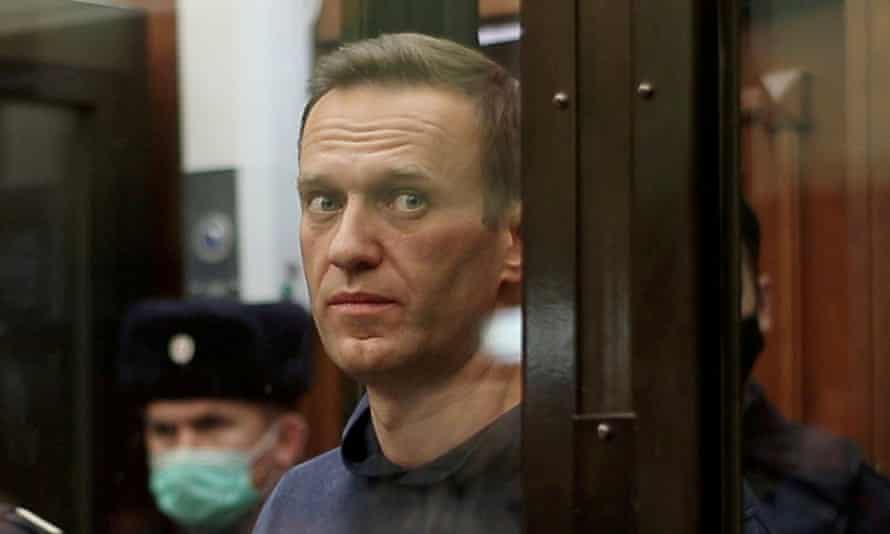
Alexei Navalny pictured in a Moscow court in February.

Alexei Navalny pictured in a Moscow court in February.

in Moscow

Last modified on Thu 1 Apr 2021 05.23 AEDT

Alexei Navalny has gone on hunger strike after saying he was denied urgent medical treatment in prison.

The Russian opposition leader has complained of a “sharp deterioration” in his health since his transfer to a prison colony in the Vladimir region to serve a two-and-a-half year sentence on embezzlement charges. The colony, which is 60 miles from Moscow, is notoriously strict and said to excel at isolating inmates from the outside world.

Navalny, who barely survived a poisoning attack in August traced back to Russia’s FSB, complained of “aggressively progressing” pain and numbness in his back and legs. “Parts of my right and now left leg have lost all feeling,” he wrote in a note, which has been reposted to his social media accounts.

“I’ve declared a hunger strike with the demand that the law be enforced and a doctor be admitted to see me,” Navalny wrote. “So for now I lie hungry, but for the time being with two legs.”

Navalny says has not received medicine he has requested and the prison administration has subjected him to psychological pressure and sleep deprivation, detailing a fellow inmate to wake him every hour on the pretext of making sure he has not escaped.

Inmates often go on hunger strikes or commit other acts of self-harm in order to protest over poor conditions in Russian prisons. Some declare “dry” hunger strikes in which they also refuse water.

Navalny did not specify which kind of hunger strike he had declared but has said it will continue until prison authorities allow him to see a doctor. “My requests are modest, obvious, and the right to medical care and an examination by a doctor … is written in black and while in the law. But for some reason the law doesn’t apply to me.”

It is not clear whether Navalny’s condition is tied to the poisoning attempt last year, which left him in a coma. He was evacuated to Berlin’s Charité hospital, where he was diagnosed with poisoning from a novichok-style nerve agent similar to the one used in the Salisbury attacks in 2018.

Navalny said that upon reawakening, he had to learn to perform simple tasks and struggled with persistent exhaustion. Nonetheless, he returned to Russia just months later, flying to Moscow’s Vnukovo airport. He was arrested for allegedly violating his parole in a 2014 embezzlement case he has said was politically motivated and sentenced to two-and-a-half years in prison. Navalny has accused Vladimir Putin of personally ordering his attempted murder and his imprisonment. The Kremlin has denied the accusations.