Contemporary politics,local and international current affairs, science, music and extracts from the Queensland Newspaper "THE WORKER" documenting the proud history of the Labour Movement.
MAHATMA GANDHI ~ Truth never damages a cause that is just.
Mercury looms into view as the BepiColombo spacecraft flies past.(AP: ESA)
Help keep family & friends informed by sharing this article
A
joint European-Japanese spacecraft got its first glimpse of Mercury as
it swung by the solar system's innermost planet while on a mission to
deliver two probes into orbit in 2025.
Key points:
The spacecraft took a photo as it flew within 200km of the planet's surface
The mission was launched in 2018
Five further fly-bys are needed before BepiColombo slows enough to release space bots
The
BepiColombo mission made the first of six fly-bys of Mercury on
Saturday morning AEST, using the planet's gravity to slow itself down.
After
swooping past Mercury at altitudes of under 200 kilometres, the
spacecraft took a low resolution black-and-white photo with one of its
monitoring cameras.
The European Space Agency (ESA)
said the captured image showed the planet's northern hemisphere and its
characteristic pock-marked features, among them the 166-kilometre-wide
Lermontov crater.
Five
further fly-bys are needed before BepiColombo is sufficiently slowed
down to release ESA's Mercury Planetary Orbiter and JAXA's Mercury
Magnetospheric Orbiter.
The two probes will study Mercury's core and processes on its surface, as well as its magnetic sphere.
The
mission is named after Italian scientist Giuseppe "Bepi" Colombo, who
is credited with helping develop the gravity assist manoeuvre that
NASA's Mariner 10 first used when it flew to Mercury in 1974.
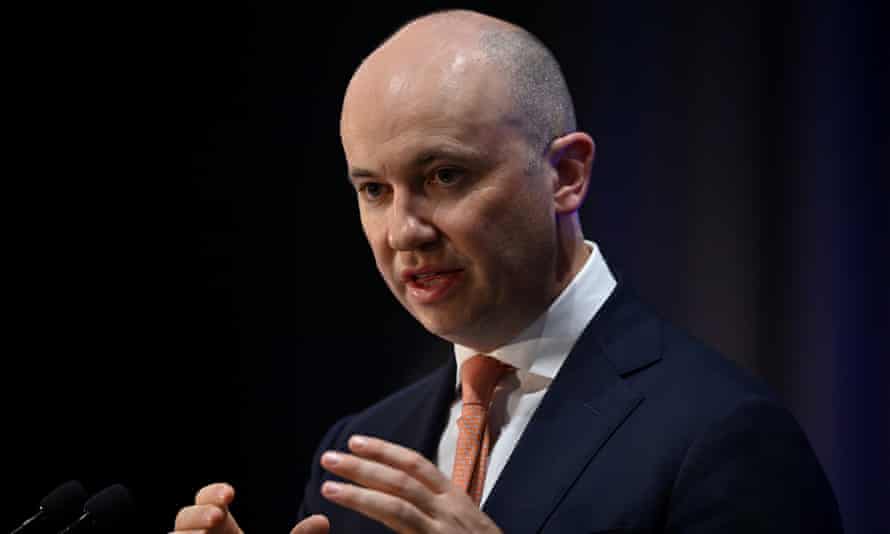
Matt
Kean says Matt Canavan and George Christensen ‘never worry about
rocking the boat, so why should progressive, economically rational
Liberals not do likewise?’
Last modified on Sat 2 Oct 2021 07.57 AESTThe
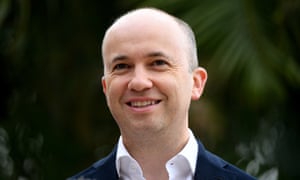
New South Wales environment minister Matt Kean has called on fellow
Liberal moderates in Canberra to replicate the forceful lobbying of
National MPs, and insist that Scott Morrison takes a net zero target to the Cop26 in Glasgow.
Kean
has warned in an interview with Guardian Australia’s politics podcast
that traditional Liberal voters are prepared to rise up against Liberal
governments failing to take ambitious action to reduce emissions and
transition to a sustainable economy.
The interview follows NSW this week unveiling a new pledge to halve emissions in the state by 2030. The previous state target was a 35% cut compared with 2005 levels.
The
new commitment spearheaded by Kean was backed by Liberals and Nationals
in cabinet – while their federal counterparts remain publicly split on
climate policy in the lead up to the Glasgow conference.
With
the Cop26 bearing down, the NSW minister and prominent Liberal moderate
says colleagues in Canberra need to find their voice, and quickly. “I
think sensible Liberals need to make their position very clear to the
prime minister just as Matt Canavan, George Christensen and other
characters make abundantly clear their views on these issues.”
“They
never worry about rocking the boat, so why should progressive,
economically rational Liberals not do likewise? We should be standing up
for our constituencies, we should be standing up for our country and we
should be making our voice known in the Liberal party and in the public
domain.”
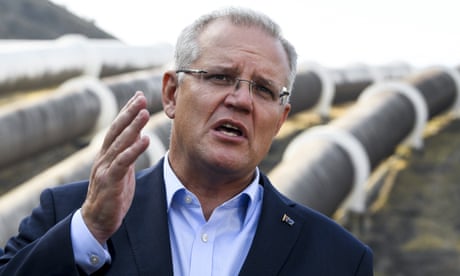
Kean believes Scott Morrison should
adopt the mid-century net zero target, and also commit to a more
ambitious medium-term emissions reduction target.
Courtesy
of the NSW commitment, and with other states contributing to the heavy
lifting on emissions reduction, Morrison would now be in a position to
unveil a 34% cut in national greenhouse gas emissions by 2030 based on existing pledges, rather than sticking to the current national 2030 target of a 26 to 28% cut.
There
has been sustained speculation that Morrison could update the 2030
pledge as well as committing to net zero, assuming the Nationals can be
persuaded. But the scenario considered more likely is Australia will
predict overachievement on the existing target rather than adjust the
current pledge.
The NSW environment and energy
minister said the coming transition should be viewed through the lens of
economic opportunity rather than cost. In electoral terms, he says the
threat in the Liberal party’s electoral heartland is real, with groups like Climate 200 promoting independent candidates.
“The
number one issue in my community is taking action on the environment
that also helps our economy, and that should be completely in line with
what conservatives, who are meant to be conserving things, should be
about: conserving our planet, handing it to the next generation better
than we found it, but also seizing the biggest economic opportunity that
we will ever see,” Kean said.
“I don’t want to see strong, good Liberal moderates thrown out and replaced with independents.”
“Strong
economically rational and socially progressive voices in the Liberal
party can bring about change for the better and that’s what we are doing
here in New South Wales”.
“I want those people
to stand up in the Liberal party and be counted and then they won’t
have an issue from independent voices looking to knock them off in a
general election”.
The
Morrison government is expected to unveil its commitments for Glasgow
by mid-October. Some Queensland Nationals have signalled they are
implacably opposed to net zero.
Federal
Liberals in metropolitan seats have called publicly for Morrison to
adopt the net zero commitment. A number of these MPs would also support a
higher medium term emissions reduction target.
Given
the opposition from some Nationals, government MPs say the federal
minister for energy and emissions reduction Angus Taylor has privately
floated the idea that the Coalition could adopt a plan to get to net
zero without signing up to the target. But many Liberals regard this
idea as completely suboptimal in a policy sense, and politically
untenable.
Sign up to receive the top stories from Guardian Australia every morning
Guardian Australia revealed earlier this week Morrison met on Tuesday with a deputation of Liberals
in a teleconference – including Dave Sharma, Fiona Martin, Trent
Zimmerman, Julian Leeser, John Alexander, Julian Simmons, Angie Bell,
Paul Scarr, Andrew Bragg, Tim Wilson, Katie Allen, Dean Smith, Jason
Falinski, Celia Hammond and Bridget Archer.
The
prime minister is understood to have told the group it remained his
preference to land a roadmap laying out the required technology, actions
to get to net zero emissions by mid-century and the 2050 target.
Morrison also acknowledged that climate change was now a vote-changing
issue in the Liberal party heartland.
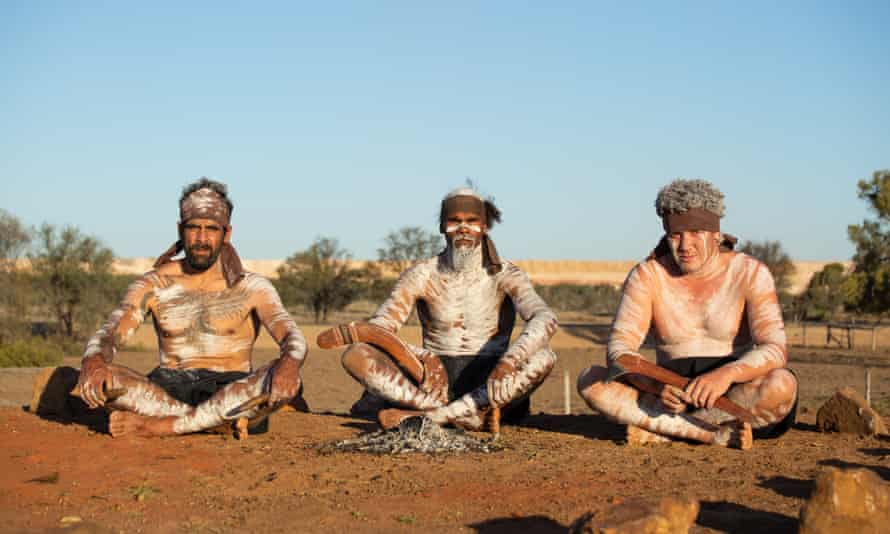
Miner says group is ‘trespassing’ but police have acknowledged their cultural rights under human rights act.
Wangan
and Jagalingou man Coedie McAvoy says acceptance by police of right to
practise culture ‘is a great feeling for us … This has been a long time
coming.’
Queensland
police have told a group of First Nations people occupying the site of
Adani’s Carmichael coalmine for the past five weeks that they have no
intention of removing them from the area “at this time”.
The
group of Wangan and Jagalingou traditional owners opposed to the
coalmine project began an ongoing cultural ceremony within the boundary
of Adani’s mining lease in late August.
Adani says the group are “anti-fossil fuel activists” who are “trespassing under the guise of traditional activity”.
Police
say in a statement their investigations and negotiations are “ongoing”.
But officers at the mine site have told the group of traditional owners
that they recognise their cultural rights to conduct ceremony, under
provisions of the 2019 Queensland Human Rights Act.
“We
understand that your connection to culture is disappearing and you
don’t want to lose that,” a police officer says in an audio recording
shared with Guardian Australia.
“At the moment
you guys are here and you’re practising culture, and part of that under
the Human Rights Act is for that to be practised and shared.
“We
have no intention at this time is to come in [and remove you], our
intention is to support you through that [and] mediate the two groups.
“Initially
we were here [because Adani] were making a complaint against you guys
being here, at this time that is not the case. Please note we are not
the enforcers here. If they want to do something they’ve got their legal
avenues they need to take.”
In a formal statement, police said they were still investigating Adani’s complaint.
“A
police command team, including police negotiators and police liaison
officers have been in negotiations with all stakeholders involved,” the
statement said.
“This includes people at the
camp, mining employees and executives from government departments with a
view to obtain a peaceful and non-disruptive resolution into the
future.”
Earlier this year, the Queensland police service issued a “statement of regret”
to W&J man Adrian Burragubba, who complained to the Queensland
Human Rights Commission about his removal from a pastoral lease area
near the mine site.
It’s phenomenal that they actually understand the rights that we are asserting
Coedie
McAvoy, a Wangan and Jagalingou man and the son of Burragubba, said the
group was “practising our culture and performing traditional ceremony
on our home lands, the place of our ancestors”.
“The
police came in with the understanding that we are practising our human
rights. They accepted that we have human rights pursuant to section 28
of the Queensland Human Rights Act and they quoted that section knowing
that we are asserting that right. It’s phenomenal that they actually
understand the rights that we are asserting.
“This has been a long time coming in the history of my family, going back to the separation and removal from country.
“For
[police] to come back now as representatives of the Queensland
government, and accept that we are asserting our right to practise our
culture is a great feeling for us.”
“We are the
first Aboriginal people to use the Human Rights Act to defend our
cultural rights and we are going to keep doing it.”
“While
in this case [Adani] was ultimately given exclusive possession to the
land and granted approvals for its mine, the inability to maintain
social licence to operate with some members of the local Indigenous
community adds another layer of risk to a project that was already
facing challenges in maintaining social licence to operate with the
broader community because of environment concerns,” the Moodys report
said.
“This may also add further complexity to a
project where some participants from the investment community have
signalled an unwillingness to provide funding.”
Adani said the group at the mine site were “anti-fossil fuel activists” who were unlawfully trespassing.
“The complaints are now with Queensland Police Service to appropriately deal with,” the miner said.
“We
are supportive of our traditional owners undertaking cultural practices
and ceremonies on their traditional lands and as a responsible
landholder we will continue to ensure that when people do wish to access
our land properties, they are able to do so in a planned, safe, and
respectful manner
“However, we won’t tolerate
criminal activity on our mining lease, nor anti-fossil fuel activist
group Frontline Action on Coal cloaking their anti-coal protest camp and
trespassing under the guise of traditional activity.”
Katharine Murphy speaks to New South Wales energy minister Matt Kean about the state’s plan to cut emissions in half by 2030 – a move that has added pressure on the Morrison government to act on climate change
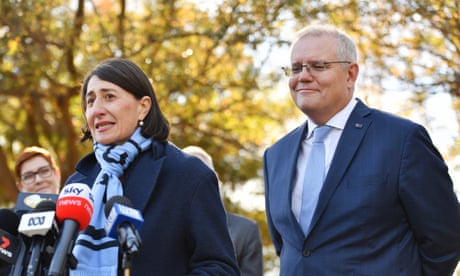
Gladys Berejiklian, the woman touted last year as the one who had "saved Australia", could not save herself this week.(AAP: Mick Tsikas, ABC News: Chris Gillette)
Help keep family & friends informed by sharing this article
Just
24 hours earlier, the Financial Review's annual power list had been
trumpeting the fact that, for the first time in the 21-year history of
the list, the Prime Minister was not perceived as the nation's most
powerful person.
Instead, it was four premiers
— Gladys Berejiklian, Daniel Andrews, Annastacia Palaszczuk and Mark
McGowan — who were regarded as the ones running our lives.
But
by lunchtime of publication day, Berejiklian — so often held up as the
Gold Standard of pandemic management by Scott Morrison — was gone.
The woman touted as the one who had "saved Australia" in last year's power list could not save herself.
Having survived the maelstrom
of a COVID outbreak in her state that had seen its citizens locked down
for four months, but finally seeing case numbers falling and vaccination
rates rocketing, the NSW Premier was undone by a system designed to
uphold standards of public integrity: a system which her federal
counterparts will neither countenance, and in a depressingly increasing
number of cases, would be lucky to survive.
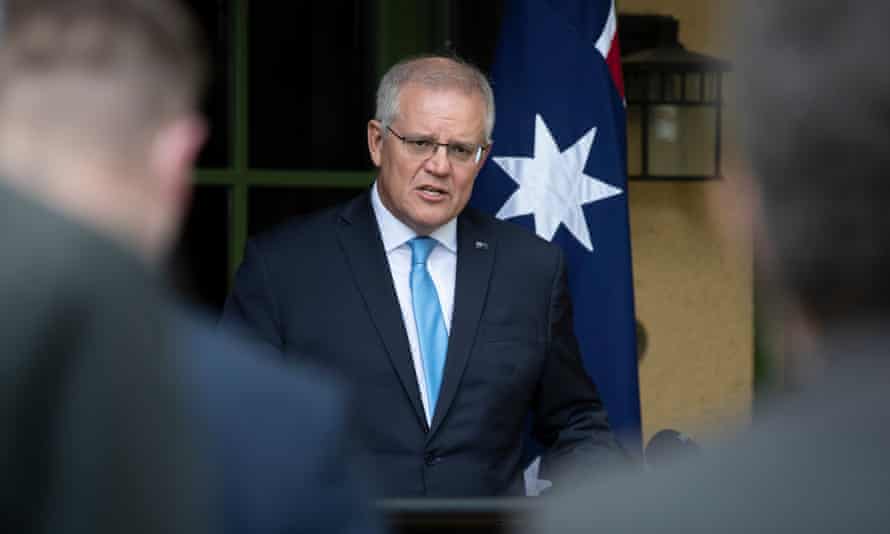
The Prime Minister literally raced out ahead of her announcement to make sure everyone got to hear a few of his own.
The
PM brought forward a press conference to announce a reshuffle of his
ministry, and the opening of international borders from next month, to
ensure his news would at least get out there before being swamped by
events in Sydney.
Despite having done so, he said
he couldn't take questions about Berejiklian's resignation because: "I'm
not aware of the circumstances or ... what the Premier has said, so I'm
at a disadvantage to be able to respond to that question."
Scott Morrison's very own political quarantine system.
Scott Morrison pays tribute to Gladys Berejiklian as NSW Premier resigns
Morrison is doing a lot of racing
He raced through the announcements like a man with a plane to catch.
Angus
Taylor — who has been the subject of questions about his own
ministerial standards on a number of occasions — has been given
Christian Porter's old job, in addition to the energy and emissions
reduction ones he already holds, after Porter was forced to stand down
because he couldn't or wouldn't say where up to $1 million in legal
funding had come from.
Most of the other promotions
were forgettable, other than for the reasons the PM gave for giving
them. Victorian MP Tim Wilson, for example, was being rewarded because
"before the last election, there was no one more passionate in
advocating the case when it came to the retirees tax". That would be a
political campaign against Labor's proposed changes to the dividend
imputation system.
And there was the opening of international borders by November to announce, too.
Scott
Morrison is doing a lot of racing at the moment. Racing to beat
Berejiklian in the news cycle, racing to get states to lift lockdowns,
racing to get international borders open. "It's time to give Australians
their lives back," he said repeatedly on Friday.
This
is the dynamic that increasingly seems to be running the government.
This week the NSW Liberal Party moved to bring forward its federal
preselections. The premiers note a certain zeal in their dealings with
the PM in National Cabinet meetings in the way he presses them to open
things up, irrespective of case numbers.
The
Queensland Premier noted rather testily on Friday that National Cabinet
had not received any briefing papers on the plans to open international
borders, even though the story had already been widely briefed to the
media.
And the government announced this week that
it would be ending emergency payments in the three jurisdictions where
they are being paid — NSW, Victoria and the ACT — as soon as they reach
80 per cent vaccination rates.
Youtube The Brief, September: Going Nuclear
Who's running the country?
The
argument is that such payments can't go on forever. Fair enough, too.
Except this creates enormous uncertainty for almost 2 million people
currently receiving these payments.
According to
data compiled by Anti-Poverty Week, there are currently 1.906 million
people receiving disaster payments or boosted welfare payments, and
1,050,000 of them are in NSW.
The plan is that
those payments will start to be wound back one week after the 80 per
cent vaccination rate is achieved. The payments go from $750 a week to
$450. The only problem is that very few people would presume that, at an
80 per cent figure, businesses just immediately open up again and
re-employ at their old hours.
It's likely to be a
bit messier than that. But putting such harsh conditions on ending the
payments is designed to pressure the states to lift lockdowns as quickly
as possible. More racing.
Simon Birmingham says workers will need to rely on other government support when the payments end.
The
process of suddenly re-opening international borders is also unlikely
to be completely smooth. Getting planes and systems up and running will
take time.
But the Prime Minister is relying on all
these things happening smoothly enough so that people will feel like
they are getting their lives back. It will all add to the impression
that it is the Prime Minister once again running the country, not the
premiers.
That would put him in a good place to go
to an election, and it is hard to get past the impression that all this
racing — all the decisions — are now being driven as a race towards
polling day.
The risks for the government — but
more importantly, the risks for the country — are that all that racing
is going to leave us vulnerable on a number of fronts, notably the
federal government's abysmal record at running almost anything through
this pandemic.
It leaves people who have lost jobs
through no fault of their own vulnerable to losing financial support. It
leaves the health and hospital system vulnerable to surging cases.
The PM is in such a hurry that he doesn't even think he has time to go to the Glasgow climate change talks.(AAP: Lukas Coch)
NSW remains critical to the government
Queensland
Health Minister Yvette D'Ath revealed on Friday that: "Every single
Health Minister from every state and territory has signed a letter to
the Commonwealth Health Minister, Greg Hunt, and said, 'We need extra
funding, we need 50-50 shared funding.'"
"We've had a funding guarantee under COVID until June 30," D'Ath said. "That has now stopped. That needs to be reinstated."
It will be difficult to be listened to when everyone is in such a hurry.
NSW
remains critical to the federal government's political fortunes. So it
is unfortunate that, as columnist Niki Savva reported a few weeks ago,
the PM called NSW Treasurer and premier-apparent Dominic Perrottet a
"f***wit" in a heated phone call about Perrottet's repeated calls for
JobKeeper to be reinstated.
The Prime Minister is
in such a hurry — and so busy dealing with COVID — that he doesn't even
think he has time to go to the Glasgow climate change talks.
Morrison's
message of hope resonates with swinging voters. Focus group
discussions reveal vaccine hesitancy and fear of serious disease have
fallen, and there is an overall optimism about the economy.
Voters
remain sullen about the Prime Minister's management of the vaccine
rollout and quarantine, but feel we have reached a stage where the
country is looking to come out of the worst of things.
And
in all of this, Labor is disappearing: its message that Scott Morrison
only had two jobs to do is fast becoming irrelevant, and it has
sidelined itself from the national security debate.
One politician has fallen this week. Another has a glimmer in his eye.
Laura Tingle is 7.30's chief political correspondent.
But
even if Scott Morrison lands net zero he would rather market his
climate pivot at home rather than abroad – there’s an election to
prepare for.
Scott Morrison announcing his cabinet reshuffle on Friday. The Coalition government is trailing Labor in the polls.
Last modified on Sat 2 Oct 2021 06.01 AEST
Shuffling the ministerial decks
is always complicated for prime ministers because noses get put out of
joint and orderly habits are disrupted. As Scott Morrison winged his way
back from Washington last weekend, the word was the PM would keep his reshuffle surgical.
Morrison obviously had to deal with the hole created by the departure of Christian Porter
(who was shifted out of attorney general into the industry portfolio
when his position became untenable, and then departed industry after he
couldn’t disclose who donated to a trust fund to help pay his legal fees
for a defamation case).
Fixing
the industry bit of the post-Porter equation was easy: get Angus to do
it. “Angus” being Angus Taylor, the minister for energy and emissions
reduction. Industry could sit comfortably enough with his other
portfolios.
Last weekend, the word was science and technology would be hived off from industry and given to Ben Morton.
Morton
is a Morrison protege – the prime minister’s eyes and ears around the
government. “The apprentice” (Morrison’s label for Morton) is also a
sandgroper, like Porter.
But
as the week went on, the speculation shifted. Science wasn’t
necessarily a good fit for Morton, who would need to go on being
Morrison’s eyes and ears around the government.
Science
went to another Western Australian, Melissa Price, and Morton was
anointed special minister of state. Special ministers of state are
fixers, particularly when elections are in sight. As well as boosting
Morton, Morrison also elevated another of his very close allies, Alex
Hawke, to the cabinet.
Friday’s reshuffle – shoved out the door at warp speed in the mildly surreal minutes before Gladys Berejiklian resigned as New South Wales premier
– carried the distinct sound of circling the wagons, which isn’t
necessarily what you’d expect, unless you are paying close attention.
Right now, Morrison is trying to land new climate commitments
ahead of the Cop26 in Glasgow. While senior people insist Morrison’s
net zero plane is going to land, on a runway, with zero casualties,
either in the second or third week of October, climate policy can be
lethal territory for Australian prime ministers, and not just prime
ministers called Malcolm Turnbull (as Kevin Rudd and Julia Gillard can
attest).
Morrison’s current trouble seems to be confined to a handful of Queensland Nationals
as opposed to the entire right faction of the Liberal party, which was
Turnbull’s cross to bear during rounds one and two of his internal
climate wars.
Thus far, the right has been
quiet. People say the majority view is grudging acceptance because of
the shifting politics – although some conservatives report a growing
backlash bubbling up from the base about a net zero commitment.
Morrison referenced the shifting politics when he met a deputation of mainly moderate Liberals earlier this week.
This group of MPs was given some face time with Morrison after they
asked to see him. The objective was to send a clear message: the group
wanted a commitment to the net zero target. They did not want a handful
of Queensland Nationals writing the government’s climate change policy.
At
one point during the meeting, Morrison told the group he understood
climate action was now a vote-changing issue, and not only in the seats
of the people arrayed before him on the video call. To decode this
observation, we need to understand the electoral dynamics of 2019.
Climate change was certainly a headache for Liberals in a handful of
safe city seats where the margins were sufficient to protect incumbents
from incursions by independents. But the government’s unconscionable
policy record wasn’t a problem for the Coalition electorally across the
board.
Sign up to receive the top stories from Guardian Australia every morning
Morrison
evidently thinks things have shifted (and this is a prime minister who
researches propositions intensively). If the centre of political gravity
has shifted in favour of climate action in parts of the country where
the Liberals need to hold or win seats, then the Liberal party will need
to act, or (more pertinently) at least look like it’s acting.
If
that’s the electoral reality, political hard heads in the right faction
of the Liberal party can hold their noses about net zero if they
believe greenwashing ahead of Glasgow is what’s required to keep Labor
out of power.
But for some hardcore
conservatives, Morrison revisiting the Coalition’s climate crime scene
will be a provocation. It will be yet more proof of his obnoxious
dictatorial pragmatism. It is not clear yet whether or not conservative
feet will be stamped or rhetorical punches thrown. Perhaps they won’t,
because there are always consequences for picking fights. But wise prime
ministers prepare for all contingencies.
So there’s climate to land. There’s also an election to prepare for.
Morrison
is as focused on the latter as he is on the former. One current litmus
test of this is Glasgow, and whether or not the prime minister is
prepared to front the Cop26 conference. Perhaps Morrison will attend.
But the vibe the prime minister is sending at the moment is he’s
unlikely to go, even to front his own climate pivot.
The
reason for Morrison’s reluctance is obvious. Jet setting in the age of
Covid requires periods in quarantine that are unhelpful for domestic
visibility. Assuming the prime minister can land his net zero deal with
Barnaby Joyce, Morrison would rather market his climate pivot at home
rather than abroad.
Given
the federal election will be under way some time over the next six
months, Morrison’s prime ministership is absolutely on the clock. Polls
have Labor in front. Perhaps the surveys are all wrong. They were in
2019 – largely because polls in the modern era can be surveys of the
politically engaged rather than disengaged voters who swing elections.
But if the polls are correct, the government has to make up ground.
New South Wales is an important state for Morrison, and the premier has just walked
after the state’s anti-corruption watchdog revealed it was
investigating whether she broke the law by failing to report the conduct
of her ex-lover, the former Wagga Wagga MP Daryl Maguire.
That
means Australia’s largest state is about to change leaders just as we
transit from pandemic to endemic – with all the risks and unknowns that
entails. All the states are seeking increased funding for their
hospitals to manage the coming surge. The unknowns of this transition
would be another reason not to be in Glasgow.
Morrison
evidently judges that Australians in the lockdown states are ready for
freedom, even if freedom necessitates an increase in personal risk. The
prime minister wants to validate that sentiment. Friday was supposed to
be dominated by news that international travel would resume in November, but the hijinks in NSW swallowed that bauble whole.
To
state the obvious: a lot of what’s going to happen over the next few
months is out of the prime minister’s control. You might have a message
plan, but events have a nasty habit of overtaking it.
While we are on statements of the obvious, here’s another one: Peter Dutton is very quiet, and Josh Frydenberg is very visible.
I
have absolutely no reason to think there is any trouble brewing. But
looping back to where we started, with Friday, and that reshuffle – if I
were Morrison, dealing with all these moving parts, I’d want my friends
close too.
Australia is one of the world's biggest per-capita greenhouse gas emitters, and a Climate Question listener wants to know why the world isn't demanding her country do more.
Jodie lives in tropical Queensland, which she says is 'paradise', but it's also a place affected by bushfires, drought, and cyclones.
Prime Minister Scott Morrison says 'Australia can always be relied upon' to deliver action on climate change, but critics at home and abroad point to a record of over-promising and under-delivering.
Observers also blame the country's powerful and profitable fossil fuel industries as a reason why the Australian government has been slow to make progress.
But is it time, as listener Jodie asks, to give her country a 'a kick up the bum'?
Contributors:
Dr Niklas Hohne, The New Climate Institute, Cologne
Greg Bourne, The Climate Council Australia
Presenters - Neal Razzell and Graihagh Jackson
Reporter - Issy Phillips, FBi Radio, Sydney
Producer – Jordan Dunbar
Editor – Emma Rippon