Contemporary politics,local and international current affairs, science, music and extracts from the Queensland Newspaper "THE WORKER" documenting the proud history of the Labour Movement.
MAHATMA GANDHI ~ Truth never damages a cause that is just.
Welcome to Episode 4 of the Spring Series of Good Will Hunters, which asks, Can Australia be a Sustainability Superpower?
WWF is proud to be collaborating with Good Will Hunters on this
series, in the lead up to COP26, the UN Climate Change Conference in
Glasgow from 31 October to 12 November. The sustainability of our
ecosystems, energy networks, food systems and the cities we live in has
never been more important. You can join the conversation via
@goodwillpod or #RegenerateAustralia.
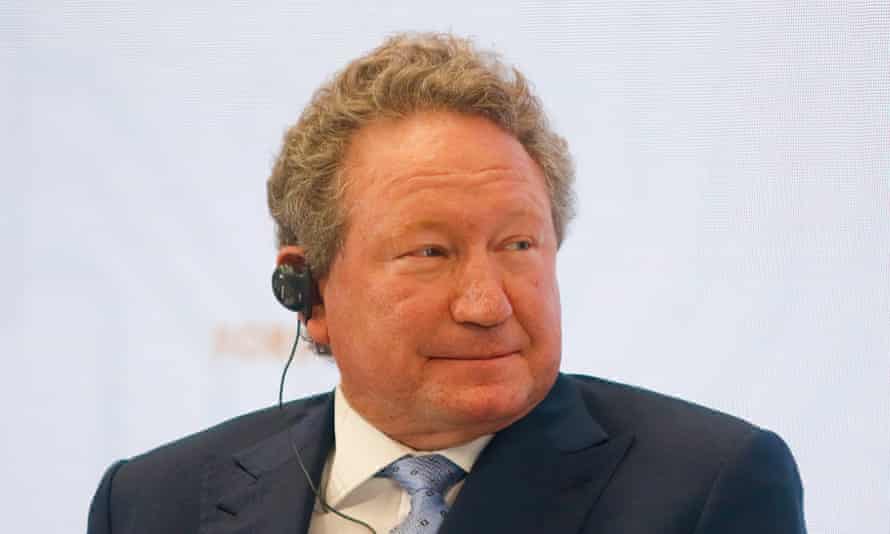
In our fourth episode of the series, we speak to Dr Andrew “Twiggy”
Forrest, Chair and Founder of Fortescue Metals Group and Fortescue
Future Industries (FFI), Minderoo Foundation, and Tattarang. You’ll hear
us talk about how Fortescue has gone in front of Government policy, to
invest in world-leading technological innovations in renewable energy.
As Andrew says in the interview, renewable energy isn’t about throwing
money at something which you’ll never see a return. It’s about creating a
sustainable industry, and a large part of that responsibility falls on
the shoulders of the world’s largest energy companies.
We hope you enjoy the episode. Join the conversation via @GoodWillPod and #RegenerateAustralia.
Fortescue Metals Group boss Andrew Forrest
has criticised “failed” carbon capture and storage technology and said
the general population is entitled to feel sceptical about its use.
As the Morrison government moves to award carbon credits to
fossil fuel projects that promise to capture and store carbon dioxide,
the mining billionaire has told a podcast such projects had failed “19
out of 20 times”.
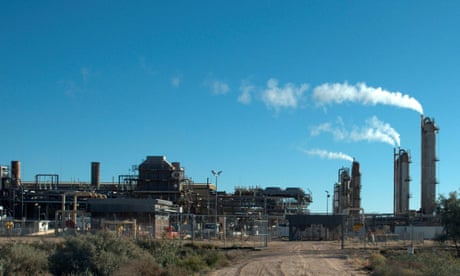
Speaking to the Good Will Hunters podcast, Forrest pointed to his home state of Western Australia, where Chevron’s CCS facility
at its Gorgon liquefied natural gas development failed to meet a
requirement to capture and bury at least 80% of the project’s emissions
during its first five years.
The federal government has looked to carbon capture and storage (CCS) technology as a means to promote both the expansion of the gas industry and hydrogen production from fossil fuels.
Last week, the energy and emissions reduction minister Angus Taylor
announced the government had committed $250m to help design CCS hubs
and support research and commercialisation of CCS technology, including
identifying viable geological storage sites.
“You
know, in my own home state of Western Australia, we have some of the
biggest gas developments in the world who’ve been granted permission to
develop on carbon sequestration,” Forrest told the podcast.
“And it failed. And that’s quite normal around the world.
“So
to suddenly say, well, carbon sequestration, we’re going to wave a
wand, it’s going to work reliably. Well, you know that, actually – if
you’re a realist – is a bridge way too far.
“It’s good in a soundbite, but it doesn’t work in reality.”
Dermot
O’Gorman of WWF Australia, who also appeared on the podcast, said CCS
had been used as a delaying tactic for more than a decade, with billions
going into a technology that, to date, had failed.
“Going
into Climate Cop26, the world needs to be doubling down on renewable
hydrogen, which will in the future only become cheaper, whereas fossil
hydrogen will undoubtedly get more expensive,” he said.
Forrest and the former prime minister Malcolm Turnbull launched
a new organisation last month – the Green Hydrogen Organisation – which
will advocate for Australia’s hydrogen industry to focus solely on
green hydrogen produced from renewable sources.
Forrest
is exploring green hydrogen through Fortescue Metals’ green arm
Fortescue Future Industries, which is chaired by Turnbull.
Both
men will fly to Glasgow for the global Cop26 climate talks in November,
where countries will be expected to increase their ambition to make
deep emissions cuts by 2030.
Forrest told the
podcast it was a “cop out” for heavy emitting companies to put in place
net zero targets for 2040 or 2050 in the absence of short-term pledges
to greatly reduce carbon emissions.
He
said such targets might be suitable for governments but for heavily
polluting industries long-term pledges were “really pretty meaningless”.
“All of us need to pick up the challenge right now,” he said.
He
also told the podcast that the use of carbon offsets to hit emissions
targets was not going to be enough to meet the global climate challenge
to keep the average temperature increase below 2C.
Forrest
said Fortescue would rely on carbon offsetting in the short term to
meet its own targets “because we simply haven’t put the multi-billion
dollar investment into place yet”.
Once that occurred he said the company would not use them at all.
“We’re not an advocate of offsets,” he said.
“If
you’ve got absolutely nothing else, then certainly look at them, but
make sure they’re very sincere because they can be unreliable, and there
are scams in the offset industry.”
The energy and emissions reduction minister, Angus Taylor, declined to respond to Forrest’s comments.
In
statements about CCS last week, Taylor said it was an important
component of the government’s technology-led approach to reducing
emissions.
“Analysis by the International
Energy Agency shows that half the global reductions required to achieve
net-zero will come from technologies that are not yet ready for
commercial deployment,” he said.
“That’s why
we’re partnering with industry to accelerate new projects and unlock the
emissions and economic benefits of carbon capture technology.
“The
IEA and IPCC (Intergovernmental Panel on Climate Change) both regard
carbon capture technologies as essential to achieve the goals of the
Paris Agreement.”
Retired
admiral says alternatives needed to deal with extreme weather events so
defence force can be ready for security emergencies.
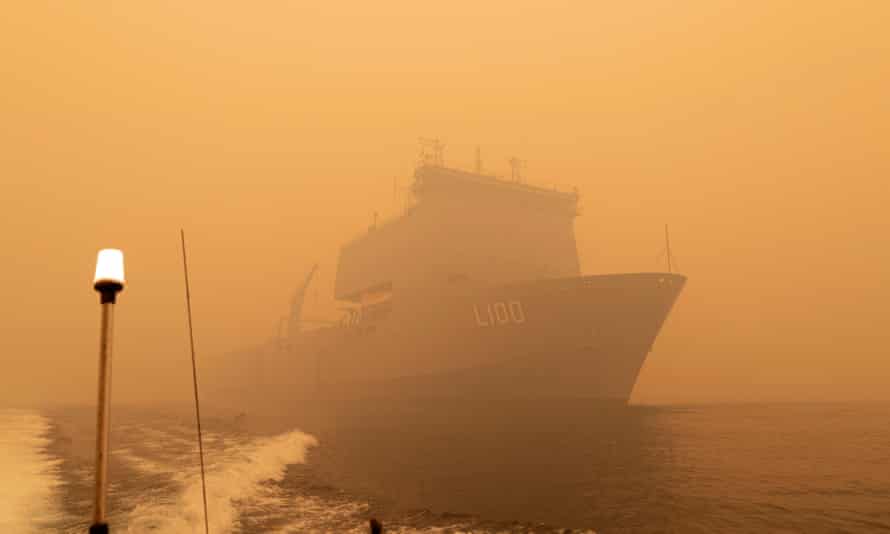
HMAS
Choules, used to evacuate the town of Mallacoota during the black
summer bushfires. Former ADF chief Chris Barrie says defence force
shouldn’t be used to clean up after extreme weather events.
Daniel Hurst Foreign affairs and defence correspondent
Australia’s
military will be less ready to confront other security crises if troops
are increasingly required to respond to climate-related disasters, a
former chief of the Australian defence force has warned.
Retired
Admiral Chris Barrie made the comments in an interview with Guardian
Australia as he called on the Australian government to pledge at the Glasgow climate conference to cut emissions by more than 50% by 2030, declaring: “We need to all pull together.”
“It
is no longer sufficient to say, ‘it doesn’t matter what we do, the
defence force will be there to pick up the mess or sweep up the mess
afterwards’,” Barrie said.
Barrie, now an executive member of the Australian Security Leaders Climate Group, said Scott Morrison
had written to assure it that the government would release a plan
before November’s UN summit – but “we haven’t seen enough to be
convinced that the government is doing anything serious” about the
climate crisis.
The ADF did not recruit people
to fight bushfires and sweep up after floods, Barrie said, but was
increasingly relied on for such purposes because it was a workforce the
government controlled.
“The defence force that
we can afford to have will never be big enough to deal with concurrent
events and extreme weather events like the black summer bushfires,” said
Barrie, who was chief of the ADF from 1998 to 2002.
“And
that’s why we need to think carefully about how we are going to head
off the likelihood that these things might happen, and then be prepared
to deal with them – but not using ADF people. They’re the most expensive
people you can buy to do this kind of work.”
Asked if the climate crisis would leave the ADF less prepared to respond to broader strategic challenges, such as China’s military activities in the region,
Barrie replied: “Let’s say we are headed to 3C [of warming] and we’re
finding our ADF is out there doing those kinds of work. If there’s a
defence emergency and they all bugger off, where are we left?”
The
Australian government’s defence strategic update, published last year,
warned of rising tensions between China and the US and said
high-intensity conflict in the Indo-Pacific was “less remote than in the
past”.
The document included only a passing
reference to climate change, saying threats to human security “will be
compounded by population growth, urbanisation and extreme weather events
in which climate change plays a part”.
Barrie
said he believed the foreign minister, Marise Payne, and the defence
minister, Peter Dutton, were “led by their US counterparts” to include
extensive comments about climate change in a joint statement issued
after the annual Ausmin talks in Washington DC last month.
The
statement also stressed the 2020s as a “critical decade”, recognised
“that the impacts of climate change at 1.5°C are much lower than at
2°C”, and acknowledged “the global security threat posed by climate
change”. The US Department of Defense will now share its defence-related
climate assessment tool with Australia.
Barrie
said that development “reinforces the view that the other players
around the globe are concerned about Australia’s position and they’re
doing their best to try and get Australia to do more before Glasgow”.
While domestic political debate in Australia has largely focused on Morrison’s struggle to win support from the Nationals to firmly commit to net zero emissions by 2050, Barrie noted the need for deeper cuts this decade.
Barrie
believes that should include strengthening Australia’s Tony Abbott-era
pledge to reduce emissions by 26% to 28% by 2030 compared with 2005
levels.
The Australian Security Leaders Climate Group argues
Australia needs to mobilise “all the resources necessary to reach zero
emissions as fast as possible”, and Barrie said he believed the 2030
target should be more than 50%.
The comments come after a senior US climate official, Jonathan Pershing, said in August Australia should be considering a 50% cut by 2030, given the urgency of the threat posed by global heating.
Barrie said the Australian government should look at the climate crisis in a similar way as the Covid-19 pandemic.
“What
Covid is telling us is that everybody has to pull in the same
direction, that it’s not good enough for half the people to be
vaccinated and for half of the people not to be vaccinated,” Barrie
said.
“It’s not good enough for people to say,
‘it doesn’t actually matter what I do, I’ll do what I damn well like,
but everybody else better behave themselves’. Because we are all on the
planet together – we’re all on earth together. And on climate change and
on dealing with the pandemic, we need to all pull together.”
Morrison signalled to a group of metropolitan Liberals
during a private briefing last week that he wanted to reach an
agreement before Glasgow on both a policy roadmap and a 2050 net zero
target, although some in the Nationals remain opposed.
Facebook whistleblower Frances Haugen leaked documents about the company and has now spoken publicly.(Supplied: 60 Minutes)
Help keep family & friends informed by sharing this article
A
data scientist who worked with Facebook has accused the social media
company of choosing profit over reducing the platform's potential to
spread misinformation and foster radicalisation.
Key points:
A former manager at Facebook says the company must focus more on curbing misinformation
She says the company's behaviour fed the January 6 Capitol riot in the US
Facebook has rejected the allegations, saying it does more than a reasonable person would expect to protect users
In
an interview with the US version of 60 Minutes, Frances Haugen revealed
herself as the person who anonymously filed complaints with US law
enforcement officials, alleging the company's own research showed how it
magnified hate and misinformation.
Ms Haugen, who
worked at Google and Pinterest before joining Facebook in 2019, said she
had asked to work in an area of the company that fought misinformation
because she had lost a friend to online conspiracy theories.
Ms
Haugen, who will testify before US Congress this week, said she hoped
her activism would make the government more strictly regulate
Facebook's activities.
She said Facebook
prematurely turned off safeguards designed to thwart misinformation and
rabble rousing after Joe Biden defeated Donald Trump in last year's US
presidential election, alleging the company's decision contributed to
the deadly January 6 invasion of the US Capitol.
After
the election, the company dissolved a unit on civic integrity where she
had been working, which Ms Haugen said was the moment she realised "I
don't trust that they're willing to actually invest what needs to be
invested to keep Facebook from being dangerous".
Ms Haugen said Facebook's choices contributed to the US Capitol riot.(AP: Manuel Balce Ceneta)
Ms Haugen said a 2018 change to Facebook's content flow favoured hateful content.
She
said despite the enmity that the new algorithms were feeding, Facebook
found they helped keep people coming back — a pattern that helped the
social media giant sell more of the digital ads that generate most of
its advertising.
Facebook's annual revenue has more
than doubled from $US56 billion ($77 billion) in 2018 to a projected
$US119 billion this year, based on the estimates of analysts surveyed by
financial data company FactSet.
Facebook hits back at claims
Even
before the full interview was released in the US, a top Facebook
executive had derided the Ms Haugen allegations as "misleading".
"Social
media has had a big impact on society in recent years, and Facebook is
often a place where much of this debate plays out," Nick Clegg, the
company's vice-president of policy and public affairs, wrote to Facebook
employees in a memo sent on Friday.
Facebook vice-president Nick Clegg has rejected Ms Haugen's allegations.(Facebook Brussels)
"But
what evidence there is simply does not support the idea that Facebook,
or social media more generally, is the primary cause of polarization."
The
60 Minutes interview intensifies the spotlight already glaring on
Facebook as politicians and regulators around the world scrutinise the
social networking's immense power to shape opinions and its polarising
effects on society.
The backlash has been
intensifying since mid-September, when The Wall Street Journal published
an exposé based on leaks from Ms Haugen that revealed Facebook's
internal research.
It concluded the social
network's attention-seeking algorithms had helped foster political
dissent and contributed to mental health and emotional problems among
teenagers, especially girls.
Ms Haugen alleged Facebook rushed to switch of misinformation safeguards after the US election.(AP: Jose Luis Magana)
Although
Facebook said the newspaper had cherrypicked the most damaging
information in the internal documents to cast the company in the worst
possible light, the revelations prompted an indefinite delay in the
rollout of a children's version of Instagram.
Mr Clegg appeared on US network CNN on Sunday in another pre-emptive attempt to soften the blow of Ms Haugen's interview.
"Even
with the most sophisticated technology, which I believe we deploy, even
with the tens of thousands of people that we employ to try and maintain
safety and integrity on our platform … we're never going to be
absolutely on top of this 100 per cent of the time," he said.
Rioters, fuelled by misinformation that Donald Trump won the US election, stormed the US Capitol in January.(AP: Jose Luis Magana)
He
said that was because of the "instantaneous and spontaneous form of
communication" on Facebook, adding: "I think we do more than any
reasonable person can expect to."
Ms Haugen, 37, is
from Iowa and has a degree in computer engineering and a master's
degree in business from Harvard University — the same school Facebook
founder and leader Mark Zuckerberg attended.
She
has filed at least eight complaints with US securities regulators
alleging Facebook has violated the law by withholding information about
the risks posed by its social network, according to 60 Minutes.
Facebook in turn could take legal action against her if it claims she stole confidential information from the company.
"No-one at Facebook is malevolent," Ms Haugen said during the interview.
"But the incentives are misaligned.
"Facebook
makes more money when you consume more content. People enjoy engaging
with things that elicit an emotional reaction. And the more anger that
they get exposed to, the more they interact and the more they consume."
Neville and Linda Hicks have turned their home into a virtual power plant as part of a trial.(ABC News)
Help keep family & friends informed by sharing this article
As
Glasgow looms over the federal government's climate change goals, new
research could help both the major parties embrace more aggressive
emissions reduction targets bysaving up to $6,000 a year on voters' household energy costs.
Key points:
The Rewiring Australia project is encouraging households to switch from gas to solar-powered electricity
Dr Saul Griffith says consumers would reduce their emissions and save thousands of dollars each year
The household sector "is the easiest sector to decarbonise", Dr Griffith says
American-Australian
engineer Dr Saul Griffith mapped the American energy system for the US
Department of Energy. He advocates for rapid, mass-scale household
electrification, through the organisation Rewiring America.
His new work focuses on "Rewiring Australia" and is co-authored by thinktank The Australia Institute.
Dr Griffith told 7.30 that the "politics of climate in Australia [are] poised to change".
"The
household is in the key position to drive that change because the
household is where the savings will be realised," he said.
Saul Griffith says households can save thousands of dollars by switching off gas and using solar-powered electricity. (Supplied: Saul Griffith)
"If
we electrify the two cars in the average household, we put oversized
solar on their rooftops, we electrify their water heaters, electrify the
kitchen and electrify any space heating in that household by 2030,
we'll be saving [them] $5,000–$6,000 per year.
"[The household sector is] the easiest sector to decarbonise. They're ready to go right away, we have the right technologies.
"And,
if we do that aggressively, this decade, we buy ourselves time to solve
the slightly harder-to-solve problems, which is steel, beef,
agriculture, aluminum, cement and our other harder-to-decarbonise
sectors," he said.
Around 42 per cent of
Australia's emissions are linked to fossil fuels across our 10 million
homes and, according to the Lowy Institute, 74 per cent of Australians
say '"the benefits of taking further action on climate change will
outweigh the costs".
'It has made a difference'
The Hickses say their electricity bills are lower since putting solar panels on their roof.(ABC News)
Linda
and Neville Hicks are retirees on the pension who have lived in their
public trust home for 27 years. Their home has recently been radically
modernised to be a "virtual power plant" (VPP) with solar panels and a
home battery.
"It has made a difference to us in
regards to our power. Our electricity bills are lower, which is a bonus
for us. And also we've got the battery, which if we have power cuts,
then obviously we won't be without power," Ms Hicks told 7.30.
Part of Dr Griffith's approach is electrifying all the household "machines" as a matter of urgency.
The Hickses say they would not have been able to afford solar panels and a battery without federal and state grants.(ABC News)
"If
you bought a natural gas water heater last year, it will have emissions
for another 15 years. If you bought a petrol car last year, it will
emit carbon dioxide for the 20 to 25 years that it lives for," Dr
Gritthis said.
The upfront costs for such an upgrade remain high.
However,
the Hicks' VPP came with no upfront costs, paid for by a combination of
state and federal grants — because they are participants in a Tesla VPP
trial, which also feeds power to the electricty grid.
"There was no way that we would ever be able to afford to put the system in," Ms Hicks said.
"And
there'd be so many pensioners out there that would benefit from this.
Especially families, low-income families, they would benefit from it
too."
Cars, home gas
Neville Hicks still drives a petrol car.(ABC News)
While the Hicks family is ahead of the curve, they could also be taking advantage of other emissions and energy cost savings.
The biggest outlay in energy costs, and source of emissions for the Hickses, is their two cars.
"If
you take a typical Australian vehicle, it's 15 to 20 cents per
kilometre to drive it if you're buying $1.50-a-litre petrol," Dr
Griffith said.
"If that same size, same shape car
is electric and you're running that off solar on your roof, that will
cost you about 1 cent per kilometre to drive."
The
other major source of domestic emissions reductions and cost-cutting is
gas cooking and gas heating, according to the research.
Dr Saul Griffith says households can reduce emissions by moving their
gas cooking and heating to solar-powered electrical appliances.(Flickr: Daniele Civello)
"There's
another technology, like the electric vehicle, that's a little bit
magical — it's called a heat pump. Australians know them as their split
systems," Dr Griffith said.
"That heat pump can
produce three or four units of heat for one unit of electricity in, so
it's enormously efficient, about four times more so than natural gas.
"I
think we calculated natural gas running a hot shower, a long,
eight-minute shower, might cost you about 80 cents. But if you're
running that with a heat pump off the solar on your roof, it'll cost you
about 10 cents."
Dr Griffith says the Hicks family could be proof of when policy, investment and technology align.
"The
Hickses have taken the first couple of steps with the battery and solar
that they've even been helped by the government to put on their roof,"
he said.
"And we need to go all the way with
families like that by doing the same thing — electrifying the vehicles
in their garage, in induction cooktops for their cooking, and
electrifying their heating systems.
Dr Saul Griffith hopes the "culture war against climate change" will soon be over.(ABC News: Jerry Rickard)
"They will very quickly start seeing those economic rewards."
It
is research that may show both the major parties a pathway for more
aggressive emissions reductions, through hip-pocket savings.
"We're
trying to solve the problem of the culture war against climate change
that's been going on for 20 or 30 years by showing that everyone can
win," Dr Griffith said.
"It's a positive future
that we're going towards and it's going to be savings for households,
it's going to be huge numbers of jobs created, and that we need to do it
with urgency to make those things come true."
It is logic that Mr Hicks, who claims to not fully "understand the technology", can understand.
"The
more that we can get from the sun, any solar from the sun, on our roof,
it's definitely going to help save everybody," Mr Hicks said.
Sayed Rizk sat still on his lounge, holding a mug between weak hands. His face was darkened and his tea untouched.
The 70-year-old had been awake since 3am that morning, unable to sleep through pain and discomfort.
When his wife, Najwa, woke to find him there, she called for her daughter.
“I told her, your dad is not OK. We need to take him to the hospital.”
After seven days of suffering Covid symptoms inside his home, Sayed’s family called for an ambulance.
Najwa
and Sayed Rizk lived together in their home in Sydney’s West Ryde with
their daughters Nicole and Souad. Last month, the family became sick
with Covid and their beloved patriarch became one of more than 330
people in New South Wales to die during the latest outbreak.
“He used to say he wasn’t scared. I’m not going to die from Covid, he’d say. It’s not going to happen to me. And it did.”
‘It does not compare to your normal flu’
The family first felt unwell on Sunday 8 August.
“The
symptoms were horrible, and hit us all at once,” says Nicole, 28. “We
stayed at home and dealt with them as best we could. But it does not
compare to your normal flu. This was the flu multiplied by one hundred.”
She recalls the sudden onset of head and body aches. “Imagine the aftermath of being hit by a train. That’s how intense it was.”
Like
her daughter, Najwa can’t forget the pain that hit her body. “At
nighttime, you can’t sleep because of the pain. And during the day, you
can never get comfortable.”
“You can’t do
anything,” Najwa says. “We were barely eating. We had no taste, no
smell, and a very, very heavy cough. I remember not being able to keep
my eyes open.”
On the fourth day of symptoms, still bedridden herself, Najwa watched her husband’s condition worsen.
“He
would try to get up from bed and fall,” she says. Weak on his legs,
Sayed called for Nicole, who tried to pull him up. “But she was weak
herself, and couldn’t do it.”
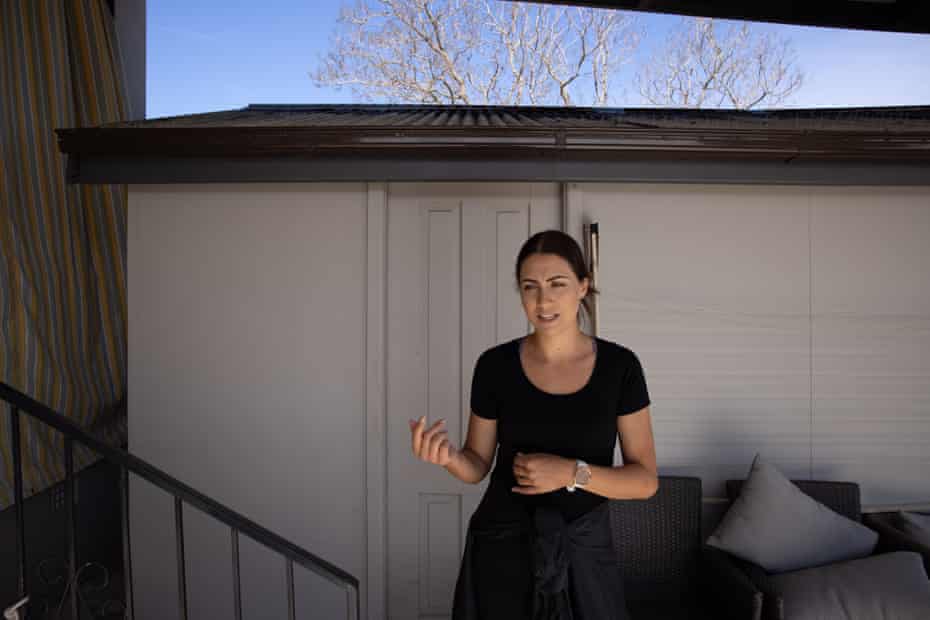
Nicole Rizk talking about the day her father died. Photograph: Carly Earl/The Guardian
The next day, in another attempt to shower, Sayed fell on the tiled floor.
Though unable to stand, Sayed kept assuring his family he was fine. But Najwa’s concern only grew.
The next night, a violent cough kept Sayed from sleeping, and Najwa woke to find him in the lounge room.
“He
had been up since 3am in the morning,” Najwa says. “He didn’t want to
wake us up. He was worried we were all too sick as well.”
Nicole says her father’s face had turned an off, dark colour. “We knew we couldn’t keep him at home,” she says.
On
15 August, seven days after their initial onset of symptoms, Sayed was
taken by ambulance to Ryde hospital in Sydney’s north-west.
‘We told him don’t panic, everything will be fine’
When
he arrived at Ryde hospital, Nicole says there were no beds available.
“He was left in a chair. After five hours, he was given a bed and the
drip.”
Sayed was also given an oxygen mask to assist with breathing, and was started on a number of medications.
“Doctors
would tell us he was stable, slightly improved, then slightly worse.
Stable, slightly improved, much worse. With Covid there is nothing
consistent. It was constant anxiety.”
When Sayed first entered hospital, Najwa and her family had hope for Sayed’s recovery. Photograph: Carly Earl/The Guardian
Eventually, the family were told Sayed’s breathing was not getting better.
“My
dad was still awake at this point,” Nicole says. “We called him. We
told him, don’t worry. Don’t panic and everything will be fine.”
Sayed was then sedated, intubated and transferred to Hornsby hospital.
When Sayed’s family contacted Ryde hospital to retrieve his personal items, they were told the belongings were lost.
Among
his clothes, wallet and mobile phone were a gold chain with a crucifix
and a thin gold bracelet. Her father had been wearing the bracelet and
chain “every day, for the last twenty years”.
“They are more than sentimental. It is the worst feeling to not have that with us at this time.”
Nicole
was sent an email by the hospital’s general manager three weeks later,
apologising for the missing belongings and expressing disappointment
that she was not informed sooner.
In a
statement, a Northern Sydney local health district spokesperson
reiterated that apology, saying they were sorry “for the additional
distress caused by the loss of the patient’s personal belongings while
he was under the care of Ryde hospital”.
The
spokesperson also confirmed an “extensive search for the missing items
was conducted by staff” and that the matter has been reported to NSW
police and an insurance claim lodged.
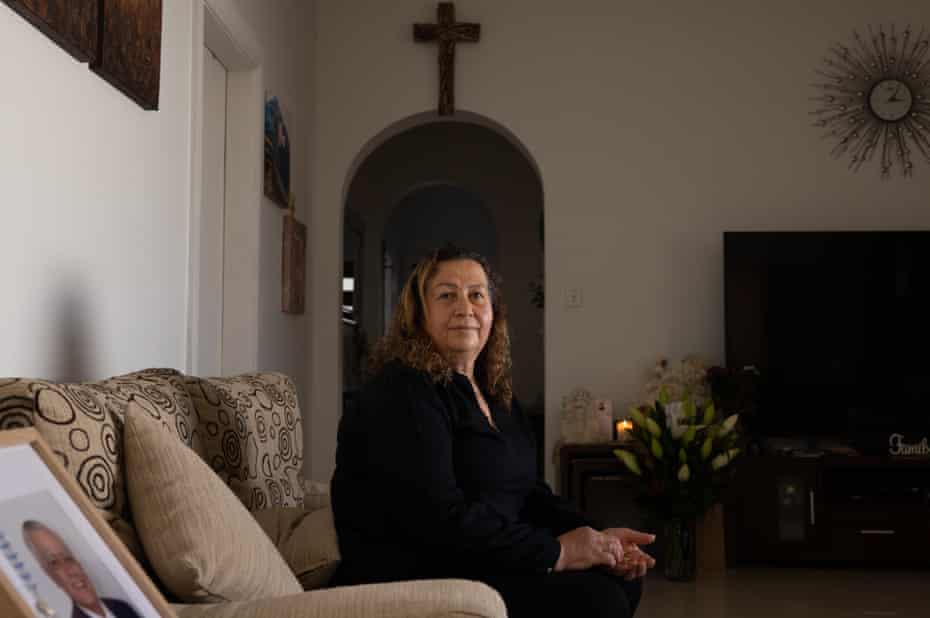
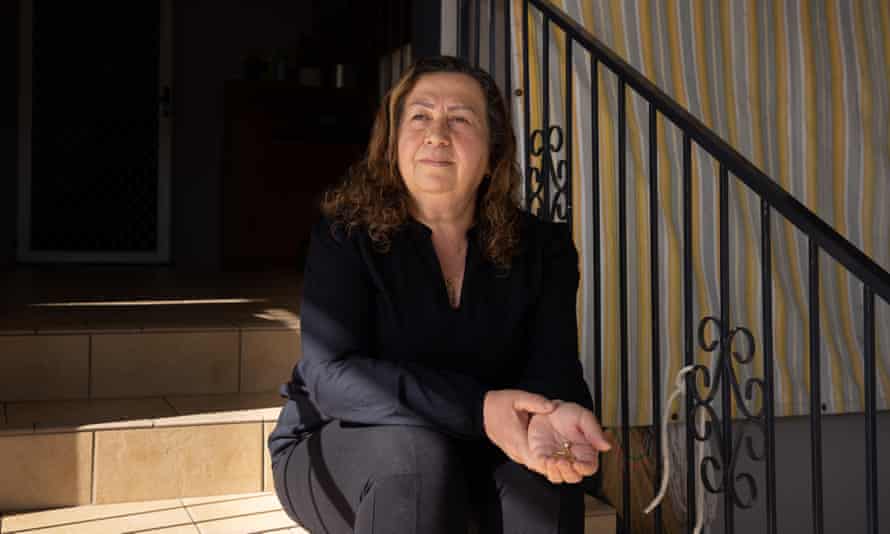
Najwa Rizk holds her husband’s crucifix, found by chance in an X-ray. Photograph: Carly Earl/The Guardian
Upon
entry at Hornsby hospital, Sayed was given an X-ray. In the scan, staff
noticed the shape of a cross. “They turned his shoulder, and his
crucifix was stuck there, pulled off the chain,” Nicole says.
“Everything else is gone, but we have the crucifix, because it went with him to Hornsby by chance.”
‘We knew it was the last time we would see our dad alive’
Nicole says, from the very beginning, “there was no sense anything was going to work”.
Sayed’s
family would call the hospital two to three times a day for an update.
Nicole describes the anxiety of waiting for the call as “gruelling”, and
says her mother was on edge the entire time.
“She was so anxious, crying for the entire two weeks,” Nicole says.
Najwa, Nicole and her sister Souad were eventually approved for a visit with Sayed in hospital.
Nicole says she “went in knowing it was the last time we would see our dad alive”.
“First
the nurses and doctors put on their PPE. The gloves, the masks,
everything. Then we went in. Dad was sedated. That was the hardest thing
I’ve ever had to do, seeing him in that state.”
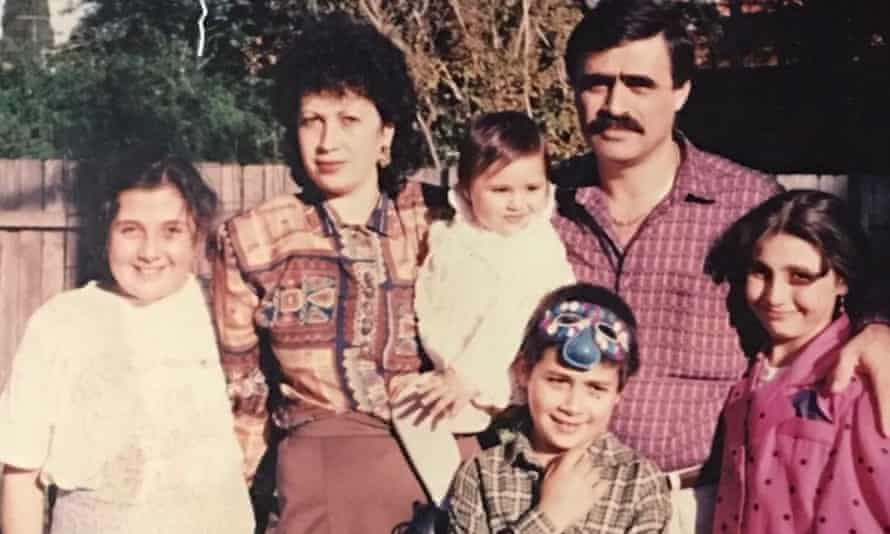
The
Rizk family were able to video call Sayed on his last day in hospital.
Pictured are parents Sayed and Najwa Rizk, and children Nicole, Souad,
Malinda and Kaisar. Photograph: Supplied
The nurse was empathic and understanding, letting the family extend their fifteen-minute visit to almost two hours.
“We
were able to pray with him, and speak to him. We took him holy oil and
water.” The family were also able to video call their brother Kaisar,
and sister Malinda in Lebanon, who is unable to come home.
Najwa
describes not wanting to leave her husband in the hospital that
afternoon. “Inside my mind, and my heart, I was not at peace”.
“I felt in my heart something was going to happen.”
At
this point, Sayed’s blood oxygen levels were dropping dangerously low.
The family were also told Sayed’s rheumatoid arthritis was an underlying
condition to be wary of.
“We didn’t know arthritis had anything to do with Covid. But we were told the treatments weren’t working.”
Nicole,
Souad and Najwa left Sayed at 3pm that day. That night, they fell
asleep close to 11pm. Three hours later, at 2:27 in the morning on
Thursday 2 September, the Rizk family house phone rang.
“We all got this sickening feeling in our guts,” Nicole says. “Our house phone never rings.”
Najwa says, “I felt the house collapse around me.”
A
doctor from Hornsby hospital was calling to let them know Sayed had
passed away minutes before. “He told us his organs shut down due to
Covid pneumonia,” Nicole says.
“He said, ‘I’m sorry’. And that was it. We lost him.”
‘We became one of those numbers’
Before
her family’s battle with Covid, Nicole “never in a million years”
expected to contract the virus, let alone lose her father to it.
The
family would listen to the daily acquired cases and death numbers. “We
would hear that 12 people died and think gratefully, at least it’s not
four hundred.”
Now, when Nicole looks at Covid
numbers, she thinks instead of how many people went through the anxiety,
the depression and the helplessness that her family went through.
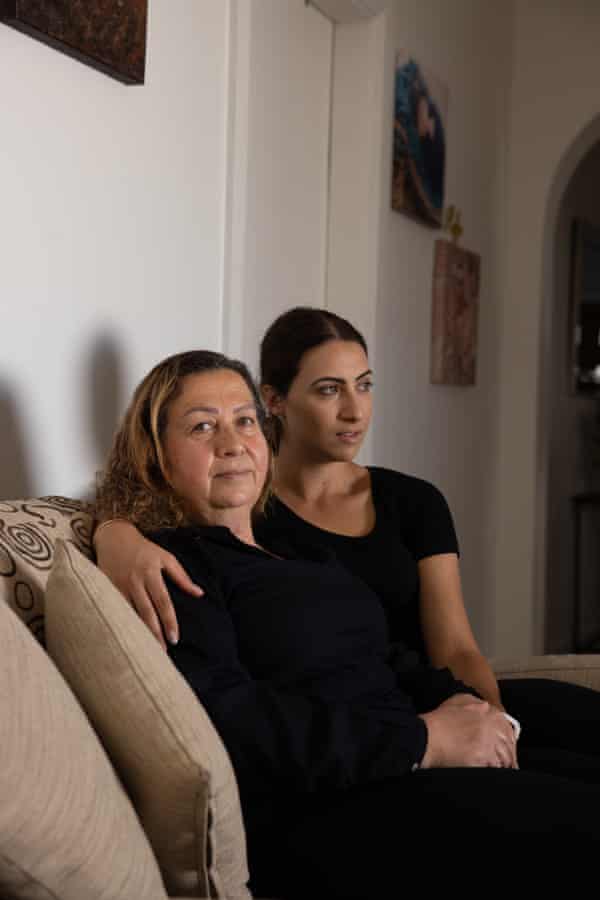
Najwa Rizk and her daughter Nicole. Photograph: Carly Earl/The Guardian
“The
people who are dying are just being portrayed as a number, rather than
real families being torn apart,” she says. “Only when you become one of
those numbers, when you’re in it, do you realise how serious it is.”
After four weeks, Najwa still hasn’t fully gotten her taste back. For Nicole, the cough lingers and returns sporadically.
Still
housebound in Sydney’s extended lockdown, grieving the loss of Sayed
has been especially difficult for the family, unable to access the
support of extended family members and loved ones.
Najwa
is grateful to be with her daughters, but knows things “won’t be like
before”. She says her late husband was “very quiet, very helpful, and a
very, very good man”.
“He loved everyone and he was loved by everyone. He did not deserve this.”
“It’s
never going to be the same,” she says. “There’s something missing. Even
when we sit at the table to eat dinner, it is different.”
Najwa says she “just wants families” like hers to “stay inside your house”.
“Wear
your mask. Be considerate,” she urges. “If one person is sick, they can
pass it on to a whole family. A whole family will be sick, and it could
end just like it did for us.”
“I hope no one experiences what we experienced,” Najwa says. “No one in the world.”
Senior ICU nurse Michelle Spence delivers a tearful plea for people to get vaccinated.
You can watch this and read at the same time with picture in picture
Help keep family & friends informed by sharing this article
A senior intensive care nurse has described Victorian patients "begging" to be vaccinated before being put on life support.
Key points:
Royal Melbourne Hospital nurse Michelle Spence says her patients include otherwise fit and healthy young people
Only 5 per cent of people in Victorian hospitals with COVID-19 are fully vaccinated
Northern Hospital nurse Jacqui Harper says many nurses are experiencing burnout
Michelle
Spence, the ICU nurse unit manager at the Royal Melbourne Hospital, was
visibly emotional as she detailed otherwise fit and healthy people
deteriorating after contracting COVID-19.
"One of
the saddest things I've seen over the last few weeks is people wanting
the vaccination just before we put them on a life support machine," she
said.
"That is the absolute truth. I've seen it myself. They're begging for the vaccination.
"They're very young. And once we get to that, we're about to put them on life support, it is really too late."
Speaking at the state's daily coronavirus update, Ms Spence said she had seen people die in the ICU by themselves.
"And that is absolutely not what this should be about. Loved ones deserve to have their families with them when they die."
Ms Spence said she had seen fit, healthy people ending up in the ICU, including a tradesman in his 30s.
"The
only thing I can tell you that would have changed, and again, this is
my opinion, I've seen it at the end of the bed, is the fact that he was
not vaccinated," she said.
Nursing manager Jacqui Harper says she has seen patients deteriorate rapidly on the COVID ward.
Jacqui
Harper, the nurse unit manager from the Northern Hospital in Epping,
said the patients she saw coming into the hospital were "seriously,
seriously ill".
"The clinical deterioration is so
sudden. One minute, sitting in a chair, an hour later they could be
saying their goodbyes," she said.
"They find it difficult to breathe, some needing high levels of oxygen, ventilators, and ICU support.
The Northern Hospital, where Ms Harper works, is located in Epping, which is one of the hardest-hit suburbs in Melbourne.
"To it be a nurse right now? Very challenging. Very challenging when the community are not getting vaccinated," Ms Harper said.
"We
have got to do all those other things. We have to do the orthopaedic
traumas that come through. All of the other cases we get as well.
" … And being in that epicentre, it's been hard.
Healthcare workers 'worried about the next few months'
The number of patients needing ventilation has steadily risen alongside daily case counts.(AAP: Penny Stephens/ Western Health, file photo)
There
are 476 people in hospital with COVID-19 across Victoria, with 98 of
those in intensive care, including 57 people on a ventilator.
Of the people in hospital on Saturday, only 5 per cent were fully vaccinated.
As
of Sunday afternoon, there were 12 teenage patients in hospital, none
of whom were fully vaccinated. Of the 22 patients in their 20s, only one
was fully vaccinated.
There were 64 patients in
their 30s, only one of whom was fully vaccinated, and 60 patients in
their 40s, none of whom were fully vaccinated.
Victoria
this weekend recorded another record-high daily case count. And the
number of new infections is expected to keep climbing until a peak later
this month.
That peak is projected to happen
around the same time the state hits the target of having 70 per cent of
the population aged 16 and over fully vaccinated.
Ms
Spence said healthcare workers were bracing for the fact that when
lockdowns lifted at that stage, it would be a great time for the
community but the hardest time for the health system.
Both Ms Spence and Ms Harper said their respective wards were at, or nearing, full capacity.
Last year, the state government announced it would provide an extra 4,000 ICU beds across the state.
That
promise has not been fulfilled, with ministers and Premier Daniel
Andrews saying there has not yet been the demand to justify the beds.
Opposition Leader Matthew Guy has pushed the government to deliver on the promised beds.
"We'll open beds as we need to," Mr Andrews said on Sunday.
"Because
ICU beds are so precious, and because you don't have unlimited numbers
of staff, we don't open ICU beds and then have them empty, with a nurse
at the foot of the bed waiting for a patient."
He said the state was hoping and "working as hard as we can to have less patients, not more".
Ms
Spence said at the Royal Melbourne Hospital and across the state,
staffing models were being altered and beds were being opened in a
staged way, based on need.
But she said if people were vaccinated and followed lockdown restrictions, the state would not need the extra 4,000 beds.
Ms
Harper said there would always be the challenge of burnout and fatigue
affecting the workforce, and the chance the system may not cope.
"Because COVID's unpredictable. We don't know what's going to decline in the next minute," she said.
"So
we might not cope, and we all have emotions too. So dealing with the
challenges of people not being able to see their loved ones, us holding
their hands for their last dying breath, it's hard.