Contemporary politics,local and international current affairs, science, music and extracts from the Queensland Newspaper "THE WORKER" documenting the proud history of the Labour Movement.
MAHATMA GANDHI ~ Truth never damages a cause that is just.
Pictures of Bondi rammed with beachgoers have been replaced with its packed testing centre.(AAP: Bianca De Marchi)
Help keep family & friends informed by sharing this article
A
joke bounced around the country earlier this week. It ricocheted across
social media, on front pages and out of the mouths of dads deprived of
more days on the couch in front of the cricket.
"Want to get a fast test? Play the Poms."
But
for the people who had waited in a testing queue for longer than
England's second innings, it was no laughing matter. With queues for
kilometres at some PCR test sites that actually opened over the
Christmas weekend and rapid antigen tests rarer than the hottest
Christmas toy, frustrations ran deep.
We've heard
the horror stories — testing centre queues so long they were closed just
minutes after opening time, friends who'd visited upwards of five sites
trying to get a pre-holiday test, people with long-standing medical
appointments missing out on a required PCR test.
Beyond
the cancelled plans and missed Christmases, we don't really have a way
to judge the real damage done by the poor testing situation.
Some
of those with symptoms — or even multiple positive self-administered
rapid antigen tests — are skipping the PCR confirmation, turned off by
the queues or the risk of passing it on while waiting.
Add
to this the rapidly rising positive rate of those who do make it to the
front of the line. In NSW over the past seven days, it has skyrocketed,
Despite more than 35,000 cases a day across the nation, experts presume we're seeing the tip of the iceberg.
NSW Chief Health Officer Kerry Chant admitted as much in the state's Friday press conference.
"Obviously
we recognised that some people are probably taking a [rapid antigen]
test themselves and making their own decision … you should behave as if
you've had a confirmed PCR if you're choosing not to [have one] but our
recommendation is that you should," she said.
It's
tempting to see the testing crisis as evidence of Australia falling at
the first hurdle, but in reality, the hurdles are gone and the track has
changed.
We're running a completely different race but we're still trying to follow the old rules.
We're
so far beyond COVID-zero that Queensland's Chief Health Officer Dr John
Gerrard said it baldly this week: infection with COVID-19 was required
for the pandemic to evolve to be endemic — a constant presence in our
lives.
"Not only is the spread of this virus inevitable, it is necessary," he said on Thursday.
"In order for us to go from the pandemic phase to an endemic phase, the virus has to be widespread."
That's a big cognitive jump for Australians — and there's no going back.
A new festive decoration: QR codes and hand sanitiser. (ABC News: Danielle Bonica )
We're in it now
For
anyone watching on, it was clear we were facing the perfect storm.
Christmas parties. La Niña forcing us back indoors. The festive season.
Generations mixing together after months of distancing.
Enter a new variant, faster than any we've seen to date, and a lot can change in a matter of weeks.
NSW
was hit by Omicron first, with cases rising from mid-December and
escalating sharply just before Christmas. Victoria — which had been
sputtering along mainly in the low 1,000s since the end of lockdown —
started picking up around then too, albeit at a lower rate than NSW.
Perhaps
the escalation was most marked in Queensland, with its newly reopened
border no longer protecting it from the surge. Cases moved from double
digits on December 21 to well into the 3,000s by year's end. South
Australia and Tasmania, too, have an established surge.
Even fortress WA wasn't safe, though it has kept its numbers in single figures for now.
After
months of sheltering behind borders and lockdowns, Australia can no
longer escape the sort of numbers we used to scoff at overseas despite
our nationwide vaccination rate of more than 90 per cent.
At our current pace of 126,224 second doses a week, we can expect 95% of Australia’s adult population to be fully vaccinated by late February 2022.
Total doses include doses given to people aged 12-15 and people who already had two shots of vaccine.
Dates refer to the reporting date (usually the day following vaccination), not the vaccination date.
But
with strong community response to prevention measures, hard work from
the health sector and a stroke of good luck, we dodged the worst-case
scenarios.
Not this time.
NSW
Health Minister Brad Hazzard suggested on December 15 — just 18 days
ago, when the state recorded 1,360 cases a day — that NSW should brace
for 25,000 cases a day by the end of January.
NSW 'could' have 25,000 COVID-19 cases per day.
On the last day of December, that was starting to look optimistic, with the 20,000 mark already broken, well ahead of that pace.
NSW Chief Health Officer Kerry Chant said on Friday it was a challenging time, but not unexpected.
"It reflects the international experience with Omicron, where we're seeing a rapid doubling rate," she said.
Omicron is a game changer, Prime Minister Scott Morrison said on Thursday.
"We
need to reset how we think about the pandemic, and how we manage
ourselves and the things we need to do as governments," he said,
announcing new definitions of "close contacts" and loosening the
parameters for who needs to get tested.
But here lies the cognitive gap for Australians.
Mindsets don't change overnight
It's
one thing to know that the way we see COVID is changing, that this is
potentially a milder variant for most people and mass vaccinations
should prevent the huge rate of hospitalisation and death seen overseas
last year.
But Australians have had the need to get
tested drilled into them from the start of the pandemic. Every press
conference, every QR code, every public health poster. Every exposure,
every sniffle.
A new set of rules won't change that
demand overnight — especially at a time when we're reconnecting with
loved ones, taking holidays and mixing like we haven't in months. Many
are worried — if not for themselves then for their more vulnerable loved
ones.
Lockdowns aren't yet a distant
memory: Australians are still used to shutting down when cases go up.
And before Christmas, many businesses did just that.
But
Australia is approaching the wave from a different starting point to
other countries and that's affecting how our infrastructure is handling
the surge and our attitudes towards it.
Our
competing priorities were shown in the need for PCR tests to travel to
states with fewer cases — which helped fuel the testing crisis in NSW
and Victoria. It took longer than ideal for NSW to put its foot down,
and for Queensland and South Australia to back down.
Again, when a new "national" set of rules for close contacts
and testing were announced on Thursday — with four different timelines,
and exceptions in South Australia, an "in principle" yes but no changes
in WA and an announcement to come from the NT. And the rules changed again less than 24 hours later.
The
decision to make rapid antigen tests free in only limited cases —
apparently to allow the "private market" certainty to order more stock,
according to Morrison — won't see supplies increased in the short-term
to fill the gap.
The good news is that hospitalisations haven't risen at the same rate as positive cases, nor have ICU admissions or deaths.
The
changes to the close contact rules should limit the number of
healthcare workers taken off the roster and strengthen the system, along
with a new directive from NSW to allow asymptomatic staff deemed as
close contacts to leave self-isolation.
It's unclear at what price these changes come, in terms of increased risk to essential workers and their families.
"It
seems national cabinet is prepared to bet that a massive Omicron
outbreak won't cause large numbers of hospitalisations," Australian
Medical Association president Omar Khorshid said on Thursday.
"We
expect hospitalisations to rise in coming weeks, simply due to the very
large number of cases, which will be far larger than the positive tests
indicate, due to today's decision."
But for now, fewer of us need to get tested and, according to Morrison, that's cause to relax.
"If you don't fulfil this definition of a close contact then there is no need for you to be in that line," Mr Morrison said.
"You should go home. Go to the beach, go and do what you want to do. Read a book in the park."
We've
come a long way from chained-off beaches and scare photos of heaving
crowds at Bondi, though we're not all quite ready to live with that
reality yet.
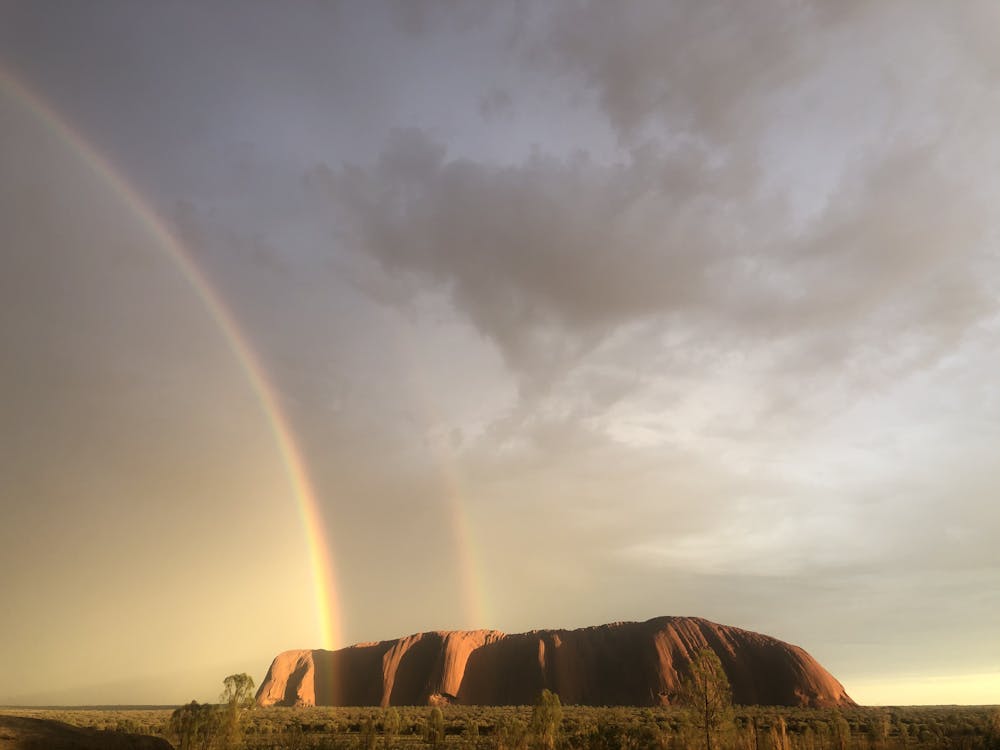
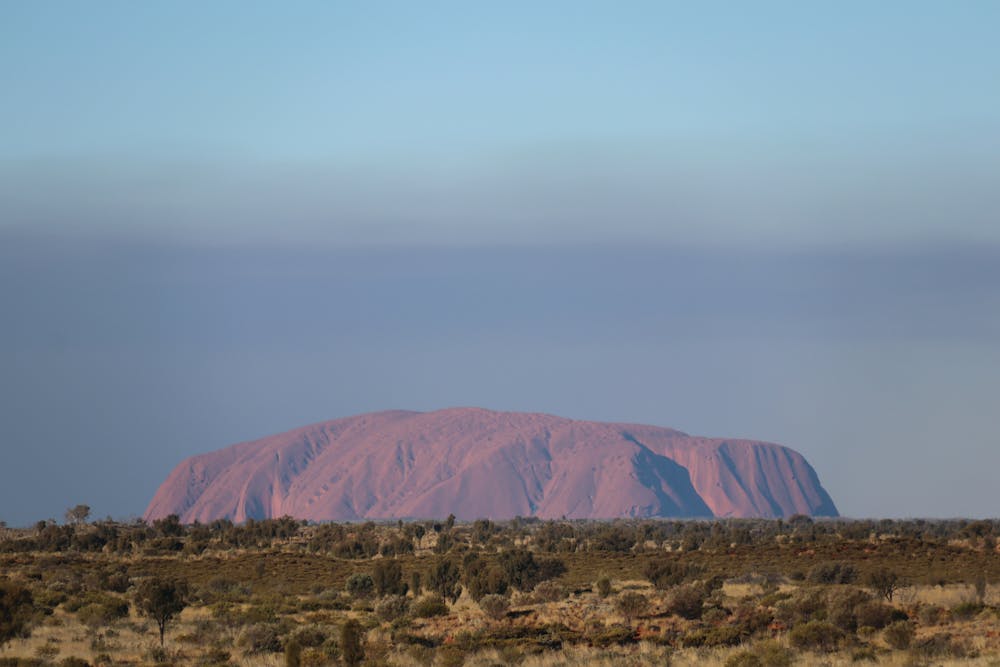
Part of the magic of Uluru is the way it tricks your senses.
Deep
orange by day, it appears to change colour at sunrise and sunset,
becoming a more vibrant shade of red, and then almost purple.
Its size also seems to change depending on your perspective.
Approaching
Uluru from afar you are struck by how small it appears. But as you get
closer, you realise it is truly a huge mountain, a behemoth in the
middle of the comparatively flat Australian desert.
Australian
geologists are now revealing yet another dimension to Uluru’s magic: The
spectacular forces that led to its formation.
Uluru is a time capsule.
Within
its sand grains there is an epic 550-million-year saga of continents
colliding, mountains rising and falling, and the remarkable strength of
our most iconic mountain.
The Anangu are the owners of the land on which Uluru sits and they have long understood its magic.
Their
Dreaming stories tell of the dramatic creation of Uluru and Kata Tjuta
on the previously featureless Earth by ancestral creator beings known as
the Tjukuritja or Waparitja.
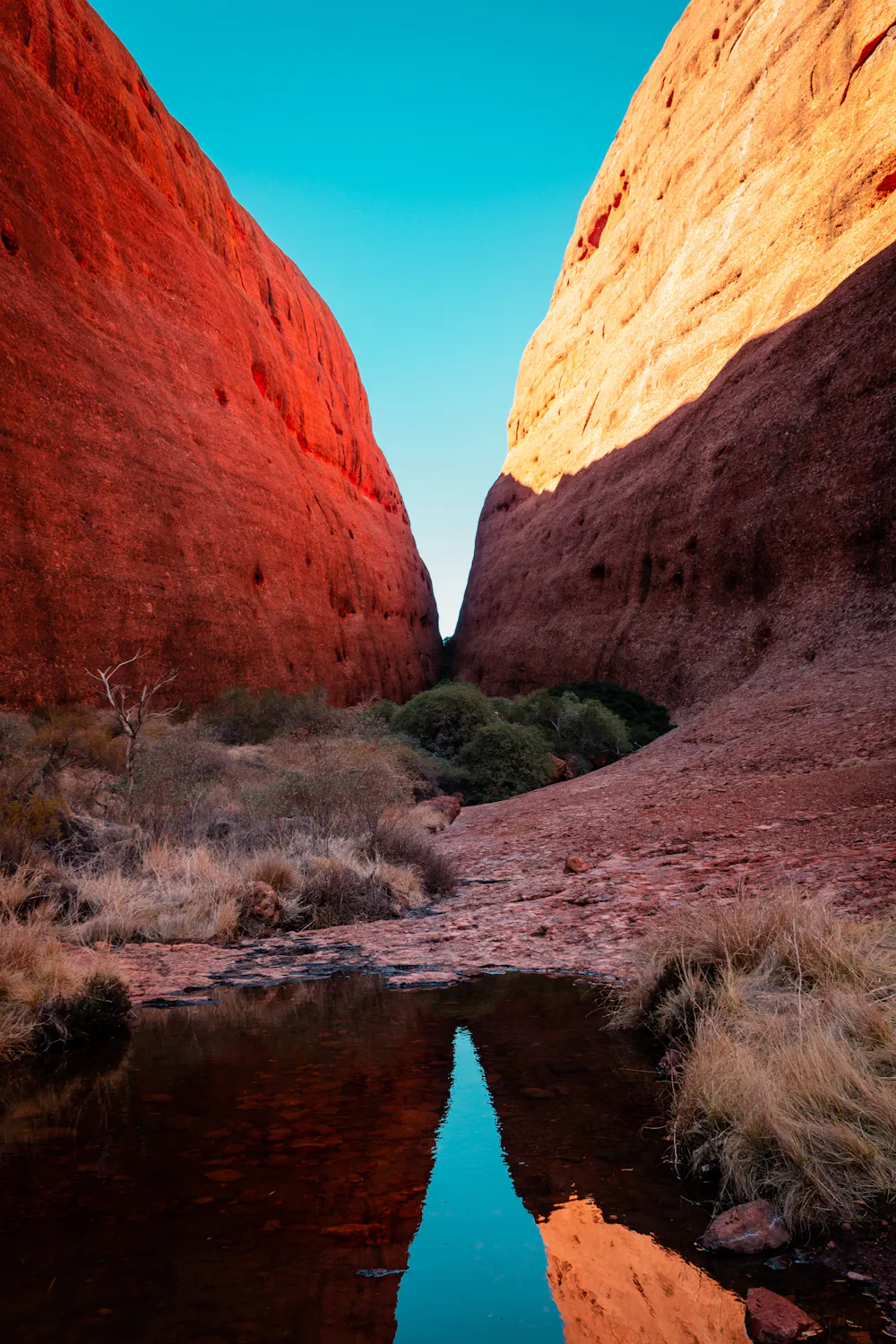
If you get the opportunity to tour Uluru with a Traditional Owner you will hear stories about the significance of some of the dimples, caves and undulations, many of which have a unique and important place in Anangu culture.
The story of Uluru began 550 million years ago, when India smashed into the West Australian coast. Photo: Robyn Lawford
Compared
to the Traditional Owners, whose knowledge dates back several tens of
thousands of years, scientists have only realised the significance of
Uluru over the past 30 years or so.
Uluru’s geological history has been revealed by assembling different types of data, like pieces of a giant jigsaw puzzle.
That puzzle is taking shape and the scene it reveals is perhaps even more spectacular than the rock itself.
To tell Uluru’s story from the beginning we need to travel back in time 550 million years.
India smashed into the Western Australian coast
Earth’s tectonic plates are constantly in motion, continents collide with each other and then rift apart.
About 550 million years ago, continents collided as part of the assembly of the supercontinent Gondwana, one of several times in Earth’s history where most of the continents were stuck together in one continuous piece of land.
Back then, a map of our globe would have looked very different.
At
this time, Antarctica was nestled against the Great Australian Bight.
If you were around then you could have walked from Australia directly
into Antarctica without getting your shoes wet.
India was situated to the west of Western Australia when it was pulled toward our continent and smashed into the coastline.
India
and Australia’s collision caused massive stresses to reverberate
throughout the Australian crust, like waves of energy crashing through
the continent.
When those waves got to Central Australia, something pretty remarkable happened that geologists can understand by mapping the rocks beneath the surface.
Unlike
a fracture in your arm bone, these faults never healed, so they
remained broken, forming weak zones susceptible to breaking and moving
again.
So, when the waves of energy from WA reached Central
Australia, the network of fractures moved, pushing rock packages on top
of each other. As the rocks moved past each other, they also moved
upwards and were thrust into the air.
Uluru is made of sandstone, a type of rock formed in oceans. Photo: Unsplash CC BY
An enormous mountain range emerged
Each fault rupture moved the rocks so quickly that huge earthquakes shook the ground.
Gradually,
these faults uplifted an enormous mountain range. It was called the
Petermann mountains, and it was unlike anything in Australia today.
The mountains were hundreds of kilometres long and five kilometres high, more akin to the Indian Himalayas than Australia’s Great Dividing Range.
They were mostly made of granite, a rock that crystallises from molten rock (magma) deep underground.
This
granite was pushed up to the surface in the mountain-building process.
Normally, mountains would be covered in vegetation, but 550 million
years ago land plants had not yet evolved, meaning these mountains were probably bare.
Boulders cracked off, an ocean formed
Bare mountains weather quickly because they are more exposed to rain and wind.
Big
cracks formed in the granite, splitting away rocks and boulders, which
fell into rivers gushing down deep valleys carved into the mountain.
At sunrise and sunset, Uluru appears to change colour. Photo: Christian Bass/UnsplashCC BY
These huge braided rivers
came off the northern side of the Petermann mountains and snaked across
the landscape until the rivers entered a low-lying region, called a
sedimentary basin.
When the river reached the basin, the sediment from the mountains dropped out of the water, depositing layer upon layer of sand.
The weight of it pushed down on the underlying rock, causing the basin to deepen until it was kilometres thick.
The overlying layers compacted the sand deposited previously, forming a rock called sandstone.
Over
time the basin continued to deepen and was covered by water, forming an
inland ocean lapping at the foot of the huge mountain range.
Ancient faults reawakened, and Uluru rose from the ocean
Sediment
continued to deposit into the ocean until about 300 million years ago
when the ancient faults began to reawaken during a new mountain-building
event called the Alice Springs orogeny.
The
thick layers of sand that had cemented into solid sandstone were
uplifted above sea level. Squeezed together by huge tectonic forces, the
layers buckled and folded into M-shapes. The apex, or hinge of folds, was compressed more than surrounding rocks, and it is from the hinge of a massive fold that Uluru formed.
Uluru resisted the forces of weathering that eroded other rocks. Photo: Shutterstock
Folding
and deformation made Uluru strong and able to resist the forces of
weathering that eroded the surrounding, weaker rocks, including almost
all of the once-mighty Petermann mountains.
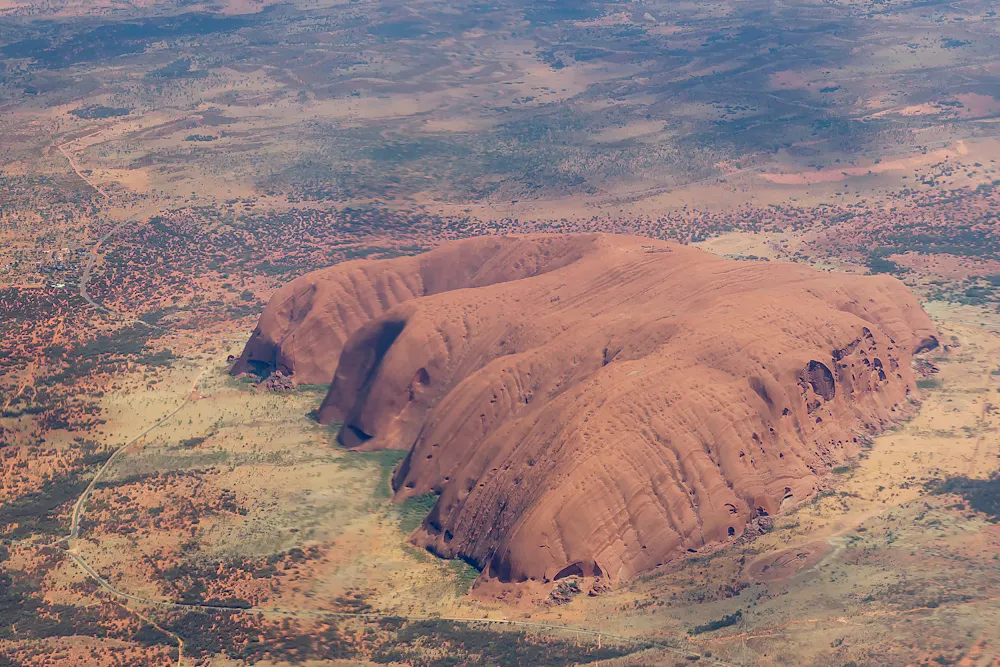
If we could dig underneath Uluru, we would see it is only the very tip of a rock sequence that extends kilometres down under the surface, like a rock iceberg.
Uluru is a sacred site to Anangu and our respect for their deep knowledge and ownership of this land means we no longer climb Uluru.
But even if we could, why would we want to?
Uluru’s
magic is most evident when you stand at its base, look up, and picture
in your mind the enormous forces that conspired to form it.
At a city supermarket, rapid antigen tests are being sold for $14.95. The problem is they have none left, and are not taking orders.
They will take an order at the local pharmacy, but the tests will be $19.95 each. And take a minimum of 10 days to arrive.
And
up in north Queensland, not far from Thursday Island where 11 people
are now COVID positive, a single test is being flogged for $37.50.
That
one example shows everything wrong with how our leaders – state and
federal – are dealing with this next stage of the pandemic.
Yes,
we saw the Prime Minister Scott Morrison announce a response on Thursday
to the threat Omicron is creating, but it’s simply a response.
As
he was announcing changes to definitions and details of
government-issued rapid antigen tests, people continued to join long
queues in the hope of nabbing their own.
Australia’s response to Omicron is not a strategy or a way forward in how we live and work with this pandemic long term.
Meanwhile, this pandemic is well and truly in front.
The pandemic rules appear to be changing, leaving the coronavirus in front. Photo: Getty
If
Omicron is going to fan out through the population, as health officials
are warning, how are we going to operate and bring a new normal to our
lives?
That’s the simple question that needs a detailed, strategic
and flexible plan, based on data and geography and the emotional and
physical wellbeing of the people it needs to target.
Just look at where we are.
Go
and get vaccinated, our leaders say. But how do you do that when no
booster is available in many areas in Australia – including capital
cities – for several weeks?
Or when those aged under 18 are not even eligible?
And what are our politicians doing about about our most vulnerable cohorts?
For example, vaccination rates in the Indigenous population are low – about 50 per cent.
What is the plan there? Moving a shipping container to one of the areas – as a makeshift morgue – as we saw this week?
Some were told on Thursday they had gone into lockdown, as a staff member tested positive.
What
happens when the next person and the next person tests positive? Will
our elderly see their families for weeks, or even months?
Is there a plan being worked on there?
The list goes on – as our politicians babble on.
The
risk is that off-the-cuff announcements and policies have worked
against a long-term workable and united strategy because people have
lost faith in our leaders to deliver.
Many people have waited for hours in queues to be tested. Photo: Getty
Go and get tested, they told us – and we’ve dutifully waited up to four hours or longer in the hot sun for that to happen.
Don’t we all know people who say they will not do that again? Surely that’s not part of the plan.
And waiting up to seven days – yes, one week – for results to come back surely is a disincentive to be tested?
Long-term
policies – even if they need to be massaged as we go – allows us to
plan, to talk to our children, and to look towards the future.
To that end, is school starting back at the end of January?
Will there be a choice between remote or in-person learning?
How
are we going to replace those teachers (and police officers and health
officials) who refused to be vaccinated, and been stood down?
Should students be vaccinated to attend class in high school? Is that under consideration?
If a leader has a policy here, could they share it with schools who say they are simply waiting on public health advice?
School students and teachers are yet to find out if there is a choice between remote or in-person learning.
At
least one university has now declared that all students must be fully
vaccinated to walk on campus, so what about the university residential
colleges on the same ground?
And if one or a few universities are mandating vaccines, shouldn’t that be the case everywhere?
Health officials recommended people consider working from home, but said they would not mandate it.
So what happens if an employer orders a worker into the office? Can they do that?
What happens when a customer refuses to check in at a coffee shop?
In Queensland, small business owners have been told to call the police. Is that their job? Is that a policy?
And
why check in, I was asked today, when fewer and fewer people are doing
it – and when it appears contacts are now not being traced, or the time
lag means those in close contact have been out and about in the
community for days after?
Records broken in Bilbao and Segovia, and avalanche warnings in Alps where it is too warm even for fake snow
People on Malvarrosa beach in Valencia, eastern Spain, on Wednesday, when temperatures reached 19C.
In Bilbao, northern Spain,
temperatures hit 24.7C, a high not seen since record-keeping began in
1947. In Segovia, near Madrid, 22.7C was recorded, the highest since
1920, and nearby Avila reached 20.2C, its highest since 1983.
“These
high temperatures are not normal,” said Rubén del Campo, a spokesperson
for the state meteorological agency AEMET. “These are temperatures that
you would normally see in the month of April.”
He
attributed the year-end heat to a mass of hot air over Spain combined
with high pressure. “It’s a normal phenomenon that we do see, but what’s
strange this time is the high temperatures we’re seeing.”
Scientists have long predicted that the climate crisis and global heating would lead to more frequent extreme weather, although random extreme events occur naturally.
The high-pressure anticyclone has shifted to France and Italy, and alpine rescuers have warned of a risk of avalanches.
Luca
Mercalli, a meteorologist, said: “At the moment it is about 15C in
areas of the Alps at an altitude of 1,600 metres and is not hitting zero
beneath 4,000 metres. It hasn’t even been freezing at night – the
temperature has not dropped below 10 degrees, and this is very unusual.”
Temperatures
in some of Italy’s best-known ski resorts, including Cortina d’Ampezzo
and Courmayeur, are forecast to be 13-15C above the seasonal norm on New
Year’s Day, and the balmy weather is expected to linger until 3
January.
Ski resorts at an altitude of up to
2,000 metres are bereft of snow. “And they can’t produce artificial snow
as the temperature is too warm,” said Mercalli.
Italy’s
alpine rescue service has advised skiers to regularly check weather
bulletins owing to the risk of avalanches. “The elevated temperature
combined with strong winds create the conditions for avalanches,”
Mercalli said.
The rest of Italy is also
experiencing abnormally warm conditions, with a high of 18C expected in
Rome on Saturday and 22C in the Sicilian city of Catania by the middle
of next week.
In Spain, the high temperatures
cap off a year that began with a deadly snowstorm that blanketed large
parts of the country in snow and brought Madrid to a standstill.
“It’s
been a year of extremes,” Del Campo said. The snowstorm left some
municipalities grappling with temperatures as low as -25C, while days
later the coastal city of Alicante hit 30C.
“We’ve never seen -25 and nearly 30C in the same month,” said Del Campo. “That’s not something we’ve ever seen in Spain.”
Italy
also experienced extreme weather events in 2021, with Siracusa in
Sicily believed to have broken the European record for the highest
temperature, reaching 48.8C in August.
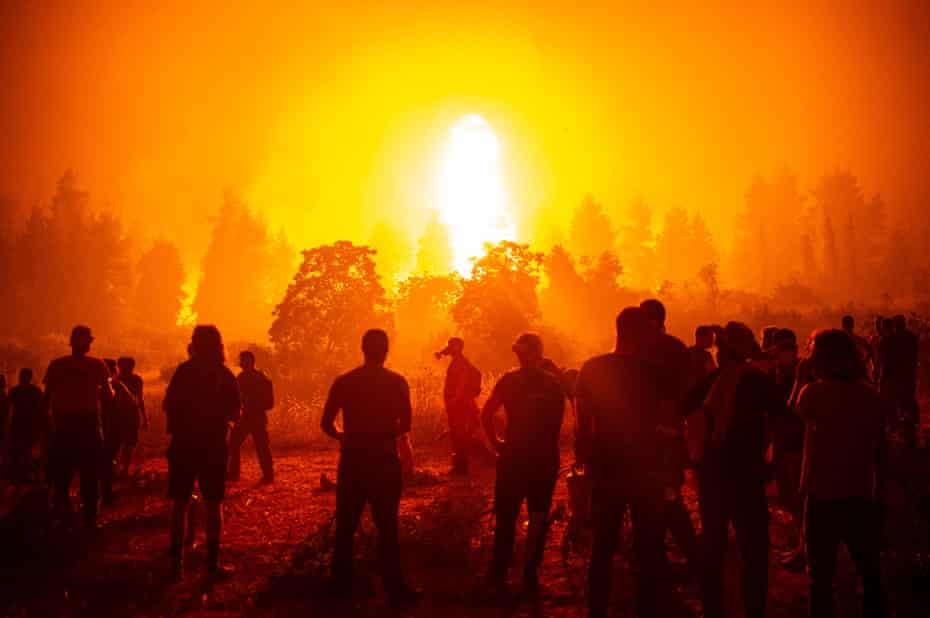
Local
youths and volunteers wait to support firefighters during a wildfire
next to the village of Kamatriades in Greece. Photograph: Angelos
Tzortzinis/AFP/Getty Images
A look back at 12 months of key summits, devastating weather and alarming discoveries
The year began with a counting up of the damage after the catastrophic extreme weather events of 2020, from fires to floods. Looking at the US alone, California more than doubled
its previous annual wildfire record with more than 1.7m hectares (4.1m
acres) burned and Nasa concluded that 2020 had been the joint hottest
year on record. The US’s Noaa and the UK Met Office put it in close
second to 2016.
And
2021 – the year that would see the crucial UN climate summit held in
Glasgow in November – was not showing signs of being much better. The
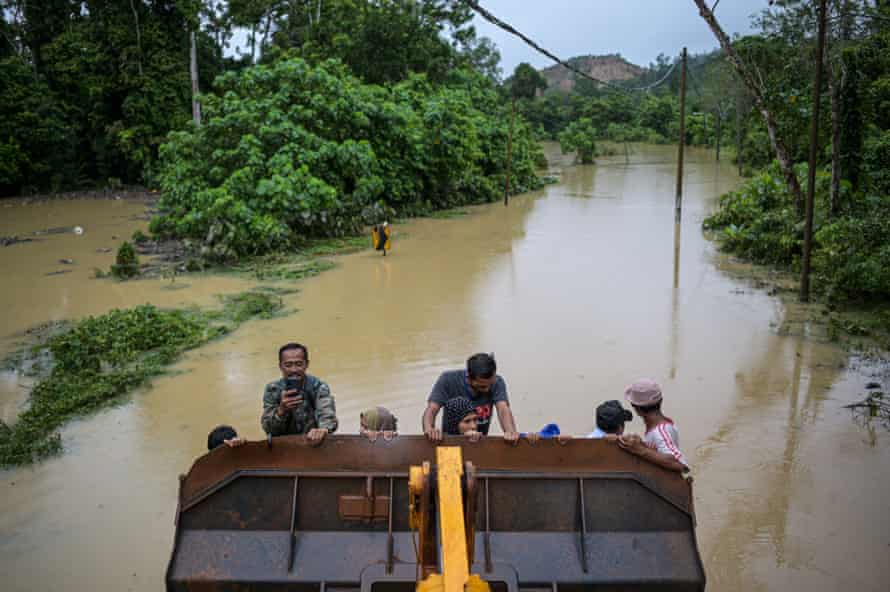
continent of Africa had its warmest January on record, while torrential rains fell in Malaysia,
leading to the evacuation of 50,000 people and the death of at least
six. Meanwhile in Turkey there were fears that Istanbul would run out of
water following the most severe drought in a decade.
Residents in Sementeh, near Lanchang in Malaysia’s Pahang state are evacuated on a digger. Photograph: Mohd Rasfan/AFP/Getty Images
But there were small steps of progress on other fronts. Within hours of becoming president, Joe Biden announced that the US would be rejoining the Paris agreement. The Israeli company StoreDot announced that car batteries that could be fully charged in five minutes had been produced in a Chinese factory for the first time.
In my view, we’ve already waited too long to deal with this climate
crisis and we can’t wait any longer. We see it with our own eyes, we
feel it, we know it in our bones, and it’s time to act.
Joe Biden
And in the UK a plan to reintroduce white-tailed eagles to the east of the country was, unusually, led by farmers, who said they wanted to “inspire people with nature and drive wider nature recovery”.
February
The
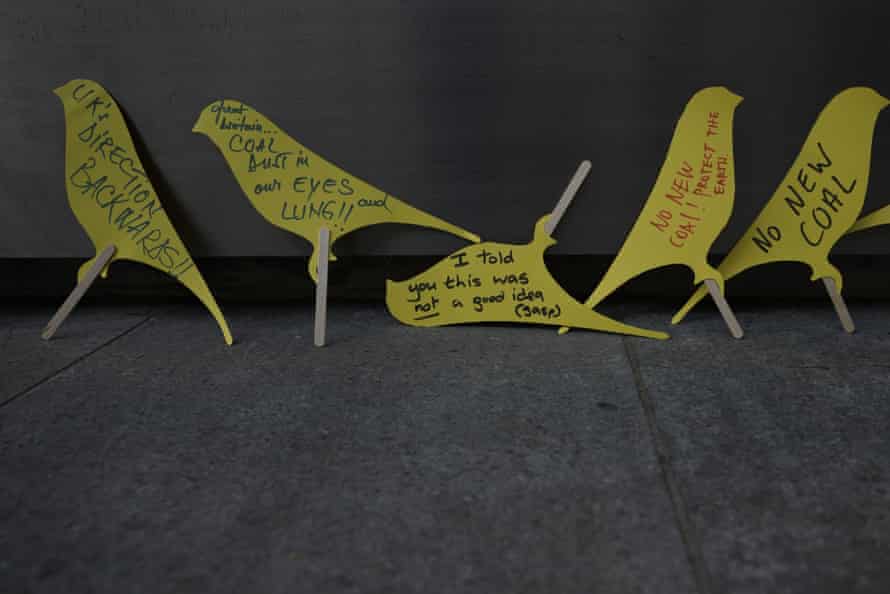
internationally renowned scientist James Hansen waded into the UK’s row
over plans for a new coalmine in Cumbria, saying it showed
“contemptuous disregard for the future of young people”. A few days
earlier, nine activists had announced that they were in a tunnel under
London’s Euston station, dug secretly beneath a tent, in order to
protest against the high-speed rail link the UK government was in the
process of building.
Protesters’
canary-shaped handwritten messages outside the Home Office during a
demonstration against a proposed coalmine in Cumbria. Photograph: Alastair Grant/AP
A
historic wave of winter weather hit the eastern US and Texas, with
nearly 10 million people without power at the storm’s peak, and millions without water after pipes burst; it was later assessed to have been the most costly winter storm event on record.
In an amazing rewilding operation in Indonesia, 10 rescued orangutans were returned to the wild. Helicopters were used to ferry the critically endangered apes deep into the forest.
And in Madagascar scientists found what is believed to be the smallest reptile on Earth. Brookesia nana, a nano-chameleon, has a body the size of a sunflower seed, just 13.5mm long.
March
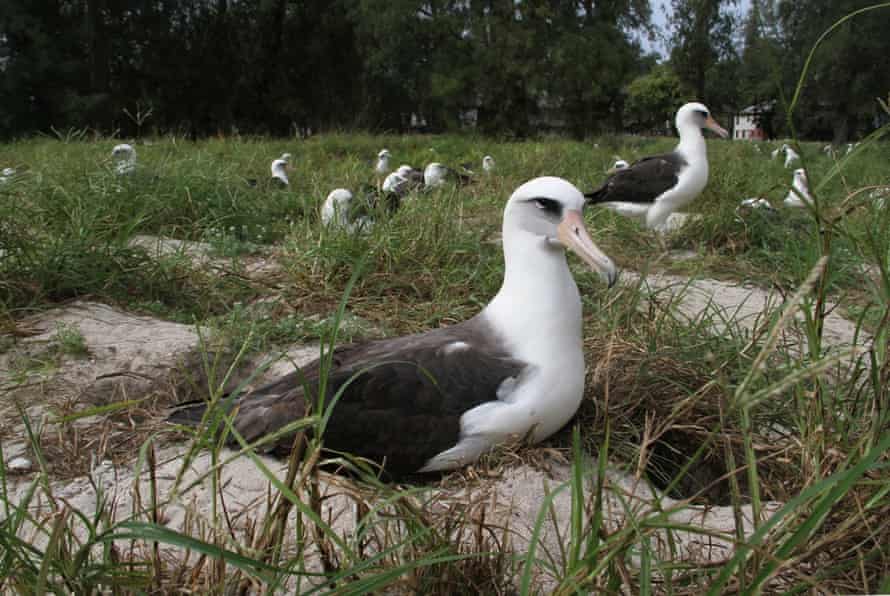
The world’s oldest Laysan albatross, a female named Wisdom, nesting on Midway Atoll national wildlife refuge. Photograph: USFWS - Pacific Region
New York was lit up by news that dolphins had come to play
in the East River – validation of a long-term clean-up of the river
which had cost the city $45m. Further north, in the Midway Atoll
wildlife refuge in the North Pacific, the “oldest wild bird in history”,
70-year-old Wisdom the Laysan albatross, hatched another chick. Banded
by biologist Chandler Robbins in 1956, Wisdom has outlived a number of
partners (albatrosses normally mate for life).
On the other side of the planet, Australia was being hit by horrendous floods,
with thousands forced to flee rising waters in New South Wales, and the
insurance industry facing millions of dollars in claims. The same
region, meanwhile, was also battling a mouse plague, with horrifying footage showing the ground moving as the rodents took over.
In the US, Deb Haaland was confirmed as the first ever indigenous cabinet secretary,
as she took over the environment department. The huge surge in
renewable energy around the world continued, with China announcing that
it had built windfarms with a staggering total capacity of almost 100GW in 2020 – an increase of nearly 60% on 2019. But Climate Action 100, launching the first ever benchmark for tracking corporate progress on climate change, found that only a handful of the big polluters were taking serious action.
April
A landmark legal decision
by the German supreme constitutional court found that the government’s
climate protection measures were insufficient to protect future
generations. The government promised it would take action on what one of
the young activists who had brought the case called “a huge win for the
climate movement”. In the UK meanwhile, the coroner who oversaw the sad
case of a young girl, Ella Kissi-Debrah, who died after an asthma
attack in 2013, published a report which called for the lowering of legally binding maximum levels of particulate air pollution in the UK.
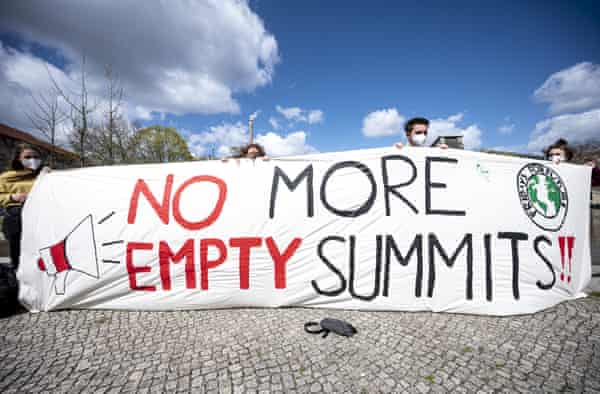
Activists from the environmental group Fridays for Future demonstrating in Berlin’s Invalidenpark. Photograph: Fabian Sommer/AP
And in the US, a two-day summit on climate change was wound up with promises
on all sides, including one from the US to cut its greenhouse gases by
50-52% by 2030. The country also pledged to double financial aid to help
other countries with their targets. “Is it enough? No,” said John
Kerry, Biden’s climate envoy, who had earlier struck a deal to cooperate with China on climate change. “But it’s the best we can do today and proves we can start to move.”
The shifts came against the background of a troubling development however, as scientists concluded that
the warm Atlantic current linked to severe and abrupt changes in the
climate in the past was now at its weakest in at least 1,600 years. The
current is known as the Atlantic Meridional Overturning Circulation
(Amoc).
Huge sandstorms in China turned the skies over Beijing yellow for several days, while Cyclone Seroja brought heavy rain and strong winds to Western Australia, with some locations seeing their highest ever daily rainfall.
May
A Dutch court ordered Royal Dutch Shell
to cut its global carbon emissions by 45% by the end of 2030 in an
unprecedented ruling that will have huge implications for the energy
industry and other polluting multinationals. The decision came just as
the International Energy Agency published Net Zero by 2050, a landmark
report which stated that exploitation and development
of new oil and gas fields would have to stop this year, and no new
coal-fired power stations could be built if the world wanted to stay
within safe limits of global heating and meet the goal of net zero
emissions by 2050.
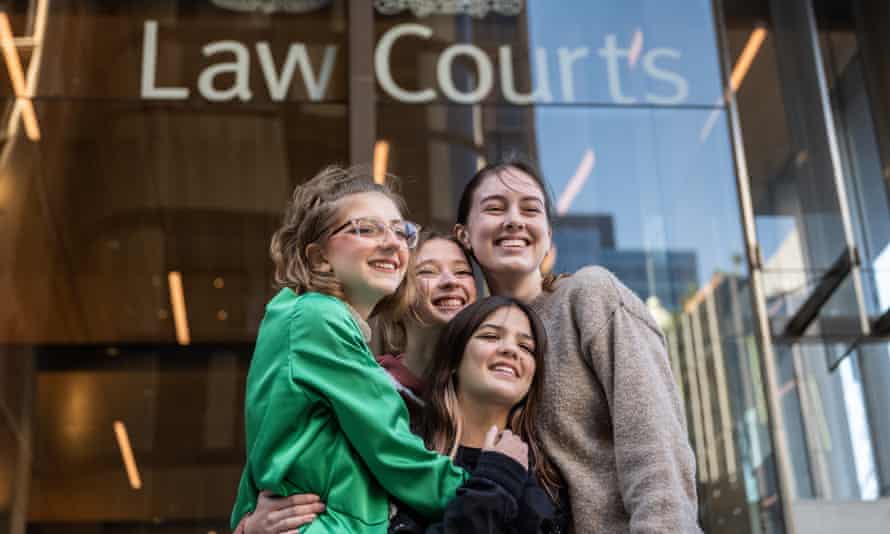
Ava
Princi, Liv Heaton, Izzy Raj-Seppings and Laura Kirwin embrace outside
the federal court of Australia in Sydney. Eight young Australians and a
nun sought an injunction in September 2020 to prevent the environment
minister, Sussan Ley, from finally approving the Vickery coalmine
extension project in north-east New South Wales. Photograph: James Gourley/AAP
Meanwhile in Australia the federal court found that the environment minister, Sussan Ley, had a duty of care
to protect young people from the climate crisis, in what lawyers said
was “the first time in the world” such a duty of care had been
recognised.
In France, the minister for
ecological transition delighted and appalled people in equal measure
with the announcement that the new climate law would take meat off the menu once a week in schools.
Turkey was hit by “sea snot”
– a blanket of mucus-like stuff that was silting up the coasts, created
as a result of warm temperatures and agricultural run-off that
encouraged phytoplankton to grow. But in California, after a short and late rainy season, the governor was declaring an impending drought emergency in 41 of 58 counties.
June
One
of the most extraordinary and powerful heatwaves ever experienced by
North America hit the west coast in June and did not go away. Caused by
what meteorologists called a “dome of high pressure”, the heatwave
extended from California – worsening the drought even as the first
wildfires of the season began – all the way up to Canada, where
temperatures rose up to 121.28F (49.6C), shattering all previous
records. “This is the beginning of a permanent emergency,” the governor of Washington state said.
Other parts of the world also saw scorching temperatures.
Both Europe and Asia had their second warmest Junes on record, while
Africa and New Zealand had the warmest June ever recorded.
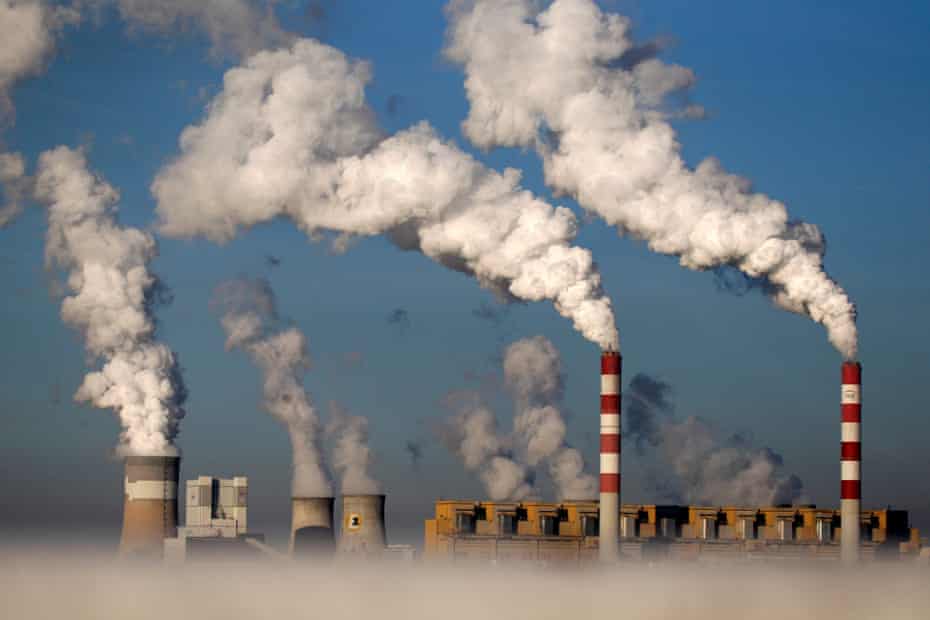
Smoke billows from the chimneys of Bełchatów power station in Poland. Photograph: Kacper Pempel/Reuters
But efforts to fight back continued too. Poland announced it would shut down Bełchatów, Europe’s most polluting power plant (although only in 2036). The City of London said it would be creating a heat network and digging boreholes for one of the UK’s largest low-carbon heating systems.
Sri Lanka braced itself for disaster after the MV X-Press Pearl, a ship carrying toxic chemicals, caught fire off the coast and sank. Meanwhile China was fixating on a herd of elephants that had trekked 300 miles into the city of Kunming.
July
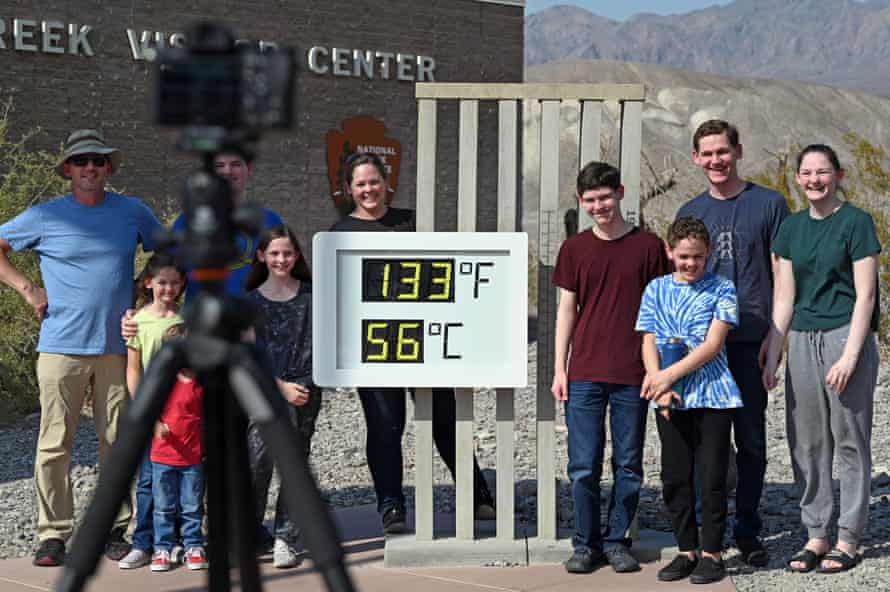
The average global surface temperature for July was the hottest since records began in 1880, with Death Valley in California registering 54.4C (130F).
People visit the unofficial thermometer reading 56C (133F) at Furnace Creek Visitor Center on 11 July. Photograph: David Becker/Getty Images
As
the US heatwaves and droughts worsened, India, China and Europe were
being hit by catastrophic floods. Torrential downpours on India’s west coast led to 115 deaths, while Henan province in China saw a year’s worth of rain – 604mm – in a single day. Horrifying videos
showed the waters rising in subways, while hundreds of thousands were
forced to evacuate. And in Germany rows broke out when it emerged that a
flood early-warning system had failed to work, after torrents of rainwater tore through villages and towns, leaving more than a hundred people dead.
Meanwhile the Australian government continued to fight attempts
to have the Great Barrier Reef declared “in danger”, with local
politicians saying they feared for the impact the declaration would have
on jobs. In the UK, the water company Southern Water was fined a record
£90m after a six-year investigation
found evidence that it had deliberately poured untreated sewage into
the sea in order to avoid the cost of upgrading infrastructure.
And, to top off a gloomy month for the planet, new data showed
that the melting of Greenland was surging, with the amount of ice
vanishing in a single day enough to cover the whole of Florida in 5cm of
water, according to researchers.
August
The Intergovernmental Panel on Climate Change delivered its starkest warning to the world yet, concluding that climate change was unequivocally caused by human activities, and warning that some of the impacts were now inevitable and “irreversible”.
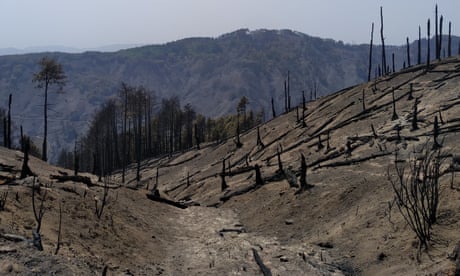
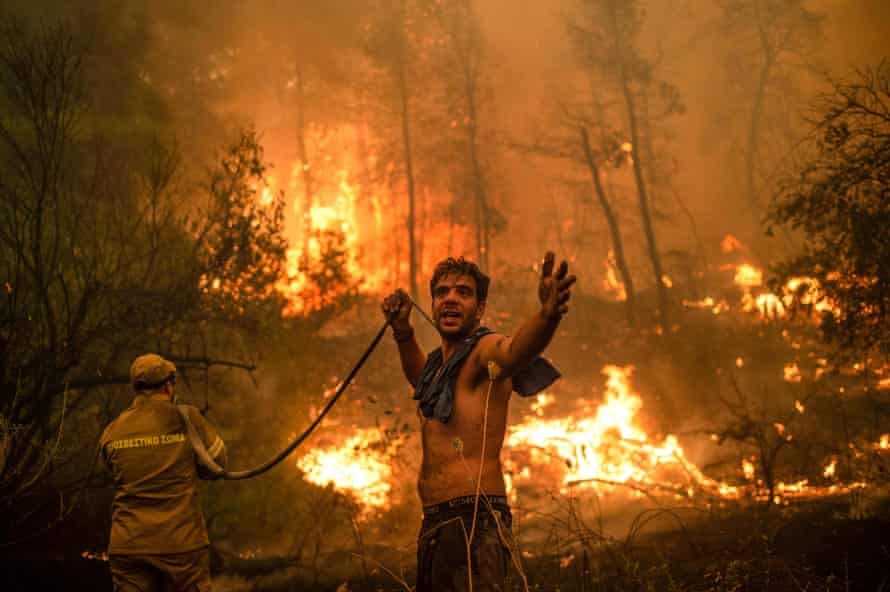
As the heat continued, wildfires broke out in the Mediterranean,
where the Greek prime minister described them as the country’s
“greatest ecological disaster in decades”, and across more than 9m
hectares of forests in Siberia.
A local resident holds an empty water hose near the village of Pefki in Greece. Photograph: Angelos Tzortzinis/AFP/Getty Images
A Swedish company shipped the world’s first customer delivery of “green steel” – made without using coal – as solar power outstripped coal in Australia for the first time when, for a fleeting moment, more electricity was generated by solar power.
In
the UK, Extinction Rebellion swung back into action, blocking London
Bridge and Oxford Circus, pouring red paint in entrances at the City of
London and locking on outside the Science Museum over its sponsorship
deal with the oil giant Shell.
September
“Blah blah blah”
was what Greta Thunberg called the promises from global leaders around
the world to tackle climate change, pointing out that carbon emissions
were still on track to rise 16% by 2030. As Cop26 drew nearer, and
following the summer of record-breaking fires, heatwaves and floods,
politicians everywhere were under increasing pressure to improve their
offers. A US/EU deal to reduce methane emissions felt like a good contribution.
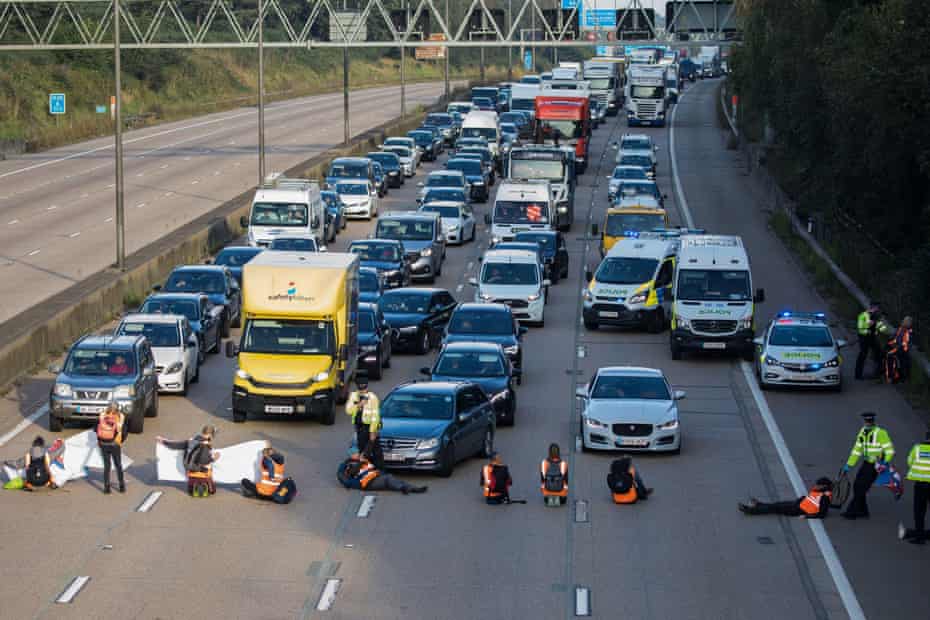
Insulate Britain climate activists block the anticlockwise carriageway of the M25 near Ockham. Photograph: Mark Kerrison/Alamy Live News
A new protest movement launched in the UK, as Insulate Britain
demonstrators began sitting on motorways to demand climate action in
the form of insulation for the country’s housing stock. In Scotland, as
preparations sped up, one man built an ark
on a hillside, telling the planning committee when it asked if it was a
permanent structure: “It’s not permanent in the same way that humanity
won’t be if we don’t take action on the climate.”
In a painful irony, new data revealed that the wildfires were themselves releasing record-breaking
amounts of carbon dioxide. Meanwhile, an energy crisis was breaking
across the world, with sky-high gas prices in Europe and pressure on electricity and coal supplies in China.
October
China hosted the Kunming conference on biodiversity and announced a $233m (£170m) fund to protect biodiversity in developing countries.
We shall take the development of an ecological civilisation as our guide to coordinate the relationship between man and nature.
Xi Jinping
With just days to go before
Cop26, Australia, one of the countries most notorious for holding out
against climate action, published its plan for how it would reduce
carbon emissions, but it was called “a scam” containing no detail and no modelling.
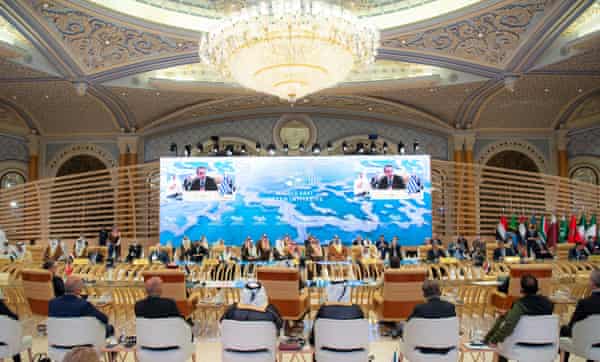
Delegates at the Green Middle East Initiative Summit in Riyadh, Saudi Arabia. Photograph: Saudi Green Initiative/Reuters
Elsewhere, however, signs of change were palpable, with a series of plans announced at the Middle East Green Initiative Summit, led by the United Arab Emirates which will be hosting Cop28 in two years’ time.
A Tesla became the first ever battery-powered car to top Europe’s sales chart. And in the UK, the government was forced by a near rebellion to U-turn and place a duty on water companies to reduce sewage discharges.
In the US, one senator gained global notoriety: Joe Manchin, a conservative Democrat, was holding out against his own party for huge cuts
to President Biden’s climate change plans. For a brief moment, it
looked as if Biden would have to go to Cop26 with no legislative
progress at home.
November
Cop26
was under way at last, after two years of pandemic, delays, worries,
criticisms and negotiations. World leaders gathered for the first two
days and were exhorted by David Attenborough
to be “motivated by hope rather than fear”. Biden had finally got his
bill passed, but the UK’s prime minister, Boris Johnson, put a dampener
on events by making his speech and then hopping into a private jet to make the short journey to London.
The first week saw an onslaught of deals on methane, deforestation, coal, the ambition to stick to 1.5C of warming and finance,
with hundreds of the world’s biggest banks and pension funds with
assets worth $130tn committing themselves to limiting greenhouse gas
emissions.
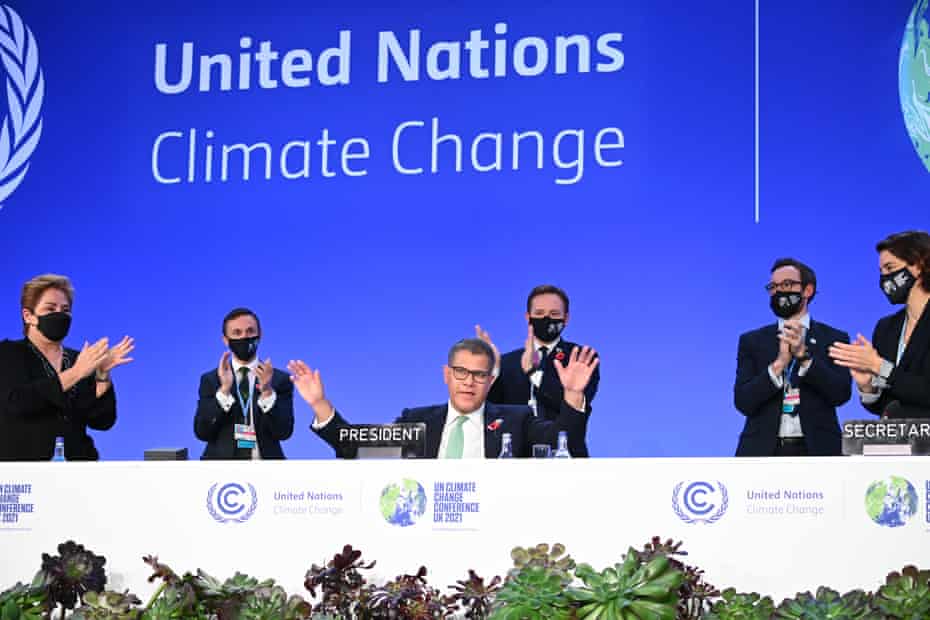
Alok Sharma receives applause after giving the closing speech at Cop26 in Glasgow. Photograph: Jeff J Mitchell/Getty Images
By
the end of the second week of hard negotiation, the summit’s president,
Alok Sharma, had cajoled countries into a deal including a ratchet
mechanism that asked every country to upgrade its emission reduction
plans in time for the next Cop in Egypt in a year’s time, and each year
thereafter. However, many were dismayed that the deal did not include
the loss and damage facility that most of the world had asked for, to
help developing countries in particular pay for the impacts of the
climate crisis already being felt.
Beyond the summit, rain storms hit British Columbia in Canada, earlier battered by the summer’s heatwaves, broke up roads and led to a state of emergency.
Out in the oceans one of the rarest animals in the world was glimpsed: the mythical white sperm whale, seen surfacing for a moment, from the waters off Jamaica.
December
The World Meteorological Organization (WMO) announced in the middle of the month that it had
recognised a new Arctic temperature record: the summer of 2020 had seen
the Russian town of Verkhoyansk hit with an all-time high of 38°C
(100.4°F).
Floods swept Queensland, Australia, with up to 180mm of rain falling in 24 hours in some parts of the state. The UK was hit by Storm Arwen and Storm Barra. Heavy rains fell in Iraq,
leading to serious flooding and displacement. And tornadoes ripped
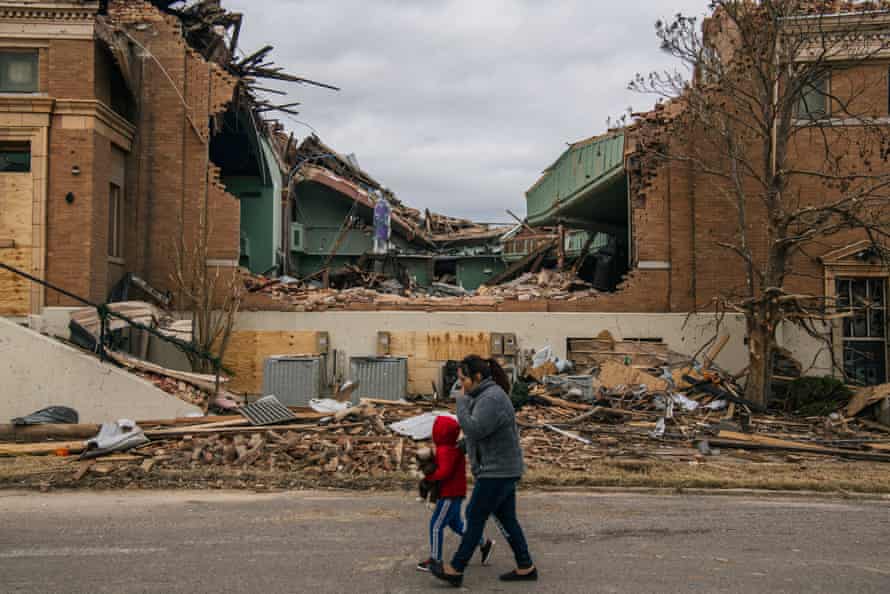
through North America, with at least 70 deaths in Kentucky in what was described as the “most devastating tornado event” in the state’s history, only to be followed, by the end of the month, by record-breaking temperatures and snowfall.
A family walks past a destroyed church in Mayfield, Kentucky. Photograph: Brandon Bell/Getty Images
EO Wilson, who died on 26 December,
had warned many times that humans could not continue to use the land
and resources of the planet in the way they did. The biologist was
caught up in controversies at times during his career. Nevertheless, his
warning that “we live in a delusional state” if we do not understand
the burden that the western way of life imposes on Earth, rings true
even now.
If all mankind were to disappear, the world would regenerate back to
the rich state of equilibrium that existed 10,000 years ago. If insects
were to vanish, the environment would collapse into chaos.