Tuesday, 1 March 2022

This climate crisis report asks: what is at stake? In short, everything.

Extract from The Guardian

Last modified on Tue 1 Mar 2022 03.38 AEDT

“A liveable and sustainable future for all”. It is the very last words of the new report from the Intergovernmental Panel on Climate Change (IPCC) that spell out what is at stake. In short, it is everything.

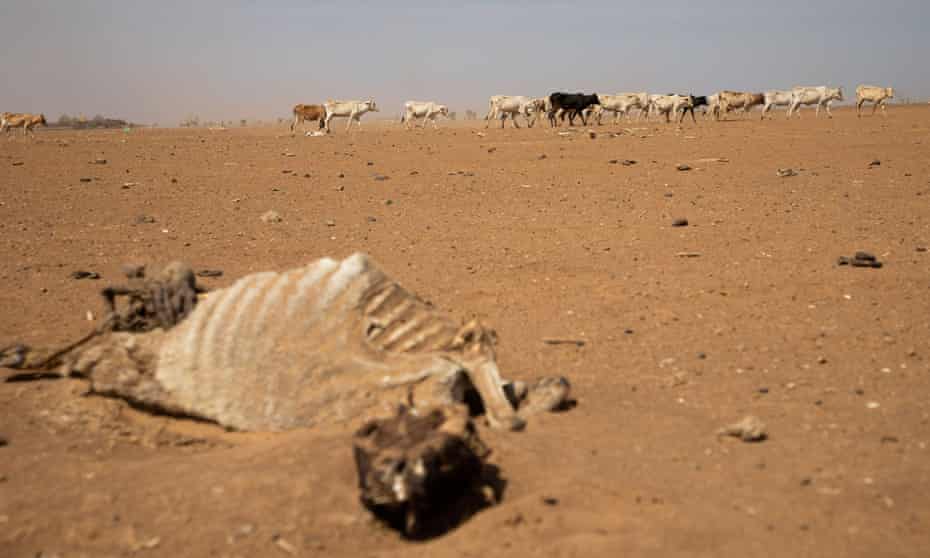
The damage from global heating is already hitting hard. The comprehensive IPCC assessment, which is based on 34,000 studies, documents “widespread and pervasive” impacts on people and the natural world from increasingly frequent and intense heatwaves, droughts, wildfires, storms and floods. Some impacts are now irreversible.

Heat is killing more people, drought is killing more trees and warming oceans are killing more coral reefs, the nurseries of the oceans. But without action, worse is coming, the report said, and faster than scientists had thought.

But tackling climate impacts alone will not work. The IPCC sets out in the strongest terms to date that the climate crisis is inseparable from the biodiversity crisis and the poverty and inequality suffered by billions of people.

Given this scope, and with a liveable future on the line, the assessment could be seen as one of the most important in human history. It was produced by more than 1,000 physical and social scientists and unanimously approved by the governments of 195 nations.

“I have seen many scientific reports in my time, but nothing like this,” said Guterres. Laurence Tubiana, at the European Climate Foundation and one of the architects of the 2015 Paris climate agreement, said the report was “brutal” and “there can be no more excuses” for inaction.

Already, 3.5 billion people are highly vulnerable to climate impacts and half the world’s population suffers severe water shortages at some point each year, the report said. One in three people are exposed to deadly heat stress, and this is projected to increase to 50% to 75% by the end of the century.

Half a million more people are at risk of serious flooding every year, and a billion living on coasts will be exposed by 2050, the report said. Rising temperatures and rainfall are increasing the spread of diseases in people, such as dengue fever, and in crops, livestock and wildlife.

Even if the world keeps heating below 1.6C by 2100 – and we are already at 1.1C – then 8% of today’s farmland will become climatically unsuitable, just after the global population has peaked above 9 billion. Severe stunting could affect 1 million children in Africa alone. If global heating continues and little adaptation is put in place, 183 million more people are projected to go hungry by 2050.

The ability to produce food relies on the water, soils and pollination provided by a healthy natural world, and the report said protection of wild places and wildlife is fundamental to coping with the climate crisis. But animals and plants are being exposed to climatic conditions not experienced for tens of thousands of years. Half of the studied species have already been forced to move and many face extinction.

Maintaining the resilience of nature at a global scale depends on the conservation of 30% to 50% of Earth’s land, freshwater and oceans, the IPCC report said. Today, less than 15% of land, 21% of freshwater and 8% of oceans are protected areas, and some regions, like the Amazon, have switched from storing carbon to emitting it.

The IPCC report is also crystal clear that adapting to the climate crisis is as much a social problem as a scientific one. The best way to give effective and lasting protection from climate chaos is through action that addresses “inequities such as those based on gender, ethnicity, disability, age, location and income”.

“Targeting a climate resilient, sustainable world involves fundamental changes to how society functions, including changes to underlying values, world-views, ideologies, social structures, political and economic systems, and power relationships,” the report’s authors said in an accompanying document. “This may feel overwhelming at first, but the world is changing anyway – climate-resilient development offers us ways to drive change to improve wellbeing for all.”

The report warned that climate “losses and damages” are “strongly concentrated among the poorest vulnerable populations”, who have done least to cause the problem. That is a significant phrase, echoing the “loss and damage” for which low-income nations are demanding compensation from rich nations, and which will be a key issue at the next UN climate summit in Egypt in November.

Madeleine Diouf Sarr, the chair of the Least Developed Countries at the UN climate talks, said: “I read this report with a great deal of fear and sadness, but not surprise. It’s very clear to us that no amount of adaptation can compensate for failing to limit warming to 1.5C.”

However, the regional analysis in the IPCC report demonstrates that the climate crisis affects everyone. In North America, it warns of increasing deaths and physical and mental illness due to greater extreme weather, from storms to wildfires. In Europe, “substantive agricultural production losses are projected for most areas over the 21st century”.

Australia faces “increases in heat-related mortality and morbidity for people and wildlife”, while “destruction” lies in wait for small island settlements. In central and south America, “severe health effects due to increasing epidemics” are anticipated, particularly from diseases spread by insects and other animals. Among the most populous continents, one of Asia’s greatest risks is flooding, and Africa is haunted by hunger as climate impacts hit farmers.

The IPCC message that hope remains is measured: “Near-term actions that limit global warming to close to 1.5°C would substantially reduce projected losses and damages related to climate change in human systems and ecosystems, but cannot eliminate them all.” Some low-lying areas appear doomed already.

The report also noted that “losses and damages escalate with every increment of global warming”, meaning every action to cut emissions or adapt matters. Adaptation is heavily underfunded, the IPCC said, but investment now is far cheaper than acting later.

Among the adaptation measures the IPCC cites are restoring wetlands to protect against flooding, greening the world’s fast-growing cities to cool them, and using trees to shade crops and livestock.

The IPCC scientists said the end of the century is less than a lifetime away, with a child born today being 78 years old in 2100: “Actions taken now will have a profound effect on the quality of our children’s lives.”

The future is in the decisions we make today, said Christiana Figueres, former UN climate chief and now at the Global Optimism group: “We can prevent and protect ourselves from extreme weather, famines, health problems and more by cutting emissions and investing in adaptation strategies. The science and the solutions are clear. It’s up to us how we shape the future.”

World's largest cargo plane 'destroyed' during Russian invasion, Ukranian Foreign Minister says.

 Extract from ABC News

Posted 
An Antonov An-225 Mriya cargo plane taxis after landing at an airfield in the settlement of Hostomel.
The plane, which visited Australia in 2016, was famous for its size.(Reuters)
Help keep family & friends informed by sharing this article

Russia has "destroyed" the world's biggest cargo plane, Antonov-225 Mriya, according to Ukrainian authorities, who have vowed to rebuild the aircraft.

The plane, dubbed "Mriya", which is Ukrainian for "the dream", was hit by Russian troops on an airfield near Kyiv, Ukraine's Foreign Minister, Dmytro Kuleba, said.

"Russia may have destroyed our Mriya. But they will never be able to destroy our dream of a strong, free and democratic European state," Mr Kuleba said.

Ukrainian state arms manufacturer Ukroboronprom said the aircraft was burnt during Russian shelling at Antonov airfield in Hostomel, near Kyiv, where it had been undergoing maintenance.

Aircraft manufacturer Antonov Company said: "Until the An-225 is reviewed by experts, we cannot report the technical condition."

Russia has not publicly confirmed the attack, but heavy fighting was witnessed at Hostomel airfield, north-west of the capital, last week.

Aerial images also show what appears to be significant air-strike damage and grassfires near the Antonov Airport.

There has been significant airstrike damage and grassfires near the Antonov Airport in Hostomel.(Maxar Technologies via AP)

The longest and heaviest aircraft ever built

The plane became well known due to its size, and even visited Australia in 2016.

Designed in the 1980s, it is the longest and heaviest aircraft ever built. It also boasts the largest wingspan of any aircraft in operational service.

Ukroboronprom said its restoration was estimated to take more than $US3 billion ($4.17 billion) and five years to complete.

"Our task is to ensure that these costs are covered by the Russian Federation, which has caused intentional damage to Ukraine's aviation and the air cargo sector," it said in a statement.

ABC/Reuters

Vladimir Putin's nuclear threat crosses new threshold, expert says.

Extract from  ABC News

By Michael Vincent
Posted 

Play Video. Duration: 1 minute 56 seconds
Video from the Russian Ministry of Defence shows a column of Russian intercontinental ballistic missiles heading to a military parade.
Help keep family & friends informed by sharing this article

Intercontinental ballistic missiles (ICBMs) — the kind that can carry nuclear warheads — are usually only seen in military parades and during remote pre-planned tests.

So when Vladimir Putin's Ministry of Defence posted a video of a column of Russian ICBMs casually driving down a highway with Russian flags waving during this crisis, it raised heart rates as much as eyebrows.

Hours later came the Russian President's address to his nation's military.

"I'm ordering the Defence Minister and chief of the general staff to switch the Russian army's deterrent forces onto a high alert mode of combat stand-by duty," he said.

Vladimir Putin says he has put Russia's nuclear forces on high alert.(Reuters via Sputnik/Alexey Nikolsky/Kremlin)

It is important to note the video of the ICBMs on the highway did say they were heading to a military parade, but Mr Putin's three nuclear warnings in as many weeks have sent chills down the spines of military analysts.

"Putin has gone over a threshold that was not crossed during the Cold War," said Michael Kimmage, a former adviser on Ukraine and Russia for the US State Department during the Obama administration.

"The Cold-War messaging from the Soviet Union, from the United States, about nuclear weapons was far more disciplined than what Putin has been doing in the last couple of weeks.

"He's made one just blatant threat about using nuclear weapons if the situation doesn't go his way.

Jean-Yves Le Drian says Mr Putin should remember NATO also has nuclear capability.(Reuters: Muhammed Hamed)

"Obviously, you don't want to get into a war of words, or a kind of tit for tat, or some kind of escalatory spiral politically with Putin. But I think you can't let that go on answered."

French Foreign Minister Jean-Yves Le Drian did respond. "Vladimir Putin must also understand that the Atlantic Alliance is a nuclear alliance," he told French TV.

"The French didn't find the perfect recipe," Professor Kimmage said. "But to go back and forth, and keep on a level with Putin, that to me makes perfect sense at the moment.

A man wearing a suit and tie speaks into a microphone.

Michael Kimmage says Mr Putin has passed a threshold that was not crossed in the Cold War.(Twitter: CatholicUalumni)

"If Putin's going to bluster in that manner, it's not that you bluster in return, but you remind him that the costs of even this kind of threatening are going to go both ways.

"If he's going to break the rules, there will be certain kinds of consequences."

At this time of international crisis, Russia and the US must keep lines of communication open, he said.

"What has happened in the last few weeks has left very few channels of communication between Washington and Moscow," Professor Kimmage said.

"That's not entirely without precedent, but it's important.

"The Soviet Union and the US only avoided nuclear war during the Cuban Missile Crisis by communicating."

A new domino effect is playing out and it does not bode well.

Professor Kimmage spelled it out like this: "Putin's repeated messaging about using nuclear weapons comes at a time when there's almost complete mistrust among Western leaders and the Russian leader," he said.

"That combined with fewer and fewer channels of communication, and escalating sanctions and military commitment from the West to Ukraine, [adds the pressure on Russia] while the Russian attack falters.

"It doesn't mean Putin will use nuclear weapons of course — I doubt he's suicidal — but at the moment this is a crisis with no exit."

Watch this story on 7.30 on ABC TV and ABC iview.

Window to save ourselves from climate change 'rapidly closing', IPCC warns.

Extract from ABC News

By national science, technology and environment reporter Michael Slezak
Posted 
A seagull stands on a rock in Sydney Harbour in the foreground, with heat haze above Sydney city visible in the background.
The IPCC has warned Sydney and Melbourne will see 50C days in the future.(ABC News: Mary Lloyd)
Help keep family & friends informed by sharing this article

The world’s climate scientists and governments have declared climate change is now a threat to human wellbeing and warned we are about to miss the window to “secure a liveable and sustainable future for all”.

The finding comes in the latest Intergovernmental Panel on Climate Change (IPCC) report on the impacts of climate change and how we can adapt to them.

The new report found the scale of the impacts from climate change threatened to overwhelm Australia's — and the world's — ability to adapt in the coming decades, with some impacts requiring rapid and radical transformations in how we live and operate, combined with immediate and sharp cuts to greenhouse gas emissions. 

Immediate actions aimed at stopping warming at 1.5 degrees Celsius could reduce many of the most severe impacts to society and ecosystems, but will not stop all of them.

Current global policies put the world on a course of at least 2.1C warming by 2100, and possibly as much as 3.9C.

Lismore child rescue

As flooding hits Australia's east coast, the IPCC warns humanity faces more frequent extreme weather.(AAP: Jason O'Brien)

Regardless of our actions now, the report says regional and urban areas will face irreversible changes that will impact millions of people's lives, including:

  • Sea level rises that will destroy and displace homes and infrastructure
  • Heat that will kill more people each year 
  • Hanged weather patterns that will lower the productivity of both crop farming and livestock in many areas

"The scientific evidence is unequivocal: Climate change is a threat to human wellbeing and the health of the planet," IPCC Working Group II co-chair Hans-Otto Pörtner said.

The report urges urgent action to adapt to the changes we will see, as well as cuts to greenhouse gas emissions.

Those urgent adaptation actions include improving low-income houses to cope with heat, changing planning regulations to stop dangerous development, and planning for the closure of some industries.

The report advises we must address inequality between rich and poor, which it says exacerbates vulnerability to climate change and undermines our capacity to adapt.

"What's clear is that climate change already is impacting on the poorest and most disadvantaged people across the globe disproportionately. And those projections are expected to continue," said one of the report's authors, Mark Howden from the ANU.

The report also said the time for incremental adaptations was past, and we now needed "transformational" changes.

For example, instead of protecting houses from rising sea levels, some may need to be abandoned or rebuilt on higher ground. Some sectors, such as snow tourism in Australia, may need to prepare for closure altogether. 

"This abdication of leadership is criminal. The world's biggest polluters are guilty of arson of our only home."

Delaying not an option, IPCC says

The emissions reduction policies of Australia and the rest of the world would leave many human and natural systems beyond adaptation limits, the report said.

But it said many of the most devastating impacts were still avoidable by simultaneously implementing transformational adaptation and drastically cutting emissions. 

"It is essential to meet the goal of limiting [the] global temperature rise to 1.5C. And science tells us that will require the world to cut emissions by 45 per cent by 2030 and achieve net zero emissions by 2050," Mr Guterres said.

"But according to current commitments, global emissions are set to increase almost 14 per cent over the current decade."

"I know people everywhere are anxious and angry," Mr Guterres said. "I am too. Now is the time to turn rage into action."

The report is the second of three being produced by the IPCC in its sixth assessment round (AR6).

It was written by 270 authors and synthesises more than 34,000 pieces of scientific research. And it is approved by 195 governments.

The first report, released in August last year, analysed the physical basis for climate change, and was labelled a "code red for humanity". 

Report says government failing to address inevitable sea level rises

The report criticises Australia's federal government, as well as state governments, for an "absence" of clear guidance, "rendering Australia unprepared for flooding from sea-level rise".

Play Video. Duration: 1 minute 6 seconds

A year ago a massive storm caused severe coastal erosion at Wamberal Beach. (ABC Central Coast: Sofie Wainwright)

Those impacts are set to be significant for Australia, since about 85 per cent of Australians live within 50km of the coast.

The report found if the sea level rose by 1.1m — which could happen early in the next century — up to a quarter of a million residential buildings would be exposed to inundation as well as thousands more commercial and industrial buildings.

Between $164 billion and $226 billion of infrastructure would be exposed, along with up to 35,000km of roads and 1,500km of rail lines.

It notes protecting shorelines will become increasingly expensive and, in some cases, impossible.

In some places, "managed retreat" from coastlines may be the best option, the report says.

Extreme heat to kill hundreds more in Australian cities

With 90 per cent of Australians living in cities, the report notes Australia is particularly vulnerable to the urban impacts of climate change.

If greenhouse gas emissions continue to be high, the number of days each year with temperatures over 35C will increase by up to 350 per cent — and by at least 80 per cent — by 2090.

Brisbane summer sunrise with city buildings in view from Mt Coot-tha summit in March 2019.

Extreme heat is expected to kill hundreds more Australians if emissions are not reduced.(ABC News: Shelley Lloyd)

However, if emissions are reduced quickly, those extreme-heat days could increase by only 25-80 per cent by 2090.

With just 2C of warming, unprecedented extreme temperatures as high as 50C are likely to be seen in Sydney and Melbourne.

If emissions continue to remain high, the number of deaths could rise to 600 every year in Melbourne, Sydney and Brisbane between 2031 and 2080, compared to a historical figure of about 142.

But if emissions are rapidly reduced, that could be reduced to about 300 per year, saving thousands of Australian lives.

The report notes that the impacts of urban heat disproportionately affect those with low incomes.

It notes that air conditioning reduces mortality during heat waves by about 80 per cent, but that those in poor-quality housing and the homeless are particularly vulnerable.

It said planning decisions needed to keep more space between houses, result in more trees being planted and encourage the use of reflective building materials, all of which could significantly reduce urban heat as well as reduce the reliance on electricity, thereby reducing the risks of blackouts.

Food production already hit and it is going to get tougher

Agriculture has already copped significant disruption from climate change in Australia and that is set to get worse.

In some parts of Australia wheat yields are expected to decline by up to 30 per cent by 2050 and extreme weather will lower milk production and livestock reproduction.

A crop of wheat in the foreground, with fields, blue skies and grain bins in the background

Australia's grain-growing regions are predicted to shrink under drier and warmer conditions.(ABC News: Greg Nelson)

The report said while the sector was slowly changing, it would require radical "transformative" adaptation to cope with the physical impacts of climate change, and also because of the necessary role the sector would play in reducing greenhouse gas emissions.

But the report noted the ability of agriculture to make the required adaptations could be undermined by financial limitations and insurers abandoning parts of the increasingly high-risk sector.

“Without a major turnaround in carbon emissions and the way we farm, we are likely to see mass crop failures and food system collapse — with people in poverty hit first and hardest by a crisis they did not cause,” Olivier De Schutter, chair of the international panel of experts on sustainable food systems, said.

"Transforming agriculture is now urgent, governments must act to support local communities' efforts to feed themselves and encourage resilience through diversity, not uniformity."

Some natural ecosystems likely to collapse

While the report has an intense focus on adaptation, it says there is little we can do to help coral reefs adapt, meaning ecosystems like the Great Barrier Reef look set to face devastating consequences.

In 2016, the worst coral-bleaching event on record occurred on the Great Barrier Reef, with over 90 per cent of reefs affected.

 A scuba diver moves in the ocean over a row of bleached coral

Coral bleaching on the Great Barrier Reef in February 2016 — the worst on record.(Supplied: The Ocean Agency / XL Catlin Seaview Survey)

The report said that would get worse no matter what we did, with bleaching conditions projected to occur every five years from 2035, after which time the frequency would depend on how quickly we reined in emissions.

If emissions remained high, bleaching could occur every year from 2044. If we reduced emissions more quickly, it could take a further six years before those conditions were seen yearly on the Great Barrier Reef.

Unfortunately, the direct impacts of heat would likely be compounded by other climate change impacts. Cyclone intensity would increase, which would “greatly accelerate coral reef degradation,” the report said.

A shark swims over bleached coral in the Great Barrier Reef.

Bleaching events, as seen on the Great Barrier Reef in 2020, are set to become more frequent.(Supplied: Morgan Pratchett/ARC Centre for Excellence for Coral Reef Studies)

Heavier downpours will wash more sediment and pollution into the water from the coast, which will compound the damage, as well as boost the population of coral-eating crown of thorns starfish.

The report noted the Australian government's investment of $1.9 billion in the reef, but said adaptation measures aimed at climate impacts might only slow the damage and would "not prevent widespread bleaching".

Some other ecosystems are in nearly as perilous a position, including alpine ash forests, mangroves and marine kelp forests.

Multiple climate impacts will compound, amplify

The report highlights the "compounding" impacts of climate change, and how impacts in one sector can "cascade" into other sectors.

Compounding impacts are when multiple events happen at the same time, and each amplifies the effects of the other. 

"One example would be the combination of more intense cyclones and sea level rise," Professor Howden said.

"When a cyclone comes in against the coast, often it pushes water up ahead of it and rises the water underneath it, and you get a storm surge that causes coastal flooding and damage.

"Now, if you've got sea level rise, that actually means you increase the amount of damage for any given cyclone strength."

A kangaroo looks at the camera through a landscape of burnt out trees

Up to 8.1 million hectares burned during the Black Summer fires in 2020.(via Unsplash: Jo-anne Macarthur)

An example of cascading impacts was the Black Summer bushfires, which were exacerbated by climate change, and had multiple effects through disparate systems including threatened species, housing, health, finance and tourism.

The report said these sorts of cascading and compounding impacts "require new, larger-scale and timely adaptation".

The backs of two navy personnel on a boat through thick yellow smoke.

Dramatic evacuation scenes in Mallacoota were just the beginning of a cascade of impacts from the Black Summer bushfires.(Twitter: Darren Chester)

In particular, the report highlights the need for "climate-resilient development", which involves reducing inequalities in society.

Economic impacts are within our control

The report indicated Australia could lose 6 per cent of its GDP by 2070 under 3C of warming, while a 2.6 per cent rise in GDP was possible for a 1.5C scenario.

It cited a CSIRO study, which found real wages would be halved by 2060 unless we addressed emissions and adaptation.

Responsibility for adapting to climate change falls to all levels of government, all industries and individuals.

So analysing how good Australia had been at adapting was complex, Professor Howden said.

But Australia’s federal government has been criticised for not taking adaptation seriously enough.

In 2019, the ABC revealed documents showing Australia’s top government bureaucrats believed Australia was not adequately prepared for the impact of climate change, which could impact "the full spectrum of human activity" and was already "overwhelming" the country's ability to respond.

A group of Australia’s most senior bureaucrats, called "Project Climate Ready", was set up in 2017 when Malcolm Turnbull was prime minister, but was abandoned in 2018.

Richie Merzian, from the Australia Institute, said Australia had never undertaken a national climate risk assessment, despite the UN requesting such documents be produced.

"It's unbelievable and irresponsible that after all the devastating fires, floods and droughts, the federal government has never undertaken a national risk assessment to better understand and prepare for climate change impacts," Mr Merzian said. 

A spokesman for the federal government said the government was making unprecedented investments in climate adaptation and resilience and was working internationally to reduce emissions.

Just how bad could a big solar storm be in the internet age? And how would Australia be affected?

 Extract from ABC News

By Genelle Weule
Posted 
A large fiery solar flare erupting from the Sun
An enormous coronal mass ejection bursts from the Sun in 2012. Luckily this one missed Earth.(NASA/GSFC/SDO)
Help keep family & friends informed by sharing this article

Samuel McGowan was an early adopter of technology for his time.

Within a year of arriving in Victoria in 1853 from Canada, the entrepreneurial engineer had overseen the construction of the southern hemisphere's first experimental telegraph, an 18-kilometre-long wire stretching between Melbourne and Williamstown.

By 1859, Melbourne was connected by telegraph to the booming goldfield settlements of Ballarat and Bendigo, and lines ran to Sydney and Adelaide.

But something weird happened on August 29 and September 2 of that year.

Mr McGowan told the Victorian parliament that the transmission of signals was affected by fluctuating electrical currents in the atmosphere coinciding with the aurora australis, a phenomenon he'd seen before in his home country. 

"On one occasion during this interesting disturbance of the natural elements, I communicated with, and received an acknowledgement from, a station distant 32 miles, through atmospheric currents alone, there being at the time no battery on the line."

Mr McGowan witnessed the fallout of what has become known as the Carrington event.

Drawing of sunspots by English astronomer Richard Carrington from 1859

Drawing of sunspots by English astronomer Richard Carrington from 1859(Wikimedia)

The 1859 solar storm is the most powerful in recorded history — it played havoc with fledgling telegraph systems, sparking fires around the world, and created auroras that stretched to northern Queensland.

All this happened at least a decade before the bunch of separate states on the Australian mainland were connected to the rest of the world. And it was even longer until the first electrical lights flickered in the streets of Tamworth, the first petrol motor car hit our dusty tracks and the first plane flew in our skies.

So what would happen if a Carrington event hit us today?

Anatomy of a space storm

Solar storms like the Carrington event are caused by explosive bursts of charged particles flung from the Sun in a phenomenon known as a coronal mass ejection (CME).

A CME really only affects us if the stream of particles, or solar wind, is pointed in our direction, says Hannah Schunker, a solar physicist at the University of Newcastle.

Youtube Dr Hannah Schunker explains the physics of a solar storm on Catalyst.

If the Sun's magnetic field is the opposite of Earth's magnetic field at the time, the charged particles are able to enter Earth's upper atmosphere travelling down to the polar regions.

This sudden burst of electromagnetic energy creates stunning auroras, but it can also fry anything that conducts electricity.

In the 160 years since Mr McGowan's telegraph lines went haywire there have only been a couple of solar storms that come anywhere near the strength of the Carrington event.

Aurora Australis over the Southern Indian Ocean from the ISS

The aurora australis lights up the sky over the southern Indian Ocean as seen from the ISS.(Supplied: NASA)

On March 13, 1989, the entire Canadian province of Quebec was plummeted into a blackout for 12 hours as a surge of power knocked out the electricity network.

People were left without heating, and the train network and airport shut down.

The solar storm also affected the power grids in the US and a number of satellites tumbled out of control for several hours.

This space storm, dubbed "the worst in the space age" by NASA, was roughly about half the strength of a Carrington event.

Artist's depiction of solar wind colliding with Earth's magnetosphere

The solar wind collides with Earth's magnetosphere, sending charged particles towards the poles.(NASA)

But we are yet to see a superstorm in the digital age, says Sangeetha Abdu Jyothi, a computer scientist who studies internet resilience at the University of California, Irvine.

"The internet's infrastructure was laid out in the past three decades, Dr Abdu Jyothi says.

We had a lucky miss in 2012 when a superstorm of the same magnitude as a Carrington event missed Earth.

And many scientists believe it is only a matter of time before our luck runs out.

Sun's cycle is ramping up

The Sun goes through cycles where sunspot activity increases roughly every 11 years when the poles flip.

We're now about two years into the 25th cycle recorded since 1755.

Dr Schunker says the solar maximum in this cycle is likely to occur around 2025 (give or take a year).

"That means that the Sun is becoming more and more magnetically active … and this is when flares and CMEs occur."

Youtube Watch how the Sun changes over 10 years. Source: NASA Goddard Space Flight Center/SDO

NASA predicts that Cycle 25 will be relatively quiet, and even though there was a solar storm recently that knocked out 40 SpaceX satellites, it's living up to that so far, Dr Schunker says.

"It's a bit slow, but it's consistent with predicting a quiet cycle. It's not alarming."

But that doesn't mean we couldn't get hit by a big storm. 

The 2012 storm that missed Earth occurred in the last cycle, which was also predicted to be quiet.

"Most people do predict [this cycle] will be fairly quiet … but it doesn't mean that those conditions for a large CME or a large flare can't occur."

Scientists are constantly monitoring activity on the Sun and the solar wind using spacecraft such as The Solar Dynamics Observatory (SDO) and the Deep Space Climate Observatory (DSCOVR).  

But once a CME is detected, we only have about 12 hours' notice before it arrives at Earth, and less than an hour before we know how bad it will be.

How Australia could be affected

As the electrically charged particles hit the protective bubble surrounding our planet, they create turbulence in our upper atmosphere.

This turbulence disturbs the signals used by satellites to communicate with Earth, affecting communications and GPS systems.

The surge in electrical current could also damage satellites, and even cause them to drop out of orbit and burn up.

Power lines and the long-distance undersea cables that form the backbone of the internet on Earth may also not cope with the massive spikes in electrical current.

An excerpt from a NASA infographic shows how space weather can affect technological infrastructure.

A solar storm can disrupt services that rely on satellites, GPS signals, power networks and long-distance cables, which form the backbone of the internet.(NASA)

Along with causing power outages that affect our homes and businesses, a big hit could take out much of the technology we now take for granted.

"We're not going to have GPS positioning, we're not going to have access to Google Maps or our phones," Dr Schunker says.

People living at high latitude locations towards the north and south pole will be the worst affected.

This is where the charged particles are directed down towards Earth, producing spectacular auroras.

But it may not just be places that regularly see curtains of green and pink shimmering across the sky — like Tasmania — that will be hit.

A photograph of bright green and pink lights filling the night sky.

The aurora australis, also known as the southern lights, is a regular feature in Tasmania's sky.(ABC My Photo contributor @sophiefaz)

A solar storm in 1972 may actually have even been responsible for triggering undersea bombs during the Vietnam War, Dr Schunker says.

"Vietnam is not at a high latitude," she says.

"I think that the effects in the higher atmosphere at low latitudes just hasn't been studied enough."

Then in 2003, a series of superstorms about two-thirds the strength of the 1989 storm hit Earth around Halloween.

At their peak they:

  • caused aircraft to be rerouted;
  • played havoc with many satellite and communication systems;
  • shut down spacecraft;
  • blacked out communications in Antarctica for more than five days;
  • caused a power outage in Sweden for about an hour

But they didn't just affect high-latitude countries; they also burnt out transformers on South Africa's power network.

With growing evidence that a superstorm could affect mid- to low-latitude parts of the world — such as mainland Australia — scientists have begun looking more closely at mid-latitude countries as well.

2017 study looked at the impact of a storm of this scale on Tasmania's and Queensland's energy networks.

It found that even though Queensland is further away from the poles than Tasmania, it's slightly more vulnerable to a storm of this intensity.

That's because power lines in Queensland cover longer distances, and are predominantly aligned in an east-west direction in south-east Queensland.

The internet has not been tested

While modelling of the power networks across the world has been underway for decades, internet researchers and operators are mostly blind to the impact of a rare and hard-to-predict event, Dr Abdu Jyothi argues.

Last year she presented preliminary modelling of the impact of a major solar storm on the global network.

Her analysis suggests that while Australia is not likely to lose communication across the continent, we could be cut off from some parts of the world.

Australia is connected to the rest of the world via long-distance cables that run under the Pacific Ocean to the US, as well as cables that run to Singapore.

Map of undersea cables

The undersea cable network forms the backbone of the internet.(Supplied: Telegeography)

Long-distance undersea cables rely on repeaters, which are powered by an electrical line that runs along the length of the cable, to boost the signal.

"The vulnerability of submarine cables under large scale storms has not been studied in depth, so we don't know which of them would fail," she says.

In the event of a large storm, Dr Abdu Jyothi's analysis suggests Australia will likely stay connected to New Zealand, but lose direct contact with the US.

"If Australians need to access a service that's only in the US and the service is disrupted, then you basically cannot access that,"  she says.

"[But] the preliminary analysis shows the connection to Asia could remain."

As we've seen with the Tonga volcano disaster,  damage to undersea cables can take weeks, or even months, to repair.

But satellite communications would be faster to restore, says Dr Adbu Jyothi, who is also studying the resilience of satellite systems.

"One good thing with satellites is that if some parts of the globe are not affected, we could launch satellites from there," she says.

"If we have satellites and rockets ready, it takes only five days to get it operational."

Then it will also need to be in contact with ground stations in unaffected areas to ensure it is working and in the right orbit, she adds.

What content you can access will depend upon where the data centres are located, with companies in the high latitudes at greater risk of being affected by power outages.

While some tech companies such as Google and Microsoft have data centres in Singapore, others such as Facebook are concentrated in the US, Dr Abdu Jyothi says.

"If  [content providers]  have their data centres in a more distributed fashion, they are more resilient," she says.

But there is still much more work needed to understand just how much disruption to the internet a Carrington event could cause.

"In the past 30 years we've never had an instance of internet reset, where the whole system is shut down and has to come back up," Dr Abdu Jyothi says.

"Even when there are attacks which are targeting specific providers or specific services, a lot of dependent services [like hospitals and airlines] fail.

"We could handle the pandemic because we had good connectivity of the internet.

A big hit could give us a taste of what life was like back in Samuel McGowan's day.

Find out how scientists are working to help us predict the next big solar event on Catalyst at 8:30pm on March 1 on ABC TV and iview.