Thursday, 30 March 2017

Renewables roadshow: how Canberra took lead in renewable energy race

Renewables roadshow – Canberra: ‘100% renewable by 2020. It will happen’

As Australia remains mired in a broken debate about the supposed dangers of renewable energy, some states and territories are ignoring the controversy and steaming ahead.
While Australia is far from the renewable capital of the world, the Australian Capital Territory may soon be among the world’s top renewable energy regions. And as it transitions, the ACT is demonstrating the benefits of the renewables boom to the rest of the country.
In 2016 the ACT government legislated the target of sourcing 100% renewable energy by the end of this decade. It is the most ambitious renewable plan in the country, although Victoria is pushing ahead with a target of 40% by 2025. New South Wales has lagged behind other states, and doesn’t have a specific renewable energy target, but it aims to have net-zero emissions by 2050.
As part of the ACT renewable energy plan, the government has run a smaller-scale community solar scheme,says Lawrence McIntosh, project leader of SolarShare, a member-owned company building solar projects in and around the ACT.
Standing among the grapevines of the Mount Majura vineyard, McIntosh describes the country’s largest community-owned solar farm that will soon greet drivers as they enter the nation’s capital from the north. “It’s our flagship project for the Canberra community,” he says.
The vineyard needs sloped ground to grow its grapes, so on a flat piece of land it isn’t using for grapes, SolarShare will install 5,184 modules, creating a 1.26MW solar farm.
“That’s about enough power for two to three hundred homes and we’ll have in the range of 500 to 600 investors, who together own this solar power array,” McIntosh says. Those owner-investors will come from the local community, with people in the ACT invited to buy shares in the project, which start from about $500.
While one in 10 ACT households has solar on their roof, many other homes are not suitable for solar – they may be renters, live in an apartment, or have shading over their roofs. To allow those people to take part in the changing energy system, the ACT government offered to buy electricity from a large-scale solar project that allowed members of the community to have direct ownership in it. After a competitive process, SolarShare’s Mt Majura solar project was selected to progress to the next stage.
In the ACT, Shane Rattenbury is the minister responsible for the scheme SolarShare is relying on. He’s the head of the Greens in the ACT, and is also minister for climate change and sustainability in the ACT’s Labor government.
The federal coalition has attacked state and territory renewable energy targets, saying they are “unrealistic”. But the ACT’s 100% renewables target appears set to easily meet its aim. “Canberra has taken on a 100% renewable energy target, delivered by 2020, and it will happen,” Rattenbury says.
“The government has already signed the contracts so the wind turbines are now being built. Some of the solar and wind has already come on stream. A lot more comes on in April 2017 and certainly by the time we get to 2020, we will have a 100% supply of electricity from clean sources.”
By reaching the 100% renewable energy target, he says the ACT will reduce its emissions by about 40%. “We’ve achieved the lowest prices ever seen for renewable energy in Australia,” Rattenbury says.
With an effective reverse auction, the ACT has given other states a leg-up, by lowering the cost of new wind generation. The auction there achieved costs that beat those in the surrounding NSW’s lowest prices by more than 10%.
But more than just providing clean energy, Rattenbury says it gives the ACT community confidence they’ll have cheap and reliable power for decades to come. “They’re fixed prices over the next 20 years, so we’ve really protected our community against future energy price rises.”
Rattenbury says the community is right behind the target. “There’s a certain pride in Canberra being a jurisdiction that is doing what the science tells us we need to do – embracing renewable energy and doing it in a way that is affordable,” he says.
Having renewable energy owned by the community has increasingly been used as a way of building support among the community – and undoing some of the anti-renewables campaigning waged by fossil-fuel interests. McIntosh says community ownership of renewables is going to be a key way to accelerate the pace at which renewable energy is deployed. “I think we’ve seen in other countries, in places like Denmark in particular, where I believe every single solar renewable energy installation, within about a 4km radius, about 50% of the ownership comes from within that radius.”
He says that has driven community support and enthusiasm for the transition away from fossil fuels. And McIntosh says they’ve seen the community get behind the Mt Majura solar project. “The reaction from the community to our project has been really great.”
Motivations for backing the project are varied. McIntosh himself is doing it because he thinks community ownership of electricity supply is important. He sees it as a form of participatory democracy. “I think that’s important because it means people get to take part economically in the way our energy system is changing,” he says.
A local resident, David Osmondlin, plans to invest in the SolarShare project. He’s been involved in a number of renewables projects, and sitting on his veranda underneath a wind-powered Ikea light, he says he’s passionate about the political role community-owned renewable energy can play.
“Having community ownership really builds social license in a community,” he says. “It gets all the community behind it. It makes it much more likely for the politicians to support it if there’s a groundswell of community support behind it.”
But he is also in it for the money. “Interest rates are very low at the moment and most of these community renewable projects are making a better return than putting your money in the bank,” he says.
Osmondlin is pleased to be living in the ACT, where this sort of project is supported by the government. But in less progressive states and territories, he says community-owned renewable energy projects could be the way forward, with people taking the decision into their own hands.
“Obviously other governments around Australia have been less progressive. Community projects like these are one way that communities have got around recalcitrant governments that have been too slow to act.” 

South Australia to get $1bn solar farm and world's biggest battery

System will include 3.4m solar panels and 1.1m batteries, with operations set to begin by end of 2017

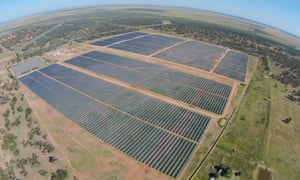
Billion dollar solar farm and battery project will be ‘significant stimulus’ for South Australia.
Billion dollar solar farm and battery project will be ‘significant stimulus’ for South Australia. Photograph: Arena

A huge $1bn solar farm and battery project will be built and ready to operate in South Australia’s Riverland region by the end of the year.
Battery storage developer Lyon Group says the system will be the biggest of its kind in the world, boasting 3.4 million solar panels and 1.1 million batteries.
The company says construction will start in months and the project will be built whatever the outcome of the SA government’s tender for a large battery to store renewable energy.
Lyon Group partner David Green says the system, financed by investors and built on privately owned scrubland in Morgan, will be a “significant stimulus” for South Australia.
“The combination of the solar and the battery will significantly enhance the capacity available in the South Australian market,” he said.
Green said the project, along with a similar one it plans to build near Roxby Downs, would have gone ahead whether or not Port Augusta’s Northern power station had closed in 2016.
“We see the inevitability of the need to have large-scale solar and integrated batteries as part of any move to decarbonise,” Greens said. “Any short-term decisions are only what I would call noise in the process.”
Premier Jay Weatherill commended the Lyon Group for the Riverland initiative, which will enable 330mw of power generation and at least 100mw of storage. “Projects of this sort, renewable energy projects, represent the future,” he said.
The premier said the company is among several to express interest in building a 100mw battery as part of the South Australia government’s power plan announced this month, to be financed by a new $150 million renewable technology fund.
Weatherill said the government will consider the bidders over the coming weeks.

Climate change: China calls US 'selfish' after Trump seeks to bring back coal

State-run tabloid says Beijing cannot fill vacuum left by US and urges west to pressure Trump on global warming

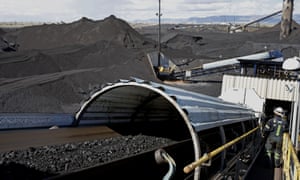
a coal mine in utah
Donald Trump has previously called climate change a hoax created by the Chinese. Photograph: Bloomberg via Getty Images

Chinese state media has lambasted Donald Trump’s efforts to roll back many Obama-era environmental regulations, with a state-run tabloid saying that: “No matter how hard Beijing tries, it won’t be able to take on all the responsibilities that Washington refuses to take.” In an editorial highly critical of Trump’s retreat on environmental regulation, the Global Times made it clear Beijing was uncomfortable taking over leadership of the fight against climate change and could not fill the vacuum left by the US.
“Western opinion should continue to pressure the Trump administration on climate change. Washington’s political selfishness must be discouraged,” the editorial said. “China will remain the world’s biggest developing country for a long time. How can it be expected to sacrifice its own development space for those developed western powerhouses?”
China is the largest emitter of greenhouse gases responsible for global warming, followed by the US, and Chinese leaders firmly agree climate change is a real threat. Their rhetoric has often outpaced their commitments to curb emissions and the country also consumes more coal than the rest of the world combined, although coal use has plateaued in recent years.
“China is not the kind of leader in terms of climate change that will pull other countries along,” said Lauri Myllyvirta, a senior campaigner at Greenpeace based in Beijing. “The Chinese government will only commit to targets it is very comfortable delivering and it needs to work with other major countries. China won’t strike out on its own.”
China is both the worlds largest exporter of renewable energy, and at the same time one of the leading exporters of coal-fired power plants.
Trump has also threatened to pull out of the Paris climate agreement, putting him at odds with China’s president Xi Jinping who has said the “hard-won” deal should remain in force. “All signatories should stick to it instead of walking away from it, as this is a responsibility we must assume for future generations,” Xi said at the World Economic Forum in January.
Even ExxonMobil, America’s largest oil company, has said the US should not back out of its commitments under the accord.
The Global Times editorial said: “Washington is supposed to take the lead in the global fight against climate change but the Trump administration could be the first to ditch the agreement, which is disappointing.”
Trump has previously repeatedly called climate change a “hoax” and without proof has blamed China for rising temperatures. “The concept of global warming was created by and for the Chinese in order to make US manufacturing non-competitive,” he said in a 2012 tweet.
China has committed to having its emissions peak by 2030 as part of a deal with the US, but many forecasts say the country will reach that target years ahead of schedule.
For people living in smog-choked Chinese cities, relief might seem far off. Beijing plans to meet Chinese national air quality standards by 2030, but those levels are still three-and-a-half times higher than those recommended by the World Health Organisation.
China has invested heavily in renewables, but coal remains heavily used in the power, steel and cement industries.

Late-night TV roasts Trump on climate: he 'surrendered Florida to the ocean'

Comics including Stephen Colbert and Seth Meyers discussed the executive order rolling black environmental protection and further Russian connections

‘Clean coal sounds like an oxymoron but then so does president Trump,’ Stephen Colbert says.
‘Clean coal sounds like an oxymoron but then so does president Trump,’ Stephen Colbert says. Photograph: YouTube

Late-night hosts on Tuesday decided to focus on Trump’s latest decision to remove many of Obama’s environmental regulations and further revelations about possible Russian connections.
On The Late Show, Stephen Colbert spoke about the most recent executive order. “A lot of people are upset with Donald Trump because he’s not keeping all of his campaign promises,” he said. “He didn’t repeal Obamacare last week so today he kept an important campaign promise, one that he said many times: today he repealed the environment.”
He claimed that the decision means that he’s “just surrendered Florida to the ocean”.
The White House has claimed that it will create many new jobs. “Repealing environmental regulations will create all sorts of new jobs: oil refining, fracking, clean water historian, keeper of the last six bees ...” Colbert joked.
He then played footage of Trump bragging about the clean coal that will now be created. “Clean coal sounds like an oxymoron but then so does President Trump,” he said.
On Late Night with Seth Meyers, the host started with the news that Jared Kushner is the latest of Trump’s cabinet to be linked with Russia. “At this point it would just be easier to talk about people at the White House who didn’t meet with shady Russians,” he said.
Trump’s response to the latest allegations was to tweet that Clinton’s links with Russia should be focused on instead. “You know why congress isn’t looking into Hillary Clinton?” he said. “Because every day you’re presenting them with a thousand bigger problems. If Godzilla is rampaging in the streets, it’s not the best time to say ‘we need to fix these potholes’.”
He then talked about Devin Nunes, chairman of the house intelligence committee. “Nunes looks like every guy you don’t remember meeting,” he joked.
Meyers listed the strange story surrounding Nunes, who disappeared for a short amount of time right before delivering suspect information to the president. He pitched a film version: “Steve Carell stars as a bumbling congressman turned spy in the new comedy High Nunes”.
He then made a link between Trump and Jeff Bridges’ character in The Big Lebowski. “The Dude and Trump have a lot in common,” he said. “They both have bathrobes, both obsessed with their rugs and they both love White Russians”
During a press conference. Sean Spicer’s response to a question about Russia was to blame the press for making links that aren’t there. He claimed that if Trump used Russian dressing on a salad, people would see it as a connection. “The most suspicious thing about that scenario is the idea that Trump would eat a salad,” he said.
On The Tonight Show, Jimmy Fallon addressed Trump’s low approval rating, a new record that’s worse than anything ever recorded by either Clinton or Obama. “After hearing this, Trump promised to hunt down Bin Laden and sleep with an intern,” he said.
He also discussed the connection that’s been unearthed between Jared Kushner and Russia. “When he heard his son-in-law was having meetings with shady Russians, Trump said ‘You can start calling me dad’,” he said.
Footage from the most recent White House presser showed that Sean Spicer appeared to have some food stuck in his teeth. “Spicer had so much food in his mouth, he barely had room for his foot,” he said.
On The Daily Show, Trevor Noah introduced a skit. “If Trump only wants to spend time on the military then maybe we just have to make everything military,” he said.
He joked that Meals on Wheels, which would be eliminated as part of Trump’s latest budget proposal, should be militarized with “meal team six” throwing meals through windows.
During the skit, a member of the team says: “If we look and act like the military when we deliver food, we can trick the president and protect meals on wheels.”

Cyclone Debbie's cooling effect won't prevent Great Barrier Reef bleaching, scientist says

OceanWatch had expressed hope cyclone could have alleviated pressure the reef is under and prevented further bleaching

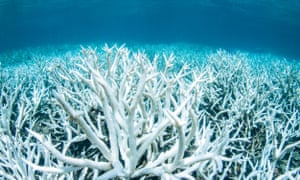
Bleached coral on the Great Barrier Reef
Marine scientist Terry Hughes says the effects of Cyclone Debbie will not prevent further mass bleaching events on the Great Barrier Reef. Photograph: Reuters

The cooling effect of Cyclone Debbie will not be enough to prevent further mass bleaching of the Great Barrier Reef, a leading marine scientist has said.
The category-four tropical storm made landfall on the north Queensland coast on Tuesday, leaving a trail of destruction in its wake. Airlie Beach, Proserpine and Bowen were among the worst hit, though Hamilton, Hayman and Daydream islands were also affected.
The extent of the devastation wrought by the slow-moving cyclone on the embattled reef remains to be seen but suggestions that the wild weather could prevent further mass bleaching have been downplayed.
The environmental charity OceanWatch had expressed hope that the cooling effect of Cyclone Debbie on ocean temperatures could have alleviated the pressure the reef is under and prevented further bleaching.
Temperatures of between 23C and 29C are optimum for coral but the Great Barrier Reef has suffered through unusually warm waters in 2017 and much of 2016, prompting sustained, and in some cases, severe bleaching.
OceanWatch suggested that the wild weather would have brought deeper, cooler water to the surface while shading the coral from the sun, reducing light stress.
But Prof Terry Hughes, the director of the Australian Research Council Centre of Excellence for Coral Reef Studies, told Guardian Australia that the effects of Cyclone Debbie would not prevent further mass bleaching events, as the most severe damage this year had occurred north of her path.
“Cyclone Debbie has come a month too late and in the wrong place to prevent mass bleaching,” he said.
The centre began reef-wide aerial surveys on 16 March, though further activities were delayed by Debbie.
Preliminary information from the first survey showed that all reefs assessed between Cairns and Lockhart river showed some signs of bleaching, ranging from mild to severe.
Last week Hughes had flown over the reefs between Mackay and Townsville, which he said were “only very lightly bleached compared to reefs further north”.
“The cloud and wind has cooled down the sea temperature, which might help the lightly bleached corals near the cyclone recover their colour more quickly. But it’s too late for further north.”
The storm had also likely caused structural damage to some coral that, already weakened by bleaching, may struggle to recover.
Earlier this month, the Great Barrier Reef Marine Park Authority confirmed “moderate to severe” mass coral bleaching for the second consecutive year.
The Tasmanian Greens senator Peter Whish-Wilson raised the devastating impact of the bleaching in the Senate on Wednesday.
He quoted Hughes’s tweet last year: “I showed the results of aerial surveys of bleaching on the Great Barrier Reef, and then we wept.”


I showed the results of aerial surveys of on the to my students, And then we wept.
This drew a mocking response from the Liberals, with the South Australian senator Simon Birmingham replying that “Senator Whish-Wilson needs a lot more than a hanky ... [he] needs a reality check”.
I quoted @profterryhughes saying "I showed the results of bleaching on the reef to my students & then we wept". Watch the govt response.

'The activist Bonnie and Clyde': young lovers lead Portland's Trump resistance

Activism is the foundation of the relationship between Kathryn Stevens and Gregory McKelvey, leaders in the Oregon city’s post-election protest

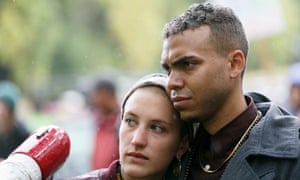
Young, in love, and part of the resistance: McKelvey and Stevens at a protest.
Young, in love, and part of the resistance: Gregory McKelvey and Kathryn Stevens at a protest. Photograph: Gregory McKelvey

The doormat outside a generic apartment in a suburb of Portland, Oregon, bears the words “COME BACK WITH A WARRANT”. Inside, two leaders of the self-titled resistance are at rest. Kathryn Stevens answers the door in workout clothes. In the living room, her boyfriend, Gregory McKelvey, lounges on a sectional in sweats.
This sunny weekday afternoon comes as a quiet break in an otherwise frenetic chapter in their lives. “Before the election,” Stevens says, “I was a very ritualistic, regimented person. I woke up at a specific time, I did yoga. Routines no longer exist. You have to adapt.”
In the wake of Trump’s election, the activists, who are both 24, swiftly formed a group called Portland’s Resistance to fight “a Trump presidency, the rise of white nationalism, and widening income inequality”. McKelvey says local protesters needed leadership, and they looked to him for guidance. Amid this turmoil, Portland’s Resistance was launched. Within a day, they had created a Facebook page and begun organizing.
McKelvey and Stevens soon found themselves at the center of a chaotic scene. On the third night of anti-Trump demonstrations, Portland’s protests took a violent turn as anarchists shattered storefront windows and car windshields.
Local television crews visited McKelvey’s home and asked him to answer for the violence. “Martin Luther King said, ‘A riot is the language of the unheard.’ And it’s not my job to silence anybody that feels unheard,” he told a KOIN 6 News reporter. “I think it’s my job to lead by example, and I’m not gonna lead through chaos. I’m not gonna combat hate with more hate. I’m gonna combat it with love.”
“OK,” the reporter said, “but when you do the gatherings, in love, do you think that sometimes invites the other element that is doing the things you don’t condone?”
“I think we should blame Donald Trump for that,” he answered, “and I do.”
A few weeks later, McKelvey and Stevens created a GoFundMe page that raised more than $50,000 to help repair property damaged by rioters. They now envision a movement that’s inclusive, that upends systems of oppression and that elects like-minded candidates.

Kathryn Stevens at a rally.
Kathryn Stevens at a rally. Photograph: Finn Hawley Blue
McKelvey grew up black in Portland – one of the nation’s whitest big cities. After college, he enrolled in Lewis and Clark Law School and worked as a campaign manager for a state congressional candidate. Through politics, he segued into activism and became involved in local Black Lives Matter events.
Stevens, who is queer, moved to Portland for college after growing up in Vernonia, a small timber town about 40 miles north-west of Portland. As a teen, she experienced homelessness before a foster family took her in. Post-college, she has worked as an advocate for the homeless during an affordable-housing crisis.
Since November, the couple has planned events, made speeches, led community meetings and spent a night in jail. McKelvey refers to them as the “activist Bonnie and Clyde”. Activism is not incidental to their relationship. It’s their foundation.
The two began dating after Stevens sent McKelvey a Facebook message early last summer. Up to that point, their circles had overlapped, but their paths hadn’t crossed.
At the start of 2016, McKelvey had been invited to speak at a Bernie Sanders rally. The young law student overcame a bad case of nerves to discover his knack for public speaking. People kept asking him to speak at their events, and his involvement grew in local Black Lives Matter demonstrations. His appearances were gaining attention, and Stevens took notice.
Her Facebook message to him wasn’t flirtatious. It was more like networking, in her usual upbeat tone: “I want to know more about the work you’re doing in the community,” she wrote. “Let’s get coffee sometime.”
A few days later, Stevens says, McKelvey sent her a message asking if she was going to a march that evening. “Yeah, for sure, I’ll see you there,” she responded. She arrived that day to find McKelvey, to her surprise, giving a speech in front of a big crowd. “Oh, OK, I’m going to your event,” she thought.

‘I couldn’t do what I do without her’, says McKelvey.
‘I couldn’t do what I do without her’, says McKelvey. Photograph: Finn Hawley Blue
The next day, they met for coffee and went to a food drive for a local not-for-profit group. They recognized in one another a shared vision. Their interests and values aligned. From then on, Stevens attended every one of McKelvey’s events she could.
She admired his energy, his commitment to the cause. “In a lot of my relationships in the past, my ambitions have been something that have been difficult for other people to handle,” Stevens said. But for both, activism is the top priority. “I couldn’t do what I do without her,” McKelvey says. By the time election day arrived, Stevens and McKelvey were together in every sense. They were often side by side at demonstrations in news photos: McKelvey in skinny jeans and a long jacket, Stevens with a beanie pulled over her buzz cut.
A couple of weeks after the riots, the pair were arrested during a protest organized by high school students. They’d been invited by a few students to offer guidance. Hours into the event, police arrested McKelvey and Stevens on allegations of disorderly conduct. Those charges were later refiled. McKelvey’s now charged with failure to obey a police officer, and Stevens is charged with resisting arrest. They plan to sue the Portland police bureau for what they allege were baseless and targeted arrests.
Neither McKelvey nor Stevens were happy to be arrested, but they accept that arrest is a risk inherent in protesting. Perhaps increasing their chances: none of their events has been permitted.
“You have a right to go out there and speak your mind,” McKelvey says. “The constitution says nothing about a permit.” But McKelvey and Stevens say that decision may change for future events. They acknowledge that permitted protests may be safer and more accessible for some.
There is no blueprint for leading a movement that fits this precise political moment. They’re learning as they go.
“Neither of us thinks we’re the smartest people in the world or the best activists in the world,” McKelvey says. “But we happen to be at the forefront of this movement right now. So we’re going to utilize that right now to hopefully push it toward progress.”

Trump poised to sign away privacy protections for internet users

President to approve law killing rules meant to prevent internet service providers from selling consumers’ web browsing and app storage histories to advertisers

Without these protections, ISPs are free to track your browsing behavior and sell that data to advertisers without consent.
Without these protections, ISPs are free to track your browsing behavior and sell that data to advertisers without consent. Photograph: Tolga Bozoglu/EPA

President Donald Trump was expected to sign legislation on Wednesday allowing internet service providers to sell the browsing habits of their customers.
The move, which critics charge will “fundamentally undermine” consumer privacy, overturns an Obama-era rule issued last October that was designed to give consumers greater control over how internet service providers (ISPs) could share their information.
Those rules, drawn up by the Federal Communications Commission (FCC), were scheduled to take effect by the end of 2017 and would have forced ISPs to get people’s consent before selling their data to advertisers and others.
Fifteen Republicans broke ranks to vote against the controversial measure on Tuesday evening but the House of Representatives voted 215 to 205 to approve a resolution that uses the Congressional Review Act (CRA) to prevent the privacy rules from taking effect.
The CRA allows an incoming president to overturn previous executive branch regulations and has been used by Trump to repeal a number of Obama’s key initiatives.
The repeal reached the president’s desk on Wednesday morning and the White House has signalled Trump’s clear intention to sign it.
Without the FCC broadband protections, ISPs such as Comcast, Verizon and AT&T are free to track your browsing behaviour and sell that data on to advertisers without consent. This represents a huge treasure trove of personal data, including your health concerns, shopping habits and visits to porn sites. ISPs can find out where you bank, your political views and sexual orientation simply based on the websites you visit. The fact that you are looking at a website at all can also reveal when you’re at home and when you’re not.
“Give me one good reason why Comcast should know what my mother’s medical problems are,” said congressman Mike Capuano during the hearing before the vote, explaining how he had researched her condition after a trip to the doctor. “Just last week I bought underwear on the internet. Why should you know what size I take? Or the color?”

The House Democratic leader, Nancy Pelosi, said: “Americans learned last week that agents of Russian intelligence hacked into email accounts to obtain secrets on American companies, government officials and more.
“This resolution would not only end the requirement you take reasonable measures to protect consumers’ sensitive information, but prevents the FCC from enacting a similar requirement and leaves no other agency capable of protecting consumers.”
But Ajit Pai, Trump’s newly appointed head of the FCC, argued that the Obama era rules were an example of regulatory overreach and that another regulator, the Federal Trade Commission, already polices online privacy rules.
“Moving forward, I want the American people to know that the FCC will work with the FTC to ensure that consumers’ online privacy is protected though a consistent and comprehensive framework. In my view, the best way to achieve that result would be to return jurisdiction over broadband providers’ privacy practices to the FTC, with its decades of experience and expertise in this area,” he said.
Those in favor of repealing the privacy rules argued that it levelled the playing field for internet service providers who want to get into the advertising business like Google and Facebook. According to ISPs, scrapping the rules would allow them to show the user more relevant advertising and offers, which would give the companies better return on the investment they have made in infrastructure. They argue that web browsing history and app usage should not count as “sensitive” information.
But privacy advocates and consumer watchdogs immediately joined Democrats in condemning the policy shift.
“Today Congress proved once again that they care more about the wishes of the corporations that fund their campaigns than they do about the safety and security of their constituents,” said Evan Greer, campaign director of digital rights group Fight for the Future.
“Gutting these privacy rules won’t just allow internet service providers to spy on us and sell our personal information, it will also enable more unconstitutional mass government surveillance, and fundamentally undermine our cybersecurity by making our sensitive personal information vulnerable to hackers, identity thieves, and foreign governments,” she added.
Carmen Scurato, director of policy and legal affairs at the National Hispanic Media Coalition, called the vote “a disturbing rubber stamp from conservative policymakers aimed at dismantling needed consumer protections for corporate profit.
“With the approval of the president, corporations will now be handed the ability to share the sensitive, personal information of millions of Americans without their consent and hinder the FCC’s role as a consumer watchdog far into the future,” she said.