Friday, 30 November 2018

Adani's Carmichael coal mine to begin construction within weeks


BREAKING: Adani's Carmichael coal mine to begin construction within weeks - The Australian
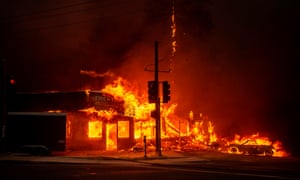
As more than 120 bushfires burn across Queensland, with people describing "20-metre flames fanned by 'tornado-like' winds"*, Adani has announced it will proceed with its mega coal mine in the Galilee Basin. Adani will reportedly self-finance its mine, after failing to secure finance from any Australian or international banks.
Australia Institute research shows Adani's mine will only fuel global warming, contributing to extreme weather events like bushfires, heatwaves and further bleaching of the Great Barrier Reef.
Adani's coal mine must not go ahead. It is a disaster environmentally and it does not stack up economically. 
BREAKING-Adani.png
No New Coal Mines - Australia Institute research has debunked the jobs claims of Adani again and again. Coal mining is small employer in Australia. Coal mining employs fewer people in Queensland than arts and recreation. While Adani tells the public it will employ thousands of people, Adani boasts to shareholders its mine will be automated from pit to port. Our research shows the best way to protect coal jobs in existing mines is to stop the construction of new, highly automated coal mines in the Galilee Basin. That's why the Australia Institute backs former President of Kiribati Anote Tong's call for a global moratorium on new coal mines.
No fossil fuel subsidies - Australia should not be building new coal mines, nor should governments be subsidising them. The Queensland Government is still offering Adani a secret royalty deal. The Australia Institute has tried to find out what the deal is through FOI requests but they have blocked access to all information about the deal. By deferring royalties, the Government will be lending Adani hundreds of millions of dollars at a discount rate - that’s if they ever do pay it back. No one else in Qld gets this special deal. But Adani can. Worse still, Adani is still under investigation for potential environmental breaches.
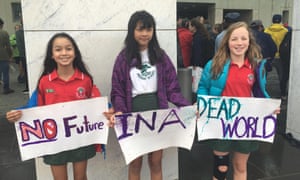
It is not too late to stop Adani's polluting mega coal mine, but now it's crunch time. Tomorrow, Friday 30 November, tens of thousands of school students are preparing a big school walk out for climate action and you can join them to Stop Adani. The School Strike for Climate Action is organising rallies in Melbourne, Sydney, Brisbane and Adelaide, as well as almost 30 other towns across Australia.
MELBOURNE > 12 noon, 30 November, outside VIC Parliament on Spring Street 
SYDNEY > 12 noon, 30 November, Martin Place outside Channel Seven (btwn Elizabeth and Phillip Street) 
BRISBANE > 12 noon, 30 November, outside QLD Parliament 
ADELAIDE > 11am, 30 November, outside SA Parliament
There are likely to be snap rallies held across Australia next weekend as well.
Australia Institute supporters have backed our fossil fuel research over many years, whether debunking jobs claims or our work exposing the fossil fuel subsidies and the cost to taxpayers, so we will keep you posted as we hear more details. Thank you for your ongoing support for our mining and fossil fuel research, as part of our Climate & Energy program.
- The Australia Institute Team


P.S. You can read some of our key research reports on Adani here:
- In the dark on Adani deal
- The impact of Galilee Basin development on employment in existing coal regions
- FOI: Adani's helping hand - Australian government rattles the tin in China and South Korea
- Adani's automated mine risks just transition for coal workers


*People caught up in Queensland bushfires describe 20-metre flames fanned by 'tornado-like' winds, ABC 

Past four years hottest on record, data shows

World running out of time to combat climate change, warns meteorological organisation
Global temperatures have continued to rise in the past 10 months, with 2018 expected to be the fourth warmest year on record.
Average temperatures around the world so far this year were nearly 1C (1.8F) above pre-industrial levels. Extreme weather has affected all continents, while the melting of sea ice and glaciers and rises in sea levels continue. The past four years have been the hottest on record, and the 20 warmest have occurred in the past 22 years.
The warming trend is unmistakeable and shows we are running out of time to tackle climate change, according to the World Meteorological Organization, which on Thursday published its provisional statement on the State of the Climate in 2018. The WMO warned that, on current trends, warming could reach 3C to 5C by the end of this century.
“These are more than just numbers,” said Elena Manaenkova, the WMO deputy secretary general. “Every fraction of a degree of warming makes a difference to human health and access to food and fresh water, to the extinction of animals and plants, to the survival of coral reefs and marine life.”
The world has committed to keeping warming to no more than 2C above such levels, with an aspiration to limit rises to 1.5C, which the Intergovernmental Panel on Climate Change (IPCC) has said will cause the dieback of coral reefs, sea-level rises and extreme weather in many regions.
Greenhouse gas levels were also recently found to be at record levels, and a UN report this week said the world must triple its emissions reduction efforts to stay within 2C – and to stay within 1.5C, those efforts needed to be five times greater.
On Monday, the Met Office said summer temperatures in the UK could be 5C hotter by 2070, making this year’s heatwave the norm for the future, while winters could get much wetter. London could become increasingly vulnerable to storms and flooding owing to sea-level rises, with the water level in the capital likely to rise by 1.15 metres by the end of the century.
The WMO found the extent of Arctic sea ice in 2018 was much lower than normal, with the maximum in March the third lowest on record and the September minimum the sixth lowest.
The oceans have been absorbing record or near-record amounts of heat at certain periods. The year started with a weak La Niña event but by October there were signs of a return to El Niño conditions, which can raise global temperatures further.
There were a greater number of violent storms than usual, including 70 tropical cyclones in the northern hemisphere, compared with the long-term average of 53. Storms brought devastation to the Mariana Islands, the Philippines, Vietnam, the Korean peninsula and Tonga, while hurricanes Florence and Michael caused substantial damage in the US.
Wildfires raged in Greece, Canada, California and other areas, while floods devastated Kerala in India and displaced more than 1.4 million people. Japan also experienced serious flooding, as did east Africa.
Petteri Taalas, the secretary general of the WMO, a leading authority on climate change, said: “We are not on track to meet climate targets and rein in temperature increases. If we exploit all known fossil fuel resources, the temperature rise will be considerably higher.
“We are the first generation to fully understand climate change and the last generation to be able to do something about it.”
Manaenkova added that every effort to reduce greenhouse gases and the impacts of climate change was worthwhile. “Every bit matters,” she said, citing the harm done by temperature rises to every aspect of life, including economic productivity, food security, glacier melt and water supplies, and the future of low-lying islands and coastal communities.
Jens Mattias Clausen, Greenpeace’s head of delegation at the UN climate change conference (COP24) in Poland, said: “The evidence, if we needed any more, continues to stack up. The record-high heatwaves, record-low Arctic sea ice, above average tropical cyclones and deadly wildfires are an alarm bell impossible to ignore. We’re in the midst of a climate crisis and this meteorological report spells out the worsening threat in startling clarity. It’s no longer our future that is in peril; our today is at risk.

“The recent IPCC report also showed that we still have hope. We have 12 years to move the needle and any leader who comes to COP24 unprepared to step up and take action needs to read the WMO report and understand it’s time to stop talking and start acting on climate – while we still have the chance.”

The ticking bomb of climate change is America's biggest threat

It’s time for the United States to treat climate change as the national security challenge it is
Imagine that US leaders were told that hundreds of nuclear weapons were set on a timer to detonate across the planet, progressively and in increasing numbers, over the coming years and decades. The lives of millions would be upended, if not made nearly impossible to survive, by transformed weather patterns and resource scarcity. Tens of millions would become migrants as regions became uninhabitable. Millions would die, more and more as time went on. If this science fiction were reality, US leaders would lead an international effort to immediately disarm and dismantle the weapons.
But this isn’t science fiction. Climate change is a ticking time bomb, literally threatening to end human life on earth over the coming centuries. As climate journalist Peter Brannen describes it, Earth faced a similar crisis hundreds of millions of years ago during the “Great Dying” when volcanoes spewed so much carbon dioxide into the air – including magma that blanketed an area as large as the lower 48 US states, 1km deep – that it almost killed all life. Today, Brannen says, “we’re shooting carbon dioxide up into the atmosphere 10 times faster than the ancient volcanoes”.
There is no greater national security threat than climate change. Even the specter of nuclear war between great powers – the only thing that could remotely mimic the effects of climate change over time – is a much lower risk than climate change, which is already happening.
Every year we fail to act the problem grows, and the solution becomes more difficult. As America dithers, climate change is sparking a slow-motion nuclear-scale holocaust. If the world fails to urgently mitigate climate change, no other challenge – not the rise of China, Russian aggression, terrorism, nor some other future geopolitical peril – will matter because humans won’t survive to be the cause of these threats or suffer from them.
America’s failure is not for lack of capacity to safeguard against future threats – the US invests hundreds of billions of dollars every year in defense to deter adversaries such as Russia and China, and tens of billions more in intelligence capabilities to monitor threats. Instead, America is paralyzed by a lack of political will. Donald Trump and his allies in Congress – many of whom deny the existence of climate change – are making the problem worse. The president announced his intent to withdraw the US from the Paris climate agreement and is rolling back regulations that would have cut emissions.
Despite this dark reality, there is reason for hope. In 2015, the world came together to negotiate the Paris agreement, which set the goal of limiting global temperature increases to well below 2C. Despite a hostile Trump administration, many US governors, mayors, businesses and private citizens are already leading the way. So are other countries as they seize the economic and public health opportunity that comes with a clean energy future.
The path ahead, to say the least, is daunting. Even if the US were not to leave the Paris climate agreement, the action required to realize its potential is enormous. US policymakers will need to use every policy tool in their toolbox to drive unprecedented deployment of clean energy and build out zero-carbon transportation infrastructure. When the US leads by example, domestic emissions will fall, and new diplomatic doors to more ambitious climate action will open.
Climate activist Bill McKibben says that “global warming … is a world war aimed at us all” and recommends that, like the national effort forged during the second world war to defeat the Axis powers, the US must “mobilize” American industry and citizens to transform to a clean energy economy.
Everybody will need to pitch in. For example, when the Obama administration was negotiating the bilateral climate deal with China in 2014 that made the Paris agreement possible, my colleagues and I in the east Asia bureau at the state department worked with the US climate negotiators on a statement with the 10 nations of Asean committing to cut emissions – a statement only made possible by the US-China deal. The painstaking negotiations for this relatively symbolic statement were indicative of how much work the US needs to put into the climate effort in every corner of the world – and the ripple effects it can have elsewhere.
It’s time for the US to treat climate change as the national security challenge it is. Diplomats are ready to negotiate new agreements. Development experts can support sustainable solutions for countries facing resource scarcity and in need of resilient infrastructure and community designs that can withstand more intense and damaging extreme weather events. The military can help respond to extreme weather disasters. National security experts around the world already recognize climate change as a serious threat to global stability and are ready to answer a global call to action.
Without success in tackling climate change, eventually none of the other threats we face will matter.

  • Michael H Fuchs is a senior fellow at the Center for American Progress, a former deputy assistant secretary of state for east Asian and Pacific affairs and a Guardian US contributing opinion writer

Climate change is the biggest threat to our futures, not striking from school

Extract from The Guardian

We are walking out for a day to send the Australian government a message: you can no longer pretend we are not here
This month, hundreds of children are going on strike from school to demand urgent action on climate change. From rural Victoria to Townsville, we are walking out of school for a day or more to tell our politicians to listen to us and protect our futures.
We are Milou, Jean and Harriet and we are 14 years old.
Two of us – Milou and Harriet – live in rural Victoria. Throughout our lives, we’ve witnessed the impacts that drought, bushfires and extreme weather have on a community. We have been forced to evacuate when a bushfire came through our town. It was scary. But it is something that will happen more and more as climate change gets worse.
We feel frustrated and let down when we think about the climate crisis and our future. There is so much our politicians could be doing that they aren’t. It seems they are in denial. Our government is supposed to protect us, not destroy our chances of a safe future.
Climate change doesn’t only affect our environment. It affects our physical and mental wellbeing. Milou’s mum is a psychologist and she knows how much something like a bushfire can threaten everything a person cares about. It’s hard to hold on to dreams for the future when we don’t know what that future holds.
We feel hurt when we hear people say that we can’t think for ourselves because we’re still children. This is just an excuse not to listen to us. We are perfectly capable of thinking for ourselves. We deserve to be heard and understood.
As kids, we can’t yet vote or run for government, however scientists say there’s only about a decade left for us to avoid the worst impacts of climate change. By the time our generation is making decisions, it will be too late. We’re striking from school to push for urgent change now.
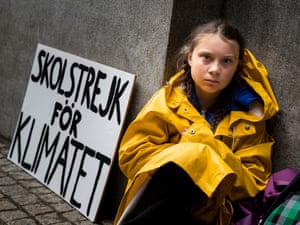
We were inspired after seeing 15-year-old Greta from Sweden in the newspaper. She’s striking every Friday to put climate change in the spotlight in her country. Australia is even more vulnerable to climate change impacts, which is why we are doing the same here.

Greta Thunberg leads a school strike outside the Swedish parliament, in an effort to force politicians to act on climate change.
Greta Thunberg leads a school strike outside the Swedish parliament, in an effort to force politicians to act on climate change. Photograph: Michael Campanella for the Guardian

None of us want to grow up in a world where dangerous bushfires and crippling droughts are normal, where we struggle through extreme heatwaves, and where young people lose their homes to sea level rise.
We are often told to count our blessings. We feel lucky to live in such caring communities. But, when we think of all our blessings, it also makes us want to cry. The idea that our children and grandchildren may not get to experience the beautiful world that we live in, is one of the saddest things we can think of.
We want to live in a world powered by 100% renewable energy. We don’t want massive new coalmines like Adani’s that will wreck the climate and our future.

Although we love school and learning, we love our family, friends and community more. And we will do anything to ensure all of us have a safe planet to live on. So, we are striking from school to save our future, and the futures of the people we love and those not yet with us.

"We might not be able to vote, but we have rights. We have a right to a future." Words from an 8 year old.

🌏🌏🌏🌏🌏🌏🌏🌏🌏🌏🌏🌏🌏 .

And we have a message for our politicians: it’s time to listen to us. You cannot continue pretending we are not here, and that climate change is OK. Because we are here. The climate crisis is here, and it is destroying our planet. People’s lives and livelihoods are on the line. We have trusted you to do what is in the best interest of our country, and it is clear to us that you aren’t doing enough.
At the end of November, we are going on strike together with kids from across Australia to get our voices heard. We’re giving up our education for a day to learn more about climate change, experience how to make a difference, and demand our politicians take urgent action on the most important issue of our time.

Part-time parliament; full-time civil war: Shorten’s parting shot to Morrison

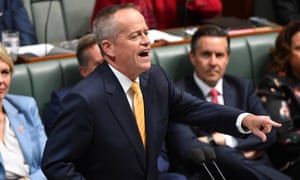
Bill Shorten has bookended a horror parliamentary week for the Morrison government with a full-throated parliamentary onslaught, declaring the parliament is “part-time under this prime minister, but the civil war in the Liberal party is a full-time occupation”.
When a government MP was ejected from the chamber during a rowdy question time, Labor attempted to capitalise on the Coalition’s lack of command of the chamber, now that it governs in minority, with a snap suspension of standing orders, creating an opening for Shorten to launch a stinging critique.
Labor ultimately lost the procedural vote in the House, with four of the independents abstaining, and Bob Katter backing the Coalition, but Shorten grabbed the opportunity to declare his opponents had given up on governing, and were now only talking “to themselves about themselves, in conservative echo chambers”.
Referencing recent electoral drubbings for the Coalition, Shorten said the Liberals now “pontificate about this mythical rightwing base and … write off whole communities as irrelevant”.
He said the government explained various setbacks by arguing various electorates were unrepresentative of the community as a whole. “Batman isn’t the real Australia. Perth is not the real Australia. Fremantle is not the real Australia. Mayo is not the real Australia. Braddon isn’t the real Australia. Longman isn’t the real Australia. Wentworth isn’t the real Australia.”
Shorten said the government had disavowed the whole state of Victoria after the weekend state election defeat.
He contended the “part-time parliament” – a reference to the scaled-back sitting program for 2019 – “points to a bigger issue”.
“This is a government which has simply ceased to govern. Not only have they given up governing, they’ve given up pretending to govern. They have no agenda and no legislation,” Shorten said, adding the government was now “swept along by the currents of hate and division”.
Morrison, who departed for the G20 meeting in Argentina immediately after question time, attempted to repel the political assault by pointing to the government’s record in economic management.
Morrison said the government had presided over the strongest growth in the median wage in the past 13 years, and the strongest growth in non-mining investment in 30 years, as well as the lowest level of welfare dependency of working-age Australians in 25 years.
“The Labor party has a plan to divide this country,” Morrison said. “The Labor party has a plan to undermine the very principles of a fair go that has made this country the strong, united, vibrant country that it is today, and Australians, I believe, will get the opportunity to see that between now and the next election.”
“They will know absolutely when they go to the next election that the leader of the Labor party, and the Labor party, wants to disrupt the living standards of Australians by imposing their ideological and reckless agenda on the Australian people.”
Morrison does not have a bilateral meeting scheduled with Donald Trump at the G20 but trade is expected to be a major focus, with the United States and China in the middle of a damaging trade war. Morrison is expected to meet the British prime minister Theresa May.
Parliament rose on Thursday night and will return for the final parliamentary sitting week of the year on Monday. Morale inside the government is low, reflecting the current level of political adversity, and the crossbench independents are flexing their muscle, wanting to use the remaining parliamentary sessions to get some runs on the board.
The manager of government business Christopher Pyne met the lower house crossbenchers late on Thursday – a constructive gesture after earlier in the week threatening to send the new member for Wentworth, Kerryn Phelps, to the high court.
The independents want the government to bring on debate next week about a private members bill Phelps has proposed to allow the immediate transfer of children and their families from Nauru. The crossbench at this stage lacks the numbers to trigger debate if the government doesn’t facilitate it.

It remains unclear whether the home affairs minister Peter Dutton will be referred to the high court to have his eligibility tested, with some of the independents now saying other government and Labor MPs also have questions to answer.

Australia named as one of the world's worst performers on biodiversity

WWF rates Australia a zero due to the absence of biodiversity measures in our Paris climate change commitments
Australia has been named as one of the worst performers among a group of 100 nations due to the absence of biodiversity measures in our climate change commitments, according to a new report by WWF.
The report, published this week during the conference of parties to the Convention on Biological Diversity in Egypt, examines whether climate commitments from countries under the Paris agreement also offer benefits for nature and biodiversity.
While countries aren’t required to include biodiversity measures in their nationally determined contributions (NDCs), some activities, such as reducing deforestation and preserving habitat, have dual benefits for the climate and nature.
WWF is calling for more integration between between the two.
“Given that resources are finite and that action in one area can have a knock-on effect in another, the best way forward is to take integrated action on climate, development and nature,” the report states.
“Climate and biodiversity are intrinsically linked as climate change is one of the underlying drivers of habitat and biodiversity loss, while the deterioration of ecosystems and their services contributes to rising greenhouse gas emissions.”
Australia was one of the worst performers among the group. Along with the United States and Canada, Australia was rated a zero because none of its commitments involved biodiversity measures.
“Australia’s NDC is brief and focused on economy wide targets, rather than detailed plan implementation,” the report states.
“In 2015, the government released their national climate resilience strategy, which better reflects an integration of biodiversity considerations into climate policy.”
By comparison, the report said countries in the Caribbean, Latin America, south-east Asia and the Pacific were better at considering the significance of biodiversity, nature and forestry measures as part of their climate response.
Martin Taylor, a conservation scientist with WWF, said countries such as Indonesia were taking steps to reduce deforestation but “Australia is doing none of that”.
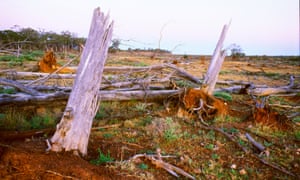
“There’s no commitment to end deforestation. In fact we’ve had an explosion in deforestation recently,” he said.
“We’re not performing at all because climate isn’t even mentioned in the NDC to the climate agreement.”
The report was released as countries prepared on Thursday morning in Sharm El-Sheikh to agree on a pathway toward a new global framework for protecting biodiversity.
New targets for people and nature are set to be established at a summit in Beijing in 2020 which conservationists hope will mobilise countries to do more about the global extinction crisis.
“It is clear from the meeting in Egypt that Australia is going to need to ramp up its policy ambition if we are to move off of the bottom ranks for protecting nature and wildlife,” said James Trezise, a policy analyst with the Australian Conservation Foundation.
“There is an important opportunity for both major parties to think about how their policies can contribute to a new deal for people and nature, especially in the context of a likely May election.”

Comment was sought from the environment minister, Melissa Price

Michael Cohen pleads guilty to lying to Congress over Trump project in Russia

One of Donald Trump’s closest advisers spoke with a Kremlin official about securing Russian government support for a planned Trump Tower in Moscow during the 2016 presidential election campaign, he said on Thursday.
Michael Cohen, who served as Trump’s legal fixer for more than a decade, said in an explosive testimony that Trump continued trying to develop a tower in Russia’s capital months into his campaign for the presidency – contradicting Trump’s account.
The development signalled legal peril for Trump, whose presidency has been besieged by special counsel Robert Mueller’s inquiry into whether his campaign team colluded with Russia’s interference in the 2016 US election.
Cohen made his disclosure as he pleaded guilty to lying to Congress about the Moscow project. He said he made false statements to hinder the Trump-Russia investigation and to protect Trump, who was identified in court as “Individual 1”.
“I made these statements to be consistent with Individual 1’s political messaging and out of loyalty with Individual 1,” Cohen told the federal court in Manhattan on Thursday morning, after signing a plea agreement with Mueller. He did not say if Trump directed him to lie.
Mueller said Cohen had specified that he lied “to give the false impression that the Moscow project ended before the Iowa caucus” which took place on 1 February – the critical first vote in Trump’s presidential primary contest in 2016.
Outside the White House, Trump told reporters that Cohen was “a weak person and not a very smart person” and claimed without evidence that Cohen was lying to secure a reduced punishment for other crimes.
Mueller said that in addition to lying about the extent of Trump’s oversight of the Moscow project, Cohen’s emails showed that he also lied when he told Congress that there had been no plans for Trump to travel to Moscow in 2016.
The new disclosures challenged Trump’s repeated denials that neither he, nor his associates, had any contact with Russian officials. Mueller is investigating whether Trump’s team coordinated with Moscow’s interference in 2016, which US intelligence agencies concluded was aimed at helping Trump win.
In August last year, Cohen told congressional investigators that though he had sent a speculative email to Russian president Vladimir Putin’s press secretary, Dmitry Peskov, about the Trump Tower project, he received no reply, and had no other contacts with Russian officials about the plans.
But Mueller said in a court filing on Thursday that Cohen now admitted that he did receive a reply from Peskov’s office, and that during a telephone call with Peskov’s assistant in January 2016, he “requested assistance in moving the project forward” with land and financing.
Cohen also said on Thursday that efforts to pursue the Moscow project actually continued until June 2016 – several months later than he claimed previously. By that time, Trump was the presumptive Republican presidential nominee.
Last year, Cohen claimed to Congress that in January 2016 it was decided the Moscow development “was not feasible for a variety of business reasons and should not be pursued further”. This allowed Trump to deny having had any business ties to Russians during the presidential campaign.
Cohen now admitted that he had briefed Trump on the Moscow more frequently than the three occasions that he previously said, according to Mueller, and that he also briefed unidentified Trump “family members”. Trump’s eldest three children were senior executives in his property company.
The special counsel said Cohen also made plans for Trump to travel to Russia during the presidential campaign. He asked Trump if a visit would be possible and “asked a senior campaign official about potential business travel to Russia”, Mueller said.
Cohen allegedly said in a May 2016 email that Trump’s visit to Russia would take place “once he becomes the nominee after the convention”.
Mueller said Cohen made that suggestion in an email to Felix Sater, a Russian-born business associate of the Trumps, who worked with Cohen on the “Trump Tower Russia” plans and claimed to have connections with influential figures in Moscow.
Sater, identified as “Individual 2”, emailed Cohen the day after Cohen spoke with the Kremlin aide, according to Mueller. “It’s about Putin they called today,” the email said.
Sater continued trying to arrange travel to Russia for the project for several months, according to Mueller. In May 2016, he wrote to Cohen to say he had spoken “with Moscow” about “a pre-meeting trip” involving only Cohen and a possible further visit involving “the two big guys” – apparent references to Trump and Putin.
Sater also emailed Cohen to say that Peskov wanted to invite Cohen to the June 2016 St Petersburg Forum – styled as Russia’s answer to the World Economic Forum in Davos – where Cohen could meet Putin or Dmitry Medvedev, the Russian prime minister.
“He said anything you want to discuss, including dates and subjects, are on the table to discuss,” Sater told Cohen. Mueller said Cohen eventually scrapped plans to attend the conference.
In August this year, Cohen pleaded guilty to violating election campaign finance laws. He told the court at the time that he did so at the direction of Trump. He has been cooperating with Mueller’s Trump-Russia investigation since then.
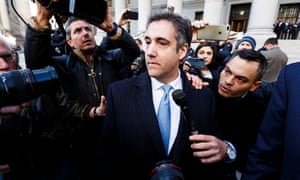
Cohen on Thursday appeared more upbeat than at his August hearing. He greeted reporters and seemed relaxed throughout proceedings. Wearing a grey suit, white shirt and periwinkle tie, Cohen answered routine questions from Judge Andrew Carter about whether anything – such as prescription medications – could affect his judgment in pleading guilty. He said no.
The developments followed several days of increasingly frenzied attacks against Mueller by Trump, who has without evidence accused the special counsel of carrying out a “witch-hunt” against him and his associates.
Mueller said on Monday that Paul Manafort, Trump’s former campaign chairman, had continued lying to investigators even after agreeing to cooperate with the inquiry into Russian election interference.

The new actions against Manafort and Cohen promptly followed the president’s long-delayed submission of written answers to questions from Mueller. Investigators are likely to be comparing alleged and admitted lies told by Manafort and Cohen with the answers provided by Trump to check the president gave truthful responses.