Friday, 27 January 2023

With only a simple yes or no vote available in the referendum, scenes on Invasion Day expose the problem Labor faces.

Extract from The Guardian


Objections to the date of Australia Day persist, but this year opposition to the voice bubbled to the fore.
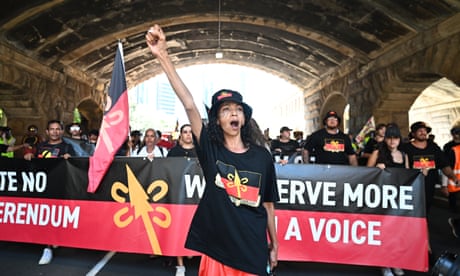
People hold a banner as they take part in an Invasion Day march through the streets of Sydney
‘Indigenous people have been patient for a couple of centuries while white Australia refused to reflect, refused to listen, refused to atone, refused to engage.’

Suited up on the shores of Lake Burley Griffin in Canberra on a sparkling summer day, having handed out the annual gongs and welcomed new citizens to their adopted homeland, Anthony Albanese posed a simple question about the voice to parliament.

“If not now, when? If not now, when will this change occur? If not the people of Australia this year, who will make this change that will improve our country, improve our national unity?”
This prime ministerial cadence samples one of the mantras of the civil rights movement – if not us, then who? These five words form the enduring question of progressivism posed by leaders from John F Kennedy to Barack Obama: can we locate our better angels? Can we rise?

The pitch needed to be simple, because Albanese lacks the silver tongue of a Kennedy or Obama, and because the appeal wasn’t being made in a vacuum. In a referendum campaign sense, Australia Day was the obvious springboard to next steps. But the day is both totemic and bitterly contested.

Totemic because 26 January is the day of dispossession. The day when sovereignty was never ceded. The day that reminds Indigenous peoples British colonists exiled them in their own lands, then spent generations compounding the harm. Contested, because it is a day where a deep well of intergenerational trauma intersects with a hot-takes complex addicted to spectacle and indifferent to suffering.

It has become the noisiest day of the year, and away from the manicured Canberra lakefront and the workshopped locutions of aspirational politicians, voices were raised.

For several years the focal point of protests has been changing the date. Polling data suggests this campaign is gaining some ground. Every year, Australians become a little more equivocal about whether Invasion Day is the right day for an inclusive national celebration. The centre of gravity is shifting.

Objections to the date persist, but this year, opposition to the voice bubbled to the fore. “Fuck your voice,” read one prominent sign, ferried through Canberra to the Aboriginal tent embassy. “No to the voice – manufactured constitutional consent”, read several others outside the old parliament house.

Nioka Coe-Craigie, who said her parents had helped found the tent embassy, claimed constitutional recognition would “silence our voices”. She said her community would not recognise a government-backed Indigenous body. “When they stand over there with them, they lose the right to speak on behalf of our people,” Coe-Craigie said, gesturing toward parliament.

The summer break has furnished an opportune lull for Peter Dutton to foment opposition to the proposal. Festooned in a Socratic cloak, feigning everyman curiosity, the Liberal leader has waved his 15 questions. This is a prelude to saying no to the voice if Dutton judges the Liberal party base will break rather than bend to the epic reasonableness of consulting Indigenous people on policy that affects them. Remnants of the right are itching to weaponise the voice as the Wokerati handing black Australia a veto power.

Dutton signalled late on Thursday that he would be “happy to attend a future meeting” of the government’s voice referendum working group, following Albanese’s public invitation to be constructive the day before.

But critics at Invasion Day rallies aren’t worried the voice is overreach. They are worried it means nothing. Whose voice is this voice? Will this thing have any power? What will it change? What will it cost us? Can it detonate the racist foundations of colonial Australia?

Indigenous people have been patient for a couple of centuries while white Australia refused to reflect, refused to listen, refused to atone, refused to engage, and asserted its inalienable right to create exclusionary institutions either indifferent or hostile to justice for First Nations people. Patience for earnest incrementalism isn’t infinite.

For the record, the voice isn’t a top-down proposal. It emerged from Indigenous peoples in a statement from the heart.

But for some, this change isn’t enough. “Why would we accept our political role in this country as an advisory body?” a young woman named Leah said. “For us to accept a role as a consultative body, not decision-makers. Those are crumbs, what’s on the table being offered to us now ... We don’t want a seat at their table.”

Despite strong criticism on the stage in the nation’s capital, opposition to the voice was less enthusiastic in the crowd. Applause was noticeably quieter to those remarks than others.

Back from the loud-hailers, in the throng, the voice was considered an advance. Numerous non-Indigenous people said they believed the advisory body would be a step forward, and that they would support it. “There’s no power unless you get in that door [of parliament],” said one woman, Nell.
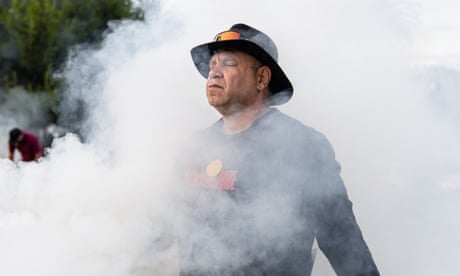
But some also said they would reconsider their views after hearing the criticisms of Indigenous speakers. Amy, a young woman attending the rally with friends, said she previously thought supporting the voice was “a no-brainer” and hadn’t understood why some Indigenous people opposed it.

“Hearing it today was eye-opening. It’s not a no-brainer for me any more,” she said. Nell said she understood why some Indigenous speakers saw the voice as “tokenism”, but believed it would have benefits.

It is possible Invasion Day 2023 will be remembered the high water mark of “fuck your voice”. It’s possible the scepticism on display won’t influence the many Australians who like the sound of a voice but haven’t a clue what it is.

While we can’t know the future, the scenes at Thursday’s rallies expose the perennial problem for Labor.

Critics on the right will chide the government for going too far, while critics on the left want them to go further. With only a simple yes or no vote available in the referendum, the government is entirely alive to the possibility of being sandwiched and outflanked on both edges.

Small Queensland town of Eidsvold loses free-to-air TV signal as council closes transmission tower.

Extract from ABC News

Play Video. Duration: 2 minutes 31 seconds
Eidsvold will lose free-to-air TV.(Patrick Heagney)

Every day, Anne Johnson looks forward to her evening routine.  

"I come in, after a long day of mowing or around the yard," she said.

"Seven o'clock is for Home and Away.

"And then we just sit back and watch whatever's on."

But after today, Ms Johnson will no longer be able to access her favourite shows.

She is one of 600 residents in the rural Queensland town of Eidsvold who will lose the majority of their free-to-air television service after the local council decided to close the transmission tower.

An elderly woman in a black and white striped dress stands in front of a cream wall of her house.
Anne Johnson says the tower closure will send Eidsvold back to the "dark old days".(ABC Wide Bay: Pat Heagney)

"It's disgraceful," she said.

"In all my time, I don't know of any other place that's lost their TV coverage."

Ms Johnson said the closure would send the town "back to the dark old days".

"I mean, it's a given that you should get free-to-air TV; it's just normal.

"We're being treated like we're not normal anymore."

The North Burnett Regional Council decided in April 2021 to close the tower today.

It means Eidsvold and some surrounding properties will lose access to all commercial television stations and SBS, but will continue to receive ABC services through a separate tower.

The closure has angered residents, who say TV is a crucial lifeline for the isolated community.

A middle-aged man with grey hair and a grey shirt faces the camera from in front of a window.
Noel Thompson says the decision to close Eidsvold's tower will strip the town of its connection to the world.(ABC Wide Bay: Pat Heagney)

Noel Thompson said it was "not fair" and that the town was being forgotten.

"They're taking so much away from us," he said.

"It's so important to people to have their local TV. We've got no pub, we've got nowhere to go, nothing to do at night."

North Burnett Regional Council CEO Margot Stork said the decision to close the tower was made after the council had maintained the infrastructure for more than a decade.

"That decision was made for two reasons — one being the cost of continuing the service and the changes to television services over the period.

"Secondly, this is not a core business of council to be providing these retransmission services."

The council said "alternatives were considered" but ultimately it was decided that the re-transmission program would cease.

A Broadcast Australia spokesperson said it did not have data on the number of towns that had lost access to television stations, but that it was "not frequent".

The organisation said the last time it happened "at any scale" was in 2010 to 2012 when viewers converted from analogue to digital television.

'Cut off from the world'

Eidsvold, a small rural town about 400 kilometres north-west of Brisbane, has one of the highest proportions of Indigenous residents in Queensland.

North Burnett Community Service CEO Yasmin Barber said television played a vital role in keeping the community connected.

"Given our rural nature, we're already quite isolated and we don't have access to a lot of services and activities," she said.

"So I'm actually really concerned from a social isolation perspective.

"We've had lots of people who have come to us and expressed distress about what they're going to be able to do.

"For better or worse,TV is their kind of social interaction for a lot of the time and how they feel connected to the outside world."

A group of women gather to protest with one shouting and holding a sign that reads, 'No TV'.
The tower closure has angered residents who say TV is a vital lifeline for the small community.(ABC Wide Bay: Pat Heagney)

Wakka Wakka elder Max Chapman said the removal of free-to-air TV would leave residents in limbo.

"We've got nothing here," he said.

"I'm an old-age pensioner. I can't be going around to parties or down to the pub. We don't even have a pub.

"[Television] is about the only thing in life to keep us going.

"It gives us something to do."

An indigenous man stands in a dark blue checkers shirt with brown sunglasses and a hat.
Max Chapman says TV is the only entertainment there is in Eidsvold.(ABC Wide Bay: Pat Heagney)

Alternatives 'out of reach'

The North Burnett Regional Council said Eidsvold residents would be able to access free-to-air TV through a federal government service known as VAST.

"Community members are invited to actually speak with electricians within their area to look at what necessary infrastructure needs to be put in place in their household to connect," Ms Stork said.

But Ms Barber said set-up costs and connectivity issues meant many in the community would go without TV altogether.

"I just spoke to one of our local sparkies and he said the new set-up is $800 straight up and for any additional TVs it's $350 on top of that," she said.

"So that is just significantly out of reach for the vast majority of people in our community."

She said limited internet and telephone service made the loss of TV reception more devastating.

A woman in a dress with squiggles of pink, yellow and green stands in a park in front of a tree and a sign that reads Eidsvold.
Yasmin Barber says she's concerned about the social impacts the loss of TV coverage will have on the small community.(ABC Wide Bay: Grace Whiteside)

"Some people say, 'People can stream if they have access to the internet', but we already know the uptake of NBN and other internet services is very low and it's very expensive.

"There's poor telephone service too. You can only get Telstra mobile coverage and that's patchy at best.

"So there's a whole range of compounding things that really make this a significant issue for the people of Eidsvold."

Seaweed researchers find bright future for underwater crop.

 Extract from ABC News

By Lucy Cooper
Posted 
Underwater view of seaweed farming
Researchers have investigated the benefits of seaweed farming.(Supplied: Dudarev Mikhail)

Queensland scientists are getting serious about seaweed to address the planet's food security and environmental and climate change challenges. 

University of Queensland School of Earth and Environmental Science PhD candidate Scott Spillias's study found expanding seaweed farming could help reduce demand for terrestrial crops.

He said his team's study also found farming could reduce global agricultural greenhouse gas emissions by up to 2.6 billion tonnes of CO2-equivalent per year.

How seaweed helps

Mr Spillias said seaweed's uses were not just limited to reducing greenhouse gas emissions.

A cow eats seaweed, looking at the camera.
The CSIRO has refined an emission-busting seaweed for cattle.(Supplied: Future Feed)

"In the way we can process corn or soy, we can process seaweed to extract specific nutrients or proteins so that we can feed it to animals," he said.

"We can also use it to produce biofuels like ethanol or biodiesel."

Man splies at camera holding chopsticks and a bowl of seaweed.
Scott Spillias says he has incorporated more seaweed into his diet since beginning his research.(Supplied: Olivia Page)

Indonesia has an established seaweed industry, growing species that require warmer waters than Australia.

Department of Agriculture graduate Madeleine Grist said Indonesia produced about 66 per cent of the hydrocolloid seaweeds, which included carrageenan seaweeds.

"Carrageenan is like a gelling agent, so it's used in a lot of pharmaceuticals, and you'll find it in your vegan ice creams because it is a substitute for gelatin in a lot of cases," she said.

Ms Grist travelled to South Sulawesi to experience the more established industry in person.

She said hoped to bring knowledge back to Australia as the seaweed industry grew.

"[Compared with Australia] Indonesia is definitely where it's a more developed industry," she said.

Two women bend down and look through harvested seaweed.
Madeleine Grist works with farmers in the "booming" seaweed industry in Indonesia.(Supplied: Madeleine Grist)

Scaling up production

 Seaweed is a low-value crop with a high-value potential, which has scientists excited.

"The analysis we did showed that around 650 million hectares of the ocean would be suitable for seaweed farming and that's around 2 per cent of the global ocean," Mr Spillias said.

"Those places would be suitable in the sense that you could put a seaweed farm there and it wouldn't be too difficult."

Australia is also home to many native species of seaweed, but unlike crops such as wheat has not received much attention from a domestication perspective.

"Terrestrial crops have undergone thousands of years of domestication and people have selected the traits they want and so those are the crops with the big, nutritious fruits that we use today," Mr Spillias said.

"[Domestication] is going to make the seaweed industry a lot more viable, both economically and sustainably."

Barriers to change

Seaweed farming provides diverse sources of income for communities, especially the smallholder farming system in Indonesia.

"While these seaweed farmers [in Indonesia] are earning a lot more money than they would with fishing they don't earn much for the amount per kilo of seaweed based on the amount of labour they have to put into it," Ms Grist said.

"There's not a lot of mechanisation; a lot of it is done by hand."

Mr Spillias said the economics of seaweed farming was a barrier.

"The reality is that the ocean is a pretty hostile environment for humans, for things that humans make, and so there's a lot of risk with building seaweed farms and maintaining them," he said.

"Right now there are these economic barriers, but those are going to start to go away as we develop the technologies to push humanity further out into the ocean."

brown seaweed in front of ocean
The economics of seaweed production are a challenge.(Supplied: AusKelp)

Helping the environment

In his research, Mr Spillias estimated the environmental benefits of different seaweed production scenarios.

Considering factors such as land-use change, greenhouse gas emissions, water and fertiliser use, and the expected changes in species prevalence by 2050, Mr Spillias could identify potential benefits of expanding seaweed production.

"In one scenario where we substituted 10 per cent of human diets globally with seaweed products, the development of 110 million hectares of land for farming could be prevented," Mr Spillias said.

More on:

Russian missile, drone strikes kill 11 in Ukraine, damage energy infrastructure.

Extract from ABC News

Posted 
Crater from missile strike seen next to destroyed home.
Ukraine's capital was the target of renewed Russian missile strikes on Thursday morning.  (AP Photo: Roman Hrytsyna)

Russia has sent Ukrainians racing for cover with drone attacks and a rush-hour missile barrage, killing 11 people, the day after Kyiv secured Western pledges of dozens of modern battlefield tanks to try to push back the Russian invasion.

Moscow reacted with fury to the German and American announcements, and has in the past responded to apparent Ukrainian successes with massed air strikes that have left millions without light, heat or water.

The Ukrainian military said it had shot down all 24 drones sent overnight by Russia, including 15 around the capital, and 47 of 55 Russian missiles.

Air raid alarms sounded across Ukraine as people headed to work. In the capital, crowds took cover in underground metro stations.

Emergency officials said the drone and missile attacks killed 11 people and wounded 11 more.

Ukrainian Energy Minister Herman Halushchenko said energy facilities were again targeted on Thursday by Russian forces who were "trying to cause a systemic failure in the energy system of Ukraine".

He acknowledged that some energy facilities had been hit, resulting in emergency outages, and repair teams were working to restore power supply as quickly as possible.

Maksym Marchenko, the governor of southern Ukraine's Odesa region, said energy infrastructure facilities were damaged in his and several other regions, causing “significant problems with electricity supply".

People take shelter at a Kyiv metro station, sitting on the floor and on steps.
People take shelter inside a metro station during massive Russian missile attacks in Kyiv on Thursday.(Reuters: Viacheslav Ratynskyi)

The attacks on Odesa came just as the French Foreign Minister Catherine Colonna was arriving for a visit to the Black Sea port, designated a "World Heritage in Danger" site on Wednesday by the UN cultural agency UNESCO.

Ms Colonna was due to meet her Ukrainian counterpart, Dmytro Kuleba, to discuss humanitarian and military aid and potentially whether France might join its NATO allies in supplying Ukraine with battle tanks, in this case its own Leclerc model.

Both Moscow and Kyiv, which have so far relied on Soviet-era T-72 tanks, are expected to mount new ground offensives in spring.

Ukraine has been asking for hundreds of modern tanks in the hope of using them to break Russian defensive lines and recapture occupied territory in the south and east.

A view of a tnak in the mud with gun pointing forward
Germany says the Leopard 2 tanks are scheduled to arrive in Ukraine by the end of March or beginning of April.(AP: Michael Sohn, file)

Ukraine must form 'fist of freedom'

"The key now is speed and volumes. Speed in training our forces, speed in supplying tanks to Ukraine. The numbers in tank support," President Volodymyr Zelenskyy said in his nightly video address on Wednesday.

"We have to form such a 'tank fist', such a 'fist of freedom'."

Maintaining Kyiv's drumbeat of requests, Mr Zelenskyy said he had spoken to NATO Secretary-General Jens Stoltenberg and asked for long-range missiles and aircraft.

Ukraine's allies have already provided billions of dollars in military aid, including sophisticated US missile systems that have helped turn the tide of the war.

The United States has been wary of deploying the difficult-to-maintain Abrams, but changed tack to persuade Germany to pledge its more easily operated German-built Leopards.

Germany will initially send 14 tanks from its inventory, which it said could be operational in three or four months, and approve shipments by allied European states with the aim of equipping two battalions — in the region of 100 tanks.

The Leopard is a system that any NATO member can service, and crews and mechanics can be trained together, Ukrainian military expert Viktor Kevlyuk told Espreso TV.

German Defence Minister Boris Pistorius said Ukrainian crews will start their training in Germany in coming days on German-made Marders, which are infantry fighting vehicles, while training on the heavier Leopard 2 tanks would start "a little later".

"In any case, the aim with the Leopards is to have the first company in Ukraine by the end of March, beginning of April," he added. 

US President Joe Biden said the 31 M1 Abrams tanks that Washington will provide alongside Germany's Leopards posed "no offensive threat" to Russia.

But Sergei Nechayev, Russia's ambassador to Germany, on Wednesday called Berlin's decision "extremely dangerous", saying that it "takes the conflict to a new level of confrontation".

The Kremlin said it saw the promised delivery of Western tanks as evidence of the growing "direct involvement" of the United States and Europe in the 11-month-old conflict, something both deny.

Fighting continues on front lines

Ukrainian soldiers fire 2S7 Pion self propelled gun in a field.
Russia says Wagner contract militia are moving forward inside Bakhmut, as Ukrainian forces fight to hold the eastern city.(Reuters: Oleksandr Ratushniak)

The heaviest fighting for now is around Bakhmut, a town in eastern Ukraine with a pre-war population of 70,000 that has seen some of the bloodiest combat of the war.

Ukraine's military said Russia was attacking "with the aim of capturing the entire Donetsk region, with no regard for its own casualties".

The Russian-installed governor of Donetsk said on Wednesday that units of Russia's Wagner contract militia were moving forward inside Bakhmut, with fighting on the outskirts and in neighbourhoods recently held by Ukraine.

Reuters could not verify the battlefield reports.

The regional administration in the southern Kherson region, where Ukrainian troops recaptured the regional capital in November, said Russian shelling killed two people and wounded five over the past day.

Reuters/AP

More on:

Ukrainian ambassador calls for Novak Djokovic's father to be banned from Australian Open over Russian flag incident.

Extract from ABC News

Posted 

Ukraine's ambassador to Australia has called for Novak Djokovic's father to be banned from the Australian Open, after he appeared to pose with a group holding the Russian flag.

Footage shared to YouTube appeared to show Srdjan Djokovic outside Melbourne Park standing with a group displaying a Russian flag superimposed with Vladimir Putin's face.

The incident took place at Melbourne Park on Wednesday night following Novak Djokovic's quarterfinal win over Russian Andrey Rublev.

One of the men in the video was wearing a T-shirt with the symbol "Z" — an emblem representing support for Russia's invasion of Ukraine.

Russian and Belarusian flags were banned from the tournament after a Russian flag was waved during the opening round.

The YouTube video was posted by a user identified as Simeon Boikov.

NSW Police has confirmed it is seeking Boikov's arrest on an unrelated matter.

Ukrainian ambassador Vasyl Myroshnychenko said the flag was a symbol of the invasion of Ukraine, and called on Tennis Australia to ban Srdjan Djokovic for the remainder of the tournament.

"It's unacceptable, it's a disgrace for the tournament," he said.

"There must be sanctions imposed."

He said Novak Djokovic needed to clarify his own position.

"It's important to ask Novak Djokovic his opinion on the situation," Mr Myroshnychenko said.

"Is he supporting Putin? Is he supporting war in Ukraine? What does he think about his father's support?"

Novak Djokovic's management was contacted for comment.

In March last year, Novak Djokovic pledged financial support to Ukrainian tennis player Sergiy Stakhovsky, who had joined the fight to protect his country from the Russian invasion.

"Thinking of you … hope all calms down soon," Novak Djokovic said at the time.

"Please let me know what would be the best address to send help. Financial help, any other help as well."

Opposition leader calls incident 'bizarre'

In a statement, Tennis Australia did not directly address the incident appearing to involve Srdjan Djokovic, but said some spectators were removed from Melbourne Park on Wednesday night.

"A small group of people displayed inappropriate flags and symbols and threatened security guards following a match on Wednesday night and were evicted," the statement read.

"Players and their teams have been briefed and reminded of the event policy regarding flags and symbols and to avoid any situation that has the potential to disrupt.

"We continue to work closely with event security and law enforcement agencies."

A tennis player clenches his fist.
The incident occurred after Novak Djokovic's win against Russian Andrey Rublev.(Reuters: Loren Elliott)

Federal Opposition Leader Peter Dutton called the incident "bizarre".

"The Russian onslaught continues, and frankly everybody of goodwill should be trying to deter, not encourage, President Putin. So, it's a bizarre act," he told Channel 9.

"It's an issue for Tennis Australia as to how they react."

The West is sending some of the world's best battle tanks to Ukraine. This is what Kyiv is set to score.

 Extract from ABC News

Kyiv's battle tank line-up is about to look very different after the US and Germany this week finally gave approval to send highly sought-after heavy Western weapons to Ukraine.

Berlin bowed to intense international pressure and announced it would send 14 of its Leopard 2 A6 tanks to the battlefield and also approved shipments by allied European states.

Washington then pledged to send 31 American-made M1 Abrams to Ukraine, ending months of refusal. 

Both offers come soon after Britain committed 14 Challenger 2 tanks to the war effort.

Tanks provide a level of direct firepower, mobility and protection for the Ukrainian land forces that no other system, such as artillery, infantry, helicopters or drones, can.

The new array of powerful weapons is expected to breathe new momentum into Ukraine's fight and help it claw back ground that has fallen to Russia. 

Kyiv has called it an "important game changer", with the foreign minister enthusiastically tweeting that "the tank coalition is formed".

So what makes these particular tanks so superior? 

And what are some of the possible drawbacks?

German soldiers stand in front of Leopard tanks.
Based on the International Traffic in Arms Regulations treaty of arms control, Germany has the export control of Leopard 2s, regardless of which country owns them.(P: Martin Meissner)

Leopard 2 — The best in the West 

Developed in the 1970s by German defence company Krauss-Maffei Wegmann, the Leopard 2 tank is regarded as one of the West's best.

The manufacturer goes as far as claiming it's "the world's leading battle tank".

It is equipped with sophisticated technology and was specifically engineered for the European theatre, Ian Langford, a retired military officer and national security expert, told the ABC.

"It's essentially capable of destroying all Soviet or Russian armour," he said. 

Germany has built more than 3,500 Leopard 2s since beginning production in 1978.

It is one of the most widely used Western tanks. 

This not only means that several nations may be able to tap into their supplies to send tanks to Ukraine, but it will be easier for Kyiv to manage maintenance and crew training.

"Perhaps most critically, the Leopard is integrated into the NATO system of ammunition, equipment and materials so you can sustain, maintain and replace them very quickly," Mr Langford said.

A Leopard 2 tank is pictured during a demonstration event.
More than 2,000 Leopard 2 tanks have been deployed in over a dozen European countries and Canada.(AP: Michael Sohn/File)

The Leopard weighs more than 60 tonnes, has a 120mm smoothbore gun and a fully digital fire-control system.

It is a four-crew tank with a range of about 500 kilometres, and top speeds of about 70 kilometres per hour

It uses technology such as optics and laser rangefinders that allow it to sense and anticipate the older-made Soviet armour that Russia relies on.

"It can look beyond the visible horizon and can therefore manoeuvre to advantage in that context," Mr Langford said.

Unlike the US Abrams tanks, Leopards run on diesel fuel rather than jet fuel.

"So if need be, you can literally pull up at a service station and fill them up, as opposed to the really high-performance fuels that other tanks like Abrams have to rely on," Mr Langford said.

German leader stands beside three soldiers in front of Leopard 2 tank.
German Chancellor Olaf Scholz was resisting the release of the tanks, wary of moves that could escalate the war and risk the NATO alliance being drawn into the conflict.  (AP: Moritz Frankenberg/dpa)

There have been reports that heavy tanks like the Leopard will have mobility issues, especially when trying to cross rickety Soviet-era bridges. 

But Mr Langford said they were known to operate easily over Eastern European roads, rail and infrastructure. 

Any limiting factors were not specific to tanks, and other conflicts had shown that they were better at navigating tricky terrain than other equipment, he added. 

"Because it's got tracks and the ground pressure that means you can distribute the weight so that it can run over some of those bridges," Mr Langford said.

"The question around whether the Leopard is appropriate and even capable of operating in Eastern Europe is a bit moot because they're actually designed for that."

America's M1 Abrams 

Until now, the US had resisted providing its own M1 Abrams tanks to Ukraine, citing extensive and complex maintenance and logistical challenges with the high-tech vehicles.

Just last week, Colin Kahl, the Pentagon's top policy adviser, told reporters the Abrams were complicated, expensive, difficult to maintain and hard to train people to use.

Carrying a crew of four, Abrams were first deployed to war in 1991.

The tank has thick armour, a 120mm main gun, armour-piercing capabilities and advanced targeting systems.

Variants of the M1 tanks can weigh up to 70 tonnes and they have a maximum speed of about 68kph.

The US has more than 4,000 in stock. 

Abrams_Image_WSH2020
For the Abrams to be effective in Ukraine, Kyiv's forces will require extensive training.(courtesy, US Army)

The Abrams tanks use a turbine jet engine to propel themselves.

They burn through at least seven litres of fuel per kilometre regardless of whether they are moving or idling, which means a network of fuel trucks is needed to keep the line moving.

Where there are benefits to the Abrams is in the protection space, Mr Langford said. 

"The Abrams have plenty of armour and armour packs that bring more levels of protection," he said.

However, against Russia's T-72 and T-62 tanks, the Leopard was still superior in protection, he added. 

Leo Purdy, a military fellow at the Australian Defence Force Academy, said the Abrams could technically outmatch the Soviet-era T-62, T-64 and T-72 currently on the battlefield.

And they were at least on par with Russia's third-generation T-80 and T-90s on a tactical level, he said.

Close up US President Joe Biden speaking at lectern.
It is believed US President Joe Biden nudged Germany, which had said the Leopards would not be sent unless the US put its Abrams on the table.(Reuters: Evelyn Hockstein)

"In simple terms, these tanks will provide improved firepower, protection and mobility to the Ukrainian armoured forces over the Soviet-era 'T series' tanks," Mr Purdy told the ABC.

"At the tactical level, Western tanks will provide a qualitative advantage.

"And at the strategic level, additional tanks will help counter the numerical advantage of the Russians."

Logistics is a primary issue associated with the Abrams, which may take months to deliver.

Ukraine's military will also have to go through significant preparation to learn to operate, maintain and sustain them.

"Tank technology is important, however how they use them — for example, the doctrine to guide how they fight, and how they are supported — is equally, if not more so [important]," Mr Purdy said.

"If the tank crews are poorly trained and they do not employ their tanks using a combined-arms fighting approach with adequate logistics support, then tanks become vulnerable."

The timing for both the delivery of the tanks to Ukraine and the training of Ukrainian troops is unclear.

"While I expect Ukraine will no doubt appreciate these tanks, having three different kinds of Western tank (and potentially multiple versions of the Leopard 2), in addition to the various Soviet-era 'T' series tanks will cause some logistic headaches as it will require three different sets of training for both the crews and the maintenance teams," Mr Purdy told the ABC.

US officials have only said it will take "many months" to deliver the Abrams tanks, but the Leopards will arrive faster.

A handful of Challenger 2s

Britain announced earlier this month it will send 14 of its Challenger 2 tanks to Ukraine.

The Challenger 2 was introduced into service in the 1990s and is the British Army's main battle tank.

The army claims that it has "never experienced a loss at the hands of the enemy".

The Challenger is a four-crew tank weighing 62.5 tonnes, with a 120mm rifled gun.

Two British military officers stand in front of a Challenger 2 tank.
Britain was the first to announce it would send heavy battle tanks to Ukraine, offering its Challenger 2s. (AP: Pavel Golovkin)

Mr Langford said given the small amount the UK was providing, it appeared to be more of a gesture than a move that would significantly boost battlefield capabilities. 

"But it's a really important one as the British try and push partners to continue to donate equipment and materials to Ukraine," he said.

US President Joe Biden said that in total European allies had agreed to send enough tanks to equip two Ukrainian tank battalions, or a total of 62 tanks.

"With spring approaching, Ukrainian forces are working to defend the territory they hold and preparing for additional counter offences," he said when announcing the Abrams approval. 

"To liberate their land, they need to be able to counter Russia's evolving tactics and strategy on the battlefield in the very near term."

Kyiv is calling for hundreds of battle tanks from the West.

Mr Langford said it wanted 300 Leopard 2s alone. 

Which tanks are currently on the battlefield?

Both Ukraine and Russia have so far been fighting with very similar versions of the same tanks.

These include the T-62, T-64, T-72, T-80 and T-90 main battle tanks.

Many in the T series are left over from the collapse of the Soviet Union and the end of the Cold War. 

"In technological terms, both sides have similar tank capabilities," Mr Purdy said.

"However, in numerical terms, the Russians have lots more tanks than Ukraine."

Mr Langford said the T series tanks were difficult to sustain and maintain given that most of their spare parts and equipment came from Russia.

"Because of all the export controls now on the Russian economy, their (Ukraine's) ability to replace and sustain its armour is really limited," he said. 

"Their vulnerability is their ability to replace and sustain their tank variants across their fleet."

Russian servicemen drive T-90 tanks during a rehearsal for the Victory Day parade in Red Square in central Moscow.
Russian servicemen drive T-90 tanks during a rehearsal for the Victory Day parade in Red Square in central Moscow.(Reuters: Sergei Karpukhin)

He added that a lot of the technology was "pretty immature".

"They don't have the sights, the kind of weapons systems and sophisticated sensing suites that the Leopard has," he said.

Even the T-90, which Mr Langford said Russia designed to specifically destroy Abrams, was so far not performing well in Ukraine. 

"It hasn't been the game changer that the Russian defence industry had talked about for some time," he said.

"It's just not performing."

With enough modern Western tanks, Ukraine could essentially replace its T series. 

Ukrainian President Volodymyr Zelenskyy said the key now was speed and volume.

"Speed in training our forces, speed in supplying tanks to Ukraine, the numbers in tank support," he said.

"We must form such a tank force, such a freedom force, that after it strikes, tyranny will never again rise up."

ABC/wires