Thursday, 30 May 2024

The International Court of Justice's ruling on Israel's invasion of Rafah has turned into a complicated legal argument. Here's why.

Extract from ABC News 

ABC News Homepage


For months, as they pleaded for help to stop the Israeli army killing of tens of thousands of civilians, Palestinians in Gaza have been asking one question: "Does the world not see us?"

They had hoped last week's ruling by the International Court of Justice (ICJ) on Israel's invasion of Rafah would be a turning point, ending the military encroachment into an area that was the designated "safe zone" for fleeing Gazans.

But since that ruling, Israel's invasion has pushed deeper into civilian areas of Rafah.

The death toll of women and children has soared again, after an internationally-condemned Israeli air strike on the Tel Al-Sultan neighbourhood.

The strike caused a fire in an area where thousands of people were taking shelter after many fled the eastern areas of Rafah several weeks ago.

Israel says it was targeting Hamas commanders and didn't intend to cause civilian casualties.

So is Israel flouting international law — as numerous countries claim — and if so, will there be any consequences?

The ruling on Israel that has been interpreted in different ways

The International Court of Justice ruled that Israel must "immediately halt its military offensive, and any other action in the Rafah governorate, which may inflict on the Palestinian group in Gaza conditions of life that could bring about its physical destruction in whole or in part".

Two men at a desk with the word "Israel" written on a sign
Israel's legal team argues that the IDF's actions in Rafah are not causing genocidal conditions. (Reuters: Piroschka van de Wouw)

Israeli scholars and judges have interpreted the ruling to mean its military actions can continue inside Rafah, so long as it's not committing genocide or genocidal acts, which Israel maintains its not.

Many other countries around the world — including Australia — have instead taken the ruling as a direct order for Israel to stop its ground invasion in Rafah and withdraw its forces from the ground there, without qualification or interpretations.

In delivering the ruling the ICJ president noted very clearly that Israel's military action inside Rafah already "entails a further risk of irreparable prejudice" to Palestinian lives, outlined under the genocide act.

This means the court found that Israel's current military offensive in Rafah is already creating a real and urgent risk of "genocidal conditions of life" — hence the new ruling to protect Palestinian civilians.

Numerous world leaders, human rights groups and scholars support the world court's position that what is happening inside Rafah is already causing irreparable harm and has to stop.

A man stands at a tent camp dand inspects a wall with holes in it.
The strike caused a fire in an area where thousands of people were taking shelter.(Reuters: Hatem Khaled)

And the European Union has already criticised the differing interpretations of the ruling and foreshadowed disastrous consequences for world order.

"Introducing caveats, objections or exceptions based on non-legal grounds damages the rule-based order, damages our values and will damage our international standing," the European Union's foreign policy chief Josep Borrell EU said.

"If one of the parties is not satisfied by the decision of the court, it can, of course, address a specific request for interpretation, but not disregard it."

What does Israel say the ruling means?

The main issue for Israel centres around whether the military must stop its operations in Rafah entirely, or only if it risks causing genocidal conditions — which Israel argues it is not.

"Israel has not and will not carry out military operations in the Rafah area that create living conditions that could cause the destruction of the Palestinian civilian population, in whole or in part," said National Security Adviser Tzachi Hanegbi.

Legal minds across the world are also arguing about the interpretation.

Palestinians look at burnt buildings and debris after an Israeli strike.
Palestinians look at the destruction after an Israeli strike where displaced people were staying in Rafah.  (AP: Jehad Alshrafi)

Member of the Institute of International Law in Europe Pierre d'Argent argues that Israel is within its legal rights to continue fighting inside Rafah.

He said that "compliance with the order may be brought by stopping all military action, but also conducting a less massive operation".

But Hungarian-American human rights lawyer and war crimes prosecutor Reed Brody disagreed, said the ruling was an unequivocal decision "that responds to the gravity of the situation in Gaza … ordering Israel to halt specific military operations."

Former ICJ staffer and international law expert Mike Becker also said that "there is no ambiguity in the court's order that Israel's current military offensive already creates … a real and urgent risk of 'genocidal conditions of life" — adding that Israel's continuation of the military offensive is "open defiance" of the ICJ order.

So what can be done?

Countries and rights groups across the world have expressed outrage over the continued Rafah military action.

Irish Foreign Minister Micheál Martin called the Rafah air strike "barbaric" and said Israel is undermining the UN "legal humanitarian system," by continuing its military action invasion there.

Australia's Foreign Minister Penny Wong also said after the Rafah strike that the "human suffering is unacceptable" and again told Israel "this cannot continue".

But who, as Palestinians have been asking for months and months, will stop Israel if it's not abiding by the international law, as is being alleged?

The court's ruling is binding on member states — Israel being one of them — but the court crucially doesn't have enforcement powers.

One option that is open to member states of the ICJ is to impose sanctions on Israel, which the EU is reportedly considering.

But that so far means little on the ground.

What does this mean for the people of Rafah?

As in other rulings made by the ICJ, it appears international law is only as powerful as its enforcement.

A man carries a sleeping baby
A man cradles his sleeping child as they evacuate from a part of Rafah that is about to be subject to a military operation. (Reuters: Hatem Khaled)
y]

Those who argue Israel isn't complying with the law say in this case, enforcement has been negligible.

Rights groups who support the ICJ ruling say the very fact that so many more innocent civilians have been killed in Rafah since it was issued shows the urgency and true intention of the court's ruling. They say that Israel is at risk of causing irreparable harm to Palestinians there.

While countries including Australia have declared they expect Israel to "comply with the international law", this case shines a light on the ambiguity of laws that are meant to protect civilians.

And that's what is at the heart of this issue — innocent Palestinian civilians, who didn't want a war, who don't want to die, and who want to be protected.

Israel says it's doing all it can to protect civilians in Gaza, including in Rafah.

But the death toll keeps rising.

Israel says Gaza war likely to last another seven months as tanks probe Rafah.

Extract from ABC News 

ABC News Homepage


Israel has sent tanks on raids into Rafah and said its war on Hamas in Gaza would likely continue all year, after Washington said the Rafah assault did not amount to a major ground operation that would trigger a change in US policy.

Israeli tanks moved into the heart of Rafah for the first time on Tuesday, despite an order from the International Court of Justice to end its attacks on the city, where many Palestinians had taken refuge from widespread bombardment.

Rafah residents on Wednesday said the tanks had pushed into Tel Al-Sultan in western Rafah and Yibna and near Shaboura in the centre before retreating towards a buffer zone on the border with Egypt, rather than staying put as elsewhere.

"We received distress calls from residents in Tel Al-Sultan where drones targeted displaced citizens as they moved from areas where they were staying toward the safe areas," the deputy director of ambulance and emergency services in Rafah, Haitham al Hams, said.

Israel said its military controlled three quarters of the buffer zone on the Egyptian border and aimed to control all of it to prevent Hamas smuggling in weapons. 

Palestinian Health Minister Majed Abu Ramadan said there was no indication the Rafah border crossing would be reopened for aid any time soon.

Palestinian health officials said 19 civilians had been killed in Israeli air strikes and shelling across Gaza.

Israel accuses Hamas militants of hiding among civilians, which the militants deny.

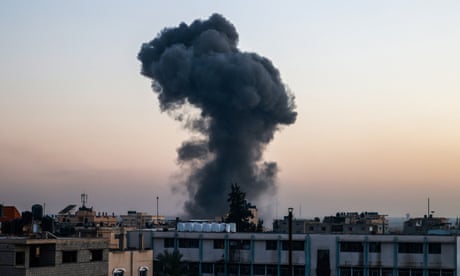
Image of houses, behind them a large plume of smoke rises.
Smoke rises following Israeli strikes during an Israeli military operation in Rafah, in the southern Gaza Strip.(Reuters: Hatem Khaled)

Fighting likely to continue throughout 2024

Fighting in Gaza would continue throughout 2024 at least, Israeli Prime Minister Benjamin Netanyahu's National Security Advisor Tzachi Hanegbi said, signalling that Israel was not ready to end the war as demanded by Hamas, as part of a deal that would see the exchange of hostages for Palestinian prisoners.

"The fighting in Rafah is not a pointless war," he said, reiterating that the aim was to end Hamas rule in Gaza and stop it and its allies attacking Israel.

The United States, Israel's closest ally, reiterated its opposition to a major Israeli ground offensive in Rafah on Tuesday while saying it did not believe such an operation was under way.

Mediator Qatar was expected to pass on Israel's latest ceasefire and hostage release proposal to Hamas on Tuesday, a person familiar with the issue said. 

There was no immediate word on Wednesday from Hamas, which has said talks are pointless unless Israel ends its offensive on Rafah.

The armed wing of Hamas and its ally Islamic Jihad said they confronted invading forces in Rafah with anti-tank rockets and mortar bombs and blew up explosive devices they had planted.

Three Israeli soldiers were killed and three others were badly wounded, the Israeli military said, by what public broadcaster Kan radio reported was an explosive device set off in a Rafah building.

Palestinian health officials said several people were wounded by Israeli fire in eastern Rafah and stores of aid were set ablaze. Residents said constant Israeli bombardment overnight destroyed many homes in the area, from where most people have fled after orders by Israel to evacuate.

Internet and mobile signals went down in parts of both east and west as Israel attacked, the pro-Hamas Shehab news agency, residents and other journalists said. The Israeli military said it could not confirm the reports.

Some residents reported seeing what they described as unmanned robotic armoured vehicles opening fire from machine guns in parts of the city.

Image of a damaged tent camp. In the middle stands a man with crutches.
A man looks on as Palestinians inspect a tent camp damaged in an Israeli strike during an Israeli military operation in Rafah.(Reuters: Hatem Khaled)

Healthcare needed immediately in Rafah and north Gaza, Palestinian Health Ministry says

Gaza's health ministry said several hospitals in areas where the Israeli military was operating had stopped functioning.

Spokesperson Ashraf Al-Qidra called for immediate safe pathways for fuel, medical aid and medical teams to Rafah and northern Gaza.

"The Israeli occupation deliberately finished off the healthcare presence in Rafah and the north," Mr Qidra's statement said, adding that there was no help for people wounded there.

Around a million Palestinians who had taken shelter in Rafah at the southern end of the Gaza Strip from Israel's offensives elsewhere have now fled after Israeli orders to evacuate, the UN agency for Palestinian refugees UNRWA reported on Tuesday.

The Palestine Red Crescent Society (PRCS) said it had evacuated its medical teams from its field hospital in the Al-Mawasi area, a designated civilian evacuation zone, citing "continued artillery and air bombardments" in the vicinity.

The World Court said in its ruling on Friday that Israel had not explained how it would keep the Rafah evacuees safe and provide food, water and medicine. Israel said the order allowed room for some military action to root out Hamas fighters there.

In the nearby city of Khan Younis, an Israeli air strike killed three people overnight, including Salama Baraka, a former senior Hamas police officer, medics and Hamas media said.

Image of a white vehicle with black letters UN on it, it's badly damaged and lies upside down.
Around a million Palestinians who had taken shelter in Rafah from Israel's offensives elsewhere have now fled after Israeli orders to evacuate, UNRWA reported.(Reuters: Hatem Khaled)

The Palestinian Red Crescent said one of its staff, Issam Aqel, was killed in an Israeli air strike on his house in the Bureij refugee camp in central Gaza, taking to 30 the number of staff killed since October 7, at least 17 of them killed on duty.

Israel delivered its latest ceasefire and hostage release proposal to Qatar, and Qatar was to provide it to Hamas on Tuesday, a person familiar with the issue said. 

There was no immediate word on Wednesday from Hamas, which has said talks are pointless unless Israel ends its offensive on Rafah.

Reuters

Icelandic volcano on Reykjanes Peninsula erupts for fifth time since December.

 Extract from ABC News

Posted 
Bright orange lava erupts from the black ground as smoke pours into the sky
Experts are working to better understand the size and scale of the latest eruption in Iceland.()

A volcano in Iceland has erupted for the fifth time since December, shooting lava 50 metres into the air along a fissure that authorities say is more than 3 kilometres long.

Local media reported that a state of emergency had been declared by the Icelandic police force.

Icelandic authorities sent notices to locals and workers in the town of Grindavik, warning of an impending eruption Wednesday morning local time.

Bright orange lava spews from the ground in a long line, with smoke and ash billowing into the sky
The Icelandic Meteorological Office recorded some 400 earthquakes in the last seven days in the area.(Supplied: Live from Iceland)

People were evacuated from the town and the nearby tourist hotspot Blue Lagoon geothermal pool just before midday, following an earthquake in the area.

The Icelandic Meteorological Office (IMO) said the lava "jets are reaching a height of at least 50 metres and the length of the fissure is about 3.4km long" in a statement on Wednesday afternoon, local time.

It said the coast guard helicopter was surveying the area to get a more accurate understanding of the eruption's size and location.

An aerial view of a large fissure with bright orange lava and smoke pouring from it
The eruption is in the same area as previous seismic events.(Birn Oddsson/Iceland Civil Defense via AP)

French tourist Maia Biegatch, had just arrived at the Blue Lagoon when the eruption occurred.

"We received alerts on our phones telling us to 'evacuate, evacuate', so we turned back," she told AFP.

"It was a total surprise."

Authorities had warned of the risk of renewed volcanic activity in the Reykjanes Peninsula, just south of the capital Reykjavik, as studies showed magma accumulated underground.

The IMO also recorded some 400 earthquakes in the area of the volcano's crater in the past week.

A massive plume of smoke billows from a bright orange line in the ground
Despite a significant eruption cloud, Iceland's international airport was operating as normal on Wednesday.(AP Photo: Marco di Marco)

Iceland's Department of Civil Protection and Emergency Management said on social media that despite the call to leave, three residents remained in Grindavik — something it described as "not advisable".

The lava flow was heavy, estimated at between 1,500 and 2,000 cubic metres per second, the IMO said.

While authorities said that seismic activity had decreased significantly, it said lava had reached defences built to the west of Grindavik that were built to protect the town from eruptions.

Similar man-made barriers have been built to steer lava away from infrastructure including the Svartsengi geothermal power plant and the Blue Lagoon geothermal pool.

A white cloud of smoke billows from a volcano that is photographed from the top-down by an aeroplane against a black landscape
Authorities are warning that noxious gases from the eruption could travel to populated parts of the island including the capital Reykjavik in coming days.(Birn Oddsson/Iceland Civil Defense via AP)

The latest event follows the end of another eight-week-long eruption on the peninsula that saw molten rock spew from the ground.

The fiery spectacle underlines the challenges the island nation of almost 400,000 people face as scientists have warned eruptions could happen over and over in Reykjanes for decades or even centuries.

Bright orange lava spews into the sky amid a green, mountainous landscape
People in the area were warned of an imminent eruption just hours before the latest event began.(Supplied: Live from Iceland)

The eruption was the eighth on the peninsula, home to some 30,000 people, since 2021 when geological systems that were dormant for some 800 years again became active.

Previous incidents had disrupted district heating, closed key roads and even razed several houses in Grindavik, where only a few residents have since returned.

Fire burns on ground in front of a collection of white buildings, with one building on fire.
Lava damaged homes in Grindavik during an eruption in early January.(AP: LIVEFROMICELAND.IS)

Icelanders often refer to their country as the "Land of Fire and Ice" as a tribute to its otherworldly landscape forged by glaciers and volcanoes. Iceland is positioned between the Eurasian and North American tectonic plates, making it a seismic hotbed.

While a 2010 eruption in a different part of Iceland grounded some 100,000 flights internationally due to huge ash clouds, Reykjanes is typically home to fissure outbreaks which do not reach into the stratosphere.

ABC/Reuters

Labor backs ICC’s role in international law as other MPs condemn Israeli ‘war’ on body.

Extract from The Guardian

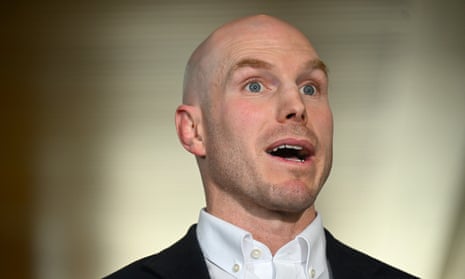
 David Pocock

Independent senator David Pocock says Australia ‘cannot pick and choose which potential crimes are politically convenient for the ICC to investigate’.

Australia ‘must continue to protect and defend the ICC’s independence and rebuff any attempts to politicise its actions,’ says David Pocock

in Canberra
Thu 30 May 2024 01.00 AESTLast modified on Thu 30 May 2024 01.01 AEST

The Australian government has backed the international criminal court as playing a vital role in upholding international law after revelations of a nearly decade-long secret Israeli “war” against the ICC.

Other Australian politicians were more forthright in responding to the Guardian’s reports about how Israel had deployed its intelligence agencies to surveil, hack, pressure, smear and allegedly threaten senior court staff in an effort to derail its inquiries since 2015.

Independent senator David Pocock said the international community must support the court’s work “without fear or favour”, while the Greens denounced reported threats to the court’s previous prosecutor, Fatou Bensouda, as “deeply concerning”.

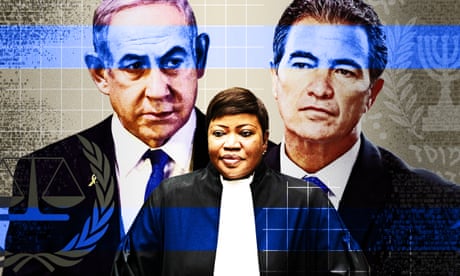
A covert operation against Bensouda, revealed on Tuesday, was allegedly run personally by Benjamin Netanyahu’s close ally Yossi Cohen, who was at the time the director of Israel’s foreign intelligence agency, the Mossad.

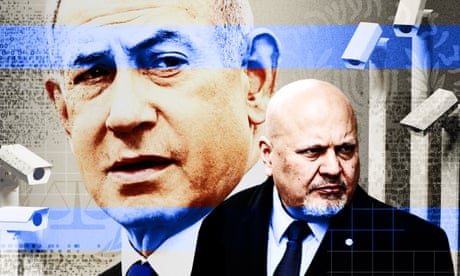
Details of Israel’s nine-year campaign to thwart the ICC’s inquiry into alleged war crimes have been uncovered by the Guardian, the Israeli-Palestinian publication +972 Magazine and the Hebrew-language outlet Local Call.

The Australian government did not respond directly when asked whether it was concerned by the reports of Israel’s campaign of espionage and intimidation against the ICC, but reiterated its support for the institution.

“Since John Howard ratified the Rome Statute in 2002, Australia has respected the international criminal court,” a spokesperson for the foreign minister, Penny Wong, said.

“This is because it is in Australia’s national interest for international law to be upheld.”

The comments also follow threats by the opposition leader, Peter Dutton, to cut ties with the ICC if an arrest warrant is issued for Netanyahu, the Israeli prime minister, in connection with the conduct of the ongoing war in Gaza.

A recent intercepted communication suggested that Bensouda’s successor as prosecutor, Karim Khan, wanted to issue arrest warrants against Israelis but was under “tremendous pressure from the United States”, according to a source familiar with its contents.

The Greens senator and justice spokesperson, David Shoebridge, said political leaders and intelligence agencies should not “spy on and threaten courts”.

“That the US and Israel are seeking to undermine the court and its prosecutors to avoid accountability is not surprising, but it would be to Australia’s eternal dishonour if our government joined in this undemocratic interference,” Shoebridge said.

“The reported threats to the ICC prosecutor from the head of Mossad are deeply concerning and look like the actions of a rogue state.”

Pocock said Australia “must continue to protect and defend the ICC’s independence and rebuff any attempts to politicise its actions when it is operating exactly as it was intended to in times of conflict”.

“The opposition to the ICC’s work we are witnessing from some quarters currently in the context of the conflict in Gaza was notably absent when the ICC embarked on an investigation of potential crimes against Ukraine by Russian forces or issued an arrest warrant for the Russian President last year,” Pocock said.

“We cannot pick and choose which potential crimes are politically convenient for the ICC to investigate.”

The ACT senator said it was “critically important to ongoing international peace and security that countries around the world uphold international law and respect the authority of its institutions”.

Pocock said it was “during the most challenging periods” that the value of such institutions was greatest: “We are living through such a time.”

Khan announced last week that he had applied for warrants for the arrest of Netanyahu and the Israeli defence minister, Yoav Gallant, over alleged war crimes and crimes against humanity, including “starvation of civilians as a method of warfare”.

They deny the allegations, arguing the application for arrest warrants amounts to an attempt to deny Israel’s right to self-defence.

Khan simultaneously sought warrants for the arrest of three Hamas leaders – Yahya Sinwar, Mohammed Deif and Ismail Haniyeh – over the 7 October attacks and the cruel treatment of hostages.

The application now goes to a pre-trial chamber to be decided by a panel of three judges, with the options for the arrest warrants to be approved in whole or in part or rejected.

Dutton said last week that the Australian government must “put pressure on the ICC to make sure that they reverse this terrible decision” and to “stand with an ally and a country that was subject to barbaric attacks by a listed terrorist organisation”.

Dutton and the opposition’s foreign affairs spokesperson, Simon Birmingham, did not respond to requests for comment on Israel’s reported campaign of espionage and intimidation against the ICC.

In response to the earlier reporting, a spokesperson for Netanyahu’s office said: “The questions forwarded to us are replete with many false and unfounded allegations meant to hurt the state of Israel.”