Contemporary politics,local and international current affairs, science, music and extracts from the Queensland Newspaper "THE WORKER" documenting the proud history of the Labour Movement.
MAHATMA GANDHI ~ Truth never damages a cause that is just.
Monday, 8 May 2017
How corporate dark money is taking power on both sides of the Atlantic
A secretive network of business lobbyists has long held sway in US
politics. Now their allies in the UK government are planning a Brexit
that plays into their hands
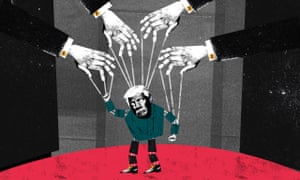
Illustration by Nate Kitch.
Contact author
It took corporate America a while to warm to Donald Trump.
Some of his positions, especially on trade, horrified business leaders.
Many of them favoured Ted Cruz or Scott Walker. But once Trump had
secured the nomination, the big money began to recognise an
unprecedented opportunity.
Trump was prepared not only to promote the cause of corporations in
government, but to turn government into a kind of corporation, staffed
and run by executives and lobbyists. His incoherence was not a
liability, but an opening: his agenda could be shaped. And the dark
money network already developed by some American corporations was
perfectly positioned to shape it. Dark money is the term used in the US
for the funding
of organisations involved in political advocacy that are not obliged to
disclose where the money comes from. Few people would see a tobacco
company as a credible source on public health, or a coal company as a
neutral commentator on climate change. In order to advance their
political interests, such companies must pay others to speak on their
behalf.
Soon after the second world war, some of America’s richest people began setting up a network of thinktanks
to promote their interests. These purport to offer dispassionate
opinions on public affairs. But they are more like corporate lobbyists,
working on behalf of those who fund them.
We have no hope of understanding what is coming until we understand
how the dark money network operates. The remarkable story of a British
member of parliament provides a unique insight into this network, on
both sides of the Atlantic. His name is Liam Fox. Six years ago, his
political career seemed to be over when he resigned as defence secretary
after being caught mixing his private and official interests. But today
he is back on the front bench, and with a crucial portfolio: secretary of state for international trade.
In 1997, the year the Conservatives lost office to Tony Blair, Fox,
who is on the hard right of the Conservative party, founded an
organisation called The Atlantic Bridge. Its patron was Margaret
Thatcher. On its advisory council sat future cabinet ministers Michael Gove, George Osborne, William Hague and Chris Grayling. Fox, a leading campaigner for Brexit, described the mission of Atlantic Bridge as
“to bring people together who have common interests”. It would defend
these interests from “European integrationists who would like to pull
Britain away from its relationship with the United States”.
Atlantic Bridge was later registered as a charity. In fact it was
part of the UK’s own dark money network: only after it collapsed did we
discover the full story of who had funded it. Its main sponsor was the immensely rich Michael Hintze, who worked at Goldman Sachs before setting up the hedge fund CQS. Hintze is one of the Conservative party’s biggest donors. In 2012 he was revealed as a funder
of the Global Warming Policy Foundation, which casts doubt on the
science of climate change. As well as making cash grants and loans to
Atlantic Bridge, he lent Fox his private jet to fly to and from Washington.
Another funder was the pharmaceutical company Pfizer. It paid for a researcher at Atlantic Bridge
called Gabby Bertin. She went on to become David Cameron’s press
secretary, and now sits in the House of Lords: Cameron gave her a life
peerage in his resignation honours list.
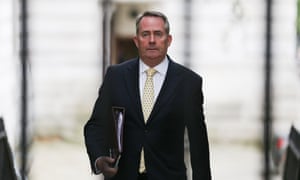
Trade secretary Liam Fox. Photograph: Daniel Leal-Olivas/AFP/Getty Images
In 2007, a group called the American Legislative Exchange Council (Alec) set up a sister organisation, the Atlantic Bridge Project.
Alec is perhaps the most controversial corporate-funded thinktank in
the US. It specialises in bringing together corporate lobbyists with
state and federal legislators to develop “model bills”. The legislators
and their families enjoy lavish hospitality from the group, then take
the model bills home with them, to promote as if they were their own initiatives.
Alec
has claimed that more than 1,000 of its bills are introduced by
legislators every year, and one in five of them becomes law. It has been
heavily funded by tobacco companies, the oil company Exxon, drug companies and Charles and David Koch – the billionaires who founded the first Tea Party organisations. Pfizer, which funded Bertin’s post at Atlantic Bridge, sits on Alec’s corporate board.
Some of the most contentious legislation in recent years, such as state
bills lowering the minimum wage, bills granting corporations immunity
from prosecution and the “ag-gag” laws – forbidding people to
investigate factory farming practices – were developed by Alec.
To run the US arm of Atlantic Bridge, Alec brought in its director of international relations, Catherine Bray. She is a British woman who had previously worked for the Conservative MEP Richard Ashworth and the Ukip MEP Roger Helmer. Bray has subsequently worked for
Conservative MEP and Brexit campaigner Daniel Hannan. Her husband is
Wells Griffith, the battleground states director for Trump’s
presidential campaign.
Among the members of Atlantic Bridge’s US advisory council were the ultra-conservative senators James Inhofe, Jon Kyl and Jim DeMint. Inhofe is reported to have received over $2m in campaign finance from coal and oil companies. Both Koch Industries and ExxonMobil have been major donors.
Kyl, now retired, is currently acting as the “sherpa”
guiding Jeff Sessions’s nomination as Trump’s attorney general through
the Senate. Jim DeMint resigned his seat in the Senate to become president of the Heritage Foundation
– the thinktank founded with a grant from Joseph Coors of the Coors
brewing empire, and built up with money from the banking and oil
billionaire Richard Mellon Scaife. Like Alec, it has been richly funded by the Koch brothers. Heritage, under DeMint’s presidency, drove the attempt
to ensure that Congress blocked the federal budget, temporarily
shutting down the government in 2013. Fox’s former special adviser at
the Ministry of Defence, an American called Luke Coffey, now works for the foundation.
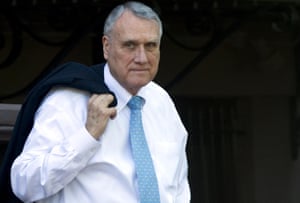
Former Arizona senator Jon Kyl. Photograph: Saul Loeb/AFP/Getty Images
The Heritage Foundation is now at the heart of Trump’s
administration. Its board members, fellows and staff comprise a large
part of his transition team. Among them are Rebekah Mercer, who sits on Trump’s executive committee; Steven Groves and Jim Carafano (State Department); Curtis Dubay (Treasury); and Ed Meese, Paul Winfree, Russ Vought and John Gray (management and budget). CNN reports that “no other Washington institution has that kind of footprint in the transition”.
Trump’s extraordinary plan to cut federal spending by $10.5tn was drafted by the Heritage Foundation, which called it a “blueprint for a new administration”. Vought and Gray, who moved on to Trump’s team from Heritage, are now turning this blueprint into his first budget.
This will, if passed, inflict devastating cuts on healthcare, social
security, legal aid, financial regulation and environmental protections;
eliminate programmes to prevent violence against women, defend civil
rights and fund the arts; and will privatise the Corporation for Public
Broadcasting. Trump, as you follow this story, begins to look less like a
president and more like an intermediary, implementing an agenda that
has been handed down to him.
In July last year, soon after he became trade secretary, Liam Fox flew to Washington. One of his first stops was a place he has visited often over the past 15 years: the office of the Heritage Foundation, where he spoke to, among others, Jim DeMint. A freedom of information request reveals that one of the topics raised at the meeting was the European ban on American chicken washed in chlorine: a ban that producers hope the UK will lift
under a new trade agreement. Afterwards, Fox wrote to DeMint, looking
forward to “working with you as the new UK government develops its trade
policy priorities, including in high value areas that we discussed such
as defence”.
How did Fox get to be in this position, after the scandal that
brought him down in 2011? The scandal itself provides a clue: it
involved a crossing of the boundaries between public and private
interests. The man who ran the UK branch of Atlantic Bridge was his
friend Adam Werritty, who operated out of Michael Hintze’s office
building. Werritty’s work became entangled with Fox’s official business
as defence secretary. Werritty, who carried a business card naming him
as Fox’s adviser but was never employed by the Ministry of Defence,
joined the secretary of state on numerous ministerial visits overseas,
and made frequent visits to Fox’s office.
By the time details of this relationship began to leak, the charity
commission had investigated Atlantic Bridge and determined that its work
didn’t look very charitable. It had to pay back the tax from which it had been exempted (Hintze picked up the bill).
In response, the trustees shut the organisation down. As the story
about Werritty’s unauthorised involvement in government business began
to grow, Fox made a number of misleading statements. He was left with no
choice but to resign.
When Theresa May brought Fox back into government, it was as strong a
signal as we might receive about the intentions of her government. The
trade treaties that Fox is charged with developing set the limits of
sovereignty. US food and environmental standards tend to be lower than
Britain’s, and will become lower still if Trump gets his way. Any trade
treaty we strike will create a common set of standards for products and
services. Trump’s administration will demand that ours are adjusted
downwards, so that US corporations can penetrate our markets without
having to modify their practices. All the cards, post-Brexit vote, are
in US hands: if the UK doesn’t cooperate, there will be no trade deal.
May
needed someone who is unlikely to resist. She chose Fox, who has become
an indispensable member of her team. The shadow diplomatic mission he
developed through Atlantic Bridge plugs him straight into the Trump
administration.
Long before Trump won, campaign funding in the US had systematically corrupted the political system. A new analysis
by US political scientists finds an almost perfect linear relationship,
across 32 years, between the money gathered by the two parties for
congressional elections and their share of the vote. But there has also
been a shift over these years: corporate donors have come to dominate
this funding.
By tying our fortunes to those of the United States, the UK
government binds us into this system. This is part of what Brexit was
about: European laws protecting the public interest were portrayed by
Conservative Eurosceptics as intolerable intrusions on corporate
freedom. Taking back control from Europe means closer integration with
the US. The transatlantic special relationship is a special relationship
between political and corporate power. That power is cemented by the
networks Liam Fox helped to develop.
In April 1938, President Franklin Roosevelt sent the US Congress the following warning:
“The liberty of a democracy is not safe if the people tolerate the
growth of private power to a point where it becomes stronger than their
democratic state itself. That, in its essence, is fascism.” It is a
warning we would do well to remember. • A fully linked version of this column will be published at monbiot.com. Twitter: @GeorgeMonbiot

No comments:
Post a Comment