Contemporary politics,local and international current affairs, science, music and extracts from the Queensland Newspaper "THE WORKER" documenting the proud history of the Labour Movement.
MAHATMA GANDHI ~ Truth never damages a cause that is just.
Tuesday, 11 July 2017
Earth's sixth mass extinction event already under way, scientists warn
Researchers talk of ‘biological annihilation’ as new study reveals
that billions of populations of animals have been lost in recent decades
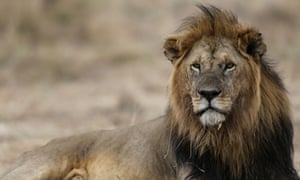
‘The lion was historically distributed over most of Africa, southern
Europe and the Middle East. Now the vast majority of lion populations
are gone.’
Photograph: Xinhua / Barcroft Images
A “biological annihilation” of wildlife in recent decades means a
sixth mass extinction in Earth’s history is already well underway and is
more severe than previously feared, according to new research.
Scientists analysed both common and rare species and found billions
of regional or local populations have been lost. They blame human
overpopulation and overconsumption for the crisis and warn that it
threatens the survival of human civilisation, although there remains a
short window of time in which to act.
The new study, published in the peer-reviewed journal Proceedings of the National Academy of Sciences,
eschews the normally sober tone of scientific papers and calls the
massive loss of wildlife a “biological annihilation” that represents a
“frightening assault on the foundations of human civilisation”.
Prof Gerardo Ceballos, at the Universidad Nacional Autónoma de
México, who led the work, said: “The situation has become so bad it
would not be ethical not to use strong language.”
Previous studies have shown species are going extinct at a significantly faster rate
than for millions of years before, but even so extinctions remain
relatively rare giving the impression of a gradual loss of biodiversity.
The new work instead takes a broader view, assessing many common
species which are losing populations all over the world as their ranges
shrink, but remain present elsewhere.
The scientists found that a third of the thousands of species losing
populations are not currently considered endangered and that up to 50%
of all individual animals have been lost in recent decades. Detailed
data is available for land mammals, and almost half of these have lost
80% of their range in the last century. The scientists found billions of
populations of mammals, birds, reptiles and amphibians have been lost
all over the planet, leading them to say a sixth mass extinction has
already progressed further than was thought.
Billions of animals have been lost as their habitats have become smaller with each passing year.
The scientists conclude: “The resulting biological annihilation
obviously will have serious ecological, economic and social
consequences. Humanity will eventually pay a very high price for the
decimation of the only assemblage of life that we know of in the
universe.”
They say, while action to halt the decline remains possible, the
prospects do not look good: “All signs point to ever more powerful
assaults on biodiversity in the next two decades, painting a dismal
picture of the future of life, including human life.”
Wildlife is dying out due to habitat destruction, overhunting, toxic
pollution, invasion by alien species and climate change. But the
ultimate cause of all of these factors is “human overpopulation and
continued population growth, and overconsumption, especially by the
rich”, say the scientists, who include Prof Paul Ehrlich, at Stanford
University in the US, whose 1968 book The Population Bomb is a seminal, if controversial, work.
“The
serious warning in our paper needs to be heeded because civilisation
depends utterly on the plants, animals, and microorganisms of Earth that
supply it with essential ecosystem services ranging from crop
pollination and protection to supplying food from the sea and
maintaining a livable climate,” Ehrlich told the Guardian. Other
ecosystem services include clean air and water.
“The time to act is very short,” he said. “It will, sadly, take a
long time to humanely begin the population shrinkage required if
civilisation is to long survive, but much could be done on the
consumption front and with ‘band aids’ – wildlife reserves, diversity
protection laws – in the meantime.” Ceballos said an international
institution was needed to fund global wildlife conservation.
The new research analysed data on 27,500 species of land vertebrates
from the IUCN and found the ranges of a third have shrunk in recent
decades. Many of these are common species and Ceballos gave an example
from close to home: “We used to have swallows nesting every year in my
home near Mexico city – but for the last 10 years there are none.”
The researchers also point to the “emblematic” case of the lion: “The
lion was historically distributed over most of Africa, southern Europe,
and the Middle East, all the way to northwestern India. [Now] the vast
majority of lion populations are gone.”
Historically lions lived across Africa, southern Europe, the Middle
East, all the way up to Northwestern India. Today their habitat has been
reduced to a few tiny pockets of the original area.
Prof Stuart Pimm, at Duke University in the US and not involved in
the new work, said the overall conclusion is correct, but he disagrees
that a sixth mass extinction is already under way: “It is something that
hasn’t happened yet – we are on the edge of it.”
Pimm also said there were important caveats that result from the
broad-brush approach used. “Should we be concerned about the loss of
species across large areas – absolutely – but this is a fairly crude way
of showing that,” he said. “There are parts of the world where there
are massive losses, but equally there are parts of the world where there
is remarkable progress. It is pretty harsh on countries like South
Africa which is doing a good job of protecting lions.”
Robin Freeman, at the Zoological Society of London, UK, said: “While
looking at things on aggregate is interesting, the real interesting
nitty gritty comes in the details. What are the drivers that cause the
declines in particular areas?”
Freeman was part of the team that produced a 2014 analysis of 3000 species that indicated that 50% of individual animals have been lost since 1970,
which tallies with the new work but was based on different IUCN data.
He agreed strong language is needed: “We need people to be aware of the
catastrophic declines we are seeing. I do think there is a place for
that within the [new] paper, although it’s a fine line to draw.”
Citing
human overpopulation as the root cause of environmental problems has
long been controversial, and Ehrlich’s 1968 statement that hundreds of
millions of people would die of starvation in the 1970s did not come to
pass, partly due to new high-yielding crops that Ehrlich himself had noted as possible.
Ehrlich has acknowledged “flaws” in The Population Bomb but said it
had been successful in its central aim – alerting people to global
environmental issues and the the role of human population in them. His
message remains blunt today: “Show me a scientist who claims there is no
population problem and I’ll show you an idiot.”
Earth’s five previous mass extinctions
End-Ordovician, 443 million years ago
A severe ice age led to sea level falling by 100m, wiping out 60-70%
of all species which were prominently ocean dwellers at the time. Then
soon after the ice melted leaving the oceans starved of oxygen. Late Devonian, c 360 million years ago
A messy prolonged climate change event, again hitting life in shallow
seas very hard, killing 70% of species including almost all corals. Permian-Triassic, c 250 million years ago
The big one – more than 95% of species perished, including trilobites
and giant insects – strongly linked to massive volcanic eruptions in
Siberia that caused a savage episode of global warming. Triassic-Jurassic, c 200 million years ago
Three-quarters of species were lost, again most likely due to another
huge outburst of volcanism. It left the Earth clear for dinosaurs to
flourish. Cretaceous-Tertiary, 65 million years ago
An giant asteroid impact on Mexico, just after large volcanic
eruptions in what is now India, saw the end of the dinosaurs and
ammonites. Mammals, and eventually humans, took advantage.

No comments:
Post a Comment