Contemporary politics,local and international current affairs, science, music and extracts from the Queensland Newspaper "THE WORKER" documenting the proud history of the Labour Movement.
MAHATMA GANDHI ~ Truth never damages a cause that is just.
Everyone
knows the Australian government cannot end the war alone, but we do
have an important role to play as a middle power, and it must be more
than just words
Much has been made this week over Anthony Albanese’s strongest comments yet
criticising the Netanyahu government’s ongoing blockade of humanitarian
aid into Gaza. While welcome, his rhetoric calling this an “outrage”,
“unacceptable” and “untenable” feels inadequate in the face of what
looks like a genocide unfolding in full view of the world.
These
words have not been matched with any new “concrete action” of the kind
being called for by what feels like just about everyone, and
foreshadowed by three of Australia’s closest allies, the UK, France and Canada.
The prime minister hasn’t been able to offer a satisfactory explanation
as to why Australia wasn’t a signatory to this stronger statement of
intent, choosing to move away from the mantle of middle power leader
we’ve worn so proudly in times past.
Australia has a proud history of standing up against human catastrophe. Gaza should be no exception
The
time for stronger global action is now. For too long the international
community has failed to follow up words of condemnation with action.
Palestinian people have been killed in their tens of thousands, two
million teeter on the brink of starvation and the Israeli government continues to build new settlements
in the West Bank. The pleas for help are becoming ever more desperate,
like that of Palestinian ambassador to the United Nations, Riyad
Mansour, who broke down while addressing the security council over the deaths of children in Gaza.
In
the absence of political leadership we’ve seen people with moral
courage step up. Surgeons armed with smartphones, not only saving lives
but broadcasting in real time and in unprecedented detail the trauma
that this conflict is inflicting on innocent people, especially
children.
Earlier this week I hosted an event with
one of these medical missionaries, Dr Mohammed Mustafa, a British
Australian emergency physician of Palestinian heritage who has completed
two rotations on the ground in Gaza, most recently in March this year.
More than 1,000 Canberrans packed into parliament’s Great Hall to hear
him speak, but despite the crowd you could have heard a pin drop.
Dr
Mo talked about the horrific choices medical personnel face trying to
save who they can during the mass casualty events that are all too
common. He came with a message of hope and compassion. He read a
statement from the family of an Israeli hostage, condemned the attacks
of October 7 and articulated the simple truth that “killing women and
children is wrong, no matter if it’s Palestinian children and women or
Israeli”.
Dr
Mohammed Mustafa at Parliament House in Canberra on Tuesday. The
emergency physician has completed two rotations on the ground in Gaza. Photograph: Lukas Coch/AAP
Dr
Mo also lay down the challenge to the Australian government to step up
and help fund a deployable children’s hospital, and to engage
diplomatically with Israel to facilitate its entry to Gaza.
Rebuking the prime minister’s assertion that Australia wasn’t a “major
player” in the Middle East, he said: “You don’t have to be a major
player to feed children. You don’t have to be a major player to heal
children. We need healers in the Middle East, and Australia can be the
healer. It can lead the world.”
As Dr Mo spoke
I was reminded of one of my heroes, Desmond Tutu. He was constantly
urging people to recognise our shared humanity and that “if you are
neutral in times of injustice, you have chosen the side of the
oppressor”. This is indeed a time to focus on our shared humanity. And
the fact that Jewish people are not Prime Minister Netanyahu, Gazans are
not Hamas. Here in Australia we must come together, not turn our
frustrations on our fellow Australians. Dr Mo can serve as an example to
us all. After what he’s seen, he has every right to rage, but chooses
instead to see the pain of everyone affected by these horrors.
Dr
Mo was one of the first to start what he calls “Doctor diaries”,
sending content from inside Nasser hospital at great personal risk in a
bid to focus global attention on Gaza. It’s something we’ve seen others
continue.
Everyone knows we cannot end the war
alone, but we do have an important role to play as a middle power that
believes in an international rules-based order.
In June last year I called on the Albanese government to consider targeted sanctions
against members of the Israeli government and the Israeli Defense
Forces. Almost 12 months and tens of thousands more deaths later, those
calls continue to grow, including from within Labor’s own ranks.
We
should have a consistent, values-based approach to how we respond to
war and disasters and how we use our humanitarian program. This includes
providing an equitable amount of aid and assistance based on need, not
politics. Alongside this Australia must stop exporting weapons or parts
of weapons that could be used to kill and injure civilians, and start
providing emergency visas to the family members of Australians.
If the horror unfolding in Gaza is not our country’s red line for stronger action then I don’t know what is.
The
government is not managing a Labor Party conference. It is speaking for
all of us in a world where opinions are rapidly changing. (ABC News: Ian Cutmore)
Link copied
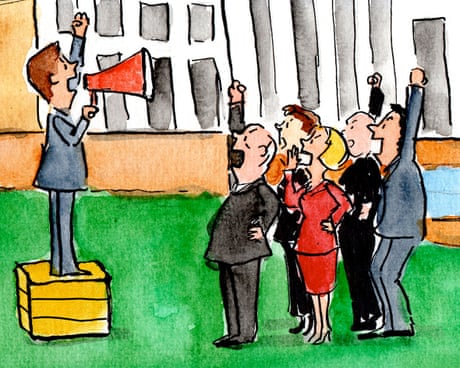
"Dear government, don't be terrible."
There was no greater sin in journalism, back in the day, than using the personal pronoun in your copy.
It
has proved a good rule to follow over the past 45 years. Not just in a
style sense but in terms of the state of mind in which you write: it's
not about you, it's about your readers, or viewers even.
But
the transition, the fact that this is the last column on Australian
politics, suggests a small amount of indulgence or reflection may be
allowed.
7.30 farewells political editor and 'national icon' Laura Tingle
Postcards from the Edge
Political
reporting can often have a Postcards from the Edge feeling about it: a
report from a very different jungle to the one most normal people
inhabit, with hopefully a bit of translation and explanation thrown in
for good measure about how and why politicians act as they do.
But
this particular column aims to turn things around a bit: a postcard
sent back to our pollies, with a few reflections drawn from four decades
of having to watch them in action, close up.
First,
as an indulgence taken purely on behalf of readers, let us agree that
the federal Coalition can be put aside. That seems only fair, given that
the Coalition seems so determined to be irrelevant.
Please
come back, opposition MPs, when you've remembered what you are there
for, or possibly when you have something more intelligent to say.
In
the meantime, try not to embarrass us all with your apparent complete
lack of reflection on why you may have not only been rejected by the
electorate, but now represent less than a third of the House of
Representatives.
You have
stumbled around, splitting and reunifying, slagging each other off, on
matters of "high principle" which seem to be completely malleable to the
number of positions various parties get on the frontbench.
Instead,
let's focus on the new government: the one that has won an
exceptionally large number of seats in the House of Representatives and
which is probably already doing stuff that's affecting us voters.
Labor's landslide election win and the Coalition's crushing defeat has re-shaped the political terrain.
Labor's big mandate
All governments are new after an election, whether they realise it or not, whether they have been in power for years or not.
There are inevitably some different bums on seats.
But
more importantly, the context in which the government of the day is
thinking about issues will have totally changed: both the economic and
global circumstances, and the political circumstances.
What new governments can do with their numbers in the House and in the Senate is regularly discussed.
But what they are able to do (important distinction) or should do is discussed less.
Having
watched many federal elections (14) and therefore many transitions of
government, it is never clear that new governments quite understand how
their mandates, or more importantly, their scope for action may have
changed.
It's not just about the number of seats they hold in the House of Representatives and the Senate.
It's about the relative power of the other parties and the messages that the electorate seems to have sent.
And
it's particularly about understanding what constraints that might have
been shaping judgements for the past few years — constraints that have
become so entrenched you don't even realised they are there — may have
shifted or been removed entirely.
The 2025 election has been generally seen as a message of a rejection of the fringes — at both ends — and a move to the centre.
The prime minister has spoken about the idea of "progressive patriotism" as being central to his campaign
"We spoke about doing things the Australian way, not looking towards any other method or ideology from overseas," he said.
"At
a time where there's conflict in the world, where people are often
divided on the basis of race or religion, here in Australia, we can be a
microcosm for the world."
So there's a nice thought.
But
whether you want to prosecute a case for a nice thought, or a really
complex policy agenda, you need to be both able and willing to sell it.
A
range of opinions is a good and healthy thing, and keeps a government
(particularly one with a big majority) vibrant and credible.
A changing political landscape
The
political landscape for the past 15 years has been treacherous,
starting with the hyper-aggressive politics of Tony Abbott's leadership
of an opposition which sought to bring down the Gillard government on
the floor of the parliament.
The
biggest thing that the Albanese government has to get its head around
is that the ultra-toxic nature of conservative attack politics has
fundamentally shifted.
Sure, News Corp and its Sky After Dark franchise continues to prosecute a particular message.
But
there is no clear and effective attack dog politician in the mould of
Tony Abbott or Peter Dutton now obvious in the Coalition ranks.
And the ideological policy underpinnings which drove them — particularly Abbott — are also in splinters.
Think how that political agenda and it associated tactics have affected politics, and the caution of the Labor Party.
Labor
embraced AUKUS, for example, without any apparent thought or
contemplation, because it did not wish to be in a different position on
foreign policy, defence and the US alliance to the Coalition.
This
is not to suggest Labor should immediately abandon AUKUS. It's just
that, with the Coalition in disarray, the prospect of Labor being in
power for two terms, and US President Donald Trump apparently determined
to make the US look like the world's most unreliable ally, Australia
now has the space to consider what is actually in our best individual
strategic interests.
That's a space we have effectively never been in before, given our obsession with Great and Powerful Friends.
But
there is no clear and effective attack dog politician in the mould of
Tony Abbott or Peter Dutton now obvious in the Coalition ranks. (ABC: Matt Roberts)
Political norms turned upside down
There
are so many other underlying presumptions about political norms
generated by the Coalition: the ones on debt and deficits; on personal
wealth; on migration and dog whistling on race.
Once
again, it is not a question of overturning policy, just of having the
clear eyes to rewire politics without the fear of these political
attacks necessarily cutting through.
There's a couple of other ideas that are reinforced by watching a lifetime of political theatre.
The first is about only half remembered memories.
People speak ad nauseum of golden days when governments, and/or the parliament got things done.
From
someone who lived and worked through those times: don't get sucked into
all the stuff about how social media makes it harder. Believe that none
of the tax reforms, the social welfare reforms, the energy reforms, or
whatever, were actually easy.
Everything was fought, as it is now, tooth and nail, whether that be by the Hawke/Keating governments or the Howard government.
The
arguments only started to fail when politicians got too tired to keep
prosecuting them. When the exasperation with "dumb" journalists or
voters got too much.
In a
famous bit of correspondence originally reported in 2008, the former
Hawke and Keating government minister, Gordon Bilney, wrote a letter to a
local government bureaucrat once he was on his way out the door.
"One
of the great pleasures of private life is that I need no longer be
polite to nincompoops, bigots, curmudgeons and twerps who infest local
government bodies and committees such as yours," it said.
"In the particular case of your committee, that pleasure is acute."
To
those who knew him, it was very Gordon Bilney. But it reflects the
exhaustion people in the political process inevitably feel, and which
can be the most debilitating limitation on getting things through.
One
of the smartest people to occupy a senior ministerial advisory post
once said that he knew it was time to go when he found himself thinking,
when confronted by someone lobbying on a policy: "don't you think we
haven't already thought of that?"
There's
a bit of that air around this government already. And if they are going
to be successful in using this term to produce change, that has to
change.
You can have conflict in your ranks
Another truism that has snuck into politics, particularly Labor politics, is that you can't have conflict in your ranks.
Well
the finance minister, Peter Walsh, publicly advocated for a completely
different set of tax reforms to those of the Treasurer during the Hawke
years and the government did not fall.
A
range of opinions is a good and healthy thing, and keeps a government
(particularly one with a big majority) vibrant and credible.
Ed Husic says Labor should consider sanctions against Israel
So
just accept — even welcome — some friction, particularly the sort of
high class friction provided by figures like Ed Husic, who has
demonstrated more decency, bravery and class on the vexed issue of Gaza
than anyone else in the Parliament.
You
are not all managing factions now, or a Labor Party conference. You are
speaking for all of us in a world where opinions are rapidly changing.
Not
being a terrible government means considering just what opportunities
you have to change the conversation now that you are not wedged so
savagely from the left and right.
A
despairing Abraham Lincoln, desperate to get a general who would
aggressively prosecute the war on the Union's behalf wrote to General
"Fighting Joe" Hooker in 1863 in words which Australian voters might
borrow in a letter to a government which has a once in a generation
capacity to produce change:
"Beware of rashness, but with energy, and sleepless vigilance, go forward, and give us victories."
And
that is all that I can wish for Australian governments to deliver to
its people, as I end four decades of keeping watch on what our
governments do in our name.
Laura Tingle finishes this week as 7.30's political editor. She starts as the ABC's global affairs editor in coming weeks.
Israel has already built over 100 settlements across the occupied West Bank. (Reuters: Dedi Hayun)
In short:
Israel
says it will establish 22 new settlements in the occupied West Bank,
including the legalisation of "outposts" already built without
government authorisation.
The
announcement comes after Britain, France and Canada warned Israel this
month it could impose targeted sanctions if Israel continued to expand
settlements in the territory.
Israel's
Defense Minister says it is a "strategic move that prevents the
establishment of a Palestinian state that would endanger Israel".
Link copied
Israel's
government has approved 22 new Jewish settlements in the occupied West
Bank despite some Western countries threatening targeted sanctions.
Finance
Minister Bezalel Smotrich, an ultra-nationalist who advocates for
Israeli sovereignty over the West Bank, said on Thursday the new
settlements would be located in the northern area of the West Bank but
did not specify where.
Israel's
Defense Ministry said that among the new Jewish settlements, existing
"outposts" would be legalised and new settlements would also be built.
"[It]
strengthens our hold on Judea and Samaria [West Bank], anchors our
historical right in the Land of Israel, and constitutes a crushing
response to Palestinian terrorism," Defense Minister Israel Katz said.
He added it was also “a strategic move that prevents the establishment of a Palestinian state that would endanger Israel".
Around
700,000 Israeli settlers live among 2.7 million Palestinians in the
West Bank and East Jerusalem, territories Israel captured from Jordan in
the 1967 war.
Israel later annexed East Jerusalem in a move not recognised by most of the international community.
Palestinians
see expansion of the settlements as a hindrance to their aspirations to
establish an independent state, with East Jerusalem as its capital.
Israel
has already built over 100 settlements in the territory, which range
from small hilltop "outposts" to fully developed communities with
apartment blocks, shopping malls, and factories.
Most of the international community considers these settlements illegal, including Australia.
The International Court of Justice ruled Israeli settlements in the West Bank were illegal. (ABC News: Haidarr Jones)
The
International Court of Justice (ICJ) ruled in 2024 that Israel was in
breach of international law, ordering it to end settlement activity and
pay reparations to Palestinians.
Israel's government dismissed that finding as "blatantly one-sided" and not legally binding.
It
deems most settlements legal under its own laws, while some of the
illegal "outposts" are often tolerated and sometimes later legalised.
Sanctions threat
There
is a growing list of European countries demanding an end to the war in
Gaza, while Britain, France and Canada warned Israel this month it could
impose targeted sanctions if Israel continued to expand settlements in
the West Bank.
A joint
statement by the three countries also said that they "strongly oppose
the expansion of Israel’s military operations in Gaza".
Settlement activity in the West Bank has accelerated sharply since the war in Gaza, now in its 20th month.
Nabil
Abu Rudeineh, a spokesperson for Palestinian President Mahmoud Abbas,
called Israel's decision a "dangerous escalation," accusing the
government of continuing to drag the region into a "cycle of violence
and instability".
"This
extremist Israeli government is trying by all means to prevent the
establishment of an independent Palestinian state," he told Reuters,
urging US President Donald Trump's administration to intervene.
The
Israeli anti-settlement watchdog Peace Now called it "the most
extensive move of its kind" in more than 30 years and warned it would
"dramatically reshape the West Bank and entrench the occupation even
further".
Hamas official Sami Abu Zuhri condemned the announcement and called on the US and the European Union to take action.
"The
announcement of the building of 22 new settlements in the West Bank is
part of the war led by Netanyahu against the Palestinian people," Abu
Zuhri told Reuters.
Following the ICJ ruling last year, Australia sanctioned seven Israeli settlers in the West Bank due to violent attacks on Palestinians, including sexual assault and torture.
White House to appeal court ruling blocking tariffs
Link copied
A US court has put a temporary stay on an earlier ruling that Donald Trump's "liberation day" tariffs were illegal.
The ruling looked set to derail the president's attempts to reorder global trade.
Wall
Street posted gains on Thursday after the levies were overturned, and
the case looks "likely" to end up before the US Supreme Court.
The
lawsuit was filed by a group of small businesses, including wine
wholesaler VOS Selections, whose owner has said the tariffs could
torpedo the company.
Lawyers for the plaintiffs argued Donald Trump lacked legal authority to impose sweeping tariffs on America's trading partners.
Here's what could happen next and what it could mean for Australia.
A federal court has blocked President Donald Trump's liberatoin day tariffs. (AP: Evan Vucci)
What happened at court?
The
US president unveiled his sweeping tariff plan at the White House in
early April, imposing so-called "reciprocal" levies of up to 50 per cent
on some of America's biggest trading partners.
Prime minister slams Trump’s ‘unjustified’ tariffs on Australia
After
suspending most of the reciprocal tariffs, the Trump administration had
settled on a 10 per cent "baseline" tariff on all imports into the US,
with a higher rate levied against China.
On Wednesday, three US federal trade court judges blocked the plan.
Trump had overstepped his authority,
they ruled, when he invoked a 1977 act — the International Emergency
Economic Powers Act — to declare a national emergency and justify the
tariffs.
US expert at think
tank Chatham House, Max Yoeli, said the court's decision had put a pause
on these tariffs, but not other levies that were in place before Donald
Trump's "liberation day" announcement.
"Even
though it is not a complete step back from the US tariff posture, it
does provide a little bit of breathing room for trading partners around
the world as they try to decide how to move forward facing the threat
from the United States," Mr Yoeli told ABC's The World program.
What does it mean for Trump?
Following
the US International Trade Court's ruling, an appeals court promptly
reinstated the tariffs during the appeals process.
But
the initial ruling raises questions about whether the central plank of
Trump's second term can ever be enacted by the president alone.
Many of America's trading partners, as well as many US citizens who opposed levies, will be relieved.
Big brands prepare global price hikes to offset US tariffs (Samuel Yang)
Former
US trade official Wendy Cutler, who is now vice-president at the Asia
Society Policy Institute, tells AP the court's decision "throws the
president's trade policy into turmoil."
"Partners
negotiating hard during the 90-day tariff pause period may be tempted
to hold off making further concessions to the US until there is more
legal clarity," she said.
It is
also expected that companies will have to reassess their supply chains,
perhaps speeding up shipments to the United States to offset the risk
that the tariffs will be reinstated on appeal.
What will happen next?
The
US Court of International Trade's civil ruling has been paused by the
US Court of Appeals, and failing success there, it could ultimately go
to the Supreme Court.
Of the nine Supreme Court justices, six were appointed under Republican presidents and are considered conservative-leaning.
Mr Yoeli said the case was "likely" to end up before the Supreme Court.
Importers may decide to rush deliveries into the US before the ruling can be appealed and tariffs potentially reinstated. (Reuters: Mike Blake)
"We've certainly not heard the last of it yet," he said.
"This could very well drag on beyond the midterm elections, perhaps even leading up to the presidential election in 2028."
In the meantime, countries hoping to strike a trade deal with the US may be inclined to hold off.
Before
the appeals court decision, White House economic adviser Kevin Hassett
expressed confidence that the US Court of International Trade ruling
would ultimately be reversed in an interview with Fox Business on
Thursday. He also said it would not get in the way of signing new trade
deals.
"If there are little
hiccups here or there because of decisions that activist judges make,
then it shouldn't just concern you at all, and it's certainly not going
to affect the negotiations," he said.
Can he get around the ruling?
In
a statement after Wednesday's decision, the White House said it was
"not for unelected judges to decide how to properly address a national
emergency".
It remains unclear
whether the White House will respond to the ruling by pausing all of its
emergency power tariffs in the interim.
Trump
might still be able to temporarily launch import taxes of 15 per cent
for 150 days on nations with which the US runs a substantial trade
deficit.
The ruling notes that a president has this authority under Section 122 of the Trade Act of 1974.
Trump's tariff block set for Supreme Court battle | The World | ABC News
What will it mean for tariffs on Australian goods?
Depending
on whether the Trump administration executes the tariffs, the move
could result in the 10 per cent tariff on Australian exports to the US
being suspended.
But it is
noteworthy that the available legal option for Trump of 15 per cent
tariffs on countries that run a substantial trade deficit with the US
may not apply to Australia.
According to the US Bureau of Industry and Security, the US has had a trade surplus with Australia in recent years.
And
while the US is not a major destination for Australian exports, an
American trade war with our major trading partners — namely China —
could still be felt at home.
The
weird object was first spotted in data captured by the ASKAP radio
telescope located on Wajarri Yamaji Country in Western Australia. (Supplied: Alex Cherney/CSIRO)
In short
Astronomers have detected a mystery stellar object which emitted pulses of light for two minutes every 44 minutes.
A handful of objects like this have been found before, but this is the first to emit both radio waves and X-rays.
What's next?
Researchers
expect to learn more about these objects as future telescope
observations are made, possibly opening up new ways to understand matter
and nuclear fusion.
Link copied
In
the past few years, astronomers have recorded a handful of very strange
radio signals, mostly coming from towards the centre of the Milky Way.
Armed
with increasingly powerful telescopes, they've detected objects that
emit powerful bursts of energy a few times an hour, like a chiming clock
— and then fall silent.
The
source of these "long-period radio transients", or LPTs, hasn't been
nailed down, but it was thought they were caused by dead stars.
But a newly discovered LPT, reported in the journal Nature, could shift our view about the origin of these mysterious objects.
ASKAP J1832-0911 is located in a region of the Milky Way that is dense in stars, gas and dust. (Supplied: Ziteng (Andy) Wang, ICRAR)
Unlike previous discoveries, this LPT also sends out X-ray pulses, making it the strangest one yet.
An
international team, led by Curtin University astronomer Ziteng Andy
Wang, first detected a radio signal in data captured by the Australian
Square Kilometre Array Pathfinder telescope (ASKAP) in Western
Australia.
Dubbed ASKAP J1832-0911, the object sent out radio waves for two minutes every 44 minutes.
By chance the signal was also spotted by NASA's Chandra X-ray Observatory on Valentine's Day last year.
An artist's illustration of NASA's Chandra X-ray Observatory, which was launched in 1999. (Supplied: NASA/CXC & J. Vaughan)
Dr Wang said he was "pretty surprised" when he saw pulses of X-rays happening at the same time as the radio waves.
"That is a huge discovery," Dr Wang said.
The X-ray and radio pulses were emitted for a few weeks, and then fell silent.
Had Chandra not been observing that patch of sky, the X-ray bursts would never have been detected.
"It's really, really lucky,"
Dr Wang said.
What's causing the flashes?
Astronomers
have known about flashing objects since the 1960s, but until a few
years ago, each one that had been recorded flickered very quickly,
switching on and off every few seconds or minutes.
Then, in 2022, an Australian-led team discovered an LPT which emitted super-bright radio waves regularly over hours. A handful of other LPTs have been discovered since.
Researchers have proposed different theories for the source of these LPTs.
One is a super-dense star called a neutron star that spins, regularly hitting Earth with a beam of energy from its poles.
But
these stars were thought to only be detectable when they were spinning
very quickly, becoming too faint to see as they slowed down to LPT-level
speeds.
Neutron stars send out flashes like clockwork, but they need to spin very fast to be detected from Earth. (Supplied: NASA/Goddard Space Flight Center/Conceptual Image Lab)
Or they could be weaker dead stars — white dwarfs — in binary systems, interacting with other stars.
Michael Cowley, an astronomer at Queensland University of Technology who wasn't involved with the new research, pointed out a pre-print study from last year which supported this second theory.
"This seemed like a reasonable answer and a promising step toward solving the puzzle," Dr Cowley said.
But he said the detection of X-rays coming from ASKAP J1832-0911 "throws a spanner in the works".
"Pulsed X-rays are usually associated with rotating neutron stars," Dr Cowley said.
This is the first LPT with X-rays observed happening at the same time as radio waves. (Supplied: Ziteng (Andy) Wang, ICRAR.)
He believed this meant that LPTs could be coming from several different sources.
"My
takeaway is that LPTs don't appear to be a single phenomenon. Instead,
they may represent a new category of objects, defined not by a shared
origin but by how they behave."
An extremely strong magnet
Dr Wang said it wasn't clear whether the new observation could be a white dwarf or a neutron star.
"Both are possible, but personally I would prefer an isolated neutron star," he said.
Whichever it is, the object has an extremely strong magnetic field, several billion times that of the Earth.
This
makes them very difficult to learn more about, according Stuart Ryder,
an astronomer at Macquarie University who also wasn't involved with the
research.
"They're such extreme
states of matter, we don't really have a good understanding of them
because we can't replicate that here on Earth," Dr Ryder said.
But the sheer weirdness of the object presents other opportunities.
As
radio telescopes improve, and more LPTs are discovered, they may help
physicists understand how matter works in strange environments.
"If
we can study extra-strong magnetic fields in objects and elsewhere in
the Universe, then we can learn a lot about the physics of matter," Dr
Ryder said.
He believes that understanding this extreme magnetism could help nudge science closer to clean nuclear fusion energy on Earth.
"At
the end of the day, a star is basically just a natural form of a fusion
reactor, and we're trying to replicate those conditions in a very
controlled manner here on Earth."