Contemporary politics,local and international current affairs, science, music and extracts from the Queensland Newspaper "THE WORKER" documenting the proud history of the Labour Movement.
MAHATMA GANDHI ~ Truth never damages a cause that is just.
The
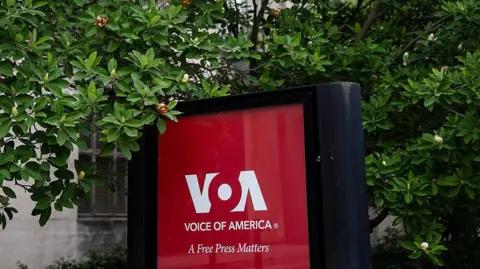
Trump administration has moved to terminate almost 500 employees of
federally funded news organisation Voice of America (VOA).
The
step is the latest in President Donald Trump's drive to strip back the
outlet, which the White House has accused of being "radical".
Acting
CEO of VOA's parent agency, Kari Lake, said the decision would "help
reduce the federal bureaucracy, improve agency service, and save the
American people more of their hard-earned money." A union representing
employees called the step illegal in a statement to the New York Times.
VOA was set up during World War Two to counter Nazi propaganda, and has become a major global broadcaster.
The
outlet is overseen by the Agency for Global Media (USAGM), which said a
total of 532 positions would be eliminated. The majority of those
employees are from VOA, which would be left with 108 staff, according to
a court filing.
The
announcement late on Friday night came a day after a judge ruled the
Trump administration had not followed proper procedures in its attempt
to fire VOA's director, Michael Abramowitz. The judge also ordered Lake
to sit for a deposition, where she would be questioned by lawyers.
The lawsuit was brought by a group of agency employees trying to block attempts to close down VOA.
"We find Lake's continued attacks on our agency abhorrent," they said in a statement to the BBC's US partner CBS News.
"We
are looking forward to her deposition to hear whether her plan to
dismantle VOA was done with the rigorous review process that Congress
requires. So far we have not seen any evidence of that, and as such we
will continue to fight for what we believe to be our rights under the
law."
Most of VOA's journalists have
been on administrative leave since March but some Farsi-speaking staff
were called back as war between Israel and Iran broke out this summer.
The
notices will also not affect journalists working in its Office of Cuba
Broadcasting division, which broadcasts news in Spanish from Miami.
Critics
say Trump's attempts to strip back VOA amount to an attack on press
freedom, and impacts America's ability to exercise soft power abroad.
The administration has accused the outlet of being "anti-Trump" and
"radical".
VOA broadcasts TV, radio and digital content in almost 50 languages.
White House says Susan Monarez not aligned with Trump's agenda
Three departing CDC officials cheered as they leave Atlanta campus
Kennedy says maybe some people should not be working at CDC anymore
White House appoints HHS top deputy as acting leader of CDC
Aug
28 (Reuters) - CDC Director Susan Monarez was fired on Wednesday after
resisting changes to vaccine policy that were advanced by Health
Secretary Robert F. Kennedy Jr. and that she believed contradicted
scientific evidence, a close associate said on Thursday.
The revelation and interviews with top officials
who resigned in the wake of the director's firing underscored the
growing division over the U.S. approach to public health and the
upheaval at the Centers for Disease Control and Prevention, which
protects U.S. health and has played a global role in eradicating
smallpox, reducing polio, and controlling HIV/AIDS.
Fellow
CDC employees cheered the three departing officials as they left the
Atlanta campus on Thursday in a show of defiance toward Kennedy and his
unscientific claims about vaccines.
Richard Besser, former acting director of the CDC, told reporters that he spoke with Monarez on Wednesday.
"She
said that there were two things she would never do in the job. One was
anything that was deemed illegal, and the second was anything that she
felt flew in the face of science, and she said she was asked to do both
of those," Besser said. He added that Monarez refused to dismiss her
leadership team without cause.
The
three top CDC officials who quit after Monarez's dismissal told Reuters
on Thursday they too had resigned over anti-vaccine policies and
misinformation pushed by Kennedy and his team.
Kennedy has made sweeping changes to vaccine policies
since taking office this year, including firing its entire expert
vaccine advisory panel and replacing them with like-minded anti-vaccine
activists and other hand-picked advisers.
The
White House named Jim O’Neill, currently deputy secretary of the
Department of Health and Human Services, as interim leader of the CDC,
an administration official said.
"(Monarez) was not aligned with the president's mission to Make America Healthy Again,
and the secretary asked her to resign. She said she would, and then she
said she wouldn't, so the president fired her," White House spokeswoman
Karoline Leavitt said on Thursday.
The number of women's teams competing in medieval combat is growing across Australia. (Supplied)
Link copied
Mary O'Mullane works as a nurse, but after hours she swaps her scrubs for armour as she trains to fight like a knight.
She is among a growing number of Queensland women participating in historic medieval combat, also known as Buhurt.
After
first donning her amour in 2023, Ms O'Mullane brought home bronze in
her category at the Buhurt International World Championships in Hungary
in July.
Mary O’Mullane represented Australia at the 2025 Buhurt International World Championships in Hungary. (Supplied)
She also captains the all-female Tyr's Valkyries team in Toowoomba, west of Brisbane.
"It does worlds [of good] for your self-confidence because you can do so many more things than you realised," she said.
"You
know that yes, people are going to be hitting you with weapons, but you
also know that you're realistically not going to get horrifically
injured.
"The confidence that knowledge gives you alone lets you try things that you probably wouldn't otherwise try."
The Tyr’s Valkyries won gold at Winterfest in Sydney this year. (Supplied)
In
Buhurt, competitors wear up to 40 kilograms of steel armour and work to
knock down their opponents using historically accurate weapons.
"It's like walking around in a sauna," Ms O'Mullane said.
"Even
just moving your arms when you first start out is a lot of effort, but
you all buckle down, work together and push through."
'Explosion' in women's participation
The Valkyries officially formed in 2024, after training alongside the Tyr's men's team for several years.
Club president Dave Melloy said he hoped introducing the Valkyries would encourage more women to join the sport.
The Valkyries all-female team clash at a knight fight in Toowoomba. (Supplied Jase Wheeler)
"When I first started, I think there was like eight women in the whole country that were fighting," he said.
"The women seem to thrive and we're happy to support them.
"If you step in the cage, your identity, your background, everything, none of that matters."
Women's
representative for the Australian Medieval Combat Federation, Ro
Vidler, said Queensland is now home to four women's Buhurt teams across
Brisbane, Logan, Toowoomba and the Sunshine Coast.
"There has always been a women's presence in the sport," she said.
"It has, in the last couple of years, started to become a lot more popular.
"We've had an explosion of women's teams in Australia, which is fantastic to see."
She said women's teams are popping up across the country, with other clubs in New South Wales and Victoria.
Competitors wear up to 40 kilograms of steel armour. (Supplied)
'Extremely freeing'
Ms Vidler, who fights with the Brisbane She Beasts, said Buhurt was an excellent way for her to relieve stress.
"Being
able to safely and consensually express yourself in a violent way is
extremely freeing, especially for women because we're not socialised to
be that way," she said.
"I feel like a lot of us have a lot of repressed rage and this sport is an excellent way to get it out in a safe environment."
Ms O'Mullane said the sport had changed her day-to-day life.
“It’s done an incredible job of teaching me how to manage anxiety,” she said.
Breaking into a male-dominated sport
Despite an increase in female participation, medieval combat remains heavily dominated by men.
Rachel Rowe began Buhurt a year ago and said it could be daunting for women wanting to get involved.
"Once you get to know the guys, they're so cool to be around but having women's only training really helps," she said.
"The women's community all around Australia is just so welcoming and supportive."
Robyn Williams announcing the Science Show's new broadcasting time in 1977.
Link copied
Fifty years ago, Australia's longest running science program was born.
Robyn
Williams recorded the first episode of ABC Radio National's Science
Show at the 13th Pacific Science Congress in Vancouver, Canada in 1975.
It was the middle of the Cold War and the internet had not yet been imagined.
And yet, many of the topics discussed at the conference still ring true today.
The first episode featuredscientists
concerned about the nuclear arms race, the rate of animal extinction,
and the impact of burning fossil fuels and climate change.
The only give away it was the 70s wasthe theme of the conference: Man's Future in the Pacific — and the funky theme tune at the beginning of the episode.
"It just shook me that the scientists here were saying what we needed to pay attention to and people weren't."
Listen to the highlights from 50 years of The Science Show — from deep-dive investigations to hoaxes.
Over
the past 50 years, the Science Show has continued to provide audiences
with scientific debate, research and information on important
discoveries.
It has also been a
beacon for the Australian science community, according to Fiona
Stanley, an epidemiologist, and former ABC Board member and Australian
of the Year.
"[The Science Show] is not just radio for entertainment, it's been a really serious contribution to Australian science,"
Professor Stanley said.
To
celebrate 50 years, we look back at Williams's favourite stories and
some of the show's most memorable moments — from identifying medical
fraud to learning about opals in Australia.
A climate change warning from 1975
The first Science Show had a dire warning about the climate effects of burning fossil fuels.
The first Science Show — which was broadcast on August 30, 1975 — included an interview with Peter Ritchie-Calder.
Lord Ritchie-Calder, thenhead of energy policy at the UK House of Lords, shared startling figures of the greenhouse gasesbeing emitted from fossil fuels and the likely disastrous effect on the world'sclimate.
"We've
been saying this at the UN and elsewhere since 1963 and here we are in
1975 and people still have not acted," he concluded.
For Williams, the interviewhighlights just how long we have known about the problem of climate change without effectively fixing it.
"This was extraordinary," he said.
"A truly significant authority exclaiming that a concern they had 12 years before was still not being acted upon effectively.
"Now make that gap 62 years!"
Uncovering a fraud in 1987
When
ABC broadcaster Norman Swan first joined the ABC Science team in 1982,
he had one thing on his mind — William McBride, a then well-respected
doctor, whohad been credited with linking thalidomide to birth defects.
Dr Swanhad heard stories of McBride that troubled him after he first arrived in Australia.
His investigation exposed the Sydney obstetrician for scientific fraud.
"The William McBride story … was unquestionably the major story of 1987 and 1988 and continued for several years," Dr Swan said.
Robyn
Williams and Norman Swan look back at the investigation into William
McBride who was initially credited with linking thalidomide to birth
defects.
"There was never any doubt where it would be broadcast.
"The
Science Show was a unique platform with its prestige and legitimacy,
not to mention the ability [it provided] to [broadcast] long-form
documentary style investigative journalism."
Swan's expose on McBride earned him the Gold Walkley and Australian Writers' Guild Award for best documentary.
A 1998 chat about the clitoris
In
1998, Williams ran a story about a landmark paper from Australian
urologist Helen O'Connell that found the anatomy of the clitoris was up
to 10 times larger than previously thought.
Until that discovery, the clitoris was not in medical textbooks or part of the conversation about female pleasure.
Dr Helen O'Connell demystified historical misconceptions with the first comprehensive anatomical study of the clitoris.
The Science Show has long supported and elevated research by women scientists, Professor Stanley said.
"[Robyn Williams] ... really pushed women and encouraged women in science," she said.
"We were given a hard time ... but [he] acknowledged us."
This
included running stories about research by Professor Stanley and
colleagues on topics such as the role of folate in the prevention of
spina bifida, and investigations into the cause of SIDS.
Protecting ancient trees
Peter Hunt was areporter in the ABC Science unit in the 1980s, where he covered a number of important stories about ancient forests.
An inquiry into logging at Terania Creek, NSW, in 1980 was a flashpoint for conservation and open science.
This episode, from November 1980, looked at aninquiry
into logging a particular forest in New South Wales. While scientists
argued that not enough was known about the area, lawyers argued about
the definition of a "rainforest".
"Peter did several Science Show specials on forests and the need to keep ancient ones intact," Williamssaid.
It was this reporting that inspired one of today's world-leading ecologists to become a scientist.
"A
young David Lindenmayer was listening and decided on the spot to take
forestry as his degree. He is now Distinguished Professor at the
Australian National University, and author of The Forest Wars [about
native forest logging]," he added.
Professor Lindenmayer said the Science Show has continued as a companion to him all these years later.
"I first remember listening to the Science Show while I was doing my teacher training in Adelaide," he said.
"I loved that show — the new discoveries and hearing scientists passionate about their work.
"It's still the same in 2025 for me — nearly 40 years later!"
Mesothelioma diaries
Asbestos
disease — mesothelioma — was covered extensively in the 1970s on the
Science Show by the late ABC journalist Matt Peacock.
"When we set up the Science Show, some of our best reporting was done by Matt Peacock," Williams told Late Night Live.
"We were accused then … of trying to undermine the Australian way of life and enterprise.
Decades later, the tragic effects of the disease werestill being felt.
Psychiatrist Jim Holmes talks about being diagnosed with mesothelioma.
In 2007, Williams's neighbour Jim Holmes was diagnosed with mesothelioma after the ceiling of his house collapsed.
Williams asked Dr Holmes if he'd like to record a diary of his experience.
Through
a four-part series, Science Show listeners were able to listen through
Holmes's diary entries about how the disease had affected him.
"Jim Holmes said it helped him cope," Williams said.
"He was communicating with the public, he was warning them about the threat of asbestos and to take it seriously."
The diet of the first Australians
Over
the past 50 years, the Science Show has focused on discoveries that
revealed how important Australia, and its people, are to our
understanding of the world.
After
coming down from the north 65,000 years ago, the first Australians
lived in caves in what is now Kakadu National Park in the Northern
Territory.
"When I first arrived in Australia they thought the overall date for arrival of Aboriginal people was 4,000 years," Williamssaid.
Fragments of charcoal reveal those who used fire and grinding to prepare a range of foods.
So what did Indigenous Australians eat all those years ago?
In this episode from 2024, Williams was joined by Anna Florin from the Australian National University, who had been investigating fragments of charcoal that preserved the cellular structure of plants near the caves.
According
to Dr Florin's research, the first Australians were highly skilled at
using fire and grinding to prepare yams, roots and tubers.
The scientist obsessed with opals
Another
theme of the Science Show throughout the years has been to spark
curiosity, ask interesting questions and find surprising answers.
Jonica Newby visits the opal mining town of Lightning Ridge and meets the geology professor obsessed with opals.
One of those questions — why Australia has so many opals — perplexed science journalist Jonica Newby.
While working on a story in 2024 about the origin of mammals in Australia, Dr Newby discovered a professor of geology in Lightning Ridge who knew the answer — and it had to do with Mars.
"Both the red planet and Central Australia have rock affected by acidification — which produces opal," Williams said.
Inspiring the next generation
While
the Science Show has been telling important stories for half a century,
it is still inspiring the next generation of scientists and students to
think big.
Ms Witkowski-Blake is now studying science and has her own podcast about insects.
"You gave me a real opportunity when I was younger to talk about science on the radio," she told Williams in a follow-up story on the Science Show in 2024.
Williams's career in radio also started with an opportunity (in his case holding down the broadcast of the Apollo 17 landing in 1972).
Three years later he broadcast his first episode of the Science Show.
Ukrainian soldiers put their skills to the test at the Interflex training in England. (ABC News: Adrian Wilson)
Link copied
Before Sergiy was a soldier, he was a dancer.
He and his wife had planned to go professional together, specialising in the tango.
Instead, he's learning the choreography of battle.
"It's kind of strange, but there's a lot that's similar between it," Sergiy said.
"You
need to find the most creative way to solve the problem, so it's
something that's connected. But of course, it's an opposite world."
Sergiy is one of more than 50,000 Ukrainian troops who have trained with Operation Interflex in England.
The program is run by the UK's Ministry of Defence, assisted by multiple allies including Australia.
Ukrainian troops have been refining their combat skills at the training. (ABC News: Adrian Wilson)
When
it started shortly after Russia's full-scale invasion of Ukraine in
2022, most Interflex recruits were civilians like Sergiy, who were
trained to become soldiers within six weeks.
The operation has since evolved to include a leadership program.
"A
lot of these guys are really experienced soldiers," said one of the
Australian soldiers, who can't be identified for security reasons.
"They have real-time experience, and the war is changing so quickly."
The depth of that experience meant Interflex was perceived as patronising by some in Ukraine.
"When
we just came here, we were absolutely sure that we knew everything …
and there was absolutely nothing they could teach us," said veteran
Ukrainian fighter Vasyliovych, who can only be identified by a nickname
according to army protocol.
"But
since we started training here, we realised … they're not teaching how
to fight, because we know that, and they are giving us some leadership
skills."
Vasyliovych, a Ukrainian soldier, has learned a lot at the training. (ABC News: Syan Vallance)
Aussies in 'coalition of the willing'
The evolution of battle and the training itself means teachers are learning too.
"Often
with the experience that the Ukrainians bring, you end up with a
collaborative training environment," said the deputy commander of
Interflex, Australian soldier Lieutenant Colonel Johnny Ozols.
Australian soldiers have also learned things from other countries involved in the program, like Finland.
"That's
been a great opportunity to share those lessons from another army that
wouldn't necessarily be a traditional partner … sharing how they think
war is best fought in the 21st Century, which is immensely powerful,"
Lieutenant Colonel Ozols said.
The operation's value may extend even further.
When
a peace deal is struck, at least 31 countries have signed up to help
defend Ukraine as part of a so-called "coalition of the willing".
Australia is one of them.
"Interflex
provides a ready-made framework of allies and partners that could form a
potential coalition of the willing, in the future," said Ed Arnold, a
senior research fellow for European security at the Royal United
Services Institute — a defence think tank.
Ukraine's military is now considered among the world's most advanced. (ABC News: Adrian Wilson)
While
Mr Arnold acknowledged the distinction between the coalition of the
willing and a reassurance force that might deploy to Ukraine after a
ceasefire, he said they were connected.
"The reassurance force would be a subset of that potentially wider coalition of the willing," he said.
"And
actually, those nations that are training within the UK on Interflex,
you would expect them to step up and provide a significant part of any
force.
"So just having them training together is important."
Russia has rejected the idea of European peacekeeping troops serving in Ukraine, but allies have not given up on it.
The
ABC understands senior Australian officials have attended most
coalition of the willing meetings, and that Canberra is still
considering whether it will put Australian boots on the ground in
Ukraine whenever a ceasefire is declared.
The Interflex training has evolved over time to include more leadership elements. (ABC News: Adrian Wilson)
'Fight like it's the 1940s'
Over
the course of the war, Interflex has allowed the Australian Defence
Force to study modern warfare through the Ukrainians' experiences.
In some ways, that has meant opening the history books to learn how it will need to fight in the future.
Technology
has played a massive part in the Russia-Ukraine conflict. Ukraine's
army is now among the world's most advanced. For example, its
development and use of combat drones is considered cutting-edge.
Despite that, troops are still forced to adopt strategies associated with bygone eras on the front lines.
As
one soldier told the ABC, when Moscow cuts or scrambles communications,
Ukrainian forces are left with no choice but to "fight like it's the
1940s".
Interflex has adapted too.
"It's
kind of a live-training theatre, which is bespoke to what the
Ukrainians need at this present moment in time," Mr Arnold said.
A Ukrainian soldier takes part in Interflex training in England this month. (ABC News: Adrian Wilson)
When
they needed trench-warfare training, soldiers participating in the
Interflex program dug systems that resembled the networks along
Ukraine's front lines, with branch-covered bunkers for protection from
Russian drones.
Like the wars of old, they had to dig by hand, with tiny spades.
"It's physically demanding work, and that's also with the pressure of battle at the same time," said Lieutenant Colonel Ozols.
"But the Ukrainianism is 'sweat saves lives.'"
At first glance, the trenches blend into the forest floor.
But an ambush drill revealed the labyrinth carved through the English woodland, that either provide protection or become a trap.
In
training, the bullets may be blanks but the lessons they learn might
mean the difference between life or death when the Ukrainian soldiers
return home.
Within weeks, these trainees will be back on the frontline, facing real Russian bullets.
Mahmoud Khalil, Heidi Matthews and Rumeysa Ozturk have been targeted by Canary Mission. (Reuters: Angelina Katsanis, Supplied, AFP: Joseph Prezioso)
In short:
A pro-Israel website called Canary Mission has been targeting critics of Israel and those advocating for Palestinians.
The site creates public profiles of students and professors they claim 'promote hatred of the US, Israel and Jews'.
Last
month, it was revealed the Trump administration relied on lists from
the site and a far-right Zionist group to investigate students for
possible deportation.
Link copied
When the shadowy pro-Israel group Canary Mission sets its sights on someone, its goal is clear.
The
blacklist site launched in 2015 with the expressed aim of preventing
pro-Palestinian student activists from getting jobs after college.
Its launch video was a blatant call to action for employers across North America.
"Today,
college campuses are filled with antisemitic, anti-American radicals,
waving Palestinian flags and placards," a voice can be heard saying.
"A
few years later, these individuals are applying for jobs within your
company … It is your duty to ensure that today's radicals are not
tomorrow's employees."
Canary Mission aimed to prevent pro-Palestinian student activists from getting jobs after college. (Reuters: David Dee Delgado)
A
decade on, the site has created hundreds of dossiers on students,
professors, health professionals and organisations, accusing them of
promoting "hatred of the US, Israel and Jews" on college campuses.
While
the site has profiled some Neo-Nazis and Holocaust deniers, many
dossiers have targeted people for simply supporting Palestine or
criticising Israeli policy.
It
has published their names, photos, workplace and education information —
including college majors, and links to their social media pages —
labelling their activism "antisemitic" or "terrorism".
Canary Mission is a blacklist site launched in 2015. (Supplied)
The
group is not alone in its mission to silence and punish criticism of
Israel — in fact it operates as part of a larger ecosystem.
However,
while many of Australia's pro-Israel lobby groups operate discreetly
and persistently behind the scenes, Canary Mission wants the world to
know exactly what its intentions are.
A 'nefarious and McCarthyist enterprise'
As
one of the many targets of Canary Mission, Andrew Ross, a professor of
Social and Cultural Analysis at New York University (NYU), said the site
has been successful in promulgating fear on campuses.
"No
matter what you have achieved in your life, if you're publicly critical
of Israeli policy you're going to be attacked, pulled into disrepute,
and efforts will be made to have you either fired from your position or
blocked from employment channels," Professor Ross said.
Andrew Ross is one of the many targets of Canary Mission. (Reuters: Angelina Katsanis)
His profile on Canary Mission detailed his support of the Boycott, Divestment, Sanctions movement (BDS), his arrest at NYU
after joining a university sit-in, and what was labelled as his "hatred
of Israel" — citing his solidarity with student protesters.
The
site's tactics have often been compared to McCarthyism in the 1950s —
when individuals were targeted, blacklisted, publicly humiliated or lost
their jobs if they were deemed to have communist ties or sympathies.
He
said appearing on the "nefarious and McCarthyist enterprise" has
amplified harassment and death threats against him and his family.
"It's a doxxing resource … used as ammunition to disparage you, to harass you, to endanger your professional life and worse."
A screenshot of Andrew Ross's profile on the Canary Mission website. (Supplied)
While
pro-Israel lobbying is not a radically new methodology, Alex Kane —
senior reporter at Jewish Currents — said it was the first of its kind
and its "poorly sourced" dossiers "ruin people's lives".
"What
made Canary Mission so unique is the leveraging of the internet to
create webs of suspicion around people … when all they're doing is
advocating for the human rights of Palestinians."
The
site also includes an "ex-canary" ritual, where those who have been
profiled can only have their name removed if they appear to repent by
writing a public apology.
The Trump administration's crackdown on immigration earlier this year saw hundreds detained and deported.
In January, Canary Mission targeted student-activist Mahmoud Khalil, a negotiator and spokesperson for pro-Palestinian protests at New York's Columbia University.
The
lengthy dossier included screenshots of Mr Khalil at protests, several
excerpts of slogans he chanted or speeches he made, and his
participation in the Columbia University Apartheid Divest student
coalition.
Soon after, far-right Zionist group Betar US posted that Immigration and Customs Enforcement (ICE) was aware of his "home address and whereabouts".
By March, officers with ICE Homeland Security Investigations arrested Mr Khalil without a warrant.
That same month, Turkish national Rumeysa Ozturk — a student at Tufts University in Massachusetts — was detained by six plain-clothes US federal officers.
It
came a year after Canary Mission published the 30-year-old's personal
details when she co-authored an op-ed in The Tufts Daily calling for the
university to divest from companies with ties to Israel.
Canary Mission took credit for Ms Ozturk's arrest, labelling the dossier "the primary cause".
Months
later, a federal judge ruled Mr Khalil's detention unconstitutional,
and Ms Ozturk was released on bail without restrictions after a judge
stated there was no evidence presented to support her detention.
Rumeysa Ozturk was released after six weeks in immigration detention. (Reuters: Faith Ninvaggi)
During
the trial of the Trump administration's deportation policy last month, a
senior official within ICE's Homeland Security Investigations division
confirmed "most" names of student protesters it was asked to investigate
were pulled from Canary Mission and Betar US.
Quincy
Institute senior adviser and investigative journalist for Responsible
Statecraft, Eli Clifton said Canary Mission's relevance and impact has
increased since its inception.
"While
there's certainly been loads of attempts to stifle free speech in the
United States, this is an odd one where actually the goal is to stifle
free speech about a country 6,000 miles away and about US foreign policy
towards that country," he said.
Canary Mission has been contacted for comment.
Canary Mission has created hundreds of dossiers on people. (Reuters: David Dee Delgado)
Unprecedented suppression of speech
Last
year, Heidi Matthews — an assistant professor of law at the Osgoode
Hall Law School of York University — found her Canary Mission profile
alongside other academics from Canada.
After
working on international criminal law for almost two decades, she said
the suppression of speech and academic freedom she was now facing was
unprecedented.
"The purpose is
to control public discourse … and to have that conversation only in the
terms dictated by the State of Israel," Professor Matthews said.
Heidi Matthews has been targeted by Canary Mission. (Supplied: Osgoode Hall Law School)
Canary Mission cited her support for the BDS movement and student encampments, and accused her of demonising Israel.
"Statements
I've made have been constructed by Canary Mission as justifying armed
resistance that targets civilians, when in fact there's just no universe
in which any kind of legitimate resistance would encompass that kind of
international criminality," she said.
Professor Matthews said the site followed the script of other defamatory smear campaigns.
"I
don't feel the need to defend myself against organisations who operate
emphatically in bad faith, not on the basis of facts and on the basis of
very well-funded and organised political motivation," she said.
She
said academic institutions have failed to support faculty members,
including through "scholarship harassment" — when people are targeted
for research they do that is incompatible with certain political views.
Pro-Palestinian
students and faculty have also been the target of a plan called Project
Esther — launched by conservative Washington-based think tank Heritage
Foundation — aimed at suppressing the movement, including protests
within schools and universities across the US.
The think tank is known for spearheading Project 2025 — a policy guide for President Donald Trump's second term that sought to reshape the federal government.
In
what it said was a plan to fight antisemitism, it branded critics of
Israel "a terrorist support network" — calling for them to be deported,
sued, expelled and fired.
Canary Mission has accused its targets of promoting "hatred of the US, Israel and Jews". (Reuters: David Dee Delgado)
Who is behind the shadowy site?
Unlike the people it profiles on its site, Canary Mission has gone to great lengths to keep its own members anonymous.
Its web domain shows it uses a proxy company to hide its IP address and ownership.
While
Canary Mission accepts non-tax deductible donations through the site,
there is no group by that name registered with the Internal Revenue
Service (IRS) — the revenue service for the US federal government.
The
site does not appear to have a fiscal sponsor either, which is a
nonprofit that helps smaller or unregistered projects accept donations
legally and provides financial oversight.
In 2018, The Forward
reported on a tax filing from a Jewish-American philanthropic
organisation showing a $US100,000 donation to the Central Fund of Israel
which was designated for "Canary Mission for Megamot Shalom".
Megamot Shalom is a mysterious Israeli-based non-profit with minimal online presence, and no spokesperson.
The
Central Fund of Israel facilitates US tax-deductible donations to
right-wing Israeli charities and channels money to illegal Israeli
settlements in the occupied West Bank.
The Forward also said that a British-born Jerusalem resident was in charge of the site.
A report found the husband of a University of Pennsylvania trustee donated to Canary Mission. (Reuters: Charles Mostoller)
Expectations 'battle' will recommence
The Israeli government has been contacted for comment.
A tax document from 2023 showed a Florida-based family foundation gave Canary Mission $US100,000, and listed that it was going to Israel.
In
a report for The Intercept, Eli Clifton found that the treasurer of the
Natan and Lidia Peisach Family Foundation — which made the donation —
was the husband of University of Pennsylvania trustee Cheryl Peisach.
Canary
Mission has dedicated an entire section of its site to targeting the
University of Pennsylvania, its faculty and student body, claiming a
"rising tide of antisemitism".
Experts say Canary Mission targets people for simply supporting Palestine or criticising Israeli government policy. (Reuters: Eduardo Munoz)
Mr Clifton said it shows how "ugly" the debate on college campuses had become — both about Israel and free speech.
"It's
pretty inappropriate to have somebody who sits as a trustee of this
organisation … funding the very attacks on this institution at a time
when the Trump administration is threatening to withhold hundreds of
millions of dollars of funding from universities," Mr Clifton said.
The University of Pennsylvania, Cheryl Peisach and her husband Jaime have been contacted for comment.
As
US colleges head into the new academic year, Mr Ross said he expects
the "battle" to recommence — and he's looking forward to the fight.
"This current generation of students has been so brave and bold," he said.
"Even though they're being repressed and there's a crackdown upon them, they will not stop."