Monday, 3 April 2017

Japan's ancient art of bonsai threatened by waning interest among youth

    Extract from ABC News

    Posted yesterday at 6:19am


    Masashi Hirao exudes the calm you'd expect of a bonsai master.
    He speaks softly and appears to glide — not walk — as he moves around a bonsai tree with his golden scissors held aloft.
    The act absorbs him, his eyes dart from branch to branch as he spins the artwork on its platform, carefully inspecting it from every angle.
    "When I first saw a bonsai tree it reminded me instantly of the view and smell of the mountain where I played in Tokushima when I was young. That's how I entered the bonsai world," he says.
    At 35, he's one of the youngest masters practising the craft in Japan. He says bonsai could die out unless another generation takes up the enthusiasm for the ancient pastime.

    "There are not many young bonsai craftsmen and many bonsai trees are being exported overseas," he says.
    "If this condition continues, bonsai will disappear in 30 years and bonsai craftsmen will also disappear."
    Mr Hirao decided to meet the problem head on.
    He now "performs" bonsai at galleries and festivals in the hope of attracting younger people.

    He takes an unrefined bonsai tree and changes its shape, turning it into a finished work of art in 30 minutes.
    "It's just showing how cool bonsai is and breaking the image of bonsai people have," Mr Hirao says.
    He hopes his performance will spark an interest and prompt a visit to a bonsai nursery.
    "I'm hoping when people come to the bonsai nursery and stand in front of a bonsai tree which doesn't move but is alive and older than they are, they can feel the energy or something that comes out of the tree without saying it in words."
    There is evidence that bonsai trees were brought to Japan from China as souvenirs in the 6th century.
    Bonsai trees came to adorn the homes of wealthy Japanese people and the "potted trees" became symbolic of Japan.
    These days bonsai is seen in Japan as an old man's hobby.
    Rumiko Ishida is the curator of the Bonsai Art Museum in Omiya, in western Tokyo.
    She says the museum attracts a lot of visitors, but not young Japanese people.
    "For Japanese people, many are senior-aged, but many of the foreign visitors are young and they're in their 30s and 40s," Ms Ishida says.
    Austen Kosasih is a 26-year-old Melburnian who is in Japan studying an apprenticeship under bonsai master Kunio Kobayashi.

    He believes bonsai is lost to Japan and its revival now depends on the rest of the world.
    "As we speak, every single day, bonsai masterpieces in Japan are being shipped to the UK, to Europe, to China, to Taiwan. They are losing national treasures on a daily basis because there is a great decline in the hobby," Mr Kosasih says.
    "It's sad, but it could be an uprising of a new bonsai generation worldwide, so I'm just hoping that will be the case.
    Mr Kosasih runs a bonsai rental business in Melbourne, offering hotels, restaurants and shops the opportunity to rent one of his bonsai trees to adorn their premises.
    He hopes it also prompts a more general interest in the hobby in Australia.

    "I think that the one thing that us Australians have is that we love our DIY — we love it!" he says.
    "Bonsai is DIY in essence, if you have a seed that you grow and you spend several generations to create something like this — it's a work of art."
    For him, bonsai offers a peaceful escape from the hustle and bustle of city life.
    "When I'm really in the zone to do bonsai I don't think about anything else. Hours can go by really quick. It's healing, it's meditative, you're so in touch with nature you tend to appreciate a lot of things that you see in your surroundings."

    Saturday, 1 April 2017

    Need for transparency as 'slush fund' allegations get bandied about


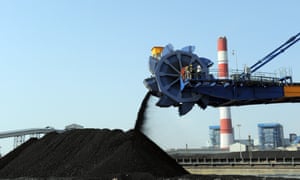
    We don’t yet know whether the $5bn Northern Australia Infrastructure Facility (NAIF) will be – as was alleged in parliament this week – a “slush fund” used to pursue the government’s “pro-coal agenda”.
    But we do know some government ministers are absolutely determined to promote coal mining and generation – in particular the Indian conglomerate Adani’s $21bn Carmichael coalmine in Queensland – without a thought for how it will contribute to the global warming that is bleaching the Great Barrier Reef up and down the Queensland coastline and increasing the intensity of cyclones.
    And we do know Adani has put its hand up for a $1bn concessional loan from the facility to help build a $2.2bn rail line that is essential for the mine to proceed. We also know Adani’s chief executive said with surprising certainty on Friday that engineering work on that rail line would start in June, and that construction was scheduled for September.
    And we certainly know the NAIF rules are way too opaque and the publicly available information way too sparse, to be absolutely sure it won’t, or couldn’t, be used to achieve a political end.
    The “slush fund” claim was made by former treasurer Wayne Swan, who told parliament the facility’s procedures were “as dodgy as Lehman Brothers”, the bank that sparked the global financial crisis. Swan has written to the auditor general demanding an investigation.
    The NAIF is supposed to be an independent statutory authority that makes recommendations to resources minister Matt Canavan about how concessional loans can be used to boost the economy of northern Australia. The minister gives final approval for any loan, but according to the legislation setting up the fund, he cannot direct its recommendations.
    Asked how Australians could be assured of the NAIF’s independence, its chief executive, Laurie Walker, told Senate estimates this month that “the minister has no ability under our act to direct the NAIF board to support any particular project or individual, and the board will absolutely adhere to its obligations under the act”.
    At that point the minister, Canavan, interrupted. “Can I just add to that, too, that I support everything Ms Walker just said, but I do see it as part of my role to help promote the fact that we have a Northern Australia Infrastructure Facility that investors to this country should, certainly, be considering as an option.”
    And he had just finished telling the committee: “I think, unfortunately, there has been a view that various Australian governments have not been supportive of the coal sector, but it is fantastic that we have a prime minister that has said loud and clear that we back the coal industry and we think it is a very strong and important sector for our economy.”
    And he has repeatedly said how confident he was in the Carmichael project’s future and how beneficial it would be for his home state. (Adani and governments repeatedly claim it will provide 10,000 jobs, although evidence from an economist commissioned by Adani itself – Jerome Fahrer of ACIL Allen – given in the land court in Queensland stated that “over the life of the project it is projected that on average around 1,464 employee years of full-time equivalent direct and indirect jobs will be created”.)
    And late last year, just before the mine’s billionaire proponent, Gautam Adani, was due to meet state and federal political leaders, Brisbane’s Courier Mail “exclusively” reported that $1bn had already been “set aside” for it, and it had recevied conditional approval. The minister said that while he was confident, that “exclusive” was a bit premature. This week the paper was again extolling the project’s benefits and puzzling out loud over why environmentalists were opposed to it, in an article written by a journalist who declared he had recently travelled to India as a guest of Adani.
    In fact, the only reason we even know the Adani mine is one of four projects now in the “due diligence” stage for NAIF funding is that the minister announced it, after speaking to the fund and the company. The NAIF itself hasn’t made public any of the companies it is working with, and says it won’t.
    Swan compared the checks and balances for the NAIF (a body set up to provide loans to projects that can’t get private financing) with the $10bn Clean Energy Finance Corporation that Labor established – a body the Abbott government repeatedly sought to dismantle precisely because it was established to provide loans to projects that couldn’t get private financing.
    The CEFC, Swan pointed out, was required to deliver a designated rate of return on taxpayers’ money. The NAIF has no such specific requirement, and had provided no documentation about how it would decide whether a loan was likely to be repaid, or even how it would determine whether a loan was needed.
    “The few policies they do have they are now keeping a secret ... the Turnbull government wants to turn it into a boondoggle machine in pursuit of its ideological and political pork-barrelling. But the NAIF appears to have been intentionally set up, in the first instance, with no ability to operate independently; with a board that has been stacked in favour of mining investments; and with an investment mandate so broad and vague that minister Canavan can essentially treat the NAIF as his own personal slush fund,” Swan fumed.
    “For months, ministers Canavan and Joyce have repeatedly promoted a $1bn loan to Adani to partly fund the Carmichael railroad while simultaneously claiming that investment decisions of the NAIF are independent. If the Adani mine is to go ahead, it must be able to stand on its own merit – it should not get one-fifth of minister Canavan’s slush fund to help make it a profitable investment.”
    The Australia Institute – one of many groups campaigning against the Adani mine – requested documents about the NAIF’s application and approvals processes, including how it would assess risk and how it would determine whether a project was in the public interest.
    The FOI request was refused on the basis that it “would reveal to proponents and other interested parties the NAIF’s methodologies beyond what is required or appropriate to disclose publicly”.
    And this week the Labor party got the Senate to back a demand that Canavan deliver similar documents in the Senate. The minister eventually replied that he couldn’t because he was “not in possession of the documents mentioned”.
    Given that the “documents mentioned” included a statement of how much risk the NAIF was prepared to take while lending $5bn of taxpayers’ money and given the act says “the facility will develop a risk appetite statement to guide its investment decisions, in consultation with the responsible minister” (that is, Canavan) it seems astonishing the minister would not have it. And if the facility hasn’t got a risk policy yet, how can it be considering a $1bn loan for a project that is set to start engineering works in June?
    There is nothing wrong with a government looking for ways to promote development in northern Australia with concessional lending.
    But there would be everything wrong with providing a massive government-backed concessional loan to achieve a political end without proper public scrutiny or process, or even a definition of how it was determined to be in the public interest.

    Donald Trump's battle with Obamacare leaves US health care in uncertain era

      Extract from ABC News

      Posted about 6 hours ago

      Under the crisp midday sun in the hills of rural West Virginia, the Myers family pile out of their tired, red pick-up truck in the car park of the Cabin Creek Health Centre.
      "A couple of them had the flu and this one had an allergic reaction and we can't figure out what it is exactly," said Ardith Myers as she gestured to her 15-year-old daughter, Alexis, who held her hand over her face.
      "So I thought I'd just bring them all, just to get them all checked you know, just to make sure," she added, flanked by her four daughters, aged three to 17.
      Before the Affordable Care Act — known as Obamacare — was passed seven years ago, a trip to the doctor like this would have been an unaffordable luxury for Ms Myers.
      "My husband does work but we can't afford medical bills without it, so it's helpful," she said.


      West Virginia is one of the poorest states in America.
      Things were quite dire for many in the Mountain State before Obamacare came in.
      "I had patients who would come in and say, 'I can either pay for my medication or buy my kids' shoes'," Cabin Creek physician Dr Mitch Jacques said.
      He estimated now one-in-five of his patients was covered under the Affordable Care Act. Statewide, it's 200,000 — nationally, 15 million. Despite the help Obamacare provided, West Virginians voted overwhelmingly for Donald Trump in the presidential election, despite his promise to abolish it.
      Dr Jacques and his colleagues breathed a sigh of relief last week when Republicans abandoned their plan to repeal and replace the Act because of party infighting.

      'It is exploding right now'

      While Republican House Speaker Paul Ryan said "Obamacare is the law of the land for now", US health care is entering an uncertain era.
      Obamacare did two key things — it allowed states to expand insurance coverage for the poorest Americans under what was called "Medicaid", and it created a marketplace for private insurers to provide affordable plans to working people who do not get health care from their employers.
      Since its creation in 1965 and expansion under former president Barack Obama, Medicaid has become entrenched in American society. 74 million people rely on it for coverage. Some Republican members of Congress were not prepared to vote for their party's Obamacare replacement legislation because of fears Medicaid would be rolled back.
      While healthcare reform is off the table for now, Mr Trump has hinted at what he plans to do.
      "I've been saying for the last year-and-a-half that the best thing we can do, politically speaking, is let Obamacare explode," he said last week after Republicans' aborted their vote in the House of Representatives.
      "It is exploding right now."

      'Hopefully ... that's one thing he doesn't mess up'

      Experts say there are also things the Trump administration can do to undermine Obamacare — including Medicaid — and allow it to fail.
      "The Trump administration has a lot of flexibility under the law that creates the Affordable Care Act to either make or break the law for people," said Professor Sara Rosenbaum, a health policy expert at George Washington University.
      "The executive branch can either operate the program to be as embracing of the population as it can possibly be, or it can choose to operate a program in a way that makes it very hard to get benefits, keep benefits, [and] come back in if you lose benefits.
      "We just don't know really what the administration is going to do."
      Interestingly, Mr Trump's failure in Washington to repeal and replace Obamacare has been a win for many of his supporters in places like West Virginia where he remains popular.
      "I know a lot of people don't seem to like him, but he seems to be doing more to help people," Ms Myers said.
      "So hopefully with the insurance, that's one thing he doesn't mess up."

      News Summary August 3, 1895.

      *THE WORKER*
      BRISBANE , AUGUST 3, 1895.


      General News Summary.

      FOR THE WEEK ENDING JULY 31.


      Two garrotters arrested in Sydney.
      Natural gas found at Taranaki, N.Z.
      Earthquake at Dunedin, N.Z.
      Terrible outbreak of cholera in Japan.
      Frost and snow in parts of Queensland.
      Nugget weighing 238oz. found at Dalyesford, Vic.
      Petroleum well discovered in South Australia.
      Successful labour social and ball held at Cairns.
      Geological survey of Croydon goldfield commenced.
      Good prices for wool still continues in London.
      Most severe weather ever known in New Zealand.
      Wide Bay Agricultural Show held at Maryborough.
      Steamer Argus still ashore on a reef near Somerset.
      Boom in deputations to the Minister for Railways.
      Turkish troops quelling the insurrection in Macedonia.
      Samuel Landerer, gored by a bullock at Gracemere, dies.
      Turkey grants an amnesty to Armenian political prisoners.
      Japan requests China to pay the war indemnity in London.
      Magazine building at Croydon takes fire and afterwards blows up.
      George Staples, a farmer, accidently shoots himself at Preston, Vic.
      Two men arrested in the act of burglarising a shop at Prahran, Vic.
      Excessively cold weather in N.S.W.; 1 foot of snow in several places.
      Serious rioting in connection with elections at Dunstable, in England.
      W.A. Prell, killed whilst drafting cattle at Richmond Downs station.
      Andrew M'Minn attempts suicide in Brisbane by cutting his throat.
      A little girl named Harvey burned to death at Mount Larcombe.
      Japan intends spending £8,000,000 in England building warships.
      Oscar Wilde declared bankrupt at the suit of the Marquis of Queensbery.
      Sydney butcher fined £100 for having in his possession contraband cigars.
      Hotel at Palmerston, N.Z., burned down and two men burned to death.
      Four kanakas arrested at Mackay for a murderous attack on a white man.
      Re-examination by doctors of Molloy confined as a leper on Peel Island.
      Micheal Davitt lectures at Charters Towers, Townsville, and Rockhampton.
      A compositor named J. G. Robinson accidentlly killed at Perth, W.A.
      House burned down at Mount Morgan, Nicholas Tucker fatally injured.
      Man named Preston blown to pieces with dynamite at Ramrod Flat, Vic.
      Brazil at loggerheads with Great Britain for annexing the island of Trinidad.
      Japanese destroy the forts of Port Arthur captured during the Chinese war.
      Queensland scholars very successful at Sydney University examinations.
      Italians report that British authorities seize 20,000 rifles untended for Abyssina.
      Attempted dynamite outrage at a bank manager's residence at Cobar, N.S.W.
      A little girl, named Ada Field, lost in the bush at Gundagi, N.S.W., is found dead.
      Dreadful railway accident in Japan , through which 140 invalid soldiers lose their lives.
      John Morton is killed by a fall of earth at Vickery's brickworks, Alexandria, N.S.W.
      Reported that Japan is demanding an additional indemnity of £7,500,000 from China.
      Elections in Ireland have resulted in an increase of members in favour of Home Rule.
      Italian Premier talks war with Abyssinia, which may embroil other European nations.
      A man named Edward Ringuet, suffering from Leprosy, arrives in Brisbane from Mackay.
      Big petition for the abolition of tolls on Victoria Bridge, Brisbane, in course of signature.
      A restaurant-keeper, named Kemplay, commits suicide by taking strhchnine at Perth, W.A.
      One hundred and sixteen natives of the Philline Islands butchered by Spanish troops.
      Macedonia insurgents capture and burn the town of Menlik after defeating the Turkish troops.
      Disastrous railway accident in France. A large number of religious pilgrims killed and injured.
      A man named Dallas riding a bicycle in Brisbane is killed through colliding with a dog cart.
      British Consul in Madagascar instructs British residents to fly to the coast, fearing massacre.
      Terrible colliery explosion in Germany. Twenty miners killed and twelve others entombed.
      Edward Stewart, head shunter at Redfern, Sydney, run over by a train and has both legs amputated.
      Little daughter of Andrew Dalton dies from the effects of injuries received at a fire at Mount Morgan.
      Second mate and seamen arrested in connection with the burning of the ship Hilaria at Port Melbourne.
      Terrible series of murders after the “Dooming” style discovered at Chicago. Perpetrator not yet captured.
      Great fire in the Broken Hill mine, block No. 11, still continues. Large number of men thrown out of work.
      A French ticket of leave man at New Caledonia blows a woman up with dynamite and then commits
      suicide.
      Several enthusiastic voters in Sydney fined for throwing rotten eggs and bags of flour during recent elections.
      Manager of the South Australian Company unsuccessfully attempts to horsewhip the South Australian Premier.
      N.S.W. Government appointing a Royal Commission to inquire into the condition of the coal trade in the province.
      Four Melbourne merchants sentenced to terms of imprisonment from three to nine months for defrauding the customs.
      Committee appointed in Brisbane to collect funds for Irish Parliamentary Party in response to Michael Davitt's appeal.
      A Queensland carrier named Sinnett compelled to pay £85 duty by South Australian Customs for crossing the border with his team.
      An Irish newspaper says a highly-honoured clerical dignitary suggests a national convention to arrange for the withdrawal of all Home Rule members from the British House of Commons.

      Michael Flynn: new evidence spy chiefs had concerns about Russian ties

      US and UK officials were troubled by Moscow contacts and encounter with woman linked to Russian spy agency records

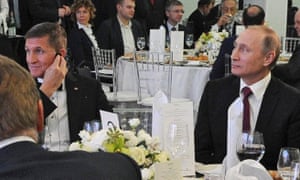
      Michael Flynn and Vladimir Putin at a 2015 dinner for the RT news channel in Moscow.
      Michael Flynn and Vladimir Putin at a 2015 dinner for the RT news channel in Moscow. Photograph: Michael Klimentyev/ Sputnik/Kremlin/EPA

      US intelligence officials had serious concerns about Michael Flynn’s appointment as the White House national security adviser because of his history of contacts with Moscow and his encounter with a woman who had trusted access to Russian spy agency records, the Guardian has learned.
      US and British intelligence officers discussed Flynn’s “worrisome” behaviour well before his appointment last year by Donald Trump, multiple sources have said.
      They raised concerns about Flynn’s ties to Russia and his perceived obsession with Iran. They were also anxious about his capacity for “linear thought” and some actions that were regarded as highly unusual for a three-star general.
      Flynn was forced to quit in February, after 24 days in the job. He resigned when it emerged he had lied to the vice-president, Mike Pence. Flynn said he had not discussed lifting US sanctions on Russia with Sergei Kislyak, Moscow’s US ambassador, but later admitted this was untrue.
      On Thursday, Flynn indicated he was willing to testify before the FBI and congressional committees about potential links between the Trump campaign and Russia in exchange for immunity. In a statement released by his lawyer, Flynn said he had a story to tell but was seeking “assurances against unfair prosecution”.
      The house oversight committee is examining the general’s activities before he joined Trump’s White House. It is likely to focus on Flynn’s contacts with foreign nationals and will also look at fees he may have received from foreign governments, including Russia and Turkey, and linked entities.
      The committee will further consider what security vetting Flynn received before he took up the job. It is seeking information from five senior officials including the FBI director, James Comey. Earlier this month, Comey confirmed his agency was investigating possible collusion between Trump and Russia to influence the outcome of the US election.

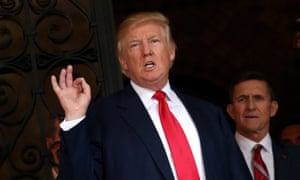
      Donald Trump with Flynn in December 2016.
      Donald Trump with Flynn in December 2016. Photograph: Carlos Barria/Reuters
      Flynn’s erratic conduct had troubled US intelligence officials for some time, multiple sources have told the Guardian.
      One concern involved an encounter with a Russian-British graduate student, Svetlana Lokhova, whom Flynn met on a trip to Cambridge in February 2014.
      At the time, Flynn was one of the top US spies and the director of the Defense Intelligence Agency (DIA), which provides information to the Pentagon about the military strengths and intentions of other states and terrorist groups.
      A historian and a leading expert on Soviet espionage, Lokhova has claimed to have unique access to previously classified Soviet-era material in Moscow. She says her forthcoming book makes groundbreaking revelations about Soviet military intelligence operations run by the GRU – Russia’s military spy agency.
      Western historians say access to intelligence agency records in Moscow has been severely restricted under Vladimir Putin. One Russian historian who has written extensively on Russian intelligence said the situation with the GRU was “a complete disaster”.
      “At least with the FSB and SVR [domestic and foreign spy agencies] there are places you can apply to view the archives, but with the GRU there’s not even a place to apply,” the historian said.
      “Maybe two or three military historians have been allowed in. Sometimes there are duplicates in other archives, but getting into the actual GRU archive is basically impossible.”
      Flynn and Lokhova were introduced to each other at the end of a dinner attended by 20 guests who included Sir Richard Dearlove – the former head of MI6 – and Prof Christopher Andrew, the official MI5 historian.
      Flynn says the meeting with Lokhova was “incidental” and lasted just 20 minutes. However, Andrew has said Flynn invited Lokhova to accompany him on his next official visit to Moscow to help with simultaneous translation. The trip fell through soon afterwards because of Putin’s annexation of Crimea, Andrew wrote in the Sunday Times.

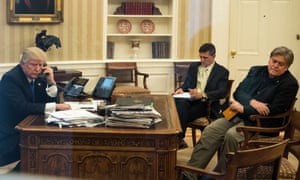
      Flynn in the Oval Office with Trump and aide Steve Bannon in January 2017.
      Flynn in the Oval Office with Trump and aide Steve Bannon in January 2017. Photograph: Drew Angerer/Getty Images
      The Guardian understands Flynn and Lokhova remained in email contact, conducted through an unclassified channel. In one email exchange described by Andrew, Flynn signed himself as “General Misha”, Russian for Mike.
      Lokhova also listed Flynn as one of four referees who would provide selective endorsements for her book, which is expected to detail how Russian spies penetrated the US atomic weapons programme.
      Though there is no suggestion of impropriety, Flynn would have been expected to “self report” any conversation with an unknown person, especially with links to an “adversary” country, such as Russia.
      Flynn did not disclose his conversation with Lokhova, the Wall Street Journal reported. Whatever concerns the US intelligence agencies had over Flynn, he retained his top-level security clearance.
      Price Floyd, a spokesman for Flynn, said: “This is a false story. The inference that the contact between Gen Flynn and a Russian [dual] national described in this story should be seen in any light other than incidental contact is simply untrue.”
      Floyd refused to comment on questions about the alleged email correspondence, or the potential citation for Lokhova’s book.
      Lokhova’s partner, David North, also declined to comment in detail. In comments to the Wall Street Journal he said Lokhova and Flynn “had a 20-minute public conversation” and have not “met or spoken since”. North also disputed Andrew’s account of the dinner in Cambridge and did not answer questions about the emails.
      Multiple sources, who spoke on the condition of anonymity, said the CIA and FBI were discussing this episode, along with many others, as they assessed Flynn’s suitability to serve as national security adviser.
      The Cambridge meeting was part of a wider pattern of “maverick” behaviour which included repeated contacts with Russia, the sources said.
      After he resigned from the DIA in 2014, Flynn became a contributor to RT, formerly known as Russia Today, the Kremlin’s English-language news channel.
      In summer 2015, Flynn met Trump for the first time after being invited to do so by his team. That year he received about $45,000 (£36,000) for attending RT’s gala dinner in Moscow, where he sat next to Putin. Flynn also accepted $11,250 from two Russian firms for speaking engagements in Washington. One of them was Kaspersky Lab, a cybersecurity company with ties to the Kremlin.
      The US army is investigating the RT transaction and whether it was properly disclosed, according to a source close to US intelligence. The US constitution’s emoluments clause forbids military officers from accepting foreign government payments without the permission of Congress.
      The sources pointed to a reported remark by Sally Yates, the former acting attorney general, who had told the White House in January that Flynn was vulnerable to blackmail by Russian intelligence.
      Flynn’s spokesman said Flynn had signed on with a speakers’ bureau after his 2014 resignation, as other former senior government officials have done. He said Flynn had alerted the DIA about the RT speech before he travelled and had briefed the DIA upon his return. The spokesman said Flynn had “nothing to hide”.
      As DIA chief, Flynn visited the GRU in Moscow in 2013. He was the first US officer ever allowed inside its headquarters, where he gave a lecture on leadership. “It was a great trip,” he told the Washington Post, adding that it was fully approved. Flynn was keen to make a second GRU visit but permission was denied, it is understood.
      In January, the Obama administration said the GRU was behind the operation to hack the US election. Putin has described claims of Russian interference as “fictional, illusory, provocations and lies”.

      Late-night TV hosts on Trump and nepotism: 'This guy has the patience of a toddler'

      Trevor Noah took Trump to task over Ivanka Trump’s new White House role, while others found the funny in Devin Nunes’s investigative skills
      Late-night TV hosts on Ivanka Trump, Mike Pence, and approval ratings

      On Thursday evening, late-night hosts took turns pulling apart the most recent controversies surrounding the Trump administration, including nepotism claims about his daughter Ivanka and the ongoing Russia investigation led by Devin Nunes.
      On The Daily Show, Trevor Noah spoke about the brazen nature of Trump’s appointment of Ivanka Trump to a new unpaid role in his administration. After playing a tape of Ivanka saying she wouldn’t ever take a role if her father got to the White House, Noah said: “Donald couldn’t stand to be apart from Ivanka, you know? In his four-year term, he was eventually gonna find some way to bring her in, but two months? This guy has the patience of a toddler.”
      “A smart man would go for the long con. You know? Trump is the guy standing outside the jewelry store going, ‘And now we wait till the guards go home. Screw it, let’s go in now!’”
      He then moved on to the story of Park Geun-hye, the South Korean president who was arrested after a corruption scandal. “Wow. A president impeached. Removed from office, and thrown in jail. Imagine that. No, no, seriously. Let’s all close our eyes and imagine that.”
      On Wednesday night’s Late Show, Stephen Colbert had focused on Donald Trump attending a women’s empowerment event; on Thursday night, he made fun of Trump’s relationship with Russia.
      “All this Russia stuff boils down to one simple question: what is Trump’s relationship with Russia and when does he plan to leave it for a younger country?” he joked.
      He then did a segment called leak-crets, during which he talked to a secret source – someone behind a screen whose voice was disguised but looked a lot like Colbert – who said the staff at the White House were scared for their jobs.
      “Scared they’re going to lose them?” Colbert asked.
      “No, they’re scared they’re going to keep them,” came the reply.
      Colbert also ripped into Mike Pence after the vice-president said he did not attend events where alcohol was served if his wife wasn’t present. “He’s so naughty that if you left him alone with a bottle of whiskey, he might try to have sex with it. And Jim Beam and Jack Daniels are both dudes. And he’s not into that scene. He has to pray away the Mount Gay.”
      He then turned his attention to Devin Nunes, and the Democrats’ call for him to recuse himself from his committee’s investigation into Russian interference in the US.
      “Nunes has refused to reveal who [his source] was out of concern that if his source was exposed, he’d have to come up with a new reason to keep canceling all the Russia hearings.”
      Seth Meyers also discussed Nunes: “In the House, the investigation is led by the Republican chairman in the intelligence committee, Devin Nunes, who has basically done everything he can to delay or interfere with his own investigation, raising the question of whether he’s investigating Trump or working for Trump.”
      Discussing reports that Nunes may have obtained information about Trump’s alleged surveillance from the White House, Meyers joked: “It’s like when you send yourself an email reminder and two minutes later, go, ‘Oh! A new email.’”
      He moved on to the White House press secretary, Sean Spicer, who he showed struggling to give straight answers to reporters. “I bet Sean Spicer fantasises about having an easier job … like Bill Cosby’s publicist.”
      He also joked about Trump’s low approval ratings in the latest Gallup poll. “Trump’s approval rating hit a record-low 35%, and this is supposed to be the honeymoon period. Trump should be good at those … he’s had three of them.”
      He also discussed the New York magazine story that claimed multiple sources had said they had heard George W Bush say “that was some weird shit” after Trump’s inauguration address. “You know things are getting crazy when you can make George W Bush sound like he’s on shrooms,” Meyers said.

      We can't just talk about growth. Equity needs a look-in, too


      Chief executives are busy people. They can be quite hard to catch and, in the normal course of events, they prefer to leave politics to their government affairs teams and their lobbyists, and the associations they bankroll to advance their policy interests in Canberra.
      So it was quite the gesture to see a flock of high flyers in Canberra getting their hands dirty.
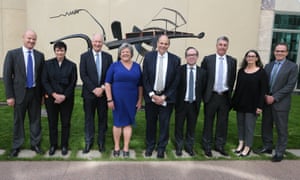
      A small battalion stood sentinel in one of the parliamentary courtyards this week – Alan Joyce of Qantas, Ian Narev of the Commonwealth Bank, Richard Goyder of Wesfarmers, Andrew Mackenzie of BHP Billiton, Catherine Tanna of EnergyAustralia – a bit like the Occupy movement in reverse.
      You might have thought they were there to argue for their tax cut, the issue that pushed the Senate to the brink in a gruelling and, at points, grimly combative parliamentary sitting week.
      They were, of course, ostensibly. Gimme gimme gimme. It’s what every rent-seeker of every stripe visiting Canberra does.
      But the visit had a more important strategic purpose. The show of force was not only about squeezing the best possible deal out of the Senate (which got complicated when Nick Xenophon had to commit the cardinal sin in contemporary politics of being a human being, having an obligation to his elderly parents when a beloved uncle died). It was also about the medium term.
      It was about making sure the Turnbull government did not go to water and dump the big business tax cuts if the Senate gutted the package. It was about pressuring the government to commit to maintaining the full $48bn policy, and trying again in the highly likely event the stressed-out Xenophon can’t be massaged or manhandled over the line.
      The message in the courtyard was simple. We are here, Malcolm, Scott, Mathias – and we are watching.

      Sally McManus at the National Press Club in Canberra on Wednesday
      ‘Sally McManus has the presentational stillness of a chief executive but preaches with a glint of steel.’ Photograph: Mick Tsikas/AAP
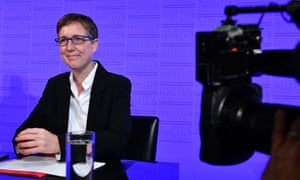
      A different strain of Occupy appeared midweek when the new ACTU secretary, Sally McManus, spoke at the National Press Club. She delivered a meticulously researched union recruitment drive on live television.
      McManus, who has the presentational stillness of a chief executive but preaches with a glint of steel that makes you look up and take notice, reasoned that neoliberalism and trickle-down economics – of the type that were playing out in real time up the road in the parliamentary precinct with the company tax debate – had screwed working people.
      “The Keating years created vast wealth for Australia but has not been shared, and too much has ended up in offshore bank accounts or in CEOs’ back pockets,” McManus noted calmly during her address. “Working people are now missing out and this is making them angry.”
      The speech was shaped by McManus’s own values – everyone active in the public sphere now has a log-cabin story – but it was studded with highly relatable focus group phrases, including: “We are now a country of stressed-out people, worried about our jobs and wondering why things have not turned out as we thought they should in Australia.”
      Indeed we are.
      Millions of us are exactly that, and feel something akin to homicidal rage when we look at the mulish boarding-school antics that characterise our daily politics, and feel confused when ideological frolics and abstract score-settling hog the national agenda rather than the existential policy challenges of our time.
      McManus is evidently formidable enough as a campaigner and communicator to be the target of full-throated political attacks by ministers including Peter Dutton, who described her this week as a modern-day communist, and by that most loyal of establishment organs, the Australian, which took time out from its enormously important and successful 18C campaign to fire off a couple of left-right combinations with such commitment a senior reporter landed on his backside.
      The union movement was primed with the amplification effort the moment McManus walked offstage at the press club. It has built up a professional activist structure since helping to run John Howard out of office during the WorkChoices campaign – some well-placed critics would say at the expense of nurturing its organisational capacity in workplaces – and unions pushed the key messages out through social media after the address.
      Down with neoliberalism! Up with Sally! Join the union!
      Like everything in national affairs, the centre of the economic conversation feels entirely hollowed out.
      There’s not much obvious middle ground between Andrew Mackenzie in a parliamentary courtyard saying neoliberalism will save us, give us that sweet tax relief and the benefits will trickle down – and Sally McManus at the press club saying down with neoliberalism, death to deregulation.
      But Malcolm Turnbull and his government have to occupy the national interest space between the two propositions and find something remotely compelling to say. If you had to find a working definition of competent government in contemporary Australia, what I’ve just said would cover about 70% of the task.
      If we pull out from all the positioning and filibustering of the political week and just ask that basic question – is the government finding anything compelling to say about Australia’s economic story in the wake of the disruption that has occurred since the financial crisis? – the answer has got to be a resounding no.
      The government is being killed on the politics of declining wage growth, income and work insecurity, equality and fairness. It literally has nothing compelling to say on these themes, which are the things Australians worry about.
      If the government had perfect freedom, and it was still remotely connected to the preoccupations of the real world, rather than expressing itself constantly as government by appeasement – appeasement to the reactionary right and its fake freedom debate, appeasement to those occupying CEOs – it would dump the whole economic program and start again.
      If it had a minute to think, it would understand that the centre right cannot avoid the equity conversation after the GFC. It would breathe, and do some work and some deep thinking, rather than just bumping from event to event, cock-up to cock-up, and constantly taking the path of least resistance.
      It would understand that no one in contemporary politics can avoid equity. It would understand the imperative of developing its own inclusive growth story, rather than just mouthing that as a proposition periodically while clinging tenaciously to the shibboleths of the pre-1998 world.
      The conversation now cannot all be about economic growth. Equity has to get a look-in as well, not only because that’s the right thing to do, and the economically sensible course, but because if it goes on being ignored, Australian voters are in a mood for punishment.
      If he doubts that, Turnbull need only have a word to Colin Barnett.