Contemporary politics,local and international current affairs, science, music and extracts from the Queensland Newspaper "THE WORKER" documenting the proud history of the Labour Movement.
MAHATMA GANDHI ~ Truth never damages a cause that is just.
Saturday, 1 April 2017
Michael Flynn: new evidence spy chiefs had concerns about Russian ties
US intelligence officials had serious concerns about Michael Flynn’s
appointment as the White House national security adviser because of his
history of contacts with Moscow and his encounter with a woman who had
trusted access to Russian spy agency records, the Guardian has learned.
US and British intelligence officers discussed Flynn’s “worrisome” behaviour well before his appointment last year by Donald Trump, multiple sources have said.
They raised concerns about Flynn’s ties to Russia and his perceived obsession with Iran.
They were also anxious about his capacity for “linear thought” and some
actions that were regarded as highly unusual for a three-star general.
Flynn was forced to quit in February, after 24 days in the job. He resigned when it emerged he had lied to the vice-president, Mike Pence.
Flynn said he had not discussed lifting US sanctions on Russia with
Sergei Kislyak, Moscow’s US ambassador, but later admitted this was
untrue.
On Thursday, Flynn indicated he was willing to testify
before the FBI and congressional committees about potential links
between the Trump campaign and Russia in exchange for immunity. In a
statement released by his lawyer, Flynn said he had a story to tell but
was seeking “assurances against unfair prosecution”.
The house oversight committee is examining the general’s activities
before he joined Trump’s White House. It is likely to focus on Flynn’s
contacts with foreign nationals and will also look at fees he may have
received from foreign governments, including Russia and Turkey, and linked entities.
The committee will further consider what security vetting Flynn
received before he took up the job. It is seeking information from five
senior officials including the FBI director, James Comey. Earlier this
month, Comey confirmed his agency was investigating possible collusion between Trump and Russia to influence the outcome of the US election.
Donald Trump with Flynn in December 2016. Photograph: Carlos Barria/Reuters
Flynn’s erratic conduct had troubled US intelligence officials for some time, multiple sources have told the Guardian.
One concern involved an encounter with a Russian-British graduate
student, Svetlana Lokhova, whom Flynn met on a trip to Cambridge in
February 2014.
At the time, Flynn was one of the top US spies and the director of
the Defense Intelligence Agency (DIA), which provides information to the
Pentagon about the military strengths and intentions of other states
and terrorist groups.
A historian and a leading expert on Soviet espionage, Lokhova has
claimed to have unique access to previously classified Soviet-era
material in Moscow. She says her forthcoming book makes groundbreaking
revelations about Soviet military intelligence operations run by the GRU
– Russia’s military spy agency.
Western historians say access to intelligence agency records in Moscow has been severely restricted under Vladimir Putin.
One Russian historian who has written extensively on Russian
intelligence said the situation with the GRU was “a complete disaster”.
“At
least with the FSB and SVR [domestic and foreign spy agencies] there
are places you can apply to view the archives, but with the GRU there’s
not even a place to apply,” the historian said.
“Maybe two or three military historians have been allowed in.
Sometimes there are duplicates in other archives, but getting into the
actual GRU archive is basically impossible.”
Flynn and Lokhova were introduced to each other at the end of a
dinner attended by 20 guests who included Sir Richard Dearlove – the
former head of MI6 – and Prof Christopher Andrew, the official MI5
historian.
Flynn says the meeting with Lokhova was “incidental” and lasted just
20 minutes. However, Andrew has said Flynn invited Lokhova to accompany
him on his next official visit to Moscow to help with simultaneous
translation. The trip fell through soon afterwards because of Putin’s
annexation of Crimea, Andrew wrote in the Sunday Times.
Flynn in the Oval Office with Trump and aide Steve Bannon in January 2017. Photograph: Drew Angerer/Getty Images
The Guardian understands Flynn and Lokhova remained in email contact,
conducted through an unclassified channel. In one email exchange
described by Andrew, Flynn signed himself as “General Misha”, Russian
for Mike.
Lokhova
also listed Flynn as one of four referees who would provide selective
endorsements for her book, which is expected to detail how Russian spies
penetrated the US atomic weapons programme.
Though there is no suggestion of impropriety, Flynn would have been
expected to “self report” any conversation with an unknown person,
especially with links to an “adversary” country, such as Russia.
Flynn did not disclose his conversation with Lokhova, the Wall Street
Journal reported. Whatever concerns the US intelligence agencies had
over Flynn, he retained his top-level security clearance.
Price Floyd, a spokesman for Flynn, said: “This is a false story. The
inference that the contact between Gen Flynn and a Russian [dual]
national described in this story should be seen in any light other than
incidental contact is simply untrue.”
Floyd refused to comment on questions about the alleged email correspondence, or the potential citation for Lokhova’s book.
Lokhova’s partner, David North, also declined to comment in detail.
In comments to the Wall Street Journal he said Lokhova and Flynn “had a
20-minute public conversation” and have not “met or spoken since”. North
also disputed Andrew’s account of the dinner in Cambridge and did not
answer questions about the emails.
Multiple sources, who spoke on the condition of anonymity, said the
CIA and FBI were discussing this episode, along with many others, as
they assessed Flynn’s suitability to serve as national security adviser.
The Cambridge meeting was part of a wider pattern of “maverick”
behaviour which included repeated contacts with Russia, the sources
said.
After he resigned from the DIA in 2014, Flynn became a contributor to
RT, formerly known as Russia Today, the Kremlin’s English-language news
channel.
In summer 2015, Flynn met Trump for the first time after being
invited to do so by his team. That year he received about $45,000
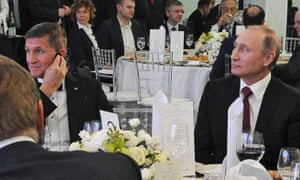
(£36,000) for attending RT’s gala dinner in Moscow, where he sat next to
Putin. Flynn also accepted $11,250 from two Russian firms for speaking
engagements in Washington. One of them was Kaspersky Lab, a
cybersecurity company with ties to the Kremlin.
The US army is investigating the RT transaction and whether it was
properly disclosed, according to a source close to US intelligence. The
US constitution’s emoluments clause forbids military officers from
accepting foreign government payments without the permission of
Congress.
The sources pointed to a reported remark by Sally Yates,
the former acting attorney general, who had told the White House in
January that Flynn was vulnerable to blackmail by Russian intelligence.
Flynn’s spokesman said Flynn had signed on with a speakers’ bureau
after his 2014 resignation, as other former senior government officials
have done. He said Flynn had alerted the DIA about the RT speech before
he travelled and had briefed the DIA upon his return. The spokesman said
Flynn had “nothing to hide”.
As DIA chief, Flynn visited the GRU in Moscow in 2013. He was the
first US officer ever allowed inside its headquarters, where he gave a
lecture on leadership. “It was a great trip,” he told the Washington
Post, adding that it was fully approved. Flynn was keen to make a second
GRU visit but permission was denied, it is understood.
In January, the Obama administration said the GRU was behind the operation to hack the US election. Putin has described claims of Russian interference as “fictional, illusory, provocations and lies”.


No comments:
Post a Comment