Saturday, 2 November 2019

Peter FitzSimons calls for change in 'draconian' laws to protect press freedom in Andrew Olle lecture

Updated about 8 hours ago

Author and columnist Peter FitzSimons has delivered a strong message that press freedom is a fundamental cornerstone of democracy and called for changes in the law to protect journalists.
He made the comments while delivering the keynote address at the annual Andrew Olle Media Lecture in Sydney on Friday night, where he emphasised the need to support robust journalism for the good of the "national fabric".
FitzSimons said the June raids by the Australian Federal Police on the ABC offices and the home of News Corp journalist Annika Smethurst were an affront to democracy.
"It was an outrage that effectively equated fearless investigative journalism with criminality," he said.
He cited Watergate as "the greatest journalistic triumph of our times" which never would have happened had the United States had similar laws to Down Under.
"How did we allow such ludicrously draconian legislation to be passed in sunny Australia?"

'Change the law'

The AFP raids on the ABC related to a series of stories by investigative journalists Dan Oakes and Sam Clark called the Afghan Files.
The stories contained allegations there were unlawful killings by Australian special forces in Afghanistan based on information from leaked Defence documents.
The search warrant was issued on the basis of allegations of publishing classified material, based on the Crimes Act 1914.
"If the law is the law and the AFP raids on the offices of the ABC and the very home of the News Limited journalist Annika Smethurst had nothing to do with the Government, change the law that led the Australian Federal Police to commit this outrage," Mr FitzSimons said.
Ms Smethurst was raided over her reports on leaked information that alleged the Government was seeking to boost domestic spying powers.
"We are in difficult times, facing serious issues," Mr FitzSimons said.
"The more that strong journalism, across the board, is supported and defended by the Government, embraced by the population and fearlessly pursued by its adherents … the stronger our nation will be."
The Andrew Olle Media Lecture is held in honour of the ABC broadcaster of the same name who died in 1995.
Money raised from the event goes to brain cancer research under a memorial fund which has been running for 21 years.
ABC managing director David Anderson delivered the news at Friday's event that Olle's family had decided to wind up the fund due to factors including increased commitments elsewhere.
Mr Anderson praised the work of Olle's wife, Annette, in running the fund.
"Her dedication and determination have resulted in several millions of dollars raised which has had a direct impact on advances made in how we treat brain cancer," he said.
Despite the closure of the fund, the annual media lecture will continue.

Donald Trump won't win the 'endless' war by simply killing terrorists like Abu Bakr al-Baghdadi

Analysis

Posted about 2 hours ago

Abu Bakr al-Baghdadi

In a society obsessed with personality politics, we assume that a leader embodies an organisation.
Abu Bakr al-Baghdadi — a rapist and sadist who oversaw especially grotesque horrors — was an ideal villain to blame for the emergence and success of the Islamic State terrorist group.
Killing him gave Donald Trump the kind of momentary victory that passes for success in our times.
"He died like a dog. He died like a coward. The world is now a much safer place," said the triumphant Commander-in-Chief.
But al-Baghdadi's end should be seen as a gory sideshow.
The Iraqi cleric was not the prominent, compelling leader you might expect of a global movement, nor — as President Trump strangely noted— "tall, handsome, very charismatic" like Al Qaeda's Osama Bin Laden.

While his religious leadership and symbolic importance as the Islamic State's caliph — supposedly descended from the Prophet Mohammed — make his death significant, al-Baghdadi's operational influence over the group is disputed.
But regardless of how big a role he played, his death won't help President Trump, or anyone, stop the "endless wars", especially the war on terror.
That ill-defined conflict — initially a response to the September 11 attacks — has occupied three US Presidents and pitted the Western world against a nebulous enemy, one that fights for ideology rather than territory.
Initially it was a war against the militant Islamist group Al Qaeda, then the Afghan Taliban which harboured it, then it became badly muddied with the invasion of Iraq in 2003 and the explosion of sectarian violence which followed.
That gave the world the group Al Qaeda in Iraq, which became the Islamic State, and its eventual leader al-Baghdadi.


Instability, injustice and ideology

The Islamic State was a product of three things: instability, injustice and ideology. All of those endure — and the proof is visible across the region.
Impoverished, marginalised and oppressed people across the Muslim world have had enough of their corrupt rulers.

People are rising against the mostly secular, Western-backed governments across the Middle East.
The corruption and decadence of the ruling class have become legendary, while the majority of the population lives in poverty under increasing political repression.
In Iraq, at least 240 people have been killed by Western-trained security forces as they demand basic services, an end to sectarianism and corruption and a fair share of the country's huge oil revenues.
In Lebanon, what should be a prosperous, modern, cosmopolitan country is an economic and political basket case, with demonstrators shutting the country down.
Egypt, the region's most populous country and a key US ally, has locked up tens of thousands of political prisoners and holds the ignoble record for the single largest massacre of unarmed protesters in history.
Australia sells weapons to the United Arab Emirates and Saudi Arabia, countries accused of committing war crimes in Yemen and which brutally suppress domestic dissent.

The lack of political representation and economic justice in the Middle East has helped strengthen the appeal of a supposedly "pure" Islamic alternative.
Opposing an ideology, especially one with the deep cultural roots of Islamism, is already very difficult. Not recognising or tackling the terrible conditions and injustice that's grown in the secular alternatives makes it even harder.

Terrorist group flourish under the right conditions

Then there's the extent to which Western intervention and inaction create the conditions for terrorist groups to flourish.
The Islamic State spread rapidly across Iraq and Syria because those countries had been weakened and destabilised by US invasion and civil war respectively.
The West's failure to respond to Syrian President Bashar al-Assad's horrific human rights abuses turned out to be as devastating as its invasion of Iraq to topple Saddam Hussein.
Even the conduct of western forces during the campaign against IS has created resentment.
Australia — which was involved in a bombing in Mosul in which up to 35 people may have died — is not above reproach.

After 35,502 air strikes across Iraq and Syria, at least 1300 civilian deaths and untold damage to homes and infrastructure, Iraqis say western governments have not provided much money or assistance towards rebuilding.
Whole sections of cities remain in ruins.

Inaction and abrogation

Now the failure to justly deal with the remnants of the Islamic State group is breeding the resentment that many observers warn will create a new terrorist movement in its place.
Human rights groups say Iraq's counter-terror courts have been arbitrarily sentencing suspected Islamic State members to death while its security services persecute perceived supporters in Sunni Muslim areas.

IS fighters in Syria languish in appalling conditions without trial.
Their families remain in squalid camps where children die from the poor conditions, while Western countries — including Australia — largely ignore pleas from the US and Kurdish groups to take their citizens back.
Some IS members have been stripped of citizenship, leaving the beleaguered countries of the region to deal with them as well as the legacy of their actions
Instead of the supposedly Western values of justice and rehabilitation, there has been inaction and abrogation.
Now the US decision to withdraw its forces from north-eastern Syria, allowing Turkey to attack, has led to escapes, riots and the haphazard transfer of prisoners, some to Iraq.
No-one knows what will happen to those camps and their inmates now the US has gone and the Kurdish guards have turned in desperation to the Syrian regime.

The seeds of alienation are being sewn

Just as IS arose from the sectarian insurgencies after the US invasion of Iraq, the seeds are being sown for the next generation of alienated, mistreated, resentful people, making a new version of IS an inevitability.
Abu Bakr a-Baghdadi spent five years in an American prison camp after the second Iraq war.
The next terrorist leader could be a child sitting in the al-Hol camp for IS families in the Syrian desert, a victim of violence doomed to repeat it.

But the focus on figureheads is ultimately misguided. Leaders can't create — or harness — a movement without underlying dissatisfaction to drive it.
Al-Baghdadi was the only name President Trump knew, the only person he wanted to hear had been killed.
He implied that destroying one man would destroy the movement.
"[This] was the big one," he said. "This is the biggest one perhaps that we've ever captured, because this is the one that built ISIS and beyond, and was looking to rebuild it again."
But even if Mr Trump is right to celebrate this victory, the Middle East remains aflame.

Hundreds of thousands of people have fled Turkey's incursion into northern Syria and the US is now protecting oil fields instead of them.
The President is tweeting about a "hero dog", while Iraq's protesting youth are being shot in the streets.
If the focus on killing terrorists was matched by efforts to rebuild infrastructure and economies and if repressive governments and corrupt leaders were the targets of justice, there would be fewer reasons for people to join terrorist groups.
Without economic opportunity and true democracy the Middle East will continue to be unstable.
Instability creates the conditions for terrorist groups to thrive.
As the West does not fight the cause, while supporting regimes that persecute their own people, we ensure the War on Terror will be the ultimate endless war.

Whether you're a 'quiet Australian' or a 'noisy minority', politics is failing you

Analysis

Posted about 2 hours ago


It's almost six months since the federal Coalition, much to its own surprise, was returned to office after winning one more seat than it did in the 2016 election. Yes, time flies when you are having fun.
Though just how much fun the Government is having is a moot point. It's all going pretty well at one level, particularly since Labor is still licking its wounds.
But there are problems within the Nationals, and between the Nationals and the Liberals. And, well, not everybody has a lot to do.
On election night, Scott Morrison said the election was a great victory for the "Quiet Australians".
"A fair go for those who have a go," for those who make a contribution and don't just seek to take, as historian Judith Brett observed.
Writing in The Monthly recently, Brett ruminated on the similarities between Morrison's Quiet Australians, Howard's battlers and Menzies' Forgotten People.
"This question is about rhetoric as much as demography," she wrote, "about how Liberal leaders project their followers and the symbolic resources they draw on.
"Each is implicitly contrasted with noisy minorities who get all the attention."
But the very idea of Quiet Australians and noisy minorities does raise some interesting questions — and sends some disturbing signals — about the virtues of being quiet, and just who represents a "noisy minority" and who represents a legitimate community view.

Staying quiet absolves the community of responsibility

On Friday, for example, the Prime Minister promised a crackdown on environmental groups which campaign against businesses that provide goods and services to mining companies. Too noisy!
GetUp! is another group who are clearly too noisy as far as the Government is concerned.
But tied up somewhere in the message about Quiet Australians is a message that not getting involved in politics, and just getting on with your life, is fine.

But that absolves a large part of the community from feeling any responsibility for what might be being done in its name.
And it creates disconnects when politicians talk about ideas in the broad, and as they relate specifically to particular communities.
Implicit in the conservative hostility to the 2017 Uluru statement from the Heart, calling for an Indigenous "voice to the Parliament" is the idea that Indigenous people would get some sort of special treatment that wasn't available to everyone else. An example of a "noisy minority" getting rewarded
The Morrison Government has progressively downgraded what "The Voice" might potentially be.
This week Indigenous Affairs Minister Ken Wyatt set out a process for providing a legislated voice for Indigenous people to local, state and federal governments.
The co-chair of the panel to "co-design" this process is Professor Marcia Langton.
She observed to the ABC this week that there are about a million Indigenous people in Australia, possibly a third or living in remote and rural Australia, "and most of them have very poor relationships with government".

"By abolishing [the Aboriginal and Torres Strait Islander Commission], the only architecture for people to represent their views was abolished", she said.
"It's gone. That happened over 10 years ago and we've had nothing since."

Pleas fall on deaf ears

While issues about onstitutional recognition and the grander ambitions of the Uluru statement will continue to be fought over, this is the problem for Indigenous people right now.
The Scotdesco Aboriginal community in South Australia has run out of water: the thing which threatens to happen to larger towns and cities if the drought continues, has already happened in this small community on the edge of the Nullarbor Plain.

It can truck in water, but because it sits 15 kilometres beyond a boundary for subsidised water cartage, it has to pay $1400 a load for water, four times what residents within the boundary pay.
The chief executive of the community corporation, Robert Larking, says the cost is crippling but repeated urgent calls to state and federal government for assistance — just to extend the boundary — have fallen on deaf ears, despite the support of the local state MP.
"We are now in a desperate situation," he says. "There is no main potable water source here for the community."
It is hard not to wonder whether something would have happened for this community months ago if it had a way of being more effectively heard; if they were farmers, rather than a tiny community trying to be self-supporting through selling saltbush.

How good is Australia?

The interim report of the Royal Commission into Aged Care was also released this week with its "shocking tale of neglect" in the system.
The sector says it needs an extra $1.3 billion this year to guarantee service quality.

Asked on Melbourne radio on Friday how he could say "how good is Australia?" in light of the Commission's findings — and a Productivity Commission report highlighting terrible problems in the mental health field — Scott Morrison, said "well look, Australia is always a great country".
Australia was a good country "because we're prepared to acknowledge where we get things wrong, not buck pass".
But, as is the case with drought funding, when pressed about whether the Government would actually move to spend money quickly to start fixing the problem, you could almost hear the subtext of the Prime Minister's message: "not if it endangers the surplus in the next few months".
Pressed further, he agreed the Government would act, in some way, before Christmas.
The depressing thing for anyone who has reported on aged care for any period of time is that there is nothing new about this chronic lack of funding.
This should hardly have come as a shock to Government. And it is, after all, the current government has been in office for six years, no matter how many prime ministers it may have had.

There are two groups who aren't being quiet at all

Aged care facilities form the backbone of many communities, including one in the small town of Murchison, in Victoria, south west of Shepparton.
This week, the community run DP Jones Nursing Home, was placed in administration. Its expenses last year were $3.5 million, its income $3.1 million.

There are signs that it is just one of many small regional nursing homes in equally desperate straights and, in towns already suffering from the drought, their closure doesn't just mean the communities' elderly being moved further away, but the loss of jobs which are helping to sustain the drought-ravaged economy.
The difference with Murchison though, is that they have been kicking up a big stink, pressuring their local member Damien Drum, and ultimately forcing a pledge from deputy prime minister Michael McCormack when he visited Shepparton late in the week.
So there are Quiet Australians, and not so Quiet Australians.
Here are two groups who aren't being quiet at all.
Both of them represent stories about the crossover between the big national political fights, and the impact on people on the ground.
And whether it is at the local level, or the national policy debate, government — and politics — are failing them.
Laura Tingle is 7.30's chief political correspondent.

Scott Morrison slams environmental groups 'targeting' businesses with 'selfish' secondary boycotts

Updated about 11 hours ago


The Prime Minister has railed against "progressives", accusing them of denying people's liberties in a speech that slammed environmentalists for targeting businesses that invest in non-renewable industries.

Key points:

  • The Prime Minister said the Coalition was looking at ways to prevent boycotts from spreading to other sectors
  • Mr Morrison also argued the right to protest "does not mean there is an unlimited licence to disrupts people's lives"
  • His speech reaffirmed his Government's commitment to jobs in traditional industries

Scott Morrison also vowed to outlaw the "indulgent and selfish" practices of environmental groups who campaign against Australian businesses that work with companies and industries they are opposed to, such as coal.
"I am very concerned about this new form of progressivism ... intended to get in under the radar but [which] at its heart would deny the liberties of Australians," he said.
In a lunchtime speech to the Queensland Resources Council, Mr Morrison argued that so-called "secondary boycotts" can have serious consequences for the Australian economy.
"Environmental groups are targeting businesses and firms who provide goods or services to firms they don't like, especially in the resources sector," he said.
"They are targeting businesses of all sizes, including small businesses, like contracting businesses in regional Queensland.
"It is a potentially more insidious threat to the Queensland economy and jobs and living standards than a street protest."
Follow this story to get email or text alerts from ABC News when there is a future article following this storyline.

'It gives you a warm glow'


The Prime Minister spoke in Brisbane in the wake of anti-mining protesters clashing with police outside a mining conference in Melbourne.
Mr Morrison said he wanted Australia to have the world's most advanced, innovative and successful resources sector in the country.
"I hear a lot about progressivism at the moment," he said.
"It sounds like a lovely word. It gives you a warm glow. I will tell you what it means.
"Those who claim the title want to tell you where to live, what job you can have, what you can say and what you can think — and tax you more for the privilege of all of those instructions that are directed to you."
Mr Morrison lamented that Australian businesses, under pressure from environmental groups, are increasingly refusing to provide services like banking, insurance and consulting to coal mining companies.
"There are two inevitable outcomes … Australian business does less business … and Australian business is forced to acquire goods or services from an alternative or overseas supplier at a higher price," he said.


'Testing the limits of the right to protest'


Mr Morrison said whilst he accepted the Government cannot force one company to provide services to another, the Coalition was looking at ways to prevent such boycotts from spreading to other sectors that have a significant carbon footprint — including gas projects, abattoirs, airlines and the sugar cane industry.
"Let me assure you, this is not something my Government intends to allow to go unchecked," he said.
"Together with the Attorney-General, we are working to identify mechanisms that can successfully outlaw these indulgent and selfish practices that threaten the livelihoods of fellow Australians, especially in rural and regional areas, and especially here in Queensland."

In an apparent reference to recent protests in Queensland by Extinction Rebellion, Mr Morrison said "radical activism" and "absolutist environmentalism" were "testing the limits of the right to protest".
"The right to protest does not mean there is an unlimited licence to disrupt people's lives and disrespect your fellow Australians," Mr Morrison said.
The Prime Minister used the speech to reaffirm his Government's commitment to jobs in traditional industries by announcing an expansion of the Skills Organisation Pilot program to include the mining industry.
"We know that mining is a high-skill, high-wage industry and this is a further statement of confidence in the industry's future," he said in his address.

Friday, 1 November 2019

Pelosi bangs the gavel: House votes to endorse Trump impeachment inquiry

Vote set rules for public phase of impeachment inquiry, laying out plan that could produce televised hearings within two weeks
For only the third time in the history of the modern presidency, the US House of Representatives voted on Thursday to formalize impeachment proceedings against the president of the United States.
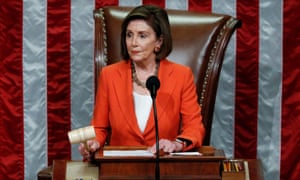
In a largely party-line vote of 232-196, the House embarked on a path that seemed likely to lead to Donald Trump’s impeachment – if not necessarily his removal from office. The House speaker, Nancy Pelosi, presided over the vote and marked it with a bang of her gavel.
Republicans held ranks to vote uniformly against the process, while two Democrats crossed party lines to join them. The House’s sole independent, former Republican Justin Amash of Michigan, voted to advance the resolution.
The vote set rules for the public phase of the inquiry, laying out a road map for impeachment that could produce dramatic televised public hearings within two weeks and a vote on impeachment itself by the end of the year.
“This resolution sets the stage for the next phase of our investigation, one in which the American people have the opportunity to hear from the witnesses firsthand,” the House intelligence chairman, Adam Schiff, said in a floor speech ahead of the vote.
“We will continue to conduct this inquiry with the seriousness of purpose that our task deserves because it is our duty and because no one is above the law.”
House minority leader Kevin McCarthy said Democrats were “trying to impeach the president because they are scared that they cannot defeat him” in the 2020 election.
As the vote was announced, Trump tweeted: “The Greatest Witch Hunt In American History!” The White House issued a statement saying “the president has done nothing wrong” and calling the process “a blatantly partisan attempt to destroy the president”.
For weeks, congressional investigators have been interviewing witnesses – 15 and counting – behind closed doors about alleged misconduct by Trump, who stands accused of using the power of his office to solicit foreign interference in the 2020 US election.

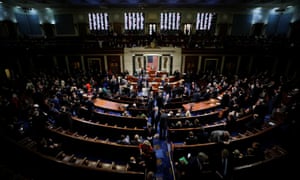
The US House of Representatives votes on the resolution, which sets up the next steps in the impeachment inquiry against Trump
The US House of Representatives votes on the resolution, which sets up the next steps in the impeachment inquiry against Trump Photograph: Tom Brenner/Reuters

The parade of witnesses was scheduled to continue on Thursday, with the testimony of Tim Morrison, a senior national security council official described in previous testimony as having a “sinking feeling” about the negotiations he witnessed between Trump proxies and the Ukrainians.
Morrison, the first White House political appointee to testify, dramatically resigned on the eve of his testimony and did not respond to reporters’ questions as he arrived on Capitol Hill on Thursday. While he had planned to testify anyway, Morrison’s resignation freed him absolutely from a blanket White House order that officials not participate in the impeachment inquiry.
Trump has denied wrongdoing, claiming that a July phone call in which he asked the Ukrainian president, Volodymyr Zelenskiy, for a political “favor”, as captured in a partial transcript released by the White House and backed up by witness testimony, was “perfect”.
The desired favor, as Trump himself explained in the call, was for Ukraine to investigate a company that had employed a son of Joe Biden, whom Trump saw as a top political threat. Trump also wanted an investigation that would cast doubt on Russian tampering in the 2016 election.
At the time, the White House had suspended almost $400m in military aid for Ukraine appropriated by Congress, and US diplomats had advised Ukrainian officials that a White House visit for Zelenskiy was contingent on the announcement of investigations.
If Trump is impeached, a Senate trial would follow, possibly early next year, with a two-thirds majority vote required to remove Trump from office.
Still in question was whether Morrison’s former boss, the then national security adviser John Bolton, who reportedly described the back-room Trump-Ukraine haggling as a “drug deal” that he wanted no part of, would testify before Congress. A lawyer for Bolton told Congress on Wednesday that while Bolton would not testify without a subpoena, the lawyer stood ready to receive a subpoena.
Testimony by Bolton, a Yale-educated lawyer, blistering conservative hawk and expert bureaucratic infighter, could be as damaging for Trump as any so far. Bolton reportedly told aides that Rudy Giuliani, Trump’s personal emissary in the Ukraine saga, was a “hand grenade” that could blow everyone up, and he encouraged multiple aides to take their concerns about Trump’s Ukraine dealings to the top lawyer on the national security council.
That lawyer, John Eisenberg, has also been invited to testify next week before congressional investigators.

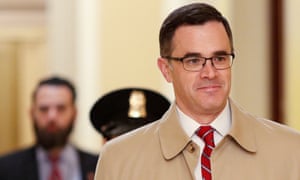
Tim Morrison arrives to testify in Trump impeachment inquiry on Capitol Hill
Tim Morrison arrives to testify in Trump impeachment inquiry on Capitol Hill. Photograph: Tom Brenner/Reuters

The House vote on Thursday implemented a procedure likely to lead to the drafting of articles of impeachment against Trump in the judiciary committee.
When Pelosi banged the gavel, Republicans shouted “objection”, briefly sowing confusion as the clerk strained to be heard and Democrats countered with calls for order. The room eventually settled and the House returned to the rest of its agenda before leaving Washington for a week-long recess.
Moments after the vote, Republicans began their assault on Democrats in “swing” districts who supported the resolution, sending emails to supporters that accused the Democrats by name of participating in a “fraud”. With only two Democratic defections, that list includes members critical to the party’s majority.
Analysts have said that Trump is vulnerable to impeachment for abuse of power, obstruction of justice and contempt of Congress, charges familiar from previous impeachment proceedings against presidents Richard Nixon, who resigned, and Bill Clinton, who was impeached but not removed from office.
The procedure allows for Republicans to request witnesses and documents and provides for the presence of lawyers representing Trump at judiciary committee proceedings.
Before that stage, however, public hearings would play out before the intelligence committee, chaired by Schiff of California, who has been spearheading the impeachment inquiry.

Schiff would call witnesses who previously testified in closed-door depositions before investigators, with an eye on presenting to the public the strongest case against Trump. Many Americans who have not been following the twists and turns of the closed-door testimony would be hearing the allegations against Trump – and meeting the witnesses, who include senior officials in the White House, state department and Pentagon – for the first time.

Adani deadline for $18.5m water licence payment pushed back until mid-2021

Exclusive: Carmichael delays raise questions about whether Indian parent company has allocated the required finance
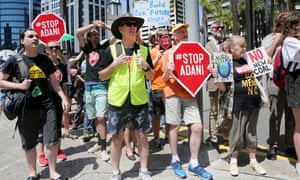
Anti-Adani protesters in Brisbane, 17 October 2019
Adani’s move to delay upfront expenses are raising questions about its claims it has allocated the required finance. Anti-Adani protesters in Brisbane. Photograph: Jono Searle/AAP

Adani has sought to delay significant upfront expenses for its Carmichael coalmine by another two years, raising questions about the company’s claims its Indian parent has allocated the required finance.
Guardian Australia can reveal Adani was granted a reissued water licence to take up to 12.5bn litres a year from the Suttor River by the Queensland government on 29 May. The deadline for the $18.5m outstanding payment has now been pushed back until mid-2021.
The company had previously been given a year’s extension beyond the initial July 2018 payment deadline. Adani’s own water modelling shows it requires 3.35bn litres of water during the first year of construction.
Adani says the reason for the delay is because the company is working through the implications of “legal challenges by activist groups” to its water scheme, and will pay when those matters are finalised.
The company has also recently sought and been granted approval by the federal government for a two-year extension to the deadline to legally acquire properties to be used as environmental offsets for the western portion of its rail corridor. Adani will have to negotiate with landholders and pay compensation to secure the offset areas.
Since announcing it had secured finance from within the Adani group to build a scaled-down version of the Carmichael mine in November 2018, Adani’s Australian operation aggressively sought to pressure governments to sign off on outstanding environmental approvals. The campaign included messaging that “we have finance” and “we’re ready to start” and linked the push for environmental approvals to the immediate provision of jobs.
Since gaining those approvals, Adani says it has agreed $450m worth of contracts and has 150 workers on site conducting land clearing, surveying, fencing works, civil earthworks and other construction activities. Financial market sentiment appears to be improving towards Adani’s Australian operations, with bonds in the Abbot Point coal terminal increasing 15% in the past month.
In a statement, Adani said Carmichael was proceeding in line with its schedule and cost estimates and that “minor variations are a matter of course on major mining projects”.
“Works will continue to ramp up over the coming weeks and months and we are on track to deliver our first coal in 2021.”
But satellite images show little physical progress has been made since the notional start of construction in June. Analysis of those images shows the company has cleared about 365 hectares (900 acres) of land at the 28,000 hectare mine site. Guardian Australia understands many of the workers on site are employed by external contractors under short-term agreements.
The energy finance expert Tim Buckley says any notional finance allocated by the Adani group to the Carmichael project was still “sitting in India”.
“The fact they don’t have $18.5m [to pay for the water licence] is pretty telling,” Buckley said. “In the scheme of the Adani group’s business that’s small change.
“[Adani chairman and founder] Gautam Adani has got the cash to build Carmichael and pay for things, let’s not pretend he doesn’t. The money is there now, but it’s sitting in India. By definition, the finance hasn’t come yet.”
Buckley says projects with secure finance were typically then able to spend the money without restriction.
“When a project gets finance, you’re off to the races. You don’t say you’re going to build a quarter of a railway line.”
He said Adani’s attempts to progress the Carmichael mine were “debt on debt on debt” and that was a good indication the Indian parent had at least some hesitation about the project, given the risks that remain from environmental activism, the diving price of thermal coal and additional regulatory hurdles, such as negotiating access to the Aurizon rail network.
Guardian Australia has spoken to contractors who previously discussed working with Adani, and who said the company had proposed an unusual sort of “vendor finance” arrangement that would effectively delay payments for work by up to two-and-a-half years, until after the mine was operational.
Adani Mining’s negative balance sheet and the groups’s lack of assets in Australia, other than the heavily in debt Abbot Point port, have raised concerns about its ability to offer security to contractors and others.
The state government requires financial assurance to cover a potential royalties deferral deal, which is still under negotiation.
The Lock the Gate Alliance said the extension for the water licence payment was “further evidence that Adani is in no way financially prepared to put its money where its mouth is”.
The Lock the Gate coordinator, Carmel Flint, said the water licence conditions contained a trigger for the Queensland government to cancel it, should payment not be made by the due date.
“It’s very unfortunate the Queensland government didn’t take the opportunity to cancel this licence and reassess the water impacts on the graziers and waterways in Central Queensland,” Flint said.
The Australian Conservation Foundation says it is concerned about allowing a further delay in securing offset areas, which would provide habitat for native species including the black-throated finch.
Christian Slattery from the ACF said offsets were inadequate, but that the variation to Adani’s conditions further weakened the protection for those species.
“This decision means delayed protection for threatened species like the black-throated finch, which Adani’s coalmine places at further risk of extinction.

“Adani’s coalmine will never have a social licence to operate in Australia. Any company that shackles itself to this project risks a permanent mark against its reputation and must be prepared for the financial consequences that will follow,” Slattery said.

In its statement, Adani said that “all activities are being conducted safely and in line with Adani Mining’s environmental requirements, including having wildlife spotters on site monitoring all construction activity”.

Six biggest coalminers in Australia produce more emissions than entire economy

Big emitting companies should be held responsible for the burning of their coal overseas, report says
Coal is stockpiled before being loaded onto ships in Gladstone, Queensland
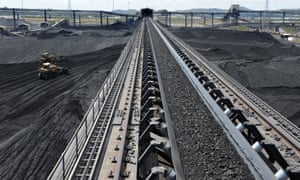
The top six coal producers were linked to 551m tonnes of carbon dioxide released into the atmosphere in 2018. Total emissions from all activity in Australia were 534m tonnes. Photograph: Dave Hunt/AAP

Coalmining in Australia by the nation’s six biggest coal producers is ultimately resulting in more greenhouse gas emissions each year than the entire Australian domestic economy.
In the latest report to estimate the role fossil fuel businesses play in driving the climate crisis, researchers from the University of New South Wales calculated the total emissions from the coal and gas produced by Australia’s top carbon companies, from extraction to the resources being burned for energy, mostly overseas.
They found the top six coal producers – BHP Billiton, Glencore, Yancoal, Peabody, Anglo American and Whitehaven – were in 2018 linked to 551m tonnes of carbon dioxide released into the atmosphere. Total emissions from all activity within Australia were 534m tonnes.
When the list was expanded to include Australia’s 10 biggest carbon producers, adding Chevron, Woodside, ExxonMobil and Santos, the combined emissions from their products was found to be 670m tonnes a year, equivalent to that from about 75% of global air traffic.
The UNSW report follows the Guardian’s global series The Polluters, which revealed 20 fossil fuel companies including BHP could be directly linked to more than one-third of all greenhouse gas emissions in the modern era. In Australia, it found a wave of planned developments by major fossil fuel companies across the north would significantly increase the amount of coal and gas the country planned to sell into Asia and could push the Paris climate agreement goals further beyond reach.
The report’s lead author, Jeremy Moss from the UNSW Practical Justice Initiative and a professor of political philosophy, said there was a clear case that big emitting companies, which the report calls “carbon majors”, should be held responsible for the consequences of their products.
Global greenhouse accounting emphasises national emissions, rather than those connected to companies. There are no plans for that to change. But there is an increasing focus within companies in reporting and considering how to deal with “scope 3” emissions, including those that are released by a company’s customers when using their products.
BHP’s chief executive, Andrew Mackenzie, acknowledged this in July when, in a speech calling for drastic action to combat the climate crisis, he pledged US$400m to develop technologies to cut emissions from not only its own operations, but also the companies that buy its resources. BHP, Rio Tinto and South 32 are among those that report scope 3 emissions.
Moss said fossil fuel companies had a moral responsibility to rapidly phase out their operations in line with the evidence of the Intergovernmental Panel on Climate Change, which found global emissions need to fall 45% below 2010 levels by 2030. He said companies should retire assets, not sell them.
He said their products should be seen through a similar prism to goods that had been banned or had limitations placed on their use on moral grounds, giving the example of Scott Morrison’s announcement that Australia would ban the export of plastic waste, in part because it was ending up in the ocean. Moss said other industries where there were moral constraints included the live sheep trade, asbestos and uranium.
“The only reason we care about these things is the impact they have. That’s a moral argument,” he said. “There is a reason we sell uranium to France and not Pakistan. It’s because if we know something was to go wrong in Pakistan, a safety issue or a dirty bomb, we’re partly culpable.
“In the same way, to say you’re selling coal to a country just to stop someone worse from doing it, that’s just not true. We use supply-side constraints all the time. We should with fossil fuels.”
Coal companies were asked for their response to the emissions analysis.
Peabody said the company recognised climate change was occurring and that human use of fossil fuels contributed to greenhouse gas emissions. “We also recognise coal is essential to affordable, reliable energy and will continue to play a significant role in the global energy mix for the foreseeable future,” a Peabody spokesperson said, adding that technology would be vital in advancing climate change solutions.
Others, including BHP and Glencore, declined to respond. In his speech in July, Mackenzie said the company would limit its direct emissions to 2017 levels by 2022 and set a target of net zero emissions by 2050, but the company faces pressure from shareholders over its membership of lobby groups that promote coal use.
Chevron, listed in the report as the oil and gas company linked to the most pollution, said managing emissions was an integral part of its planning and it had announced goals to reduce emissions intensity (the amount emitted for each dollar earned) from upstream oil and natural gas projects (by 5-10% and 2-5% between 2016 and 2023 respectively).
The UNSW report cites research that global fossil fuel emissions more than doubled between 1988, when the UN’s Intergovernmental Panel on Climate Change was established, and 2016. Emissions were greater from burning fossil fuels in those 28 years than the previous 237.
Moss said big emitters should pay compensation for the harm caused by emissions released since 1990, if not earlier.

He said many of the major producers listed in the report had long histories of pollution and continued to hold vast reserves to be extracted in the future. The researchers give the example of Glencore, which last year reported it had 6,765m tonnes of measured coal resources and 1,565m tonnes of proved marketable reserves. Moss said extracting it all could lead to 15.6bn tonnes of carbon dioxide, about 29 times Australia’s annual emissions.