Wednesday, 3 June 2020

Football pitch-sized area of tropical rainforest lost every six seconds.

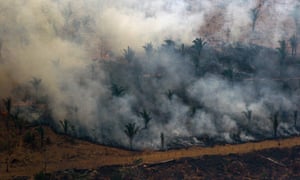
Burning forest
Forest clearance by fire near Boca do Acre in the Amazon basin in north-west Brazil in August 2019. Photograph: Lula Sampaio/AFP/Getty

The amount of pristine tropical rainforest lost across the globe increased last year, as the equivalent of a football pitch disappeared every six seconds, a satellite-based analysis has found.
Nearly 12m hectares of tree cover was lost across the tropics, including nearly 4m hectares of dense, old rainforest that held significant stores of carbon and had been home to a vast array of wildlife, according to data from the University of Maryland.
Beyond the tropics, Australia’s devastating bushfires led to a sixfold increase in tree cover loss across the continent in 2019 compared with the previous year. Rod Taylor, from the World Resources Institute, part of the Global Forest Watch network that released the analysis, said as the unprecedented fires continued into 2020, this was only a partial picture of the area affected in the southern fire season.
While Australia’s eucalyptus trees are generally well adapted to respond to fire, Taylor said this year’s blazes burned more intensely, having followed a severe drought, and spread rapidly due to high winds. The fires killed 33 people directly, an estimated 445 more through smoke inhalation, and hundreds of millions of animals.
“Whereas a normal fire might char the bark of a tree, this year’s fires turned many trees into charcoal sticks,” Taylor said. “Australia can expect more extreme fire seasons as fire risk increases due to climate change.”
The loss of trees in the tropics was the third worst recorded since data was first collected in 2002, trailing behind only 2016 and 2017. The heaviest reduction continues to be in Brazil, which accounted for more than a third of all humid tropical forest loss. Government data shows that deforestation for agriculture and other new land uses increased rapidly in the Brazilian Amazon over the past year.
The biggest surge in forest loss was in Bolivia, where fires led to an 80% greater reduction in tree cover than in any previous year on record. The institute said many of the fires were probably deliberately lit to clear farming land for planting and spread into forests due to strong winds and drought exacerbated by the climate crisis. It follows the Bolivian government making regulatory changes to encourage the expansion of agriculture.
There was a slight decrease in forest loss in the Democratic Republic of the Congo, but it was still the third highest year on record, largely due to cyclical agricultural operations, though the institute said there was emerging evidence that commercial logging, mining and clearing for plantations was having an impact.
Primary forest loss was down about 50% in both Ghana and Cote d’Ivoire, and reduced for a third straight year in Indonesia, where it fell back to a level not seen for more than 15 years. This follows Jakarta introducing a permanent moratorium on clearing for oil palm plantations and increased efforts to ensure that laws were enforced.
Frances Seymour, a senior fellow with the institute, said the level of global forest loss was unacceptable and that it was clear what was needed to reverse the trend. “If governments put into place good policies and enforce the law, forest loss goes down,” she said. “But if governments relax restrictions on burning, or signal an intent to open up indigenous territories for commercial exploitation, forest loss goes up.”


Seymour said the international community could help address the problem by introducing economic or market incentives for protecting forests. She called for governments to embrace four steps: preventing forest burning; increasing monitoring and enforcement to stop breaches; providing the poor and hungry with alternatives to forest exploitation; and not reducing protections to aid the economic recovery from the Covid-19 pandemic.

Calls for royal commission into robodebt and apology from Morrison government.

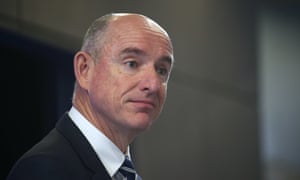
Australia’s government services minister Stuart Robert
Stuart Robert announced on Friday the government would refund $720m to people who paid robodebts. The Greens want a royal commission into the scheme. Photograph: Mike Bowers/The Guardian

The Greens have called for a royal commission into the botched robodebt scheme, amid growing demands for a judicial inquiry and an apology from the Morrison government.
Rachel Siewert, a Greens senator and chair of a Senate inquiry into the scheme, said on Tuesday she saw no other way forward than a “royal commission ensuring a full, independent review of this program and a forensic audit of this mess”.
“This scheme traumatised many already vulnerable people in our community,” she said.
“The government has been heartless and cruel throughout this entire process and their failure to even consider apologising means we cannot trust them to not do it again.”
On Monday, Labor’s government services spokesman, Bill Shorten, appeared open to a judicial inquiry, though he said this would need to be discussed within the opposition.
“Yes, I think there should be some form of inquiry,” he said. “There has been a human toll.”
The comments from Labor and the Greens followed a call from the law academic and robodebt expert Darren O’Donovan, who also called for a judicial inquiry and full audit of all Centrelink debt files.
Both parties have also noted the families of some robodebt victims say receiving letters was a contributing factor in their loved ones committing suicide.
The government last Friday promised to refund $720m to 330,000 people who paid back unlawful debts raised by Services Australia between July 2015 and November 2019.
However, it is expected the overall costs will exceed $1bn, with a class action brought by Gordon Legal also seeking interest and damages.
Also on Tuesday, the firm called on the government to apologise and pledged not to use any mea culpa offered in upcoming court hearings.
“We are prepared as the lawyers acting for the applicants and the group members to not use the fact of an apology in court if the government is willing to give a proper and genuine apology,” Peter Gordon said.
Gordon, whose decision to launch the class action with Shorten in September was mocked by the Coalition, said it would show the government was not just offering refunds due to the court action.

Guardian Australia also reported on Tuesday the Coalition was yet to rule out using legislation to reboot the robodebt scheme in the future.

The option was first raised by the solicitor general in September, suggesting the government was aware of serious legal doubts about the scheme many months before it finally agreed to issue refunds.
Siewert said: “It’s absolutely beyond the pale that after all this unnecessary pain and suffering the government still hasn’t ruled out introducing new laws to allow a future reboot of a robodebt type scheme.”
The government has defended itself by claiming the income-averaging method used under the robodebt scheme was a longstanding policy also used under Labor.
Siewert also claimed such a royal commission would ensure “every single debt regardless of age could be audited”, including those raised unlawfully before the robodebt scheme.
“The government thinks they can get away with only refunding victims served notices after 2015,” she said.
Asked about the scandal on Monday the prime minister, Scott Morrison, expressed regret but stopped short of apologising, citing the class action.
In 2016, the Coalition ramped up the discredited use of averaged tax office data to allege Centrelink recipients had misreported their fortnightly earnings in a move critics said reversed the onus of proof on to welfare recipients.
The process had been been used as a “last resort” by the Department of Human Services as far back as the early 1980s.


Despite claiming the process was used under both parties, an acknowledgement that an unknown number of unlawful debts exist before 2015, the government has refused to audit pre-2015 debts.

Late Night Live - Bruce Shapiro's America

Image: CHANDAN KHANNA/AFP via Getty Images

Bruce Shapiro's America

By Phillip Adams on Late Night Live

https://www.abc.net.au/radionational/programs/latenightlive/bruce-shapiros-america/12313072

The death of George Floyd at the hands of police has sparked protests across America. President Trump is threatening to use the military to quell the dissent. But can he?
Duration: 12min 29sec
Guests
  • Bruce Shapiro
    Columnist with The Nation magazine; Executive Director of the Dart Centre for Journalism and Trauma at Columbia University.

Australian government YouTube videos promoting logging should be taken down, Greens say.

Agriculture department spent $95,000 on campaign that encourages people to ‘look up at the trees, think about wood’
A government promotion for the forestry industry that encourages Australians to “look up at the trees, think about wood” should be taken down after a recent federal court ruling on native forest logging, the Greens say.
The department of agriculture paid a production company $94,875 last year to produce a series of videos aimed at promoting Australia’s logging industry as environmentally sustainable.
The videos appear on the department’s web page and YouTube and have been distributed through the forestry industry and state governments but have not been used as part of a broader advertising campaign.
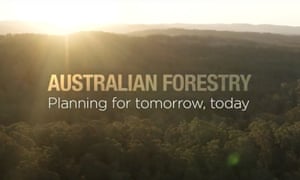
An ad for the Australian forestry industry
One three-minute video, “Australian Forestry – planning for tomorrow, today”, features expansive shots of pristine native forests and close-ups of koalas.
It describes timber as a “material so versatile, so extraordinary that if it didn’t exist, we’d have to invent it”.
The videos were made to cover all aspects of the logging industry, both native forest logging and plantations.
The narrator of the three-minute video says the industry uses cutting-edge technology and is committed to a sustainable future “where every tree we use is regrown and replaced”.
“With this infinite capacity for renewal and its incredible variety of uses, it’s no wonder we call wood the ‘ultimate renewable’,” she says.
The video says the industry is committed to forest stewardship and protecting wildlife and the environment.
“So next time you look up at the trees, think about wood and everything we use it for,” it concludes.
“And remember the forests it comes from, and the people who care for them. Australian forestry, planning for tomorrow, today.”
A second video features interviews with forestry workers and public servants.
Recent responses to written questions from the Greens senator Janet Rice show the former department of agriculture and water resources commissioned the videos as “one tactic” in a range of communication activities meant to develop a “new narrative” for the forestry industry.
“The video/s are planned to help initiate this discussion, and to disrupt the negative messaging and imagery of forestry that is commonly portrayed in, for example, the media,” a request for quote document states.
The document says the project is a “hearts and minds product” with “wow factor” that showcases sustainably managed forestry in Australia.
It suggests animation or CGI could be incorporated to show the regrowth of well-managed Australian forests.
“Did you know that some species of fauna and flora require disturbance such as a wildfire event to regenerate and grow,” the document says.
“When completed under the right conditions, a native forest harvesting operation can replicate a wildfire event.”
Rice said the videos ignored the “scientific reality” of the environmental damage caused by native forest logging and were “propaganda”. She compared the videos to the Australian Minerals Council’s “Little Black Rock” campaign for coal and said the material featured no footage of native forest logging actually happening.
“They are extraordinary. They would be worthy of something the Chaser would produce. It would be hilarious if it wasn’t so serious,” she said.
“If it was the industry producing and paying for them that would be one thing. But not our taxes at work, our government doing it. It’s outrageous really.”
Rice said she was concerned the videos made no distinction between native forest logging and logging that was managed in plantations.
She said much of what was in the videos could be applied to plantation logging – which accounts for almost 90% of Australia’s timber industry – but not to ongoing native forest logging in states including Victoria, Tasmania and New South Wales.
Last week, the federal court ruled that logging by VicForests in Victoria’s central highlands had breached state and federal environmental laws, including laws meant to protect threatened species.
Justice Debra Mortimer delivered a 444-page judgment that found VicForests had breached the code of practice in its regional forestry agreement and, as a result, was not exempt from national environmental laws. She found past and planned logging would significantly affect the vulnerable greater glider and the critically endangered Leadbeater’s possum.
The judgment was scathing of numerous practices undertaken by VicForests and described the state-owned logging agency as having “insufficient regard” for greater glider habitat.
Rice said in light of the judgment and the recent bushfire disaster the agriculture department should take the videos down.
 “It’s clearly an inaccurate depiction of the impact of the forestry industry on our forests,” she said.
“Think about it, that $100,000, it could have been put towards an under-funded recovery plan and species issues that we haven’t properly funded.”
An agriculture, water and environment department spokesperson said the total project had six videos and seven social media cutaways that were intended to “raise awareness of the Australian forestry industry and forests as a sustainably managed resource”.
“The videos refer to current sustainable forestry practices. The videos also highlight that with innovation and new technology the forest industry is continually looking at ways to improve,” the spokesperson said.
The spokesperson added “on average every tree harvested by the Australian forestry industry is regrown”.
The federal government has said it is carefully considering the implications of last week’s federal court decision. Final orders have not yet been issued and VicForests and Friends of Leadbeater’s Possum, which brought the case, are due to make submissions later this week.
Amelia Young, the national campaigns director for the Wilderness Society, said there was one aspect of the videos she agreed with – “that Australia’s forests are amazing places”.
But she said the “oft-touted ‘wood is the ultimate renewable’” fell short of reality.
“The reality is that extracting wood from our native forests to the detriment of our unique wildlife, our water catchments and clean air is strip mining forest ecosystems,” she said.


“The recent, landmark case against VicForests which found VicForests’ logging operations break both state and federal environmental laws – and significantly impact our endangered species – lays bare the extraordinary greenwash our taxpayers’ dollars have funded on behalf of the logging industry.”

BOM data for autumn is in and Australia has come out looking warm.

Bright red, yellow and orange autumn leaves
It may have been chilly in parts, but Australia was above average in autumn overall.(Supplied: Cassandra Brennan)
It might be hard to believe, considering how cold it has been in recent weeks, but autumn temperatures were actually slightly above average for Australia as a whole.
If you are in New South Wales, Victoria or Tasmania, though, you do have reason to moan — your mean temperatures were below average, although still only the 49th, 48th and 56th coldest on record since 1910.
NSW's days were particularly cold at 0.88 degrees Celsius below average, the 16th coldest average maximum temperature on record for the state.
The only jurisdiction close to a warm record was Western Australia, which recorded its ninth warmest mean temperature for autumn.
A blue boathouse in the middle of a river with its jetty underwater.
Perth's Insta-famous blue boathouse was inundated during a storm on May 25.(ABC News: Jessica Warriner)
Greg Browning, climatologist with the Bureau of Meteorology, said March and April were actually quite warm.
"April, in particular, was very warm across the country, but then we saw a significant drop-off come May," he said.
"So that was a real dampener on those warmer temperatures and really was a bit of a sudden shift towards winter conditions."
Map of Australia orange and yellow indicating above average in the north and west. Blue indicating below in inland NSW, VIC +SA.
Temperatures may have been above average overall, but it was chilly for parts of the south-east.(Supplied: BOM)

What is average?

The above-average temperatures are less of a surprise considering the BOM uses data from 1961 to 1990 to form the average for these comparisons.
This period is used as an international meteorological standard — a long dataset that formed a baseline to which people were accustomed, Mr Browning said.Metal fence with hexagonal  holes filled with ice crystals.
Some places were still frosty during autumn, as evidenced by Lake Saint Clair in Tasmania.(Supplied: Maren Gorne)
While some applications had started using 1981 to 2010 as the comparison period, he added, it had not filtered down to public products at this stage.
"Certainly based on the recent global warming that we've seen on the land and over the oceans, you would expect it to be significantly warmer than what we saw back in the 1960s and even 1990s."

Year so far and season to come

Australia is tracking for its 10th highest year to date for mean temperatures at 0.8 degrees above the 1961-to-1990 average.
Rainfall is pretty much bang on average according to Mr Browning, sitting at 1 per cent above average.
Raindrops on glass window.
There are still strong odds for a wetter-than-average winter.(ABC News: Chris Gillette)
"It's been a while since Australia has seen a significant period of above-average rainfall," he said.
"It certainly has been a big change in rainfall compared to recent years in particular."
Not all locations have received rain and some areas are still facing serious deficits after years of drought, however things are looking up on the whole.
The optimism continues when you look at the outlook, which suggests most of the country has at least a good chance of average or wetter-than-average conditions over winter.

Tuesday, 2 June 2020

Obama shares advice on how to make George Floyd protests 'a turning point'

Extract from The Guardian

Former president applauded peaceful protesters and suggested demonstrations could translate to ‘effective action’
Barack Obama in Chicago, Illinois, on 29 October 2019. ‘[T]his moment can be a real turning point in our nation’s long journey to live up to our highest ideals,’ he wrote.
Barack Obama: ‘[T]his moment can be a real turning point in our nation’s long journey to live up to our highest ideals,’ he wrote. Photograph: Ashlee Rezin Garcia/AP

Barack Obama has once again weighed in on the George Floyd protests gripping much of America and attracting global attention, suggesting the demonstrations could translate to “peaceful, sustained and effective action” to address structural racism.
He called for making “this moment a real turning point to bring about real change”, and also urged voters not to give up on the democratic system, but to participate in elections as a way to make progress.
In a new Medium post, the former president applauded the peaceful protesters who had marched in dozens of cities, large and small, coast to coast in the US in the week since the killing of Floyd, an African American man, under the knee of a white police officer in Minneapolis last Monday.
I wrote out some thoughts on how to make this moment a real turning point to bring about real change––and pulled together some resources to help young activists sustain the momentum by channeling their energy into concrete action. https://medium.com/@BarackObama/how-to-make-this-moment-the-turning-point-for-real-change-9fa209806067 


But Obama condemned those on the fringes who have engaged in violent behavior that turned resistance into riots, arson and looting in some places, especially over the weekend.
“The overwhelming majority of participants have been peaceful, courageous, responsible and inspiring. They deserve our respect and support, not condemnation,” Obama said.
“On the other hand, the small minority of folks who’ve resorted to violence in various forms, whether out of genuine anger or mere opportunism, are putting innocent people at risk.”
Obama emphasized that the protests had to translate into policy that would help to prevent more deaths like Floyd’s.
“I’ve heard some suggest that the recurrent problem of racial bias in our criminal justice system proves that only protests and direct action can bring about change, and that voting and participation in electoral politics is a waste of time,” Obama said. “I couldn’t disagree more.”
He continued: “[E]ventually, aspirations have to be translated into specific laws and institutional practices – and in a democracy, that only happens when we elect government officials who are responsive to our demands.”
The advice from the two-term Democratic president was barely out in the public domain before news began trickling out about a conference call on Monday morning that the current White House occupant, Donald Trump, had with state governors, in which he urged them to crack down on unrest and said the escalation of protest was successful when the authorities were weak, adding “and most of you are weak”.
The president reportedly called on the governors to step up enforcement and told them: “You have to dominate, if you don’t dominate you’re wasting your time. They’re going to run over you, you’re going to look like a bunch of jerks. You have to dominate.”
Meanwhile, Obama’s article on Monday leads with a picture of a large wall mural of George Floyd, with many names of other victims of police killings, including Walter Scott, Tamir Rice, Philando Castile, Freddie Gray, Breonna Taylor, Michael Brown – and Eric Garner, whose dying words “I can’t breathe”, while in a police chokehold in New York in 2014, were repeated by Floyd as his neck was knelt on for almost nine minutes by the police and once again became both an angry and galvanizing cry at protests.
And in front of the mural, a little girl is holding a sign that says: “My daddy plays with me, my daddy reads to me, my daddy tucks me in at night, please don’t kill my daddy.”
Floyd was a father of a young girl and Obama has two daughters. The picture also shows many floral tributes and signs reading “Black Lives Matter” and “Justice for George Floyd”.
Obama wrote: “The waves of protests across the country represent a genuine and legitimate frustration over a decades-long failure to reform police practices and the broader criminal justice system in the United States.”
He continued: “Yes, we should be fighting to make sure that we have a president, a Congress, a US justice department and a federal judiciary that actually recognize the ongoing, corrosive role that racism plays in our society and want to do something about it. But the elected officials who matter most in reforming police departments and the criminal justice system work at the state and local levels” including mayors, county executives, district and state’s attorneys.
The former president expressed hope that that the current protests mark the beginning of a new chapter for the country, noting that “the choice isn’t between protest and politics. We have to do both.

He concluded: “If, going forward, we can channel our justifiable anger into peaceful, sustained and effective action, then this moment can be a real turning point in our nation’s long journey to live up to our highest ideals.”

Songs that came out of the Sydney lockdown. Musicians are Lil Macdonald, originally from Maine USA, and Crackles on guitar.