Thursday, 4 June 2020

Jane Goodall: humanity is finished if it fails to adapt after Covid-19.

Humanity will be “finished” if we fail to drastically change our food systems in response to the coronavirus pandemic and the climate crisis, the prominent naturalist Jane Goodall has warned.
She blamed the emergence of Covid-19 on the over-exploitation of the natural world, which has seen forests cut down, species made extinct and natural habitats destroyed. The coronavirus is thought to have made the jump from animals to humans late last year, possibly originating in a meat market in Wuhan, China.
Intensive farming was also creating a reservoir of animal diseases that would spill over and hurt human society, said Goodall, one of the world’s foremost experts on chimpanzees and a longtime conservation campaigner, speaking alongside two European commissioners at an online event held by the campaigning group Compassion in World Farming, on Tuesday.
“We have brought this on ourselves because of our absolute disrespect for animals and the environment,” she said. “Our disrespect for wild animals and our disrespect for farmed animals has created this situation where disease can spill over to infect human beings.”
People must move away from factory farming and stop destroying natural habitats as a matter of urgency, she said, because of the threat of diseases and of climate breakdown. Factory farming is linked to the rise of antibiotic resistant superbugs, which threaten human health.
“If we do not do things differently, we are finished,” she said. “We can’t go on very much longer like this.”
She called for people to be lifted out of poverty, pointing to its strong impact on the natural world, as people with no alternatives and who are desperate to feed their families will cut down forests to survive, and in urban areas will choose the cheapest food whatever the harm caused by its production, because they have little other choice.
War and violence also fuelled the destruction of nature, she warned, and so did our overweening consumerism and urge for “stuff that we accumulate”, as well as our diets.
The wealthy should put pressure on leaders and take care over what they buy to avoid adding to the problem, she said. “We have got to stop buying their products,” she said, of companies that use factory farming and exploit nature.
“We have come to a turning point in our relationship with the natural world,” she warned, saying there was only a small window of opportunity to make drastic changes before facing disaster. “One of the lessons learnt from this crisis is that we must change our ways. Scientists warn that to avoid future crises, we must drastically change our diets and move to plant-rich foods. For the sake of the animals, planet and the health of our children.”
Stella Kyriakides, the EU’s commissioner for health and food safety, said the EU was responding to concerns through its newly unveiled agriculture and biodiversity strategies and the European Green Deal. These strategies would cut the use of pesticides and encourage biodiversity, she said.
“Highly intensive farming systems have created an abundance of food but in Europe, at least, there is also significant waste and at times animal suffering,” she told the conference. “These phenomena deeply worry me. The parts that don’t work are ethically questionable and socially and environmentally unacceptable. Our citizens expect more and we will deliver a better balance to ensure farming practices are sustainable and food is affordable.”
Janusz Wojciechowski, commissioner for agriculture, added: “We will constantly support sustainable farming and breeding practices as an alternative to intensive industrial farming.”
Concern about the links between coronavirus and the exploitation of the natural world is growing. Eighteen conservation groups have joined together in the Campaign to End Wildlife Trading, which is urging Boris Johnson to call for a global wildlife trade ban when the G20 leaders meet this November.
The groups say that such a ban is needed to end the exploitation of wildlife for traditional medicine, exotic pets, tourism and other purposes. Currently, the trade in some endangered species is banned but still rife. It is one of the biggest forms of illegal trafficking in the world, after people and drugs. The legal trade is estimated to be worth $7bn to $23bn a year, according to the campaign.
Intensive farming’s links to disease outbreaks were examined by the FAIRR global investor network in a new report, which found that more than 70% of the biggest meat, fish and dairy producers were in danger of fostering future zoonotic pandemics owing to lax safety standards, closely confined animals and the overuse of antibiotics.
Meat companies have been under pressure in the US, where the spread of Covid-19 has led to plant closures and disruption of the supply chain. In the longer term, according to FAIRR, the meat supply chain is likely to come under further pressure because of increased scrutiny and regulation needed to improve biosecurity.


Jeremy Coller, founder of FAIRR and CIO of Coller Capital, said: “Factory farming is both vulnerable to pandemics and guilty of creating them. It’s a self-sabotaging cycle that destroys value and risks lives. To avoid causing the next pandemic, the meat industry must tackle lax safety standards for food and workers alike, closely confined animals, and overused antibiotics. Covid could be the straw that breaks the meat industry’s back.”


Fewer ATMs, no more cheques and lower e-payment fees predicted for Australia in wake of coronavirus.

Reserve Bank says societal shifts around shopping amid pandemic likely to become ‘permanent change in behaviour’
ATMs in Sydney
ATM withdrawals in April were 40% lower than the year before as Australians flocked to online shopping, where cash was not an option, amid the Covid-19 pandemic. Photograph: Edgar Su/Reuters

A world without cheques, fewer ATMs and a regulatory push to lower electronic transaction fees as fewer people use cash are some of the likely impacts of Covid-19 on payments, the Reserve Bank has said.
RBA assistant governor Michele Bullock told a Morgan Stanley disruption conference on Wednesday that cash was now the payment method for just 25% of transactions, or around 10% of their value.
The long-term decline of cash has been accelerated by merchants and consumers concerned about hygiene during the Covid-19 pandemic, with many putting up signs asking for card payments or rejecting cash altogether, she said.
As shoppers flocked instead to online shopping, where cash was not an option, ATM withdrawals in April were down 30% from the month before and more than 40% lower than the year before.
Bullock said it was “likely that a large part of this will become a permanent change in behaviour” and add to pressure on banks to reduce the number of ATMs in their networks – a consolidation that will be “more urgent” and occur “more quickly” as a result.
But Bullock said there was “still a significant minority of the population that continue to use cash for face-to-face payments”.
“While a third of survey respondents did not use cash for any payments, around 10% used cash for all their payments. Cash users tended to be older or people on lower incomes.”
Bullock said the reduction in ATMs would have to be managed to prevent disadvantaging those remaining cash users. It was now “more important than ever that we ensure competitive pressure remains on the costs of electronic payments to merchants”.
Merchants would likely grapple with payment providers by threatening to apply surcharges if they did not lower their fees, and would need “least-cost routing” such as access to Eftpos.
Bullock said the RBA had so far “not mandated” providers offer least-cost routing to all merchants but it “remains an option” under consideration, as well as improving transparency of payment plans.
“But ultimately, if banks or other stakeholders are acting in ways that prevent downward pressure on merchant fees, we may need to consider regulatory options for keeping the cost of electronic payments low.”
Bullock said banks were considering closing the cheque system because electronic conveyancing was now the norm and there were few remaining uses of cheques.
Covid-19 had led to banks encouraging their remaining customers without internet banking to sign up, which “may bring the efficiency implications of maintaining the cheque system into even sharper focus”.
Bullock said that “the shift to electronic is perhaps not as difficult as many had thought”, citing outages in banks’ electronic payments system as one of the pitfalls.
With so few shoppers carrying cash, disruptions forced people to “leave goods at the counter” and merchants had “to close until the systems were restored”.

Bullock said the sector must “identify and mitigate risks of reliance on supporting infrastructure that can be single points of failure, such as the telecommunications and energy sectors”.

Australian bushfires: how the Morrison government failed to heed warnings of catastrophe.

Documents released under freedom of information show that despite warnings of dire fire risks, federal follow-up was sluggish
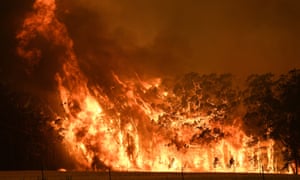
A bushfire at Bilpin, NSW, in December 2019
Questions remain about whether the government ministers responsible adequately managed the response to Australia’s summer bushfires. Photograph: Dan Himbrechts/EPA

Scott Morrison’s decision to take a holiday in Hawaii as fires engulfed the east coast of Australia will go down as among the most unfortunate political missteps in recent history. The trip became emblematic of a federal government caught flat-footed for last summer’s unfolding bushfire catastrophe.
New documents, some released under freedom of information provisions, have shed more light on the government’s preparations for the bushfire season and response to it. The documents show that while some parts of the bureaucracy were aware by August that the country was facing a horror season, that urgency did not reach their political masters.
One of the most important questions for the royal commission into the bushfire crisis will be whether state and federal authorities effectively coordinated their response.
Disaster management is primarily a state responsibility, but the commonwealth also has a role, particularly when fires cross state lines and states need additional resources. Surprisingly, there is no clear power in the constitution to declare a national emergency.
Some important functions – notably aerial firefighting, telecommunications infrastructure, emergency broadcasts on the ABC, electricity grids and assistance from the military – are in the hands of the commonwealth, or funded by it.
But despite a scientific assessment in August warning of a dire outlook, many of the follow-up actions, such as more funding for aerial firefighting equipment, were slow to flow. There appears to have been little appreciation at the executive level of just how horrific the bushfire season was predicted to be.

Aerial firefighting funding slides

Most notable was the commonwealth’s ad hoc response on aerial firefighting, which was well documented during the fires.
A funding agreement between the states and the commonwealth for the National Aerial Firefighting Agency was reached in 2003 after a particularly fierce bushfire season. The Howard government agreed the commonwealth would provide 50% of the funds each year.
But by 2017, the federal share of funding had fallen to 23%.
Despite a formal request in 2017 from the national agency to permanently increase its budget, the federal Coalition chose to offer an $11m “one-off” top-up to the centre’s $14.8m funding in 2018. That was renewed on 12 December 2019. But by then the east coast was already ablaze.
On 3 January, after hundreds of houses had been lost and several coastal towns were cut off, Morrison announced another $20m to deploy four additional air tankers and agreed to make the $11m top-up ongoing.
“When you look at that … over the last couple of years and the additional resource that is being provided on top of our standing commitment of $15m, it means the resources were delivered,” a defensive Morrison said.
Part of the reason for the slow commonwealth response is perhaps that no single minister or department, with the possible exception of the Department of Home Affairs, has ownership of planning for a natural disaster on a national scale.
At least five portfolios – health, defence, communications, energy and home affairs – have control over critical resources. Agencies such as the CSIRO and the Bureau of Meteorology have important roles in predicting the likely impact of a bushfire.
Arguably there are more agencies – notably the environment department, which has responsibility for threatened species and climate change – that should also be involved in bushfire response planning.

Heightened fire risks predicted

In the federal sphere, the main responsibility for assessing the outlook for the bushfire season fell to Emergency Management Australia (EMA) – once a separate agency, now a branch within the sprawling home affairs portfolio.
The branch told the Guardian it hosted 11 disaster preparedness briefings across all states, beginning in August 2019 when the Bushfire and Natural Hazards Cooperative Research Centre released its seasonal outlook.
The outlook warned, quite accurately though in somewhat muted language, where the risk lay.
“Australia faces the likelihood of an active fire season with above-normal fire potential forecast for significant parts of Australia, particularly the south-east,” it said.
“It has been the fifth-driest start to the year on record, and the driest since 1970. This is especially the case over the southern half of the country, which has experienced the driest January to July on record (January to July 1902 is the second driest).”
The outlook pinpointed the areas that faced the higher risk. In NSW, it said, there was “significant concern for the potential of an above-normal fire season in forested areas on and east of the Great Dividing Range”.
The risk for the ACT was said to be “above normal”, while in Victoria “above-normal bushfire activity continues across the coastal and foothill forests of East Gippsland, extending into West Gippsland and the Great Dividing Range”.
It also highlighted the risks on Kangaroo Island in South Australia, which had “a combination of drier than average and wetter than average conditions across the island which may result in above average fuel loads in parts”.
These were the areas that were ravaged by fires over Christmas and New year.
EMA said it held a further nine briefings with defence department and other agencies that needed to be involved in the co-ordination between August and November.
But for some reason the impending risk does not seem to have permeated into the executive or to cabinet.
EMA’s first briefings with ministers on preparedness for the bushfire season took place in November, and by then bushfires had already raged through parts of Queensland and northern NSW. It did not say who attended.
The minister for emergency management, David Littleproud, issued three press releases between August and November describing the coming bushfire season as “challenging”, “tough”, “testing” and “above average”. But the gist of the releases was that communities needed to start getting organised, not what the federal government was doing.

Warnings ‘fobbed off’

Some who sought to warn the federal government early, such as the former NSW fire chief Greg Mullins, felt they were fobbed off by the federal government.
As reported last year, Mullins – in his capacity as head of the Emergency Leaders for Climate Action – contacted the prime minister’s office in April, seeking a meeting to outline the potential calamity he believed was looming.
In the aftermath of the fires, Morrison has said he didn’t need to hear from former chiefs as the government could hear from the current ones. But Mullins has said it was precisely their “ex” status that allowed them to speak freely both about bushfire preparedness and its link to climate change.
Mullins’s request was referred to the minister for energy and emissions reduction, Angus Taylor, in July.
Taylor responded on 10 September, offering a date in October for a meeting in Sydney.
Mullins immediately wrote back, saying it was “unfortunate” it had taken several months to receive an invitation and that the catastrophic conditions he and his fellow fire experts had predicted had now manifested.
“Considering the gravity of the situation, a national response from the highest levels of the Australian government is required,” Mullins wrote. He requested an urgent meeting with Morrison, Taylor, Littleproud, finance minister Matthias Cormann and any other ministers involved.
Taylor replied that he had copied in Littleproud, and perhaps Mullins should seek a meeting with him.
By then Mullins could see what was unfolding. In November he told the ABC how worried he was. He said he been “fobbed off” by the prime minister, and that Taylor was “not the right person to meet with”.
Finally a meeting took place with Littleproud and Taylor on 3 December.
Mullins told the Guardian: “It was clear that there was never any intention by the PM to listen to us. We were treated with open contempt by the PM, who said he would deal with the current chiefs.
“The deputy prime minister [Michael McCormack] said we were time-wasters and that those who talked about climate change and bushfires were latte-sipping greenies.”
Asked in November why he did not meet Mullins, Morrison said the government already had advice from “existing fire chiefs doing the existing job” and his office said the Mullins group had been offered meetings with senior cabinet ministers “several times this year”.
Documents released under freedom of information also show that Taylor did not ask his department for a briefing before the meeting with Mullins – the usual step for a minister.

Ash Wednesday and Black Saturday cited

A similar request to the then-Department of Environment and Energy reveals how little thought had been devoted in that portfolio to the potential impact of the bushfire season on the environment, threatened species and its relationship to climate change.
One cabinet document was withheld, its subject unknown. The only other document produced was an assessment of what bushfires could do to the national electricity network.
In December the department warned that the Forest Fire Danger Index was high around the electricity corridors for the Queensland-NSW interconnector and the NSW-Victoria interconnector, and that dust storms were possible, which could further threaten the transmission network.
“The FDDI is tracking similar to those conditions preceding the Ash Wednesday and Black Saturday events,” it warned.
Emergency Management Australia said it activated the COMDISPLAN – which outlines how states could access non-financial assistance from the commonwealth during disasters – in early September 2019.
It coordinated the first requests for commonwealth disaster assistance itself. The Australian defence forces became involved soon after, and by November had liaison officers in the NSW bushfire headquarters.
There have been suggestions in the media that NSW rebuffed help from the federal government, particularly around the use of Navy ships, during the crisis.
There were clearly some communication problems. The New South Wales RFS commissioner, Shane Fitzsimmons, said neither he nor defence force personnel working from the state control centre were informed by Scott Morrison of a plan to deploy 3,000 army reservists to assist in the bushfire crisis.
Fitzsimmons said he learned of the plans through the media on 4 January, when fire crews were battling some of the most challenging conditions of the summer.
The dispute between Morrison and the NSW premier, Gladys Berejiklian, if there was one, appears to have related to whether a naval vessel should be sent in to Bermagui to evacuate residents .
Documents obtained from the Department of Defence show there was close co-operation on the aerial firefighting tasks, with the RFS using Defence facilities at Richmond, on the fringes of Sydney, and that Defence rapidly scaled up to provide teams that could deal with displaced residents and help clear roads.
But after the Mallacoota fires in Victoria on New Year’s Eve, when thousands of people were forced on to beaches to escape the fires, the government began deploying naval ships to the coast.
At the request of the Victorian authorities, HMAS Choules and MV Sycamore left Sydney on 1 January and arrived in the Mallacoota area the next day to provide support and evacuate 1,100 people who were sleeping on the beach.
There were fears that a similar scene could unfold in one of several towns along the NSW south coast as fires threatened again on 4 January. The documents show HMAS Adelaide sailed on 4 January, as the second wave of fires tore through communities and cut roads. But Bermagui, while ringed by fire, did not burn.
The documents show the NSW government and the RFS preferred to request Defence help clearing the Princes Highway before and after 4 January and evacuate by road, rather than by sea.
Berejiklian refused to release an email exchange with the prime minister’s office on 2 January, on the grounds that it would damage federal-state relations. Morrison’s office refused the request on the grounds that it was too wide.
RFS personnel say the liaison with Defence went very well, barring a few hiccups. A briefing note from Defence to the minister on 2 January recounted how Defence helicopters had assisted in the rescue of three people in Moruya the previous day.
“The rescue was undertaken in extremely difficult conditions and was only successful due to close co-operation between the NSW RFS, NSW Ambulance Toll AME and the Australian defence force,” the note said.
But questions remain about whether the bushfire response was adequately managed by the responsible ministers.
The summer of 2019-20 suggests there is much room for improvement in Australia’s arrangements to protect it from natural disasters.

'It should not have taken so long': robodebt took a huge toll – there must be real accountability.

The government has acknowledged wrongdoing in regards to the unlawful Centrelink scheme, but just paying back the money is not enough

Letecia Luty: The mental cost was more profound than the money

It’s hard to know what adequate compensation looks like for the half a million Australian’s whose robodebts will be waived, after the government acknowledged last Friday that they’ve illegally taken $721m from people like me. A lot of vulnerable people didn’t have many (or any) options, so they accepted to go on payment plans. I know of one single mother who had worked off $20,000 of an inaccurate and unlawful $30,000 debt. I’m glad she will be getting her money back, but people may have died because of this. Several families of robodebt victims say receiving letters was a contributing factor in their loved ones committing suicide. Our federal welfare agency was referring suicidal callers to Lifeline. What does “a fair go” look like for those people and their families?
It’s hard to describe the feeling of absolute disempowerment that comes from dealing with Centrelink. Pursuing robodebt was the signature policy of Taskforce Integrity. The name says it all: a taskforce created to deal with those who lack integrity. Stuart Robert launched the initiative with this claim: “You are not just cheating and stealing from the government; you are stealing from your neighbour; you are stealing from those genuinely in need.” This is the same guy who eventually repaid $38,000 in taxpayer money for “residential internet costs.”
The messaging in official statements, echoed by staff in Centrelink offices and call centres, encourages clients to feel worthlessness, anger, embarrassment and humiliation. All of this for $282.85 a week (pre-Covid-19), while the national poverty line was $457 per week. Anyone receiving support already knew that the Department of Human Services wanted them to feel bad about it, and robodebt doubled down on the notion that we were guilty in fiscal terms as well.
The government has acknowledged wrongdoing in regards to robodebt, but they’ve refused to apologise. In an interview with Alan Jones, Stuart Robert sounded shocked when he said that “decent people” had found themselves “very quickly in very difficult circumstances” due to Covid-19. This is obviously true, but the inference is that those who experienced hardship before the coronavirus struck were not, in fact, decent people. We’re talking about people with disabilities, seniors, students, single mothers and those actively looking for work. I spoke at the Senate committee and testified to the psychological damage Taskforce Integrity has caused.
Through support from Legal Aid, my “debt” had already been reduced to $0 by the time the refunds were announced. But the mental cost of dealing with an institution that bullies and disempowers its clients was always more profound than the money.

Jamie Luxton: Being informed of my debt put me in a hopeless headspace

In 2018, I was struggling through a Certificate IV in Mental Health when I got a call in the middle of class from someone from Centrelink.
I am on the Disability Support Pension for treatment resistant bipolar disorder, yet based on the manner in which I was informed that I owed thousands of dollars from many years ago, it was clear that the person I spoke to had no training in how to communicate responsibly and sensitively with someone who experiences mental health issues.
As someone who can experience suicidal thoughts even on what I would call a good day, being informed that I was supposedly thousands of dollars of debt instantly put me in the sort of hopeless headspace which brings on suicidal ideation.
I remember swearing and hanging up, leaving class frustrated and angry to call my parents and tell them what had happened.
Fortunately, I have supportive parents who were able to lend me the money to pay the so-called debt which I had no time, energy or evidence with which to dispute.
I am disgusted and furious about those who reportedly lost their lives at the hands of this inhumane government who established this ill-considered and illegal scheme.
I could very easily have been another death if not for my parents’ assistance.
The continual denials that there was anything wrong with robodebt, up until the point at which they lost a court case last year, seemed to show that many people in our government are completely oblivious to the experience of the majority of Australians. It should not have taken so long for them to realise the program was unlawful.
The government has now effectively been found guilty of stealing from the poor and vulnerable and that has been acknowledged in the fact that they are paying back the money, but they don’t have the integrity required to apologise for the suffering.
I don’t think simply returning the money taken goes far enough. After all, no one else would get away with theft or extortion by simply returning what was taken.
I think compensation should be paid to those affected, particularly to any families who have lost loved ones.
Those who devised this frankly shameful scheme should be held to account. I am sure I am not the only person who feels that to see some accountability where it’s due would mean a lot. Additionally an apology should be made to each and every person affected by the scheme.


Wednesday, 3 June 2020

James Hansen - Sophie's Planet #9: Chapters 13 & 14 (Climate Eruption & The First Team)

02 June 2020

James Hansen
Dr. Robert S. Cooper was a commanding leader and visionary, who lead the weather and climate eruption in NASA when he became the Goddard Space Flight Center Director in 1976.

The eruption rattled the walls of the Goddard Institute for Space Studies in New York, but our budding planetary and climate research programs survived, thanks to a group of then young scientists, pictured here in more recent times (except Tony and Makiko in 1970s photos).

http://www.columbia.edu/~jeh1/SophiePlanet/Planet.Chapters13+14.pdf

Here are drafts of Chapters 13 &14 of Sophie’s Planet for fact checking.

I opened a Twitter account @DrJamesEHansen, (https://twitter.com/drjamesehansen), but will minimize interactions until the book is finished.

Supernova 1994D: The image that captures the beauty of a powerful moment in time.

Extract from ABC News

,
Supernova 1994D in galaxy NGC 4526
The bright star in this picture has been more important than you might think.(Supplied: NASA/ESA, The Hubble Key Project Team and The High-Z Supernova Search Team)
It may just look like a bright star under a galaxy, but this simple image captures a powerful moment in time that is instantly recognisable by astronomers like Brad Tucker.
Dr Tucker studies supernovae — massive explosions that light up our universe — using the Australian National University's Mount Stromlo Observatory.
And that bright star below the galaxy is one of the most iconic images of a supernova ever taken.
"I love this photo of supernova 1994D," he says.
"You see a galaxy and just this 'bright star'. But then you realise that 'bright star' is 50 million light years away."
Not long after the dinosaurs vanished off the Earth, the star at the bottom of this image reached a critical mass (known as the Chandrasekhar limit) and exploded in a ball of powerful energy.
Fifty million years later the explosion on the outskirts of an old dusty spiral galaxy, NGC 4526, was captured by the Hubble Space Telescope.
"You would never see this with your eyes, it's so bright, yet so faint and far away, which I think is the elegance to it."
Supernovae are fleeting events lasting just weeks or, at best, a couple of months.
"So when we look back at [this galaxy] we can't see traces of that supernova. That star has completely gone."
"If we never saw that explosion, we would never have known that star system existed. And we would never have known that entire solar system just died."

The beauty of supernovae

Although the supernova looks like it is sitting by itself outside the galaxy, there are likely to be stars all around it that are too faint to see.
"Galaxies are 3D bodies. but we see them as 2D images so we kind of miss the depth in the field."
But that, said Dr Tucker, is the beauty of a supernova.
"When the entire thing explodes it goes ... from something that you don't even know exists to being so bright that it is brighter than almost the whole galaxy."
Supernova 1994D was snapped in early March 1994 in the constellation of Virgo.
Back then, the Hubble Space Telescope had just become functional and the study of supernovae was relatively young.
"These days a supernova with the name 'D' happens somewhere on January 1."
"It just goes to show how many of these things are out there, and yet back in the day, only 26 years ago it took a lot of effort to find this one."
Supernovae like this, known as type1a supernovae, play an important role in estimating the rate of expansion of the universe.
Astronomers calculate the distance between objects by measuring the brightness of the explosion.
Supernova 1994D was part of a small set of supernovae used to prove the universe was not only expanding, but the rate of expansion was accelerating, which led to the Nobel Prize-winning discovery of dark energy.
"Historically, it is part of research that proved 70 per cent of the universe was there that we didn't know of."

Australians say ABC saved lives during summer bushfires, royal commission told.

Extract from The Guardian

Research shows 60% of people in affected areas relied on information from national broadcaster to stay safe
The ABC has released research underlining its role during the summer bushfires ahead of a board meeting on Wednesday to discuss the looming cuts at the national broadcaster as well as recent calls by the government for a wage freeze for ABC staff.
The independent research, based on a qualitative survey of more than 1,600 people and quantitive results from almost 400 more, found 60% of people in bushfire-affected areas said information from the ABC helped ensure their safety.
According to the research, which has been submitted to the bushfire royal commission, 81% of people were aware of the ABC as an information source and one in two used it as their main source of information during the summer crisis.
People said they trusted the ABC’s channels and websites more than the commercial ones, and ABC local radio was essential when digital and telecommunications failed in bushfire zones.
In April the communications minister, Paul Fletcher, told the ABC he expected the organisation would defer a 2% increase for staff scheduled to take effect in October under the ABC’s enterprise agreement. ABC management cannot alter the enterprise agreement without the approval of the unions.
The ABC’s managing director, David Anderson, is preparing to deliver cuts to both content and staff to absorb cumulative budget cuts that amount to $105.9m per annum by the 2022 financial year.
The government has refused to wind back the budget shortfall despite the summer bushfires adding an extra $3m in emergency broadcasting costs to the ABC’s costs.
“Australians turn to the ABC at times of crisis and on some occasions during last summer’s bushfires the ABC was a central source for life-saving information,” Anderson said on Tuesday.
“This research confirms the ABC’s fundamentally important role in delivering those critical services to the Australian public. We are fully committed to protecting and investing in our emergency broadcasting to ensure we continue to deliver a service of the highest quality and accessible to everyone.”
Guardian Australia understands one of the areas of the ABC under scrutiny at the board meeting is the lifestyle division, ABC Life, which internal and external critics say is non-essential when funds are scarce for hard news coverage.
ABC Life costs $3m a year and its staff represent 0.5% of staff compared with 6.6% of ABC staff working on its capital city radio network and 12.6% of staff across its regional and rural operations, Senate estimates has heard.
Anderson has told the government the cost of emergency broadcasting will be $5m every year if the summer bushfires are the “new normal”.
In the first two weeks of 2020, ABC Sydney and ABC NSW local radio produced 296 hours of rolling fire coverage, ABC Gippsland 134 hours and ABC Melbourne 83 hours.
Over that same period, the ABC undertook emergency broadcasting for more than 200 emergency events across the country.
According to the research, ABC News Online was the most trusted news website, while the ABC was the most used broadcast channel during the bushfire crisis.
The ABC’s Emergency website was the ABC’s most trusted platform (74% trusting it “greatly”) along with ABC Local Radio (72%) and ABC News TV (71%).
However, there were areas the ABC could improve, namely in awareness of the dedicated emergency platforms.


Last month Guardian Australia revealed the ABC has lost $783m in funding since the Coalition government came to power in 2014.