Contemporary politics,local and international current affairs, science, music and extracts from the Queensland Newspaper "THE WORKER" documenting the proud history of the Labour Movement.
MAHATMA GANDHI ~ Truth never damages a cause that is just.
Friday, 17 February 2017
How Donald Trump became Deutsche Bank's biggest headache
It’s no surprise the bank that likes to say yes to Trump is reviewing its arrangements with him now he is president
Since Trump’s election, Deutsche has fielded numerous calls from the media on a possible financial trail to Moscow.
Photograph: Nicholas Kamm/AFP/Getty Images
The language was scathing, the tone sarcastic. “[Donald] Trump
proclaims himself the archetypal businessman, a deal-maker without
peer,” the memo said.
It mentioned Trump’s boast that he was worth “billions of dollars”.
And it listed his interests in “numerous extraordinary properties”
across the world, from New York to Panama, not to mention his latest
golf course in Scotland.
Another document noted: “Trump is no stranger to overdue debt.”
The angry memos were written by lawyers acting on behalf of Deutsche Bank, Germany’s biggest lender, which was suing the billionaire.
It was November 2008. Three-and-a-half years earlier the bank had
loaned Trump the cash to build one of his grandest projects yet: a hotel
and mega-tower in Chicago.
Trump had given his personal guarantee he would repay the $640m. As
per agreement, he was now due to hand over a large chunk, $40m.
There was only one problem: the future 45th president of the United
States was refusing to pay up. Deutsche initiated legal action. Trump
responded with a blistering, scarcely credible writ of his own, a
10-count complaint in New York’s supreme court, in the county of Queens.
In it, Trump adopted a highly unusual defence, known as “force
majeure”. He claimed that the 2008 economic crisis was a
“once-in-a-century credit tsunami”, an act of God that was equivalent to
an earthquake.
Since it couldn’t have been anticipated, and it wasn’t his fault, he
wasn’t obliged to pay Deutsche anything. It wouldn’t get the $40m or the
outstanding $330m, his writ said.
He went further. Trump claimed Deutsche Bank had actually helped cause the crunch. Therefore it owed him. Trump demanded $3bn from Deutsche in compensation.
Its New York property division first loaned money to him in 1998 at a
time when the bank was attempting to expand its commercial real estate
portfolio. By that stage, other major banks were becoming cautious about
Trump, in part, the Wall Street Journal has said, because of
frustration with his business practices.
A decade later, Deutsche was to find out for itself quite how capricious and unpredictable he could be.
In the 2008 suit the bank’s unhappy lawyers quote from Trump’s book Think Big and Kick Ass in Business and in Life.
On his struggle with banks in the 1990s, Trump writes: “I figured it
was the banks’ problem, not mine. What the hell did I care? I actually
told one bank, ‘I told you you shouldn’t have loaned me that money’.”
At the same moment Trump was suing Deutsche he was telling the Scotsman newspaperhe
was a very rich individual, with a “billion in cash”. He was willing to
spend it on his latest project: a golf course and hotel near Balmedie
in Aberdeenshire. Controversially approved by then first minister Alex
Salmond and the Scottish government, it would be the “world’s greatest
golf course”, Trump said.
It was what happened next that strikes many in the banking world as
unusual – bizarre, even. In 2005 Trump had borrowed money from
Deutsche’s commercial real estate division. In 2010 the parties settled
their legal differences.
But rather than walking away, the bank’s private wealth division then
resumed lending to Trump, the troublesome four-times bankrupt client
who had defaulted on a major loan.
Why? It’s unclear what assurances Trump offered. He had given his word before, only to break it.
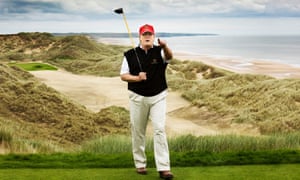
Trump at his golf course in Balmedie in 2011. Photograph: Murdo MacLeod for the Guardian
Deutsche has refused to discuss its lending arrangements to the first
family. Its clients also include Trump’s daughter Ivanka, her husband,
Jared Kushner, and Kushner’s mother, Seryl Stadtmauer. Kushner is a senior White House adviser.
Just before the US election Deutsche refinanced $370m he owes against
commercial property in Manhattan belonging to Kushner’s company.
Sources inside Deutsche say the investment banking side of the
business is entirely separate from the private bank that handles the
Trumps. Personal relationships also play an important role in private
banking.
Even so, banking experts have told the Guardian it is unusual for a
private bank to take on such loans, and unbelievable that a bank would
continue to deal with a man who had refused to pay his debt, and then
countersued using force majeure.
One former Deutsche employee, based in New York, said: “Real estate
refused to deal with him [Trump]. Only the private bank is willing to
accept personal guarantees.”
In the years since then, Deutsche Bank has been hit by scandal after scandal. It was fined more than $630m for failing to prevent $10bn of Russian money laundering – and has paid $7.2bn to settle a decade-old bond mis-selling scandal.
No wonder, then, that the bank that likes to say yes to Donald Trump
thought it best to have a proper review of its arrangements with him
following his unexpected win in the US presidential election.
Deutsche has carried out a close internal examination into its
lending to the president. The aim: to see if there were suspicious and
potentially embarrassing connections to Vladimir Putin’s Russia.
The
review began last year, when Trump became a politically exposed person
(PEP). In recent weeks Deutsche has fielded numerous calls from the
media on a possible financial trail to Moscow.
The examination failed to find any evidence of this, according to a
person familiar with the matter. Deutsche’s links to Russia have been
under the spotlight since a money laundering scheme was exposed last
summer by the New Yorker magazine.
The “mirror trades” scandal saw Deutsche brokers in Moscow buy stocks
in roubles on behalf of a Russian company. Simultaneously another firm,
registered offshore, would sell the same amount of stock in dollars,
pounds or euros. The scam allowed the bank’s Russian clients to turn
money in roubles, much of it dubious, into dollars abroad.
The scheme’s alleged mastermind was Tim Wiswell, an American trader
subsequently fired by Deutsche. According to an FCA report Wiswell, who
was head of the Russian equities desk in Moscow, received about $3.8m in
bribes via his girlfriend. These were paid into offshore accounts in
Cyprus and the British Virgin Islands.
Deutsche has not identified the Russian customers who used the scheme. Wiswell’s lawyer, Ekaterina Dukhina, refused to comment. Under
its former CEO, Josef Ackermann, Deutsche Bank developed close
connections with the Russian state. In 2006 Deutsche’s Moscow branch
hired Andrei Kostyn, the son of Andrey Kostyn, the head of VTB, Russia’s
state bank. Kostyn Jr generated much of the bank’s Moscow profits until
his death in 2011 in a snowmobile crash. Deutsche carried out an
internal investigation into the “mirror trades” scandal codenamed
Project Square. The bank scaled down its Moscow activities and
transferred some clients to VTB.
To what extent – if any – was Deutsche’s Moscow operation compromised? Did the clients have Kremlin connections? We don’t know.
Meanwhile, Democrats are piling on the pressure.
Joe Crowley, chair of the House Democratic Caucus, said: “President
Trump’s web of global financial entanglements are of serious concern.
When a foreign-owned bank that is under investigation by the Department
of Justice holds hundreds of millions in personally-guaranteed debt for
the president, that is problematic for ethical, diplomatic, and judicial
reasons. This is why we must know more about all of Donald Trump’s
business ties.”
Crowley also said he wanted the president to release his elusive tax returns.
Deutsche has not explained why it continued to bankroll Trump and his
real estate deals. Even before the 2008 legal dispute, Trump’s
chequered business record was infamous. Other financial houses in New
York refused to give him credit, following a string of failed ventures
including an airline and a casino empire in Atlantic City.
Bloomberg reported that Deutsche was now trying to restructure Trump’s $300m debt, which is guaranteed by four of his properties. The
difficulty is obvious: conflict of interest. The president owes the
bank money. At the same time the Trump administration and its Department
of Justice is investigating Deutsche over its Russian money laundering
scheme.
Trump remains the bank’s most high-profile client. He is also, increasingly, its biggest PR headache. Additional reporting by David Pegg


No comments:
Post a Comment