Contemporary politics,local and international current affairs, science, music and extracts from the Queensland Newspaper "THE WORKER" documenting the proud history of the Labour Movement.
MAHATMA GANDHI ~ Truth never damages a cause that is just.
Thursday, 6 April 2017
Climate change impacting ‘most’ species on Earth, even down to their genomes
Three recent studies point to just how broad, bizarre, and
potentially devastating climate change is to life on Earth. And we’ve
only seen one degree Celsius of warming so far.
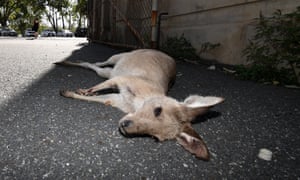
A female kangaroo lies dead after she was hit by a car while moving to
higher ground away from floodwaters in Rockhampton, Tuesday, April 4,
2017.
Flood waters are expected to hit levels not seen in 60 years.
Climate change is intensifying extreme weather events such as these as
well as making them hit more frequently. Such events, as well as other
climate impacts, are forcing animals to move around the world, often
resulting in population decline and local extinction.
Photograph: Dan Peled/AAP
Climate change is rapidly becoming a crisis that defies hyperbole.
For all the sound and fury of climate change denialists,
self-deluding politicians and a very bewildered global public, the
science behind climate change is rock solid while the impacts – observed
on every ecosystem on the planet – are occurring faster in many parts
of the world than even the most gloomy scientists predicted.
Given all this, it’s logical to assume life on Earth – the millions
of species that cohabitate our little ball of rock in space – would be
impacted. But it still feels unnerving to discover that this is no
longer about just polar bears; it’s not only coral reefs and sea turtles
or pikas and penguins; it about practically everything – including us.
Three recent studies have illustrated just how widespread climate change’s effect on life on our planet has already become.
“It is reasonable to suggest that most species on Earth have been
impacted by climate change in some way or another,” said Bret Scheffers
with the University of Florida. “Some species are negatively impacted
and some species positively impacted.”
Scheffers is the lead author of a landmark Science study
from last year that found that current warming (just one degree
Celisus) has already left a discernible mark on 77 of 94 different
ecological processes, including species’ genetics, seasonal responses,
overall distribution, and even morphology – i.e. physical traits
including body size and shape.
Woodland salamanders are shrinking in the Appalachian Mountains; the
long-billed, Arctic-breeding red knot is producing smaller young with
less impressive bills leading to survival difficulties. Marmot and
martens in the Americas are getting bigger off of longer growing seasons
produce more foodstuffs, while the alpine chipmunks of Yellowstone
National Park have actually seen the shape of their skulls change due to
climate pressure.
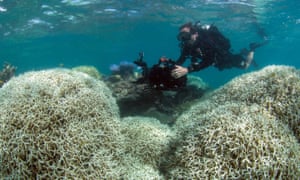
A photo from the XL Catlin Seaview Survey on March 21,
2016 shows a diver filming a reef affected by bleaching off Lizard
Island in the Great Barrier Reef. Rising temperature have caused an
epidemic of bleaching across the Great Barrier Reef. Photograph:
AFP/Getty Images
Life is proving just as strange under our new climate regime when it
comes to genetics. Pink salmon genetics are evolving for earlier
migrations – with fewer salmon encoding their genes for earlier
migrations. In making its way north, the southern flying squirrel has
begun hybridising with the northern flying squirrel. The water flea has
seen its genetics change over just a few decades to respond to higher
water temperatures.
But the fact that so many species are undergoing genetic changes
doesn’t mean they are successfully adapting to our warmer world.
“In many instances genetic diversity is being lost due to climate
change, not just in nature but also in resources that human’s depend on
such as crops and timber,” Scheffers said. “It is important to not
confuse species responses and adaptation as an indicator that everything
will be okay.”
Scheffers and his colleagues’ findings are furthered by a study
in Nature Climate Change this February that found that 47 percent of
land mammals and 23 percent of birds have already suffered negative
impacts form climate change. In all, nearly 700 species in just these
two groups are flagging under climate change, according to this
research.
“There has been a massive under-reporting of these impacts,”
co-author James Watson with the University of Queensland said in a press
release, pointing out that the IUCN Red List only considers seven
percent of mammals and four percent of birds as threatened by climate
change and severe weather. The IUCN often drags behind the latest
science – many species wait decades for an update while most species on
Earth have never been evaluated.
In worst-case scenarios, species are simply vanishing.
A third study
– this one in PLOS Biology – found that more than 450 plants and
animals have undergone local extinctions due to climate change. Local
extinction, as its name implies, doesn’t mean the species are gone for
good, but that they vanish from a portion of their range. For example,
the barren ground shrew has seen its range constrict aggressively as its
tundra home warms.
“If global warming continues, species that cannot change or move
quickly enough may go globally extinct,” the study’s author, John Wiens
with the University of Arizona, said.
Such global extinctions have already happened. Last year, scientists discovered
that the Bramble Cay melomys – an Australian rat-like rodent – went
extinct recently (it was last seen in 2007) due to rising seas
inundating its tiny coral island.
It’s the first mammal confirmed to be pushed to extinction entirely
due to climate change – or one could say our fossil fuel addiction.
Wiens’ study also found that local extinctions were happening more in
the tropics than in temperate areas. This is worrying since the tropics
hold the vast bulk of the world’s biodiversity, with many tropic
species still unstudied and even undiscovered by scientists.
But changes are rippling even beyond single extinctions.
“We now have evidence that entire ecosystems, some the size of entire
states within the USA, are changing in response to climate change,”
said Scheffers. He pointed to kelp forests that he said “are dying” and
being replaced by rocky, less-productive ecosystems.
Made up of giant brown algae, kelp as tall as trees provide essential
nurseries for fish, protect coastlines against worsening storm surges,
store vast amounts of carbon, and provide homes for species like sea
otters. But warming waters combined with ocean acidification is taking its toll.
And
Scheffers expects more “ecosystem shifts,” as scientists describe them,
in the future. Cloud forests are at risk of becoming high altitude
grasslands, coral reefs of becoming algal-dominated ecosystems, and
Arctic sea ice – open ocean.
“Given what we are seeing now, just imagine what will happen to all
these species when temperatures increase by four of five times that
amount,” said Wiens.
If global society doesn’t kick its fossil fuel addiction – and quick –
scientists estimate that temperatures could rise 4-5 degrees Celsius by
the end of the century. Such a rise would be not so much catastrophic,
but apocalyptic.
“One thing that is certain is that this global response to climate
change points to an increasingly unpredictable future for humans,”
Scheffers said.
More than half of the world’s humans today live in cities – but that
won’t make any of us immune to the changes going on in nature. According
to Scheffer’s research, humans will see a drop in productivity of
various crops or timber species, a drastic loss in marine fisheries, a
potential rise in new diseases as well as disease spreading to places
they’d never been before. Meanwhile, declines in coral reefs, kelp
forests and mangroves could lead to more lives lost in climate-fueled
storms. Loss of global biodiversity will also have knock-on effects in
societies around the world, from less productive ecosystems to impacts
we simply can’t predict today.
“I was not surprised,” Scheffers said of his research. “But I was
alarmed. The extent of impacts is vast and has impacted every ecosystem
on the Earth.”
Is all this alarmist? Sure. But it’s high time we set off the alarms –
they should have started ringing in the 1980s and been deafening by the
early 1990s.
Does all this imply nothing can be done? Of course not.
“Governments and large organisation can invest and commit to reducing
carbon emissions and protecting natural ecosystems that increase
resilience to climate change not only for nature but for people as
well,” Scheffers said. “These include large areas of connected forests
which cool local and regional climate, pristine coral and oyster reefs
that not only provide food but reduce storm surges, and well managed
watersheds that will maintain adequate fresh water.”
Wiens agreed, but added that “there also needs to be more, bolder,
large-scale efforts to reduce the carbon that is already in the
atmosphere.”
A number of companies have already produced technologies that do just
that: they pull carbon out of the atmosphere. But to date, lack of
money and support have delayed rolling out such devices en masse.
Meanwhile, the researchers agree that the Paris Agreement – the only
global agreement to tackle climate change – must be protected.
“Wisdom comes from combining truth with beliefs. There is a global
scientific consensus around climate change and its impacts on nature and
humans. It is truth that climate change will have devastating impacts
on human health and quality of life,” Scheffers said, noting that the
Trump Administration’s current flirtation with pulling out of the Paris Agreement “is not only an unwise decision but a dangerous decision.”

No comments:
Post a Comment