Contemporary politics,local and international current affairs, science, music and extracts from the Queensland Newspaper "THE WORKER" documenting the proud history of the Labour Movement.
MAHATMA GANDHI ~ Truth never damages a cause that is just.
Sunday, 6 May 2018
Two centuries on, Karl Marx feels more revolutionary than ever
From trainer fetishism to Facebook fever, it’s all there in The Communist Manifesto and Das Kapital
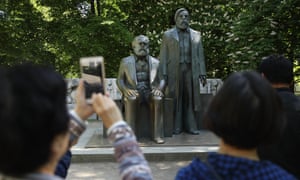
Communist front: statues of Marx (left) and Engels in a park in Berlin. Today is the bicentenary of Marx’s birth.
Photograph: Sean Gallup/Getty Images
The other day I stood at the grave of Karl Marx in Highgate cemetery in north London, wondering if he has anything say to us today, 200 years after his birth, on 5 May 1818. “Workers of all lands unite,”
reads the tombstone. But they haven’t – the solidarity of the
exploited, which Marx took to be necessary to end capitalism, scarcely
exists.
“What the bourgeoisie produces, above all, are its own gravediggers,” he and Friedrich Engels wrote 170 years ago in The Communist Manifesto.
“Its fall and the victory of the proletariat are equally inevitable.”
Not really: capitalism today is rampant. In the kind of historical irony
that the philosopher Hegel
called the cunning of reason, capitalism has even co-opted its
gravediggers to keep it alive: China, the world’s biggest socialist
society (if only ostensibly) supplies capitalist enterprises with cheap
labour that undercuts other workers around the world.
So is Marx finished? Not at all. For me, what makes Marx worth
reading now is not his Panglossian prognoses, but his still resonant
diagnoses. For instance, he and Engels foresaw how globalisation would
work. “In place of the old wants,” they wrote, “satisfied by the
production of the country, we find new wants, requiring for their
satisfaction the products of distant lands and climes.” That’s why
Chinese workers make products we never conceived would exist, let alone
that we would covet, and that would convert us into politically
quiescent, borderline sociopathic, sleepwalking narcissists. That’s
right – I’m talking about iPhones.
I find it hard to read the first few pages of The Communist Manifesto
without thinking that I live in the world he and Engels described.
“Constant revolutionising of production, uninterrupted disturbance of
all social conditions, everlasting uncertainty and agitation distinguish
the bourgeois epoch from all earlier ones.” We inhabit a world just
like that, only more intensely than Marx and Engels dared imagine. For
me, these words don’t just capture how Uber,
Deliveroo and the other virtuosos of the gig economy chip away at
values and standards to make a fast buck, but also how the planet is
relentlessly despoiled in order to satisfy tax-avoiding shareholders.
Consider, as the Marxist professor David Harvey did recently, São Paulo:
a city whose economic base is a car industry that produces vehicles
that spend hours in traffic jams, polluting streets and isolating
individuals from each other – a potent emblem of how free-market
economies are inimical to the real needs of real people.
Marx didn’t foresee Facebook, but he grasped the essentials of Mark Zuckerberg’s business model, certainly better than American senators did
at last month’s congressional hearings. “The bourgeoisie,” Marx and
Engels wrote, beautifully, “has left remaining no other nexus between
man and man than naked self- interest, than callous ‘cash payment’. It
has drowned the most heavenly ecstasies of religious fervour, of
chivalrous enthusiasm, of philistine sentimentalism, in the icy water of
egotistical calculation.”
Facebook, not to mention Amazon and Google, have made humans into exploitable assets. Which is some kind of genius.
Is this the most communist graveyard in the UK? – video
But it’s what Marx wrote in Das Kapital in 1867
on commodity fetishism that, I think, is most painfully relevant to us
today. By that term he meant how the ordinary things that workers
produce – iPads, cars, even the spate of new books
commemorating Marx’s 200th birthday – become, under capitalism,
bewitchingly strange. Just as in some religions an object invested with
supernatural powers becomes a fetish for those who worship it, so
commodities under capitalism are accorded magical powers.
"Marx didn’t foresee Facebook, but he grasped the essentials of Mark Zuckerberg’s business model"
When an iPhone is sold, it is exchanged for another commodity
(generally money). The exchange takes no account of the labour that went
into the iPhone’s making, still less the fact that some of Apple’s underpaid workers have contemplated suicide
in order to escape their lives manufacturing purportedly must-have
gizmos for you and me. “A commodity, therefore, is a mysterious thing
simply because in it the social character of men’s labour appears to
them as an objective character stamped upon the product of that labour,”
wrote Marx. György Lukács,
who profoundly influenced the Frankfurt School of thinkers, argued that
a new kind of human arises in a world where commodity fetishism is
rampant. Those new humans are so degraded that buying and selling is
their essence: I shop therefore I am. Instead of uniting to end
capitalism, we buy more shoes. When JD Sports announced a 24% rise in profits
last month, for me it felt less like good news for the ailing British
high street than footwear fetishism propping up the degrading system
that Lukács described. We’ve been took, as Malcolm X put it, in another context. We’ve been had.
In such a world it’s easy to collapse, as many of the Frankfurt
School did, into the philosophical quietism that drove Marx nuts. “The
philosophers,” he wrote in words also emblazoned on his tombstone, “have only interpreted the world in various ways; the point, however, is to change it.”
That remains the challenge. We need Marx to help us understand the
state we’re in, though that is only a prelude to the bigger struggle,
for which his writings are less helpful: namely, how to get out of it.

No comments:
Post a Comment