Thursday, 5 November 2015

Reducing carbon emissions now will safeguard Australian way of life – report

Extract from The Guardian

CSIRO study upends assumptions about domestic cost of tougher action on climate change, finding reducing emissions a ‘win-win’ for environment and economy
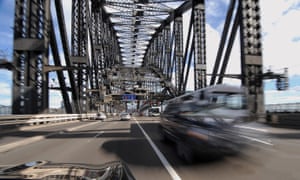
Cars travel over the Sydney Harbour Bridge
Australia has the chance to combine strong growth and a strong environmental performance without any major shift in the attitude of its citizens to consumerism, according to a new CSIRO study. Photograph: Bloomberg/Bloomberg via Getty Images

Australia can have stronger economic growth, much lower greenhouse gas emissions and a better environment – without individuals needing to make major lifestyle changes – if politicians take tougher action to reduce greenhouse emissions now, ground-breaking new modelling has found.
The CSIRO Australian National Outlook study upends traditional assumptions about the domestic impact of taking part in strong international action on climate change, finding that ambitious global action opens a possible “win-win” outcome for Australia even in the near term.
The dramatic rethink occurs because storing carbon through reforestation and other land use changes becomes a more profitable revenue earner than some existing farming, providing income that more than makes up for reduced fossil fuel exports or the costs of Australia meeting its own deeper greenhouse gas reductions.
“These win-win outcomes occur because carbon sequestration becomes more profitable than beef and other agricultural production across large areas of Australia (up to 58m hectares) ... in a world taking stronger action to reduce emissions,” 17 academics associated with the study explain in an article in the prestigious international journal Nature.
“Stronger abatement incentives also promote electrification and the use of biofuels in road transport, reducing oil imports. These economic gains outweigh the costs of more stringent national emissions targets, as well as the impacts of lower global demand for (and value added from) Australia’s emissions-intensive exports, relative to moderate national and global abatement.”
A team of 40 researchers from CSIRO have integrated modelling of global economic demand and climate policy ambition with possible Australian government policy choices on climate, water, energy use and agricultural land use as well as individual choices about working hours and consumption, to look at possible scenarios for Australia’s economic and environmental future out to 2050.
They conclude that government choices will make the biggest difference, and Australia has the chance to combine strong growth and a strong environmental performance without any major shift in the attitude of its citizens to consumerism, and without any startling new technological developments.
“Decoupling economic growth from environmental pressure before 2050 would not require a change in societal values, but is not automatic ... It is not projected to occur under existing trends, and requires, in our scenarios, collective choices to increase global and national abatement efforts,” the study finds.
The research shows that it would be in Australia’s best interests to push for much tougher global climate action and to build a higher effective carbon price into its domestic calculations than is currently the case.
It considers a moderately ambitious scenario where Australia starts with an effective carbon price of US$15 per tonne this year, a “strong scenario” with a starting carbon price of US$30, and a “very strong” scenario with a starting price of US$50 a tonne. The Coalition’s “Direct Action” policy has bought some greenhouse abatement for around A$15 a tonne, about US$10 at the current exchange rate.
“Across all scenarios analysed, we found that those scenarios where Australia and the world take stronger action to reduce greenhouse gas emissions show higher long-term economic growth and better environmental outcomes compared to scenarios that continue current trends,” the study found.
In the Australian debate, higher effective carbon prices have been rejected because of the potential impact on household electricity bills. According to the CSIRO research, household electricity bills would be 11% to 12% higher by 2050 under the “strong” scenario or 32% higher under the “very strong scenario” compared with no policy action. But it argues affordability would be about the same because households would enjoy higher incomes and energy efficiency would improve.
The win-win scenarios occur when government policy unlocks emissions reductions across all sectors – with electricity, industrial emissions and transport delivering 40% to 75% of cost-effective national abatement by 2050 and land-based carbon storage (or sequestration) supplying 30% to 40% of total abatement in the “strong” and “very strong” scenarios. The study says reforestation becomes attractive under an effective carbon price of $A40 to $60, which Australia would reach by 2020 with very strong global abatement (on track to 2°C) and before 2030 in the strong global abatement scenarios.
“Stable and predictable policy settings are also required, as to be effective in reducing emissions carbon plantings must be maintained for a 100 years or more,” the study finds.
Direct Action originally required 100-year pledges for carbon sequestration projects but has since reduced that to 25 years for soil carbon. Many business groups expect Direct Action to be modified when the Turnbull government conducts a review in 2017, after the next federal election.
The study measures the importance of carbon capture and storage technology to the long-term future of coal in global electricity generation – predicting it would increase by between 10% and 51% by 2050 if CCS is available and fall by between 7% and 63% if it is not. 

Tuesday, 3 November 2015

Australia must help Pacific islands at Paris climate summit, says PNG leader

Extract from The Guardian

The region’s largest economic power should push hard for a deal to help the Pacific islands at the summit beginning on 30 November, says Peter O’Neill
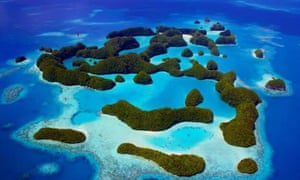
Palau’s Rock Islands in the tiny Pacific nation of Palau. Climate change could render low-lying coastal areas unliveable, driving forced migration of populations.
Palau’s Rock Islands in the tiny Pacific nation of Palau. Climate change could render low-lying coastal areas unliveable, driving forced migration of populations. Photograph: Matt Rand/AFP/Getty Images

Papua New Guinea’s prime minister Peter O’Neill has urged Australia to be an advocate for the Pacific in pushing for a strong agreement at this month’s worldwide climate change talks in Paris.
The governments of more than 190 nations will meet at COP21 in the French capital, beginning on 30 November, to discuss a new global climate accord.
O’Neill and other Pacific leaders – whose countries are already experiencing the impacts of climate change – are preparing to vigorously prosecute their concerns on global climate action in Paris.
But as the largest economy in the region, Australia must also lend its authority to the position of the Pacific islands, O’Neill argued.
“(Climate change) is a huge challenge for Pacific Island nations,” O’Neill said in Port Moresby on Monday. “We are hoping that Australia will take a leadership role in stating our position to the global community.”
The PNG leader asked that the world recognise the impact of climate change on the Pacific was not simply economic, but existential.
“I think Pacific islanders are not really looking for a financial reward,” he said. “We are looking to make sure the international community can assist in the resettlement exercise and rebuilding some of the communities.”
Climate change is likely to be a massive driver of forced migration over the next century, as densely populated, low-lying areas become unliveable because of rising sea levels, inundation, and salinity.
Nasa satellite data suggests a sea level rise of 90 centimetres or more is unavoidable over the next 100 to 200 years.
More than 150 million people, most of them in Asia, live within one metre of the current sea level.
And while rising seas will have “profound impacts” around the world, Nasa earth science division director Michael Freilich said this year, those impacts will be acutely felt in the low-lying Pacific.
“It may entirely eliminate some Pacific island nations,” he said.
The comments came as Labor leader Bill Shorten, shadow foreign minister Tanya Plibersek and shadow immigration minister Richard Marles, met O’Neill in Port Moresby on Monday.
Shorten said Australia needed a “credible” position on its own emissions in order to be an effective advocate at Paris.
“The message I’m already getting loud and clear is that climate change is a first order issue for our neighbours and we need ... Australia to have serious policies, credible policies which will help to contribute to mitigating the effects of climate change in our region.”
The government’s minister for international development and the Pacific, Steve Ciobo, is also in the region this week, visiting New Caledonia, Fiji, and Niue.
Australia recognises climate change is a critical issue for our region, with significant potential to impact prospects for economic growth and stability. We are working with Pacific Island countries on resilience measures through the Green Climate Fund and our regional aid program.”
Nations across the Pacific are already experiencing the effects of climate change, compounded this southern hemisphere summer by a severe El Nino weather pattern.
At the Pacific Islands Forum in September, smaller island countries pushed for a goal of limiting global warming to 1.5 degrees, instead of the international aim of 2 degrees.
Australia and New Zealand refused to back the lower goal but agreed to let the islands take their position separately to Paris.

Monday, 2 November 2015

Pacific islands make last-ditch plea to world before Paris climate change talks

Extract from The Guardian

‘Unless the world acts decisively in coming weeks, the Pacific as we know it is doomed,’ says Fijian prime minister Frank Bainimarama
Tuvalu


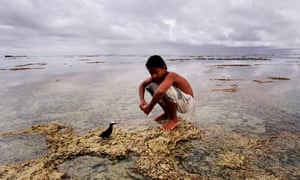
For low-lying Pacific islands the likely sea-level rise of a metre by the end of the century means coastal erosion, saltwater seeping into precious rainwater catchments and ruined crops. Photograph: Giora Dan/AAP


Amid the rustling palm trees, blissed newlyweds and colourful attire of a tropical island resort, Pacific leaders have been getting blunt with wealthy nations about the unfolding calamity of climate change that is gradually gnawing away their remote idylls.

"We in the Pacific are innocent bystanders in the greatest act of folly of any age"
Fiji prime minister, Frank Bainimarama

Ratu Inoke Kubuabola, Fiji’s foreign minister, said the country was dealing with the re-emergence of climate-influenced diseases such as typhoid, dengue fever, leptospirosis and diarrhoeal illnesses. Last year, a dengue outbreak in Fiji infected 20,000 people.
But the meeting also showed that Fiji, for one, is not pulling any more punches with large, industrialised nations it sees as culpable for climate change.
“We in the Pacific are innocent bystanders in the greatest act of folly of any age,” said Fijian prime minister Frank Bainimarama.
“Unless the world acts decisively in the coming weeks to begin addressing the greatest challenge of our age, then the Pacific, as we know it, is doomed.
“The industrialised nations putting the welfare of the entire planet at risk so that their economic growth is assured and their citizens can continue to enjoy lives of comparative ease. All at the expense of those of us in low-lying areas of the Pacific and the rest of the world.”
Bainimarama added that he has yet to see the “necessary political will” amongst wealthy nations to head off the worst impacts of climate change at the Paris talks.

These gloomy warnings are becoming grimly regular fodder for Pacific islanders to digest and, increasingly, experience first-hand.
“It’s an everyday issue here,” said Dr Karen Allen, Unicef’s representative in 14 Pacific nations. “Children here in the Pacific talk about climate change like children elsewhere talk about school or TV. It’s so routine.”
Media coverage of climate change in Fiji doesn’t have the luxury of wallowing in the sort of cosseted denialism seen in the US, Britain or Australia.
The lead story in the Fiji Times ​one day last week featured the tale of a seven-year-old child who drowned in an unprecedented high tide in the Namena district. A new FIJI$670,000 ($436,000) sea wall has been approved but the area’s commissioner, Meleti Bainimarama, conceded: “What we are doing is remedial action. I think the best thing to do is relocate the village, but it will come at a cost.”
The other front-page tale featured a man in the same village complaining how his house is regularly swamped by seawater that once lapped 20 metres from his front door. While wealthy nations mull over climate projections and agonise over potential dips in GDP, the stereotypically ebullient Pacific islanders aim to bring some steely reality to Paris.
“I won’t be going to Paris wearing the usual friendly, compliant Pacific smile,” warned Bainimarama. “In fact, I won’t be going to Paris in a Pacific frame of mind at all. I fear that our interests are about to be sacrificed.”
Previous UN climate change forums, where dreary jargon often pours treacle over any sense of urgency, have been enlivened by entreaties from Pacific island leaders. But Paris will see an escalation. Pacific islanders will be turning up in numbers – almost all leaders are expected to attend, unlike in Copenhagen in 2009 – and with a string of demands.

The latest, the Suva Declaration, calls for an end to new coalmines and a more ambitious limit to global warming. The language has sharpened beyond Fiji – Kiribati president Anote Tong recently called Australia, previously venerated as a benevolent protector in the Pacific, “selfish” for its continued enthusiasm for burning vast amounts of fossil fuels.
The cause for concern is clear – Nasa recently reported the world’s sea level has risen nearly 8cm since 1992, with the Pacific experiencing a more rapid increase than other oceans.
A rise of around a metre by the end of the century now looks likely. For low-lying islands in the Pacific, this means coastal erosion, saltwater seeping into precious rainwater catchments and ruined crops.
Meanwhile, rising temperatures will heighten the risk of diseases, including those carried by mosquitos. Cyclones are expected to become more severe. The World Health Organisation estimates climate change will cause around 250,000 deaths globally between 2030 and 2050.
At the Fiji summit, delegates wearing Sulu va Taga, a type of traditional kilt, and floral shirts spell out the problems and what must be done. Jarringly, the gathering is being held at a luxury resort on Denarau island, a manmade construction featuring manicured lawns, fountains and an 18-hole golf course, created through seabed dredging and reshaping of the coastline.
But the Pacific islands mean business. A lack of regional leadership from Australia – where senior government ministers apparently consider seawater inundation hilarious – is forcing Pacific islanders to set aside their reputation for gentle amiability in order to make themselves heard internationally.
“We don’t want to change the way we are but we need to change our approach so that when we say enough is enough, we are heard,” said Satini Tulaga Manuella, health minister of Tuvalu, which is comprised of nine scattered islands, none of which peak higher than 4.5m above sea level.

In March, Tuvalu was pummelled by Cyclone Pam, which washed huge waves over the atolls and ripped apart buildings with 350kmph winds. The dead were upturned from their resting place in cemeteries, crops were ruined, islands reshaped. Tuvalu, the fourth-smallest nation in the world at just 26 sqkm, caught a glimpse of what may cause its demise. But the government is determined the population will not migrate.
“People are worried but they want to stay, our priority is to save our country,” Manuella said. “We say if you save Tuvalu you save the world, because if you bring down emissions enough to save us, the rest of the world will be OK.
“Science is telling politicians in other countries what is happening. So why aren’t they listening? They have to look after their own people but they also have an obligation to the world. Imagine if a whole race, Tuvaluans, we have our own culture, our own ways, is made extinct overnight because we are hit by a cyclone.”
There’s recognition that the smaller of the Pacific islands face the brunt of climate change, even among those in Fiji who have had to move due to its impact.
In January last year, the Fijian village of Vunidogoloa had to relocate several kilometres inland because of the merciless advance of the sea. Saline intrusion was causing crops such as barley and cabbage to fail. The leaves on the trees were turning yellow from the salt. Children were no longer left to play unsupervised after a king tide washed away a young boy.
“We were most vulnerable at night because we didn’t know what was happening with the sea,” said Sailosi Ramatu, leader of the village. “Now people are happy, they can sleep at night. We have land that is higher up in Fiji but other countries don’t have that.”
The unfairness of islanders suffering the consequences of greenhouse gases they mostly didn’t emit is mirrored by the raw deal suffered by the women who form the cornerstone of family life in the Pacific.
The Fiji summit, hosted by the government and the UNFPA, focused on how to deal with the health and gender equity problems thrown up by climate change.
According to figures cited to delegates by Princess Sarah Zeid of Jordan, ambassador for the Every Woman Every Child program, women and children are 14 times more likely to die in a natural disaster than men.
“Cooking food, taking care of children, fetching water, taking care of livestock – climate change disrupts every element of a woman’s life,” said Zeid, who is the latest royal to lend stardust to the Pacific islands’ cause after Prince Albert of Monaco provided his backing, reportedly sinking a few cans of XXXX with aid workers at a recent call to arms in Kiribati.
“When climate impacts are rapid, the consequences for women and children are also severe,” said Zeid. “The greater the gender inequality, the greater the difference.”
As women in developing countries do the bulk of caring for children and elderly relatives, they are less likely to escape floods and cyclones. This was demonstrated by 2008’s cyclone Nargis in India, where most of the fatalities were women who held onto children while the men clung to coconut trees.
In the Pacific, there are a myriad of problems to work through – many health clinics are at risk from inundation and are inaccessible to those in remote areas. Delivery of maternal and reproductive health is patchy and the risk of sexual assault and abuse is heightened following disaster.
“In the Pacific, men surround their thatched homes and hold the poles together to keep their women and children safe inside during a cyclone,” said Unicef’s Allen. “The Pacific has the most incredible strong community spirit of anywhere in the world I’ve been.
“That makes it all the harder to face the reality of abuse. Because when your whole culture is built around how much you love and care for each other, it may be difficult to face the fact abuse is increasing.”
These challenges require money and Pacific islands are eyeing the $100bn in climate finance that has been repeatedly promised by wealthy nations. The Paris talks have left open the possibility of major help for adaptation, such as sea walls, new types of crops and relocated facilities, as well as a 1.5C, rather than 2C limit on warming.
But proposals for a facility to deal with people displaced by climate change, required because they do not fall under the UN refugee convention, have been dropped, to the dismay of Kiribati, which has purchased land in Fiji and has a “migration with dignity” policy, and the Marshall Islands, where residents of the famous Bikini atoll are currently looking to relocate to the US.
It’s a mixed picture that leaves Pacific leaders far from confident that this will finally be the year where their existential crisis triggers a response.
“We will see,” said Jone Usamate, Fiji’s health minister. “The world is a system – you do something at one end of the world and it has an impact at the other end.
“So we all need to be responsible but this is not our fault. Unfortunately, we are paying the price for it.”

NATS SHOULD PUT COUNTRY SCHOOLS BEFORE POLITICS

Media Release


Kate Ellis

Shadow Minister for Education
 Shadow Minister for Early Childhood

29 Oct 2015

Labor has today called on Nationals MPs and Senators to take a stand against the Liberals' cuts to regional, rural and remote schools.

Shadow Education Minister, Kate Ellis, has written to Nationals parliamentarians urging them to put their electorates first and political deals second.

Under Labor's Gonski reforms, 40 per cent of the additional investment was set to benefit country schools.

Instead, the Government's cuts will leave over 1.5 million country students more than $12.5 billion worse off over the next decade.

Even NSW Nationals Education Minister, Adrian Piccoli has conceded communities represented by the Nationals have the most at stake:

"Why was I the strongest advocate across all education ministers? I think it's because I'm the only National Party minister.Our electorates benefit the most." (ADRIAN PICCOLI - THE AUSTRALIAN - 14 JUNE 2014)

"On average, country students have lower Year 12 completion rates, score lower in NAPLAN and are up to 2 years behind their city peers in literacy, maths and science," Shadow Education Minister, Kate Ellis, said.

"Labor's Gonski reforms were designed to close this gap, but the Government has walked away from years five and six, as well as cutting $30 billion from schools over the next decade.

"Labor believes that every student - no matter where they live - deserves a great education.

"Country students need action now and deserve so much more than cuts from the Liberals and indifference from the Nationals.

"It's not too late for the Nationals to do the right thing and demand Malcolm Turnbull and the Liberals reverse their school cuts."

Kate Ellis, Subjects: Child care changes

Media Release


Kate Ellis

Shadow Minister for Education
 Shadow Minister for Early Childhood


E&OE TRANSCRIPT
DOORSTOP INTERVIEW
ADELAIDE
SUNDAY 1 NOVEMBER 2015


JOURNALIST: What do these changes mean for Australian mums and dads?

KATE ELLIS, SHADOW MINISTER FOR EARLY CHILDHOOD: Well what we know is that 21 months after the Government launched their child care review, and three child care Ministers later, we are still yet to see any firm child care policy from this Government. This is a government who said they would make child care more affordable, more accessible. Yet all we have seen is fees go up under this government, who have taken no action, except to cut a billion dollars from the child care support that families enjoy. We still know that this government is all about thought bubbles, they are not about serious policy.

We haven't seen a final policy from this Government, but the modelling that we have seen shows that even before today's statements, one in four Australian families would be significantly worse off under the Government's child care policy. It takes a certain amount of skill to spend an additional three and a half billion dollars to make hundreds of thousands of Australian families worse off when it comes to their child care fees.

What Australian families need is for the Government to actually provide some action on child care policy, not just keep changing ministers, changing policies, and not responding to any of the questions about the detail of the policy.

JOURNALIST: What specifically should they do?

ELLIS: Well we know that they need to outline how Australian families are going to be assisted by their action in child care policy. To date, we have seen announcements, yet we have not seen any of the detailed modelling. Let's be very clear, in the Government's Budget child care announcement, one in four Australian families will be significantly worse off despite the Government spending an extra $3.5 billion. Today we learn that they are taking action which may lead to more Australian families being worse off, yet what we are not seeing is any sense of fairness in the system.

JOURNALIST: Can you outline what sort of income thresholds you are talking about there in the one in four figure?

ELLIS: We know that this will significantly affect single-parent families and parents who might be casual workers, part-time workers. So we are talking about low and middle-income Australian families looking to be worse off as a result of this government's package. What we need from the Government is to outline specifically, clearly, how many families will be worse off as a result of their child care policy.

JOURNALIST: Do you take the view that $230,000 as a maximum figure as I read it, is generous, or too generous?

ELLIS: Oh look, we will certainly look at the detail of the Government's child care policy, if ever they choose to provide it. To date, they haven't. But what we do want them to answer is how many families will be worse off and by how much, and at what income are those families? Because whilst today they may be talking about families at the wealthier end, we know from modelling that has been released, that low and middle income families will also be hit hard as a result of the Government's changes.

ENDS

Tanya Plibersek, Subjects: Foreign aid; Amnesty report.

Media Release


commonwealthcoatofarms.png


THE HON TANYA PLIBERSEK MP
DEPUTY LEADER OF THE OPPOSITION
SHADOW MINISTER FOR FOREIGN AFFAIRS
AND INTERNATIONAL DEVELOPMENT
MEMBER FOR SYDNEY


E&OE TRANSCRIPT
TELEVISION INTERVIEW
ABC LATELINE
THURSDAY, 29 OCTOBER 2015


TONY JONES, PRESENTER: We approached the Foreign Minister Julie Bishop but she was unavailable for comment but for a different reaction to the cuts in foreign aid I was joined a short time ago from Cairns by Labor's Deputy Leader and Shadow Minister for Foreign Affairs, Tanya Plibersek. Tanya Plibersek thanks for being there.
TANYA PLIBERSEK, DEPUTY LEADER OF THE OPPOSITION: It's a pleasure.
JONES: Now, the Fred Hollows Foundation in Kenya lost $5 million, but Australian aid to Africa overall was cut by nearly $200 million. Would a Labor Government restore all of that?
PLIBERSEK: Well, we've already made an announcement that we would increase funding by $30 million a year to the Australian non-government cooperation program, which is the program that Fred Hollows was relying on for that $5 million. $5 million, obviously, makes a huge difference to an organisation like Fred Hollows. They're talking about 200,000 surgeries that they can't do because of this cut and we are determined to restore and increase - indeed, increase funding to the Australian non-government organisations that do such a great job in developing countries.
JONES: It sounds from what you're saying that you aren't committing to restoring the entire $200 million. Much of which was ramped up during a period when a Labor Government was seeking a seat on the UN Security Council. Are people right to be a bit cynical about that?
PLIBERSEK: Well, Tony I think it's impossible to restore in one go the $11 billion, over $11 billion that's been cut from the aid budget. To get to .5 per cent of our gross domestic product in aid funding, as we were on track to do when we were in government, would cost an extra 18 to $21 billion, depending on when we come back into government. It's impossible to do that in one go. The cuts have been so deep from this government that it will take us some time to fully restore the aid budget. But we know that this particular part of the aid budget, which has non-government organisations like Fred Hollows, like CARE Australia, Oxfam, Plan International, doing fantastic work, we get great value for money. We also see Australian citizens being able to donate to those organisations and then the co-funding of the government actually increases the effectiveness of the donations that individuals are making. It's a great way to really see value for money programs delivered across the globe, including in Africa.
JONES: One of the big problems you face is that even when Joe Hockey cut the largest chunk of that $7.6 billion in foreign aid out of his first Budget, opinion polls showed in a very unpopular Budget that was a popular measure. How do you turn around public perception about Australian Aid?
PLIBERSEK: Well, it's interesting, if you ask people how much they think we give in aid, they always overestimate how much Australia's giving in foreign aid. We in fact give a very modest amount. Our target, when we were in government, we almost got there, was .5 per cent of gross national income. We got - we doubled the aid budget when we were in government. We got almost to .5 per cent, but we're now back down at about .22. That means about 22 cents in every hundred dollars. If you asked people what they thought we were giving, you almost always get estimates of maybe 10 times that amount. So it's been popular, I guess, in an environment where people dramatically overestimate what we give. And they dramatically underestimate the value not just to the recipient countries but to Australia itself. If you look at a country, for example, like South Korea, where we were once an aid donor, it's now one of our major trading partners because a little bit of assistance when it was needed has helped build a very impressive economy in South Korea, where we've now got consumers buying Australian goods.
JONES:  Now, when the government cut African aid along with its other big aid cuts, it actually said it was doing that because it was refocusing on the Asia Pacific. Now, that's where you're heading in coming days. Are you going to be offering any guarantees to those Pacific nations about what a Labor Government would do in terms of increasing aid?
PLIBERSEK: Well, I can tell you, they said that they were going to focus on our region but we've seen $110 million cut from our region as well. And I was on a trip with the Foreign Minister Julie Bishop soon after those cuts were announced. Before it was made clear which countries would be hit by the cuts and she assured a number of Pacific leaders on that trip that their budgets, their aid budgets were safe. In fact, that's not been the case. Of course we think that it is important to focus on our region. We have a greater responsibility to people who are in the Pacific because they are near neighbours and because one of the huge challenges they face is the challenge of climate change, and Australians are some of the largest per capita emitters of carbon pollution in the world and our Pacific neighbours are really on the front line of climate change.
JONES: Could I just interrupt you there? On that point, how much damage did Peter Dutton's rather clumsy joke about the impact of global warming on pacific islands do to Australia's reputation?
PLIBERSEK: Well, it's one of the dumbest things I've ever seen an Australian public figure do. And these people are not - they're not worried about what will happen in future because of climate change. They are living it right now. They're seeing storm surges; they're seeing extreme weather events. They are actually making plans in some cases for whole populations to have to move from the countries that they call home, and the insensitivity of Peter Dutton's comment, it's frankly mind blowing and that's how Pacific leaders responded to it; they gave it all the treatment that it deserved.
JONES: Finally, the Amnesty International allegations, are you satisfied the Australian Government did not commit any criminal acts in its sovereign borders operations?
PLIBERSEK: Well, we have supported a Senate inquiry into these allegations. We do think obviously that the Australian Government has questions to answer about the - well, the legality of the actions that they've undertaken. I haven't had the chance to read the full report yet, so I will look forward to doing that, but the reason that we supported a Senate inquiry into suggestions that there had been improper behaviour is to shine a light on exactly what's been done and the legal status of what's been done.
JONES: Tanya Plibersek we’ll have to leave you there, thanks very much for joining us.
PLIBERSEK: Thank you, Tony.
ENDS

Labor says Australia must 'tell story of Pacific to world' at Paris climate talks

Extract from The Guardian

Climate change impact on Pacific nations is a focus for government and opposition ahead of COP21 where 190 nations will discuss a global climate accord
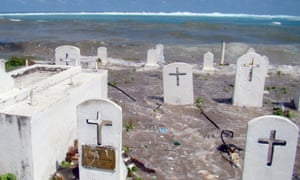
This 2008 photo shows a cemetery on the shoreline in Majuro Atoll being flooded from high tides and ocean surges in the low-lying Marshall Islands.
This 2008 photo shows a cemetery on the shoreline in Majuro Atoll being flooded from high tides and ocean surges in the low-lying Marshall Islands. Photograph: Giff Johnson/AFP/Getty Images

Australia should “tell the story of the Pacific to the world” when global leaders sit down to climate change talks in Paris at the end of this month, Labor has said.
The impact of climate change on the nations of the Pacific is a focus for both the government and opposition ahead of COP21, where governments of more than 190 nations will gather to discuss a possible new global climate accord.
The opposition leader, Bill Shorten, accompanied by foreign affairs spokeswoman Tanya Plibersek and immigration spokesman Richard Marles, will visit Papua New Guinea, the Marshall Islands, and Kiribati over four days this week, while the government’s minister for international development and the Pacific, Steve Ciobo, will travel to New Caledonia, Fiji and Niue.
The Labor leaders said climate change was an existential threat to some countries in the region.
“The dangerous consequences of climate change is no more evident than in the Pacific region. Pacific leaders have consistently identified climate change as the greatest threat to their livelihoods, food production, housing, security and wellbeing.
“This is a serious problem that demands serious attention.”
Marles, the former parliamentary secretary for Pacific island affairs, told Guardian Australia that it was important for Australia to have strong and constructive relations with its Pacific neighbours.
He praised Pacific leaders, in particular Kiribati’s president, Anote Tong, for highlighting the issues being faced by Pacific nations on the international stage.
“It is crucial that, in the lead-up to Paris, the world understands the problems being faced by the Pacific. And it’s important that Australia plays a role in telling that story of the Pacific to the world.”
Ciobo said in a statement that climate change, along with the linked areas of economic growth and trade, were key challenges for Australia’s relationship with the region.
“Australia recognises climate change is a critical issue for our region, with significant potential to impact prospects for economic growth and stability. We are working with Pacific island countries on resilience measures through the Green Climate Fund and our regional aid program.”
Australia’s relationship with the Pacific, especially over the issue of climate change, was damaged in September when the immigration minister, Peter Dutton, was picked up by a boom mic joking about climate change with then prime minister Tony Abbott.
Joking with Abbott about a meeting starting late, Dutton quipped it was running to “Cape York time”, to which Abbott replied: “We had a bit of that up in Port Moresby.”
Dutton replied: “Time doesn’t mean anything when you’re about to have water lapping at your door.”
Pacific leaders excoriated the minister. The Marshall Islands’ foreign minister, Tony de Brum, said he was “dismayed” by the “insensitivity ... [of] the big polluting island down south”. PNG prime minister Peter O’Neill said the comments were unfortunate, and Tong described the joke as “vulgar”.
“As long as there is this kind of attitude, this kind of arrogance in any position of leadership, we will continue to have a lot of tension,” Tong said.
The impacts of climate change are being felt acutely by Pacific nations, many of which are low-lying, remote, and with vulnerable infrastructure.
Eight Pacific nations are in the top 20 in the world of highest losses of gross domestic product (GDP) from natural disasters, the World Bank says.
Natural disasters – an average of 41 tropical cyclones hit the region each year – cost the Pacific islands two percent of their GDP annually.
The Marshall Islands and Kiribati are particularly vulnerable. The land mass of the Marshall Islands is less than five metres above sea level and 97% of Kiribati’s land mass is below that level.
Climate change effects are being exacerbated by a significant El Niño weather pattern in the southern hemisphere this summer, which has already caused widespread drought across the Pacific, and could threaten the lives and livelihoods of millions.
An estimated 2.4 million people could face food and water shortages in Papua New Guinea alone, the country’s national disaster centre has reported. Up to two dozen people have already died from hunger and drinking contaminated water.
In Fiji and Tonga, emergency water supplies are being shipped into remote areas.
“El Niño has the potential to trigger a regional humanitarian emergency and we estimate as many as 4.1 million people are at risk from water shortages, food insecurity and disease across the Pacific,” said Sune Gudnitz from the UN office for the coordination of humanitarian affairs.