Friday, 4 March 2016

US agency says it has beaten Elon Musk and Gates to holy grail of battery storage

Extract from The Guardian

Breakthrough in next generation of storage batteries could transform the US electrical grid within five to 10 years, says research agency, Arpa-E

Energy storage battery
Large-scale energy storage systems are needed to enable electricity companies to bring more solar and wind power on to the grid. Photograph: Jan Woitas/Corbis
A US government agency says it has attained the “holy grail” of energy – the next-generation system of battery storage, that has has been hotly pursued by the likes of Bill Gates and Elon Musk.
Advanced Research Projects Agency-Energy (Arpa-E) – a branch of the Department of Energy – says it achieved its breakthrough technology in seven years.
Ellen Williams, Arpa-E’s director, said: “I think we have reached some holy grails in batteries – just in the sense of demonstrating that we can create a totally new approach to battery technology, make it work, make it commercially viable, and get it out there to let it do its thing,”
If that’s the case, Arpa-E has come out ahead of Gates and Musk in the multi-billion-dollar race to build the next generation battery for power companies and home storage.
Arpa-E was founded in 2009 under Barack Obama’s economic recovery plan to fund early stage research into the generation and storage of energy.
Such projects, or so-called moonshots, were widely seen as too risky for regular investors, but – if they succeed – could potentially be game-changing.
Many of the projects fostered by the agency were already in sight of getting funding, Williams said. Several have now secured private sector follow-on funding. Others are being taken up by the State Department or the Pentagon, she said.
But the biggest breakthrough is in the area of energy storage. “I think that’s one area where we have delivered big time,” Williams told the Guardian.

The battery storage systems developed with Arpa-E’s support are on the verge of transforming America’s electrical grid, a transformation that could unfold within the next five to 10 years, Williams said.
The most promising developments are in the realm of large-scale energy storage systems, which electricity companies need to put in place to bring more solar and wind power on to the grid.
She said projects funded by Arpa-E had the potential to transform utility-scale storage, and expand the use of micro-grids by the military and for disaster relief. Projects were also developing faster and more efficient super conductors, and relying on new materials beyond current lithium-ion batteries.
The companies incubated at Arpa-E have developed new designs for batteries, and new chemistries, which are rapidly bringing down the costs of energy storage, she said.
“Our battery teams have developed new approaches to grid-scale batteries and moved them out,” Williams said. Three companies now have batteries on the market, selling grid-scale and back-up batteries. Half a dozen other companies are developing new batteries, she added.
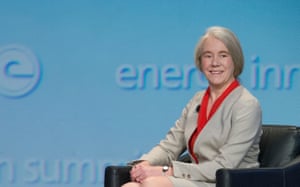
Dr Ellen Williams at the 2015 Arpa-E innovation summit.
Dr Ellen Williams at the 2015 Arpa-E innovation summit. Photograph: ARPA-E
Williams was speaking on the sidelines of Arpa-E’s annual gathering of researchers and investors this week.
Arpa-E has been upbeat in the past about emerging technologies. But researchers have struggled and failed to replicate such successes at greater scale and lower cost outside the research lab - a challenge Gates describes as the valley if death for innovation.
The agency, until now, has focused on funding early-stage research – turning projects around every three years – a faster clip than academia but still longer than private investors.
But Ernie Moniz, the energy secretary, said this week he was seeking to expand Arpa-E’s mission, in the light of a commitment from the US and 19 other governments on the sidelines of the Paris climate summit to double clean energy research funding over the next five years.
In a parallel initiative, Gates and two dozen other billionaires have committed to spend $2bn on energy research.
In addition to energy storage, the agency is backing researchers trying to find a faster system of tracing natural gas leaks – and so reduce the risks of a massive leak like the one just plugged in California.
Other Arpa-E backed researchers are using robots and drones to breed better biofuels, focusing on sorghum. Another team is responding to the risk of drought by working on industrial cooling systems that do not rely on water. Researchers are also working with the US military on low-energy air conditioning for battlefield conditions.
But Williams said she anticipates many more projects will focus on exercising more personal control of energy use, especially through the internet.
“We want power to be easy,” she said. “So I think one of the things that we will see in the next five to 10 years is a whole set of ideas about the internet of things start[ing] to develop in ways to make it easier, or even make it fun, for people to optimise their energy use.”


Thursday, 3 March 2016

Safe Schools LGBTI program workers receiving abuse, says union

 Extract from The Guardian

Australian Services Union says staff are ‘copping abuse and hate mail for their roles in delivering the support program’

Students work on computers
Workers delivering the Safe Schools Coalition’s anti-bullying program have been the target of abusive emails and hate mail, according to their union. Photograph: Alan Porritt/AAP
Workers delivering the Safe Schools Coalition anti-bullying program are receiving abusive emails, a union representing them has said.
The reports of frontline workers “copping abuse and hate mail for their roles in delivering the support program” were revealed by Australian Services Union South Australia and Northern Territory branch secretary Joseph Scales.
“We now have abusive behaviour perpetuated beyond the schoolyard and extended to the professionals and workers who are trying to combat just that,” he said.
The union represents workers in organisations such as Sexual Health Information Networking and Education in South Australia and the Foundation for Young Australians, which delivers the Safe Schools Coalition program nationally.
Scales told Guardian Australia the abusive material included Bible verses, threats of eternal damnation to those delivering the program and links to “vile” political speeches including George Christensen’s comments likening material linked to the anti-bullying program to predatory sexual grooming.
Scales said “there has been a significant increase in the last few months”. In that time the Safe Schools Coalition’s LGBTI support program has shot to national attention and been put under review by the federal government.
“When you look at it, it’s a concerted effort by those ideologically opposed to the program, rather than parents out in a school somewhere [where the program is taught] or any kind of community uprising against it,” he said.
“The current review being undertaken by the Turnbull government is a distressing criticism of a program which provides crucial support for an at risk community ... [The increase of abuse] is the very real consequence of the government’s narrative which constantly seeks to marginalise and isolate minority communities.”
Guardian Australia has previously reported that researchers behind the development of the Safe Schools program have also received abusive emails.
About 495 schools take part in the program, which is voluntary and entered into by schools after consultation with parents. Only one school has pulled out of the program as a result of parental pressure.
On Wednesday the federal education minister, Simon Birmingham, said “the objectives around Safe School are reasonable objectives to ensure the safety of children, to end bullying, to provide support to children who are struggling with issues”.
“But equally, there’s a fair question to be asked about the content of some of the resources produced and in some of the programs and we need to make sure that content is age appropriate, educationally sound and in line with the national curriculum and that’s exactly what the review I’ve commissioned will do,” he said.
On Thursday night the Greens LGBTI and marriage equality spokesman, Robert Simms, will table a petition with 35,000 signatures in favour of the Safe Schools program in the Senate. The petition by Cory Bernardi which created pressure to review the program had 9,500 signatures.
In a statement on Thursday the National Catholic Education Commission (NCEC) said a number of Catholic school authorities had deemed the Safe Schools Coalition’s material inappropriate for their schools.
A Catholic Education Commission NSW spokesman told Guardian Australia that was because the material “focuses very narrowly on sexuality” and was “incompatible with Catholic teaching which emphasises love, mutual respect and personal dignity”.
The executive director of NCEC, Ross Fox, said “Catholic schools are committed to eliminating bullying where it is occurring for whatever reason and in whatever form”.
Fox welcomed the review to consider the question of “whether government-funded material goes beyond the original purpose of the program, which was to support teachers and school communities to address bullying”.
“I believe the reservations expressed about the program material are widely shared by parents, teachers and school leaders,” he said.
A Catholic school in Sydney cancelled a visit by young adult fiction author Will Kostakis after he came out as gay.
According to a post on Kostakis’ blog the school told him it would be inappropriate to promote his new book The Sidekicks because the school was Catholic and “parents might not be happy”. Kostakis had spoken at the school about an earlier novel which featured a gay character coming to terms with his sexual identity and engaging in casual sex.
Kostakis came out as gay in a post in February after an ex-boyfriend was diagnosed with cancer.
In a reply to the school, Kostakis asked why the school had previously allowed him to promote a novel which dealt with queerness but now told him the new novel was inappropriate after his blog post “saying I like men”.
Kostakis explained that the ability to read texts championing diversity when he was a student had made him feel less of an outsider and safe, despite not being out.
“Some people were uncomfortable reading about two boys kissing, but it prompted discussion and working through prejudice,” he said.

No, we don't need income tax cuts

Opinion
Posted about 6 hours ago
It has become accepted wisdom in political circles that income taxes should be cut, but the truth is there isn't really an economic case to be made for such a move, writes Ben Oquist.
While a lively debate has raged over recent months about the inequity of reducing progressive income taxes in favour of a regressive GST increase, less time has been spent discussing whether reducing income tax, the proposed sweetener, is economically desirable.
While the public popularity of cutting income taxes is obvious, the economic arguments are thin on the ground.
It has become accepted wisdom in political circles that income taxes should be cut. Marginal tax rates are increasing and something needs to be done about bracket creep is the mantra.
Both the Government and Labor seem likely to offer personal income tax cuts to the electorate at the 2016 election. The Government may announce some in the budget or before and Labor has quietly been collecting revenue in a series of announcements that leaves them scope to also offer tax cuts.
The bracket creep drum beat has been going on for so long that both sides feel compelled to offer something.
The extra revenue from an increase in the GST is off the table, but the associated bracket creep scare campaign has done its job so well that the politicians feel they must deliver a cut. Regardless of the fact that the extra GST revenue is not there anymore, politics demands it.
But it doesn't have to be this way.
The economic case for personal income tax cuts collapsed with the GST. The real significance of the modelling released by the Treasurer was not that the increase in the GST didn't deliver growth (it's actually a drag on growth), but rather that tax cuts that would be associated with it delivered so little. With the GST revenue no longer available, any tax cuts on offer will now be even smaller, as Mr Morrison has told us. Ipso facto the growth dividend will be even smaller.
So if the growth dividend isn't there, what is the argument from Government that income tax cuts are needed?
For the Government to give tax cuts at a time when the deficit is about as big as it was under Labor would be a complete betrayal of the debt and deficit mantra of Deputy PM Barnaby Joyce. They simply can't have it both ways.
While much has been made of further bracket creep projections, all scenarios start with the current tax rates. Why not instead look at the past 10-15 years? Over that time the tax free threshold and the income level at which the top marginal tax rate kicks in have tripled.
If the tax free threshold had increased just at the rate to cover bracket creep since 2003 it would be $8,223 not the current rate of $18,200. This means that Australians have been more than compensated for bracket creep.
And at the top end? If the top rate had increased at the rate of the inflation it would only be $82,225, not $180,000. For all the railing about Australia's top marginal tax rate, only 3 per cent of workers are in it. In 2003 under John Howard, 15 per cent of the workforce paid the top rate.
Most Australians don't want a low wage, low tax society and all that comes with it. The richer a society the more prosperous it is and the higher the amount of tax that is generally needed. It is the price of civilisation.

Taxes have been slashed. And they were slashed at the height of the mining rivers of gold. If those arguing we have a debt and deficit problem really believed it, they would be agitating against income tax cuts. Instead the shock jocks plough on with their bracket creep scare campaign.
The reality is that Costello's unaffordable tax cuts backed by Rudd have more than offset bracket creep for many years to come.
So of course the reason for offering tax cuts is political. People want tax cuts and if one side offers them, the other side must match them. This is the standard political wisdom.
But it doesn't have to be this way. I don't think there is a clamour for tax cuts from the general public right now. There is in fact a new accepted understanding that there is a revenue problem, that services and infrastructure need to be built.
Of course if you offer a free ice cream to a child they will take it. But if you asked the child's parent would you be willing to pay for this ice cream so I can buy the ingredients to make some more and pay for the petrol to drive back the next day so there will be more ice cream tomorrow, the parent would no doubt agree to pay a reasonable price for the ice cream.
Well I think the public are like those parents willing to pay a bit more to build better schools, hospitals and makes our cities liveable and loveable.
We now know that moving the second highest marginal tax rate threshold from $80,000 to $100,000 would give a much bigger benefit to those on larger incomes. Those on $80,000 or less get nothing. When the median wage for full time workers is $69,000 and even less if part time workers are included, this type of tax rate change could only be described as unfair.
Treasury modelling showed a very low effect on labour supply and GDP because of reduced tax rates. But even if you accept there is a link, most economists would suggest it is much stronger when it relates to people deciding to go back to work and use childcare.
Women are more likely to be working part time. Few of these are likely to be earning more than $80,000. The economic case for such tax cuts is threadbare compared to the return on investing in alternatives like cheaper childcare and the better labour supply and growth dividend it would deliver.
Most Australians don't want a low wage, low tax society and all that comes with it. The richer a society the more prosperous it is and the higher the amount of tax that is generally needed. It is the price of civilisation.
There are big economic reform issues - participation, long term unemployment, education, heath, infrastructure, investment in liveable cities, energy transformation, building a dynamic start-up culture, the economic opportunities from protecting landscape and wildlife. Cutting income taxes just isn't one of them. It would be a shame if too much of our election year debate was taken up with discussing them. Best get them off the table so we can get on to the smorgasbord of better ideas.
Ben Oquist is the executive director of The Australia Institute. Follow him on Twitter @BenOquist

Wednesday, 2 March 2016

Malcolm Turnbull refers leak to the Australian to federal police

Extract from The Guardian

Tony Abbott quoted in story which contained leaks from a classified document that claimed acquisition of new submarines was delayed after leadership change

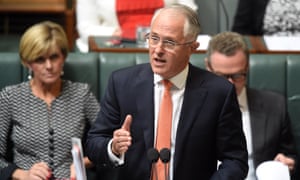
Malcolm Turnbull in question time
Malcolm Turnbull in question time on Wednesday. The Australian’s Greg Sheridan obtained the draft white paper ‘produced’ under Tony Abbott. Photograph: Lukas Coch/AAP
The Turnbull government has referred the leak of the draft white paper to the Australian federal police after the Australian published a story that claims the date of the acquisition of new submarines was delayed after the leadership change.
“I can confirm that the secretary of the department of defence has advised me that he has initiated an investigation which will obviously be conducted by the Australian federal police into the apparent leak of these classified documents that were referred to in the newspaper,” Turnbull told question time.
On Wednesday, the Australian’s Greg Sheridan obtained the draft white paper “produced” under Tony Abbott and the former defence minister Kevin Andrews.
Confirming the story’s central claim, Abbott is also quoted saying: “I’m not just disappointed, I’m flabbergasted at the decision.”
But the former prime minister’s claim is under question because, on Tuesday, the day before the story was published, the Australian Defence Force chief, Mark Binskin, was asked at a media briefing whether the submarine acquisition had been delayed.
Binskin replied: “No, no, not at all. No.”
Sheridan told Sky News that the source for the documents was not Abbott.
“Look I can say this much to you about the source, the source wasn’t Tony Abbott,” Sheridan. “I went to Tony Abbott with my information and interviewed him on the record and as he says, what he says is on the record. So he spoke to me on the record.”
On Wednesday morning, the leader of the government in the house, Christopher Pyne, said the government took the leak very seriously.
“There are no more classified documents than ones that are in the national security committee and therefore the government will take this leak to the Australian very seriously,” Pyne told Adelaide radio.
Asked whether Abbott was “off the leash and leaking like a crazy person”, Pyne said he would not “describe him that way”.
“The public want Malcolm Turnbull to succeed,” Pyne said. “Because they know that we are in an economic transition and they believe that the Coalition is the best party to manage that transition.”
Pyne said the story was confused as the acquisition of the 12 submarines was on the same timeframe as previously – the change referred to the operation of the submarines, based on defence department advice.
“We take the best advice on defence and drafts are draft documents, obviously they’re drafts, they’re not supposed to be the final document,” Pyne said.
“Whatever happened between the draft and the final document would have happened on the basis of advice from defence.
“The acquisition of the subs happened at exactly the same time as it’s always planned. The subs being in the waters and starting their operations appear to have been pushed back a couple of years, certainly not 10 years.”
Labor asked if Abbott was right to suggest the Australia needed new submarines in the middle of next decade.
Turnbull underlined the submarine delivery date was dependent on the competitive evaluation process.
Defence minister, Marise Payne, said the defence department had advised an extension of life for the Collins class submarines was “feasible and practical”.
“The Defence White paper reflects exactly that advice,” Payne said.
“There is no delay in the build of the future submarines.”
Payne said although the new submarines were recommended under the Labor government in 2009 and “Labor did nothing”.
The submarine bid has been a long and tortured process. The need for 12 new submarines was first proposed in a defence white paper in 2009. A 2013 Defence White paper again recommended the existing Collins class submarines were replaced.
In its election policy, the Coalition promised to build the subs in South Australia but after he came to government, Abbott appeared to favour construction by Japan. Former treasurer Joe Hockey said in late 2013 there was no time for an open tender because Australia needed the submarines by 2026 when the first Collins class submarines were decommissioned.
After Abbott’s leadership came under pressure in February last year, he promised South Australian senator Sean Edwards the government would have a full and open tender. 

Tony Abbott reborn as Rudd 2.0 as Turnbull's worst nightmare comes to pass

 Extract from The Guardian

Tony Abbott’s previous interventions pale in comparison with his contributions to a story in the Australian

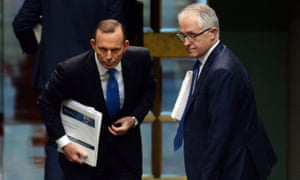
Tony Abbott and Malcolm Turnbull
Tony Abbott and Malcolm Turnbull. The Australian’s Greg Sheridan obtained the draft defence white paper produced under Tony Abbott. Photograph: Sam Mooy/AAP
Senior government ministers are openly comparing the leaking and undermining of Malcolm Turnbull to the campaign waged against Julia Gillard during the 2010 election after she ousted Kevin Rudd. The latest astonishing – and possibly inaccurate – leak has been referred to the Australian federal police.
It is obviously now up to the police to determine who did this leaking of classified defence documents. But Tony Abbott is quoted in the same article, penned in the Australian by his close friend Greg Sheridan, commenting on what the leak is purported to reveal.
For some time, the former prime minister’s occasional legacy-polishing international speeches have been escalating into more serious and frequent interventions.
Whether or not Abbott meant it last September when he said, “My pledge today is to make this change as easy as I can. There will be no wrecking, no undermining and no sniping. I’ve never leaked or backgrounded against anyone. And I certainly won’t start now”, it would appear either he, or his backers and supporters, aren’t taking that advice now.
This week Abbott had already publicly undermined the Turnbull government’s economic strategy – an intervention clad in politeness but highly damaging all the same – backing in the so-called backbench “revolt” that has, for some time, been trying to corral Malcolm Turnbull into repeating his predecessor’s rejected budget policy – focusing on deep cuts to health, welfare and education and abandoning any crackdown on tax loopholes predominantly used by the rich. Abbott has said he wears the 2014 budget as a “badge of honour”. The electorate would beg to differ.
Abbott has also called for the defunding of the Safe Schools program, because he says it is actually “social engineering”, despite it having been funded during his years as prime minister and despite it being a program Turnbull and his minister, Simon Birmingham, obviously intend to retain.
But those unhelpful interventions pale in comparison with Sheridan’s article, alleging that the Turnbull government’s defence white paper that was released last week had deferred by “almost a decade” Australia’s new submarines.
Sheridan’s assertion of the delay is backed by “several sections of the draft white paper” produced under Abbott and former defence minister Kevin Andrews, which he says he has “obtained”. Sheridan, of course, does not say who leaked him the sections of the draft white paper, documents that would have the highest security clearance. He has denied Abbott gave him the documents.
But he then quotes Abbott effectively confirming the alleged delay. “I’m not just disappointed, I’m flabbergasted at this decision,” he said.
It is unclear whether the “delay” allegation is in fact true because, before the story had even been published, the head of the defence force, air chief marshal Mark Binskin, had been asked whether any delay had occurred after the change of prime ministers and he said very vehemently this had not been the case. Turnbull told parliament defence had advised, since 2013, that it was “highly unlikely” the submarines would be delivered by the date the story claims they could have been delivered under the Abbott government plans.
The impact of the repeated interventions is obvious – to keep the Turnbull government unsteady and off balance – just as the Gillard government was. Caught short without a tax policy Turnbull and his ministers are already badly exposed to Labor’s attack. That’s their own fault.
But we’ve seen how it ends when governments are also subjected to constant undermining from their own side. 

Coalition's sugar-coated compliments mask attempt to revive bitterest budget

Extract from The Guardian

Malcolm Turnbull’s blank page on tax has allowed Tony Abbott to try to push the party back towards spending cuts
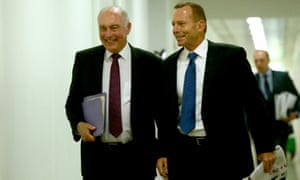
Warren Truss and Tony Abbott
Warren Truss and Tony Abbott arrive for the joint party room meeting, where the former prime minister urged Malcolm Turnbull to pay for tax cuts by cutting spending. Photograph: Mike Bowers for the Guardian
Tony Abbott has confirmed the obvious. The backbench “revolt” over the Coalition’s tax policy has really been about trying to corral Malcolm Turnbull into repeating his predecessor’s rejected budget policy.
Because of course if Turnbull goes along with the “revolters” and rejects options to reduce tax concessions for the very rich, he will be left with the only other way to pay for anything he wants to do, without increasing the budget deficit. Spending cuts.
Which is exactly what Abbott urged him to do in the party room on Tuesday – in a sugar-coated exchange in which Abbott espoused Turnbull’s “brilliance” in attacking Labor’s negative gearing cuts – and then said that was exactly why the government should not be introducing any of its own. That and the “truisms” that “we don’t have a revenue problem, we have a spending problem” and “you can’t cut taxes by raising them”. (You can obviously cut personal income taxes by reducing loopholes and tax concessions but no one seems to have mentioned that)
Since defence spending has just been quarantined – for better or for worse – the “savings challenge” Abbott refers to inevitably means cuts to social security, health and education. Pretty much the strategy in the 2014 budget. The one Tony Abbott said at the weekend he wears as “a badge of honour”. The one rejected by voters on equity grounds. What a surprise.
As has been thoroughly chewed over by now, Turnbull has brought much of his current difficulty upon himself by leaving his tax policy as a blank page. That didn’t just allow Labor to fill in the gaps with its tax policy, it allowed the economic dries in his own party time to mount a public campaign, sometimes in interviews, more often in anonymously sourced quotes, to try to push the Coalition away from progressive tax changes and, by elimination, back towards regressive spending cuts.
The backbenchers have spent the past few weeks warning against the option of putting a cap on the amount that can be claimed as negative gearing concessions and they are also lobbying against the idea of reducing the concessional contributions that can be made to superannuation.
Smart governments always look for savings but the Abbott recipe of focusing only on savings was tried in 2014, had the inevitable consequences for fairness and wasn’t really “embraced” by voters. (Abbott said Turnbull had the communications skills to carry the argument for spending cuts – as if the only problem with the 2014 budget had been the sales pitch.)
It is unclear whether Turnbull will be influenced by this corralling exercise or Abbott’s party room challenge. His departmental secretary, Martin Parkinson, is now overseeing the policy process with announcements expected within weeks. On the table are a range of tax changes (but not the GST) as well as spending cuts, with the money to be used for small personal income tax cuts and some interim spending, including funding for hospitals (to make up for Abbott’s 2014 cuts).
The government also has to decide what to do with $10bn of Abbott-era cuts still hanging around the Senate with little hope of being passed.
Turnbull’s response in the party room was an equally sugar-coated reply – extolling Abbott’s “courage” in instigating the tax review in the first place. Apparently the fact that the former prime minister then very quickly ruled out almost all options wasn’t mentioned in the assessment of his bravery. The person giving the official Coalition briefing described the discussion between current and former leaders as an “almost nauseating exchange of compliments”.
Turnbull is already looking weaker because of concessions made to some of the same conservative right wing of his party on social issues.
It seems he was trying to defuse backbench complaints about the Safe Schools program last week when he said the minister would look at its content but that concession has now become a formal “review” and has been claimed as a victory by opponents of the scheme. Some of their rhetoric over recent days has surely underlined all the reasons why a tolerance campaign is needed. Enter Abbott again, fancy that, calling for the program to be defunded because it is actually “social engineering”, despite having been funded during his years as prime minister.
Voters are more likely to be excited to see clear evidence of the changes Turnbull promised in the first place – particularly that equity will be at the heart of his economic policy – which means cuts to tax concessions as well as government spending.

Senate voting debate blocked in bid to stop double dissolution

Extract from The Guardian

Labor and crossbench refuse to allow upper house to discuss bill as Greens come under intense pressure to stall it

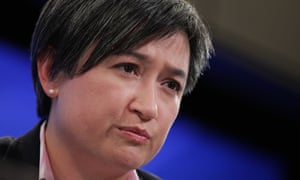
Senator Penny Wong
Senator Penny Wong said Labor was opposing the move to push the senate reform bill through the parliament on the grounds it was not good for Australian democracy. Photograph: Stefan Postles/AAP
Labor and the Senate crossbench are refusing to allow the upper house to debate laws bringing in proposed new voting rules in an attempt to deny the government the chance to call a July double dissolution election.
The Greens back the Senate changes, which ban the backroom deals that have seen micro-parties elected on a tiny number of votes, but have also come under intense pressure to stall them to prevent the government from calling a double dissolution poll straight after its May budget.
It is understood the Greens are considering some additional changes to the bill, including optional preferential voting “below the line” – but it is not clear whether they will back a crossbench plan to impose a “start date” for the laws in August, after the last possible date for calling a double dissolution.
The independent senator Nick Xenophon has said he will try to amend the bill in the Senate to introduce optional preferential voting below the line instead of requiring voters to place a number beside every candidate’s name.
“Having 12 below the line would help remove the illogical asymmetry that exists in the government’s bill,” he said.
The Greens spokeswoman Lee Rhiannon said Tuesday’s inquiry into the voting bill “established a water-tight case of why we need optional preferential voting below the line” and the Greens would support the amendment.
“We support voters being required to number at least 12 boxes,” she said. “Witnesses at today’s hearing and many of the 100-plus submissions have set out a clear case for this reform and we support it being included in the legislation.”
But tempers frayed in the Senate on Tuesday night as Labor and the crossbench continued to refuse to allow the upper house to debate the Senate voting bill, or any other bills, with only five sitting days until parliament is scheduled to rise for the long winter break.
Senator Penny Wong said Labor was opposing the move by the Coalition and the Greens to push the senate reform bill through the parliament on the grounds it was not good for Australian democracy.
“We do not believe that legislation that imposes the largest changes in three decades on this parliament on the Australian people for an election should be rushed through just because the government wants to rush to a double dissolution election with the assistance of the Greens,” said an obviously angry Wong.
She said the ABC psephologist, Antony Green, had told the inquiry by the joint standing committee on electoral matters the most likely outcome of the proposal was a “blocking majority” for the Coalition.
“In years to come if this legislation comes through and the Coalition imposes its radical rightwing agenda on the Australian people, we will be blaming you [the Greens] … because you have come in here with your piety and have lain in bed with the government on this issue and all of us will remember it,” Wong said.
The Senate returns on 10 May for the budget and the government would have to call a double dissolution election on 11 May.
Tom Rodgers, from the Australian Electoral Commission, said he would need three months to implement the laws before an election was held.
The Family First Senator Bob Day has proposed at a minimum that the Greens amend the legislation to include a start date of 22 August. Labor would back the move and so do the other crossbenchers, leaving its fate in the hands of the Greens.