Friday, 1 June 2018

Letters to the Editor, August 24, 1895.


*THE WORKER*
BRISBANE, AUGUST 24, 1895.


Mail Bag.

Wanted – (to prepare the way for Socialism in our Time)
One Adult One Vote.
Land Tax.
Income Tax.
State Bank.
Shops and Factories Act.
Eight hours day where practicable.
Referendum and Initiative.
Taxation of every person according to ability to pay.
The State to find work for unemployment.
The State to fix a minimum wage.
Free railways.
Free administration of Justice.

The WORKER does not hold itself responsible for the opinions of its correspondents.

_____________

Fair Play - Yes.
May Day - Thanks.
W. R. M. - Notes received.
L. G., Melbourne – Thanks.
SHANGHRAUN – Crowded out.
RICHD. M'DONALD Received
R. W., Gympie – May use later on.
MAGPIE, Toowoomba – Letter sent you.
W. R. M., Ipswich – Received. Will use.
P. Langston – Very glad to hear from you.
R. M'DONALD, Winton – Read and practice, and please send along part.
HANRAHAN, Thargomindah – Made inquiries; find he is now at Coolgardie, W.A.
ROUSEABOUT, Noondoo, writes complainingly of the mean actions of “White Wings.”
OLD MINES, Pikedale – Glad to hear that the electors are going to get rid of Foxton.
S. writes that Civil Service is becoming too big for the sort of men in power to manage.
BUSHMAN writes to say that big fat kanakas can be seen driving teams through Cloncurry laden with timber.
Tom L. Mills, N.Z. - Thanks very much. Editor at present absent from Brisbane; will write you on his return.
SHEAR-SLADE – You do not mention the name of the station. All orders received have been attended to. Fifty five copies sent Alice Downs.
J. CANTWELL, Thargomindah – Your case has been no doubt a hard one. There is very little justice for workers in bush courts under the eye of the squatter.
LITMUS writes to say if white men get a fair wage and a decent mode of living they can do more work than coloured labour on plantations, and he knows it from practical experience.
C. M. HOSBACK, Murchison, W. A. writes that a strong branch of the Anti-Asiatic League has been formed at the Island, Lake Austin. He also forwards copy of principles of the League.
______________

DON”T forget the WORKER Enlargement Fund?

ED. WORKER – A hiatus occurs in the article “Law of Rent” in your last issue. “Anderson's tract has the same relation to the Spencerian theory of evolution” should have read, “Anderson's doctrine has about the same relation to the Ricardian 'Law of Rent' as the theories of Erasmus Darwin to the Spencerian theory of evolution .” - MACAURA.

ED. WORKER – Now that the co-operative store in Hughenden is such a success, why not go a step further. Take up 20,000 acres and sheep farm for profit. Taking into account that we have got, or can get, the two principal factors – that is, labour and land – with a small levy to buy wire with, we ought to make it a success. All hands to improve it after Christmas. Far better than lying on creeks reading “Deadwood Dick in Nevada,” or “The last Ride of Silk Basso Sam.” - R. M'DONALD, Winton.

ED. WORKER – A word for those men who gave their labour as cooks free in the strike camps last year. This year there has been a lot of fat cooks put on at some of the sheds in preference to them. This I consider an injustice to the strike camp cooks, for I maintain that the man who was good enough to give us his labour for nothing is good enough to cook for us when we become employers. No matter if they did not cook personally for you, they looked after your fellow unionists, which is all the same. - JUSTICE.

ED. WORKER – There are a number of names mentioned as likely candidates to contest the seat for Carnarvon in the Labour interests against the honourable and talented major. But, of course, the workers' organisation will have to decide whom they will support; there must be no clashing between parties. So it is to be hoped the workers of Goondiwindi will assist in every possible way in the selection of the man who is likely to get the most support throughout the whole electorate. The committee of the workers' organisation here are working energetically, and no stone will be left unturned to down Foxton at the coming election. - STANTHORPE.

ED. WORKER – Here is a sample of the questions asked at the Bowen Downs inquiry; “How many strike camps have you been in?” “ Where were you in 1891?” “Do you know who hoisted the black flag in 1891?” All this irrelevant foolery simply shows that the police, who no doubt take their cue from the higher authorities, have their minds already made up on the matter and are merely attempting to force the witnesses to prove their theory. Exactly the same line was pursued in the matter of the late Mount Cornish fire. Nothing but what would substantial to the police theory was listened to. This theory was that the shed was set on fire in three places by incendiaries – union men, of course. They could find no motive whatever for such incendiarism. As is well known, Mount Cornish is a cattle station and has been entirely free from labour troubles. The manager is well respected by everybody in the district. If the police (here is the straight “griffin” for the Hon. Tozer) had cross-examined the black gins who are exclusively employed as domestic servants at the beautiful homestead, and also further cross-examined the station jackeroos as to their movements on the night of the fire, they would have been much, very much, nearer the mark than they were. - ONE OF THE DINGOES. Billabong.

ED. WORKER – In the Legislative Assembly, on the 7th inst., Mr. John Cameron, M.L.A. is reported to have said “that the conditions of the western men were never better than at present, and at Barcaldine the men wanted for the bore and wool-scour could not be procured nearer than Rockhampton though the wage offered was 10s. per day.” We have on several occasions come into contact with John, but have never heard of any remarkable instances of his veracity, but we venture to say at this juncture that a more flagrant violation of the truth was never perpetrated even by so shaky an individual as the member for Mitchell. What are the facts? The bore employs an engineer and three labourers at 10s. and 7s. 6d. per day respectively. It is perfectly true that these men are from Rockhampton, having been sent up by Sydney Williams and Co., the contractor (every local man who applied for work having been refused). The only local man on the job is the board's engineer. With respect to the wool-scour, the minimum rate of wage is 7s. 6d. per day, and none but well known applicants stand the slightest chance of gaining employment there. In the face of such facts as these, which are well known to everyone here, it seems absurd for even such an absurdity as John Cameron, M.L.A., to try and distort facts so widely known. But it is only a further instance of the shameless audacity and “front” usually displayed in the political tactics of the enlightened and intelligent member for Mitchell. - C. G., Barcaldine, August 13, 1895.

How Donald Trump is weaponising the courts for political ends


Trump is appointing judges far faster than Obama did – and the white-, male-dominated crop could be his most lasting legacy

With just over a year in office, Donald Trump has already appointed 21 of America’s 167 current circuit judges.
With just over a year in office, Donald Trump has already appointed 21 of America’s 167 current circuit judges. Photograph: Brendan Smialowski/AFP/Getty Images
It was a startling omission, even according to the peculiar moral norms of the Trump era. When Wendy Vitter, one of the US president’s judicial nominees, was asked whether she supported the supreme court’s 1954 Brown v Board of Education decision to end racial segregation in schools – a near sacred pillar of progress for civil rights in the 20th century – she did not say yes.
“I don’t mean to be coy,” Vitter, who is up for a seat on the US district court for the eastern district of Louisiana, told her Senate confirmation hearing. “But I think I get into a difficult area when I start commenting on supreme court decisions which are correctly decided and which I may disagree with.”
If approved, Vitter, currently the general counsel of the Roman Catholic archdiocese of New Orleans and an opponent of abortion rights, would join a wave of lifetime appointments that threatens to fundamentally tilt the balance of America’s courts – and embolden conservative activists to bring cases that once seemed lost causes.
With just over a year in office, Donald Trump has already appointed 21 of America’s 167 current circuit judges and intends to fill an additional 20 or more vacancies by the end of the year. He is far outpacing Barack Obama, whose 21st circuit court nominee was approved 33 months into his presidency amid gridlock in Congress. Seventeen of Trump’s nominees for district courts, most of whom replaced Democratic appointees, have also been approved by the Republican-controlled Senate.

"Conservatives are using the courts to bring us back to a time when ‘religious liberty’ allowed discrimination"
Dominated by white men, many of whom are under 50, it is the least diverse crop of new judges for a generation and may prove Trump’s most lasting legacy. Last December, for example, an analysis by the progressive organisation Lambda Legal found that nearly one-third of his judicial nominees up to that point had anti-LGBT records, with some openly hostile to gay rights.
“This is stunning,” said Christopher Kang, former deputy counsel to Barack Obama, who for more than four years was in charge of the selection, vetting and confirmation of Obama’s judicial nominees. “Conservatives are using the courts to bring us back to a time when ‘religious liberty’ allowed discrimination. We’re seeing legal arguments we had hoped were consigned to the dustbin of history being dusted off and used again in the hope of turning back the clock on the way we treat all Americans.”
Four cases relating to Trump’s ban on transgender personnel in the military are working their way through the courts. Employment and housing protections for LGBT individuals could be at risk. Battles over reproductive rights are also under way at state level. Last month a federal appeals court blocked an Ohio law that would cut taxpayer funding to 28 Planned Parenthood clinics, holding that conditions it imposed that denied funds to abortion providers were unconstitutional. But campaigners against abortion rights are unlikely to be deterred.
Kang, now chief counsel at the not-for-profit group Demand Justice, said: “In the efforts to roll back reproductive rights, they’re going to keep trying until they find a judge with such ideologically extreme views that he or she agrees with them.” He added: “If the supreme court moves in their direction, they only need to get one case up to the supreme court to overturn Roe v Wade.”
Trump, on course to be the first Republican since Herbert Hoover to name fewer women and minorities to the court than his Republican predecessor, has shown no compunction about weaponising the courts for political ends. At a Susan B Anthony List campaign for life gala in Washington last week, he boasted of appointing a record number of judges who will “defend our constitution and interpret the law as written”, seen by critics as cover for a throwback to the gender and racial injustices of the founding document.
Judicial appointments have proved crucial for grassroots conservatives and Christian evangelicals who might otherwise be alienated by Trump’s sex scandals and boorish behaviour. Many cited the supreme court vacancy as a major factor in their decision to vote for him in the 2016 president election, and they were rewarded with his pick of the conservative justice Neil Gorsuch.

Donald Trump shakes hands with Judge Neil Gorsuch after he was sworn in as a supreme court justice.
Donald Trump shakes hands with Judge Neil Gorsuch after he was sworn in as a supreme court justice. Photograph: Joshua Roberts/Reuters

Similarly his nominations to the lower courts, rushed through by Republicans without many of the usual protocols and traditions, have insulated him from criticism on his right flank. Curt Levey, president of the rightwing advocacy group the Committee for Justice, said: “I can’t tell you how many conversations I’ve had with people where the first thing they jump out and say is ‘judges’.”
Hewitt predicted: “By 2019, Trump judges will be participating in more than 15,000 decisions every year, and almost all those decisions will be the law of the land. There will be no fewer than 400 crucial case votes and dozens of signed opinions, each year, every year for most of the Trump judges.”
Trump’s judicial picks are profoundly shaped by the Federalist Society, a group of conservatives and libertarians who favour an “originalist” interpretation of the constitution, and the Heritage Foundation, a Washington thinktank where Newt Gingrich is a regular speaker and where Margaret Thatcher is lionised.
John Malcolm, vice-president of the Institute for Constitutional Government at the Heritage Foundation, said: “In the same way that liberals have pushed more progressive causes when they felt the judiciary was favourable, I’m quite sure that when there are more conservatives on the bench, that will prompt conservative groups to file more lawsuits.”
Progressives have in recent years won landmark victories on issues such as same sex marriage and transgender rights. But conservatives, sensing the wind changing in their favour, may push significantly harder on issues such as environmental regulations, land rights, racial profiling, trade unions and reproductive and voting rights.
The Judicial Crisis Network (JCN), he noted, was spending millions of dollars to support Trump’s nominees in the lower courts, for example by running TV ads to pressure vulnerable Democrats to support them.
Even so, the impact on litigation strategy will take time, Keith suggested. “It is a long game. It is not always the one big case; it may be smaller cases at the district and circuit courts.”
The JCN itself denied that activists were using the courts as a blunt instrument. Carrie Severino, its chief counsel and policy director, said: “The conservative strategy shouldn’t ever be – and isn’t in these cases – to run to the courts to change the law. That’s the legislature’s job.
“However, there are many issues in which the legal questions are fairly clear if the judge is willing to set aside his or her own politics to decide based on the law alone. In those cases, it is a great relief to litigants to know they will be treated fairly in the courts.”
But for their opponents, the road is long and bleak. Sasha Buchert, a staff attorney at Lambda Legal, warned of the implications for LGBT rights. “It’s absolutely a disaster. This is putting Trump’s values on the courts for the next 10, 20 or 30 years in places where folks have the least protections already.”

Big four banks quit coal only to invest in other fossil fuels, research finds

Extract from The Guardian

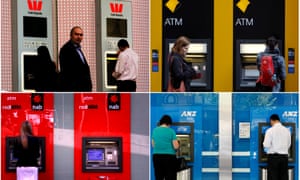
ANZ, CBA, Westpac and NAB have provided finance for 17 new fossil fuel projects since Paris target, report says

Australia’s big four banks have significantly increased investment to projects that will expand the fossil fuel industry as they claim to support efforts to limit global climate change, according to new research by the environmental finance group Market Forces.
The report shows the banks have effectively walked away from coal, after years of increased pressure from the environmental lobby and customers wanting to deal with sustainable companies. None of the big four banks has invested in new coal projects since 2015.
But a spike in finance for new oil and gas projects has, according to Market Forces’ head of research, Jack Bertolus, put a significant dent in those green credentials.
“It’s all well and good to commit to ‘two degrees’ [the Paris target to limit climate increases above pre-industrial levels] but you’ve got to back it up with action, and it’s plainly obvious that we can’t be expanding the size of the fossil fuel industry. That’s what the science says but it’s also common sense.”

Market Forces found that big bank lending to new fossil fuel projects increased by 50% in 2017, a total of $2.265bn up from $1.509bn the year before. ANZ topped the list, lending $905m, an increase of 93% from 2016, which included investment in gas fields in North Sumatra and in the Ichthys field off the northern Australian coast.
“Over their lifetimes, these projects are expected to enable 4.9bn tonnes of CO2, enough to cancel out Australia’s emissions reduction target more than five times over,” the report says.
Bertolus said banks had clearly realised that investment in coal was not worth the damage to their reputation. But he said it was hypocritical to get public relations mileage on one hand, and on the other continue to fund oil and gas projects.
“In a sense it doesn’t matter if you’re funding coal or oil and gas – if it’s inconsistent with two degrees it’s essentially a race to the precipice,” he said.
The report is particularly critical of ANZ and CommBank’s funding for fossil fuels. NAB is the best of the big four, putting considerably less into fossil fuels but still more than on renewable energy projects.
“There are plenty of choices outside of the big four that don’t fund fossil fuels at all, and in some cases have active policies about not funding the fossil fuel industry,” Bertolus said.

ANZ has publicly stated it supports the goal of attempting to limit climate increase to 2C above pre-industrial levels. “ANZ as a responsible and sustainable business is playing its part to support the transition to a decarbonised economy,” it has said.
A spokesperson for the Commonwealth said the bank’s coal funding had been “trending down for some time” and was relatively small. The bank described gas as “a transition fuel”.
“We expect that trend to continue over time as we help finance the transition to a low carbon economy.
“CBA has been supporting the shift in the Australian economy towards low carbon energy alternatives, with a significant movement from coal towards renewable energy, and gas as a transition fuel.”

Trump's hard-right judges will do lasting damage to America

Extract from The Guardian

The president has appointed an array of judges who are anti-choice, anti-union, anti-immigrant and pro-gun. They could cause permanent harm

Last Tuesday, Donald Trump addressed the Susan B Anthony List at its 11th annual Campaign for Life gala. His theme was the many successes of his administration and, most importantly, the need to rally voters to be sure that Republicans successfully maintained control of the House and the Senate in the November 2018 midterm elections. In speaking to this audience of faithful supporters identified as “pro-life” voters, he said: “Now, for the first time since Roe v Wade, America has a pro-life president, a pro-life vice-president, a pro-life House of Representatives, and 25 pro-life Republican state capitols.”
In the same speech he touted his great success in judicial appointments with the following words: “We’ve appointed a record number of judges who will defend our constitution and interpret the law as written. And we’re putting on to the bench a record number of judges. And in a short period of time, we are going to have probably the all-time record for the appointment of judges. And I’m very excited about that.”
This speech tells you exactly what you need to know about this president’s goal and his desire to define his legacy. As is well known by now, what he says yesterday he reverses tomorrow. At one time, Trump supported a woman’s right to choose. That is long gone. His goal today is nothing less that the undoing of Roe v Wade, the US supreme court decision that allowed a woman the right to obtain an abortion. He will not be satisfied until he can stack the lower federal courts – and eventually the supreme court – with judges who will overturn that precedent.

"Appointments to the federal bench continue to be the president’s most consistent success, a rallying cry for his base"

If the Republicans prevail in the midterm elections and retain control of the House and, more importantly, the Senate, the relentless march to appoint conservative judges will continue at record speed. Six months ago I authored an article for the Guardian titled ‘Trump’s new team of judges will radically change American society’.
At that time, the president had made 60 judicial nominations and 14 judges had been confirmed. Current figures reveal that the appointments to the federal bench continue to be the president’s most consistent success, a rallying cry for his base, and a campaign issue in the forthcoming election. They are poised to be his lasting legacy.
Many of the president’s actions can be easily overturned by a new president, just as Trump has erased so much of what Barack Obama achieved. But one thing that cannot be altered by a new president is the lifetime appointments to the federal bench, which will shift the balance of power in the courts for the next two generations.
When Obama took office, there were 53 vacancies, equivalent to 6% of the federal judiciary. But because Republicans obstructed Obama’s judicial nominees in the hopes of providing a Republican president an opportunity to remake the federal courts, Trump began his term with 112 vacancies.
When Senate Republicans were in the majority from 2015-2016, they blocked nine Obama nominees from receiving a hearing because they had not received the consent of their home-state senators. Now that there is a Republican president, Senate Republicans have reversed their position and have advanced three Trump nominees despite their failure to obtain approval from home-state senators.
Thirty-nine Trump judges have now been confirmed, 15 for the circuit courts and 24 for the district courts. One hundred and sixty vacancies remain to be filled, with 71 nominations now pending before the Senate and 89 vacancies yet to be filled. This is more than 15% of the federal bench. As noted in a 22 May report issued by Senate judiciary committee Democrats, the pace of confirmations has set a record. Trump’s first 15 circuit court nominees took an average of 131 days to be confirmed, while Obama’s first 15 circuit court nominees took at average of 254 days to be confirmed – which is twice as long.
A recent study by the Pew Research Center noted an average of 23 votes against each confirmed Trump judge. Obama’s nominees had an average of six no votes; George W Bush’s nominees averaged two no votes; Clinton’s averaged one; and only one no vote was cast against any judge nominated by John F Kennedy.
A record number of Trump nominees have received a “not qualified” rating from the American Bar Association (ABA), or the tepid rating of “qualified” as opposed to the “well qualified” rating of the vast majority of Obama’s nominees. Finally, Trump’s choices reflect a lack of diversity. Ninety percent of his nominees are white, and only 20% are women. Not a single African American or Hispanic person has yet been confirmed. Only 3% of pending nominees are African American and 6% are Hispanic.

abortion rights protest
‘Trump will not be satisfied until he can stack the lower federal courts – and eventually the United States supreme court – with judges who will overturn that precedent.’ Photograph: Jonathan Ernst/Reuters

Vitter’s record is abysmal. She spent the first six years of her legal career as an assistant district attorney in New Orleans, where she rose within four years to the position of chief of trials. During those years that office was repeatedly criticized by the courts for failing to comply with its constitutional obligation to provide exculpatory information to defense counsel in criminal cases. Justice Ruth Bader Ginsburg described that office as “deliberately indifferent to what the law requires”.
Vitter routinely sought the toughest sentence against black defendants – including the death penalty – but not equally against white defendants. She often criticized judges who gave less than maximum sentences. She then spent one year as an associate in a law firm. She has only appeared once in federal court.
She then retired from practicing law for the next 20 years, spending those years working on her husband’s political campaigns. She has consistently opposed abortion rights, going so far as to claim that using birth control pills exposes women to sexual assaults and that contraception causes breast cancer. Neither proposition has any scientific support.
Finally, Vitter failed to disclose speeches and publications to the Senate judiciary committee that disclosed her virulent anti-abortion views.
Ryan Bounds, a 45-year-old lawyer from Oregon, and a longtime member of the very conservative Federalist Society, has been nominated to the powerful and influential ninth circuit court of appeals. He has failed to obtain the support of either senator from Oregon. Nonetheless, he was nominated on 7 September 2017 and had a Senate judiciary committee hearing on 9 May 2018.
He has received only a “qualified” rating from the ABA. While he did graduate from Stanford University and Yale Law School and has served as a federal court law clerk and federal prosecutor, he has left only a sparse paper trail. He was a deputy assistant attorney general in the George W Bush administration but papers from that era are not publicly available.
The available materials consist of many articles written during his student years that reveal deeply conservative views. He has belittled campus sexual assaults, attacked the concepts of multiculturalism on college campuses, called student affinity groups “feel good ethnic hoedowns” and mocked students engaged in pro-labor protests. In short, he fits well within Trump’s view of the ideological qualifications for a position on a court of appeals.
There are many nominees and confirmed judges who are similar to Vitter and Bounds. Many, if not most, are opposed to abortion rights, labor unions and gun control, and support limiting immigrants’ and prisoners’ rights. The damage to the federal judiciary that will take place in Trump’s four years is of great concern. The pace of confirmation will slow if the Senate flips to Democratic control – but the irreversible harm will be completely devastating should this president remain in office for eight years.
  • Shira A Scheindlin is a former United States district judge for the southern district of New York. She is a member of the board of the American Constitution Society and of the Lawyers’ Committee for Civil Rights Under Law

ABC axes another 37 jobs in wake of $84m budget cut

Extract from The Guardian

Jobs lost in technology division are on top of 22 cut from national newsrooms as union says warns scale of ABC downsizing is not sustainable

The ABC has axed another 37 jobs just days after it was revealed the public broadcaster had shed more than 1,000 jobs since 2014.
The 37 jobs losses are in the technology division and are on top of the 22 jobs axed from the national newsrooms last month.
In answers to questions on notice the ABC told senate estimates that a total of 939 employees – or 829 full-time-equivalent – have been made redundant in four years, including 205 as a result of the closure of the ABC’s retail shops and a further 73 vacant positions were closed.
On Thursday the ABC’s chief digital and information officer Helen Clifton said the proposal would “strengthen the ABC’s ability to deliver more to audiences”.
“These are hard decisions, but the right ones to guarantee the ABC remains properly equipped, now and into the future, with so many rapid changes in technology,” she said.
“This proposal will ensure we are a future-focused media organisation able to meet changing audience expectations and will strengthen our commitment to delivering outstanding content and media experiences to Australian audiences.”
The ABC section secretary of the Community and Public Sector Union Sinddy Ealy said the number of ABC restructures is up to 17 in 18 months, or almost one a month.
ABC managing director Michelle Guthrie took over from Mark Scott more than two years ago.
“This is devastating news for ABC staff – in less than 4 years close to 1000 skilled and experienced ABC employees have lost their jobs due to restructuring,” Ealy told Guardian Australia.
“The scale of ABC loss is simply not sustainable – a point that the ABC’s own leadership has finally been forced to admit in response to the latest Turnbull government funding cut of $84m.
“Excessive ABC restructuring is hurting everyone – the leadership, the staff and ultimately everyone one of us who relies on the ABC for quality programs and services.”
Ealy said most of the “restructures” end up costing more money in the long run and ABC editorial quality suffers.
The union has also been highly critical of the “Hunger Games” approach to job cuts which places targeted staff put into selection pools where they are judged against each other.
Staff were reeling from the news of yet another, this time in technology.
The cuts follow the ABC’s decision to halve current affairs radio programs The World Today and PM in 2018 to fund other projects in news, including specialist and investigative reporting.
Earlier this week Guthrie lost a second key member of her executive team within weeks when the head of distribution for entertainment and specialist Rebecca Heap resigned just months into a major content restructure.
The shock departure follows the resignation of Guthrie’s right-hand woman, Samantha Liston, the director of engagement, who will finsh up on 25 June.
Heap was in charge of programming and digital with responsibility for iview and the ABC’s TV channels – including ABC, ABC Kids, ABC Me and ABC Comedy as well as ABC listen and Radio National.
She has resigned without any indication of a new position.

Pluto's dunes snapped by NASA's New Horizons are made from frozen methane


For a minor planet, Pluto throws up some pretty big surprises. The icy world has dunes, but unlike Earth's sandy versions, Pluto's seem to be composed of flecks of methane ice.

Key points:

  • Dune-like features were spotted on Pluto after the New Horizons mission flew past in 2015
  • Planetary scientists thought the icy world lacked the atmosphere to generate dune-building winds
  • Modelling shows how methane ice grains from mountain slopes and moderate winds could produce dunes
Published today in the journal Science, it's the latest in a swag of new discoveries uncovered by NASA's New Horizons spacecraft.
When New Horizons flew past Pluto in July 2015, it sent back detailed images of the icy world's surface.
Matt Telfer at the University of Plymouth in the United Kingdom was one of many planetary scientists and geologists who scoured the pictures for interesting features such as dunes.
One location stood out: a north-west patch of Pluto's vast heart-shaped plain of ice dubbed Tombaugh Regio.
New Horizons took photos of dune-like ripples roughly a kilometre wide and tens of kilometres long on the plain, nestled against mountain peaks standing more than 3 kilometres tall.
"There were a few areas that looked interesting," said Dr Telfer, who co-authored the paper.
Upon closer examination, their location, orientation and spacing all pointed to them being dunes.
But there was a problem: planetary scientists thought Pluto's atmosphere was too thin to sustain the winds needed to sculpt the ripples that were visible.
So how did they appear?

How to build a dune on Pluto

Think of dunes, and you probably picture sweeping swathes of hot sandy desert. Winds whisk sand grains into the air, which fall to the ground in ordered ridges.
On Earth, this happens largely because our atmosphere is thick enough to keep the wind blowing.
But Pluto has a comparatively thin atmosphere — only 0.001 per cent of what we have on Earth. Little atmosphere means weak winds.
So, armed with New Horizons data and some nifty modelling, Dr Telfer and his colleagues came up with an explanation that fit New Horizons' pictures.
Pluto is extremely cold — around minus 230 degrees Celsius — and orbits the sun at an average distance of 6 billion kilometres.
But even the meagre solar energy that falls on its icy surface is enough to warm nitrogen ice on its frosty mountains.
The nitrogen ice turns into a gas in a process called sublimation. Still-frozen methane grains from the slopes are shaken loose and lofted into the atmosphere.
Size wise, the methane grains are "on the order of typical Australian dune sand from the Simpson or Strzelecki [deserts]", he added.
Temperature differences in the atmosphere trigger "thermal winds", which keep the methane grains moving along and eventually dump them on the plain below.
Those grains, in turn, kick up more grains and so on, to eventually produce long, thin dunes.
It turns out that Pluto's thin atmosphere, plus its low gravity, may help the dune-forming process. With little gravity or wind resistance to drag or slow them down, methane grains can stay airborne longer.
The dunes are no more than half a million years old, because that's how long it takes the slab of ice they sit on to completely turn over.
But Dr Telfer suspects the dunes are much younger — perhaps on the scale of hundreds of Earth years.
And that particular site is, at the moment, the only place known on Pluto that ticks all the dune-building boxes: a supply of granular material, enough wind to push them around and atmosphere — even a little bit.

Dunes through the solar system

Unsurprisingly, there are plenty of unanswered questions.
In an accompanying article, Cornell University planetary scientist Alexander Hayes wrote "it remains to be shown how high the dunes are, when they are most active, whether they change, and whether [grain movement] can occur without lofting".
And while Dr Telfer and his colleagues suspect the dunes are made of methane grains, they haven't entirely ruled out frozen nitrogen.
This warrants further investigation, said Helen Maynard-Casely, a planetary scientist at the Australian Nuclear Science and Technology Organisation, who was not involved in the research.
"I think it could be nitrogen. We don't know much about how these compounds behave at Pluto conditions," she said.
Still, Dr Maynard-Casely said these insights into Pluto's dune-making processes are "a surprise, but a welcome one".
Pluto's not the only world in the solar system that uses sublimation and thermal winds to sculpt dunes.
When the Rosetta spacecraft dropped into Comet 67P in 2014, it spied dune-like structures — thought to be formed by thermal winds.
Sublimation and thermal winds also create dunes in the Arctic on Earth.
"The interesting stuff isn't how different Pluto dunes are to other dunes, but how similar they are," Dr Maynard-Casely said.

NBN fixed wireless blowing out bush broadband bill as Government pins hopes on fixed-line levy

Extract from ABC News

Posted about an hour ago

Wireless broadband in the bush is draining more money than expected from NBN Co due to take-up in some places being three times higher than projected.

Key points:

  • Fixed wireless congestion is causing increased NBN roll-out costs
  • Four out of five houses in some areas have taken up fixed wireless
  • The Government hopes a new bill will raise extra money for bush services

New information released this week through Senate estimates has revealed delays to upgrades and massive popularity in some fixed wireless areas.
Residents around some towers have driven take-up rates of more than 80 per cent. In 2012, take-up for fixed wireless was predicted to be 23 per cent.
Almost one in ten premises in the NBN roll-out plan — approximately 1 million homes — are on fixed wireless or satellite technology.
NBN Co chief executive Bill Morrow told senators last week that new technology added in order to address congestion "exacerbates" the negative profitability of its bush service.
"It's not about making money in these areas," he said.
"The losses we see in these wireless technology areas are offset by the profits that we make in the city centres."
The financial contribution from users of these bush services is already being dwarfed by subsidies from metropolitan fixed line users.
Even as the subsidies grow as more metropolitan homes come online, the Government describes this cost shifting as "unsustainable".
The Government has estimated losses from the satellite and fixed wireless portion of the rollout — covering those in Australia's most inaccessible, and arguably most needy, areas — will reach $9.8 billion dollars over the next three decades.

Regional broadband scheme

The Government is pursuing a new bill that aims to extract tens of millions of dollars each year from urban non-NBN fibre networks to help fund bush broadband
It works by charging fixed-line companies in competition with the NBN $7.10 per month for each customer.
The scheme is expected to raise $30 million each year in the first few years of operation, and potentially more in future as new companies enter the market in competition with the NBN.
"The NBN operates in a competitive environment and always has," a spokesperson for Communications Minister Mitch Fifield told the ABC.
"Competition will only increase in future.
"It is critical that high-speed broadband in regional Australia is sustainably funded."
Michael Sparksman, managing director of OPENetworks — a non-NBN carrier set to pay more under the scheme — said the "flat" tax hits affordable broadband services hardest and makes broadband more expensive for people on low incomes.
The scheme is likely to face opposition in the Senate.
Labor's communications spokeswoman Michelle Rowland has described the bill as "regrettable", while the Greens' NBN spokesman Jordon Steele-John was also critical.
He told the ABC the proposed scheme was "poorly designed" and that it would "potentially distort the telecommunications market".
Other crossbench senators contacted by the ABC are still assessing the legislation.

The $9.8 billion problem

"Regional Australia has traditionally been left behind when it comes to telecommunications," an NBN Co spokesperson told ABC.


"For the first time ever, these areas have been able to access broadband speeds not available to many in metro areas because NBN Co has prioritised the rollout in regional Australia."
It has come at a significant — and growing — price.
Even as fixed wireless is connected to more houses, it's getting more expensive to connect each house.
Since June last year, NBN Co has reported the cost per premises for fixed wireless has increased by more than $100 to around $3700.
Government figures peg losses per premises at $105 per month for fixed wireless services and $110 per month for satellite services.

Congestion relief delayed

New information released by NBN Co this week reveals struggles to meet its own timeframes for upgrading congested wireless towers.
Three of the nine towers targeted as priorities have suffered upgrade delays: Worrolong in South Australia and Smythesdale and Clunes North in Victoria.
The ABC sought explanations from NBN Co for the delays.
  • Worrolong is now set to be completed in July, four months later than anticipated, due to a need for a shelter for additional radio equipment on the tower.
  • Clunes North was delayed by two months due to a change of sub-contractor and replacement of faulty equipment. It is now complete.
  • Smythesdale suffered a similar delay due to a need for strengthening on existing Optus structure requiring an additional lease area.
$2 billion in capital costs has been spent so far to build the fixed wireless network.
Last week Mr Morrow admitted NBN Co had "killed" its plan to offer fast 100Mbps plans to fixed wireless users.