Wednesday, 5 June 2019

ABC journalists call on news chief to explain why Adani story was pulled

Staff urge management to defend public broadcaster amid allegations of editorial interference by mining giant

ABC journalists have condemned alleged editorial interference by Adani and called on the news director, Gaven Morris, to explain why a story on the mining giant was never run.
Staff representatives from the Media Entertainment and Arts Alliance (MEAA) and union officials met on Tuesday morning after Guardian Australia and Media Watch reported the Adani spokeswoman Kate Campbell made a direct call to Morris to complain about a story before it aired.
The radio story, which had been commissioned for Saturday AM, was pulled from the run-down hours later. The ABC said later this was done to give Adani more time to respond.
“We invite ABC News director Gaven Morris to front news floor staff today to address these allegations and any other questions from staff on the floor,” union delegates said in a statement.
“ABC MEAA members stand with ABC journalist Isobel Roe, whose story on Adani appears to have been pulled, and we reaffirm the commitment of all ABC journalists to the editorial independence of the ABC and to upholding our ability to do our job without fear or favour.”
The media union said ABC management “must defend the public broadcaster from editorial interference, be it political or corporate, and uphold the obligations of the ABC charter”.
The ABC maintains it did not broadcast the story about Adani for legitimate editorial reasons and has not responded directly to the union statement. Guardian Australia understands Morris is in Canberra on Tuesday and is unable to meet with union delegates.
“There was no complaint,” an ABC spokeswoman told Guardian Australia. “The only communication we received from Adani was a request for more time to respond to our questions.
“In light of the need to provide parties with a fair opportunity to respond and the strength of the other stories in the mix for Saturday AM, the decision was taken at an editorial level to not proceed with the story.”
Concern was also raised by the union about revelations in Guardian Australia last week that Adani had lodged several Freedom of Information requests about ABC journalists who had covered the controversial Indian mining company.
The ABC’s Queensland-based investigative reporter Josh Robertson referred to the Adani FOI application in an earlier ABC report about the company’s aggressive legal approach to opponents, through its lawyers AJ & Co.
“Since it was engaged by Adani, AJ & Co has pushed to bankrupt a cash-strapped Indigenous opponent of the mine, threatened legal action against a community legal service and an environmental group, and applied to access an ABC journalist’s expenses and documents,” Robertson reported.
Reporters Mark Willacy and Michael Slezak were asked for documents relating to news reports on allegations Adani was illegally drilling bore holes. These requests were made by AJ & Co, a legal firm acting for Adani which refers to itself as a “trained attack dog”.
Willacy and Slezak’s travel and accommodation costs and some heavily redacted phone logs were released but the majority of the application was rejected.
The MEAA media director, Katelin McInerney, said she was alarmed by attempts to access journalists’ records.
“This is a blatant attempt to intimidate and harass journalists going about their duties to report legitimate news stories in the public interest,” McInerney said.
“Attacks on press freedom must not be tolerated in a healthy functioning democracy – regardless of whether those assaults come from political interests or powerful corporations seeking to deter legitimate scrutiny of their activities.

“ABC journalists must be given the backing and support of ABC management to continue doing their job and fulfilling their responsibilities to keep their audience informed.”

Adani jobs explained: why there are new questions over Carmichael mine

Expert says it’s unusual the company has declined to make a specific promise about ongoing employment
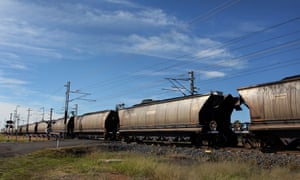
A coal train in Queensland’s Galilee Basin, where Adani plans to develop its Carmichael mine. There are fresh questions about the employment it will create
A coal train in the Galilee Basin, where Adani plans to develop its coalmine. There are questions about how much employment it will create. Photograph: Lisa Maree Williams/Getty Images

It’s been presented as a jobs bonanza for Queensland, but there are fresh questions about Adani’s Carmichael project and the employment it will create in regional Queensland.
It comes after the reemergence of an interview with the Nationals MP, Bridget McKenzie, now the agriculture minister, on Sky News.
In the interview, from late 2018, McKenzie discusses the Carmichael mine and the number of jobs that will be available.
“I think it’s great news they’ll be employing 1,500 through the construction phase and around about 100 in ongoing,” she says.
The figure she cites for ongoing work is a vastly smaller number than anything Adani has ever said publicly.
It is unclear why McKenzie said what she did or where that figure came from.
When asked, McKenzie’s office said her comments were made in November and Adani had since reviewed its numbers.
“The figure placed on the number of jobs that Adani would require for ongoing operations was made in November last year and it is very pleasing to see that Adani have reviewed these figures, indicating that up to 1,800 ongoing positions could be created at their operations, based on other QLD coal mines of a similar size,” a spokesman said.
“We unequivocally support creating jobs in regional Australia and if Adani say there could be up to 1,800 ongoing jobs resulting from their mine operations, that is a great opportunity for central and northern Queenslanders, their families and their communities.”

What Adani says

The confusion doesn’t end there. Adani, in its latest statements about its job figures says the number of ongoing operational jobs at the mine would not be 1,800, but between 800 and 1,500, based on mines of similar size in Queensland.
A spokeswoman said there would also be “1,500 direct jobs and 6,750 indirect jobs created during ramp up and construction on the Carmichael project”.
Adani has not specified which of these would be associated with construction of the mine and which would be for the rail.
The company’s current jobs forecast is smaller than the 10,000 jobs it originally promoted when it was planning a mine producing 60m tonnes of coal per year (it now plans an output of 10m tonnes), a figure that has regularly been cited by Australian federal MPs.
That 10,000 figure has also been subject of contention since 2015, when Adani’s own consultant told a court the project would create 1,464 jobs at a time the company was still planning a larger mine.

What others say

“Adani has made different jobs promises to different audiences at different times,” Tom Swann, a senior researcher at The Australia Institute, said.
Swann has followed Adani’s jobs claims over many years and compared them to other industries in Queensland.
He cites Australian Bureau of Statistics data that shows the number of jobs in renewable energy in the state almost doubled from 2016 to 2018 to reach more than 5,000. Much of this increase is being driven by large-scale solar and there is more construction in the pipeline.
A 2017 Deloitte report put the number of jobs supported by the Great Barrier Reef, which is under threat from climate change caused by human activities such as burning fossil fuels, at 64,000.
Swann questioned why Adani’s current jobs forecasts for ongoing work, which the company is basing on mines of similar size, were not more concrete.
“It is unusual they have now declined to make a specific promise about ongoing employment,” he said.
One thing that is clear is that Adani has been posting fresh advertisements for roles since gaining some of the final approvals it needs before preparatory construction can commence at the mine. There are currently 14 positions listed on the Adani jobs portal.
On Monday, the Adani Australia Facebook page posted that it was “recruiting for more than 50 jobs as pre-project works ramp up” and encouraged interested workers to email a cover letter and CV.
“We remain committed to Townsville and Rockhampton as the primary hubs of employment for the Carmichael Project, with regions such as the Whitsunday, Isaac, Central Highlands, Mackay, Charters Towers and Gladstone regions also benefiting from our project,” a spokeswoman said.

“The mine will not be automated. We will use the same conventional coal mining techniques and equipment used in other Queensland coal mines.”

Tuesday, 4 June 2019

Land clearing up more than 50% in NSW even before new laws introduced

Environment groups demand up to date figures to show ‘the full impact’ of the weaker laws
Land clearing in New South Wales rose by more than 50% in 2016-17, the year before the introduction of native vegetation laws that make deforestation easier.
Environment groups are now demanding the government publish up to date figures on the extent of habitat clearing in the state “so the public understands the full impact” of the weakening of land clearing laws in 2017.
Documents obtained by the Sydney Morning Herald under freedom of information laws show that 20,200 hectares of land was cleared for crops, pasture or thinning in 2016-17, up from 13,100 hectares the previous year and at least double the amount for any year between 2009-10 and 2014-15.
Clearing from forestry increased from 21,800 hectares in 2015-16 to 33,500 hectares in 2016-17.
Total clearing, excluding deforestation from fire, rose from 39,000 hectares in 2015-16 to 59,700 hectares.
Cobar and Bogan in the state’s central west, Wentworth in the lower Murray and Walgett in the north-west were areas where some of the highest increases were recorded.
“This is more damning evidence that under premier Berejiklian deforestation and land clearing are out of control and rapidly rising, with dire consequences for threatened species like koalas,” Kate Smolski, the chief executive of the NSW Nature Conservation Council, said.
“The scariest thing about this data is that it only represents the two years prior to new land-clearing laws introduced at the end of 2017.”
The NSW environment minister, Matt Kean, said “I understand people care deeply about conserving our natural landscapes – I do too.”
But he said preserving habitat relied on conservation efforts on both public and private land.
“That’s why this government established the NSW Biodiversity Conservation Trust (BCT) in 2017, which is investing more than $350m over the next five years to help protect and conserve our environment, plants and animals,” Kean said.
“In just over a year, the BCT has already invested $55m in 84 new conservation agreements with landholders over more than 19,000 hectares, to conserve NSW’s native plants and animals.”
But Oisín Sweeney, a senior ecologist at the National Parks Association, said the new laws provided for greater intensity of logging, “including in areas that have been protected for decades”.
“It’s therefore highly likely that the impact of logging will become even greater in subsequent report cards,” he said.
“EPA (Environment Protection Authority) data shows that, on average, 20% of logged areas fail to regenerate. So the more forest we log, the more forest we lose.
“Given the context of dual nature and climate crises, the figures again highlight how we urgently need to transition away from industrialised logging and protect our forests to prevent extinctions and store carbon.”
Penny Sharpe, Labor’s acting leader and environment spokeswoman, said the level of clearing was concerning.
“Land clearing impacts not just biodiversity, but soil and water,” she said.
“The government has been caught wanting to loosen the laws without understanding the impact.

“This level of clearing shows they need to take this more seriously and explain how these new laws are not just going to let rip across the state.”

'Disgrace': Angus Taylor under pressure after failing to release emissions data

Greens warn the new emissions reduction minister could be in contempt of parliament
Labor and the Greens have demanded the government immediately release national greenhouse emissions data, and have warned the new emissions reduction minister could be in contempt of parliament for missing the deadline to publish the figures.
Angus Taylor’s first act in his new role was to miss a Senate-set deadline on Friday for the publication of Australia’s emissions data for the December 2018 quarter.
The Senate passed an order last year that requires the minister to publish the quarterly greenhouse gas inventory no later than five months after the end of each quarter.
For the December quarter that date was 31 May.
The government, via a statement from the environment department, said late on Friday: “We anticipate the quarterly update of Australia’s national greenhouse gas inventory: December 2018 will be released soon.”
But Labor’s climate and energy spokesman, Mark Butler, said Taylor “must immediately release the latest emissions data”.
“Angus Taylor has failed his first task as new emissions reduction minister,” Butler said. “This is a disgrace and shows total disregard to the Australian people and Senate process.
“But really it’s no surprise considering Angus Taylor has continually argued against climate action and is part of a government that has continually lied about what their emissions data actually shows, which is that emissions are rising and we’re not on track to meet our international climate commitments.”
The government has been under pressure because its climate policy has been failing to stall Australia’s emissions, which have been increasing every year for the past four years.
The Senate passed the order for rolling quarterly deadlines last year to address delays in the publication of national carbon pollution figures.
The Greens climate spokesman, Adam Bandt, said the minister could be in contempt of parliament.
“The government and minister are showing early signs of contempt for the parliament and should be punished.
“Emissions data should be no different to other nationally significant data, which gets released by the ABS like clockwork. The release of greenhouse pollution data should be automatic and free from ministerial interference.”
In Senate estimates last year, department officials were asked if complying with Senate orders to publish the reports within five months would be a problem.
“No … That time is sufficient for us to make use of the available data to prepare the reports,” they said.
On Monday afternoon the Greens Leader Richard Di Natale wrote to the government’s deputy senate leader, Simon Birmingham, who is the representative for both Taylor and the environment department in the Senate.
Di Natale reminded Birmingham of the department’s testimony that it could meet the upper house deadline.
“Given the testimony from the department, the only conclusion is that it was held back for political reasons by the minister’s office,” he wrote.
“I seek your answers explaining the reasons for the delay and reserve my right to put a motion to the Senate should the government continue to demonstrate signs of contempt for the Senate and its role in scrutinising the use of executive power.”
Tim Baxter of the Climate and Energy College at Melbourne University, said although Morrison’s new ministry was only sworn in last week, he did not believe that should have led to a delay.
“I don’t really think that’s a decent excuse under the circumstances because it’s not like the report has to be written. It has to be read,” he said.
“Taylor, while he hasn’t been emissions reduction minister for long, has been energy minister and he has seen these reports.”
Baxter said much of the information that was in the report was the same as previous quarters, it was just the headline figures that changed.

“This is a pretty unambiguous Senate order. It’s not something he gets to choose …he’s the minister and it’s his job,” he said.

We must mobilise for the climate emergency like we do in wartime. Where is the climate minister?

Unfortunately, much scientific knowledge produced for climate policymaking is conservative and reticent

The second Morrison ministry contains no one with nominal responsibility for “climate” in any sense, despite the fact that it is the greatest threat facing the country. Angus Taylor, who spent much of his pre-parliamentary career fighting windfarms, claiming repeatedly that there is “too much wind and solar” in the system, is now minister for energy and emissions reduction. No mention of climate here, despite the fact that climate is what it is all about, or should be.
Sussan Ley has been made the environment minister, but more intriguing, David Littleproud is minister for water resources, drought, rural finance, natural disaster and emergency management. Let’s take another look at this: water (or lack thereof) … drought … disaster … emergency management.
Is it possible that someone is starting to join the dots – a tacit admission of an escalating climate emergency? In the National party, where competition to develop sensible climate policy is nonexistent, Littleproud has at least pushed for serious policy to address climate impacts on farmers. His title, truth be known, should be the minister for the rural climate emergency.
But when he gets a briefing from disaster management officials, he may be in for a shock. During the 2017-2018 Senate inquiry on the implications of climate change for Australia’s national security, the most compelling evidence was led by Mark Crosweller, the head of a resilience taskforce in the Department of Home Affairs, who used to be the director general of Emergency Management Australia.
He described potential worst-case climate scenarios as being of an “existential nature”. This analysis was taken up in the inquiry’s final report.
In contrast, the submission to the Senate inquiry by the Department of Foreign Affairs and Trade downplayed concerns about the impact on Australia’s economy of climate security threats, noting our dependence on strong international trade and investment and stating that:

"Climate-related costs have the potential to be a disruptive economic force, albeit accompanied by opportunities presented by global transition to a lower emissions, more climate-resilient economy.”

This rather misses the point. By mid-century, a plausible scenario is one of escalating extreme weather events, related conflict and migration, so affecting the international order and global trade that Australia itself would face dramatic political, economic, social and human security consequences in an increasingly chaotic world overwhelmed by climate impact.
If Littleproud is to take his rural climate emergency duties seriously, he needs to understand why that might be so.
We have addressed these issues in a new Breakthrough policy paper. In the foreword, retired admiral Chris Barrie says the paper has “laid bare the unvarnished truth about the desperate situation humans, and our planet, are in, painting a disturbing picture of the real possibility that human life on Earth may be on the way to extinction, in the most horrible way”.
A realistic assessment of climate-related impacts and threats depends on understanding the strengths and weaknesses of climate science projections. Unfortunately, much scientific knowledge produced for climate policymaking is conservative and reticent.
In reality, climate change now represents a near- to mid-term existential threat to human civilisation. A new approach to climate-related risk management is required, paying particular attention to the high-end and difficult-to-quantify “fat-tail” possibilities, such as climate tipping points. This should be the key task of the minister’s new department. What sort of approach should the government bring to emergency risk management in the face of existential climate risk?
It is essential these high-end, bad possibilities, not just middle-of-the-road probabilities, are seriously considered. This may be most effectively explored by scenario analysis. In our paper a 2050 scenario is outlined in which accelerating climate-change impacts pose large negative consequences to humanity which might not be undone for centuries.
To reduce such risks and to sustain human civilisation, including the Australian farming sector which is the minister’s particular concern, it is essential to build a zero-emissions industrial system very quickly. This requires the mobilisation of resources on an emergency basis, akin to wartime, rather than reactively responding to disasters when they arise. By that time it will be too late to avoid the worst climate impacts. This requires a whole of government taskforce, cutting across conventional ministerial and departmental boundaries, charged with the overriding objective of planning and implementing a rational response to the climate emergency. The plan would encompass the full gamut of national activity, including defence, industry, economic, financial, scientific and social considerations.
For the best form of natural disaster and emergency management is proactive prevention, and that is only possible if the threat is first understood and acknowledged.
Clearly the Morrison government, along with the ALP, have yet to reach that point as they contemplate further expansion of our fossil fuel industry in the Galilee Basin and elsewhere, which will only exacerbate climate pressure on our farmers.
Littleproud arguably has the most crucial and important role in cabinet. How to convince his colleagues of the real climate disasters which now confront this country, and particularly the agricultural sector, unless we rapidly move away from our fossil fuel past.
If he does not, he and his cabinet colleagues will fail catastrophically in their primary responsibility, which is their duty of care to protect the Australian people, their safety and wellbeing.

Ian Dunlop was formerly an international oil, gas and coal industry executive, chair of the Australian Coal Association and CEO of the Australian Institute of Company Directors. He is a senior member of the advisory board of Breakthrough National Centre for Climate Restoration. David Spratt is Research Director of Breakthrough.

They are co-authors of “What Lies Beneath: the understatement of existential climate risk” (Breakthrough, 2018)

Why would a billionaire persist with Adani when it will probably lose money?

Opinion

Updated yesterday at 1:27pm


By mid-June, if everything goes as expected, Adani Australia will receive the final environmental approvals for its proposed Carmichael coal mine and rail line development.
Newspaper reports based on briefings from Adani suggest that, once the approvals are in place, the company could begin digging "within days".
On Friday the Queensland government approved Adani's plan to protect a rare bird, apparently leaving it with just one final regulatory hurdle: approval for its plan to manage groundwater.
Its billboards in Brisbane read: "We can start tomorrow if we get the nod today".
But several big obstacles remain. Even after governments are out of the way, it will have to deal with markets and companies that aren't keen on the project.

Obstacles aplenty

First up, there's the problem of access to Aurizon's rail line. Adani originally planned to build its own 388km railway from the Galilee Basin to its coal terminal at Abbot Point.
However, in the scaled-down version of the project announced last year, Adani plans to build only 200km of track, before connecting to the existing Goonyella line owned by the rail freight company Aurizon.
That requires an agreement of access pricing and conditions. Aurizon is legally obliged to negotiate with Adani, but has shown itself to be in no hurry to reach a deal.
Then there's insurance.
Faced with rejection by every major bank in the world, Adani announced it would fund the project from its own resources.
But now insurers, including nearly all the big European firms and Australia's own QBE, are saying the same sort of thing as the financiers.
Without insurance, the project can't proceed, and the pool of potential insurers is shrinking all the time.

Not particularly financial

But the most fundamental problem may lie within the Adani group itself. The $2 billion required for the project will ultimately come, in large measure, from chairman Gautam Adani's own pocket.
With an estimated wealth of $7 billion, he can certainly afford to pay if he chooses to.
But it would represent a huge bet on the long-term future of coal-fired electricity, at very bad odds.

In my analysis of the original Carmichael mine proposal in 2017 I concluded that the profit from operating the coal mine would be around $15 per tonne.
A recent analysis of the revised project by David Fickling for Bloomberg yielded a marginally more favourable estimate of $US16 per tonne, or $US160 million a year for the initial output of 10 million tonnes per year.
That's a small return on $2 billion, before considering overheads and depreciation.

It'd need a long life…

Such an investment could only be profitable on the basis of a mine with a long life and substantial potential for future expansion. How likely is that?
When the start of construction was re-announced last November, it was suggested the coal might be shipped by 2021. With six months' delay, and the insurance problem noted already, 2022 seems like the earliest possible date.
But by that time, the current construction pipeline for coal-fired plants in India will have been worked through, and very few new ones will be being commissioned.
A mere eight gigawatts of new coal-fired power was commissioned in 2017-18, partly offset by 3.6GW of coal-fired power stations that closed down.
The Indian government has stated that no new coal plants will be needed after 2022, or 2027 at the latest.

A race to the bottom

In these circumstances, newly opened coal mines will be able to sell coal only if they can displace existing suppliers. This suggests prices will have to fall to a level sufficient to ensure further closures of existing mines. Such a fall would erode or eliminate Adani's already thin margins.
By 2030, with the project still in its relatively early stages, most developed countries will have stopped using coal-fired power.
The others will be moving fast in that direction. So far under President Trump, the United States has closed 50 coal-fired power stations, and will almost certainly never build another.
The only glimmer of hope for coal has been in less developed countries in Asia. But over the course of this year, even these hopes have dimmed.
Major banks in Japan and Singapore have withdrawn from funding new coal projects, following the lead of the global banks based in Europe and the US.
That leaves South Korea and China as potential sources of funding. Korea is already phasing out coal-fired power domestically and its banks are being pressured to divest globally.
The option of relying solely on China is problematic to say the least.
To sum up, unless current trends change dramatically, the economic life of the Carmichael mine is unlikely to be more than a decade — nowhere near enough to recover a $A2 billion investment.

Explaining Adani

So what could be going on? Perhaps Gautam Adani is willing to lose a large share of his wealth simply to show he can't be pushed around. Alternatively, as on numerous previous occasions, his promises of an imminent start to work may prove to be baseless.
The third, and most worrying, possibility is that the political pressure to deliver the promised Adani jobs will lead to a large infusion of public money, all of which will be lost.
The $900 million Adani sought from the Northern Australia Infrastructure Facility in 2017 would be enough to keep the project going for a couple of years, without the need for Mr Adani to risk his own money. It now appears that a similar sum might be sought from the Export Finance and Insurance Corporation.
All this is speculation. Assuming the approvals come through by the Queensland premier's self-imposed deadline of June 13, we will find out soon enough whether something happens, or whether something else will stay in the way.
John Quiggin is professor of economics at the University of Queensland. This article originally appeared on The Conversation.

Monday, 3 June 2019

Labor and the Greens have to join forces – for the climate's sake

For some it’s the option of last resort. But how much action on climate change has either party driven alone?
I have a question each for Greens and ALP members.
First, the Greens: back in 1992, when the Australian Greens was formed, is this what you wanted to achieve: emissions excluding land use are roughly 6% above 2005 levels and rising, our Paris target is a joke even before you consider it is based on dodgy accounting, the first mammal to become extinct due to climate change occurred in Australia, and the likelihood of Australia achieving zero net emissions by 2050 is virtually nil?
Would that in any way have been considered a success back in 1992?
Sure, you have some Senate seats. Lovely. But that’s not really how we measure success when the planet is warming, is it?
So here’s the question – can you honestly say you have done more to combat climate change and reduce emissions by forming your own party than if you had instead channelled your forces into the ALP à la the “progressive caucus” in the Democratic party (which was founded in 1991 and whose first chair was Bernie Sanders)?
At this point I see you roll your eyes: “Oh yes, change from within – we’ve seen how that works!” Except we’ve seen how it works when you are outside the ALP. What if you had been inside?
What if you had joined a party of government, worked slowly but surely to get numbers in various branches – such as Melbourne or Sydney, an ACT seat or two – taken control of the process for Senate selection in a state or territory so you got your candidate at the top of the ticket?
Can you honestly say you would have achieved less?
The IPA and its slithering brine of libertarians have effectively taken over parts of the Liberal party in this manner – to the point where James Paterson of all people was number 1 on the Liberal party’s Senate ticket in Victoria.
Was it also impossible for you to join a union and indulge in some politics? (And yes, I know the unions and their control over pre-selections is awful).
Heck, the activism would not have needed to stop, but you would have been inside the tent – imagine a left wing of the ALP that actually was leftwing?
Yes, the process would have been slow and frustrating, but ask yourself: just how much of a real influence have you had on climate change policy? How much success have you had?
Is it really a success that after 27 years of the Greens the LNP cares so little about climate change that Scott Morrison can appoint Angus Taylor as minister for reducing emissions?
If that is success, what does failure look like?
Sure, you might have had to compromise on some of your principles (say, on asylum seekers, but has even that been a success?) but are you a vanity project or do actually want to achieve change? Might it not be nice to be a party of government?
Which bring us to the question for the ALP:
In the past quarter of a century there have been nine elections and your party won a majority of seats in one of them.
One out of nine. ONE!
Is that success? At this point, are you really even a party of government?
Let’s be honest, you suck at winning elections.
What if somewhere in that period you realised these Greens folk are not going away, they actually seem to engage young people quite well and have some policies that not only seem quite exciting but are also the right thing to do?
Do you believe in climate change? I mean, really? Because if so, why do you hedge? You are like a doctor who says smoking kills and then tells the patient maybe to cut down to half a pack a day. No wonder people feel it is easy to believe the whole climate change thing is fake. If it was real, surely you would be a lot more urgent.
Why not have a policy that treats the climate crisis like it is a crisis?
What if at some point in the past 25 years you had been big, bold, brash … like the Greens are on the issue? Should you not have reached out to them and worked with them instead of hoping that going it alone would achieve victory?
What about some sort of coalition with this Greens mob? Not as joined at the hip but something formal, something that when in government had some Greens senators or MPs given some responsibility?
Maybe you should have looked at other aspects of the ALP, such as allowing MPs to cross the floor – I’m sure a few progressive MPs would have liked to be able to do that on data retention and encryption bills. It might have encouraged people to join knowing they can actually use their voice.
And let’s talk about factions. You know who likes factions? Nobody. Sure those factional rules might have served you well in the 1950s and 1960s when you enjoyed 23 straight years in opposition, but is there any evidence they are actually good?
And look at some of your MPs in safe seatsno one knows who they are and they are mostly there due to union-backed support and/or time spent as an advisor. Is this the way to win?
You could have stopped contesting some seats (come on, Bandt is not going to lose) and acknowledge you need the Greens preferences. Maybe instead of hating on them, you should have worked openly with them.
No, it won’t be like the LNP – the Nats compete in seats Liberal MPs only see when visiting their hobby farm or while driving through on the way to the snowfields – the Greens and ALP fight over the same territory, so it is a lot trickier.
But how about joining them in the culture wars fight, because seriously, the ALP in the past decade is the most gutless party in Australian history. Mention national security and the ALP folds (passing laws even when you have serious questions about them!). I mean, you are happy to honour Operation Sovereign Borders in the Australian War Museum. What the hell?
Do you want to be a progressive party or a party pretending to be progressive?
Now sure, it would have annoyed many older members and we might have had to cope with people like Martin Ferguson quitting the party. And well … would that really have been a shame?
You might have to admit to some policy that actually has morals attached to it (say, asylum seekers) – but wouldn’t it be nice to do good policy and actually sell it well?
You might have to give up a ministry or two, but so what – you rarely get the chance to be a minister as it is.
Now of course, none of this is going to happen. The Greens will never think they did wrong (and I am not sure they have), and the ALP will never agree to any sort of coalition with the Greens.
They both hate each other, and their differences are pretty deep.
But here’s the thing: what from the past 25 years gives anyone any belief that the next 25 years are going to be better?
I actually don’t give a stuff about the Greens winning Senate seats, or arguments from the ALP about how they have to win more than 10% than the Greens do.
I care about whether we reduce our emissions. When it comes to climate crisis, that’s the only scoreboard that matters.
Right now, the scoreboard is not a good sight for anyone who hopes to see real action on climate change, and both parties should ask themselves what they are doing to change that.

Greg Jericho is a Guardian Australia columnist