Tuesday, 2 April 2024

Meet the Israeli Rabbi and survivor of 7 October attack now in Australia to campaign for peace.

Extract from The Guardian
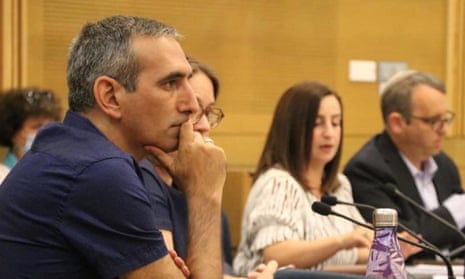
 Avi Dabush

Avi Dabush at an Israeli Knesset committee meeting in 2021. He will speak in Sydney and Melbourne on the path to peace in Israel and Palestine.

Rabbis for Human Rights director Avi Dabush sees a ceasefire as consistent with values of peace and human rights

Foreign affairs and defence correspondent
Tue 2 Apr 2024 01.00 AEDTLast modified on Tue 2 Apr 2024 08.12 AEDT

Avi Dabush felt as if he was “in a nightmare” and worried “maybe this is the end” when his family spent eight hours hiding from Hamas militants in Kibbutz Nirim in southern Israel.

So the executive director of the organisation Rabbis for Human Rights speaks with authority when he says the 7 October attacks have caused “a very deep and open wound” on Israeli society.

But Dabush, who arrived in Australia this week to give lectures on the path to peace, also strongly supports a ceasefire and doubts Israeli military force will bring lasting peace.
“I believe this is one of the biggest threats right now: that people, even though we are 170 days after the beginning, still believe that only with force we can make a new and better reality. And I don’t believe that.”

If the Israeli government flatly dismisses criticism from Australia and other allies, Dabush warns, “we will get ourselves into a place that we feel that we are right 100% and all the world doesn’t understand or is against us. It’s a very bad place to be.”

‘Radical dehumanising from both sides’

Dabush, his wife and her children, aged 12 and 15, took cover early on 7 October when they heard sirens warning of rockets fired from Gaza.

“So we ran to the shelter, the four of us and our dog,” he says, recalling that at one point he could hear Hamas militants “beside our window shouting commands”.

“We were there for eight hours till the army, the IDF, came into our house to clear it. It was very scary.”

Dabush says five people were killed in his kibbutz and five others were taken hostage. He prays for a ceasefire and the release of hostages.

He believes it would be good – for Israelis and Palestinians – if Hamas can be broken as a military force and no longer rule Gaza, but is also wary of the wider effects of Israel’s military operations.
“We know, as it was in Protective Edge [the 2014 war] and other rounds, that more and more people in Gaza really hate Israel because of their experience: their houses are ruined, they are starving, their family members are dead. So it’s not bringing hope.”

Dabush calls out “very deep and radical dehumanising from both sides”, including by Israelis who might portray a Palestinian child as a potential Hamas sympathiser or future militant. The 7 October attack, meanwhile, “shows us a very deep dehumanising of the Israelis or the Jews on the border”.

A ceasefire and two states

The Australian government has repeatedly condemned the Hamas attacks, but has also spoken out about the “dire” humanitarian crisis in Gaza and urged Israel to avoid a “devastating” ground offensive in Rafah where Palestinian civilians are sheltering.

The Israeli prime minister, Benjamin Netanyahu, said two weeks ago: “To our friends in the international community I say: ‘Is your memory so short? So quickly did you forget October 7, the most terrible massacre committed against Jews since the Holocaust?’”

Dabush – who will address events in Sydney on Tuesday and in Melbourne next week – says it is “OK and also important” for friends to “speak frankly with Israel”.

Israel’s security, he says, should be accompanied by human rights for Palestinians “and we must get help from Australia, from our allies, to go down that route”.

His organisation, Rabbis for Human Rights, sees a ceasefire as consistent with values of peace, human rights, justice and equality.

“We believe that it’s not about Jews against Arabs, or Israelis against Palestinians, or vice versa. It’s about the people who believe in those values against the people who do not.”

Avi Dabush carrying an olive plant
Avi Dabush helping Palestinian farmers plant olive trees in the occupied Palestinian territories in 2021. Photograph: Rabbis for Human Rights

Dabush says while Rabbis for Human Rights does not have a position on the specific model for a diplomatic solution, “we are against occupation because this is a root of so many violations of human rights”.

He is also part of a separate movement called A Land For All that supports a future confederation of two states.

“Its philosophy is against separation because we understand that we must live, from the river to the sea, Jews and Arabs together,” Dabush says. “We support the notion of two states but with open borders like the European Union.”

Michael Chaitow, executive director of the New Israel Fund Australia which is sponsoring Dabush’s visit, says he is “proud to partner with leaders like Avi who, despite facing the horrific violence and senselessness of October 7th, are committed to peace-building as the only path out of this conflict”.

Israeli military withdraws from Gaza's Al-Shifa Hospital after two-week raid.

Extract from ABC News 

ABC News Homepage


Aftermath at Gaza's Al-Shifa Hospital after Israeli troops withdraw.

The Israeli military has withdrawn from Gaza's largest hospital after a two-week raid, leaving behind Palestinian bodies scattered in the dirt and a vast swath of destruction.

Hundreds of people, including some who had been sheltering in Al-Shifa Hospital, rushed back to check damage and hunt for belongings.

Mohammed Mahdi, who was among hundreds of Palestinians who returned to the area, described a scene of "total destruction".

He said several buildings had been burned down and that he had counted six bodies in the area, including two in the hospital courtyard.

Footage circulated on social media and not yet verified showed the bodies of dead Palestinians, some covered in dirty blankets, scattered on the ground around the charred hulk of the hospital building, which had many outer walls missing.

It showed mounds of dirt that had been churned up by bulldozers, and numerous buildings outside the facility either flattened or burned down.

"I haven't stopped crying since I arrived here, horrible massacres were committed by the occupation here," said Samir Basel, 43, speaking to Reuters via a chat app as he toured Al-Shifa.

"The place is destroyed, buildings have been burnt and destroyed. This place needs to be rebuilt — there is no Shifa hospital anymore," Mr Basel said.

Another resident, Yahia Abu Auf, said there were still patients, medical workers and displaced people sheltering inside the medical compound after several patients had been taken to the nearby Ahli Hospital.

He said army bulldozers had ploughed over a makeshift cemetery in Al-Shifa's courtyard.

"The situation is indescribable," he said. "The occupation destroyed all sense of life here."

The UN health agency said several patients died and dozens were put at risk during the raid, which brought even further destruction to a hospital that had already largely ceased to function.

Israel claims successful raid

The Israeli Defense Forces (IDF) described the raid as one of the most successful operations of the nearly six-month war.

It claimed to have killed and detained hundreds of militants, including senior operatives, and seized weapons and valuable intelligence documents, lost two soldiers in fighting, but sought to prevent harm to civilians, patients or medics.

Israel has accused Hamas of using hospitals for military purposes and has raided several medical facilities. It says it launched the raid after Hamas and other militants had regrouped there.

Hamas and medical staff deny that Palestinian fighters have any armed presence in hospitals.

Gaza's media office said Israeli forces killed 400 Palestinians around Al-Shifa, including a woman doctor and her son, also a doctor, and put the medical facility out of function. There was no immediate Israeli response.

"The occupation destroyed and burnt all buildings inside Al-Shifa Medical Complex. They bulldozed the courtyards, burying dozens of bodies of martyrs in the rubble, turning the place into a mass graveyard," said Ismail Al-Thawabta, director of the media office.

"This is a crime against humanity."

Critics accuse the army of recklessly endangering civilians and of decimating a health sector already overwhelmed with war-wounded.

Palestinians say Israeli troops forcibly evacuated homes near Al-Shifa Hospital in downtown Gaza City and forced hundreds of residents to march south.

One video obtained by Reuters showed some Palestinians returning to the area to retrieve mattresses and other belongings from under rubble where they had previously been sheltering.

"We evacuated hoping to come back and find my belongings. I have nothing left. My house was bombed and everything has gone. I have nothing left," one woman told Reuters.

"I sought shelter at schools but they told me there was no space for me. Where do I go?"

A spokesman for Gaza's Civil Emergency Service said Israeli forces had executed two people whose bodies were found at the complex in handcuffs, and used bulldozers to dig up the grounds of the complex and exhume buried bodies.

Reuters could not verify the allegation of executions and Israel's military did not immediately respond to a request for comment.

At least 21 patients have died since the raid began, World Health Organization Director-General Tedros Adhanom Ghebreyesus posted late Sunday on social media site X.

He said over a hundred patients were still inside the compound, including four children and 28 critical patients.

He also said there were no diapers, urine bags or water to clean wounds, and that many patients suffered from infected wounds and dehydration.

The military had previously raided Al-Shifa in November, after saying Hamas maintained an elaborate command and control centre inside and beneath the compound.

It released images of a tunnel running beneath the hospital that led to a few rooms, as well as weapons it said it had confiscated from inside medical buildings, but nothing on the scale of what it had alleged prior to the raid.

Gazans driven to brink of famine 

Israel's air, land and sea offensive has killed at least 32,845 Palestinians and injured 75,392 , Gaza's Health Ministry said on Monday.

There have been 63 Palestinians killed and 94 injured in the past 24 hours, the ministry added.

The ministry does not distinguish between civilians and combatants in its count but says women and children have made up around two-thirds of those killed.

This offensive began after Hamas-led militants stormed into southern Israel on October 7, 2024, killing some 1,200 people, mostly civilians, and taking around 250 people hostage.

The IDF says it has killed over 13,000 Hamas fighters and blames the civilian death toll on Palestinian militants because they fight in dense residential areas.

The war has displaced most of the territory's population and driven a third of its residents to the brink of famine.

Northern Gaza, where Al-Shifa is located, has suffered vast destruction and has been largely isolated since October, leading to widespread hunger.

Israel said late last year that it had largely dismantled Hamas in northern Gaza and withdrew thousands of troops.

But it has battled militants there on a number of occasions since then, and the two weeks of heavy fighting around Al-Shifa highlighted the staying power of the armed groups.

Israel's Prime Minister Benjamin Netanyahu has vowed to keep up the offensive until Hamas is destroyed and all of the hostages are freed.

He says Israel will soon expand ground operations to the southern city of Rafah, where some 1.4 million people — more than half of Gaza's population — have sought refuge.

But he faces mounting pressure from Israelis who blame him for the security failures of October 7 and from some families of the hostages who blame him for the failure to reach a deal despite several weeks of talks mediated by the United States, Qatar and Egypt.

Hamas and other militants are still believed to be holding some 100 hostages and the remains of 30 others, after freeing most of the rest during a cease-fire last November in exchange for the release of Palestinians imprisoned by Israel.

Tens of thousands of Israelis thronged central Jerusalem on Sunday in the largest anti-government protest since the country went to war in October.

Deep divisions over Netanayahu's leadership long predate the war, which still enjoys strong public support.

AP/Reuters

The young Israelis who are risking prison time rather than fighting for the IDF in Gaza.

Extract from ABC News

ABC News Homepage


Eighteen-year-old Sofia Orr is about to be sent to jail for refusing to fight in the Israel-Gaza war.

The teen is standing outside Israel's military enlistment office near Tel Aviv, with her enlistment order in one hand, and a backpack with some clothes in the other.

Sofia doesn't know how long she'll be imprisoned for, but the thought of betraying her morals scares her more than the thought of a prison cell.

"It's a scary thing, I'm nervous," she says.

"But I also think that it's a very powerful thing — it's the power of saying no, of standing by my values and fighting for that voice of peace and a voice of love.

"I'm doing it, at the end of the day, as an act of love for people, all people, who live from the river to the sea." 

Sofia is what's known as a refusenik – a person who refuses to serve in the Israeli military.

The state of Israel requires every citizen over the age of 18 to serve in the military for a minimum of 24 months for women, and 32 months for men.

Religious women, married secular women, Palestinian citizens of Israel and people deemed medically or mentally unfit are exempt from compulsory service.

But everything changed on October 7 last year when Hamas-led militants stormed across the border, killing hundreds of civilians and taking 253 hostages back into Gaza. 

'Violence only leads to more violence'

After the Hamas-led attacks, the Israeli Defense Forces (IDF) summoned 360,000 reservists soldiers to join the country's fight.

Thousands of young Israelis living overseas rushed home for reserve duty in such great numbers the national carrier El Al put on extra flights to deal with the influx.

Three IDF soldiers
Israel mobilised 360,000 reservists after the country's south was attacked by Hamas-led militants on October 7. (ABC News: Haidarr Jones)

And while some others have refused to join the fight, the IDF hasn't revealed the number of objectors since October 7.

Sofia's objections are purely moral and she will be deemed a contentious refuser.

"I decided to refuse before the war because of [Israel's military] occupation … in the West Bank," she says.

"That was enough reason for me to say that this will never lead to any solution and we have to work on a real solution, which will be peace, equal rights [for] everyone who lives here."

Sofia says the war made her decision even more important to her.

"Violence only leads to more violence. And I can't stand for that," she says. 

A young woman with a protest sign in Hebrew
Sofia Orr says she's a refusenik because she doesn't believe violence will solve anything. (ABC News: Haidarr Jones )

"And I have to raise a voice against it, both for myself to make that stand, and … [for] young people in Israel, to show them that this is an option." 

As Sofia waits to enter the enlistment office, she is flanked by a small group of anti-war protesters, who chant slogans of encouragement.

"We don't shoot, we don't massacre, we refuse to be murderers," they yell.

"There is no difference between blood — we are all humans".

'How can you come out against the state?' 

Before the war, refuseniks in Israel were stigmatised, but Sofia says the decision is now seen as a national betrayal.

"I've been called a traitor, I've been called a self-hating Jew, saying I should be raped or killed," she says.

"And I've been called … naive or ungrateful."

Young men and women in Israeli military uniforms gather to watch the small crowd of anti-war demonstrators, some of them sneering at the objectors and others laughing in amusement.

A group of Israeli soldiers holding guns
Some IDF soldiers watch as protesters demonstrate outside Israel's military enlistment office near Tel Aviv. (ABC News: Haidarr Jones)

One young Israeli woman, Almaz, shouts from a nearby bus stop that Sofia's behaviour is "contemptuous".

"I think this is horrible, especially considering we are going through a war right now," Almaz says.

"I was a combat soldier who has done reserve duty since October 7. How can you come out against the state?

"There's nothing sadder than that, to see people who go out and their people and try to justify pacifists or not enlisting into the army, especially in these difficult hours we are in. It's just sad."

A woman with red hair
Almaz believes the behaviour of refuseniks is "contemptuous". (ABC News: Haidarr Jones)

But Sofia says she sees the situation differently.

"The IDF is escalating the situation and not solving it, and only making sure that more people get killed in this cycle of violence," she says. 

"I want the best for everyone and I'm doing it for the security of everyone and I'm doing it as an act of solidarity."

Ariel has been shunned by his family 

Ariel Davidod is another refusenik. He objects to Israel's occupation of the Palestinian territories and serving in the military has been a long-held view.

A young man in glasses
Ariel says he has been shunned by some of his family because he is a refusenik. (ABC News: Haidarr Jones )

But when he was called up for enlistment on October 10 he was proud to refuse. 

He received an exemption without having to go to jail – but he doesn't know why.

"I was ready to serve my sentence in jail for not cooperating with the war," he says.

"From the beginning of the war, I realised that there is no way of serving in the army. Even through the worst trauma the Israeli people have experienced, violence won't be the solution.

"We won't be able to bring back our lost ones by killing and murdering other innocent children in Gaza."

Ariel says his decision has been met with hostility from strangers, and he's been shunned by his family.

"My family is really right wing — it is tough," he says.

"Many connections have been cut, and I don't speak to many members of my family.

"It is tough on holidays. But I'm willing to lose some of those privileges because I see how important what I'm struggling for is."

Sofia learns her fate before a military judge 

Back at the enlistment office, Sofia enters the building to learn her fate, while her crowd of supporters shout "I love Sofia".

A man hugs a teenage girl
Sofia's dad, who supports her decision to refuse conscription, gives her a hug before she goes into the building. (ABC News: Haidarr Jones)

Once inside, she is taken before a military judge who sentences her to 20 days in prison.

When she finishes her prison term, the IDF can order her to present for military duty again.

If she refuses, she'll likely face another jail sentence.

But Sofia is prepared and says she won't stop resisting the Israeli law.

"I want to advance this peace, to show that this change is possible and it's important to work for it," she says. 

"And for this, it's important to me to come here and refuse, in solidarity and with empathy that is not limited by any nationality.

"It's not a situation of us against them, where someone can beat someone else."

Monday, 1 April 2024

‘There will be no day after’: hopes fade to end war in shattered, traumatised Gaza.

Extract from The Guardian

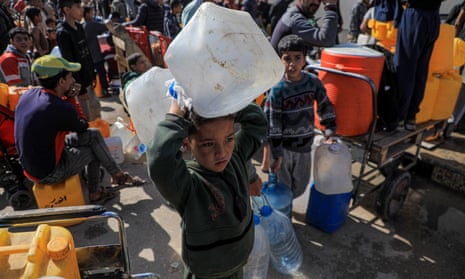
 A boy holding empty plastic water containers above his head

Palestinians wait to collect water in the southern Gaza city of Rafah, where there are a million displaced people.

Across the Middle East, a painful realisation is dawning – there will be no clean truce to hostilities.


in Jerusalem
Sun 24 Mar 2024 03.00 AEDTLast modified on Sun 24 Mar 2024 09.27 AEDT

Six months ago, Hussein al-Auda had a good job with a big international non-governmental organisation (NGO), a new baby, two curious and clever older children and a small house in Gaza City.

Now the 37-year-old is alone in Rafah, Gaza’s southernmost city, living in a half-derelict block of flats, looking after his elderly parents.

He spent his life savings to get his wife and children out of the territory to Egypt and is living on tinned beans handed out by the same, now struggling NGO that he worked for. His car and home were destroyed in an airstrike and another attack killed a dozen members of his extended family.

Despite the possibility that a UN resolution calling for an end to hostilities may eventually be passed and with indirect talks in Qatar about a ceasefire between Hamas and Israel continuing, Auda does not think any real peace will come soon.

“Everything has an end, but [at] its end, which is far away, a new war will begin,” he told the Observer.

Among Israelis, Palestinians and across the Middle East, a slow and painful realisation is gaining ground. Almost six months after the surprise attacks by Hamas that triggered the war in Gaza, it is now becoming clear that there will be no “day after”.

Many are now convinced there will be no clean end to the hostilities that initially killed more than 1,100 Israelis, mostly civilians, in Hamas’s raids into Israel in October, then at least 32,000 in Israel’s ensuing military offensive.

Moves to bring a ceasefire may lead to a momentary pause before violence and the acute humanitarian crisis in Gaza continue, albeit at a perhaps lower rhythm and intensity, possibly for years to come.

The truce being discussed in Doha would last for six weeks. Hamas has dropped its insistence on a definite agreement to progress through phases to a permanent ceasefire.

This would have allowed the Islamist militants to remain in control of a portion of Gaza for the foreseeable future and so declare some kind of a victory on the basis that, if a conventional army needs to win, an insurgent force needs only to survive.

Debris of destroyed buildings following ab Israeli airstrike in Khan Yunis, Gaza.
Debris of destroyed buildings following an Israeli airstrike in Khan Yunis, Gaza. Photograph: Anadolu/Getty Images

Benjamin Netanyahu, Israel’s prime minister, has told his negotiators that only a six-week initial pause is acceptable and insisted on Friday that Hamas will only be defeated once Israeli troops enter Rafah, where a million displaced people including Auda are sheltering, in order to destroy the organisation’s last remaining coherent armed force and find its leaders.

If the US would not support this assault, Israel would do it alone, Netanyahu said. Many fear that this is not a sound basis for a permanent end to the conflict.

“I hope we won’t be in a vicious cycle of attacks, then [Hamas] regenerates, then more attacks, or it will be a never-ending story,” said Neomi Neumann, a visiting fellow at the Washington Institute, who formerly served as head of the research unit at Israel’s security service, Shin Bet.

Nor, many aid workers on the ground in the territory now believe, will there be any sudden restoration of a semblance of order in Gaza, even if there is a ceasefire that holds.

Aid would not flood into the territory, but a sputtering spigot of humanitarian assistance may just deliver enough to keep most, but probably not all, people from starving.

There will be no immediate start of a phase of reconstruction of the cities of Gaza either – just an end to their systematic demolition.

The sheer scale of the humanitarian need is yet to be realised, many say. James Elder, spokesperson for Unicef, last week described the massive overcrowding on Gaza’s coastal road – one of the few existing thoroughfares in the territory usable by lorries and other vehicles – where hundreds of thousands of people “are sleeping in the streets, on the beach, on the sand behind the beach, in any available space”.

In northern Gaza, hundreds of thousands are surviving with inadequate food supplies amid an almost total breakdown of civil order and renewed combat. In al-Mawasi, a strip of sandy coast west of Rafah where there is no water, little food and no sanitation, new encampments shelter an unknown number.

They are there because al-Mawasi has two big advantages: its fine soil makes it impossible to dig the tunnels that Hamas has built underneath the rest of Gaza and there are no high-rise buildings. Both factors make the area safer, say those who have sought out the zone.

There are also no underground targets that may attract an Israeli airstrike, and there are no neighbours above or below whose identity – unknown to even those who live so close because of the chaos of mass displacement – may do the same.

A dozen different scenarios have been floated for the administration of the territory and the lives of its 2.3 million shattered, hungry, traumatised inhabitants. None are convincing, analysts say.

These range from the involvement of the Palestinian Authority, which is being pushed by the US but rejected by Israel, to some kind of local government by clans and powerbrokers in Gaza, which is favoured by Israel but deemed utterly unworkable by almost every observer.

Few believe that any kind of multinational peacekeeping force can be set up, or that the Gulf states will put up the vast sums necessary for reconstruction. The result is a slow slide to the default option, where the men who can muster the most coercive force take control.

In Israel, the idea that Israeli officials should run Gaza directly is gathering momentum.

“The best plan for the day after is … [Israeli] boots on the ground and [an Israeli] civil administration that operates in the Gaza Strip,” wrote commentator Nadav Shragai in Israel Hayom, a newspaper close to the government. “Anything else would be temporary and short-lived at best; in the worst case scenario, it would be a sham and conceit from the get-go.”

Many who have watched the war evolve over half a year believe that any discussions about a new post-conflict era are misleading and misplaced.

“The ‘what we should do on the day after’ conversation feels surreal,” said one veteran aid official based in Washington. “It is based on assumptions that this thing is going to be over soon. I worry that it will be going on like this for a very long time.”

Relatives of hostages held in Gaza know time is running out and are pressing for a pause to allow their release. After a break in hostilities, Palestinians and Israelis could think more clearly about future options, some said.

Gil Dickmann, a psychology student in Tel Aviv whose 39-year-old cousin Carmel Gat was abducted by Hamas and is still being held in Gaza, believes that the “total victory” repeatedly promised Israelis by Netanyahu is an illusion.

“It won’t end that way. This is a very different war … But it is not a never-ending conflict. We have been living this my whole life as a 31-year-old Israeli … We saw on 7 October that you can’t manage a conflict – the conflict manages you,” said Dickmann, who is calling for a pause now to allow his cousin and all the other hostages to be freed.

“It will take time to end a hundred years conflict, but it can be ended.”

‘We know the community is over it’: how self-regulation of gambling ads came unstuck minutes into an AFL game.

Extract from The Guardian

Clubs and bookmakers have set their own restrictions as campaigners await a decision on a proposed ban.


Mon 1 Apr 2024 01.00 AEDTLast modified on Mon 1 Apr 2024 01.48 AEDT

Just minutes after the first bounce in a round one AFL game, families watching on free-to-air television were exposed to more than 70 gambling ads – and all before 8pm.

The fluorescent ads for gambling giant Tabcorp were splashed on digital billboards, despite the company previously declaring there was “too much advertising” and that change was necessary to protect vulnerable people.

“Australian families should be able to watch live sport without being bombarded by gambling advertising,” Tabcorp’s then chief executive, Adam Rytenskild, said in March last year.

Tabcorp concedes it breached its policy of not advertising between the hours of 6.30am and 8.30pm – which is beyond what it is required to do by law. The company says displaying the ads during this time was a mistake.

“Our position on in-stadium advertising is the same as our position on free-to-air television advertising – we don’t advertise before 8.30pm and have not done so since an error was made in Round 1,” the spokesperson said.

“We know the community is over it and it’s the right thing to do.”

According to current rules and regulations, Tabcorp did nothing wrong. While ads cannot be broadcast during matches, bookmakers can pay for pitch-side ads within view of cameras. It’s a loophole that public health experts want tightened.

“This signage creates an impression for young people that gambling is embedded as part of the game,” said Samantha Thomas, a gambling researcher at Deakin University.

“Governments have a responsibility to close the range of channels that the gambling industry can use to promote its products and create brand awareness and loyalty – particularly with a view to protecting children and young people.”

‘Disappointing and frustrating’

Tabcorp’s “error” is the latest example of how, in the absence of a long-awaited regulatory crackdown, bookmakers and clubs have begun to self-regulate themselves to different standards. A conflict over gambling ads is one reason why the powerful wagering lobby splintered in recent months.

Five years ago, the Geelong Cats banned all gambling ads at its home ground. The Sydney Swans agreed to do so in 2021. Gambling ads remain at the MCG – although they have decreased in recent years – and there appears to be no limit at the Gabba in Brisbane.

All Victorian AFL clubs have turned their backs on gambling sponsorships, while the Brisbane Lions and the GWS Giants have a sponsorship deal with Tabcorp. The AFL itself continues to take a cut of every bet placed on the sport, and promotes bets for its official wagering partner, Sportsbet, that have a high failure rate.

These inconsistencies have frustrated AFL fans still waiting for regulation. A survey conducted by the AFL Fan Association found 79% of respondents supported a ban on gambling ads at stadiums. When that result was released more than a year ago, the association’s president, Ron Issko, hoped the government would act.

“It’s disappointing and frustrating,” Issko says. “Fans had clearly said that they want gambling ads significantly reduced, if not abolished, at grounds, on TV, on radio, on social media – and they are concerned we are normalising gambling.

“We are potentially grooming our kids to become gamblers. We get a number of parents writing to us saying, ‘my 11-year-old son knows the odds of who is going to kick the first goal’. What is going on?”

A proposed ban

The Albanese government is yet to respond to a parliamentary inquiry, led by the late Labor MP Peta Murphy, which called for a total ban on gambling ads, after a three-year transition period. While broadcasters don’t expect a total ban, the communications minister, Michelle Rowland, has said the “status quo” is untenable.

“The government is examining restrictions and engaging with stakeholders, including harm reduction advocates, health experts and industry, as we develop our policy,” Rowland said earlier this year.

A government response to the inquiry was due by the end of 2023.

Multiple gambling industry sources suggest the response was delayed after Murphy, 50, died.

Like Issko, the Royal Australian and New Zealand College of Psychiatrists’ president, Dr Elizabeth Moore, is also concerned by the delay. Moore is calling on the government to adopt the Murphy inquiry’s recommendation.

“There is a strong correlation between problem gambling and comorbid mental health disorders, including depression, anxiety, and personality disorders,” Moore says.

The shadow communications minister, David Coleman, also says action is overdue. More than a year ago, the federal opposition proposed a ban on all gambling advertising an hour either side of live sport matches.

“Had the government supported our bill the restrictions on gambling adverts during live sport would already be in place and running by now,” Coleman said.

The government has already introduced regulation to protect consumers from gambling harm, including a national self-exclusion register and more assertive public health warnings on broadcast ads. But Moore and others believe those changes don’t go far enough.

Tim Costello, the chief advocate for the Alliance for Gambling Reform, says the return of football has reminded many families of what they hate: “a tsunami of gambling and sports betting ads”.

“Fans hate it,” Costello says. “Parents hate it. But the AFL is unmoved. Do gambling interests now completely own our game?”