Tuesday, 23 February 2016

Half the price in half the time: solar storage innovation harnesses new energy frontier

Extract from The Guardian

Brisbane company Redback Technologies, backed by researchers from the University of Queensland, says it has cracked the formula for the most cost-effective solar storage system on the Australian market

Low-cost solar solutions for residential and commercial users has been seen as the holy grail of the new energy frontier. Photograph: Seth Perlman/AP


Tuesday 23 February 2016 12.34 AEDT

If Tesla’s Powerwall is the “Lamborghini” of the solar storage industry, a small Brisbane company backed by University of Queensland researchers says it has hit on the formula to deliver the “Toyota”.
Redback Technologies, which last week inked a commercialisation deal with UQ, claims to have harnessed the power of algorithmic software and efficient design to produce the most cost-effective solar storage system on the Australian market.
Despite relying on a smaller battery than the Powerwall – which is widely expected to be the catalyst for rapid growth of the solar storage market this year – Redback says its “Ouija board” system, available from June, will pay for itself in half the time.
Redback’s founder and managing director, Philip Livingston, said it would take an average 5.6 years to earn back the Ouija’s $9,000 price tag through electricity bill savings, versus 11 years on the Powerwall’s $15,000 to $17,000 installation cost.


Philip Livingston, founder and managing director of Redback Technologies.
Livingston said the company, set up just last year, was less concerned with batteries as the cutting edge of the household solar energy market as it was with tackling its key problem: how can households consume more of the power their solar panels produce?
“We’ve realised that even if batteries were free today, they only count for about 25-30% of an overall system cost, which means you don’t get anywhere near a five-year return on investment,” he said.
Five years was considered the benchmark in 2012, when returns for solar panel owners selling back to power companies were at their high-water mark before state governments drastically cut those rates.
“Fundamentally, the big thing we all need to be talking about as consumers is not batteries or whatever, but self-consumption – that is the itch we have to scratch,” Livingston said.

The big thing we all need to be talking about as consumers is not batteries but self-consumption
Philip Livingston
The average solar-powered house consumed only 25-30% of the power it produced, the rest now fetching scant rates on the wholesale power market, he said.
The Powerwall, with its Lithium battery, would take “self-consumption” to 57%.
The Ouija system would better that at 61%, while costing a third of the Powerwall, Livingston said.
This was in part because of a different approach to design, he said. Redback’s system components were not separated out and were lighter, he said, meaning they could be installed more quickly and by fewer staff.
“The heaviest unit in the device is the inverter, it’s 40kg; the battery enclosure we bring out next month is 25kg and each battery you place inside it is 20kg and they’re all outdoor-rated,” Livingston said.
“So effectively, a few guys and a small truck can get it installed rather than four guys and a crane, which is what you need for a Powerwall.
“In integrating these systems, what needs to be considered is not just the aesthetic, but that all the other elements add cost when integrating a system.
“While it’s great to have a battery that’s really sexy, at the end of the day, a lot more people buy Toyotas than they do Lamborghinis – or Teslas for that matter.”
Redback also claims to more efficiently exploit its smaller battery by using a cloud-based software platform to control appliances such as “hot water systems, heaters, pool pumps and the like”.
“It’s not being done by a person per se – although they can put schedules in – but by machine learning and that’s where we’re going with this,” Livingston said. “People don’t have to be focused on using expensive hardware solutions for things that can be done with software.”

Redback Technologies’ ‘Ouija board’ solar storage system.
Redback Technologies’ Ouija solar storage system.

This reliance on software to boost the efficient use of power is what led Redback to signing its memorandum of understanding with University of Queensland last week. “Who better than a university that specialises in the creation of heuristic algorithms for machine learning?” Livingston said.
“By working with UQ we are getting years and years of experience of analytic calculations, supercomputers they have on site, and we are able to use their faculties and build machine-learning capabilities that allow us to optimise these types of scenarios so we can become even less reliant on batteries over time.”
Learning to drive energy efficiency through software is a “rabbit hole that continues to grow because we are learning how to optimise these scenarios to a greater and greater extent”, Livingston said.
While the hardware is designed in Seattle and manufactured in China, all the intellectual property is generated in Brisbane, where the company has 16 staff and plans to increase its ranks of engineers.
Livingston, whose early career included installing solar water systems in the Philippines with the US Peace Corps, said he believed the Australian market for solar storage systems would soon “cut across the ‘chasm’, as they call it, of early adopters into the early majority” in line with the one in five households that now had solar panels.
“It should be quick because the economics are going to get even better than they are now,” he said.
Dean Moss, the chief executive of UniQuest, the University of Queensland commercialisation arm whose past projects include the cervical cancer preventing vaccine Gardasil, said the collaboration with Redback would “convert research discoveries into exciting, innovative new products that create change”.
Paul Meredith, the director of UQ Solar, said the company with its “energy storage innovations [and] entrepreneurial drive” would be tapping into an institution with “a rich history of cutting-edge renewable energy research, particularly in the systems integration space”.

Sea levels rising at fastest rate in 2,800 years due to global warming, studies show

Extract from The Guardian  

Higher temperatures as a result of industrialisation blamed for the acceleration, as scientists predict 131cm rise by year 2100

A young girl wades through the incoming sea water that flooded her house and village in Kiribati.
A young girl wades through the incoming sea water that flooded her house and village in Kiribati. Photograph: Jonas Gratzer/LightRocket via Getty Images
Sea levels are rising several times faster than they have in the past 2,800 years, with the process accelerating because of manmade global warming, according to new studies.
An international team of scientists examined two dozen locations across the globe to chart rising and falling seas over centuries and millennia.
Until the 1880s and the world’s industrialisation, the fastest seas rose was about 3cm to 4cm a century. During that time global sea levels did not get much higher or lower than 7.6cm above or below the 2,000-year average. But in the 20th century the world’s seas rose 14cm.
Two different studies published on Monday in the journal Proceedings of the National Academy of Sciences said that by 2100 the world’s oceans would rise between 28cm to 131cm, depending on how much heat-trapping gas Earth’s industries and vehicles expel.
Rutgers earth and planetary sciences professor Bob Kopp, lead author of the study, which looked back at sea levels over the past three millennia, said: “There’s no question that the 20th century is the fastest.
“It’s because of the temperature increase in the 20th century which has been driven by fossil fuel use.”
Sea level rise in the 20th century was mostly manmade, the study authors said. A separate, not-yet-published study by Kopp and others found that since 1950 about two-thirds of the US coastal floods in 27 locales were linked to manmade warming.
Study co-author Stefan Rahmstorf, of the Potsdam Institute for Climate Impact Research in Germany, said that if seas continued to rise as projected, another 45cm would cause lots of problems and expense, especially with surges during storms.
“There is such a tight relationship between sea level and temperature,” Horton said. “I wish there wasn’t, then we wouldn’t be as worried.”
If greenhouse gas pollution continues at the current pace, both studies project increases of about 57cm to 131cm. If countries fulfil the treaty agreed upon last year in Paris and limit further warming to another 2F, sea level rise would be in the 28 to 56cm range.
Jonathan Overpeck at the University of Arizona, who wasn’t part of the studies, praised them, saying they show a clear cause and effect between warming and sea level rise.

MASH star Alan Alda partners with Australian National University to boost science communication

Extract from ABC News

Updated yesterday at 3:51pm
Television legend Alan Alda has partnered with the Australian National University (ANU) as part of a global push to bolster science communication, which he says will counter the thinking behind movements like anti-vaccination campaigns.
Best known for playing Hawkeye in the lead role of the iconic television program MASH, Alda has also had a long association with science communication, hosting the documentary series Scientific American Frontiers for 12 years.
He is also the head of the Alan Alda Centre for Communicating Science, which has entered a partnership agreement with the ANU Centre for the Public Awareness of Science.
Take the vaccine debate ... It's a communication problem when people make their minds up based on rumour, and don't think in a way that relies more on evidence.
Alan Alda, science communication advocate
The agreement is the first international partnership the Alda Centre has entered into.
Alda told 666 ABC Canberra the centre had made several novel approaches to bettering scientists' communication skills, including providing training in improvisational acting.
"I experimented with a group of engineering students, and within a few hours I saw an improvement in the way they related to an audience," he said.
"It puts you in touch with the mind of the person you're communicating with."
Alda recognised the importance of clear scientific communication while conducting interviews for Scientific American Frontiers.
"It was a chance to talk with scientists all day long while we were shooting these interviews," he said.
"There was something about the way we were doing it that made the science come out with more clarity and more vividness.
"We were having a genuine conversation ... and that made them much more available to me, the real them came out."

End goal to get public 'thinking like scientists'

Alan Alda with two workshop participants.

Photo: Alan Alda has experimented with using improvisation workshops to improve scientists' communication skills. (Supplied: Alan Alda Centre for Communicating Science)

Alda said there was a renewed push within universities to ensure important, and often complex, scientific ideas were explained to the public.
"Universities now are really understanding that you can make true progress by teaching communication to scientists," he said.
"It's possible to get them to be clearer, more generous with their thinking, more personal with their presentation, and more understandable with their language.
"What this does is not just enlighten the general public, but it makes it clear to the policy makers and the people who grant money for scientific research ... what you want the money for."
The end goal for the push is to get more members of the public thinking like scientists.
"It'll bring about more of those people who think in a way that is based on evidence," Alda said.
"Take the vaccine debate ... It shouldn't be a debate.
"Scientifically the issue is settled, vaccinations do not bring about some of the bad effects that people are worried about.
"And yet it's a communication problem when people make their minds up based on rumour, and don't think in a way that relies more on evidence.
"Better communication will help us think more like scientists."
Alan Alda will visit Canberra next month, and give a public talk at the ANU on March 9.

Saturday, 20 February 2016

Letters to Editor June 22 1895.

*THE WORKER*
BRISBANE JUNE 22, 1895.


Mail Bag.


WANTED – (to prepare way for Socialism in our time).
One Adult One Vote.
Land tax.
Income tax.
State bank.
Shops and Factories Act.
Eight hours day where practicable.
Referendum and Initiative.
Taxation of every person according to ability to pay.
The State to find work for unemployed.
The State to fix a minimum wage.
Free Railways. Free administration of Justice.

____________

The WORKER does not hold itself responsible for the opinions of its correspondents.

____________

T.I.M. - Right.
E.J. - Held over.
G.J. - Thanks; will use.
J.B. - Have abbreviated.
TAROOM. - Noted last week.
H.J., Dipso, State Socialist. - later.
ANONTMOUS,. - May be so, but what of that?
A.V., South Brisbane. - Would like to hear further from you.
J.W., Childers. - Read “Merrie England” on that question. By post, 4d.
H.A.E. Writes in praise of the late Mr. Kendall of the Royal Exchange Hotel, Cunnamulla.
______________

ED. WORKER – I think £2 of every £10 subscribed in the West for hospitals should be sent to the Rockhampton Hospital. Numbers of serious chronic cases from the West come here, and I think it only right that some of the subscriptions should also come with them.
FRED WILSON, Rockhampton Hospital.

ED. WORKER – This Angus Gibson agreement, recently presented to your readers, is an interesting one, and is well worthy the consideration of the Labour Party in asmuch as it emanates from a man who poses as a benefactor to those who wish to get on the land. The agreement is a hard, grinding document, and eminently conducive to get the unfortunates who are foolish enough to sign it into a state in which they will prove a perennial source of income to one person only. I trust the Labour Party will give the crafty agreement full ventilation. It deserves it for obvious reasons. - SUGAR.

ED. WORKER – A word to station hands: If you see a fair young man of about 30 years of age, clad in Khaki, with mushroom shaped helmet, Vandyke fair beard, hair turning grey, a far away, dreamy look about the eyes – the result of study by the midnight oil – put on the brake. He is now temporarily located in the west. Owing to his representations in the first instance to influential patrons, three new police camps have been formed on one river. One camp is at a station part-owned by a squatter who is termed “the whitest man God put the breath of life in.” The other partner is a relative of the “Dook” of Northumberland and an absentee. I hear the police are quartered in a room adjoining the men's hut, and will no doubt be employed to assist branding and mustering the cattle among the lignum. - ELLERSLIE.

ED. WORKER – I have been working at the Great Western Hotel, Longreach, for the last year and eight months, and I suppose I must have given entire satisfaction during that time or I should not have been there so long. I worked from 6 in the morning till half-past 7 at night. I have to cook for thirty and sometimes as many as sixty people. On the night of the 25th of this month, after I had finished my work, the boss, carrying out a practice of many bush town publicans, asked me to go and dance. When I replied “Oh, no, not to-night,” he said, “Take a week's notice from to-night.” Now I think it very hard, considering that I had my foot badly scalded in his employ and was laid up three weeks in bed with it, and before it was well for the boss to ask me to dance, and then sack me for refusing. Yet this hotel is supported by all the leading and prominent union men that come in to this town. However, I hope they will show their manliness by treating the hotel in question with the same fair play as was dealt to me by the proprietor. - LIZZIR ORCHARD, Longreach, May 28.

Ed. WORKER - “If the Labour Party want separation from Great Britain let them say so.” - Courier, June 26. Of course they do. It would be strange if they did not. Why do we want separation! Because England is a nation of usurious money-brokers who are sucking the life-blood of Australia. Queensland has to pay £100,000 a month to these English Jews. “We live now within the security of the mightiest empire in the world.”
Yes, that security which a rope gives to a man about to be hanged. “We are Britons.” We are not. Many of us are descendants of Wallace and Bruce, O'Neill and O'Donnell. In the year 1654 the Puritan Government of England decreed “that the Irish as being too numerous now, be sold as slaver to merchants, and transplanted to Virginia, New England, Jamaica, and other countries.” Washington's success depended in a great measure on the assistance he received from the descendants of these Irish slaves. When an Australian Washington shall cross the Rubicon the descendants of the heroes of Beal-an-ath-a-buidh, the men who fled from the burning rafters of Glenleigh, Falcarragh and Clongorey, and the butchery of Mitchelstown, Tipperary and Yougbal will be found in his van; they will “Remember Limerick and British faith.” - DENIS LINERAN, 26th May, 1895.


ED. WORKER – Re the only J. R. D. at Wellington Point. “ Who is 'lovely women'! Who is 'unlovely woman'?” The old parliamentary hand most studiously abstained from defining the line of demarcation (if such a line existed). I will assist him, unasked, and you can bet your boots that he won't thank me for my trouble. “Lovely Woman.” I presume he means the “Society Miss,” on whom the thought of how to get her own living never dawns, born in the lap of luxury, fed on the fat of the land, clothed in purple and fine linen, educated, accomplished, and refined. They have no wish to vote; they are satisfied with their lot in life. And why not? “Unlovely Woman.” Yet lovely even in her unloveliness. There is but this one interpretation of J.R.D. It is she whom stern necessity compels to fight the battle of life single-handed; she has to face the bitter world and struggle in the seething mass of toilers, pushed here, jostled there: sometimes through hunger and weakness they fall and are trampled under foot; some rise again (but some, when once down, are so bruised and broken that they can rise no more, but sink lower and lower into the very depths of hell) for the simple right to live. Pleasures and enjoyment they have none. Hope is dead within them. All is swallowed up in the one thought, How am I to live! Is it any wonder that the feminine victims of the past mismanagement of the legislative machine should demand the right of a voice in the framing of the laws and conditions under which they live. - C. W.      

Labor's negative gearing reform proposal is economically responsible and fair

Labor’s reform proposal for negative gearing is well founded in fairness and economics. But like most reforms, particularly ones which remove a well-entrenched and significant market distortion, there are likely to be some consequences for the housing market and the economy as the reforms take effect.
The policy proposal would restrict negative gearing to investment in new dwellings from 1 July 2017, if Labor wins the election. Given the policy has now been well telegraphed and will take effect about nine months after the election, there will be a temptation for some investors to bring forward their purchase so they have an established dwelling in their property portfolio that is negatively geared.
This would likely force up the price of established dwellings. Louis Christopher, director of SQM Research, thinks there is a risk of a surge in investor demand for existing property as they scramble to take advantage of the grandfathering provisions. What happens after that is also important and Christopher notes that after 1 July 2017, “a subsequent slump could occur via the drop off in demand from investors”.
Of course, this assumes several issues which will have to be clarified if the proposal becomes law.


Importantly, for a significant bring-forward to occur, the banks would have to remain enthusiastic providers of capital for investors. If the banks don’t play that game, the price impact would be muted. Add to that some probable guidance from regulators to the banks on their lending for investment properties and it is possible if not probable that credit would not be easily forthcoming. The banks already take a more cautious approach to lending than they did prior to the GFC, partly of their own accord and partly from the lending guidelines already in place.
The other aim of the policy is to direct investment dollars into the construction of new dwellings. The hope is this would make houses more affordable and end the phenomenon where investors bid up the price of existing dwellings, squeezing first-home buyers out of the market.
After 1 July 2017, Christopher reckons there will likely be a surge in demand for new properties.
After all, negative gearing will remain in place, but as noted, only for new dwellings. It is likely this fresh and previously untapped demand for new properties will underpin more construction. The share price of several construction companies, Boral and CSR for example, are up around 10% since Labor announced their plan. The reform could therefore boost GDP, at the margin, as the dwelling supply builds over time.
If Christopher is correct, there could be financial risks for investors who do bring forward their purchase of established dwellings. If there is enough of a herd approach to “beat the change” and the price of established dwellings gets a boost, investors risk paying an artificially high price.
The risk comes after the rule change when demand for established dwellings from investors falls away sharply, as the tax distortion ends. Prices could be dampened but other issues such as interest rates, the overall health of the economy, unemployment and wages will have an influence on prices over and above this change.
For those looking to get into the property market and who have been held back by high prices, the reforms are good news with a pipeline of new supply likely to flow over time. Housing is like most other markets – extra supply relative to demand will dampen prices which, for housing, means improved affordability.
The proposed changes to negative gearing rules are economically responsible and fair. It is the sort of policy change that has been needed for many decades and the good news is it probably means the risks for house price booms in the future are greatly diminished and housing affordability, in time, will improve and home ownership rates, which have been falling, should again pick up.
It also means $30bn is available to the budget bottom line over the next decade which at the moment is something much needed in the quest to deliver a budget surplus.
Stephen Koukoulas is a research fellow at Per Capita, a progressive thinktank

Doctors to propose boycott of Australian immigration detention system

Extract from The Guardian


At upcoming AMA forum to debate healthcare of asylum seekers, several doctors will put to the meeting the radical step of refusing to participate in the system

Baby Asha
Doctors at Brisbane’s Lady Cilento hospital, pictured, refuse to discharge Baby Asha, the Australian-born infant of Nepalese asylum seekers, arguing that returning her to Nauru would be unsafe. Photograph: Dan Peled/AAP

Doctors are preparing to discuss a boycott of Australia’s immigration detention system and flouting the legal restrictions on speaking out about conditions.
At an Australian Medical Association forum in Sydney on Sunday to debate healthcare of asylum seekers, several doctors will propose the radical step of refusing to participate in the system, Guardian Australia understands.
Doctors at Brisbane’s Lady Cilento hospital continue to refuse to discharge Baby Asha, the Australian-born infant of Nepalese asylum seekers, arguing that returning her to Nauru would be unsafe. Protesters have maintained a vigil at the hospital’s front doors for a week.
Dr John-Paul Sanggaran, who worked at the Christmas Island detention centre, has argued in the Fairfax press that the current detention system is “a form a systematic child abuse ... a form of torture”.
“The only course left to us is to refuse to participate.

“The AMA’s own code of ethics states: ‘regardless of society’s attitudes, ensure that you do not countenance, condone or participate in the practice of torture or other forms of cruel, inhuman, or degrading procedures, whatever the offence of which the victim of such procedures is suspected, accused or convicted’.
“The code of conduct could not speak more clearly or directly. By continuing to work within immigration detention we merely provide legitimacy to those that would lie and mislead the public into believing healthcare of a respectable standard is being delivered.”
Dr Peter Young, formerly the director of mental health services at International Health and Medical Services (IHMS), said doctors could not arrive at the decision to withdraw their services lightly.
“But the system as it is set up, and the restrictions under the contractual arrangements that doctors and psychiatrists are made to work under, you can’t practise ethically, and you can’t practise according to professional guidelines, and if that is the case, then you shouldn’t be doing it.
“The situation as it is now, doctors participating in the system, more than being able to minimise harm for these patients, are enabling the system to continue, and lending it legitimacy.”

"… ensure that you do not countenance, condone or participate in the practice of … cruel, inhuman or degrading procedures "
Young signed an open letter from health and legal professionals supporting the Lady Cilento staff and calling for an end to offshore processing, deportations and the Border Force Act, which prevents professionals speaking out about detention conditions.
The group, which calls itself the Asylum Seeker Health Advocacy Group (Ashag), on Friday wrote to the prime minister and leader of the opposition, and the ministers and shadow ministers for health and immigration.
Ashag also demanded asylum seeker health services be managed through health departments with regular professional and ethical standards.
It accused the government of “acting to a political agenda, rather than the best interests of the patient under care”.
“Ashag notes that all clinicians have an ethical responsibility to speak out about government policy which is damaging to health and mental health and to resist practices which compromise clinical care and render doctors powerless in a politicised and punitive system,” the letter said.
“The current system of immigration detention, including detention of infants and children, is substandard. Offshore locations are not able to provide humane care and actively cause harm: long-term psychological damage will be the consequence of these enduring, unmodified policies.”

The Royal Australian and New Zealand College of Psychiatrists released new guidelines on Thursday for psychiatrists working in immigration detention, insisting that doctors must be free to publicly advocate better care or to highlight cases of abuse or inadequate medical care.
“Doing so should not expose psychiatrists to risk or perceived risk under the Australian Border Force Act,” the guidelines say. Currently doctors face the possibility of a two-year jail term for speaking out about abuse or healthcare failures.
Dr Nick Kowalenko, chair of the Faculty of Child and Adolescent Psychiatry, said indefinite detention had causal links to mental illness and “in the case of children and adolescents, prolonged detention makes them sick and is an unnecessary cruelty”.
“The guidelines published by the RANZCP make it clear that psychiatrists are behaving appropriately in questioning the practices of immigration detention and its impact upon patients of all ages.”
The minister for immigration has been contacted for comment.

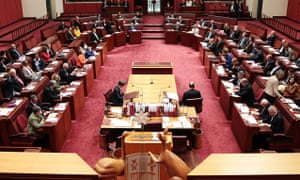
Senate voting reform stirs up hornet's nest between likely winners and losers

Senate voting reform is not entirely a “he said, she said” story, despite being so often presented that way.
The changes to Senate voting about to be introduced, and almost certainly passed, will change the makeup of the upper house to the advantage of the parties lining up to vote for them (the Coalition, the Greens and Nick Xenophon), will be to the disadvantage of the Labor party and are likely to be to the catastrophic (as in wipeout) disadvantage of the very small micro-parties (this being the one of the stated points of the exercise).
Only the follow-on questions are unclear: are these outcomes reasonable, a fairer translation of the will of the electorate, and does the new system make it more likely that the Coalition wins control of the Senate in its own right?
Whatever they’ve been talking about in public – tax cuts, steel workers’ jobs, unicorns, pixie horses, negative gearing, etc – behind the scenes politicians from all parties have been utterly preoccupied for months with this proposed change. That and the fact that the timing of their introduction provides some clues about the timing of this year’s federal election (spoiler – July or August are looking like good bets).
As revealed by Guardian Australia last week, the government has secured support from the Greens and independent senator Nick Xenophon for a compromise Senate voting reform plan. The finance minister, Mathias Cormann, has brokered the deal and it is expected to get the final tick off from cabinet on Monday.
Labor remains deeply divided about it. Deeply divided in a knock-’em-down-and-drag-’em-out kind of way. Shadow cabinet is also likely to discuss it on Monday. Until now Labor has been fobbing off queries by saying it has not seen legislation, but lower house MPs who sat on the recent Senate inquiry, Gary Gray and Alan Griffin, very strongly support even more far-reaching reforms while the Senate leadership, Penny Wong and Stephen Conroy, vehemently oppose them. (More about their reasons later.)
The government will introduce the bill this week. It will go to a committee, but only briefly. If all goes to plan it will be passed before the parliament rises for the winter break in March. In the Reader’s Digest version, the system abolishes the “group voting tickets” which allowed parties to do backroom preference deals and enabled the sophisticated “preference harvesting” that saw micro-party senators such as Ricky Muir elected with just 0.5% of the first preference vote, on the back of preferences from voters who probably had never heard of him. Voters will be asked to vote for six parties above the line, after which no more preferences are allocated.
Most experts agree the scheme will advantage the parties that are preparing to vote for it. The extent of the advantage depends on the assumptions you make about how voters and political parties will respond to the change, and how far into the future you are looking. In other words, no one can be certain.
According to Antony Green, the ABC’s election analyst: “The new system is likely to advantage the Coalition and bring it closer to an outright majority than the old system. This is because the new system gives greater weight to first preference votes and the Coalition gets more first preference votes, whereas the first preferences on the progressive side of politics are split between Labor and the Greens.”
By his calculations it remains highly unlikely the Coalition could win an outright majority at a half-Senate election, and also unlikely that it would win an outright majority in a double-dissolution election, although perhaps just slightly more possible than under the voting system now in place. The Greens would be advantaged because they are more likely to hold the balance of power in their own right, rather than sharing it with a line-up of independents. If Xenophon’s vote holds up he could be advantaged too, since at the 2013 poll preference harvesting cost him a second South Australian Senate seat.
On the question of fairness, Green argues the new system gives voters more control over where their preferences go and stops deals that elect micro-party senators over the heads of scores of other candidates with much higher first-preference votes.
And he says the new system will return a Senate where the numbers of senators representing the major parties more closely aligns with that party’s proportion of the Senate vote – because Labor is slightly overrepresented under the current system and under the new system will no longer be able to try to use preference harvesting to its own advantage as it battles for the third “left of centre” Senate spot in each state with the Greens.
But on that last point the most recent numbers don’t back Green’s argument. Based on the 2013 election, the Coalition already has more senators than its first preference vote would suggest it should.
The Coalition got 4.9m first preference votes (using the second West Australian Senate result) which is 36.7% of the total. It won 17 Senate spots, 42.5% of the total. Labor, meanwhile, won 3.96m first preference votes (29.6%) which is about in line with its result: 12 senators, or about 30% of the spots.
Green says this is because the last election was not normal, but rather had a high number of minor parties and in particular a higher number of right-leaning minor parties that may have drawn first preference votes away from the Coalition.
Another elections analyst, Ben Raue, who runs the Tallyroom website, thinks the new system will be “slightly advantageous” for the Coalition, although the advantage could be diminished if right-wing minor parties still attract votes that might otherwise go to the Coalition, but under the new system do not end up flowing back as preferences.
He thinks it could benefit the Greens to the extent that they rely less on Labor preferences and, after a double-dissolution or a number of half-Senate elections, would be less likely to share the balance of power with a range of minor parties. And it would benefit Xenophon because his new party is more likely to be able to hold the balance of power on its own if the Coalition ends up just a few votes short of an absolute majority. Raue also thinks it is highly unlikely the Coalition would attain an absolute Senate majority.
Labor’s Gary Gray says people need to go back to the point of having a voting system “to accurately translate the wishes of voters into winners and losers in the parliament” rather than try to predict the results.
“If the Coalition gets more votes than Labor they should win. If we get more votes we should win. The system should not be about advantaging one side or the other.”
But Stephen Conroy says the changes pose a huge longer-term risk for Labor and progressive politics, because a Coalition government would either gain an absolute majority or be able to pass legislation through the Senate with only Xenophon’s vote or votes.
“A system that banks on the continued existence of Nick Xenophon in parliament is deeply flawed because ultimately he will retire and then that system will reboot to give the Coalition an absolute majority,” he says.
And he reserves particular anger for the Greens, who he says are doing “a filthy deal that sells out the future of progressive policies to get their bums on Senate seats”.
Greens spokeswoman Lee Rhiannon says it is not necessarily true that the Greens would gain more seats under the new system.
“In three states – Victoria, Tasmania and Western Australia – the Greens win a Senate spot outright without relying on preferences. That means we gain no advantage if the voting system is changed. In the other states where we do not gain an outright quota we will be in competition for the last spot with minor parties and possibly Labor candidates depending on the primary vote,” she says.
And then there’s the question of why the government is doing this now and whether it is a signal of an early poll – or a “snap” poll as some speculation calls it, whatever “snap” might mean given how widely it has been speculated.
All signals do seem to point to an election being called after the May budget, either for a long election campaign and a double-dissolution election in late July, or for a half-Senate election in early August.
Pushing through the Senate changes might make a double dissolution more attractive because only one of the eight crossbench senators, John Madigan, would face the voters in a half-Senate election whereas all senators face the voters in a double dissolution. A double dissolution would certainly return a more workable Senate for a Coalition government’s second term, if it wins one. A half-Senate election would leave seven of the crossbenchers in place, and as mad as hornets.
The debate about the merits of the proposed reforms, and the extent to which they benefit the Coalition, the Greens and Xenophon, is about to get ferocious.
There will be many arguments for, and against. That they are likely to benefit the parties who are preparing to vote for them is clear. The fight will be about how much, and whether there are good reasons for change, besides self interest.