The murder of five journalists in suburban America was not a political
act. But the way that observers jumped to the conclusion that it must be
one shows the dangerous tensions of the US under Trump
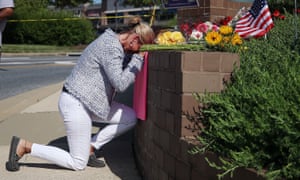
Until
this week the crisis of local journalism in the English-speaking world
was understood as a financial one. In the UK a quarter of all local
papers have shut in the last 10 years and the number of full-time
journalists has dropped in proportion, a government report has just said. One fairly typical American paper, the Capital Gazette
of Annapolis, Maryland, had lost 90% of its staff this century – down
from 250 staff to around 30. But on Thursday evening five of its
journalists were murdered by a gunman who shot his way through the front
door. It appears he bore a grudge against the paper for accurately
reporting an earlier brush with the law. Since in contemporary America
anyone with a grievance can get hold of a gun, this is in one way not
surprising. Teachers, politicians, concert-goers and schoolchildren have
all been slaughtered in recent years. Why should journalists be
different?
There is no more intrinsic value to the life of a journalist than there is to that of a street-sweeper, a billionaire, or any other human being. Yet hacks are more useful than most billionaires. The plain task of finding out what is true and making it comprehensible and interesting is an honourable trade. Honest journalism is a vital part of any decent society. Fearless journalism is a sign, and a part of the defences, of any free society. The trade can be grubby and – perish the thought – self-important but it gives us a warped mirror of our flawed selves and what we all learn from it is more important than the flaws. This is particularly true of local journalism because the local papers write about their readers and not about half-mythical celebrities. They help communities to recognise themselves in their common humanity and, at their best, can help them to come together.
One fact is specially chilling about the murders in Annapolis: before the murderer’s identity was known almost everyone who expressed an opinion, whether on left or right, assumed his motives were political. This was a natural conclusion to jump to in the present polarised climate. President Trump has called journalists “enemies of the people” (and refused to answer questions about the murders); one of his propagandists suggested the shooting was an understandable response to the social shunning of his press secretary. In the immediate aftermath of the shooting the New York police put a guard on the offices of the New York Times. That turned out, fortunately, to be an overreaction. The real enmity lies not between the press and the people, but the free press (and people) and the powerful. The places where the killing of journalists is a real danger and their imprisonment routine are those ruled by secretive oligarchs: Russia, Turkey, Pakistan, Malta, and many others. Compared to the bravery required of our colleagues in those countries the threat of job losses here is trivial. But it is still true that the enemies of democracy are the lovers of darkness and a free press is their enemy everywhere.




Perhaps this forgetfulness is protective. I have been averting my eyes. Because I cannot bear to see what we have done to nature, I no longer see nature itself; otherwise, the speed of loss would be unendurable. The collapse can be witnessed from one year to the next. The swift decline of the swift (down 25% in five years) is marked by the loss of the wild screams that, until very recently, filled the skies above my house. My ambition to see the seabird colonies of Shetland and St Kilda has been replaced by the intention never to visit those islands during the breeding season: I could not bear to see the empty cliffs, where populations have crashed by some 90% in the past two decades.
I have lived long enough to witness the vanishing of wild mammals, butterflies, mayflies, songbirds and fish that I once feared my grandchildren would not experience: it has all happened faster than even the pessimists predicted. Walking in the countryside or snorkelling in the sea is now as painful to me as an art lover would find visits to a gallery, if on every occasion another old master had been cut from its frame.
The cause of this acceleration is no mystery. The United Nations reports that our use of natural resources has tripled in 40 years. The great expansion of mining, logging, meat production and industrial fishing is cleansing the planet of its wild places and natural wonders. What economists proclaim as progress, ecologists recognise as ruin.
This is what has driven the quadrupling of oceanic dead zones since 1950; the “biological annihilation” represented by the astonishing collapse of vertebrate populations; the rush to carve up the last intact forests; the vanishing of coral reefs, glaciers and sea ice; the shrinkage of lakes, the drainage of wetlands. The living world is dying of consumption.
We have a fatal weakness: a failure to perceive incremental change. As natural systems shift from one state to another, we almost immediately forget what we have lost. I have to make a determined effort to remember what I saw in my youth. Could it really be true that every patch of nettles, at this time of year, was reamed with caterpillar holes? That flycatchers were so common I scarcely gave them a second glance? That the rivers, around the autumn equinox, were almost black with eels?
Others seem oblivious. When I have criticised current practice, farmers have sent me images of verdant monocultures of perennial ryegrass, with the message: “Look at this and try telling me we don’t look after nature.” It’s green, but it’s about as ecologically rich as an airport runway.
Gove cannot be blamed for all of the fiascos to which he has put his name. The 25-year plan for nature was, it seems, gutted by the prime minister’s office. The environmental watchdog he proposed was de-fanged by the Treasury (it has subsequently been lent some dentures by parliament). Other failures are all his own work. In response to lobbying from sheep farmers, Gove has allowed ravens, a highly intelligent and long-lived species just beginning to recover from centuries of persecution, to be killed once more in order to protect lambs. There are 23 million sheep in this country and 7,400 pairs of ravens. Why must all other species give way to the white plague?
Responding to complaints that most of our national parks are wildlife deserts, Gove set up a commission to review them. But governments choose their conclusions in advance, through the appointments they make. A more dismal, backward-looking and uninspiring panel would be hard to find: not one of its members, as far as I can tell, has expressed a desire for significant change in our national parks, and most of them, if their past statements are anything to go by, are determined to keep them in their sheep-wrecked and grouse-trashed state.
Now the lobbyists demand a New Zealand settlement for farming after Brexit: deregulated, upscaled, hostile to both wildlife and the human eye. If they get their way no landscape, however treasured, will be safe from broiler sheds and mega dairy units, no river protected from runoff and pollution, no songbird saved from local extinction. The merger between Bayer and Monsanto brings together the manufacturer of the world’s most lethal pesticides with the manufacturer of the world’s most lethal herbicides. Already the concentrated power of these behemoths is a hazard to democracy; together they threaten both political and ecological disaster. Labour’s environment team has scarcely a word to say about any of it. Similarly, the big conservation groups have gone missing in inaction.
We forget even our own histories. We fail to recall, for example, that the 1945 Dower report envisaged wilder national parks than we now possess, and that the conservation white paper the government issued in 1947 called for the kind of large-scale protection that is considered edgy and innovative today. Remembering is a radical act.
That caterpillar, by the way, was a six-spot burnet: the larva of a stunning iridescent black and pink moth that once populated my neighbourhood. I will not allow myself to forget again: I will work to recover the knowledge I have lost. For I now see that without the power of memory, we cannot hope to defend the world we love.
• George Monbiot is a Guardian columnist