Saturday, 30 June 2018

The Guardian view on defending journalism: free people need a free press


The murder of five journalists in suburban America was not a political act. But the way that observers jumped to the conclusion that it must be one shows the dangerous tensions of the US under Trump
Until this week the crisis of local journalism in the English-speaking world was understood as a financial one. In the UK a quarter of all local papers have shut in the last 10 years and the number of full-time journalists has dropped in proportion, a government report has just said. One fairly typical American paper, the Capital Gazette of Annapolis, Maryland, had lost 90% of its staff this century – down from 250 staff to around 30. But on Thursday evening five of its journalists were murdered by a gunman who shot his way through the front door. It appears he bore a grudge against the paper for accurately reporting an earlier brush with the law. Since in contemporary America anyone with a grievance can get hold of a gun, this is in one way not surprising. Teachers, politicians, concert-goers and schoolchildren have all been slaughtered in recent years. Why should journalists be different?
There is no more intrinsic value to the life of a journalist than there is to that of a street-sweeper, a billionaire, or any other human being. Yet hacks are more useful than most billionaires. The plain task of finding out what is true and making it comprehensible and interesting is an honourable trade. Honest journalism is a vital part of any decent society. Fearless journalism is a sign, and a part of the defences, of any free society. The trade can be grubby and – perish the thought – self-important but it gives us a warped mirror of our flawed selves and what we all learn from it is more important than the flaws. This is particularly true of local journalism because the local papers write about their readers and not about half-mythical celebrities. They help communities to recognise themselves in their common humanity and, at their best, can help them to come together.
One fact is specially chilling about the murders in Annapolis: before the murderer’s identity was known almost everyone who expressed an opinion, whether on left or right, assumed his motives were political. This was a natural conclusion to jump to in the present polarised climate. President Trump has called journalists “enemies of the people” (and refused to answer questions about the murders); one of his propagandists suggested the shooting was an understandable response to the social shunning of his press secretary. In the immediate aftermath of the shooting the New York police put a guard on the offices of the New York Times. That turned out, fortunately, to be an overreaction. The real enmity lies not between the press and the people, but the free press (and people) and the powerful. The places where the killing of journalists is a real danger and their imprisonment routine are those ruled by secretive oligarchs: Russia, Turkey, Pakistan, Malta, and many others. Compared to the bravery required of our colleagues in those countries the threat of job losses here is trivial. But it is still true that the enemies of democracy are the lovers of darkness and a free press is their enemy everywhere.

Wayne Swan: ending progressive taxation will turn Australia into the US

Extract from The Guardian

New Labor national president says party’s task is to ‘tear down neoliberalism and trickle-down economics’


Labor’s new national president, Wayne Swan, has launched a full-throated defence of progressive taxation, declaring the system is not class warfare, but “created to counter the class warfare that had ripped the world to pieces before, during and after, the great depression”.
After a fortnight in politics dominated by arguments about income tax, and on the same day as Bill Shorten backflipped on a company tax repeal position he’d flagged earlier this week – Swan told a dinner at the New South Wales Labor conference on Friday night the “demolition job on progressive taxation is being sold to us as some sort of mainstream economic solution”.
“Uncontroversial, common sense, accepted by all economists, but it’s anything but that. It’s a radical agenda that will dramatically widen income inequality and strip back the social wage that has defined our country since the second world war.”
“It will take our country right down the American road to a nation of haves and have-nots, forgotten communities, social division and anger – Trump’s America.”
Swan declared on Friday night “the Australian dream” was built on the pillar of progressive taxation. “It’s what helped pay for our successful industrial development from the 1940s onwards, our national infrastructure in the 1950s and 60s, the creation of Medicare in the 1970s, the increases in year-12 retention of the 1980s, the expansion of universities in the 1990s and now the NDIS.”
“Progressive taxation gave us one of the most egalitarian societies in the world. And in Europe, the United States and elsewhere, progressive taxation gave the world decades of social peace and stability. It lowered social tensions and held at bay the dangerous extremes of left and right.”
He says social democratic parties around the world have come under assault from populists on the right and the left, and warns “unless we show we have the answers people are looking for, we could be swept away too.”
Swan says Labor is currently “in a battle of political wills and ideas that will determine the future of our party.
“Our task is to tear down neoliberalism and its trickle-down economics, to argue that inequality is not inevitable, and to prove that our social democratic alternative will create a richer and better society.”
Swan’s speech also contains implicit criticisms of an alternative manifesto outlined this time last week by the left-wing frontbencher Anthony Albanese.
Albanese said the ALP needed to cherish its historical union links, but also appeal to people who were not union members. “This is not 1950,” Albanese noted, “when most Australians were members of trade unions.”
The Labor president says one of the reasons there has been a declining share of GDP going to working people is that the government in Australia “has sought to supress the voice of organised labour.”
“We in this room know that unions are the most effective check on inequality that has ever been invented,” Swan said.
Declaring himself “unapologetic about being on the side of working people” Swan says recent history demonstrates that when parties of the centre-left move away from their base, they lose.
“Insipid and tame economic agendas which fail to provide a clear alternative in the key areas of inclusive growth simply make it easier for right-wing populists to use race and gender to divide and defeat us. That’s the big lesson for us.”
He says politics must be disabused “of the destructive idea that government and collective action by people are somehow illegitimate.
“This stupid idea, endlessly advocated by right-wing ideologues, is what had brought America undone.
“We don’t need it. Instead, we need to convince people once again that collective power, expressed through their unions, their communities and government, funded by means of progressive taxation, can help us solve our country’s greatest problems.”
Swan’s outing on Friday night followed Shorten’s decision to recant a position articulated by him on Tuesday repealing the Turnbull government’s tax cuts for medium-sized businesses, a reversal which followed mounting internal pressure.
Shorten told reporters he’d recommended to shadow cabinet that businesses already in receipt of legislated tax cuts should keep them. He said it had become necessary to “amend” Tuesday’s announcement because it was “causing confusion and uncertainty for business” and because Labor had received updated financial information.
The final decision only covers tax cuts that have been legislated and have taken effect, so that means the Turnbull government’s cut in the tax rate paid by medium sized firms to 27.5% will stay.
A staged tax cut to 25% beyond 2024-25 promised by the Turnbull government will still be rolled back if Labor wins the next federal election.
Pressed on why he’d articulated one policy position on Tuesday and another on Friday, Shorten said smart politicians did not just lead, “they also have to listen”.

Sunday penalty rate changes take effect this weekend

Posted about 10 hours ago

New changes to penalty rates for some retail, hospitality, and pharmacy workers come into effect this Sunday.
According to the SDA, the Union for Retail, Fast Food and Warehousing workers, the changes will affect around 700,000 workers.
The extent of the changes depend on the industry, with penalties to be reduced by 10 or 15 per cent.
The United Voice union estimates that it will mean people on an award wage who complete a shift this Sunday will earn about $16 less than they did last week.

A tale of two workers: Ed and Gabby

Ed Smith works at a small, family run, fast food business in Sydney.
His boss has stopped putting him on Sundays, because of the cost.
"He's now got someone else working Sundays, because he can pay them a little bit less," he said.
Now that he has stopped working Sundays, he has to work extra shifts to make up the lost money, and that means he only has one spare day a week.
"My only study day now is Sunday, so I kind of wake up early, maybe 5:30 am or 6am, and start my day and get through six to nine hours of lecture content for the day.
"And then I have a little bit of time left over to work on assignments," he told PM.
"That's pretty much my life: work, uni, and that day to get everything done."

Mr Smith fears the changes will affect some of the lowest-paid workers, who study or care for someone during the week.
The penalty rate change does not affect workers like Gabby, who are on an Enterprise Bargaining Agreement.
Gabby is a retail worker who has been in the industry for five years.
She does not want to provide her surname, but is really happy with her workplace, which is not passing on the penalty cuts.
"We've been told our company won't be doing the full cut of penalty rates," she said.
"We've been told they basically value our work on weekends, and they think we should be paid accordingly."

Gabby said that has made her feel valued at work, and that her company understands its employees.
"I just think it's important that people see the value in industries such as hospitality and retail," she said.
"Without these industries, people wouldn't be able to enjoy their weekend as much as they do, and I don't think those industries should be taken for granted, and I think they should be paid accordingly."

This year will be different

Sunday penalty rate cuts from

1st July, 2018

Full and part timeCasual
Retail195pc down to 180pc195pc 185pc
Hospitality170pc down to 160pcNo change
Fast-food145pc down to 135pc170pc to 160pc
Pharmacy195pc down to 180pc220pc to 205pc


The changes have come about following a Fair Work determination made last year.
Fair Work said that penalties for some industries should be reduced each July, with changes starting last year and continuing until 2020.
Russell Zimmerman, the Executive Director of the Australian Retailers Association, says last year's changes were too small to spur on any real growth in jobs for the retail sector.
However, he believes the changes coming into effect this weekend will lead to more jobs, or at least, more work.
"Unfortunately, the first transition was only a 5 per cent reduction; this transition is a far greater amount; around 10 per cent."
"Quite honestly, what we're expecting to see is a large number of retailers start thinking about employing more staff," he said.
"If we want to grow the economy, if we want to employ people, the things we need to do is to stimulate that by giving back to small business and allow them to employ more people."

Drovers say Australia's legendary outback stock routes in danger of collapse

Updated 29 minutes ago


Australia's iconic stock routes are languishing after years of neglect and are in danger of being privatised, drovers and ecologists warn.

Key points:

  • Travelling stock routes (TSRs) are parcels of Crown land, used to move cattle and sheep
  • Drovers and graziers pay to use the stock routes, but say many are falling into disrepair
  • The NSW government says it has no plans to sell the state's TSRs, but the opposition isn't convinced

The historic network of reserves for travelling sheep and cattle are etched into the national psyche by writers Henry Lawson and Banjo Patterson.
They're also a refuge for endangered flora and fauna, and are rich in Indigenous heritage.
"I'd say there's been a rapid decline, really, in the last three years — they've just got worse and worse," laments drover Brad Brazier.
The drover has been on the road with 600 cattle around New South Wales for the past year.
The routes cover 45,000 square kilometres of New South Wales and Queensland, with 76,000 kilometres of tracks in the Sunshine State alone.

"There are a lot of changes [on the routes]. Fences going up everywhere, leasing and permanent grazing set-ups and things like that," Mr Brazier said.
"[The government] will probably end up trying to start selling those areas off which would have to open up a real can of worms. It'd be a real mess if they ever tried that. It's a big-enough mess now."
Drovers and graziers pay to use the stock reserves through a series of permits, and that money is channelled back into weed control, water infrastructure and maintenance.
But it's not value for money, according to Brad Brazier.
He said the cattle owner that he droves for would have spent half a million dollars on travelling permits over the past year, only to find that pasture has been eaten out along the route by resident herds.

The Never-Never Country

by Henry Lawson, 1905


The drovers of the Great Stock Routes

The strange Gulf country know —

Where, travelling from the southern drought

The big lean bullocks go;

And camped by night where plains lie wide,

Like some old ocean's bed,

The watchmen in the starlight ride

Round fifteen hundred head.


NSW says there are 'no plans' to sell off cattle routes

The New South Wales government is waiting for the final report of a review looking at the management of the Travelling Stock Reserves.
"There are no plans to sell off our travelling stock routes," NSW Primary Industries Minister Niall Blair told the ABC.
"Traditionally the upgrade and investment [comes] from the income that has been generated from those that have used the reserves."
"We've increased that funding by a million dollars and we'll be looking to provide more funding," Mr Blair said.
His office did not provide figures on how much revenue is raised by those who use the routes, saying that "it varies greatly from year to year depending upon seasonal conditions."
But NSW Opposition spokesman for lands and primary industries Mick Veitch said he's concerned they've slated the travelling stock reserve estate for sale.
"The new Crown Land Management Act says the minister can transfer Crown Land to state-owned corporations or departments without notifying the public," Mr Veitch said.
"They could transfer a Crown Land parcel to Property NSW — that is the real estate arm of the New South Wales government — and it would just make it so much easier to sell without telling the community, and anyone else that may be interested in looking after that parcel of land."

Drought puts added pressure on outback cattle routes


In north-western New South Wales alone, there are 38,000 cattle on the routes.
"It's one of the only main drought relief things we've got," Brad Brazier said.
He has been droving for more than three decades and says he's never seen the state so dry — or the routes so poorly maintained.
At Krui Bore near Moree, the windmill turns slowly, but there's no water to be pumped, and it's not even connected to the tank or troughs.

"I've passed through Krui Bore many times over the last 30 years and I've never actually seen this dam dry," he said.
That's an indication not only of how bad things are out here, he said, but also the lack of resourcing to clean out the drains feeding the dam before a storm dumped four inches of rain in April.
The dry dam meant his herd had to walk 25 kilometres between drinks, when anything over 10km is a stretch for the cattle.

'We should be managing them like the Royal Botanic Garden'


Like drover Brad Brazier, ecologist Phil Spark is deeply concerned about areas of the routes being fenced off by landholders, with permits to graze for one month or up to five years.
"We are losing a lot of diversity in plants through more constant grazing. Vast areas, really large areas are now fenced for long-term grazing permits," he said.
He has just finished an ecological assessment of the north-west region, and said it identified 60 threatened species of plants and animals.
The problem, he said, is that the Travelling Stock Reserves (TSRs) are "not resourced at all".
"That's what brought on this new grazing regime of long-term permits to supposedly get money to feed into the management of them, but that hasn't worked. It's contributing to the decline of the travelling stock routes."

Stock route manager defends grazing permits


From tomorrow, travelling cattle won't be allowed onto the stock routes in north-western New South Wales, unless they are moving to a clear destination.
"Our TSR network is just about exhausted," said Wayne Gransey, the team leader for the North-West Land Services, the New South Wales government agency which manages the stock reserves.
"We've been managing as best we can with high stock numbers, but it's got to the stage where ground cover is at critical levels that can cause soil erosion and land degradation," he told the ABC.
"We've had to make difficult decisions on future management."
He said the number of cattle allowed on short-term grazing permits held by landowners would also be reduced.
Mr Gransey said grazing permits were an important part of managing the stock routes.
The successful tenderer of a long-term permit promises to manage the land as their own, and is responsible for care and maintenance and weed control.
Mr Gransay said that arrangement eases pressure on his staff.
"We've got an incredibly dedicated team of rangers and field officers. Yes, we can't get it all done, but we cover a massive area and they do an excellent job."
He said fences were also used to keep stock off busy roads, and to restrict illegal activity such as woodcutting and rubbish dumping.

Millions of dollars needed to fix up stock route water points


In central-western Queensland, which has battled drought for the best part of seven years, there are similar concerns.
Regional councils manage the stock routes but receive only $800,000 between them from the state government — not nearly enough, according to the Mayor of Longreach, Ed Warren.
He said Longreach ratepayers kick in an extra $100,000 a year and neighbouring councils would contribute similarly.
"There's a lot of watering points and infrastructure getting further behind and it would be millions of dollars to spend to bring them up into a working condition," he said.
Mayor Warren would like to see a wider system of grazing permits to generate more revenue for the stock routes.
He said 70 per cent of the landholders that graze stock on the routes pay nothing.

Professional drover Billy Little, who has worked the routes across both states, would like a better user-pays system, but cautions against fencing off sections for local grazing.
More than anything, he wants the stock routes kept in public hands.
"I want Australians to know it's their land, it doesn't belong to a few land-holders who adjoin it, it's everybody's land."

Friday, 29 June 2018

Our natural world is disappearing before our eyes. We have to save it


It felt as disorienting as forgetting my pin number. I stared at the caterpillar, unable to attach a name to it. I don’t think my mental powers are fading: I still possess an eerie capacity to recall facts and figures and memorise long screeds of text. This is a specific loss. As a child and young adult, I delighted in being able to identify almost any wild plant or animal. And now it has gone. This ability has shrivelled from disuse: I can no longer identify them because I can no longer find them.
Perhaps this forgetfulness is protective. I have been averting my eyes. Because I cannot bear to see what we have done to nature, I no longer see nature itself; otherwise, the speed of loss would be unendurable. The collapse can be witnessed from one year to the next. The swift decline of the swift (down 25% in five years) is marked by the loss of the wild screams that, until very recently, filled the skies above my house. My ambition to see the seabird colonies of Shetland and St Kilda has been replaced by the intention never to visit those islands during the breeding season: I could not bear to see the empty cliffs, where populations have crashed by some 90% in the past two decades.
I have lived long enough to witness the vanishing of wild mammals, butterflies, mayflies, songbirds and fish that I once feared my grandchildren would not experience: it has all happened faster than even the pessimists predicted. Walking in the countryside or snorkelling in the sea is now as painful to me as an art lover would find visits to a gallery, if on every occasion another old master had been cut from its frame.
The cause of this acceleration is no mystery. The United Nations reports that our use of natural resources has tripled in 40 years. The great expansion of mining, logging, meat production and industrial fishing is cleansing the planet of its wild places and natural wonders. What economists proclaim as progress, ecologists recognise as ruin.
This is what has driven the quadrupling of oceanic dead zones since 1950; the “biological annihilation” represented by the astonishing collapse of vertebrate populations; the rush to carve up the last intact forests; the vanishing of coral reefs, glaciers and sea ice; the shrinkage of lakes, the drainage of wetlands. The living world is dying of consumption.
We have a fatal weakness: a failure to perceive incremental change. As natural systems shift from one state to another, we almost immediately forget what we have lost. I have to make a determined effort to remember what I saw in my youth. Could it really be true that every patch of nettles, at this time of year, was reamed with caterpillar holes? That flycatchers were so common I scarcely gave them a second glance? That the rivers, around the autumn equinox, were almost black with eels?
Others seem oblivious. When I have criticised current practice, farmers have sent me images of verdant monocultures of perennial ryegrass, with the message: “Look at this and try telling me we don’t look after nature.” It’s green, but it’s about as ecologically rich as an airport runway.
When our memories are wiped as clean as the land, we fail to demand its restoration. Our forgetting is a gift to industrial lobby groups and the governments that serve them. Over the past few months I have been told repeatedly that the environment secretary, Michael Gove, gets it. I have said so myself: he genuinely seems to understand what the problems are and what needs to be done. Unfortunately, he doesn’t do it.
Gove cannot be blamed for all of the fiascos to which he has put his name. The 25-year plan for nature was, it seems, gutted by the prime minister’s office. The environmental watchdog he proposed was de-fanged by the Treasury (it has subsequently been lent some dentures by parliament). Other failures are all his own work. In response to lobbying from sheep farmers, Gove has allowed ravens, a highly intelligent and long-lived species just beginning to recover from centuries of persecution, to be killed once more in order to protect lambs. There are 23 million sheep in this country and 7,400 pairs of ravens. Why must all other species give way to the white plague?
Responding to complaints that most of our national parks are wildlife deserts, Gove set up a commission to review them. But governments choose their conclusions in advance, through the appointments they make. A more dismal, backward-looking and uninspiring panel would be hard to find: not one of its members, as far as I can tell, has expressed a desire for significant change in our national parks, and most of them, if their past statements are anything to go by, are determined to keep them in their sheep-wrecked and grouse-trashed state.
Now the lobbyists demand a New Zealand settlement for farming after Brexit: deregulated, upscaled, hostile to both wildlife and the human eye. If they get their way no landscape, however treasured, will be safe from broiler sheds and mega dairy units, no river protected from runoff and pollution, no songbird saved from local extinction. The merger between Bayer and Monsanto brings together the manufacturer of the world’s most lethal pesticides with the manufacturer of the world’s most lethal herbicides. Already the concentrated power of these behemoths is a hazard to democracy; together they threaten both political and ecological disaster. Labour’s environment team has scarcely a word to say about any of it. Similarly, the big conservation groups have gone missing in inaction.
We forget even our own histories. We fail to recall, for example, that the 1945 Dower report envisaged wilder national parks than we now possess, and that the conservation white paper the government issued in 1947 called for the kind of large-scale protection that is considered edgy and innovative today. Remembering is a radical act.
That caterpillar, by the way, was a six-spot burnet: the larva of a stunning iridescent black and pink moth that once populated my neighbourhood. I will not allow myself to forget again: I will work to recover the knowledge I have lost. For I now see that without the power of memory, we cannot hope to defend the world we love.

• George Monbiot is a Guardian columnist

Ex-Nasa scientist: 30 years on, world is failing 'miserably’ to address climate change

Extract from The Guardian

James Hansen, who gave a climate warning in 1988 Senate testimony, says real hoax is by leaders claiming to take action
Thirty years after a former Nasa scientist sounded the alarm for the general public about climate change and human activity, the expert issued a fresh warning that the world is failing “miserably” to deal with the worsening dangers.
While Donald Trump and many conservatives like to argue that climate change is a hoax, James Hansen, the 77-year-old former Nasa climate scientist, said in an interview at his home in New York that the relevant hoax today is perpetrated by those leaders claiming to be addressing the problem.
Hansen provided what’s considered the first warning to a mass audience about global warming when, in 1988, he told a US congressional hearing he could declare “with 99% confidence” that a recent sharp rise in temperatures was a result of human activity.
Since this time, the world’s greenhouse gas emissions have mushroomed despite repeated, increasingly frantic warnings about civilization-shaking catastrophe, from scientists amassing reams of evidence in Hansen’s wake.
“All we’ve done is agree there’s a problem,” Hansen told the Guardian. “We agreed that in 1992 [at the Earth summit in Rio] and re-agreed it again in Paris [at the 2015 climate accord]. We haven’t acknowledged what is required to solve it. Promises like Paris don’t mean much, it’s wishful thinking. It’s a hoax that governments have played on us since the 1990s.”
Hansen’s long list of culprits for this inertia are both familiar – the nefarious lobbying of the fossil fuel industry – and surprising. Jerry Brown, the progressive governor of California, and the German chancellor, Angela Merkel, are “both pretending to be solving the problem” while being unambitious and shunning low-carbon nuclear power, Hansen argues.

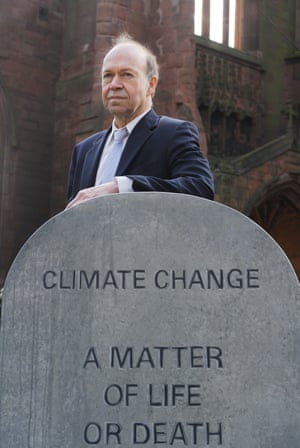
James Hansen: ‘Promises like Paris don’t mean much, it’s wishful thinking. It’s a hoax that governments have played on us since the 1990s.’
James Hansen: ‘Promises like Paris don’t mean much, it’s wishful thinking. It’s a hoax that 
governments have played on us since the 1990s.’ Photograph: Arrizabalaga/REX Shutterstock

There is particular scorn for Barack Obama. Hansen says in a scathing upcoming book that the former president “failed miserably” on climate change and oversaw policies that were “late, ineffectual and partisan”.
Hansen even accuses Obama of passing up the opportunity to thwart Donald Trump’s destruction of US climate action, by declining to settle a lawsuit the scientist, his granddaughter and 20 other young people are waging against the government, accusing it of unconstitutionally causing peril to their living environment.
“Near the end of his administration the US said it would reduce emissions 80% by 2050,” Hansen said.
“Our lawsuit demands a reduction of 6% a year so I thought, ‘That’s close enough, let’s settle the lawsuit.’ We got through to Obama’s office but he decided against it. It was a tremendous opportunity. This was after Trump’s election, so if we’d settled it quickly the US legally wouldn’t be able to do the absurd things Trump is doing now by opening up all sorts of fossil fuel sources."
Hansen’s frustrations temper any satisfaction at largely being vindicated for his testimony, delivered to lawmakers on 23 June 1988.
Wearing a cream-coloured suit, the soft-spoken son of Iowan tenant farmers hunched over the microphone in Washington to explain that humans had entered a confronting new era. “The greenhouse effect has been detected and it is changing our climate now,” he said.
Afterwards, Hansen told reporters: “It is time to stop waffling so much and say that the evidence is pretty strong that the greenhouse effect is here.” He brandished new research that forecast that 1988 was set to be the warmest year on record, as well as projections for future heat under three different emissions scenarios. The world has dutifully followed Hansen’s “scenario B” – we are “smack on it” it, Hansen said last week – with global temperatures jumping by around 1C (1.8F) over the past century.
These findings hadn’t occurred in a vacuum, of course – the Irish physicist John Tyndall confirmed that carbon dioxide is a heat-trapping gas in the 1850s. A 1985 scientific conference in Villach, Austria, concluded the temperature rise in the 21st century would be “greater than in any man’s history”. The changes in motion would “affect life on Earth for centuries to come”, the New York Times warned the morning after Hansen’s testimony.

James Hansen testifies before a Senate transportation subcommittee on 8 May 1989, a year after his history-making testimony regarding climate change.
James Hansen testifies before a Senate transportation subcommittee on 8 May 1989, a year after his history-making testimony regarding climate change. Photograph: Dennis Cook/AP

Three decades of diplomacy has blossomed into an international consensus, albeit rattled by Trump, that the temperature rise must be curbed to “well below” 2C (3.6F) above pre-industrial times. But in this time emissions have soared (in 1988, 20bn tons of carbon dioxide was emitted – by 2017 it was 32bn tons) with promised cuts insufficient for the 2C goal. Despite the notable growth of renewable energy such as solar and wind, Hansen believes there is no pathway to salvation without a tax on carbon-producing fuels.
“The solution isn’t complicated, it’s not rocket science,” Hansen said. “Emissions aren’t going to go down if the cost of fossil fuels isn’t honest. Economists are very clear on this. We need a steadily increasing fee that is then distributed to the public.”
Hansen faced opposition even before his testimony – he recalls a Nasa colleague telling him on the morning of his presentation “no respectable scientist” would claim the world is warming – and faced subsequent meddling and censorship from George HW Bush’s administration.
He eventually retired from Nasa in 2013 and promptly reinvented himself as an activist who was arrested, wearing his trademark hat, outside the White House while protesting against the Keystone oil pipeline.

James Hansen is arrested outside the White House for protesting on 27 September 2010.
James Hansen is arrested outside the White House for protesting on 27 September 2010. Photograph: Alamy

The dawdling global response to warming temperatures means runaway climate change now looms. The aspirational 1.5C (2.7F) warming target set in Paris could be surpassed by 2040. Huge amounts of ice from western Antarctica are crashing into the ocean, redrawing forecasts for sea level rise. Some low-lying islands fear extinction.
“It’s not too late,” Hansen stressed. “There is a rate of reduction that’s feasible to stay well below 2C. But you just need that price on carbon.”
John Holdren, who was Obama’s chief science adviser, told the Guardian that the Paris agreement achieved what was possible without support from Congress and that legally binding lawsuits would be “problematic”.
However, he added that while he had reservations about Hansen’s policy ideas he was one of the “true giants” of climate science.
“Poor Jim Hansen. He’s a tragic hero,” said Naomi Oreskes, a Harvard academic who studies the history of science. “The Cassandra aspect of his life is that he’s cursed to understand and diagnose what’s going on but unable to persuade people to do something about it. We are all raised to believe knowledge is power but Hansen proves the untruth of that slogan. Power is power.”
That power has been most aggressively wielded by fossil fuel companies such as Exxon and Shell which, despite being well aware of the dangers of climate change decades before Hansen’s touchstone moment in 1988, funded a network of groups that ridiculed the science and funded sympathetic politicians. Later, they were to be joined by the bulk of the US Republican party, which now recoils from any action on climate change as heresy.
“Obama was committed to action but couldn’t do much with the Congress he had,” Oreskes said. “To blame the Democrats and Obama is to misunderstand the political context. There was a huge, organized network that put forward a message of confusion and doubt.”
Climate scientist Michael Oppenheimer, who testified at the same 1988 hearing about sea level rise, said the struggle to confront climate change has been “discouraging”.
“The nasty anti-science movement ramped up and now we are way behind.”
“I’m convinced we will deal with the problem,” he said. “[But] not before there is an amount of suffering that is unconscionable and should’ve been avoided.” 

Meet America's new climate normal: towns that flood when it isn't raining

Extract from The Guardian

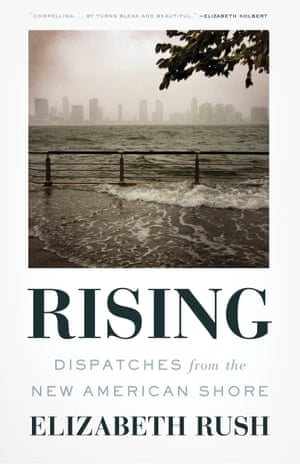
In this extract from Rising, Elizabeth Rush explains ‘sunny day flooding’ – when a high tide can cause streets to fill with water
I spend the afternoon in Shorecrest, a neighborhood a couple of miles north of downtown Miami. To get there I leave the beach behind and drive past Arky’s Live Bait & Tackle, Deal and Discounts II, Rafiul Food Store, Royal Budget Inn, Family Dollar and Goodwill. As I continue north, the buildings all lose their mirrored glass and their extra floors, until most are single story and made from stucco.
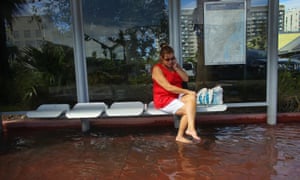
It isn’t raining when I arrive in Shorecrest, and there isn’t a storm offshore; the day is as clear and as blue as the filigree on a porcelain plate. But the streets are still full of water. I watch as a woman wades ankle deep across Tenth Avenue. She has gathered her long russet-colored skirt in her right hand, and in her left she holds a pair of Jesus sandals. When she reaches the bus stop, she sits and puts her shoes on.
“We get flooded with just about every high tide,” the woman tells me. “And if the moon is big it’s worse.”
In Shorecrest I spend a minute watching the bay burble up through the street grate and on to Northeast Little River Drive before whipping out my camera and snapping half a dozen photos. Just then a man walks up behind me, peers down, and says: “I’ve seen fish come swimming out.”
“No, you haven’t!”
“I have,” he says, pushing his sunglasses up. “I’ve been here 20 years. When I first moved we used to flood once a year, maybe twice. Now it’s constant.” His name is Robert Cisneros. He grew up in Cuba and moved to Florida in 1962, dropping the final “o” in Roberto. He thought the name change might help his fledgling boat repair company succeed.

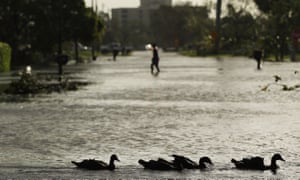
‘Many places in the Sunshine State are so low lying that high tide – when coupled with something as innocuous as a full moon – can cause the streets to brim with water.’
‘Many places in the Sunshine State are so low lying that high tide – when coupled with something as innocuous as a full moon – can cause the streets to brim with water.’ Photograph: Spencer Platt/Getty Images

I ask if the city is helping the neighborhood come up with short-term solutions. Robert gets upset. “I think they need to raise the street. They need to install pumps. But those kinds of things only happen on the beach. They’re not giving any of us here any relief.”
Like Miami Beach, Shorecrest was built atop a former wetland. On the strip, where billions of dollars in real estate investment are at risk, the government is using a mixture of property taxes and municipal bonds to invest in formal sea level rise adaptation. But in Shorecrest, Hialeah, and Sweetwater – low to middle-income neighborhoods where the majority of residents are people of color – residents are expected to remove their shoes and wade through the water.
Robert shakes his head in disbelief. “I wanted to leave this house to my kids, but soon it’s going to be worthless,” he says. On his stoop sit two pairs of rubber boots, ready for the flood that is already here.
The following Friday I return to the Cox Science Center at the University of Miami. In the parking lot I sit in my rental car as the past decade of storms goes thundering through my mind. I see large waves pulsing into New Orleans’ Lower Ninth Ward. Roiling chocolate milk ripping homes off their foundations in Oakwood Beach, Staten Island. Family cottages in the Rockaways in New York turned into aquariums during Sandy.
I remember walking through the Lower Ninth five years after Katrina. The storm’s eerie language was still clearly legible on one house’s laminate siding: a painted X, its upper quadrant marked to show one dead in the attic. On the next building, a lighter, more haunting X showed two dead on the ground level. Someone had attempted to scrub it away, to remove the memory of the killing wind, the way the water deformed the foundation and window frames, the lives it took.
I start descending the poorly lit staircase to the basement of Cox, where the geology department is – fittingly – located.
Rising Cover 300dpi RGB (1)
 Photograph: Milkweed Editions

The atmosphere down in the office of the department’s chair Harold Wanless, or “Hal”, is more in keeping with my mood. Perhaps it’s also in keeping with Hal, whose decades of research on sea level rise have earned him a reputation for cataclysmic prediction. He is wearing the same taupe suit as the week before. The skin below his eyes is the color of charcoal, and the rest of his face sags, too. Still he manages a smile. Up close it is hard to imagine that the media has nicknamed this good-natured septuagenarian “Dr Doom”.
Hal pushes some of his scattered papers aside so I can set up my recording device. I have my question, just one, prepared: “What single event woke you up to the reality of sea level rise?”
“You know, 20 years ago I never thought I would end up seeing the rise because everything, all the projections at that time, really didn’t ramp up until well into the 21st century. But then I started going out to Cape Sable.” Cape Sable is the southernmost part of the mainland; it reaches into the Florida Bay like a swollen hook. “Out there the beaches were disappearing, mangroves were moving in, tiny channels turned into huge rivers in a matter of years. Even the roseate spoonbills started abandoning their nesting grounds. I had never, in my life of studying the geology of the coast of Florida, seen anything like it. That is when I knew in my gut that the early predictions were wrong and that sea level rise was unfolding a lot faster than any of us ever imagined.”
“What comes next?” I ask.
“We have to start relocating the things we value,” he says. “Like the Smithsonian Institution, which is sited on top of an old marsh. We have to make seed banks, a global archive for the future, and we have to move our power plants, in order to maintain a functioning society. We have to start lining the trash dumps that line our shores, we have to start preparing for inundation. Remember, the last time carbon dioxide levels were the same as they are today, the ocean was one hundred feet higher.”

Elizabeth Rush.
Elizabeth Rush. Photograph: Stephanie Ewens

The last time carbon dioxide levels were this high was during the Pliocene epoch, 2.6 to 5.3 million years ago, when megatoothed sharks prowled the oceans. The last time carbon dioxide levels were this high, the tectonic plates beneath India and Asia collided, forming the Himalayas. The last time carbon dioxide levels were this high, California’s Sierra Nevada rose up and tilted its granite face west. The Alps folded and thrust their splintered rock toward the sky. The last time carbon dioxide levels were this high, armadillos migrated north across a newly formed land bridge between today’s North and South America. Dogs headed in the opposite direction. But no one can remember these things, because humans didn’t exist.
I leave Hal’s office and drive back across the bay. That night the moon is big and full, making the ocean weightier. The salt water unspools in the streets and continues drowning, by degrees, the low-lying land that lines our shore. Soon, I think, if Hal is right, all of this will be underwater, not just temporarily, but for good.