As Britain faced a heatwave, the Observer’s architecture critic found
himself between Norway and the north pole, exploring icy Svalbard on an
epic trip for artists and writers
In a
tragicomic photograph
to be found on the internet, a hydrogen balloon lies sideways on the
sea ice, somewhere north of Svalbard. Still inflated, it clings to its
spherical dignity, while the ropes that connect it to its upended basket
describe elegant. It is a dark silhouette against a horizonless
surround, in which the white ice of the foreground grades into a lightly
greying sky.
The two men posing by the basket and the one behind the camera don’t
have long to live. They will make it across the ice back to land but,
with inadequate provisions and equipment, will die there. It will take
some decades before their remains and their camera are found. Such was
the fate of the
1897 expedition,
brave to the point of idiocy, in which the Swede SA Andrée tried to fly
to the north pole. He used a steering system that was almost certain
not to work, and he set off in his newly made balloon without final
checks for leaks.
Andrée
was driven by national pride, a desire to prove the virility of Sweden.
In this he was not alone. In the late 19th and early 20th centuries,
urged on by excitable press coverage, explorers risked their lives to
prove their own and their nations’ superiority. Two different Americans,
Frederick Cook in 1908 and Robert Peary in 1909, said they were the
first to reach the pole, and in 1926 another, Richard Byrd, claimed he
was the first to fly there. All their claims have since been cast in
doubt. In the 1920s Mussolini used the airship exploits of the Italian
Umberto Nobile to promote his regime. When Nobile went missing in 1928
the great Norwegian Roald Amundsen, although he didn’t care for fascism,
would die in the internationally publicised race to find him.
The Arctic can have this effect on people: its function in the
imagination of the world is as a place to test or define, to look for
some truth about existence by viewing it from its limit. The challenge
of its otherness might explain why Mary Shelley chose to open
Frankenstein in the Arctic wastes, and why the Soviets built the
showcase coalmining town of
Pyramiden
more grandly and formally than its function required. Now the
significance of the Arctic is above all about climate change, its
effects there being particularly visible, significant and dangerous.
"What if we couldn’t stand each other, on this vessel alone on icy seas? Agatha Christie would have loved the scenario"
The belief that the Arctic has something to tell us motivates the
Arctic Circle residency,
a programme whereby artists, scientists and writers can, for half the
actual cost, take part in expeditions aboard a tall sailing ship, around
the coasts and islands of Svalbard. Feeling the need for new
perspectives on life, I applied – and in early June joined 28 other
participants, plus guides and crew, on the three-masted barquentine
Antigua. Two weeks without night or internet, ignorant of World Cup
results and the latest Trump eruptions, voyaging between 78 and 81
degrees north, going where the wind suggested, marvelling at glaciers in
shades of blue beyond the power of words or cameras to capture –
cobalt? cerulean? sapphire? “Are you going to find yourself,” teased a
friend, “under an iceberg?”
There
is an element of the mythical about Svalbard. Its mention can draw
blank looks, except from readers of Philip Pullman who know it as the
land of armoured bears but who still don’t know much about the
nonfictional version. It is better known as Spitsbergen, the name given
by the Dutch navigator Willem Barents when he discovered it in 1596,
more than a century after Columbus reached America. Norwegian patriotism
led to its renaming in the 20th century: through the optimistic reading
of an ambiguous medieval account, it was decided that the Vikings had
got there first and called it Svalbard. It is, in any case, an
archipelago far north of Norway, a bit smaller than Scotland, the last
bit of Europe before the north pole. The name Spitsbergen is still
applied to its largest island.
Svalbard’s
shape on a map,
a splat of kelp upon a rock, may be the least familiar in Europe. It
occupies the zone where Mercator’s and other projections dissolve into
absurdity, with Svalbard becoming either nonsensically big or weirdly
distorted, sometimes getting left out altogether. On globes it can
disappear beneath the black plastic cap that holds the object in place.
An azimuthal projection, the kind that puts the north pole at the centre
of concentric circles of latitude, reveals it to have more to do with
the cold family of Arctic lands – Greenland, the islands of north Russia
and Canada – than with the European mainland.
Human history has a shallow grip on Svalbard. Before Barents (or
those Vikings) arrived, there were no indigenous populations, no
equivalent of Inuit in north America, nobody at all. It wasn’t until the
20th century that people started living there permanently, and such
life has been extreme, framed by tales of endurance and danger:
explorers stuck in the ice through long winters, stranded travellers
surviving in snow holes for months, whalers taking insane risks in
pursuit of profit, the appalling working conditions and mortality rates
of miners.
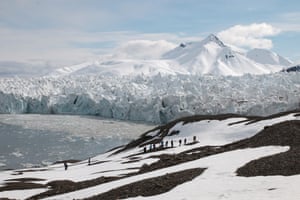
Some of the 29 writers and artists who joined the Arctic
Circle residency on Svalbard last month. In the distance is the
Wahlenbergbreen glacier, which ‘resembles an army of orks’. Photograph:
Leslie Leong
Animal
and plant life, too, looks like something that could easily be scraped
off the surface of the land. Springy moss, purple and yellow saxifrage,
and a type of buttercup stay within centimetres of the ground. There are
no trees, except for low, flat willow and birch that take decades to
reach the size of dinner plates. There are no butterflies or bees.
Whereas the polar sea is abundant in life, vertebrate species on land
are few, if memorable: polar bears, arctic fox, reindeer, ptarmigan.
Instead there is naked geology, exemplary sedimentary mountains whose
layers were formed by hundreds of millions of years of shifting land
and sea, back to a time when what is now Svalbard was located south of
the equator. On one edge, where plate movements pressed it against what
is now Greenland, they twist and buckle. Elsewhere equally exemplary
igneous rocks, formed in intense heat and pressure in the earlier
history of the planet, create the hard, spiky skylines that gave
Spitsbergen (“pointed mountains”) its name.
Formations that in other lands would be worth a journey by themselves
are here commonplace. They are unforgiving, even tedious, in their
sterile magnificence. Animation comes from the clarity, luminosity and
subtle alterations of the famous
Arctic
light. Because the light reflects in all directions off snow and ice,
and because sunshine comes (especially around midnight) at a low angle,
you are suspended in it. At the same hour, when the shadows deepen and
when a light meter would register a lowering of levels but all still
looks dazzling, there is a bright-dark quality comparable to that of a
solar eclipse.
Along with rock and light, the landscape is made of four
other elements – ice, snow, cloud and water – all, of course, variants
of the same substance. Their changes and interactions are infinite. You
know them underfoot, hard or collapsing, as well as by sight. Above all,
there are the glaciers, one after another, covering much of Svalbard,
crackling and growling with their internal forces, crumbling into
pillars and pinnacles with the unsteady and unlikely beauty of the
about-to-collapse. One in particular, the currently surging glacier of
Wahlenbergbreen, resembles an army of orks, ranks of ugly upright giants
marching to their collapse into the sea, where they will turn into
glistening floating ornaments, whose cute technical name is “bergy
bits”.
You see clearly that everything is in inorganic motion, if at
different speeds – waves, ice, strata, continental plates, weather.
There are similarities of patterns: a field of moss looks like a
mountain range, ice floes drift like clouds, glacier ice behaves like
rock, only speeded up. All landscapes are temporary, as the architect
Cedric Price said of buildings, but some are more temporary than others.
The Arctic’s absence of measures like trees and houses makes it hard
to read the scale of a glacier – 100ft high? 400ft? More? Dry haze-less
air makes distance inscrutable, removing the aerial perspective that
helps us read depth. The sun’s 24-hour, 360-degree path messes with time
and orientation. It is otherworldly. It is a sketch of another planet.
It is not greatly bothered about human presence, even though human
presence has the potential to be devastating: whatever the poltroons who
deny it might say, this ice is indeed retreating and, quite apart from
its effects when it turns up in melted form in a town or field near you,
a world of beauty will be destroyed.
So
there we were, a group of strangers collectively categorised as
creative, industriously trying to make sense of it all. We were mostly
from the anglosphere – Canadians, Americans, British, Australians – with
a Peruvian and a Norwegian. The guides and crew, some of them artists
and writers themselves, some former participants in the residency who
liked Svalbard so much that they came back, were part of the collective
exploratory society.
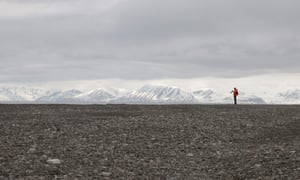
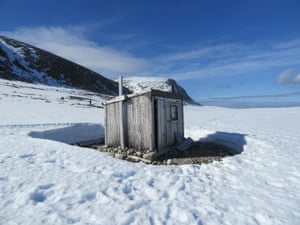
‘Solitary specks in the vast landscapes’: a cabin on Svalbard – the last one before the north pole. Photograph: Rowan Moore
“Don’t get eaten by a polar bear” was common advice before I left,
but Other People were scarier. What if we couldn’t stand each other, on
this vessel alone on icy seas? Agatha Christie would have loved the
scenario: a confined space, multiple personal histories, several ways to
die. It didn’t seem auspicious that my allocated cabin-mate greeted me
with a box of earplugs and the warning that he snores. But I slept,
partly by imagining that his occasional rumblings were the sounds of
glaciers or walruses. Collectively we participants got along well, not
only because it was clearly dumb not to, but also because this was a
group of likable and dedicated people. There were irritations, to be
sure, and occasional outbreaks of what might be considered madness, but
the overwhelming experience was the pleasure of encountering people we
wouldn’t have met otherwise, and making lasting friendships.
We were conscious of a precedent – in 2005 a group called Cape
Farewell organised a residency in Svalbard that included Ian McEwan and
Antony Gormley, that formed the basis of McEwan’s novel
Solar.
We were a less starry bunch but possibly we had a better time, not least
because they went in the harsh month of March. It helped that we were
lucky with wildlife – two blue whales within an hour of leaving port,
six bears in three sightings, an extended viewing of an ugly of
walruses, plus seals, arctic fox, reindeer and an array of birds. (And,
yes, according to some contested sources an “ugly” is a collective noun
for those large brown sea beasts.)
If
it would be nice to tell daring tales of narrow escapes but the truth
is that dangerous places have to be highly managed. On land, you can’t
leave the protection of the guides, who are armed with rifles as a last
resort against polar bears (although there was a mildly alarming moment
involving a grounded boat and a curious bear). You could swim in the
extremely cold water or go up the ship’s foremast in a safety harness,
but these are hardly epic adventures.
Rather, we busied ourselves with our personal attempts to respond to the Arctic.
Adam Kuby,
a public artist from Portland Oregon, filled a crack in ice with
gold-coloured fabric and photographed it. Emma Hoette, one of the crew,
who is currently studying at the Laban centre in London, reprised
a performance where she sits on a cold rock, naked but for a woollen neck warmer that she slowly unravels.
Philip Kanwischer,
from Calgary, made a digitally altered photograph of our anxieties:
that curious bear multiplied several times over. All had to observe the
same rule: you may leave nothing behind on the islands and beaches and
take nothing away. Any manmade objects that might be older than 1946 –
barrel hoops, shoes, broken bottles — are designated as cultural
artefacts and must not be touched.
"The Arctic doesn’t give a damn about us. If it could have a preference, it would want us dead"
Writers took notes for future poems and essays. I read an account of the 1873 expedition of the explorer
Benjamin Leigh Smith,
who happens to have been my great-great-great uncle, and traced the
intersections of his routes with ours. In Mosselbukta, where he found a
Swedish expedition that had spent the Arctic winter trapped by ice, I
saw the ruins of a flatpacked house these pre-Ikea Swedes had built. It
later collapsed; its timbers are miraculously preserved by the dry, cold
air.
As a writer on architecture, I had imagined that the appeal of the
Arctic would include its lack of my usual subject matter, but there are
buildings there too, all the more poignant for their survival in hostile
places. There are the structures of coalmining, mineheads perched on
near-cliffs and long-legged conveyor systems that recall the inventions
of HG Wells or the
Walking Cities of the 1960s architectural group Archigram.
There are trappers’ huts, researchers’ cabins and tiny refuges for
travellers, all solitary specks in the vast landscape. There is the
steel mast from which in 1926 Raoul Amundsen and Umberto Nobile, at that
point collaborating with each other, flew in an airship to the north
pole.
These structures are to the point. They waste no energy. They combine
flimsy-looking tarpaper with oversized driftwood because that is what
is to hand. It would be lost effort to cut up the wood into more
proportionate pieces. Decorated at most with reindeer antlers or a
bear’s jawbone, they have the striking aesthetic of buildings that don’t
have time for aesthetics, their unusual asymmetries of lightness and
mass being responses to unusual conditions.
The same cannot be said of
Pyramiden,
a piece of the Soviet Union on foreign soil, made possible by
international treaty that gives certain countries additional to Norway
rights to Svalbard. It is now a frigid modern Pompeii, where guided
tours can visit the dead 1990s house plants, the idle kitchen equipment,
the northernmost grand piano and the increasingly quaint office
machines that were left behind when, following the collapse of the
Soviet Union and with it the withdrawal of the town’s state support,
Pyramiden was abandoned. The black coal fields, striking after all that
pure ice, are apocalyptic.
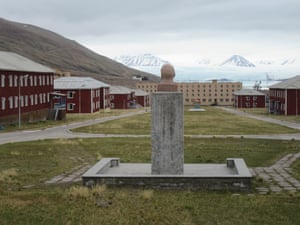
A bust of Lenin gazes over Pyramiden, the
‘frigid modern Pompeii’ that was once a thriving Soviet outpost. Photograph: Rowan Moore
In its 1970s heyday it was an exhibition town, a sought-after posting
for Soviet citizens, with model apartment buildings and the world’s
northernmost bust of Lenin gazing down an avenue nicknamed the Champs
Élysées. It has the only turf in Svalbard, imported from the Ukraine, on
which the only dandelions sometimes flower. It has a shed where
strawberries were grown. Its buildings are higher than anywhere else in
the archipelago, and its mining structures more elaborate and massive –
as much to make them impressive as out of necessity. As an exercise in
pitting man against nature, with the associated effects of hubris, it
has something in common with the Swedish balloon.
Svalbard architecture exposes with special lucidity the heroism and
foibles of human life, which is what the Arctic does more generally. It
doesn’t give a damn about us. If it could have a preference, it would
want us dead. But its very implacability makes us want to read ourselves
in it and enables us to do so. The message of those sedimentary
mountains is that, over a scale of tens of millions of years, nature
will probably shrug off whatever monstrosities we inflict on it, as it
has previous catastrophes like meteorites and volcanic explosions, but
that will be much too late for us. This realisation makes climate change
more urgent, not less. We made this problem and it is down to us to fix
it. There is no one and nothing else to help us.
It’s a little preposterous to seek the meaning of the Arctic, but if
it has one it’s in what it reflects. One of the strangest sights was,
after 10 days’ sailing, of a man we hadn’t met before. Wonders included
the rediscovery, over a return via Oslo airport to Britain, of crowds,
summer warmth, trees, trucks, streetlamps, passwords, football results
and new Trump eruptions much like the old ones, of a snail trail and a
mulberry bush in the garden. Some of these things seemed
inconsequential, some repulsive, some precious. A possibly obvious truth
was vividly reinforced, which is that there is no fundamental reason
why any of them are here. We’d miss them, some of them, if they weren’t.