Sunday, 30 December 2018

Vital ecosystems in tidal flats lost to development and rising sea levels

Extract from The Guardian

First global coastline survey shows 16% of tidal flats lost between 1984 and 2016
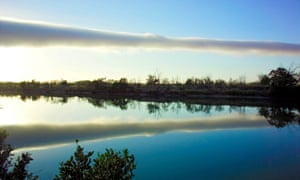
Coastal development and sea level rise are causing the decline of tidal flats along the world’s coastlines, according to research that has mapped the ecosystems for the first time.
Scientists from the University of New South Wales (UNSW) and the University of Queensland used machine-learning to analyse more than 700,000 satellite images to map the extent of and change in tidal flats around the globe.
The study, published in Nature, found tidal flat ecosystems in some countries declined by as much as 16% in the years from 1984 to 2016.
Tidal flats are mud flats, sand flats or wide rocky reef platforms that are important coastal ecosystems. They act as buffers to storms and sea level rise and provide habitat for many species, including migratory birds and fish nurseries.
Almost 50% of the global extent of tidal flats is concentrated in just eight countries: Indonesia, China, Australia, the US, Canada, India, Brazil and Myanmar.
Nicholas Murray, the study’s lead author and a senior research fellow at the centre for ecosystem science at the University of New South Wales, said because tidal flats were often at least partially covered by water they had been difficult to monitor in the past.
“This is a big ecosystem,” he said. “It’s all over the planet and highly susceptible to threats but we haven’t known where they are, which has limited the ability to monitor them.”
The research team worked with Google and used its computing resources to analyse every satellite image ever collected of the world’s coastlines.
They found that tidal flats, as an ecosystem, were as extensive globally as mangroves and that coastal development and sea level rise, in particular, were causing their decline.
In parts of China and western Europe, they found tidal flats that were up to 18km wide. In Australia, they occur all over the country, including places such as Moreton Bay in Queensland and along the Gulf of Carpentaria.
For 17% of the world, there was enough data available to measure declines from 1984 to 2016.
In these locations, which were mostly in China, the US and countries in the Middle East, they found declines in tidal flats of 16%.
For a further 61% of the world, there was enough data to analyse changes from 1999 to 2016 and the research showed declines of 3.1% in this period.
Murray said airports, aquaculture and other infrastructure that had been built on top of tidal flats in countries such as China were major threats. Reduced sediment flows from rivers around the world had also led to a reduced amount of sediment being deposited as tidal flats.
Murray said dams were one of the major drivers of reduced sediment flows from rivers. He said further analysis would be needed of the ongoing impact of the other key threat – sea level rise.
“This study has really given the data to start making those links,” he said. “It means you can really start to understand the impact of sea level rise and coastal development.”
The researchers suggest the study could be used to advance protected areas for tidal flats, which have not always been as well-protected historically because they fall between land and sea.
The map is publicly available and Murray said it had laid the fundamentals for an ongoing monitoring system.
“The easiest way to think about this is, for decades we’ve been able to observe deforestation,” he said. “We can now do that for tidal flat ecosystems.

“We can identify places where tidal flat ecosystems are being lost and the main drivers of those losses, which will allow us to respond with conservation action.”

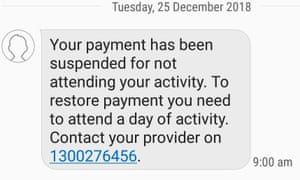
Happy Christmas from Centrelink – your welfare payments have been stopped

Extract from The Guardian

Automated systems labelled ‘heartless’ as email and text notifications ruin holiday
It was some way to start Christmas morning – a message telling Irina that her parenting payment had been suspended.
“I am the only person my child has,” the single mother of a five-year-old daughter said, “and she’s looking to me on Christmas morning to take the lead and I’m just sitting there with tears streaming down my face.”
Welfare payments are brought forward each Christmas to avoid any mishaps while Centrelink and job service providers are closed.
But this year some have reported getting text messages or emails telling them their payments were suspended for failing to complete their mandatory work-for-the-dole or ParentsNext activities, which the recipients said should have been cancelled or rescheduled. At least one message seen by Guardian Australia was received at 9am on Christmas Day.
The suspensions – which are automated – came despite the fact that the majority of job service providers were required by the department to review appointments booked during this period and cancel them where appropriate.
The department also said it had automatically lifted any outstanding payment suspensions so “any new payment suspension that occurred in the few days prior to Christmas, would also be lifted”.
She told Guardian Australia she then got a text on Boxing Day telling her to contact her provider about her suspension, despite the fact it will be closed until 2 January.
Irina’s next payment is due on 2 January, the same day rent for public housing will be automatically deducted.
“It felt like a slap in the face to be cut off so ruthlessly on Christmas Day,” said Irina, who did not want her surname used.
“I’ll have to suspend all direct debits, risk being kicked out of the house, risk electricity being cut off … I can approach Salvos and Foodbank for help but how ridiculous that now I have to spend time doing all this.”
Generally, people can only have their payments restored by “re-engaging” with their provider, most of whom are closed between 24 December and 1 January. Centrelink is shut from 25 to 27 December and on 1 January. Irina said on Friday, four days after her payment was suspended, that it had been restored. She was not sure how this had happened.
One Newstart recipient told Guardian Australia they had received a text at 9am on 25 December telling them their payment had been suspended for failing to attend a work-for-the-dole activity on Christmas Eve. The person said they understood they were not obliged to meet these requirements during the Christmas period.
A second person receiving Newstart allowance reported receiving a text saying they did not need to do their work-for-the-dole activities over Christmas, followed by a text notifying them of a suspension.
Earlier this month Jobs Australia – which represents non-profit employment agencies – called for the government to immediately remove welfare compliance measures for people like Irina, who are forced to take part in ParentsNext.
Jeremy Poxon, a spokesman for the Australian Unemployed Workers’ Union, told Guardian Australia the digital compliance system “has a dismal record of failure – and these ‘errors’ continue to unfairly punish and burden social security recipients”.
“Our automated decision-making systems are cruel and heartless. They place all burden and responsibility on social security recipients, who – instead of receiving proper care and support – must constantly ‘please’ algorithms and ‘justify’ their receipt of income support.”
A spokeswoman for the Department of Jobs and Small Business told Guardian Australia on Thursday it had “received a handful of calls in relation to payment suspensions occurring today”.
“The department has confirmed that all callers have or will receive their payment as per their usual pay date.”
The spokeswoman added that the department had “automatically lifted any outstanding payment suspensions for all jobseekers in Jobactive, DES, ParentsNext and CDP”.
She said any “jobseeker impacted during this period, whose provider is closed, should contact” the national customer service line.

Irina said on Friday, four days after her payment was suspended, that it had been restored, although she was not sure how this had happened.

Changing channels: the questionable influence of radio shock jocks and Sky after dark

How does a small handful of commentators such as Alan Jones and Ray Hadley wield political power?
As you walk the corridors of Parliament House in Canberra, many of the TVs in the offices are tuned to the pay TV channel Sky News late into the night. Ministers’ and backbenchers’ offices, and even the cafe down the hall, echo to an anxious call to arms from the same political quarter – the right wing of the Liberal party. It’s here that you’ll find climate change denial, sexism and racism aired with regularity. And then there’s Peta Credlin, still haunting parliament, driving home the same message that led to Tony Abbott being ousted as prime minister.
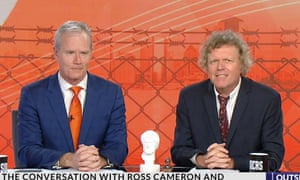
There are others too; Alexander Downer’s former media minder Chris Kenny, Andrew Bolt and Paul Murray, recently in the news for his “hot mic” confession that “Sky News at night is a Liberal party echo chamber”. As if to emphasise the point, shortly after Murray was outed, the Liberal MP Craig Kelly, famous for saying that burning fossil fuels protects us, and equally famous for threatening to move to the crossbenches if he didn’t get preselection for his New South Wales seat, joined the Sky team, replacing Ross Cameron, the former Liberal MP who was sacked for his offensive descriptions of Chinese people. This followed the sacking of the controversial former Labor leader and now One Nation politician Mark Latham in 2017.

Ross Cameron, who was sacked for offensive descriptions of Chinese people, and Rowan Dean on Sky News’ Outsiders.
Ross Cameron, who was sacked for offensive descriptions of Chinese people, and Rowan Dean on Sky News’ Outsiders. Photograph: Sky News

Outside the halls of power in Canberra, there aren’t so many people watching – TV ratings for last month revealed none of Sky’s programs made the top 20. As Tim Burrowes, the content director of the Australian media and marketing company Mumbrella pointed out, Sky News “got less than Peppa Pig, which scored 38,000” viewers. Yet the opening last month of the Sky News TV studio in Parliament House – promoted as the biggest in Canberra – is a sign of News Corp’s lavish investment in the channel. Burrowes says NewsCorp “always invests in a platform of influence” and that Sky News placed NewsCorp “at the centre of the debate. You have that soft power. You have the potential to influence.”
According to Burrowes, Sky is “two channels – the balanced and respected channel” during the day hosted by esteemed journalists such as David Speers but “after it gets dark it is very different”. It might not be a full-blown copy of Fox News in the US but many believe it is heading in that direction.
In the morning, Alan Jones is at the microphone on Sydney’s 2GB. Jones has been No 1 in his Sydney time slot, 5.30am to 9am, for more than 200 surveys. His program is seen as being highly influential. “Because it is treated as influential, it is influential,” Burrowes says.

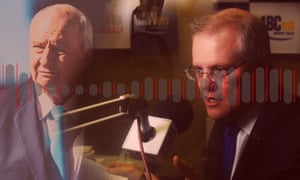
2GB and Sky News host Alan Jones and the prime minister, Scott Morrison.
2GB and Sky News host Alan Jones and the prime minister, Scott Morrison. Composite: AAP

Deciphering exactly how many people are listening, though, can be difficult. Perhaps unsurprisingly, radio stations prefer to quote figures that boost their numbers.
During the radio survey published last month, Jones boasted an audience of 432,000 in Sydney and 90,000 in Brisbane. (Snippets of his program are also broadcast on 70 radio stations nationally.) That means that more than half a million people tuned in at some time during the program for eight minutes or more. But the average audience for Jones during his breakfast show is not so impressive, just 161,000 in Sydney and 28,000 in Brisbane.
Chris Mitchell, the former editor-in-chief of the Australian newspaper, who made his name as a partisan warrior on the right, said the success of broadcasters like Jones and fellow conservative 2GB radio host Ray Hadley was in part due to “confirmation bias”. People liked to hear “opinions they agreed with”.

"The political climate means that Gladys Berejiklian has a completely different fight on her hands."

The former NSW premier and now Labor senator Kristina Keneally provides some insight into how to handle Jones and his rightwing ideology. As premier, between 2009 and 2011, her office set up a special desk, tasked with keeping an eye on the subjects that were of interest to Jones and Hadley. Hadley attracted 326,000 listeners (average 130,000) in Sydney and 77,000 (average 26,000) in Brisbane during the last ratings period.
The current NSW government has not been so lucky, and the political climate means that Gladys Berejiklian has a completely different fight on her hands.

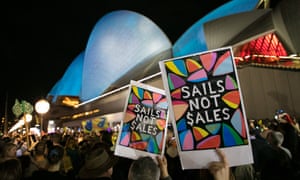
Sydneysiders protest against allowing the Everest Cup to be advertised on the sails of the Sydney Opera House. The NSW premier, Gladys Berejiklian, ultimately gave Alan Jones what he wanted
Sydneysiders protest against allowing the Everest Cup to be advertised on the sails of the Sydney Opera House. The NSW premier, Gladys Berejiklian, ultimately gave Alan Jones what he wanted. Photograph: James D Morgan/Getty Images

Last October Jones attacked the chief executive of the Sydney Opera House, Louise Herron, for refusing to allow the building’s sails to be used to advertise the barrier draw for a $13m horse race being run at Randwick. Jones’s bullying rant against her had barely subsided when Berejiklian caved in and gave Jones what he wanted. This was more than just the intersection of high art and a horse race. It was a metaphor for what has been called the struggle for the soul of the Liberal party of Australia, a battle between the middle ground and the authoritarian right.

Fox News-style ‘shock and awe’

As one of the first Liberal party MPs to speak out against the influence of the hard right inside the party, and the role of Jones and Sky in fomenting what’s been described as the toxic atmosphere in federal politics, Craig Laundy struggles to understand why the party is on a course he believes could make it unelectable.
“The reality of politics, especially as a marginal seat holder, you need 50% plus one to get elected and that’s just in your seat,” he says. “But you need then 50% plus one of the total of seats, which is 150 at the next election, to form government. Now you are not going to get that by lurching hard right. You’re just not.”
Laundy, who first won Reid – until then a traditional Labor seat – in 2013 with a narrow 0.8% victory, increased the margin to 5% at the 2016 election. But while Laundy has managed to turn Jones’s attacks – he called Laundy a Turnbull sycophant – into a political advantage in an electorate where Jones doesn’t have much support, others haven’t been so lucky.

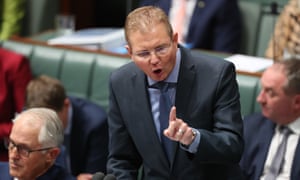
Craig Laundy
Liberal party Craig Laundy, who says of Sky ‘a lot of my colleagues take what they say as gospel’. Photograph: Mike Bowers for the Guardian

The power of Jones, Hadley and Sky is not how many viewers and listeners they influence but the effect they have on the party branch members who then pressure their MPs. Laundy believes Sky is “going for that Fox News-style US shock and awe because there is definitely a market for it”. And although that market is small, the reason many of the Liberals watch Sky so closely is because it is influential with the activist members of their branches, particularly in marginal seats. Laundy counts himself lucky because “most of my branches are moderate”.
The result of the Longman byelection in Queensland this year, a seat the Liberal-National party (LNP) had hoped to win from Labor, was a catastrophe for the government that saw the LNP’s primary vote collapse. Such a disaster might have persuaded the Liberals to move towards the middle ground but instead they shifted in the opposite direction – eventually dumping their leader, Malcolm Turnbull. The far right candidate, Peter Dutton, received a sizeable 35 votes – with more than a third of the Liberal party’s parliamentary caucus supporting him – before Scott Morrison emerged as the “compromise candidate”. The pressure on MPs from their party members to support Dutton had been unrelenting. In the Queensland seat of Petrie, adjacent to Longman, branch members put extraordinary pressure on their local Liberal National party member, Luke Howarth, after they had received “a relentless pounding from Sky News after dark”, according to Laundy.

"Our side of politics spends their whole time in their offices with Sky News playing in the background."
As he told Guardian Australia’s political editor, Katharine Murphy, recently: “The part that gets missed for people outside Canberra … is when you are in Parliament House, our side of politics spends their whole time in their offices with Sky News playing in the background, and you are watching colleagues going head-to-head with Labor on policy, but once it gets to 6pm it goes from panel-style shows to commentary shows.
“Look that’s [Sky’s] business model. It isn’t sour grapes. They are entitled to do this. They are trying to go the Fox News, US-style controversial rightwing shake-it-up … and a lot of my colleagues take what they say as gospel.”
And they are, he said, “signals that don’t appropriately reflect the middle ground in Australia”.
Howarth argues that while not every politician is influenced by Sky or talkback radio it is different “when leadership spills are on”. He says Hadley was encouraging people to contact their local member to say they wanted Dutton. Howarth received 30 calls urging him to support Dutton. He says he was going to vote for Dutton anyway.

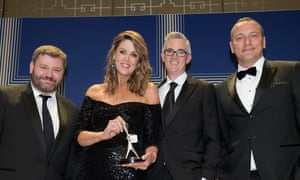
Paul Murray, Peta Credlin, David Speers and Kieran Gilbert at the 2017 Logie awards.
‘Two channels’: Paul Murray, Peta Credlin, David Speers and Kieran Gilbert at the 2017 Logie awards. Photograph: Tracey Nearmy/AAP

The problem with Turnbull, according to Howarth, was that he did not meet his own key performance indicators. Turnbull had said 30 polls was too many for Abbott and that is why he had challenged him. “We let him get to 38 before deciding to spill.”
The greater problem, according to Howarth, is that although he believes his voters are “traditional Libs” the push to the right – enthusiastically supported by Jones, Hadley and Sky – might encourage them to switch their vote to another party like One Nation. At the last Queensland state election, One Nation “gave its preferences against all sitting members”. If they put up a candidate in his seat at the next federal election and did the same again it would make his 1.6% margin extremely vulnerable.
Very few Liberal party MPs would speak on the record about the pressure they came under from Sky, Jones and Hadley but, as one MP pointed out, with strong support for Dutton in the first spill “if you want to get on in the Liberal party you will need [the conservative right’s] support”.

Ray Hadley
Ray Hadley attracted 326,000 listeners (average 130,000) in Sydney and 77,000 (average 26,000) in Brisbane during the last ratings period. Photograph: Joel Carrett/AAP

Another Liberal MP from Victoria, who declined to be named because of the impact it might have on their preselection, agrees. The MP says the problem with Sky after dark is that it is basically a small, narrow group of people talking to a small, narrow, group of people who happen to be influential in the National and Liberal parties. These party members spout back extremist arguments to their MPs who are “completely spooked by it”, and are easily swayed on climate change and refugee policy.
“The problem is that we have to get preselected,” the MP says. “They say ‘you are a communist’ if you stand up to them.” There are also direct policy implications. Sky, Jones and Hadley have influence over MPs “who don’t have strong views”, the MP says.
Some Liberals, though, still hold to the party line. MP Ben Morton, the former director of the West Australian Liberal party, believes there is less respect today allowing “discussing of opinion and thought”. He says the criticism is equally valid “on one side of the political spectrum as on the other”.

The bush expansion

As News Corp implemented a full takeover of Sky in 2016, the rightward lurch was being watched over by Lachlan Murdoch from New York, apparently the only person with a Foxtel set top box outside Australia. It seems, like his father, Lachlan is anything but a passive viewer, and, according to some, further to the right. Murdoch has a “great interest in what is going on at Sky – particularly after dark”, one observer noted. There appears to be no mystery about the direction from New York.

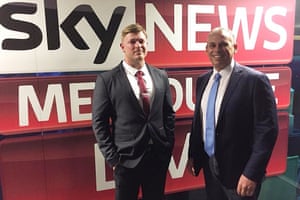
Blair Cottrell and the former Northern Territory chief minister Adam Giles, who conducted the interview on Sky
Blair Cottrell and the former Northern Territory chief minister Adam Giles, who conducted the interview on Sky. Photograph: Facebook/ Blair Cottrell
News Corp’s Sydney Daily Telegraph reported Sky News had already taken its flagship programs to broadcast out of 25 different regions in rural Australia – “reaching out to the kind of voters Trump won over as ‘the forgotten people.’”
Sky has teamed up with Win TV to broadcast across the company’s regional network from South Australia, regional Western Australia, Tasmania, regional Queensland and NSW. There is a possible audience reach of 7.813 million. Even though, unlike the Sky News channel, the programs are free-to-air, the audience figures so far suggest there is much work to be done bringing to the bush the kind of anti-migrant and climate change denial arguments that have so destabilised the Coalition government.

"The tough on crime, anti-migrant campaign in Victoria, backed by the Murdoch papers and Sky, dramatically failed."

Meanwhile there has been speculation that Jones’s 2GB contract – worth a reported $4.5m a year – may not be renewed, although other reports suggested this was just a matter of timing, with his contract up for renegotiation just as the Fairfax Media takeover by its new owners, Nine Entertainment, was happening. Nine, who got Jones as part of the package, will have to weigh up if Jones and his behaviour, which led to a recent $3.7m defamation payout, is worth his massive salary.
There is also the result of the Victorian election to take into account. The tough on crime, anti-migrant campaign, backed by the Murdoch papers and Sky, dramatically failed to persuade the electorate. But then again, the Liberal party it seems has not been listening to the electorate; it’s been watching Sky after dark and there’s little indication it’s going to change the channel.

Paul Whittaker, the CEO of Sky News, was contacted for this story

Adani 'conservation area' for endangered finch sits on proposed Clive Palmer mine

Adani has set aside a “conservation area” for the endangered black-throated finch at the same site earmarked for the massive Clive Palmer-backed Alpha North coalmine.
The environmental group Lock the Gate said the land-use conflict meant the Adani plan to protect the black-throated finch – which is one of two crucial management plans for the Carmichael mine yet to be approved by the Queensland government – amounted to an “elaborate hoax”.
But Adani’s response suggested the Indian company could seek to block elements of the neighbouring Alpha North coalmine, or prompt a court battle, to safeguard its own project.
“We will not allow the conservation area for the black-throated finch to be compromised,” Adani said in a statement to Guardian Australia.
Adani owns the relevant pastoral land – effectively the property at surface level. Palmer’s Waratah Coal has several exploration permits for the coal resource underneath, and has applied for a mining lease.
The Waratah Coal plan for Alpha North includes a series of open-cut and underground mines, planned to produce 80m tonnes of coal a year from two separate areas. A 20,000ha section Adani plans to use for a conservation area roughly corresponds to Alpha North plans for four longwall underground mines.
In applications, Waratah Coal has acknowledged that Alpha North could cause subsidence, and could affect black-throated finch habitat and watercourses.
The bird is endangered and researchers have previously said the Adani Carmichael mine’s offset strategy would be “grossly inadequate” to protect it.
Waratah Coal requires permission from pastoral land holders, including Adani, before being granted a mining lease. If there is a dispute, the matter goes before the Queensland land court.
Carmel Flint from Lock the Gate, which has a history of advocating for pastoral land owners in conflict with miners, said the land court “would do little to stop Waratah Coal from mining the area”.
“Mining licences trump pastoral leases completely under the law in Queensland,” Flint said. “As a result, this so-called ‘conservation area’ that Adani has allocated to the black-throated finch is utterly meaningless. It’s an elaborate hoax they’ve devised to enable them to start the Carmichael project, knowing full well that the area is likely to be mined in the future.”
The Queensland government has not yet approved Adani’s black-throated finch management plan, which includes 33,000ha of private protected land for the finch and other native species. About 60% of the conservation offset is on land covered by the Alpha North exploration permit and lease application.
Adani said in its statement it would not allow the conservation area to be compromised “as it is a condition of the approvals for the Carmichael mine and lies on pastoral lease owned by Adani”.
“A mining lease has not been granted for the Alpha North project and that project is yet to begin the required lengthy and rigorous approvals process.”
Adani has sought to characterise its outstanding management plan approvals as routine. It released a statement four days before Christmas accusing the Queensland government of “blocking” the delivery of jobs by not finalising the outstanding management plans.
Alongside the black-throated finch plan, Adani needs approval for a groundwater dependent ecosystems management plan. The ABC reported this month the CSIRO had raised concerns about the groundwater plan.

Waratah Coal was contacted for comment.

Adani provided 'persuasive' evidence of 'illegal' water bores, environmental lawyers say

Posted about 2 hours ago


Mining firm Adani has unwittingly provided "persuasive" evidence for a Queensland Government investigation into allegedly illegal works on its Carmichael mine site, environmental lawyers say.

Key points:

  • Environment department is investigating video evidence of illegal water bores on mine site
  • EDO says Adani provided data that demonstrates it has broken the rules
  • Adani insists the bores are operating as permitted under its licence

The evidence includes specifications of groundwater bores registered by Adani on a government website, which Queensland's Environmental Defenders Office (EDO) said could only be used for prohibited dewatering operations, and not for monitoring as Adani has claimed.
Adani has also confirmed it cleared 5.8 hectares of land when correcting an "administrative error" in its reporting to government, an action the EDO branded unlawful.
A spokeswoman for Adani insisted the company had acted in accordance with its environmental approvals, had not been dewatering for mining operations, and had "cooperated with both relevant State and Commonwealth departments regarding these allegations".
The Department of Environment and Science (DES) began an investigation in September to examine allegations Adani had drilled illegal groundwater bores.
Satellite and drone evidence of drilling was presented to DES by the EDO on behalf of its client, environmental group Coast and Country.
Coast and Country spokesman Derec Davies said the evidence had resulted in an official investigation by the Queensland Government.
"Adani have been caught red handed breaking the law, and then lying about it within official documents," he said.
Dewatering bores are used by miners to prepare for open cut and underground operations.
Conservationists have repeatedly warned that Adani's dewatering plans could threaten the nationally important Doongmabulla Springs.
An Adani spokeswoman said the company had drilled the bores "to take geological samples and monitor underground water levels", which she said was permitted as a stage one activity under its licence.
However, an expert has told the ABC the registrations for five of the bores that appear on a Department of Natural Resources, Mines and Energy website bear the hallmarks of dewatering bores, not monitoring bores.

They show the bores are constructed with steel rather than plastic casing, were considerably thicker than Adani's registered groundwater monitoring bores and ran deeper at 135 to 273 metres.
The bore reports did not include the baseline underground water level or the elevation of each bore, information considered critical for monitoring.
The five registered bores are also ascribed the abbreviation "DWB", commonly used for dewatering bores, instead of "GMB", commonly used for groundwater monitoring bores.

'The evidence is clear'

EDO chief executive Jo Bragg said the public information provided by Adani since the State Government launched its probe in September amounted to "highly persuasive" fresh evidence it had breached its environmental licence.
"This is very important that the government acts to properly investigate and enforce environmental laws against a big corporate citizen like Adani," she said.
"We say the evidence is clear they have done six hectares of significant site clearance and they have done illegal drilling and illegal dewatering.
"What's the point of having terms and conditions if the Government doesn't enforce them?"
Adani has had its environmental authority since 2016, but is forbidden from carrying out dewatering operations or "significant site disturbance" until the State Government approves its groundwater management plan.

An RMIT University environmental engineering professor, Matthew Currell, said he did not believe bores built to such specifications would be used for water monitoring.
"On the face of it, no, absolutely not," he said.
"I mean, the way that a production bore or a dewatering bore is constructed is very different to how you would construct an ideal monitoring bore.
"It wouldn't take very long at all to establish on looking at a bore like that what its primary purpose is for.
"Most definitely, you'd construct a different type of bore if you're going to use the bore for monitoring as opposed to dewatering and production."
Another drilling industry source estimated Adani's bores cost more than $400 a metre in materials, whereas a standard monitoring bore cost $164 a metre.

Registered pump tests show Adani had drawn at least 140,000 litres taken from target aquifers, which the EDO argued was also a breach of its licence.
On September 18, Adani issued a statement saying it had neglected to report the clearance of 5.8 hectares, more than double the area identified by satellite imagery in Coast and Country's complaint to the State Government.
The Adani spokeswoman accused the ABC of "acting as the mouthpiece for organisations like the Environmental Defenders Office and Coast and Country, which continually make claims that are later proven false".
She said Coast and Country had "taken unsuccessful legal action against Adani on previous occasions and had costs awarded by the court against it".
"To avoid paying those costs orders, Coast and Country placed the relevant entities to the litigation into liquidation and has then proceeded to create new entities to enable them to make further baseless allegations using the Coast and Country name," she said.
"Adani will continue to comply with all of its legal obligations whilst it focuses on creating jobs for regional Queensland."
Mr Davies said Adani, "lashes out at its critics when in a corner".
"If as much energy was put into protecting Queensland's water and natural environment they might not find themselves mired in such constant controversy," he said.
Ms Bragg said the DES had been "investigating this persuasive evidence for quite some time" and had the option of prosecuting Adani or issuing civil enforcement orders.
"Frankly, it's really not good enough," she said.
"We've been told by Adani itself and politicians that there's many, many terms and conditions attached to these approvals.
"Here we have this very convincing evidence they've been breaching their environmental approvals — the Government should act."

A DES spokesman said its investigation remained active and the department could not comment further on the matter.

Saturday, 29 December 2018

Syrian government claims to enter Kurdish-held town of Manbij to stop Turkish attacks

Updated about 2 hours ago


Syria's military claims to have entered the Kurdish-held town of Manbij and raised the national flag there, which Kurdish representatives say is to ward off a threatened Turkish offensive.

Key points:

  • US-backed Kurdish forces hold the northern Syrian town of Manbij, under Turkish threat
  • The Kurds have invited Syrian government forces to defend the town
  • Sources say that US troops have not left the area, while Syrian forces have just arrived

But US troops who still patrol the town and Turkey denied there was any change of forces in the contested area.
The US-led coalition said Syria's claims were "incorrect," and called "on everyone to respect the integrity of Manbij and the safety of its citizens."
Turkey and its allied fighters, which views the Kurdish militia as a terrorist group, has been threatening a military operation against Manbij in recent days.
The Kurds are an ethnic group indigenous to the lands that now make up south-eastern Turkey, north-eastern Syria, northern Iraq, north-western Iran and south-western Armenia, who have long fought for an independent state known as Kurdistan.
Many of the countries that house the Kurds have violently opposed Kurdish self-determination, and Ankara has stepped up attacks on Kurdish-held posts in northern Syria throughout 2018.
Kurdish official Ilham Ahmed said the US troops who patrol the town and the tense front line with Turkey-backed fighters have not withdrawn from Manbij, while Syrian troops have only arrived at the front lines.
"The aim is to ward off a Turkish offensive," Ms Ahmed said.
"If the Turks' excuse is the [Kurdish militia], they will leave their posts to the government."
A resident of Manbij, who spoke on the condition of anonymity, said there was no sign of government troops.
Pro-state Syrian TV aired footage from inside Manbij of commercial streets on a rainy day, but did not show any troops.
It aired images of a military convoy driving late at night, reportedly to Manbij.
The Syrian Observatory for Human Rights said Syrian troops have deployed around Manbij on the front line with the Turkey-backed fighters to the west.

'We are aiming to wipe out all terrorist organisations'

Turkey will have nothing left to do in the Syrian town of Manbij once "terrorist organisations" leave the area, President Tayyip Erdogan said.
Anakara has threatened an assault on Manbij to drive out the Kurdish YPG militia, which it regards as a terrorist group.
Mr Erdogan said that Turkey was not in a hurry to carry out the operation.
"In the current situation, we are still supporting the integrity of Syrian soil. These areas belong to Syria," he said.
"Once the terrorist organisations leave the area, we will have nothing left to do there.
"It's not just about Manbij, we are aiming to wipe out all terrorist organisations in the region. Our main target is that the YPG takes the necessary lesson here."

Another complex front opens in the Syrian civil war


While US forces are set to leave Syria after President Donald Trump surprised the world and his Cabinet by making the decision to leave Syria for good — saying the US "won against ISIS" — it is unclear who will fill the power vacuum left by the world's pre-eminent military superpower.
The announcement by the Syrian military was quickly welcomed by the Kremlin, whose spokesman Dmitry Peskov called it a "positive step" that could help stabilise the situation.
Iran hailed the government announcement as a "major step toward establishing the government's authority" over all of Syria.
The Syrian Kurdish group, which had partnered with the US since 2014 to fight the Islamic State group, have sought new allies, reaching out to the government and the Russians to protect their Kurdish-administered areas in north Syria.
The Syrian government has said it welcomed the Kurdish group returning under its authority.
But government officials have stated they will not consider a Kurdish autonomous area.
Syria's entry into Manbij comes a day before Moscow is to host top Turkish officials to discuss the crisis in Syria after the US announced its withdrawal.
A timetable for the withdrawal has not yet been made public.
ABC/Wires

Mueller closes in: what will the Trump-Russia inquiry deliver in 2019?

The special counsel investigation into Russian meddling and possible collusion is notoriously leak-proof but it could soon touch Trump directly or members of his family
Robert Mueller currently appears to be building charges against Jerome Corsi and Roger Stone but does he also have bigger targets in mind?
Robert Mueller currently appears to be building charges against Jerome Corsi and Roger Stone but does he also have bigger targets in mind? Photograph: Tom Williams/CQ-Roll Call,Inc.

After two years of the Donald Trump presidency, the national stores of civic goodwill are depleted. That could make for a testy 2019, because it appears that the country’s defining political tensions are about to break into open clashes.
One field of battle will be Congress, where Democrats say they will use their control of the House of Representatives to mount investigations of Trump and his coterie. Another will be the campaign trail, where Democrats (and maybe some Republicans) will begin to compete to replace Trump.
But perhaps overshadowing them all is special counsel Robert Mueller’s investigation into Russian interference in the 2016 US election, and links between the Trump campaign and Moscow.
Mueller is expected to advance significant new aspects of his investigation, which could end up targeting Trump himself in a very public way in the new year, according to legal experts and observers.
Analysts interviewed by the Guardian uniformly warned that Mueller’s velocity and vector are basically unknowable, because his team does not leak private information, while salient public information, such as Mueller’s willingness to move to the sentencing phase for cooperative convicts such as Michael Flynn, is open to interpretation.
But the broadest possible question about what the next year might hold in store for Mueller pertains to his core investigation of alleged collusion between the Trump campaign and Russia and obstruction of justice by the president, analysts said.
“I think the biggest question is, is he going to present evidence that Trump committed crimes?” said Alex Whiting, a Harvard law professor and former prosecutor on the international criminal court. “Either obstruction of justice or collusion. He wouldn’t bring an indictment because justice department policy won’t permit it. But whatever evidence would be handed off, I think, to the Congress, and it will have to be considered.
“That’s as big as it gets. I think that’s really – that’s the ultimate question.”
A basic obscurity and air of secrecy still attend Mueller’s work. For all the major developments in the Mueller investigation in 2018 – from the April raid on former Trump fixer Michael Cohen’s home to the fiery Flynn sentencing hearing earlier this month – the public gained a relatively limited view on the progress of Mueller’s core investigation of election tampering and potential obstruction.
A Mueller memo describing Flynn’s “valuable” cooperation was almost entirely redacted in sections describing Russia-related matters. Likewise, a Cohen memo was adamantly non-specific in its description of “core” investigative matters that Cohen helped with.
One of the most revealing Mueller documents to emerge was a draft plea agreement with the conspiracy theorist Jerome Corsi revealing that Mueller alleged that Corsi helped Trump political adviser Roger Stone communicate with WikiLeaks, which served during the election as a Russian cutout.
“For now, he appears to be building charges against Corsi and Stone,” former US attorney Renato Mariotti said of Mueller.
If Trump himself would be the biggest target Mueller might approach in 2019, and Corsi or Stone would be lower-level, Mueller might also target someone just short of the president, such as Trump’s son, Donald Trump Jr, or his son-in-law, Jared Kushner, analysts said. Both men appear to be legally exposed to charges of making false statements either to investigators (as Flynn did) or to Congress (as Cohen did).
Barb McQuade, a University of Michigan law professor and former US attorney, pointed to Mueller’s description of Cohen’s cooperation and noted that Cohen had “described the circumstances of preparing and circulating his response to the congressional inquiries” – a response he later admitted was false.
“That suggests there were others who were trying to get their story straight,” said McQuade. “And I imagine that that would be an area that Mueller would look at, to say: ‘Well, Michael Cohen told a lie. Did anyone else tell the same lie?’

Michael Cohen ‘described the circumstances of preparing and circulating his response to the congressional inquiries’, something which could have a bearing on others’ testimony.
Michael Cohen ‘described the circumstances of preparing and circulating his response to the congressional inquiries’, Mueller wrote. Photograph: Xinhua/Barcroft Images

“And if they did tell that lie, number one, there are going to be charges against them for lying to Congress but, number two, why did they lie?
“People tend to lie under a situation as serious as that only if they believe that the truth would be worse. And so if they’re lying about the Trump tower Moscow, what truth about that is worse?”
Major incidents before or after the last US presidential election could emerge as focal points for Mueller in the new year. The special counsel might reveal new evidence about the circumstances surrounding a June 2016 meeting at Trump Tower, or a February 2017 meeting between Trump and Comey, at which Comey said that Trump encouraged him to drop an investigation of Flynn.
Further criminal charges might emerge in the case of hush payments made to the porn actor Stormy Daniels and former Playboy model Karen McDougal, or new details might emerge of projects or prospective projects advanced by Trump and his family in Moscow or the Middle East. In the background would be questions about the nature of the Trump campaign’s relationships at the time with any foreign backers.
Foreign countries and nationals are not supposed to be involved in US campaigns or elections.
“We all at this moment know very little about where Robert Mueller’s investigation will lead, because it has been so leak-free and they have been so careful about keeping their cards very close to the vest, and admirably so,” said Lisa K Griffin, a law professor at Duke University with a focus on federal criminal justice policy.
“I don’t think anyone knows, and I think most of the conjecture about it has been wishful thinking in both directions.”
Whiting said: “Trump has tried repeatedly to minimized this investigation, to delegitimize it, to dismiss it, and that hasn’t worked and it’s not going to work.

“I think this investigation and the consequences are going to be significant and they’re here to stay, and there’s nothing he can do about it.”