Contemporary politics,local and international current affairs, science, music and extracts from the Queensland Newspaper "THE WORKER" documenting the proud history of the Labour Movement.
MAHATMA GANDHI ~ Truth never damages a cause that is just.
The word “unprecedented” has been in
regular use lately. As predictions about climate change increasingly
become observations, we are witnessing firsthand the impacts of more
frequent and severe weather events. These events are playing havoc with
our health, our agricultural systems, our communities and our economy.
But they are also having devastating impacts on our natural ecosystems
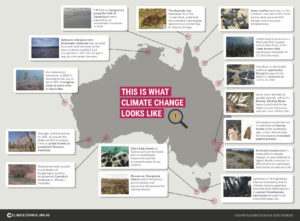
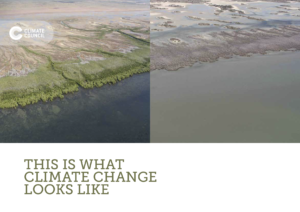
and unique wildlife. The Climate Council’s new report, ‘This is What Climate Change Looks Like,’
highlights recent examples of these impacts. In many cases, our
ecosystems and species were already under threat from other
human-associated causes – like land clearing, over-harvesting, and
invasive feral animals and weeds. Climate change is adding to
this litany of woes, in some cases providing what might be the last
straw for species and systems already under grave stress.
Australia is home to more than a
million species of plants and animals, yet our track record on
conservation is woeful; climate change is making it even harder to
protect our natural ecosystems and unique wildlife.
Our natural ecosystems and unique
wildlife are already under grave stress from land clearing,
over-harvesting and invasive feral animals and plants; climate change is
adding to this litany of woes and is proving to be the last straw for
some systems and species.
The status of biodiversity in
Australia is considered ‘poor and deteriorating’ according to the most
recent State of the Environment Report, which also found that the
traditional pressures facing the environment are now being exacerbated
by climate change.
Between 1996 and 2008, Australia was
among the top 7 countries responsible for 60% of global biodiversity
loss. The International Union for the Conservation of Nature ranks
Australia fourth in the world for species extinction and first for loss
of mammals.
Australia has one of the highest
rates of species extinction in the world and it now holds the first
record of a mammalian extinction due to climate change. Other species
are in grave danger because of our warming climate.
The Bramble Cay melomys was listed
as endangered but no active steps were taken to protect the native
rodent found on a low-lying atoll in the Torres Strait; storms and
rising sea levels led to its extinction.
Green turtles are in grave danger
because the animals hatching in the northern Great Barrier Reef are 99%
female due to warming. The complete ‘feminisation’ of the population may
occur in the very near future with disastrous consequences.
Bogong moths are in decline in the
Australian alps because drought has affected the grass on which the
larvae of the moths feed. These moths are a vital part of the food chain
for many alpine birds and mammals.
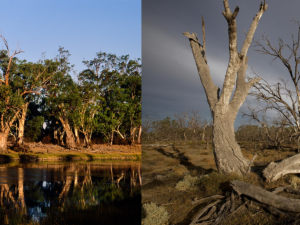
Image showing the death of iconic red river gums along the waterways and floodplains of the Murray-Darling River. Credit: Bill Bachman; Amy Toensing.
Droughts, ‘dry’ lightning strikes and heatwaves are transforming many Australian forests.
Ignitions from ‘dry’ lightning
storms are increasing in frequency because of climate change, sparking
many remote bushfires. Thousands of dry lightning strikes in early 2016
caused bushfires that devastated nearly 20,000 hectares in the Tasmanian
Wilderness World Heritage Area.
The Murray-Darling Basin has
suffered a long-term drying trend, seriously affecting the magnificent
river red gums that line the waterways. Climate change-exacerbated
droughts, on top of water mismanagement, are depriving the gums of the
flooding they need every few years to remain healthy.
The jarrah forests of Western
Australia are suffering as a result of long-term rainfall decline, as
well as drought and heatwaves.
Giant kelp forests that support rich
marine biodiversity are declining around the southern mainland coast
and Tasmania due to underwater heatwaves and the impacts of changes in
the distribution of marine herbivores.
Australia needs to take a far bolder
approach to conservation to ensure our species and ecosystems are as
resilient as possible to worsening extreme weather.
Australia’s high greenhouse gas
emissions are contributing to increasingly severe changes in the climate
system, which means further deterioration of our environment is
inevitable.
Creating and connecting new habitats and the translocation of some species will be necessary to prevent further extinctions.
Australia must achieve deep and
rapid cuts to greenhouse gas emissions to keep temperature rise to well
below 2 degrees above pre-industrial levels.
Australia needs to accelerate the
transition to clean, affordable and reliable renewable energy and
storage technologies and ramp up other climate solutions in transport,
industry, agriculture, land use and other sectors.
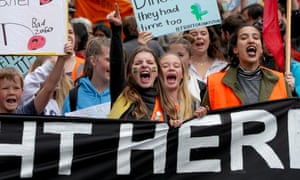
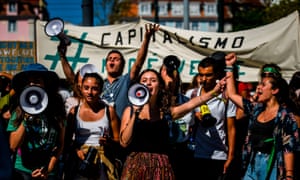
Demonstrators in Lisbon on Friday, part of a global climate strike joined by an estimated 2 million people worldwide.
Photograph: Patrícia de Melo Moreira/AFP/Getty Images
Six million people have taken to the streets over the past week,
uniting across timezones, cultures and generations to demand urgent
action on the escalating ecological emergency.
A fresh wave of climate strikes swept around the globe on Friday with
an estimated 2 million people walking out of schools and workplaces.
Organisers say that during the week of protests – that began with a global climate strike last week – a total of 6 million people, from trade unionists to schoolchildren, have taken part in thousands of towns and cities.
“This week was a demonstration of the power of our movement,” said a
spokesperson for the FridaysForFuture group which has helped coordinate
the demonstrations. “People power is more powerful than the people in
power. It was the biggest ever climate mobilisation, and it’s only the
beginning. The momentum is on our side and we are not going anywhere.”
A climate protester in Wellington. More than 3.5% of New
Zealand’s population joined Friday’s demonstrations. Photograph: Hagen
Hopkins/Getty Images
On Friday there were huge protests in Italy – where more than 1
million people were reported to have taken part – Spain, the Netherlands
and New Zealand, where more than 3.5% of the country’s population
joined the demonstrations.
Organisers said they were expecting more people to join as the day progressed. High turnouts were expected in Canada, where Greta Thunberg
– who kickstarted the school strike movement with a solo protest in
Sweden 12 months ago – was due to join demonstrators in Montreal.
May Boeve from 350.org,
which has helped organise the demonstrations, said: “We will keep
fighting until the politicians stop ignoring the science, and the fossil
fuel companies are held responsible for their crimes against our
future, as they should have been decades ago.”
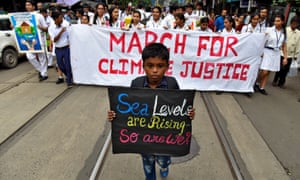
Students on a Fridays For Future march in Kolkata, India. Photograph: Ranita Roy/Reuters
The day of protests began in New Zealand, where an open letter was
delivered to parliament on Friday morning calling on the government to
declare a climate emergency – following the lead of numerous councils
around the country.
“Our representatives need to show us meaningful and immediate action
that safeguards our futures on this planet,” Raven Maeder, the School
Strike 4 Climate national coordinator, said. “Nothing else will matter
if we cannot look after the Earth for current and future generations.
This is our home.”
Strikes and demonstrations followed in scores of other countries from
Ghana to Samoa, the Philippines to Indonesia, South Korea to Taiwan.
In some countries, protesters have had to go to extraordinary lengths
to express their message to resistant authorities or an indifferent
public.
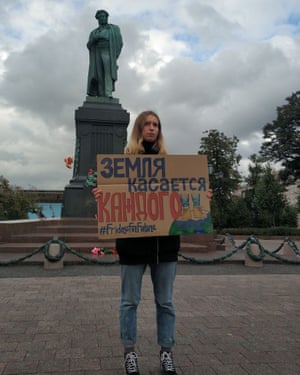
A climate striker in Pushkin Square, Moscow, where
protesters have found it ‘almost impossible’ to get permission for a
mass demonstration
Makichyan Arshak has been staging a solo school strike in Pushkin Square, Moscow, for 29 weeks.
“In Moscow it is almost impossible to get permission for a
mass demonstration so we protest in a queue. One person holds a poster
for five minutes, then hands over to the next person who is waiting
nearby. That way, we don’t have any problems because it is a series of
solo strikes rather than a group gathering,” said the 25-year-old
violinist, a graduate of the Moscow Conservatory.
Demonstrations also took place across South America, from Mexico City’s vast Zócalo square to the Plaza de Mayo in Buenos Aires.
On Bogotá’s high Andean plain, the environmental movement has faced a
severe crackdown. In July, protesters across Colombia pleaded for an
end to the violence that has resulted in numerous activists being
killed, with the peace and development thinktank Indepaz putting the
figure at 734 deaths in the first seven months of 2019.
Greta Thunberg: the speeches that helped spark a climate movement – video
“We want to keep fracking out of our country and demand an immediate
change towards decarbonisation,” said the activist Susana Muhamad, who
was planning to march past the offices of the country’s largest
petroleum company, Ecopetrol.
In Brazil, organisers said there were climate protests in São Paulo
and at least nine other cities. In Rio de Janeiro, a group of university
students rallied in the city centre bearing banners urging: “System
change not climate change” and chanted: “What do we want? Climate
justice. When do we want it? Now!”
Nayara Almeida, a 21-year-old student at the Federal University of
Rio de Janeiro, said the group’s demands to the government included
greater protection of the Amazon rainforest. “Our future is threatened
and they are insensitive to that. We need politicians to make this a
priority.”
The global climate strikers say their action is a sign of the growing
awareness and anger of the severity and scale of the climate crisis
among people around the world.
This week Thunberg excoriated world leaders
at the UN for their “betrayal” of young people after the New York
summit failed to deliver ambitious new commitments to address dangerous
global heating.
The climate activist told governments: “You are still not mature
enough to tell it like it is. You are failing us. But the young people
are starting to understand your betrayal.”
Scott Morrison has made his first visit to the United States as
prime minister. It was a trip that included a close encounter with the
unpredictability of the Trump White House, a foreign policy pivot, and a
backlash about a lack of climate policy action. Guardian Australia’s
political editor, Katharine Murphy, travelled, with the prime minister. Here is what she witnessed:
Washington
We’ve been positioned at the White House since 5am, watching the sun
creep over the American capital. Security is as laborious as you’d
expect. Dogs sniff bags, then the secret service guys have a good look,
passports are collected, checked and returned, White House passes and
pins are distributed, and then at last we clear the metal detectors.
Eventually we make it to the press briefing room, the small blue one,
famous through several presidential administrations but now abandoned by
Donald Trump. The modest proportions don’t fit his presidency. Now it’s just a transit zone.
We are greeted by a blond woman in a broad-brimmed hat. June, a
self-described southern belle, is receiving visitors in the briefing
room, although it’s not clear why. She identifies herself as a fellow
scribe working for Christian radio and television in Nashville. When
she’s not reporting on the Trump White House, she’s rallying Christians
for the president. This seems something of a line cross for a reporter
with White House press accreditation – but we’ve been on the premises
for about 10 minutes and it’s clear that we’re not in Kansas any more.
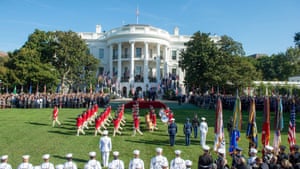
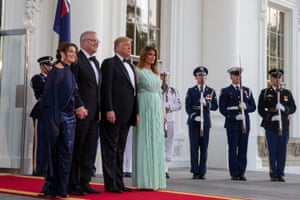
Donald and Melania Trump welcome Scott and Jenny Morrison
on the south lawn with full military honours. Photograph:
MAI/REX/Shutterstock
On the other side of the building, visitors are streaming across the
South Lawn to grab prime positions to witness The Donald receiving The
Scott at the official welcome. Flags, American and Australian, are held
aloft on a glorious summery day. Eventually we are permitted to wander
down to the lawn as well.
The Donald’s grass is lush and slightly dewy, making me
regret my choice of footwear. The daylight is now dazzling but the
bucolic scene is disturbed by Austin rebuking Steve in the media pen.
The confrontation happens just before the splendidly peppy pipe band
strides across the lawn for the ceremonial welcome.
I’ve
never met Austin before this moment but he looks about 30, buttoned
down and watchful as a raptor – a White House wrangler who looks as
though he hasn’t sat down, eaten anything apart from a protein bar, or
slept more than four hours straight a night since early infancy. Steve
has transgressed and Austin convenes a short, sharp show trial in front
of me. I’ve nabbed a prime position on the fence in the media pen right
in front of the entrance, and I don’t intend to move unless the secret
service guy standing beside me gets feisty.
“You left the media area to make a call,” Austin says, voice
appropriately low so as not to disdain the Wonderful Occasion swelling
around us. Steve is older than his accuser and possesses the rumpled
look of a longtime print or news wire reporter. I’ve never seen Steve
before either, but he’s clearly part of the White House press pool and
looks like a man disinclined to small talk. My guess, from my quick scan
of the body language, the suppressed inner sigh, is that Steve has seen
a number of Austins in his reporting lifetime, perhaps a small
production line of them, and is not much gripped by this power play.
Steve says nothing. Austin persists. In a minute we are going to go
full Veep. “The secret service told me you left the media area to make a
call – is this correct?” Steve, at the end of his tolerance for J’Accuse
now, delivers his mic drop. “Yah,” he says. “One of the secret service
guys held back the rope so I could get out to make the call. I needed to
take the call.” I suspect Austin doesn’t really know where to take this
from here. The aide returns to the front of the fence, shoulders back,
eyes front. It’s showtime.
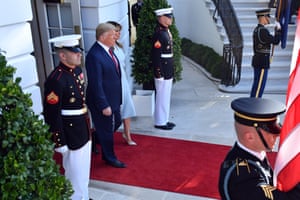
Trump strides out of the White House with Melania. From my vantage
point they look like a pair of Easter Island statues. This is my first
encounter with the current leader of the free world and my curiosity is
intense. How will Trump look uncut?
Donald and Melania Trump arrive to greet Scott Morrison. Photograph: Mick Tsikas/AAP
Will
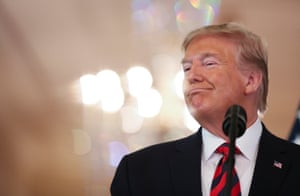
he look how he does on television, with that weird affect – the pursed
lips, narrowed eyes and nose and chin set to an upward inflection,
indicative of defiance and displeasure? Or is this a posture he adopts
only after he pulls on the presidential onesie every day and heads for
Fox News, purring “ready for my close-up Mr DeMille”?
I discover this is how Trump looks all the time, or at least all the
time he is in open space. He’s striding to the podium with exactly that
look, with Melania, who is a dignified presence yet strangely devoid of
life force. Perhaps she laughs and sings and dances in her track pants
like no one is watching in her private domain but, in public, Mrs Trump
looks like a perfectly proportioned doll in a doll’s house.
Over the next little while, Trump will lavish praise on Melania for
her crack presidential spouse skills. The first lady, Trump reports over
and over during the course of Friday, “worked so hard” on the table
settings for the state dinner, pondering every detail. The flowers, the
centrepieces, so wonderful, so beautiful. The best table decorations anyone has ever seen.
It’s hard for me to imagine the reality of the first lady’s life,
what it must be like to agonise over centrepieces for state dinners amid
the sound and fury of her husband’s bitterly contested presidency.
Given her reserved public presence, it feels like an impertinence to
wonder.
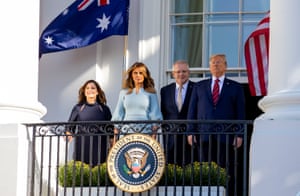
There’s no time for whimsy in any case, because the Morrisons are now
on the premises, ready for their induction into the Trumpiverse. In
comparison with the Trumps, Scott and Jenny Morrison, from the
Sutherland shire, Australia – more latterly of Kirribilli House – look
like a well-to-do couple from the suburbs. They are earthed in this big
moment, respectful of the tradition they are now associated with, the
tradition of Washington’s special friends being drawn to the nation’s
bosom.
Scott Morrison’s arrival in Washington marks the second
state visit of Donald Trump’s presidency. Photograph: Tasos
Katopodis/ABACA POOL/EPA
Presumably
they are buzzing with anticipation and anxiety, given that the
unofficial White House weather forecast for Friday is clear skies, a
light breeze and a high probability of catastrophic cyclone once their
delegation reaches the Oval Office. Looking normal in this environment
takes some doing, but the Morrisons manage.
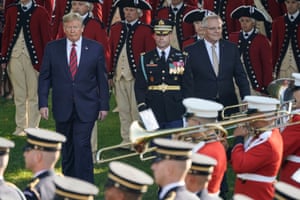
The troops march, and are duly inspected; the visitors clutch their
flags, which flutter gaily in the breeze. The anthems are played. The
two couples appear content with each other and the scripted remarks they
share with each other and the crowd. Just before the conclusion of the
formalities, Austin is back working the fence line to move us, lickety
split, to the holding pen outside the Oval Office. Fortunately, the war
with Steve seems to have subsided.
Trump and Morrison review the troops during an official arrival ceremony. Photograph: Joshua Roberts/Reuters
I wash up near Steve and the other White House wire reporters. One of
the group explains to me that Steve is the man if they want to get a
question to the president. Trump will answer Steve. It’s unclear why
that’s the case, and I don’t ask.
She also gives us tremendously helpful advice: Trump will be on for a
rave when we get in there. We are surprised by this. Our assumption was
we’d be in and out in a matter of minutes. Our river guide shakes her
head. Trump, she says, is in an expansive frame of mind. Best we prepare
some questions. She also predicts that Trump will struggle to
understand our accents. If he doesn’t understand, the president will
say: “Say it.” This means ask the question again, she says.
I assume this is some sort of weird in-joke until I hear Trump do
just that. “Say it,” Trump says, narrowing his eyes and curling his lip.
It’s utterly peculiar, but it’s an earworm. Once you hear it, it’s hard
to get the locution out of your brain. Say it.
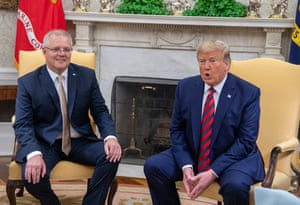
Trump reacts to questions during a joint press conference with Morrison. Photograph: Sipa USA/SIPA USA/PA Images
The
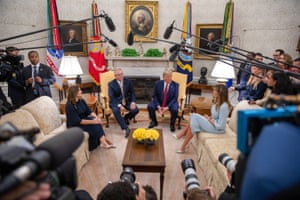
door of the Oval Office swings open and we are thrust into pure
madness. The media scrum feeds off the static electricity in the room.
It heaves like a wave. Our questions crash on the shore. Thud, thud,
thud. Mr President. The Americans in the pool want to know
about Joe Biden and the Ukraine controversy – a story that will spiral
towards impeachment during the week of our visit.
No American journalist gives a crap about Australia, and Morrison,
and the second state visit to Washington of this febrile presidency. Fun
fact: Emmanuel Macron, back when he imagined he had a talent for Trump
whispering, was the first to be afforded the honour. But who cares?
Conventions are devalued in the coarseness of politics in 2019. No one
pretends to care. Everyone just has to emerge with what they need.
Journalists crowd the two heads of state during their press conference. Photograph: REX/Shutterstock
Once we realise this is going to be nuts – a small blazing blitzkrieg at the seat of American power with no rules of engagement
– Australian reporters also start hurling questions across a range of
topics. Trump looks delighted by the disorder. It’s where he thrives.
Morrison shifts in his seat.
The president lays into the media. We are hopeless, finished,
friendless. But Mr President, what about the call? Did you speak to
Ukraine’s new president? It was a beautiful call. Next question. Say it.
The Morrisons sit tight as the stiff westerly blows. The prime
minister isn’t visibly alarmed but he’s hyper alert. Jenny Morrison
composes her face into a placid mask – until Trump suddenly raises the
spectre of nuclear weapons and Iran. I catch her eye at that moment and
she startles, ever so slightly. Her eyes, to me, say “help me”. I catch
Morrison’s eye a couple of times and the corners of his mouth crinkle.
I
am a spectator at this circus but the prime minister isn’t permitted
the luxury of distancing. Morrison is a peer of the president, a leader
of a respectable middle power who has chosen, as the New York
Times columnist Maureen Dowd puts it with just the right squeeze of
lemon during our visit, “to play ball with the Mad King” – to give
friendless Donald a friend.
“It was a beautiful call.” Trump responds to journalists
asking about his call with the president of Ukraine. Photograph:
REX/Shutterstock
The prime minister, unlike us, enjoys the benefit of knowing what
Trump really thinks on a range of fronts; he has that baseline to keep
him tethered through the rhetorical turbulence. But back in the
nosebleed seats we lack those insights. During our 33 minutes in the Oval Office,
Australian journalists are on a rollercoaster, hanging upside down,
while the president indulges a dialogue with himself about whether to
launch a military strike against Iran, or whether restraint is the
better course. He lands eventually at restraint but the disorientation
is so profound it takes me a while to process that’s where we’ve landed.
Eventually Trump stops feeling all the feelings and we are herded
out. I ask one of my fellow travelling reporters whether the president
just raised the prospect of nuclear attack, because I fear the sleep
deprivation might be messing with my cognition. He’s as knocked around
as I am. Yes, he thinks so, but he needs to listen to the recording. TV
reporters are wondering out loud how on earth they are going to distil
what just happened into a package. How do you do this in a minute and a
half?
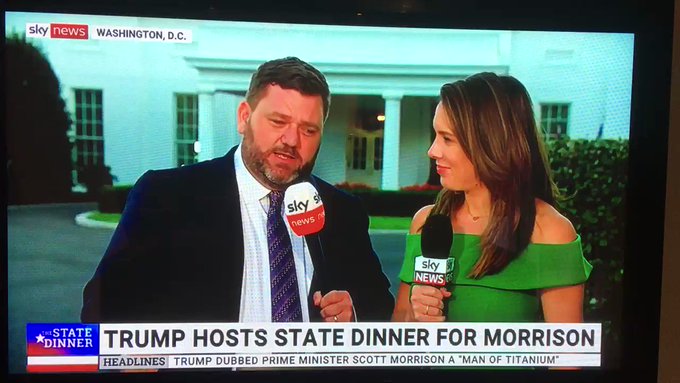
At the height of my disorientation, I spot Paul Murray from Sky’s Fox
News lite after-dark crew at the back of the room. As we are guided
out, Morrison beckons Murray forward and introduces him to the
president. This introduction yields an exclusive interview with Trump
which includes the simpering question: “What do you want to say to your
many Australian supporters who wish you nothing but the best in November
2020?” I suppose it could have been what was his favourite colour.
Paul Murray gets his exclusive with @realDonaldTrump but talk about not asking the hard questions.
The madness persists. The day ends with wranglers trying to
facilitate some access to the state dinner, which is al fresco, in the
Rose Garden. As we are herded through the South Lawn accompanied by the
lilt of violins serenading guests and the murmur of clinking glassware
and small talk, a secret service guy in night goggles, with foliage in
his helmet, suddenly materialises from the bushes and sprints across in
front of us.
Mr. and Mrs. Trump meet with Mr. and Mrs. Morrison as they attend a state dinner. Photograph: Pool/ABACA/PA Images
Shortly
after this our White House wrangler declares this walk off the record,
which generates considerable confusion among the scribes. How can a walk
to a pool position be off the record? Which bit is off the record? This
walk never happened? How do we explain our capacity to bear witness to
events at the state dinner? Did we parachute in?
We resolve not to overthink this and press on, and eventually get
close enough to see the guests drifting around the Rose Garden: the
Australian billionaire box maker Anthony Pratt is hard to miss with his
shock of orange hair; the younger Murdochs are there, Lachlan and Sarah,
I reckon I’ve spotted the mining magnates Twiggy Forrest and the
generally reclusive Gina Rinehart,
who appears to be floating. I rub my eyes, fearing a fancy. Perhaps
Rinehart is not floating, more likely I’m swaying, peering through a
large shrub, sleep deprived and smacking the mosquitos that threaten my
ankles, questioning my life choices.
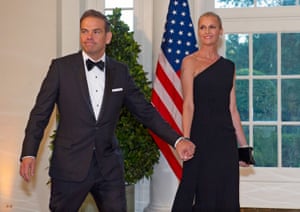
Fox CEO and co-chairman of News Corp Lachlan Murdoch (L)
and Sarah Murdoch arrive for the state dinner. Photograph: Ron
Sachs/POOL/EPA
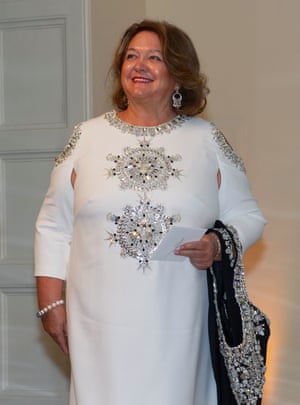
Hancock Prospecting chairwoman Georgina Rinehart arrives for the state dinner. Photograph: Ron Sachs/POOL/EPA
I
see Rinehart again the next day, floating (she is definitely wafting
like a cloud, because I know I’m no longer swaying) into a soiree at the
Australian ambassador Joe Hockey’s residence, in a white dress with
sequins and what appear to be pom poms trailing at the back. Morrison’s
old chief of staff and new department head, Phil Gaetjens, by contrast,
is wandering around in a Wallabies rugby jersey with cut-off sleeves.
While the grandees mingle, Rinehart sets up court with her entourage
in a shaded corner of the garden on what looks like a sedan chair, but
is actually just a garden settee. The visual cue is Ms Rinehart is
receiving guests, as long as they are not journalists. The media mogul
Kerry Stokes is also said to be mingling but I don’t clap eyes on him.
In Hockey’s garden I strike up a conversation with an expatriate pub
owner who is now the mayor of Annapolis and is campaigning to tighten
gun control. Gavin Buckley, formerly from Western Australia, is an
avuncular Democrat at a Republican knees-up, a fish out of water who
can’t quite believe his luck. Buckley tells me he hugged Hockey for the
great honour bestowed upon him.
The whole scene is F Scott Fitzgerald meets the pre-woke capitalism
of the 1980s, and the humidity is sending us all bonkers. Servers hand
out party pies and sausages with disturbing names like cheese and
Vegemite, and bald men in linen sports jackets compete for shade. One of
our travelling media pack then proceeds to conduct a mock interview of a
new magnolia tree which has just been planted to celebrate the Morrison
state visit. With the Magnolia, this is Brett Mason, SBS News.
It’s a joke, hijinks to help us stay alert when we are hitting that
hour of the day when jetlag threatens to take your legs out. But we’ve
crossed the sense barrier and we haven’t even hit the Trump rally. What
could possibly go wrong?
Ohio
It’s a voyage with billionaires, this American excursion with
Morrison. I confess that this is new territory for me. The cashed-up and
politically connected drifted past us during the pomp and circumstance
in Washington, and now we are closing in on Anthony Pratt as we speed to
Wapakoneta, first airborne and then jammed in Morrison’s motorcade with
police cars racing past, sirens blaring, to stop traffic on the
freeway.
Crowds await the opening of Pratt Paper Plant in Wapakoneta, Ohio. Photograph: Mick Tsikas/AAP
Morrison,
who will be thriving on all this hard work and energised by the thought
that he might be called upon to pull things back from the brink, is
upbeat during a quick amble down the back of the plane. He wonders what
we have made of the Oval Office. “Two words,” I shoot back. “How good?”
The gaggle of Morrison staff tumbling in and out of black vans in the
motorcades, and standing glassy eyed at midnight in hotel foyers,
clutching their phones and wondering what day it is, look in reasonable
shape despite the fact that most of them won’t have slept much. Team
Morrison and senior bureaucrats drift in and out of our orbit, leaving
us mostly in the hands of a crack team of departmental minders. These
officials, particularly the logistics people, are always the unsung
heroes of these trips. The wranglers on this trip are outstanding. The
pace is punishing – at times it feels like early in the Kevin Rudd era.
The transitions are down to the second and there are no screw-ups, at
least none that are visible to us.
One of Morrison’s press secretaries, Nick Creevey, has joined us for
the sprint to Wapakoneta on the commandeered Dayton school bus. We’re
all practising the pronunciation of Wapakoneta. Wah-pa, Christ, how do
you spell this bloody place again? Katina Curtis, the meticulously
prepared Australian Associated Press reporter, is patient with the
spelling drills. Hey Katina. How do you spell …
There are few female journalists on this trip, and overseas voyages,
in my experience, tend to take on an Aussie barbecue dimension. This is a
generalisation but, as generalisations go, not an unfair one. Male
correspondents largely herd together, socialise together, crack jokes
together, reinforce one another’s insights, and women run on a parallel
track. It’s a strange dynamic at times; stranger because the blokes who
engage in the behaviour would be entirely unconscious that’s what’s
happening. It’s just custom, or muscle memory. Hashtag road trip.
Hashtag dudes.
Dayton to Wapakoneta is flat and rural. The billboards we pass are a
combination of fast food temptations and Jesus Christ, saving the born
and unborn. I’m both fascinated to learn what we are driving into and
mildly apprehensive, given that Trump rallies can be hostile to the
media covering them, and hackles in the base must be raised by the
latest mainstream media pursuit over Trump and Ukraine. The president
loves a persecution narrative with him at the centre of it – it fuels
the righteous rage of his supporters. Everyone can be aggrieved
together.
Trump supporters await the arrival of their hero in Wapak
oneta. Photograph: Mick Tsikas/AAP
Nobody in the PM’s entourage expresses any apprehension at all about
Ohio, not even a hint of it. But my instinct suggests they are also
worried about the unknown. There are risks in the look of this thing.
Should Morrison really be at a Trump rally (even though the Ohio
event is more complicated than a 2020 campaign whistle stop with
Morrison attached). Apart from the possibility of any bizarre,
indefensible off-piste business, there is also the risk of Trump banging
on and on and on. It is entirely possible scheduled remarks at the
opening of a box factory could stretch into a Castroesque monologue that
kills our logistics stone dead. Morrison’s crew had expected the Oval
Office encounter to last for a few minutes and instead it stretched,
putting them behind for the remainder of the day.
I filed a column describing our arrival into Wapakoneta
and the rapturous welcome the locals gave Trump, but there were some
other memorable moments behind the scenes. When Trump and his entourage
finally blow in to town in a blaze of police sirens and secret service
agents, we are reunited with the same White House press pool we met on
Friday outside the Oval, grinding through another event. I clock Steve
in the distance, kicking on.
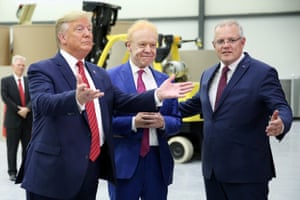
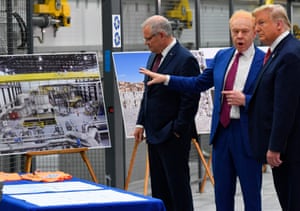
Trump engages Pratt the minute he’s in the factory. The two
billionaires exchange lavish compliments as they amble towards the
gaggle of reporters. Presumably the box maker is explaining recycling to
Trump as they go. Rubbish in, box out, cash in.
Trump and Morrison with the chairman of Pratt Industries, Anthony Prat. Photograph: Jonathan Ernst/Reuters
The
president then tracks towards where the journalists are corralled
behind the fence, straining to get an iPhone snap for Twitter. He’s
looking for Steve, the Trump whisperer, because he’s got exciting
information to share. “So that’s 100% recycled paper into a really, fine
finished product,” the president enthuses on the fence line. “It’s
really amazing, Steve. They start off with …” Trump pauses delicately …
“can I use the word ‘garbage’?”
Pratt is entirely comfortable with the word. Pratt Industries, Ohio,
is proudly euphemism-free. Trump picks up the story: “They start off
with waste, garbage, and they end up building it into a – making it into
really great cardboard and paper.”
“A hundred per cent of the plant”. As I mentioned earlier, I’ve never
seen Steve before these couple of brief encounters, he is a complete
stranger to me, and what follows is pure speculation, but I’m going to
hazard a guess that he knows what recycling is. I reckon Steve does know
about it.
In the last presidential contest, Anthony Pratt bet
$100,000 on Trump to win against Hillary Clinton. Photograph: Saul
Loeb/AFP/Getty Images
Trump is another story. Possibly this impromptu recycling-for-dummies
tutorial is just the president being performatively didactic, or
perhaps he is inoculating himself from cable TV hysterics who might
associate reuse with One World Government. Or perhaps this is the first
time in his life he’s encountered recycling.
Trump continues to roll this newfangled Pratt magic around in his
mind, and engage journalists enthusiastically along the fence line.
“That’s really some equipment. The finest equipment in the world. And
more and more people are going this way.
“Normally,
you take down trees and you make the paper. In this case, Anthony does
90, 95% out of waste, out of garbage, and they make incredible final
product through a very – through really a very – a really costly but
efficient process.” He could be describing the interface between tycoons
and politicians but let’s not be caustic or labour the metaphor. We
need to continue with our story.
Emboldened by this level of engagement from the president, one of the
Australian journalists calls out: “Do you want more businessmen like Mr
Pratt, Mr President?”. Trump is confused. Say it. (Implied, not stated: louder visiting freak, take two.) Say it.
“Do you want more businessmen like Mr Pratt to invest in America like
he has?” Trump narrows his eyes. “Yeah, well, we have some good ones.
But this man is number one in Australia, they say.” Number one of
course, being the highest Trump accolade. That and apex predator.
Pratt returns the favour before we leave America. He tells the
Australian newspaper Trump is going to win in the 2020 election. Lest
this just appear guesswork, or another shovel load of obsequiousness,
history shows that Pratt has a sharp eye. In the last presidential
contest the billionaire box maker bet $100,000 on Trump to win against
Hillary Clinton.
Asked whether he’d make the same bet again, Pratt reports that he’s
raised the stakes. There is now $2bn on the table – investments in new
paper operations in the US. “I told the president we want to continue to
invest and fulfil our pledge,” Pratt tells the paper. “It was very
gracious of him to come to our Ohio plant opening. I was fortunate to
spend some time with him. He was as gracious as ever.”
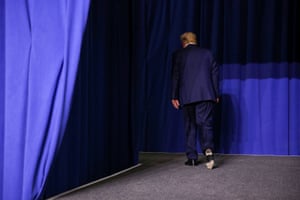
Trump departs after the tour and plant opening with Morrison and Pratt. Photograph: Jonathan Ernst/Reuters
Gracious indeed. As another wealthy entrepreneur, Malcolm Turnbull, was once fond of saying. What. A. Time. To. Be. Alive.
New York
By the time we roll out of Chicago – a whistle stop characterised by a
serious foreign policy pivot from Morrison, and an unfortunate photo
opportunity in front of a McDonald’s smart board that built a visual
bridge to Engadine for people familiar with the infamous internet meme
(let’s just leave it at that) – and on to New York, the drumbeat is
cacophonous, literally and figuratively.
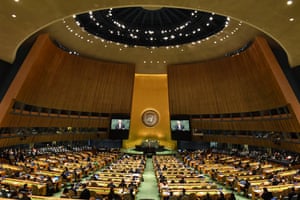
It is leader’s week at the UN general assembly, and the area around
the headquarters is locked down. The streets teem with protesters and
delegates, and groups of Africans gather on Forty-fourth Street to drum
and sing. The UNgeneral assembly circus drives New Yorkers bonkers, the
streets are gridlocked and the eateries overflow, but the vibrancy of it
is quite wonderful: the convivial murmur of languages on the east side
of Midtown, the colour and style of the clothing, the downing of
late-night whiskey amid animated conversation.
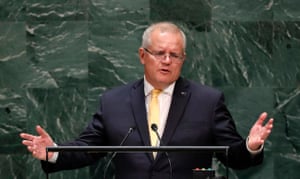
Morrison delivers his statement to the 74th session of the UN general assembly. Photograph: Mick Tsikas/AAP
Trump
declares theatrically, with Nancy Pelosi closing in, during his address
to the UN national assembly, that this is the time for patriots, not
globalists. It’s a soundbite crafted for Breitbart or Fox News, potent
with his rusted-ons, but a hollow slogan in the world of facts and
evidence. Did I miss the bit of history where globalisation became
optional? For what it’s worth, New York categorically ignores him. On
the streets, in the stores, in the financial district, globalisation
prevails. It’s not even a contest.
Beyond the literal, the figurative drumbeat is for Trump. Impeachment
is closing in on the president. Some commentators say he looked subdued
at the UN, which would be a rare lapse in self-confidence. The mood at
the start of the week in Washington was come and get me suckers. But I’m
out of the presidential orbit now so I have no first-hand observation
to report.
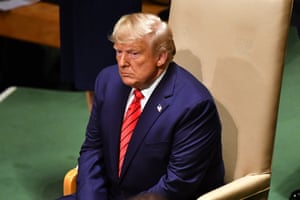
Trump waits to give his address. Photograph: Mick Tsikas/AAP
Morrison, comprehensively overshadowed by movements in the tectonic
plates of the major powers, ploughs on diligently with his UN program
and seems unperturbed by the misfortune of his two mates, Boris Johnson
and Trump, hitting some serious turbulence. If the prime minister had
any regrets about taking hospitality from Trump and aligning Australia’s
diplomatic language precisely with the president on some thorny
geopolitical issues, he certainly didn’t show it.
A certain defensiveness did creep in on climate change, though.
Morrison wasn’t cranky but there were persistent pesky questions from
the travelling media about Australia’s lack of policy ambition, and
about his decision not to attend the UN climate summit on Monday. Even
Trump called by. Why didn’t Morrison? There was the sound of prime
ministerial teeth being gritted.
Interestingly,
Morrison’s speech to the UN general assembly, which was billed
initially as being an address about practical environmentalism, not
climate change, drifted back into climate. There was a significant chunk
defending his government’s policies, and some umbrage at the media for feeding false narratives – not fake news, mind you, but stoking prejudicial sentiment.
Morrison defends his government’s record on climate change to the UN general assembly. Photograph: Lucas Jackson/Reuters
In New York we meet our final billionaire, Mike Cannon-Brookes. The
final piece of my triptych, the next gen mover and shaker, moves in
different circles to Pratt and Rinehart. MCB didn’t make the cut for the
state dinner at the White House, evidently, but he made a bit of a
splash at the UN.
The Atlassian founder went to the climate summit to commit his company to a target of net zero emissions
by no later than 2050. Cannon-Brookes nudged Morrison on Twitter:
“Please give us a future we can believe in tomorrow. Inspire us. Lead
us. Don’t bullshit us. I’m happy to help, as are millions of Aussies.”
I meet Cannon-Brookes at the Flower Shop, a hipster bar on the Lower
East Side. His minders invited us down for a beverage. Most of my
colleagues are punctual but I’m late, because the traffic is terrible,
and the bearded tech entrepreneur lobs late as well. There is an
overwhelming smell of weed that eddies through the bar as we settle in,
which I stress is not connected to anyone in our group or Atlassian’s.
I don’t know who is responsible for this licentiousness and don’t
intend to investigate, frankly – but it’s surreal, meeting a
thirty-something billionaire in a bar as the bookend of this bonkers
week, and having the bar reek of marijuana – that I find it hard to stop
laughing at the unlikeliness of it all. It caps off the Through the
Looking Glass sensation of the US odyssey.
The evening is convivial and, unsurprisingly, there is much
impassioned talk about climate change and energy policy and a fair
sprinkling of acronyms – a bunch of Aussies jousting good naturedly
about the future of the planet in a bar in Manhattan. I leave
Cannon-Brookes downstairs shooting pool with a few stayers, settling in
to welcome the dawn, and head uptown, clearing my head by walking up
Forty-fifth Street as the dumpster trucks and the street sweepers move
into high gear for the pre-dawn cleanse.
I engage a cop at a checkpoint just to make sure I haven’t veered
wildly off course in a desperate bid for oxygen. “The Roosevelt is just
up here,” I inquire, “right?” The cop smiles and sips his coffee. “I’m
from Brooklyn, m’am.”