Contemporary politics,local and international current affairs, science, music and extracts from the Queensland Newspaper "THE WORKER" documenting the proud history of the Labour Movement.
MAHATMA GANDHI ~ Truth never damages a cause that is just.
Bridget
McKenzie remains in the firing line for the corrupt $100 million
community sport grants program, but the bigger #sportsrorts story has
moved on to the Prime Minister’s role.
For those paying attention, there is no surprise about the scandal coming home to roost in Scott Morrison’s lap.
The
extra last-minute funding and fine political targeting of the final
rounds of grants were way above the Minister for Sport’s pay grade.
The
Prime Minister’s office is of course fighting a rearguard action –
deny, quibble, deny, repeat – but the inevitability of responsibility
residing above Senator McKenzie is playing out with the reporting that
it was political operatives in Mr Morrison’s office who were calling the
vital electoral shots.
“Morrison’s senior adviser for
infrastructure and sport, a former Nationals staff member, no less, was
point man on the political divvying up of the grants,” Peter van
Onselen, himself a former Coalition staffer, reported in the Weekend Australian.
“He
was working closely with campaign strategists inside the Prime
Minister’s office and the federal Liberal Party secretariat before
presenting the allocations to McKenzie as a neatly wrapped-up final
product. After which cabinet ticked and flicked the winning applications
through to the implementation stage.”
Senator McKenzie and her office are still in it up to their snouts.
The
minister’s office became closely involved in setting the program’s
structure to ensure the minister would have ultimate say over who
received what money where.
The political fix was in from the get-go to ensure the program could be taken out of Sport Australia’s control.
Bridget McKenzie and PM Scott Morrison front the media in Canberra on January 14.Crikey’s Bernard Keane has previously reported
on the peculiar nature of the community sports infrastructure grant
program, how it circumvented existing, less-corruptible grant platforms.
A
source with knowledge of how the program was set up told me a team from
the minister’s office, including an expert in Commonwealth grants
procedures seconded from the Health Department, moved in on Sports
Australia to specify how the program would be run – contrary to usual
Sports Australia standards and causing considerable unease within the
commission.
A program that began in “unusual” circumstances became steadily more “unusual” as it rolled on.
The
business case for the Australian Sports Commission to get involved in
assisting with community-level infrastructure, instead of its usual
preoccupation with winning medals, had evolved from an extensive review
of the commission’s role.
The initial approval was for a modest one-off program.
It blew out to $100 million as the election drew near, with the government throwing extra funds at Sport Australia.
Those
extra scores of millions of dollars were ticked off by the Cabinet
Expenditure Review Committee – the leadership of the government.
The program was run out of Adelaide by a specific team whose jobs were over when the program was concluded.
That team was inundated with applications when the program was announced by the government.
The
need for improvement in real community sports infrastructure – as
opposed to solar panels for an elite Adelaide golf club and
half-million-dollar donations to the Mosman rowing club – is immense.
The Adelaide team worked long and hard to do the right thing.
The Auditor-General’s investigation was happy with the team’s work, less so with the overall Sport Australia performance.
But, as everyone now knows, the political fix was then put in.
Extra
funding, more rounds of grants, the team’s recommendations ignored as
political officers decided where taxpayers’ money would go and for what
purpose.
As the Auditor-General underlined, in the final two
rounds it was primarily about marginal electorates, trying to keep the
Coalition in government – not what was the best use of taxpayers’ money
for the best community sport outcomes.
The extent of political
domination of Sport Australia – made possible by that careful initial
structuring of the program – might be epitomised by the minister’s
office pushing through grants after applications had closed.
As the scheme became rorted in the minister’s office, glaring inconsistencies beyond the political targeting crept in.
Some
have already become public – the Adelaide rugby club getting money for
women’s changing rooms when they don’t have a women’s team – and more
will emerge as long as focus remains on the detail.
One example from the Auditor-General’s report of how perverted the scheme:
Four applications for electronic scoreboards were marked as eligible
and funded, while 10 other applications were marked as ineligible
because they requested funding for scoreboards.’’
But
there’s a danger in being distracted by the rich ridiculous details
when the bigger question remains where ultimate responsibility lies for
defrauding and lying to community sports organisations.
In the face of the scandal, the government has been ripe with evasions and weasel words, as previously reported.
As
Van Onselen’s report moves the game closer to its corrupting source,
one particular interchange deserves closer scrutiny when 3AW’s Neil Mitchell ventured closer to the nub: MITCHELL: But it looks political. It looks political. Was there any advice taken from campaign strategists or Liberal Party head office? PRIME MINISTER: Well, not that I can speak of.
What
a strange choice of words, “not that I can speak of”. I’m not quite
sure what that means. I suspect I’m not supposed to be quite sure.
Given
the care that went into corrupting the community sports infrastructure
grants, it would not be unreasonable to think the key perpetrators would
ensure the Prime Minister a degree of “plausible deniability”.
Peter
van Onselen’s column nods at that: “Maybe the Prime Minister wasn’t
personally involved. We can’t be sure. My sources haven’t divulged that.
Perhaps, even though Morrison is a former state party director who ran
campaigns, he stayed out of this pork-barrelling process.” The Australian toned down van Onselen’s column somewhat while turning it into a news story on the paper’s front page.
Instead
of the PM’s senior staffers’ role being presented as fact, it became
“sources have told” on the news pages and “the claim is contested by Mr
Morrison, who has rejected suggestions that funding allocation decisions
originated from within the office of the Prime Minister”.
On Twitter after publication, van Onselen was asked to name the political staffers.
We’re waiting. There are other shoes to drop.
Also
on Twitter, the anonymous writer @RonnieSalt last week found it
interesting that the well-connected and experienced Liberal Party
staffer Jonathan Hawkes was appointed to Senator McKenzie’s office in
September 2018 as her media adviser.
Whoever @RonniSalt is, she has shown a nose for timely information.
Ronni
was using Twitter to investigate what town Bridget McKenzie actually
resides in before mainstream newspapers taking an interest over the
weekend, and has previously filed repeatedly on Angus Taylor’s business
dealings.
It’s in the government’s interest and especially Mr
Morrison’s interest to keep the #sportsrorts story focused on Bridget
McKenzie, but that’s no longer the most important part.
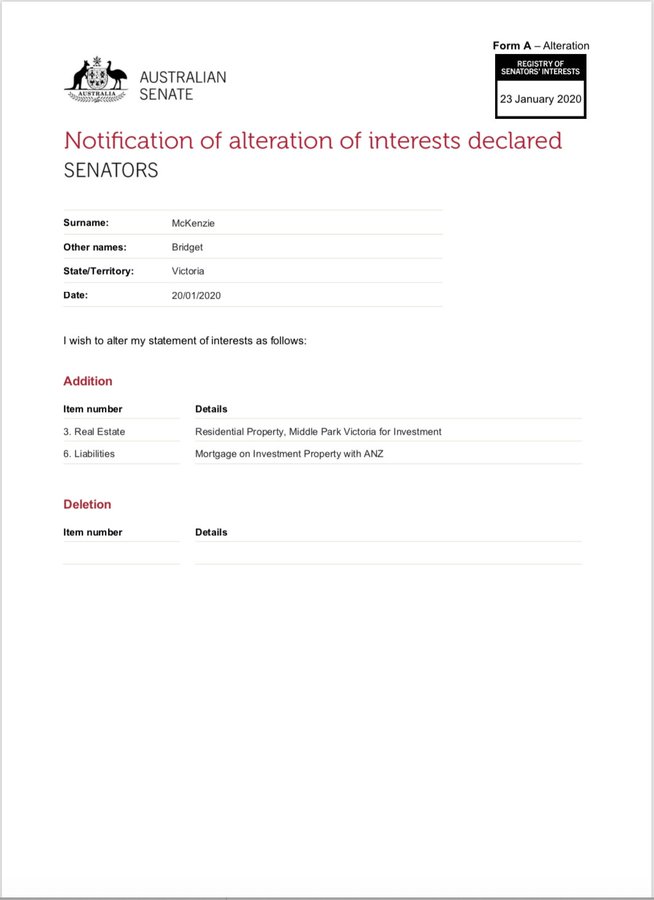
Absolutely fabulous that Bridget McKenzie updated her register of
interest today to include a property she owns in the salubrious suburb
of Middle Park (inner Melbourne)
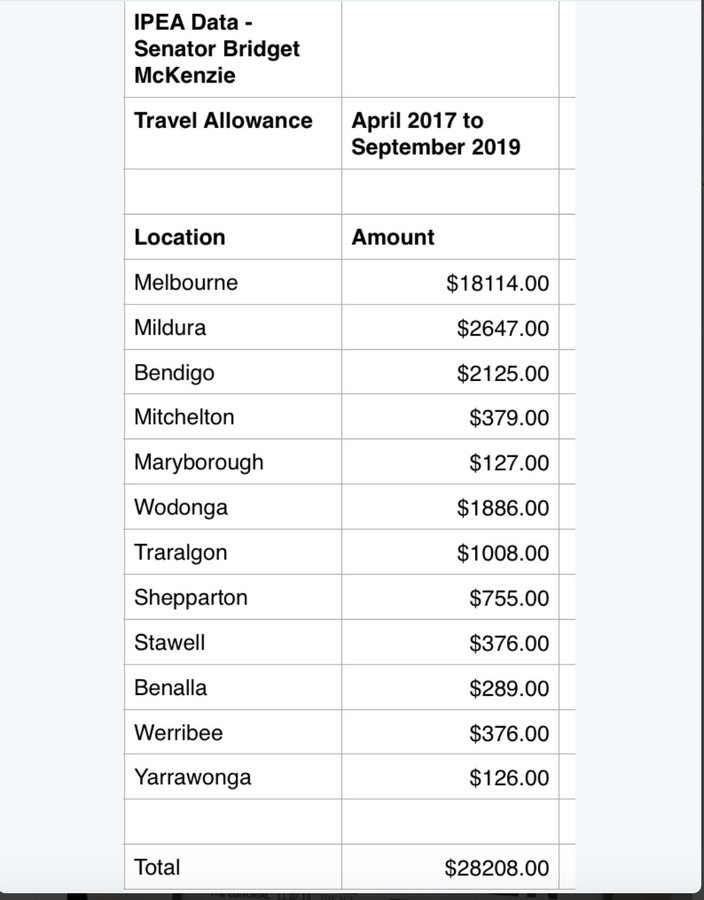
We await with interest the quarterly travel allowance claims from Senator McKenzie for her trips to Melbourne
Scott
Morrison’s urgent task to press the reset button at Wednesday’s
National Press Club address has been reduced to a repackaging exercise
from a very damaged salesman.
Consider this: The Prime Minister of
Australia left the country for holidays mid-December when the nation’s
biggest city was encircled by a mega-fire ignited by lightning in the
Blue Mountains seven weeks before.
By the time he and his family
boarded the Jetstar flight to Hawaii, Sydney had already recorded the
worst air quality in the world at nearly 30 times safe levels.
The
choking smoke reinforced the anxiety and jeopardy millions of
Australians were already feeling in what was being described by experts
as an unprecedented fire crisis.
Mr Morrison did so as retired
emergency and fire chiefs revealed he had refused to meet them to
directly hear their warnings earlier in 2019 that the nation needed to
be better prepared for a catastrophic bushfire season made worse by
climate change.
The Prime Minister’s first instinct on returning
to a nation reeling from weeks of bad news, that was in fact worsening,
was to virtually say it had nothing to do with him.
The PM blamed the states, said no one advised him more was needed and no one had asked for it.
It was an admission that he was blind to the conflagration on the doorsteps of his official residences in Canberra and Sydney.
It
was a complete derogation of duty from the leader of a government who
often states his prime responsibility is to “keep Australians safe”.
If there were any doubts that Australians were now viewing Mr Morrison through a different lens, the first Newspoll of 2020 showed his approval crashing and Opposition Leader Anthony Albanese leap-frogging him as preferred prime minister.
Trying to regain lost ground
Mr Morrison has tried every contortion to regain lost ground.
He has blitzed the media, announced a $2 billion fire recovery and relief package, and spoken of “resilience and adaptation”.
None
of it makes up for the failure to provide the funding required for more
water-bombing aircraft or for an already-in-place contemporary national
fire disaster plan.
The PM’s problem is the huge hit his credibility has taken.
The
nickname infesting social media – “Scotty from Marketing” – while
delighted in by his opponents will be lethal if it becomes an embedded
general perception.
Sports rorts
Mr Morrison’s inept handling of the fire crisis has been matched by his response to the scathing Auditor-General’s report into the $100 million sports grants process.
The
Prime Minister’s first response was to attempt to deny the
Auditor-General had found anything wrong with his minister, Bridget
McKenzie, and her handling of what was found to be a brazen partisan
pork-barrelling exercise of dubious legality.
Senator McKenzie is
resisting calls to go and is refusing to take the fall for implementing a
scheme the whole government embraced as a campaign masterstroke.
The
Prime Minister is a victim not only of his own poor judgment but, in
both cases, is wedged by the fraught dynamics in his narrowly returned
coalition government.
The Nationals have no appetite to be seen being dictated to by the Liberal Prime Minister over Senator McKenzie’s fate.
That
they can’t see the damage the unresolved imbroglio is doing to become
just another manifestation of the post-election car crash the government
has become.
The Liberal National Party in Queensland – an
amalgamation of the two parties – will brook no strengthening of the
government’s emissions reduction targets.
It argues its pro-Adani coal mine, jobs before climate, action saved the day for Mr Morrison at the election.
That
leaves a weakened Prime Minister with few convincing options to offer
for the sort of direction the nation is now demanding.
Paul Bongiorno AM is a veteran of the Canberra Press Gallery, with 40 years’ experience covering Australian politics
‘Flames literally surround the city in which the Australian prime
minister announced ‘resilience and adaptation’ will substitute for
climate mitigation.’
Photograph: Lukas Coch/AAP
There
was a battered paper cartoon pasted to our office cupboard, sometime
back in the year 2000. It depicted a landscape of power plants belching
smoke, in the foreground of which was a billboard where an enthusiastic
woman in a sunhat sipped a margarita through a straw. A speech bubble
came from the woman’s lipsticked mouth: “Global warming?” she gushed. “I
can’t wait!”
It was supposed to be a joke.
Memory of that cartoon provoked an old, nihilistic laugh to echo in
my throat at a confluence of climate events this week, 20 careless years
later. Dear world, three months after they began, the Australian fires
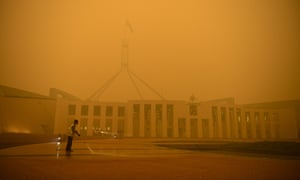
are not out. Today, ash is raining in our nation’s capital, orange flames stare over the mountains behind Canberra. Scientific consensus, affirmed by Australia’s exhausted fire chiefs,
is that the fires are effects of the anthropogenic climate crisis. And
yet even as the fires roar at the physical gates of power, on Sunday the
conservative columnist Andrew Bolt, of the Murdoch press, published an
insistence that climate change is “overall, a good thing”. The only
thing missing from this new cartoon is the lipstick.
Bolt’s claim actually represents some intellectual evolution on the
issue. It wasn’t so long ago that global scientific consensus on the
reality of climate change amounted to naught but an “end-of-the-world
religion” to him. He’s hardly the only conservative megaphone that’s
been braying to disrupt meaningful political action on climate change
these last, wasted, crucial decades. He is, however, a useful local
avatar to illustrate the history of both the denialist campaign, and how
encroaching reality is obliging the adaptation of its messaging.
It was as far back as 1896 when scientists first warned about the climatic impact of fossil fuel emissions. In 1956, the New York Times
advanced the same concerns; an article appeared with the headline
“Warmer Climate on the Earth Could Be Due to Increasing Carbon Dioxide
in the Air”. Although these warnings were ignored, fossil fuel
corporations such as Shell and Exxon sat quietly on studies that
confirmed their key assumptions.
Finally, research from the Intergovernmental Panel on Climate Change in
1988 informed a fateful, public conclusion that a “greenhouse effect …
is changing our climate now”.
But by 1989, organisations were already appearing
pursuing overt strategies – copied from the tobacco industry – to sow
doubt about the validity and credibility of the scientific alarm,
downplay the significance of evidence and demobilise meaningful
political action. From the beginning, climate denial has been driven by
two conflating forces; the financial interests of fossil fuel companies
and a conservative political movement that sees environmental regulation
as a challenge to ideological preferences for private property,
neoliberal economics and borderless capitalism. Denialist thinktanks
like the Heartland Institute praise themselves for service to an
“ultimate goal” that has, of course, nothing to do with facts or science, but instead “to keep global warming alarmists from winning the public debate”.
This is the decades-long frame into which Bolt and his
comrades slip. A non-scientist himself, Bolt’s analysis more or less
always conforms to a pattern perfected worldwide; locate an isolated
item of contradictory, impenetrable data and insist its existence proves climate science is a shibboleth of untruth, misquote a credible scientist, quote a non-credible one, and insist all climate activists are unhinged loons.
How bleak it is now, with Canberra burning, to revisit Bolt’s
comments of 2006, when he was the subject of a Media Watch investigation
of his selective misstatements on climate data. “Some people believe
that bushfires may get worse in the future because of man-made global
warming,” announced Media Watch, “Andrew Bolt isn’t one of them.” By 2009,
so tight was the grip of denialism over the discourse, if not the
facts, that Bolt felt confident enough to declare “this mad global
warming scare could at last be over”.
Really?
2009 was the same year that future prime minister, Tony Abbott similarly declared
“the climate change argument is absolute crap”, one more example of the
impressive cohesion of conservative commentary with its political
result. A side note: not one 2016 Republican candidate for president
accepted the science of climate change. Back here, denialist MPs such as
the internationally embarrassing Craig Kelly are frequent guests of Bolt’s show.
What to make of Bolt’s most recent concession to the reality of
actual climate change is what his insistent “good thing, overall”
messaging reveals of the new political reality facing the conservative
movement. Unlike an election result that can be willed into existence
through sheer force of persuasion, the planet is not actually
persuadable. The ideological resistance among conservatives to address
the source of climate crisis is so powerful, so historically entrenched,
that flames literally surround the city in which the conservative
Australian prime minister himself has announced that “resilience and
adaptation” amid the fires will substitute for climate mitigation,
prevention, action to make them stop. On cue, the megaphones insist this
nightmare will be good for us.
Take it from one of the selectively misquoted credible scientists: global heating is not heralding a new agricultural prosperity,
these forces are causing forests to burn, not to bloom. They can’t
offer solutions. The propaganda of a new denial is all they’ve got. • Van Badham is a Guardian Australia columnist
Scott Morrison says ‘we are playing our part’, and given climate
change cannot be stopped, Australia needs to focus on bushfire
resilience and adaptation
Scott Morrison used a speech at the National Press Club in Canberra on
Wednesday to recast the government’s policy approach on the climate
crisis as one of practical action ‘right now’ rather than international
advocacy.
Photograph: Mick Tsikas/AAP
The prime minister, Scott Morrison, has rejected suggestions
Australia could increase its international advocacy on climate change,
saying the country is already “carrying its load” and must adapt to a
warmer climate regardless of emissions policy.
After indicating that the government would
“evolve” its climate change policies to address heightened concerns
about the role of global warming in Australia’s ongoing bushfire crisis,
Morrison used a keynote speech at the National Press Club on Wednesday
to talk up the government’s current policies, including its emission
reduction targets.
“We
know that Australia on its own cannot control the world’s climate as
Australia accounts for just 1.3% of global emissions,” Morrison said.
“We also know that no fire event can be attributed to the actions of
any one country on emissions reduction. But Australia must play its part
and we are playing our part. Taking action is agreed – our action,
though, is a balanced and responsible emissions reduction plan.
“The science tells us the effects of emissions already in the
atmosphere will continue to be felt in coming decades, even under the
most ambitious global emissions reduction scenarios.”
When asked if the government could “step up and advocate” for more
ambitious global action on climate change given its role as a “proud
middle power”, Morrison said Australia was already doing enough.
“Australia is carrying its load and more. We are doing what you would
expect a country like Australia to do, but what I won’t do is this: I
am not going to sell out Australians – I am not going to sell out
Australians based on the calls from some to put higher taxes on them or
push up their electricity prices or to abandon their jobs and their
industries,” he said.
The prime minister also said the government’s target of a cut of 26%
to 28% of 2005 emission levels by 2030 was “set”, but he repeated claims
that Australia was on track to “meet and beat” its target.
Department of Environment data suggests national emissions will be 16% below 2005 levels by 2030, well short of the minimum 26% goal. The government is using carryover credits from the Kyoto protocol to make up the difference.
Seeking to recast the government’s policy approach as one of
practical action “right now”, Morrison also argued that Australia should
focus on resilience and adaptation to respond to the effects of climate
change over the coming decades, given it could not be stopped.
His focus on “climate action now” included hazard reduction burning,
building new dams, developing new drought-resistant crops, and a drought
resilience plan.
“Mitigation and adaptation both contribute to resilience. Mitigation
reduces the risk, adaptation is how we prepare for the climate risk we
cannot reduce.
“When it comes to practical safety of people living in bushfire
zones, hazard reduction is even more important than emissions
reduction,” Morrison said.
“We need to seriously engage with issues like how we manage native
vegetation, how we allow landowners to clear asset protection zones on
their property … where we allow structures to be built and how, the
material and standards they are built to, and where and when hazard
reduction burns or other practices are carried out.
“All these considerations have a direct impact on the safety of
Australians living in this climate and in this bush environment.”
Morrison said he had also asked the CSIRO, supported by an expert
advisory panel chaired by the chief scientist, Alan Finkel, to bring
forward recommendations for “further practical resilience measures”,
including on buildings, public infrastructure, industries such as
agriculture and protecting natural assets, which would be discussed at
the March Council of Australia Governments (Coag) meeting.
The prime minister also flagged that he would soon have further
detail to announce on a new bilateral agreement with New South Wales on
energy and emissions reductions, with other states and territories to
follow.
“These agreements will focus on keeping energy prices affordable,
improving the reliability of the electricity grid and driving down
emissions while we do so, and I commend Angus Taylor for the great work
he’s been doing in this area.”
It was not clear whether emissions reduction would be a requirement, as had been the case for the dumped national energy guarantee, but Morrison indicated that improved access to domestic gas supplies would be a key element of the new agreements.
“We need to get the gas from under our feet. There is no credible
energy transition plan for an economy like Australia in particular, that
does not involve the greater use of gas as an important transition
fuel,” Morrison said.
The prime minister, Scott Morrison, may pat heads and utter soothing
words, but he and his government have played with the truth about
Australia’s emissions targets.
Photograph: Mick Tsikas/AAP
Think of it as a hypnotist’s trick, because that’s what it is. Scott Morrison
says it over and over: there is no dispute about the need to take
action to reduce Australia’s emissions. No dispute. You are getting
sleepy. No dispute.
In fact there is a dispute, and a serious one. By failing to do what is necessary,
the government Morrison leads maintains a serious dispute with what the
climate science tells us needs to be done both in Australia and
internationally to avert the most dangerous risks associated with global
heating.
When it comes to mitigation, Morrison’s government is in dispute with the facts.
It is in dispute with the evidence.
It is in dispute with the truth.
Day in, day out.
So despite his gritted-teeth soothing and head-patting from the podium at the National Press Club on Wednesday after a summer of calamity, there’s a dispute alright, and it’s one of the most important disputes of our time.
This dispute is about the future, and how our government shapes it on
our behalf. The dispute turns on whether climate change is now all
about adaptation, about adjusting and adapting to the new reality – or
whether Australia, as a responsible, reformist, middle power, is still
at the policy and diplomatic barricades trying to avoid the worst case
scenario.
Dear prime minister. That’s a big dispute. Big with a capital B. And
this is a dispute that every citizen of this country, and every citizen
of the world, has a direct stake in.
Here’s one piece of advice for all you good folks who watched
Morrison’s scene setter at the press club: do not consent to having your
head patted.
Do not consent to the high stakes hypnotism. When the prime minister
says “taking action is agreed”, do feel free to say to yourself or to
anyone around you: “No, it isn’t agreed.”
If so inclined, add this: “Climate action remains contested, and it remains contested because the Coalition chose to weaponise climate change at the precise moment in history when we needed to get about solving it.”
If
you feel on a roll at this point, add this: “And this political party
still weaponises climate change against its opponents if it feels
there’s an electoral advantage in doing so.”
Morrison told us, blithely, on Wednesday, that solving the challenge
of climate change goes beyond targets and summits. It will be driven by
technology, not by taxes – a convenient sort of rationalisation – as if
this was all unavoidable, inexorable, a fixed set of conditions, rather
than a choice, and a choice the Coalition has been at the epicentre of.
Some facts. When we had a “tax” on carbon in Australia (that wasn’t a
tax, either then, or now), emissions came down, which is what the
science tells us needs to happen. When the Coalition repealed that “tax”
(that wasn’t a tax, then, or now), emissions crept up, which is what
the science tells us is dangerous. As my colleague Adam Morton has
reported countless times, national emissions peaked in 2007, the last
year of the Howard government, came down each year under the Rudd and
Gillard Labor governments, and have flatlined since the Coalition was
elected in 2013.
Reversing that positive trajectory of abatement was a choice the Coalition made.
It wasn’t something that the universe imposed arbitrarily on the
government, a bit of happenstance. It was a choice these people,
including Morrison, made. Eyes wide open.
Another fact. When Australia went to the United Nations climate talks late last year and argued we should use carryover credits from the Kyoto period
– an accounting fix that means Australia will promise to reduce our
emissions by 26% but in practice only reduce our emissions by about half
that headline number – that was a choice too. We made a choice to do
less than is necessary, hurting ourselves in the long term, and making
it harder to sustain any sort of global consensus for ambitious action.
These
things aren’t happening because of strange, alien forces beyond our
collective control. They are happening because our government is
choosing to fail on climate change mitigation.
I’ll say it again because it’s important, and inexplicable, no matter
how long you look at the same set of facts hoping to comprehend the
incomprehensible: our government is choosing to fail, and trying to make
a virtue of it.
Our government has access to the science, to the best advice
available, and yet it continues to shirk the mitigation challenge. It
continues to gamble with the future in the worst way imaginable.
Morrison still has time to turn this appalling behaviour around, and
there are some interesting markers if you can penetrate his various
maxims and misdirections. Working with the states on bilateral
agreements to reduce emissions is one hint worth watching. I suspect our
prime minister is still hedging his bets and refining his thoughts.
But until actions follow words, there is only one reliable measure to judge the government on. Its record.
The Guardian will become the first major global news organisation to ban
outright advertising from companies that extract fossil fuels.
Photograph: Marcin Rogozinski/Alamy
The Guardian
will no longer accept advertising from oil and gas companies, becoming
the first major global news organisation to institute an outright ban on
taking money from companies that extract fossil fuels.
The move, which follows efforts to reduce the company’s carbon
footprint and increase reporting on the climate emergency, was announced
on Wednesday and will be implemented with immediate effect. The ban
will apply to any business primarily involved in extracting fossil
fuels, including many of the world’s largest polluters.
“Our decision is based on the decades-long efforts by many in that
industry to prevent meaningful climate action by governments around the
world,” the company’s acting chief executive, Anna Bateson, and the
chief revenue officer, Hamish Nicklin, said in a joint statement.
They said the response to global heating was the “most important challenge of our times” and highlighted the Guardian’s own reporting on how lobbying by energy companies has explicitly harmed the environmental cause.
Environmental groups have long argued that energy companies use
expensive advertising campaigns to “greenwash” their activities, paying
to highlight relatively small investments in renewable energy while
continuing to make the vast majority of their revenue from extracting
fossil fuels. They have called for news outlets to reject such
advertising, although until now only a handful of small outlets have adopted this approach.
Last year, the editor-in-chief, Katharine Viner, announced the Guardian would adjust its style guide
to represent the scale of the environmental challenge facing the Earth,
using terms such as “climate emergency” and “global heating” rather
than “climate change” and “global warming”. At a corporate level, the
company has emphasised its commitment to becoming carbon-neutral by
2030, while also almost entirely divesting its Scott Trust endowment
fund from fossil fuel investments.
The decision to reject the advertising money from fossil fuel firms
comes at a tricky time for the media industry, with the Guardian Media
Group board warning the business is facing substantial headwinds this
year. Advertising
makes up 40% of GMG revenue, meaning it remains a key way to fund the
journalism produced by Guardian and Observer journalists around the
world.
Bateson and Nicklin said the ban would result in a financial hit.
“The funding model for the Guardian – like most high-quality media
companies – is going to remain precarious over the next few years. It’s
true that rejecting some adverts might make our lives a tiny bit tougher
in the very short term. Nonetheless, we believe building a more
purposeful organisation and remaining financially sustainable have to go
hand in hand.”
They acknowledged that some readers would like the company to turn
down advertising for any product with a significant carbon footprint,
such as cars or holidays, but said this was not financially sustainable
while the media industry’s business model remained in crisis.
“Stopping those ads would be a severe financial blow, and might force
us to make significant cuts to Guardian and Observer journalism around
the world,” they said.
They added that they hoped readers would continue to sign up as
members to support the Guardian’s journalism but that advertising would
remain a key source of funding for years to come. As a result, the pair
said they hoped the decision to ban fossil fuel adverts would appeal to
other companies who would like to advertise with the Guardian.
“We believe many brands will agree with our stance, and might be
persuaded to choose to work with us more as a result. The future of
advertising lies in building trust with consumers, and demonstrating a
real commitment to values and purpose.”
The campaign group Greenpeace welcomed the move. “This is a watershed
moment, and the Guardian must be applauded for this bold move to end
the legitimacy of fossil fuels,” said Mel Evans, senior climate
campaigner for Greenpeace UK.
“Oil and gas firms now find themselves alongside tobacco companies as
businesses that threaten the health and wellbeing of everyone on this
planet.
“Other media outlets, arts and sports organisations must now follow
suit and end fossil fuel company advertising and sponsorship.”
Acoss has joined others calling for Newstart to be raised by $95 a week.
Photograph: Julian Smith/AAP
People on Newstart now receive only 75% of what is needed just to
afford basic living costs, analysis shows, prompting a new call from
campaigners for a nearly $100-a-week boost to the unemployment benefit.
Citing new analysis of the wage index between 2016 and 2018, the
Australian Council of Social Service (Acoss) will reveal on Thursday
that it is now calling for a $95 boost to the $279.50 weekly payment, up
from a previous demand of $75 a week.
The proposal, contained in Acoss’ federal budget submission, aims to
address the widening gap between the combined rate of Newstart and rent
assistance and what the organisation says a single unemployed person
needs to afford essentials such as food and shelter.
The Acoss chief executive, Cassandra Goldie, said the government must
be willing to jettison the surplus to fund a Newstart increase,
likening the situation to the prime minister’s recent pledge that the
bushfire recovery would not be influenced by concerns about the budget
bottom line.
“It’s effectively senseless cruelty to continue to ignore what is so
widely understood to be one of the key causes of the level of poverty in
Australia,” she told Guardian Australia.
Pointing
to the organisation’s own research showing more than 80% of Newstart
recipients skipped meals to make ends meet, Goldie also warned the
government against a targeted boost to the incomes of a select group of
Newstart recipients, as some Nationals MPs have proposed.
“We challenge the government to say which of those people are less
deserving of needing to feed themselves and keep a roof over the head,”
she said.
The Newstart allowance, which has not increased in real terms in 25
years, is indexed to inflation, while other payments are tied to wages.
This means the unemployment benefit continues to fall further behind
living costs, as well as other payments like the age pension, and is now
considered one of the least generous employment benefits in the world.
The $3.8bn-a-year Acoss proposal would boost payments for 850,000
people across the country, including those on other allowances such as
youth allowance and sickness allowance, and also calls for a $20-a-week
increase to rent assistance.
Using a measure developed by the UNSW’s social policy research
centre, Acoss found that between 2016 and May 2018, basic weekly living
costs rose $26 to $460 a week, while the combined rate of Newstart and
rent assistance increased by only $7 over the same period. Despite calls from within its own ranks,
the government has repeatedly declined to increase Newstart, saying it
is focused on getting people off Newstart and into work, and citing a
sizeable decrease in the number of claimants, which is now down to
680,000.
However, critics point to figures showing the average amount of time people spend on the payment has ballooned out to more than three years, while policy changes mean those relying on Newstart are increasingly likely to be sick or disabled.
At
the Senate inquiry into the payment’s adequacy, which is still ongoing,
Coalition senators last year demanded that campaigners identify “new
taxes” that would fund a boost to the unemployment benefit.
The Acoss budget submission proposes, among other things, a crackdown
on tax concessions for trusts (estimated to save $1.2bn a year) and
small businesses ($300m a year), negative gearing reform ($600m), and
calls on the government to reverse the second phase of its income tax cuts, which come into effect in 2022.
In response to a ballooning aged care waiting list,
the submission also calls for $2.3bn-a-year boost to home care
packages, and a $2bn across-the-board increase to community sector
funding, which Acoss says would reverse cuts made in the former Abbott
government’s 2014 budget.
The Newstart proposal now puts the welfare peak body in lock step with accounting giant KPMG,
whose policy for a $92-a-week increase was among the more ambitious
demands flatly rejected by the Morrison government last year.