Contemporary politics,local and international current affairs, science, music and extracts from the Queensland Newspaper "THE WORKER" documenting the proud history of the Labour Movement.
MAHATMA GANDHI ~ Truth never damages a cause that is just.
The JobKeeper legislation put forward by Treasurer Josh Frydenberg was necessarily rushed.(ABC News: Nick Haggarty)
Almost
half the Australian workforce could be paid up to $1,500 a fortnight
for six months through the $130 billion JobKeeper wage subsidy scheme.
But many employers are giving up before a single payment has been sent.
Key points:
Around 900,000 businesses expressed interest in JobKeeper but so far just over 500,000 have signed up to the scheme
Businesses are required to pay all their staff at least $1,500 a fortnight to be eligible for a JobKeeper reimbursement
Many business owners say there are a number of confusing requirements and exclusions that have discouraged them from joining up
Understandably, the most expensive welfare program in the nation's history is having teething problems.
Since
enrolments opened at the start of last week, more than 500,000
businesses have signed up, covering more than 3 million employees,
according to Assistant Treasurer Michael Sukkar.
But that is barely more than half of the 900,000 businesses that initially expressed interest.
Many
are blaming confusing exclusions, uncertainty about which employees
will be eligible and the yawning gap between when they must start paying
staff and getting reimbursement from the tax office.
Children's
entertainer Kathryn Placing is used to holding attention at
sugar-filled birthday parties. But the Adelaide performer has struggled
to navigate the system that aims to pay employers to keep on staff, such
as the 12 workers she uses during festivals and events.
"Because our workers are sub-contractors there's nothing we can do to help our staff," she said.
"Some
of them haven't earned enough on their ABN (Australian Business Number)
with us to qualify for JobKeeper, so they're going to have to go on
JobSeeker and we've been having to hold their hands through it
financially."
Children's entertainer Kathryn Placing is being forced onto JobSeeker because of the JobKeeper rules.(Supplied: Marco Catalano)
Mrs
Placing and her husband have a partnership, but only one partner can be
nominated to receive JobKeeper, so she is aiming to receive the lower
JobSeeker payment, previously called Newstart, which was recently temporarily doubled to $1,100 a fortnight.
The
scope of the JobKeeper program is even broader, aiming to keep workers
'linked' to employers by providing a $1,500-a-fortnight wage subsidy.
It
supports businesses that have seen their turnover drop by at least 30
per cent for smaller firms and 50 per cent for big companies.
The
hope is it will help the economy recover faster when restrictions ease
by lessening the level of unemployment, which most forecasts still
expect to peak above 10 per cent.
But the
liberalised nature of how people are 'engaged' at work – including
freelancing, casual work, contracting and the gig economy – has smashed
into a system that rewards employees who fall into the neat definitions
of permanent full and part-time work.
Pay now, maybe get back later
One
employer – with around 1,500 casual employees and 200 permanent staff –
is not applying for the program because it cannot get straight answers
from the Australian Taxation Office.
"It's all
grey," said a person from the company, speaking on condition of
anonymity because they are not authorised to discuss the company with
the media.
It
seems a so-called 'one in, all in' rule does not exclude seasonal
workers, meaning the company would have to pay casual workers logging
just a few shifts a year.
"And (the ATO) won't
confirm which employees are eligible before you have to pay them —
that's the problem," they added, explaining that it could leave the
employer permanently out of pocket if it paid staff but was not
reimbursed.
The company has opted out of the scheme, meaning casuals will have to apply for the lower JobSeeker payment.
The experience echoes one of the key concerns about applying for JobKeeper.
Businesses
originally had to pay staff the $1,500 by this Thursday (April 30), but
employees eligibility would not be confirmed, and the subsidy paid,
until May.
Australian Small Business and Family
Enterprise Ombudsman Kate Carnell welcomed news that small businesses
have been given an extension to make payments until May 8.
"Small
businesses now have extra time to deal with cash flow pressures as a
result of any delays with their financial arrangements," she said in a
statement.
Still, some businesses will need to
borrow money for the first payments. The four major banks have
established special JobKeeper phone lines to help small business fund
the gap and have promised to fast-track applications.
Businesses have until May 31, 2020, to formally enrol to claim JobKeeper payments.
'Continuous change' in a novel scheme
However, other quirks remain as the Government has tried to define the scheme.
Staff at AFL and NRL clubs, the organisational wings of the Liberal Party and the Labor Party? In.
Preeti
Sharma, senior accountant at Sashi Veale & Associates in western
Sydney, is helping small businesses trying to access the scheme.
"The main issue is cash flow," she agreed.
Most clients are using personal or business overdrafts to fund the gap.
One of the other key problems — "continuous change" — is unlikely to go away, as the Government tinkers with the massive scheme.
"Obviously the Government is trying to keep business on its feet, but they haven't had months to plan," Ms Sharma said.
"It's tough for us, it's tough for them, but hopefully it will have the effect it is hoping for."
Fear factor
Mrs Placing has not touched the welfare system since she became a mother and accessed parenting payments.
Twenty-five years earlier she was briefly on Newstart when between jobs.
"Even
when we started out our birthday party business we chose to stay off
the support network and work second jobs … rather than draw on that
program," she said.
"Probably the key factor would
have been the effort-to-reward ratio, like the amount of work that goes
into it for almost no money — it just seemed too hard to be worth
bothering."
The
coronavirus crisis wiping out future income — and the
generously-increased levels of support through JobKeeper and JobSeeker —
has changed her attitude, but the trepidation remains.
"I get scared of being involved with Centrelink," she said.
"You
hear so many stories — robo-debt collections and accidental
overpayments and all of the things. I actually get a bit nervous about
relying on Centrelink in case there's a problem down the track where
I've made a mistake and I'm suddenly in debt to them."
There are potential shortages much worse than toilet paper if global supply chains were to shut down completely.(ABC News: Freya Michie) As
Australia was swept by panic buying and medical shortages this year,
the scenes were eerily familiar for one of the country's most senior
military planners.
Key points:
The ABC has obtained a confidential report which exposes essential services' vulnerabilities during a global crisis
Australia's reliance on imports for health care, water treatment, fuel and maintenance were identified as key vulnerabilities
There
are growing calls within the Federal Government for a new national
security strategy to make Australia more self-sufficient
In
a secret meeting only a year earlier, the Defence Department's director
of preparedness Cheryl Durrant and a group of Australian industry
leaders had predicted a strikingly similar scenario.
"We predicted the unpredictable," says Ms Durrant, who left the department in January.
"We knew the problems, we knew this might be coming, we knew that various things needed to be done."
The
ABC has obtained a confidential report prepared for Defence just a year
before the COVID-19 outbreak, which provides a forecast of Australia's
vulnerabilities in a global crisis.
Ms
Durrant is speaking out about the predictions after ending her 30-year
Defence career because she believes it is her duty to convince Australia
to prepare for an increasingly unstable world.
"I've
looked at the global situation," she says. "It's no use festering in a
bunker somewhere in Canberra — it's a time of crisis."
She
says the risks to Australia are snowballing, with climate change,
US-China tensions and the rise of nationalist governments among the key
threats to global stability.
The report, which Ms
Durrant commissioned to plan for the growing threats, lays out a
timeline of how Australian essential services would collapse within just
three months of a crisis worse than the COVID-19 threat, which would
put a halt to global trade.
"If you think of the COVID crisis as a test run, it's really a critical thing for us to learn from this," she said.
"The lesson is expect the unexpected."
Cheryl Durrant was the Department of Defence director of preparedness
and mobilisation and warns Australia must do more to prepare for crises.(ABC News: Greg Nelson)
Preparing for the worst
As
the Defence Department's director of preparedness and mobilisation, Ms
Durrant planned for horror scenarios that would keep most Australians up
at night.
Last year, she commissioned a landmark
review of Defence planning — the first so-called mobilisation review
since the Cold War — to prepare for what the department concluded was an
increasingly likely global crisis.
"We saw three
main possibilities of that happening: the increasing and escalating
effects of climate change and natural disasters; a global power
conflict, probably between America and China; and finally a pandemic —
one with a much greater death rate than what we're seeing with the COVID
crisis," Ms Durrant said.
"The review looked at the big issues, like if we had to go to war, do we have enough fuel? Do we have enough energy?
"Can the national supply chains and our national infrastructure support Defence in a war or other crisis?"
To
answer her questions, Ms Durrant gathered 17 senior engineers from
Australia's key industries to war-game whether Australia's supplies
could sustain the nation through a prolonged crisis, where global supply
chains were severely disrupted.
"We asked, if we
had basically a halt on global supply — a couple of steps more demanding
than we're seeing in the current crisis — what would run out in one
week, two weeks, one month or three months?" she said.
"We wanted to understand what was the thing we were most vulnerable in."
Dr Bronwyn Evans, chief executive officer of Engineers Australia.(ABC News: David Maguire)
The
experts were selected by their industry peak body, Engineers Australia,
from sectors including health care, electricity, fuel, water, mining
and telecommunications.
"Out of this thought
experiment, what the group looked at across each of their sectors was
what would this mean for their particular sector," Engineers Australia
CEO Dr Bronwyn Evans said.
"They identified that
because we're part of the global supply chain, when the ability for that
to continue to function [broke down], you'd start to get shortages,
you'd run out of things in areas, for example, like the water supply,
like telecommunications."
The report's forecasts
The
final report by Engineers Australia, obtained by the ABC, laid out a
chilling timeline of how Australia's essential services would break down
in an unspecified global crisis.
A
timeline of effects of a global crisis which severely disrupts supply
chains. Excerpt from an Engineering Australia report commissioned by the
Department of Defence.(Supplied)
While the group didn't look at a pandemic specifically, some of the predictions were eerily accurate.
According
to the report, "the workshop delivered the overarching advice that, in
the scenario provided, Australia would suffer massive upheaval within
one week due to job losses, social unease and [public and industrial]
hoarding."
With at least 90 per cent of Australia's
specialist medical supplies imported, the report found specialist
medicines "may be exhausted within days", with "severe repercussions for
public health".
Within a fortnight, with a restriction of imported medical equipment, "health care would be degraded".
For
Ms Durrant, the report was evidence Australian governments could have
been better prepared when the fallout from the pandemic hit the nation's
hospitals, supermarkets and Centrelink queues.
"In order to have that response that is really sharp out of the blocks, we weren't quite there in the first couple of weeks.
"I
was bemoaning the fact that even though we'd done the work and had seen
what might happen, we hadn't yet been able to get the buy-in to do the
further planning and actually act on that information."
Australia's fragile position
Australian
industries and governments are now scrambling to prepare in case more
supply chains come under threat in the global economic fallout from
coronavirus.
Former deputy chief of the Air Force John Blackburn is gaining support
among federal politicians for a plan to make Australia more resilient to
global shocks.(ABC: 7.30)
The
pandemic is causing widespread disruptions to shipping and air freight,
and wreaking havoc on suppliers across Europe, America and Asia.
For
nearly a decade, former Air Force deputy chief John Blackburn has been
sounding the alarm, warning Australia is vulnerable to global forces
because of its low stocks of essential supplies.
The
retired air-vice marshal is attracting a chorus of supporters from the
military and Federal Parliament, who are urging Prime Minister Scott
Morrison to establish a national strategy to make Australia more
resilient to global shocks.
"The economic fallout from COVID is putting us into uncharted territory," says Mr Blackburn.
"We
could be talking about a failure of the trading system in areas — that
is a nightmare we don't want to go to and requires very close
cooperation between governments.
He says successive
Australian governments have failed to consider the risks of an
overwhelming reliance on global trade, particularly given our geographic
isolation.
Report says water systems could fail within a week
The Engineers Australia report predicts a disastrous domino effect for Australia if trade is severely disrupted.
According to the report, the first casualty after health care would be sanitation, creating a further risk of disease.
It says water treatment and sewage systems could start to fail within a week as crucial imported chemicals run out.
"That surprised us, that was something we hadn't expected," Ms Durrant said.
"We found that like our medical supplies, most of the chemicals were sourced offshore and we had only a limited supply.
"And
also like our medical supplies, they're complex chemical compounds —
chemicals that require the raw product to be shipped somewhere, made
into a secondary product, and then coming into Australia to be used in
the water supply system."
Hydrochem chief executive Nick Duncan has been preparing for disrupted supply chains.(ABC News: Jeremy Story Carter)
The risk of disruptions has been a wake-up call for the industry.
Water
suppliers and treatment companies are coordinating with national
authorities, as they try to trace their supply chains, identify
bottlenecks, stockpile more chemicals and confront unprecedented
competition for shipping.
At its factory in
south-east Melbourne, water treatment company Hydrochem began hoarding
chemicals not long after the outbreak in Wuhan.
"When
we first got wind of what was happening in China, we were very aware of
how that might play out," Hydrochem chief executive Nick Duncan said.
The
company uses chemicals from China and other countries to treat water
and prevent disease in crucial sites across Australia, including
hospitals, building developments, meat processing plants, shopping
centres and mining facilities.
"The total percentage [of chemicals] from overseas is probably in the range of maybe 20 or 30 per cent," he said.
"At
the moment, the delays in shipping have meant that what would normally
come in two months is taking four months. We're basically doubling the
advanced stock that we're ordering from those countries.
"Most
of the time, if something's unavailable, then we can find something
else that will do. But it might be more expensive. It might not be as
efficient."
Hydrochem has made sure it has extra stores of chemicals needed for water treatment.(ABC News: Jeremy Story Carter)
A
month ago, the industry's peak body wrote to the National COVID-19
Coordination Commission to warn that potential shortages and other
"high-risk" supply chain issues could require government assistance.
"It's
right at the top of the watching brief for all the water utilities,
just to make sure that the chemicals are there," says Adam Lovell, the
executive director of the Water Services Association of Australia.
"When
you get down to some of the more critical or nuanced chemicals that are
used in treatment, many water utilities will be making sure they've got
contingency plans.
Gavin Stevenson's business Fruitman Sam relies on diesel fuel to keep produce trucks on the road.(ABC News: David Maguire)
According to Energy Minister Angus Taylor, the pandemic is shifting the Government's thinking on market intervention.
"COVID-19 has heightened our sense of awareness of what is an essential good or service," Mr Taylor said.
"There are critical items where we need to ensure we've got strong control over the supply chain."
The
Federal Government has been warned since 2011 that Australia's fuel
reserves are insufficient to sustain the country through a crisis.
According
to the Defence-commissioned report, Australia only has enough liquid
fuel to last just over two months if global supplies are cut off.
A
shortage of fuel would have a devastating impact on all Australian
industries, including trucking — and with no way to move them,
Australia's plentiful food supplies would begin to run out in the first
month of the crisis.
It is a sobering thought for
Gavin Stevenson, whose Sydney delivery business Fruitman Sam is busier
than ever because of the coronavirus lockdown.
Driving
across the city to hand-deliver boxes of seasonal fruit and vegetables
from the markets, he's also reaping the benefits of low demand for
diesel fuel, which is considerably cheaper.
"You probably take it for granted that you can just go to a bowser and fill up, like it's your lifeline," he said.
"I can't walk these boxes to places."
The
Federal Government will take advantage of the record low prices,
spending $94 million on a US stockpile of fuel in an attempt to keep
food suppliers like Fruitman Sam moving in a crisis — but it has nowhere
in Australia to store it.
"We do want to make sure we have enough fuel in the event of an extreme disruption," Mr Taylor said.
"The
great challenge at the moment is the world is close to running out of
storage for fuel because of the demand drops due to COVID-19.
"Right
now in Australia, our storages are full or close to full, but over time
we want to make sure there is [more] storage closer to home.
"This is hugely important whether you're a farmer, manufacturer, a commuter, a tradie.
The Defence-commissioned report warned that Australia's problems would go far beyond fuel.
It
predicted that within three months, the nation as we know it would
cease to function. Australia would be racked by social unrest and
widespread unemployment.
Essential services
including electricity and telecommunications would be falling apart
because the industries rely on imported spare parts.
Within
the Liberal Party, there are hopes among some that the Government's new
focus on supply chains and sovereignty will translate to broader
government policy.
Before the pandemic, Mr Morrison
was already facing a push from two former military men on his
backbench, retired army Major-General Jim Molan and former Special Air
Services soldier Andrew Hastie, for a new national security strategy to
make Australia more self-sufficient.
"Right now, a
lot of our supply chain is hyper-concentrated in China itself," chair of
the parliamentary security and intelligence committee Andrew Hastie
said.
"We do not want to be strategically or economically coerced."
To
be prepared for any threat, Ms Durrant is urging the nation to invest
in resilience, starting with a series of steps: a comprehensive tally of
Australia's essential supplies, detailed models of our supply chains,
and decisions on which capabilities need to be established domestically.
"It's
critical Australia doesn't only respond to the COVID crisis but
prepares for the unexpected," says Ms Durrant, who has joined John
Blackburn's think-tank, the Institute for Integrated Economic Research.
"We
need to understand the supply chain vulnerabilities, we need to make
choices about what is critical for the functioning of Australian society
and economy and business, and we need to invest in the processes and
skillsets and the data systems that enable you to do that.
"Australia
is at an interesting fork in the road where it goes on from here. If we
take the attitude, 'She'll be right, go back to business as usual,
bounce back', I think we're going to find ourselves not as well prepared
for what happens next."
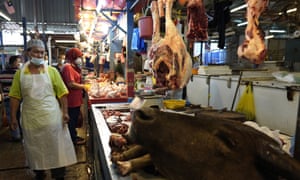
A poultry butcher at a wet market in Kuala Lumpur.
Photograph: Vincent Thian/AP
The coronavirus pandemic is likely to be followed by even more deadly
and destructive disease outbreaks unless their root cause – the rampant
destruction of the natural world – is rapidly halted, the world’s
leading biodiversity experts have warned.
“There is a single species responsible for the Covid-19 pandemic –
us,” they said. “Recent pandemics are a direct consequence of human
activity, particularly our global financial and economic systems that
prize economic growth at any cost. We have a small window of
opportunity, in overcoming the challenges of the current crisis, to
avoid sowing the seeds of future ones.”
Professors Josef Settele, Sandra Díaz and Eduardo Brondizio led the most comprehensive planetary health check
ever undertaken, which was published in 2019 by the Intergovernmental
Science-Policy Platform on Biodiversity and Ecosystem Services (IPBES).
It concluded that human society was in jeopardy from the accelerating
decline of the Earth’s natural life-support systems.
In an article published on Monday, with Dr Peter Daszak, who is preparing the next IPBES assessment,
they write: “Rampant deforestation, uncontrolled expansion of
agriculture, intensive farming, mining and infrastructure development,
as well as the exploitation of wild species have created a ‘perfect
storm’ for the spillover of diseases.”
These activities cause pandemics by bringing more people into contact
and conflict with animals, from which 70% of emerging human diseases
originate, they said. Combined with urbanisation and the explosive
growth of global air travel, this enabled a harmless virus in Asian bats
to bring “untold human suffering and halt economies and societies
around the world. This is the human hand in pandemic emergence. Yet
[Covid-19] may be only the beginning.”
“Future pandemics are likely to happen more frequently, spread more
rapidly, have greater economic impact and kill more people if we are not
extremely careful about the possible impacts of the choices we make
today,” they said.
The scientists said the multitrillion-dollar economic recovery
packages being rolled out by governments must be used to strengthen and
enforce environmental protection: “It may be politically expedient to
relax environmental standards and to prop up industries such as intensive agriculture, airlines, and fossil-fuel-dependent energy sectors, but doing so without requiring urgent and fundamental change essentially subsidises the emergence of future pandemics.”
A global “One Health” approach must also be expanded, they
said. “The health of people is intimately connected to the health of
wildlife, the health of livestock and the health of the environment.
It’s actually one health,” said Daszak.
Furthermore, surveillance programmes and health services need to be
properly funded in nations on the frontlines of pandemic risk, they
said: “This is not simple altruism – it is vital investment in the
interests of all to prevent future global outbreaks.”
Daszak said: “The programmes we’re talking about will cost tens of
billions of dollars a year. But if you get one pandemic, even just one a
century, that costs trillions, so you still come out with an incredibly
good return on investment.
“Business as usual will not work. Business as usual right now for
pandemics is waiting for them to emerge and hoping for a vaccine. That’s
not a good strategy. We need to deal with the underlying drivers.”
In March, the UN’s environment chief, Inger Andersen, told the Guardian “nature is sending us a message”
with the coronavirus pandemic and the ongoing climate crisis. She said
failing to take care of the planet meant not taking care of ourselves.
Last week, the UN secretary general, António Guterres, said governments must seize the opportunity to “build back better” after the pandemic by creating more sustainable and resilient societies.
Prof Thomas Lovejoy, at the United Nations Foundation and George
Mason University in the US, who coined the term “biological diversity”
in 1980, said on Saturday: “[The pandemic] is not nature’s revenge; we
did it to ourselves.”
“It is the consequence of our persistent and excessive intrusion in
nature and the vast illegal wildlife trade, and in particular the
wildlife markets, the wet markets, of south Asia and bush meat markets
of Africa,” he said. Earlier in April, a major study found that the
human impact on wildlife was to blame for the spread of viruses.
In the new article, the biodiversity experts said: “We can emerge
from the current crisis stronger and more resilient than ever, [by]
choosing actions that protect nature, so that nature can help to protect
us.”
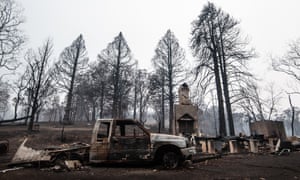
Law centre says there is a risk home insurance could become unaffordable
in the wake of last bushfire season, leaving many uninsured or
under-insured.
Photograph: James Gourley/AAP
The climate crisis
will make insurance unaffordable for many people, particularly those in
regional areas, as the damage from extreme weather events increases, a
consumer group has warned.
In a submission to the royal commission into natural disasters sparked by last summer’s unprecedented bushfires,
the Consumer Action Law Centre calls for an urgent independent inquiry
into the cost of insurance in light of heightened risks linked to global
heating.
The group’s recommendations include the introduction of an insurance
price monitor to prevent consumers being exploited, a standard
definition of key terms such as “fire” in industry contracts and a
modernised regime of what “standard cover” means so policies can be
easily understood and compared.
Gerard Brody, the Consumer Action Law Centre’s chief executive, said
there was a risk home insurance could become unaffordable in the wake of
last bushfire season, leaving many uninsured or under-insured. He said
the issue had been compounded by the Covid-19 pandemic as many people
affected by bushfires in regional communities later lost the income they
relied on from tourism and hospitality.
“Insurance promises to offer peace of mind, but with delayed claims,
confusing policies that don’t always provide the expected coverage and
woeful responses to financial hardship by the insurance industry we’re
concerned that home insurance still isn’t working for many people,”
Brody said.
The
law centre’s call follows similar warnings elsewhere. Murich Re, the
world’s largest reinsurance company, last year told the Guardian that
climate change could make cover for ordinary people unaffordable as it
attributed US$24bn of losses from the Californian wildfires on human-induced heating.
In October, the Reserve Bank of Australia found it was increasingly
important that investors and institutions manage carbon risk, and warned
insurers were the most directly exposed to climate change.
It said inflation-adjusted insurance claims for natural disasters were
more than twice as large last decade as the one before, and was likely
to continue to grow.
The Consumer Action Law Centre said since the summer
bushfires it had received reports from community organisations in
regional areas of significant delays in insurers undertaking assessments
or arranging quotes for bushfire damage in remote parts of Victoria.
It said problems spanned different types of natural disaster, citing an Australian Competition and Consumer Commission inquiry into insurance in northern Australia
that found premiums had increased far more in that part of the country
than elsewhere over the previous decade after insurers adopted a more
fine-grained assessment of the greater risk in the north from cyclones
and floods.
The group said rising costs were increasingly being worn by people
who needed insurance most, when historically risk had been shared across
the community.
“We have significant concerns about how this will play out as the
impact of climate change worsens, particularly for regional parts of
Australia where climate change means bushfires will be more frequent and
more severe,” Brody said in the centre’s submission to the royal
commission.
“It was recognised in the letters patent of this royal commission
that this is the reality Australia is facing. For Australians who live
in areas increasingly at risk from bushfires, premiums are going to
continually (and sometimes rapidly) increase.
“If homeowners cannot afford to rebuild due to the cost of premiums
or the impacts of underinsurance, then they will be forced to leave
their community.”
Consumer Action’s recommendations include the government introducing outstanding recommendations from the banking royal commission relating to insurance as a matter of urgency to ensure people were treated fairly.
Submissions to the natural disasters royal commission close on Tuesday. A final report is due in August.
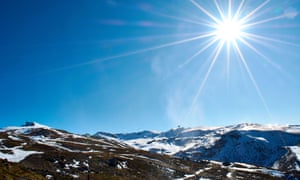
A ski resort in Granada, Spain, which was forced to use artificial snow cannons due to a lack of snow this winter.
Photograph: Carlos L Vives/Alamy
This year is on course to be the world’s hottest since measurements
began, according to meteorologists, who estimate there is a 50% to 75%
chance that 2020 will break the record set four years ago.
Although the coronavirus lockdown has temporarily cleared the skies,
it has done nothing to cool the climate, which needs deeper, longer-term
measures, the scientists say.
Heat records have been broken from the Antarctic to Greenland since
January, which has surprised many scientists because this is not an El
Niño year, the phenomenon usually associated with high temperatures.
The US National Oceanic and Atmospheric Administration calculates there is a 75% chance that 2020 will be the hottest year since measurements began.
The US agency said trends were closely tracking the current record of
2016, when temperatures soared early in the year due to an unusually
intense El Niño and then came down.
The US agency said there was a 99.9% likelihood that 2020 will be one of the top five years for temperatures on record.
A separate calculation by Gavin Schmidt, the director of the Nasa Goddard Institute for Space Studies in New York, found a 60% chance this year will set a record.
The Met Office is more cautious, estimating a 50% likelihood that
2020 will set a new record, though the UK institution says this year
will extend the run of warm years since 2015, which is the hottest
period on record.
Abnormal weather is increasingly the norm as temperature records fall year after year, and month after month.
This January was the hottest on record, leaving many Arctic nations without snow in their capital cities. In February, a research base in the Antarctic registered a temperature of more than 20C (68F) for the first time on the southern continent. At the other end of the world Qaanaaq, in Greenland, set an April record of 6C on Sunday.
In the first quarter, the heating was most pronounced in eastern
Europe and Asia, where temperatures were 3C above average. In recent
weeks, large parts of the US have sweltered. Last Friday, downtown Los
Angeles hit an April high of 34C, according to the National Weather
Service. Western Australia has also experienced record heat.
In the UK, the trend is less pronounced. The daily maximum UK
temperature for April so far is 3.1C above average, with records set in
Cornwall, Dyfed and Gwynedd.
Karsten Haustein, a climate scientist at the University of Oxford,
said global warming was nudging closer to 1.2C above pre-industrial
levels. He said his online tracker
showed a relatively conservative level of 1.14C of warming due to gaps
in the data, but that this could rise to 1.17C or higher once the latest
figures were incorporated.
Although the pandemic has at least temporarily reduced the amount of
new emissions, he said the build-up of greenhouse gases in the
atmosphere remains a huge concern.
“The climate crisis continues unabated,” Haustein said. “The
emissions will go down this year, but the concentrations keep on rising.
We are very unlikely to be able to notice any slowdown in the built-up
of atmospheric GHG levels. But we have the unique chance now to
reconsider our choices and use the corona crisis as a catalyst for more
sustainable means of transport and energy production (via incentives,
taxes, carbon prices etc).”
This was echoed by Grahame Madge, a climate spokesman for the Met
Office: “A reliance and trust in science to inform action from
governments and society to solve a global emergency are exactly the
measures needed to seed in plans to solve the next crisis facing
mankind: climate change.”
Unemployed Australians have welcomed a
coronavirus-led boost to payments, but despair that it has taken a
pandemic to increase their income to a level that lets them eat three
times a day.
Key points:
The JobSeeker supplement has been called the biggest single increase in unemployment benefits since the 1940s
Previously $550 a fortnight, it has risen to $1,100 a fortnight, which is above the poverty line
More than a million people are believed to have become unemployed in the past two weeks due to public health measures
"I'm absolutely furious," said Avery Howard, 18, who
has been part of a broad coalition of business leaders, union bosses and
peak bodies who spent years campaigning to raise the Newstart rate from
about $40 a day.
"There's
been so much talk about how the payments are not liveable, and the big
thing it took to change it was a major public health crisis. I'm
furious."
The Newstart allowance of around $550 a fortnight, re-named "JobSeeker", haseffectively been doubled from today by a temporary Coronavirus Supplement.
It
takes the baseline payment to $1,100 a fortnight — above the poverty
line — and will also be automatically paid to people who receive the
Sickness Allowance, Youth Allowance, Austudy and Parenting Payments.
Mr Howard has not been financially supported by his parents since the age of 15.
He has spent three years surviving on Youth Allowance.
"I said it to a friend the other day and it struck me
how crazy it is, but I told them: 'I've just gotten used to not having
as many meals as I'm supposed to'," Mr Howard said.
"It's been
astoundingly difficult. I spend all my time watching every cent I have. I
have to make sure I'm not [missing] a bill and going into debt."
'Newstart recipients were starving themselves'
Jeremy
Poxon of the Australian Unemployed Workers' Union calls the supplement
the biggest single increase in unemployment benefits since the 1940s.
"Before
the rate was doubled we knew a majority of Newstart recipients were
starving themselves to survive on the entitlement," he said.
The long-term unemployed and those already registered for Newstart will receive it too.
A
surprising coalition of business groups — including the Business
Council of Australia and the AI Group — joined social service
organisations in unsuccessfully pushing Australia's major political
parties to raise the $40 a day rate of unemployment payments, arguing
the low payment was hampering economic growth and excluding people from
being able to join the workforce.
"The minute the COVID-19 crisis
hit people realised very, very quickly," said chief executive of the
Victorian Council of Social Services, Emma King.
"We had people
saying 'Well, we can't have people living on $40 a day', even though
that's what had been happening to people who are finding themselves on
unemployment benefits for the last 25 years."
The way social distancing required the rapid shutdown of industries — and caused huge queues outside Centrelink overnight — had changed views, she noted.
"I think what we've seen before is real commentary around the 'deserving' and the 'non-deserving'," she observed.
"Instead
we're seeing that anyone can find themselves out of a job and anyone
knows that they simply cannot get by on $40 a day."
On behalf of his members, Mr Poxon is more blunt.
"Long-term unemployed Newstart recipients have been
telling us how interesting it is that now that wealthier people — the
people who are not 'meant' to be unemployed — are unemployed, that
they're getting all these concessions," he said.
"That the
Government can click their fingers and double the Newstart rate and
waive now a lot of the punitive eligibility requirements."
But he is delighted that the boost has occurred, at least temporarily.
"Upwards
of a million people are going to be able to regularly put food on the
table, they're going to be able to afford to pay their bills," Mr Poxon
said.
"A lot of people are already telling us they're lining up
medical expenses and treatments that they've had to put off for years
now."
'There's room to decide where my dollars are going'
Mr
Howard is looking forward to building a small buffer of savings, saying
this is "the dream", and not spending hours a day concerned about where
his next meal is coming from.
"It's going to be a massive change.
Just the psychological impact alone, I don't have to be as meticulous
as I have been, there's room — not to be careless — but to have more of a
decision to where my dollars are going," he said.
There is an economic benefit as well. Because
low-income earners have such a small cushion of savings, money they are
given gets spent — supporting business.
More than 6 million
people who were already on Newstart, the Aged Pension and the Disability
Support Pension received $750 stimulus cheques this month.
Bank data shows nearly half of the $4.5 billion was spent in the first fortnight.
"We've
seen really clear evidence that those recipients — and remember this
was targeted to low-income groups who were more likely to spend the
money — and those people did spend it," said Andrew Charlton, director
of illion & AlphaBeta (part of Accenture).
Dr Charlton helped
devise the stimulus package that helped Australia be the only developed
economy to avoid a recession in the global financial crisis of 2008 and
2009.
He said stimulus packages had a bad reputation because
people thought the money would be saved or spent on frivolous items and
activities.
"People accuse it
of being blown on pokies and flat screen TVs," he said. "What we've
seen in this crisis, with real data, is that neither of those things are
true.
"The stimulus has been well-targeted to low-income people who are going to spend it.
"It
has supported the spending of those people, and importantly they
haven't blown it on alcohol and poker machines — it's been spent on
necessities."
While the Coronavirus Supplement could be unwound,
reducing the renamed JobSeeker payment to the historically low level of
Newstart, Ms King is hoping that does not happen: for the people on it,
and the broader economy.
"There's a double benefit here, that
people can actually afford to rent somewhere and they can afford to
participate in society in a way that they simply can't on $40 a day,"
she said.
"So there's both a moral and economic very strong argument as to why they should be left as it is."