Contemporary politics,local and international current affairs, science, music and extracts from the Queensland Newspaper "THE WORKER" documenting the proud history of the Labour Movement.
MAHATMA GANDHI ~ Truth never damages a cause that is just.
What’s
coming is a huge (politically risky) dismount from a public health
strategy labelled suppression but more like elimination.
‘Slogans like “safe plan” sound like insurance, but this transition is risky, both practically and, of course, politically.’
Last modified on Sat 28 Aug 2021 10.15 AEST
I’m
not sure exactly when the word “safe” was added to the word “plan” in
prime ministerial sentences, but it crept there sometime during this
parliamentary sitting week. I noticed this particularly on Thursday.
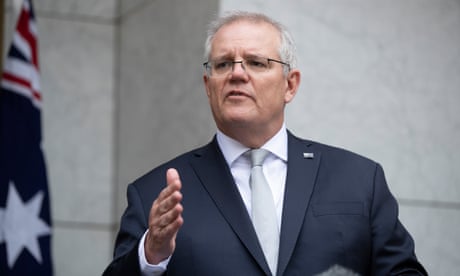
“Our national plan is a safe plan,”
Scott Morrison told reporters in his courtyard at Parliament House.
“It’s the safe plan to ensure that Australia can open up again with
confidence.”
In case you’ve missed it, the “safe” plan is the four-phase strategy to reduce public health restrictions once vaccination rates in the population aged over 16 reaches 70%. Epidemiological modelling from the Doherty Institute
informs the strategy. If you’ve tuned in this week, you’ll know the
Doherty modelling is being buffeted by two headwinds – rolling disputes
within the federation, and the more polite zone of expert disagreement. These crosscurrents are all pretty interesting, but this weekend, safety is what I want to consider.
“Safe”
is a courageous word for a prime minister to lob in a pandemic, because
pandemics aren’t safe events. It’s certainly true that Australia has
endured less tragedy than places like the United States. But we aren’t
safe from this virus, and most people know that.
At
the risk of stating the obvious, pandemics bring anxiety, illness and
sometimes death. People either get sick, or they worry about getting
sick. Australian governments have imposed lockdowns to keep people safe,
but that physical safety carries a cost. Mental wellbeing suffers.
What
Morrison wants to do over the coming weeks is nudge Australians past
his previous shibboleth of saving “lives and livelihoods”. “Lives and
livelihoods” was the bulletproof political mantra that allowed the prime
minister to take actions during the crisis that centre-right
governments wouldn’t normally countenance. His new mantra will be
“living with Covid”.
Morrison shouldn’t compound bad judgments by peddling false comforts
But
“living with Covid” is a different experience for Australia. Morrison’s
“safe plan” involves gradually turning off the commonwealth money
machine. As vaccination rates rise, it also involves decoupling from a
public health strategy that has been labelled suppression but is more
like elimination.
Given
where we’ve been for the last year and a half, floating, isolated from
the world in a bubble of government-built expectations that Australia’s
primary objective is saving lives and livelihoods, what’s coming is less
“safe plan” than huge (and politically risky) dismount.
Slogans
like “safe plan” sound like insurance, but this transition is risky,
both practically and, of course, politically. Morrison is beginning this
dismount when his political capital has ebbed from the highs of 2020.
People
are anxious, and angry. They’ve endured the commonwealth’s terrible
vaccination bungle. People in Sydney are also living with Gladys
Berejiklian’s failure to lock down the city fast enough. In fairness to
the premier, it is possible Delta would have vaulted right over the
state’s “gold standard” contract tracers even if she’d locked Sydney
down sooner, because the evidence suggests this variant is a pitiless
adversary.
But Berejiklian didn’t try hard enough.
That’s the truth.
It’s
galling then, to tune in every day at 11am to watch the NSW premier
reframing her abject failure as an act of courageous leadership.
Berejiklian presents herself as a pace-setter, the only premier with the
bottle to speak unvarnished truths, like the elimination of community
transmission is impossible (unlike those panicky Labor premiers with
their fingers wedged in the Delta dyke).
But this is a found strategy; a virtue of necessity.
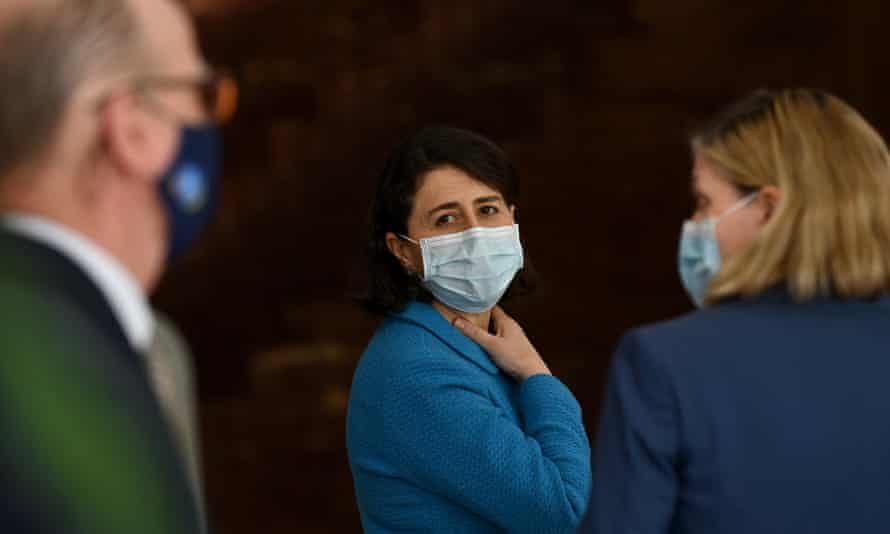
NSW
premier Gladys Berejiklian and chief health officer Kerry Chant at a
press conference in Sydney on Thursday after the state recorded more
than 1,000 cases. Photograph: Getty Images
Given she failed to try hard enough, and given her failure now sets the baseline for the rest of the federation, Berejiklian could at least spare us the self-serving piety. But please know
she doesn’t spare us. On Thursday, NSW surpassed 1,000 cases a day, and
chief health officer Kerry Chant predicted more bad news would come.
As Berejiklian confirmed the new daily record, she softened the blow by promising people a picnic.
Now I love picnics, and perhaps this was a cut-through morale boost for
Sydneysiders locked down for nine weeks. But from my vantage point in
Canberra (locked down for a fortnight) this looked pretty surreal.
Adding
to the strange was Nationals leader John Barilaro informing viewers
regional communities were “a tinderbox ready to explode” with new
Covid-19 cases – as if he were somehow detached from these events – like
he was David Attenborough narrating a wildlife documentary. It was
certainly “Barra’s” most memorable observation since accusing
Covid-infected Canberrans of defecating secretively in Merimbula.
Between
the picnic and the tinderbox and the ambulances ramping outside Sydney
hospitals, Chant, who soldiers on most days next to Berejkilian, added a
useful corrective to the “safe plan” evangelism in Sydney and in
Canberra.
She
said vaccine equity was one of the necessary preconditions of being
able to live with Covid. It would be important to vaccinate the
homeless, Indigenous people and other vulnerable populations because
Australia was only as safe as our most vulnerable person. Proving her
point, by the end of Thursday we learned that Wilcannia had a higher
transmission rate than the worst hotspots in Sydney – and no ventilators.
The
weird thing about Thursday’s 1,000 cases milestone was my profound
sense of deja vu. I remember very clearly last March, 22 March to be
precise, the day when Australia sprinted past 1,000 cumulative coronavirus cases.
Unlike now – when 1,000 cases (daily) gets presented to people as a
minor speed bump on the road to whatever Covid-normal is – last March,
1,000 cases (cumulative) was the trigger for Berejiklian and Victorian
premier Daniel Andrews to force Scott Morrison’s hand on lockdowns.
Over the weekend of March 21 and 22, the two premiers demanded a lockdown of all non-essential services. If you’ve forgotten that time, Berejiklian was battling the fallout from the Ruby Princess debacle.
Making matters worse, Sydneysiders had ignored the (still novel) polite
advice about social distancing, and hit Bondi beach en masse. A
glorious autumn had followed the summer of calamity when wildfires
turned the sky mustard yellow or pitch black, and sometimes red, like
Hell had yawned, and people yearned for breathable air, and restorative
sand and surf.
Last
March, Berejiklian and Andrews pushed Morrison towards that first
significant lockdown because they were worried about the risks of their
health systems being overrun. Back then, the view in NSW and Victoria
was community behaviour would not start to shift until governments sent
people a signal blunt enough to be life-changing.
The
point of this reminiscence is to map the counterpoint. Last year 1,000
cases pushed Australia into our new public-health driven normal – masks,
density restrictions, lockdowns. Now, as NSW passes a milestone of
1,000 daily cases, we have the “safe” plan to transition to
Covid-normal.
So let me repeat, nothing here is “safe”.
It might be necessary now, to move past the safety-first world that Berejikilian and Andrews created at the opening of the pandemic. It might be sensible
to rebalance the responsibilities between governments and individuals
once vaccination rates rise, because the duty of care of the state to
its citizens isn’t infinite.
It is certainly prudent for the governments of the federation to try and reach agreement about what restrictions get eased when. It’s likely true
that suppressing community transmission is difficult with this variant,
so if that’s the reality, policies need to adjust accordingly. In
periods like this, choices bend towards the greatest good for the
greatest many rather than chasing the impossibility of first-best
policy.
It is also important for government to listen
to the tolerances of their communities. It’s pretty obvious that some
people are now so sick of lockdowns they would prefer to take their
chances with a potentially deadly virus rather than remain in the
artificial world of harsh restrictions. Morrison is very obviously
genuflecting to that constituency.
But not everyone possesses that mindset.
So
let’s be clear about the limits of safety. This “safe plan” isn’t safe
for the people who will get very sick with this virus and die over the
coming months. It won’t be “safe” if testing, tracing and quarantine
can’t keep pace with new outbreaks. It won’t be “safe” if the variants
after Delta can’t be contained with vaccines. It won’t be “safe” for
people who can’t overcome their hesitancy about vaccines, or don’t have
the tools to properly weigh the risks. It won’t be “safe” to open the
international border when large swathes of the world’s population don’t
yet have access to a vaccination.
Bear in mind too that the Doherty Institute modelling only considered the “transition” phase over the next six months. It doesn’t consider how relaxed restrictions will ultimately affect transmission in the community because the environment is too uncertain.
Of
course we need to move forward, rejoining each other and the world, and
vaccination gives us the tools to do that. We can’t expect governments
to eliminate every risk. But we also need to approach the coming
dismount with eyes wide open.
The prime minister has made a number of very poor judgments this year.
He shouldn’t compound bad judgments by peddling false comforts.
It
has shipped more than a billion doses, saved countless lives – and
faced controversy over its safety and supply. Here, some of those who
created the vaccine tell the story of their epic race against the virus.
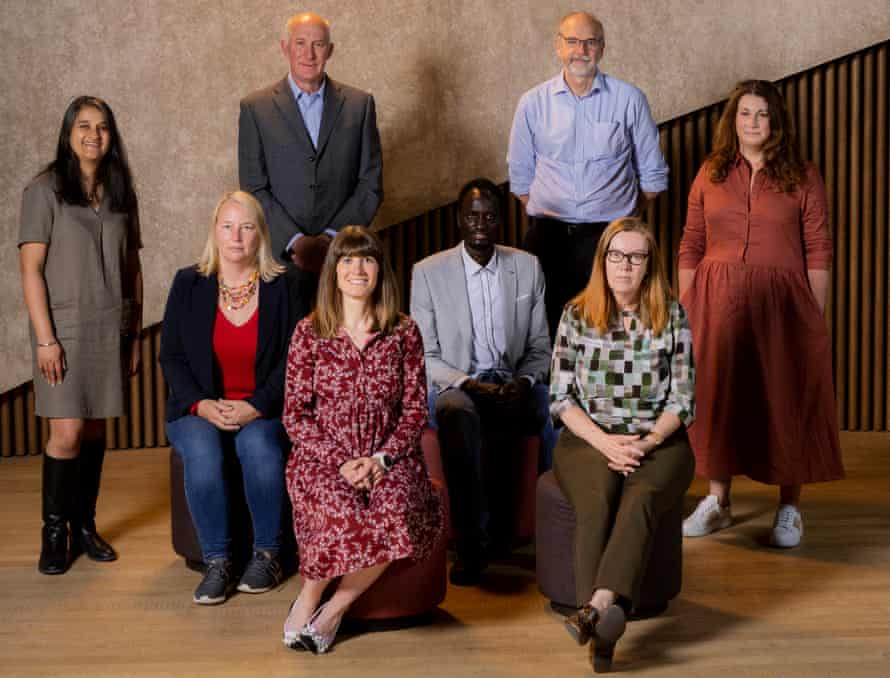
Members
of the academic team who worked on the AstraZeneca vaccine, shot on
location at Blavatnik school of government, University of Oxford.
In
December 2019, hospitals in Wuhan, China, reported that they were
dealing with dozens of cases of pneumonia of an unknown cause. They soon
identified the disease as being caused by a novel coronavirus.
Teresa Lambe, associate professor, Jenner Institute
My brother lived in China, so whenever there was an emerging or break
pathogen there, I used to follow it. I remember thinking very early on
that this was probably another influenza strain.
Sarah Gilbert, Saïd professor of vaccinology, Jenner Institute
[Before Covid] I was developing vaccines against a range of emerging
pathogens, specifically Mers, Nipah and Lassa [virus]. We also had
applied for funding to work on preparedness for “disease X” – the
unknown pathogen that is coming. But it wasn’t funded, so we didn’t
manage to put any of those plans in place.
Andrew Pollard, director, Oxford Vaccine Group None of us thought that this was about to be a pandemic.
On 11 January 2020, media reported the first death from what would come to be known as Sars-CoV-2, or Covid-19. The same day, Chinese virologist Zhang Yongzhen published the genome sequence of the virus online. Lambe received the genome in her email inbox early Saturday morning.
Lambe We knew it was coming, and we’d already had a discussion about what to do. We designed [the vaccine] over that weekend.
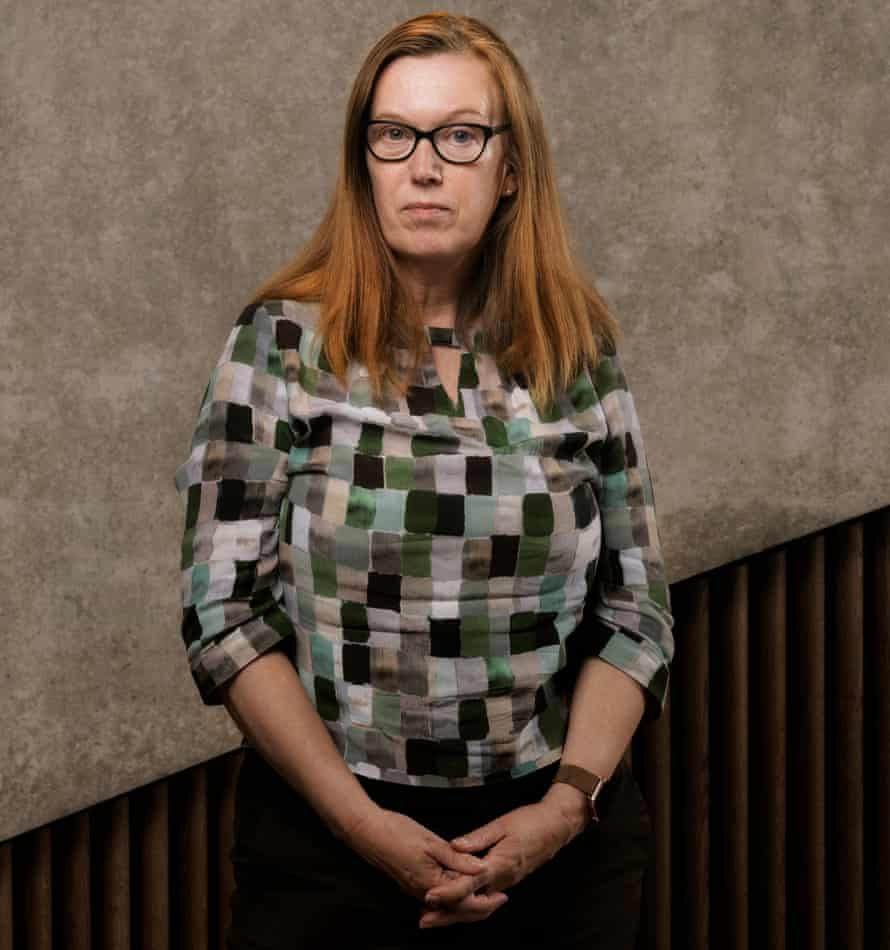
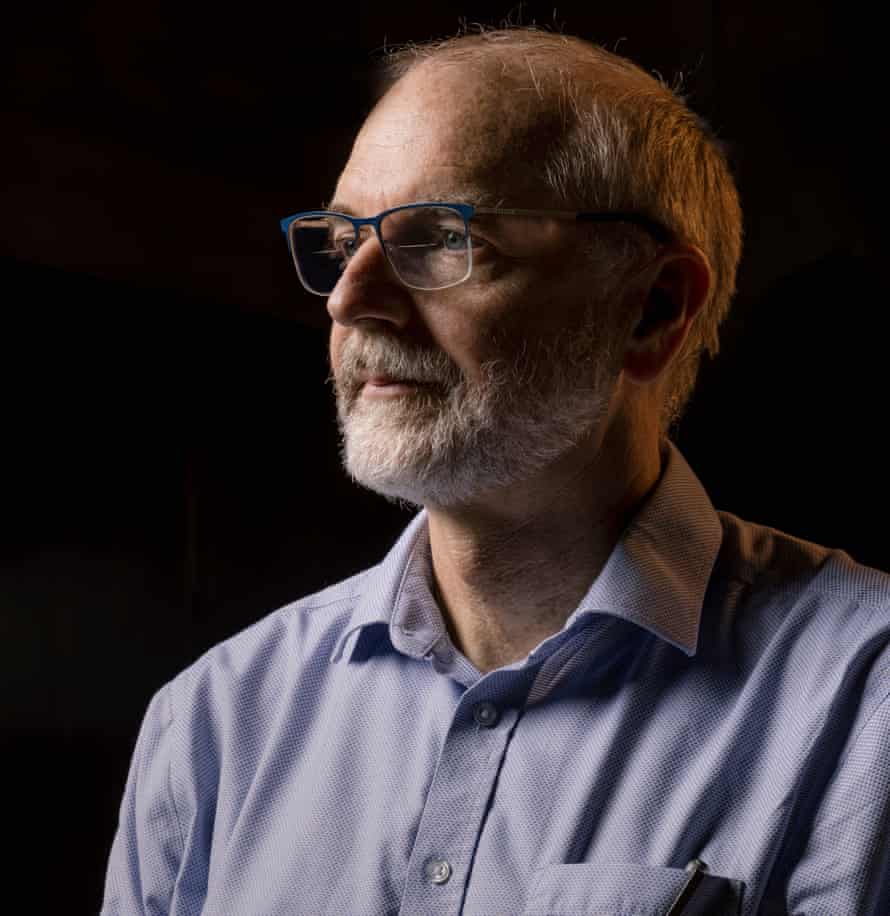
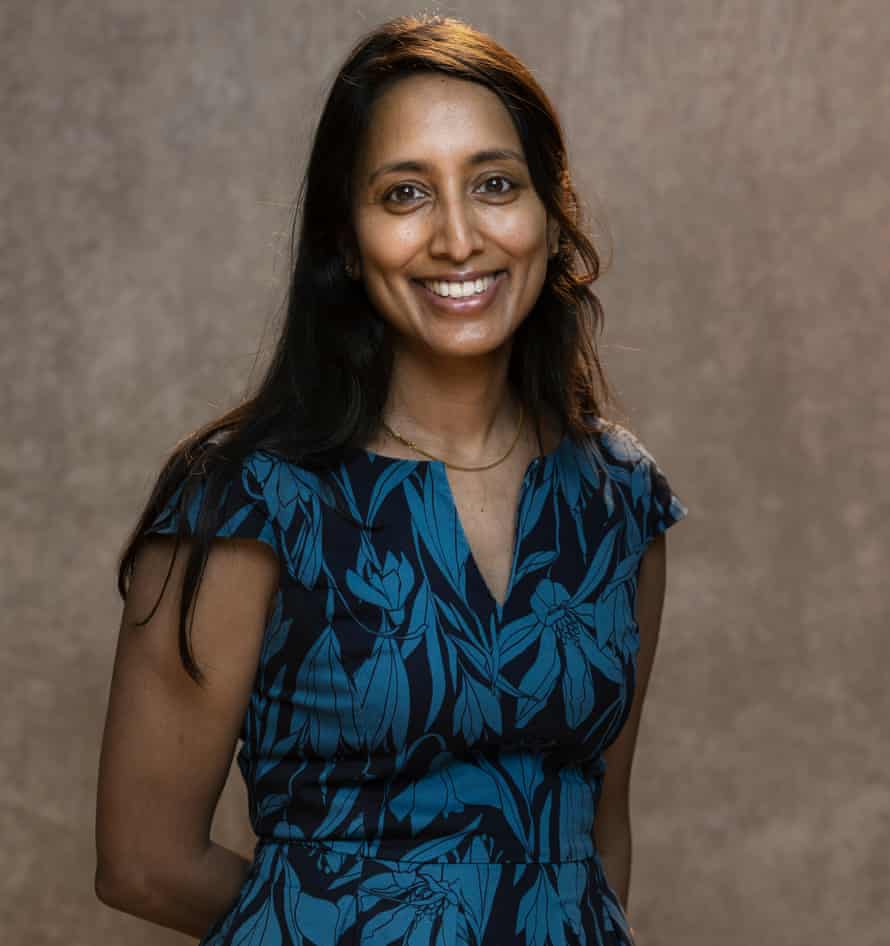
Sarah Gilbert: ‘We’re not a big corporation.’ Photograph: Manuel Vázquez/The Guardian
Gilbert
We knew before the genome came that it was a new coronavirus, not the
original Sars, not Mers or any of the seasonal human coronaviruses. But
because it was a coronavirus, we knew the part of the genome we
needed was the part that encodes the spike protein on the surface.
That’s what you want to raise an antibody response against.
Cath Green, head of the clinical biomanufacturing facility
Sarah [Gilbert] had already made a vaccine against Mers, so she knew
what the vaccine against the new coronavirus was going to look like.
They take the DNA sequence of the coronavirus spike protein from the
Chinese lab and adapt that to make it the right fit to go into our
system. The Jenner lab take that sequence and insert it into a bigger
sequence which contains the adenovirus genome. So I received from them a
really small tube with a few micrograms of DNA. My job was to make that
into the vaccine.
Gilbert It was potentially just a demonstration project at that stage.
On 30 January 2020, the World Health Organization declared the novel coronavirus
outbreak a “health emergency of international concern”. By that point,
the virus had spread to several countries, including Japan, Taiwan and the US, which closed its borders to Chinese travellers. The same day, the first case was confirmed in the UK.
Pollard
Knowing the scale of what we were facing – vaccines normally take 10 to
15 years to produce – was concerning. We had to try to think how we
were going to change that into something where we could make an impact
before the pandemic could kill millions of people.
In
mid-February, Gilbert’s group at the Jenner and Pollard’s Oxford
Vaccine Group joined forces to focus their efforts on developing their
vaccine candidate. By then, cases were spreading rapidly worldwide.
Pollard We realised that to do something fast and at scale, we all had to come together.
Federica Cappuccini, senior postdoctoral scientist There were emails going around, like, what’s your availability? What skills do you have? What can you do [to help]?
Hannah Robinson, clinical delivery lead
I remember when we had that first meeting, one of the scientists was
saying that every day we’re not getting a vaccine out there, that’s
10,000 people dying.
Green
and her colleagues inserted the DNA – containing the instructions to
make the spike protein – into a culture of genetically modified human
kidney cells.
Green We
have to take the DNA and insert it into the human cells in a very
controlled environment. And then we have to identify a clone – a cell
that is starting to make the vaccine, but doing that from one single
copy of the DNA we’ve inserted. The vaccine is a virus, so it’s
multiplying in the cell; eventually the cell pops, the virus is
released, and it can then infect the surrounding cells. One virus fills
up a cell, that pops, goes up to 100 cells, they pop, fill up 1,000
cells, and so it goes exponentially. Although we started with one virus
particle, I think we ended up with 300ml of a solution containing the
vaccine. Every single dose of the AstraZeneca vaccine that’s in somebody’s arm today originated with our first clone. D8, it was called.
To test the vaccine’s safety, and its ability to induce an immune response, it was administered concurrently to animal subjects: to mice and pigs at the Pirbright Institute in Surrey, and rhesus macaques, at Rocky Mountain Labs in Montana in the US. Meanwhile, the Oxford scientists raced ahead with planning a phase 1 clinical trial.
Pollard
Normally you might get into studies in mice, look at the data from
those, then you might go into non-human primates, but that’s several
years gone by. If you get good results, you go and find someone to fund
you to do the manufacturing, which might take 18 months, then you start
the phase 1 trial. We realised that you have to overlap all those
processes. So the animal studies started in February, and by the time we
got to March, the manufacturing was under way for human trials – and we
didn’t even have any data from the animal studies yet.
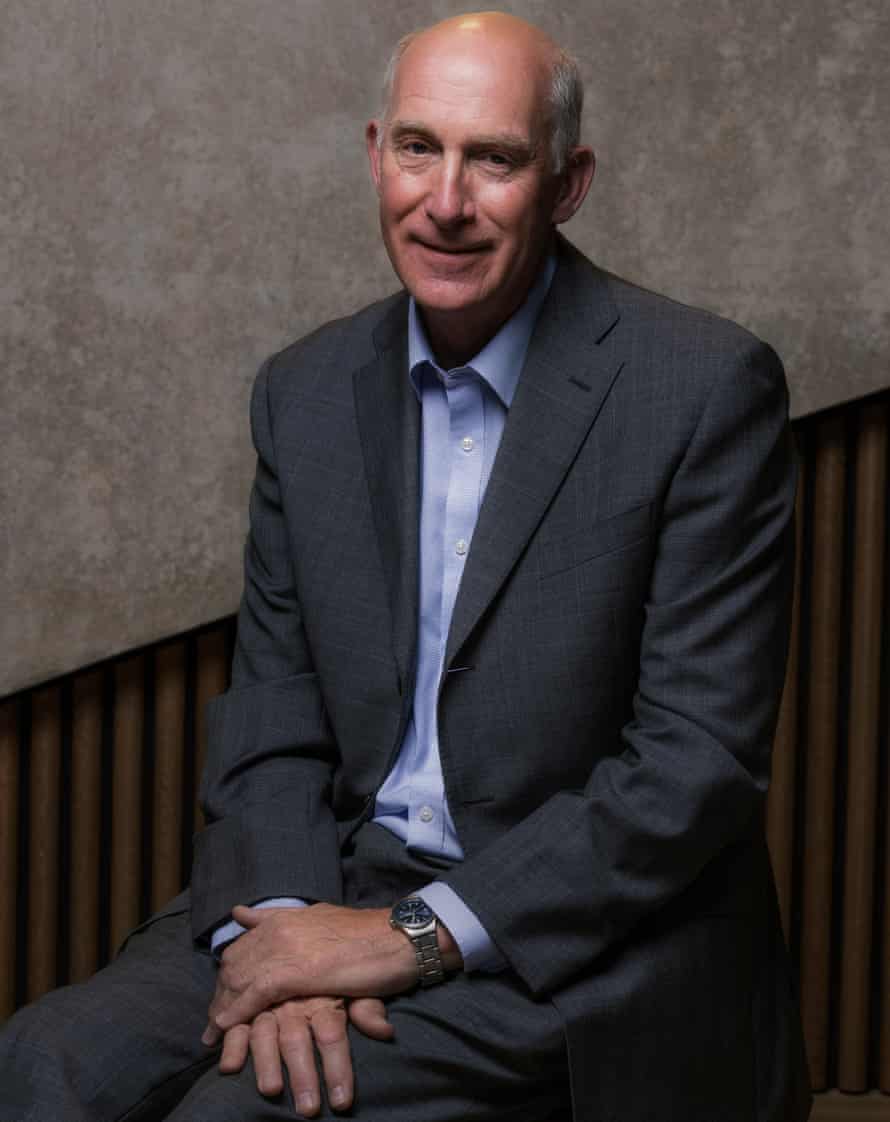
Andrew Pollard: ‘We need to be ready for new variants.’ Photograph: Manuel Vázquez/The Guardian.
Robinson
You’ve got to do submissions to ethics committees and the MHRA
[Medicines and Healthcare products Regulatory Agency, which approves the
use of vaccines in the UK] – all the documents that are used to run a
trial. They need to be written and reviewed, then submitted, which in a
pre-pandemic process would take maybe six months.
Pollard
The MHRA made this the priority, so they put more people on it.
Everything was sent in; seven days later they were able to give
approval.
On 23 March 2020, with cases hitting 6,650 a day in the UK, Boris Johnsonannounced
the UK would enter the first lockdown. Non-essential businesses were
closed; all non-essential workers were ordered to stay at home to
prevent spreading the virus. The same day, the government awarded a
£2.2m grant to fund the Oxford team’s research.
Maheshi Ramasamy, senior clinical researcher
I’m a consultant trained in infectious diseases and my day job is
looking after people in the hospital. The first time we saw cases here
in Oxford was just after that February half-term. We started to see one
or two, and admitted them as a precaution. Then, around mid-March, I
turned up on Monday on the ward. On the Friday we’d had one person with
Covid; now there were 11. They were much older, they were very frail,
and they were dying.
Lambe I
remember the walk from my house being so quiet, not having to look
before crossing the road because there were no cars. It was eerie.
Green
Everything ground to a halt. We were struggling to get masks,
disinfectant. But because we’ve got a lab here, and hand sanitiser is
effectively just ethanol, a bit of hydrogen peroxide and some glycerol,
we made a few litres and splashed that around.
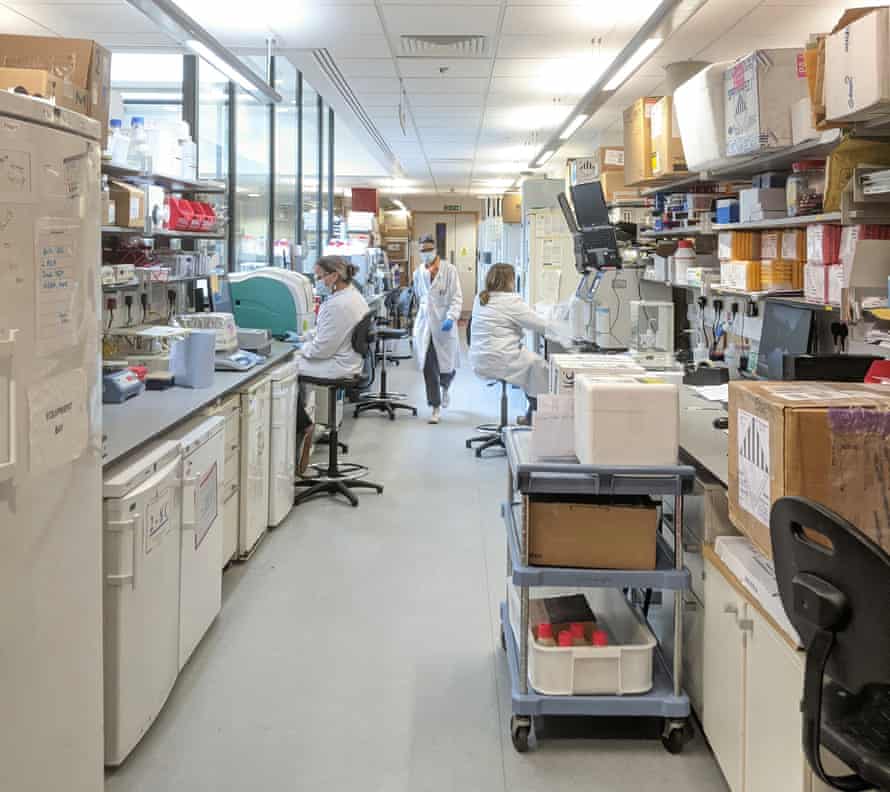
Researchers working in the Jenner Institute. Photograph: Manuel Vázquez/The Guardian
Pollard There was no PPE available within the NHS. We needed thermometers for our volunteers; there were none anywhere in Europe.
Gilbert I remember a conversation with Matt Hancock, him saying, “What do you need?” I said, “PPE.”
Ramasamy
That was a really miserable time to be working in hospital. We were all
terrified of this new disease that we’d never seen before. We didn’t
know how to manage it. There was one moment when somebody said to me,
“Is this what the end of the world feels like?”
By early April, as the daily death toll in the UK topped 1,000 for the first time and the prime minister was put in intensive care, the first batch of the vaccine was nearly ready to begin the phase 1 clinical trial.
Green
There’s a stage where you have to centrifuge the material through a
gradient, and all of the vaccine lines up in one layer. You can see it.
Kathy, one of my production team, came out and said: “Look at these
babies!” We were like, “Oh my God!” That was the day when we knew we had
enough, and we could get it into somebody’s arm in three weeks’ time.
That was great. I will remember that always.
Pollard
We had by then already got ethical approval, and the vaccine had been
made. So the day after the [successful] results from the animal trials
were available, we gave the first dose.
On 23 April, the first dose of the Oxford vaccine, then known as ChAdOx1, was administered to Elisa Granato, a microbiologist. Within 48 hours, fake news websites began to spread a rumour that Granato had died from side-effects of the vaccine.
Pollard She hadn’t, of course.
Gilbert Her relatives had to be kept informed, because her family and friends were hearing that she’d died.
Pollard
The BBC did an interview that Sunday morning with Elisa and they were
able to demonstrate that she was alive. In that case, the media in the
UK saved the day. Despite that, some of those fake news stories have
really damaged confidence in vaccines.
Lambe I don’t think I appreciated how much we needed to communicate with the public until we were almost halfway through.
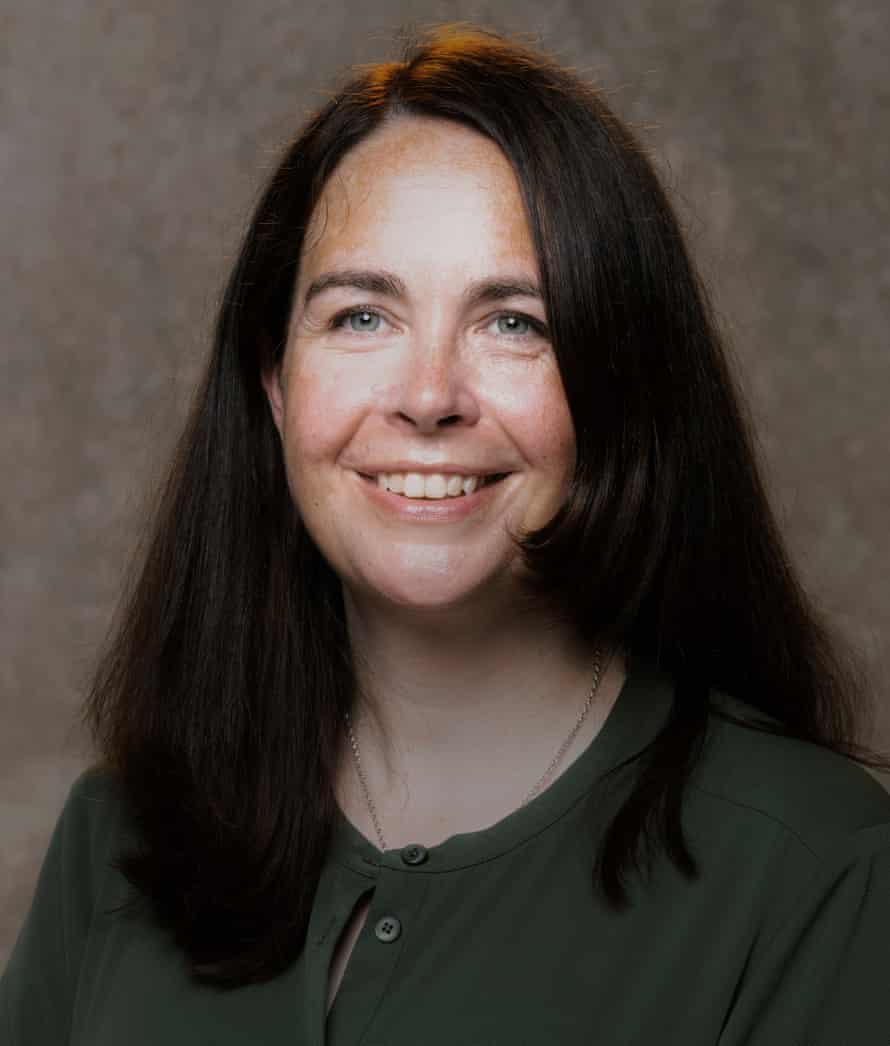
Teresa Lambe: ‘I remember thinking this was probably another influenza strain.’ Photograph: Manuel Vázquez/The Guardian
Gilbert
What I’m trying to do more recently is let people know that, you know,
we’re not some other type of being. We’re not a big corporation, we’re
not evil big pharma. But we work with big pharma, because big pharma
have a useful job to do.
Lambe And they’re not evil! They’re really nice people.
On 30 April, Oxford University signed a deal with the British-Swedish pharmaceutical company AstraZeneca to mass-produce the vaccine. Crucially, the company agreed to Oxford’s demand that it provide the vaccine for no profit to developing countries during the pandemic.
Gilbert
We weren’t involved in those discussions. It was other people within
the university. We were frankly flat out with what we were doing at that
time.
Lambe But it was an absolute for everybody in the team.
Pollard
We wanted to have a vaccine that could be distributed globally so you
need a big pharmaceutical company to do that. AstraZeneca fit the bill.
The most extraordinary thing about them is they were prepared to do that
not-for-profit. It’s almost unthinkable that a business would think
that was a reasonable thing to do.
With phase 1 trials demonstrating a successful antibody response and no severe side-effects, plans were put in place to commence a phase 2 and phase 3 trial simultaneously in the UK and South Africa, and later Brazil and the US. Meanwhile, the US, UK and other governments signed deals with AstraZeneca to purchase tens of millions of doses. Rival companies Pfizer and Moderna had also begun clinical trials.
Pollard
The first lockdown was having the most incredible impact on suppressing
the virus. By the time the trials actually started, it was clear that
there weren’t going to be enough cases. So for our phase 2 and 3 trials,
which were already being planned through April, there were two bits of
thinking. One was: we have no idea what the next wave will look like, so
we ought to be geographically dispersed. It could be the next big wave
was in the UK, or it might be that we needed to be in South Africa or
Brazil. The other was to make sure we wouldn’t find the people in Africa
or South Asia or Latin America saying, “Well, this vaccine has only
been tested in Europe.” So that was the rationale for being in each of
those countries.
Throughout the trial, supply of the vaccine was limited, which led to extraordinary measures.
Robinson
I remember being on the call with Andy [Pollard] on a Sunday with the
Italian manufacturers, and we decided that we would have to charter a
plane and get the vaccine to the UK, so our UK team could label it, so
it would be available the following day for us to run the clinic.
It emerged that, due to a technical complication, the vaccine doses manufactured in Italy were of a different concentration from those Green’s lab had produced in Oxford.
Gilbert
We have to measure the concentration of the vaccine and there are
different ways of doing it. Advent [the Italian manufacturer] use one
assay [test] and we use another one. When we got the batch from Italy,
we discovered we were getting different results from the two assays. One
of them was giving us a result twice as high as the other. So we had to
decide which concentration to use to continue with the clinical trials.
If we had chosen one, there was a risk we could be giving half the
dose, and if we chose the other, there was a risk we could be giving
twice the dose. So we went with the safe option, which was to give the
one where if we were wrong, we’d be giving half a dose.
Pollard
We went back to the MHRA and they agreed we should adjust the dose.
Then we continued with the trial. And I think that huge flexibility –
the regulator allowing us to adjust that – actually saved an enormous
number of lives.
By the summer, as the world waited for news
of a potential vaccine, the Jenner Institute became the target of
unprecedented attention from world media, but also anti-vaccine
protests, cyber attacks and even thieves.
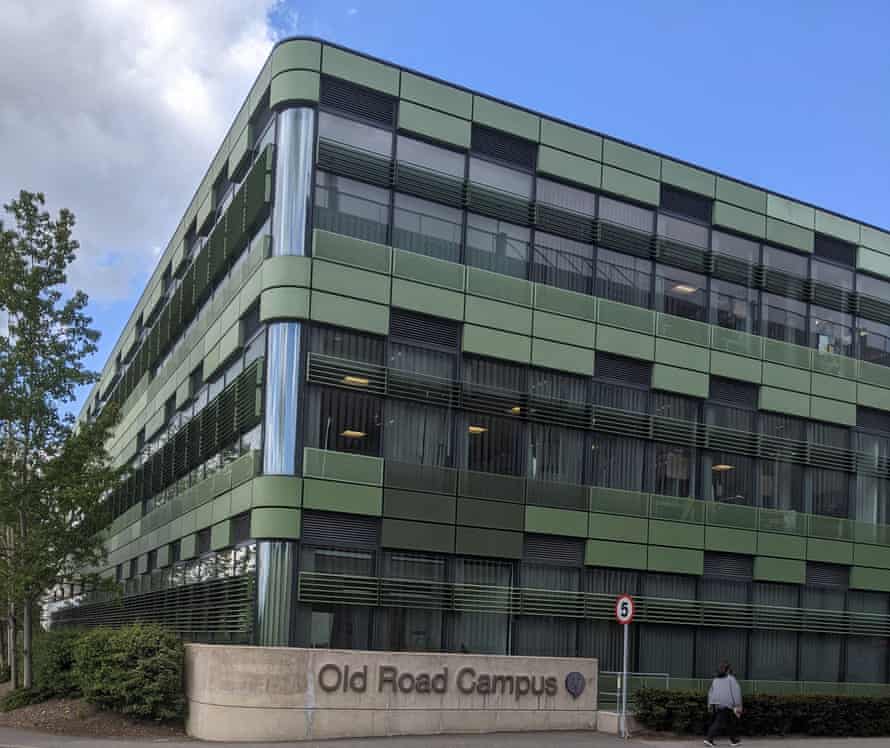
Charles Parkins, facilities manager, Old Road CampusWe
did have demonstrations outside, a guy and his supporters making a lot
of noise and allegations. We had a few of those; they were dealt with by
university security and police. But the person who shut the loudmouth
up was one of the builders working on the site. After that, he lost his
voice.
Oto Velicka, senior buildings and facilities manager
We had a lot of cyber attacks and threatening emails, tweets on our
feeds and social platforms, and phone calls, which we had to get the
police involved in.
Charles Parkins: ‘We had people protesting outside.’ Photograph: Manuel Vázquez/The Guardian
Parkins
One thief got into the building. He rummaged through offices, found a
couple of brand new computers, put them in his backpack and left. The
strange thing is, two or three days later, another chap banged on the
front door saying, “I want to come in.” I said, “You’re not coming in.”
He dropped a plastic bag by the door. I called security, thinking it
could be a bomb or anything. They came across and said, “Charles, it’s
four brand new computers.” I don’t know what the connection was between
the two guys, but we ended up with our computers back.
On 9 November 2020, the world rejoiced as Pfizer/BioNTech announced their vaccine
was 90% effective. On 16 November, Moderna announced its vaccine showed
94.5% efficacy. A few days later, Oxford had amassed enough data to
release initial results on the efficacy of the Oxford/AstraZeneca vaccine. Overall, the data showed its vaccine was 70% effective at preventing Covid-19.
Confusingly, the data showed that for those given two full doses,
efficacy was just 62% – but a smaller group given the half-dose,
followed by a full dose, saw 90% effectiveness.
Cappuccini
Because Pfizer and Moderna released their efficacy data before us, that
window – which wasn’t really a long time – felt like ages.
Pollard
I was sitting here and the data safety monitoring board members went
through the data with me. I was exhausted as we’d been working so hard
to get everything ready. It was quite a surreal moment because no one
else in the team was here. It was just me on my own seeing the data for
the first time. I phoned Sarah Gilbert and told her the results.
Gilbert
I got a call on Saturday evening from Andy Pollard, which surprised me,
because he’d told me not to expect any results until Sunday. I was
saying, “Why can’t you just tell me the result?” Because I was expecting
a number, x% – but it was more complicated than that, as we all now
know. But it was effective, and that was great.
Pollard The exhaustion meant that the emotion was perhaps less than there might have been.
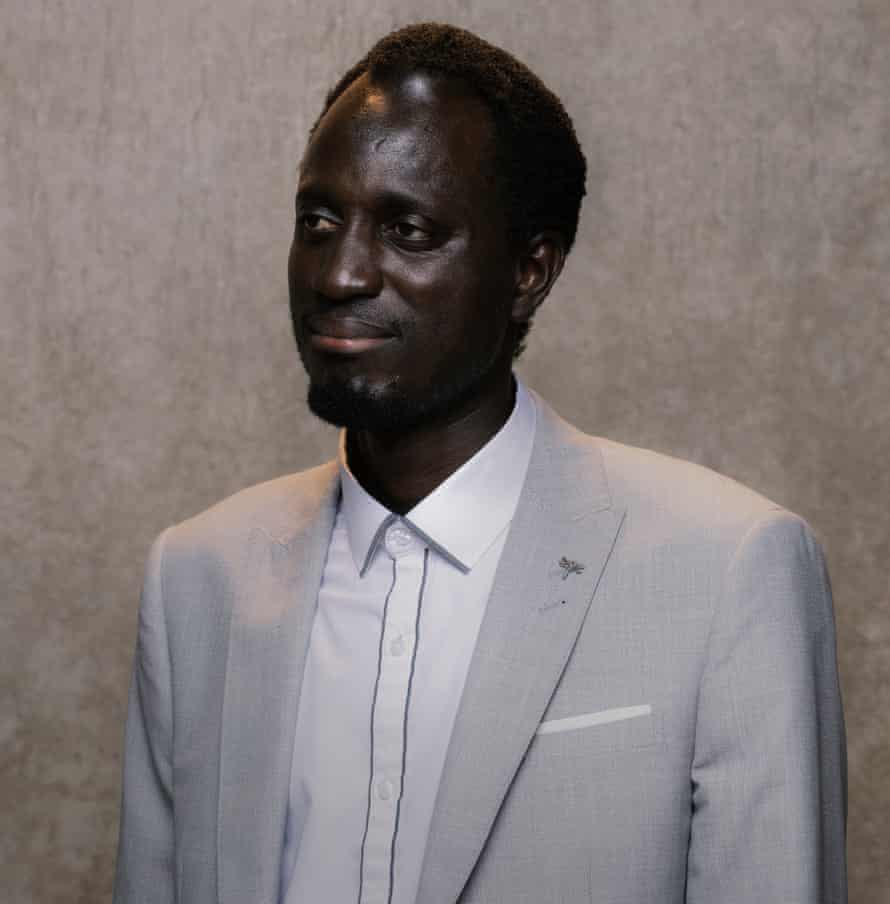
Mustapha Bittaye: ‘Every effort, every sleepless night, have all paid off.’ Photograph: Manuel Vázquez/The Guardian.
Mustapha Bittaye, postdoctoral researcher
I knew the vaccine was going to be used across the globe. My family
back in the Gambia are going to benefit from this vaccine. So when I
heard about the efficacy results, I was so happy. It brought a sense
that every effort, every sleepless night, the long hours, have all paid
off.
Cappuccini Because these vaccines are going to go in the arms of the people we love as well.
On 23 November, AstraZeneca
released its findings. The complexity of the results led to criticism
in the scientific community, who were unhappy that the company had
communicated the results by press release, without making the underlying
data immediately available.
Gilbert
There is a legal requirement, with AstraZeneca involved: if they have
any data that might affect their stock price, it has to be communicated
immediately before the markets open. Our preference is absolutely not to
release data by press release; we want the peer-reviewed publication.
But that had to happen.
Ramasamy
The low dose thing was a bit of a red herring. When we went back and
looked at the data, it was actually the interval between doses that was
important. So the longer the gap between the first and the second dose –
when you go from four weeks to 12 weeks – you get better immune
responses.
On 30
December 2020, the MHRA approved the vaccine for rollout in the UK. In
January, in the midst of the second wave, hundreds of thousands of doses
were administered to at-risk groups in the UK. However, because
of manufacturing problems, supplies to the EU were delayed, triggering a
political crisis. To make matters worse, French president Emmanuel Macron claimed the vaccine was “quasi-ineffective” in those over 65 – seemingly based on a lack of data in older age groups.
Pollard
There were two reasons why we didn’t have enough cases in that older
age group. One was because in all countries, older adults were more
conservative in the pandemic, so they were less exposed to the virus.
The second reason is that there was nothing known about the vaccines,
and our data safety monitoring board said, “We are a bit more worried
about older adults, so we think you should do them sequentially. Look at
the safety and get the immune response data before you start your
efficacy arm in that older age group.” So by the time the interim
analysis in November came, we hadn’t had much time to accrue data in
older adults.
The Old Road Campus research building. Photograph: Manuel Vázquez/The Guardian
Gilbert
We’re not involved with [the politics] at all, because that is
AstraZeneca. We’re watching the news like everybody, but there’s nothing
we can do about it. AstraZeneca had made very large efforts to get
manufacturing established. But these aren’t small molecule drugs; these
are not very straightforward things to manufacture. Nobody’s done this
at this scale before, let alone at this speed, so you can’t predict how
long it’s going to take.
Pollard I don’t think [supply] could have been any better than it is today, given how hard it is to make vaccines.
Lambe Still more than 90% of the Covax doses are AstraZeneca. And that to me is a big deal.
Gilbert
Our aim from the very beginning has been to make a vaccine for the
world, not financial profit. As there are still not enough doses of
licensed Covid vaccines for everyone in the world, we need to make sure
political decisions don’t result in any of those doses going to waste.
Reports began to emerge linking the AstraZeneca vaccine to rare blood clots, as well as low platelet counts, in a very small number of recipients. (The Johnson & Johnson vaccine, which also uses an adenovirus vector, has also been linked to similar cases.) It is now thought that blood clots may affect about one
in 100,000 patients. In response, many countries have decided not to
administer the vaccine to lower age groups. Fear of blood clots is also
contributing to low uptake in poorer countries.
Ramasamy
All drugs have side-effects. We were looking out for it within the
clinical trials, monitoring every time a participant had any kind of
serious medical event. As a clinician, it’s always devastating when you
hear about severe side-effects.
Maheshi Ramasamy: ‘It was the interval between doses that was important.’ Photograph: Manuel Vázquez/The Guardian
Gilbert
It’s difficult because different vaccines were being used in different
age groups in different countries. At one point, Europe was saying that
it was a phenomenon happening to women, not to men. That’s not actually
true – it was just that the vaccine was mainly being given to young
healthcare workers, the majority of whom are women. We still don’t
understand it. People have come up with a number of hypotheses, and
we’re investigating them. It may take quite a long time to fully
understand, because it is so rare.
Pollard
Over the course of the last year, about 1,800 people out of every
million have died with Covid. And when we look at the death rate among
the vaccinated people from their side-effects, it’s about two per
million. So it’s absolutely clear from an overall risk-benefit
perspective that we should be vaccinating people.
Parvinder Aley, director of operations If
you would take any other regulated drug and accept the regulators know
what they are doing, this is no different. It’s gone through every
single one of those processes. And we’ve lived a lot of those processes.
So I can tell you the regulators have scrutinised this in great detail,
not just in the UK but globally, and have been willing to give it
authorisation – and that many regulators can’t be wrong.
Oxford and AstraZeneca have recently begun testing a reformulated vaccine that is designed to better target new variants, which could also be used as a booster shot.
Pollard
The first design work began in mid-December. At the moment, we’re in a
position where we see very good protection [from the current vaccine]
against severe disease from the variants that have been circulating. So
the question I think will be: do you need a new variant vaccine? I still
don’t know, because we need more evidence. Do we need to be ready? Yes.
And that’s why we’re developing new vaccines. We hope we’ll have data
in the autumn.
Gilbert We
already know from the clinical data that we’re getting good protection
against severe disease and hospitalisation against variants. It’s not
like the vaccine suddenly doesn’t work at all any more. [Two doses are
up to 92% effective at preventing hospitalisation, according to Public Health England data.]
In June, seven of the Oxford scientists, including Gilbert, Lambe, Pollard, and Green, were named on the Queen’s birthdayhonours list
for their services to public health during the pandemic. For the Jenner
and Oxford Vaccine Group, the intensity of the last year is taking its toll.
Gilbert
It’s been gruelling. The last 18 months have been intense, and we’ve
had to respond in the best way we could as a team. There has been very
little time to think of anything else, and in addition to developing the
vaccine we have done what we can to communicate what we know and don’t
yet know, making sure that we have scientific justification for anything
we say. It has been frustrating, after the enormous care that has been
taken at every stage of the work, to see others have not always
communicated findings clearly or accurately.
Pollard It was intense for such a long period of time. We didn’t have any weekends off.
Ramasamy So many people say that they still feel traumatised by the time working with Covid patients. It was just incredibly awful.
Bittaye
The development of the vaccine in a year is like the modern-day
equivalent of landing a human on the moon. It’s a massive achievement.
And it all happened on the back of an unprecedented public-private
sector collaboration.
Lambe We
and others have sacrificed so much during this pandemic. I don’t want
the next generation to have to do that. I don’t want my kids to have to
do it. And it’s only a matter of time to the next pandemic – because
there will be one. We need to put processes in place so we’re in a
better place next time. I worry that we’re going to try to run into the
sunset and forget what we’ve learned and what we’ve sacrificed.
Josh
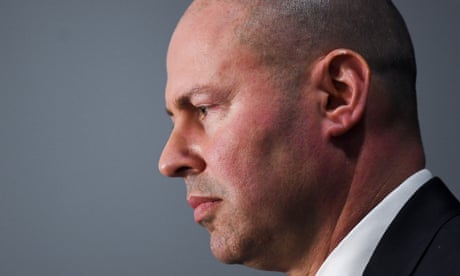
Frydenberg has acknowledged that managing carbon risk is now a major
preoccupation in global capital markets as the Morrison government mulls
what commitments it will take to the Cop26 in Glasgow later this year.
While Nationals have incorrectly characterised managing carbon risk as virtue signalling
on multiple occasions, the treasurer told Guardian Australia’s politics
podcast that climate change, and the assessment of carbon risk, was now
“influencing global capital markets in a significant way”. He
acknowledged it was a “factor behind financial stability”.
“We
are going to see more and more climate-related disclosure and
regulatory agencies are across that, both here and overseas,” Frydenberg
said. The treasurer acknowledged with the world moving to constrain
carbon emissions in line with the Paris agreement goals, there were now
“material risks” to Australian businesses.
He
said he had spoken recently with Mark Carney, the former governor of
the Bank of England, about international developments. “He’s been very
engaged in this and it was a very interesting discussion.
“I
talk to the central bank governor, Phil Lowe, and he says this is a
major topic at central bank governors’ meetings – so yes [climate
change] is influencing in a significant way global capital,” he said.
Frydenberg
said he had been clear on budget night back in May that he wanted
Australia to reach net zero emissions by 2050, or sooner. “I take this
issue very seriously,” he said.
“I’ve been very
consistent that climate change is real and man is contributing to it
and we need to take relevant actions to reduce our emissions.”
Asked
whether the Morrison government intended to make a firm commitment to
reaching net zero at the Cop26 in Glasgow, rather than articulating
non-specific aspirations, Frydenberg said the deliberations were
ongoing.
“We are having lots of internal conversations – I can’t say any more than that,” the treasurer said.
“We
are having lots of internal conversations about this issue and there
are lots of angles to it. Global capital is one, another is what this
means for our export industries and jobs, what does it mean for the
electricity market and affordability, what does it mean for our general
manufacturing approach.”
Some Nationals insist they will oppose any attempt by Scott Morrison to make a concrete commitment to net zero, but Frydenberg said “a lot of progress is being made”.
“The
way you move the dial is to try to take people with you. If you storm
the barricades, you will never win this one. You’ve got to persuade,
you’ve got to promote an evidence-based approach. Progress is being made
behind closed doors.”
Australia is under significant pressure from key allies, particularly the US and the UK, to increase national ambition.
A
senior US climate official has warned Australia’s targets are “not
sufficient” and the country should be considering a 50% cut in
greenhouse gas emissions by 2030. Dr Jonathan Pershing, the deputy to US
presidential climate envoy John Kerry, said recently the major report by the Intergovernmental Panel on Climate Change had “set the stage” for the Cop26 summit in Glasgow in November and would place “a lot more pressure” on the world’s biggest 20 emitting countries to act.
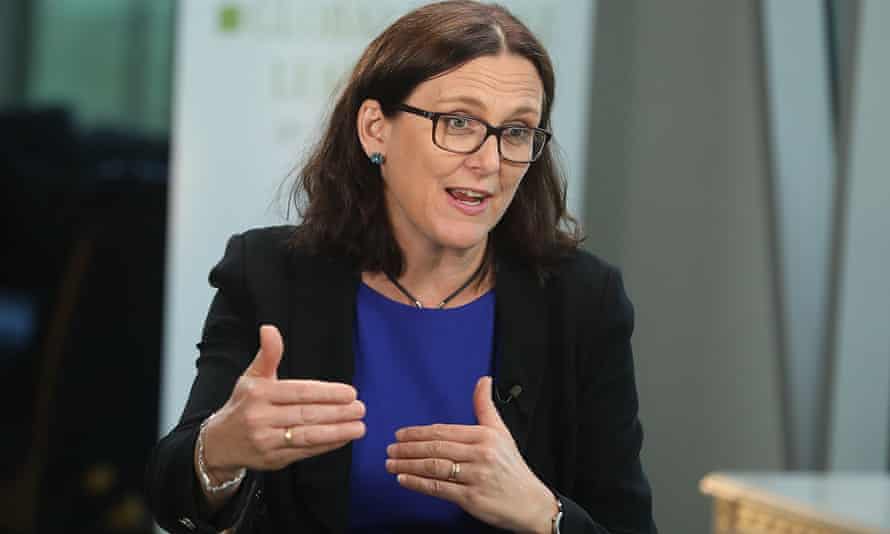
Earlier this week, the former European Union trade commissioner, Cecilia Malmström, warned Australia was becoming “more and more isolated” on climate action at a time when floods, fires, droughts, and the latest assessment by the IPCC shows global heating “is created by humanity”.
Scott Morrison has hinted
the government may update its 2030 target ahead of Cop26 in Glasgow in
November, but Frydenberg said: “I’m very comfortable with the target
we’ve got.”
The
Abbott-era 2030 target is widely criticised as being insufficient to
meet the challenge of global heating and the Morrison government has
also been criticised for prioritising a “gas-led recovery” from the
coronavirus pandemic.
Frydenberg acknowledged
during the podcast that “a lot of listeners won’t like our focus on gas,
but it is a transitional fuel”. He said gas peaking plants were
required alongside batteries and pumped hydro to firm renewables during
the transition to low emissions.
Frydenberg was
previously the minister for the environment and energy in the Turnbull
era, when he presided over efforts to legislate the national energy
guarantee – a mechanism that would have reduced emissions in the
electricity grid. That effort failed when Malcolm Turnbull was toppled.
Frydenberg
said he “tried to do as well as I could” during that period, “and I do
think we made some gains”. He said resolving a climate and energy policy
had been difficult for successive governments because the issue “plays
to the extremes”.
He said climate change had
become a cultural battle as well as an issue of science and economics,
“but I do think that is changing, maybe not as fast as some people would
like, but maybe too fast for others”.
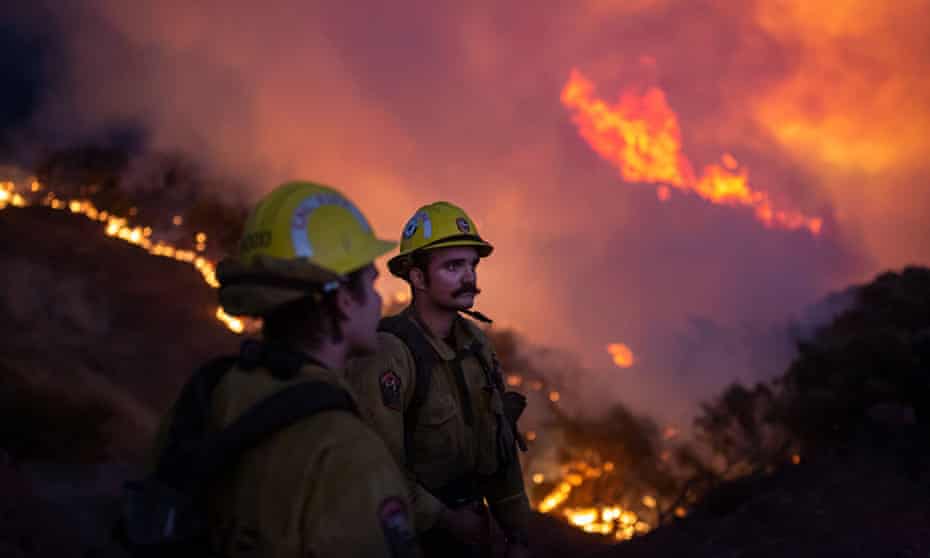
The
hot, dry and windy weather conditions fueling the huge wildfires that
have besieged the western US this summer have increased in frequency
over the past 50 years, a new study has found.
Since
1973, global heating has desiccated the west, driving increases in
“fire weather” days from the Pacific coast to the Great Plains,
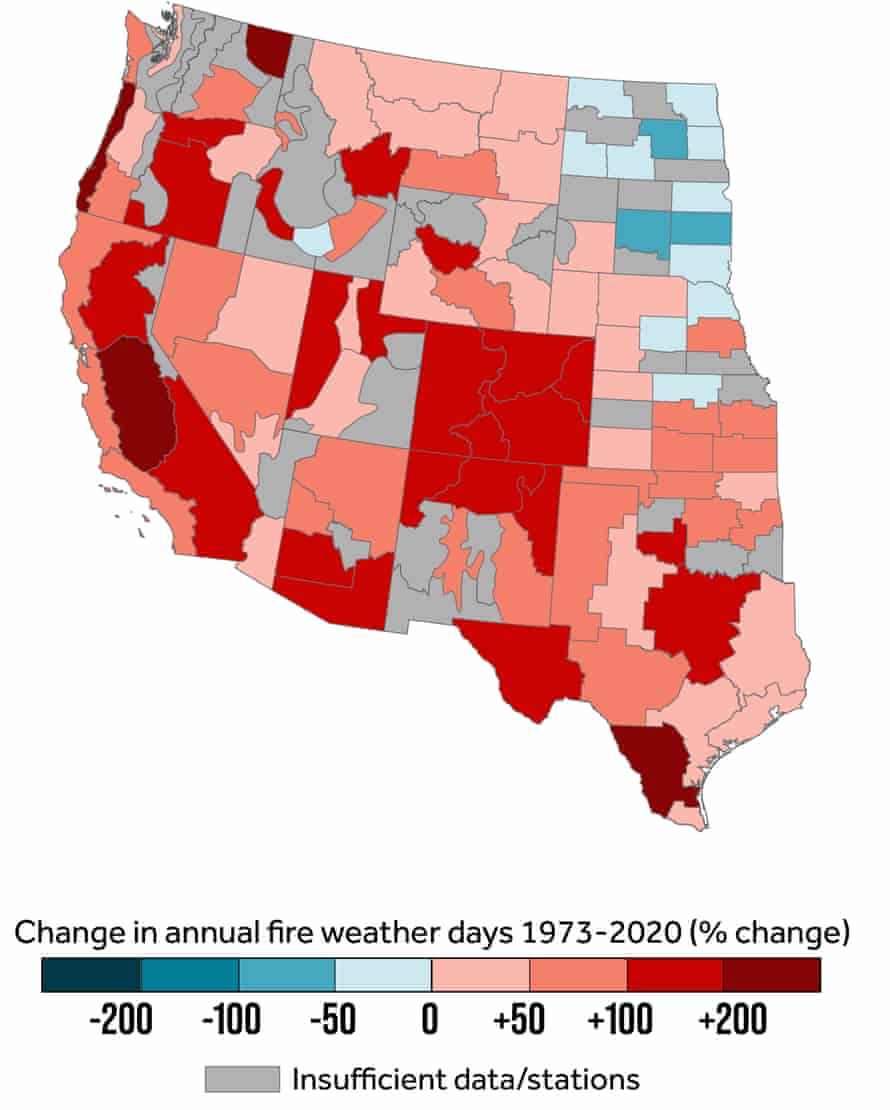
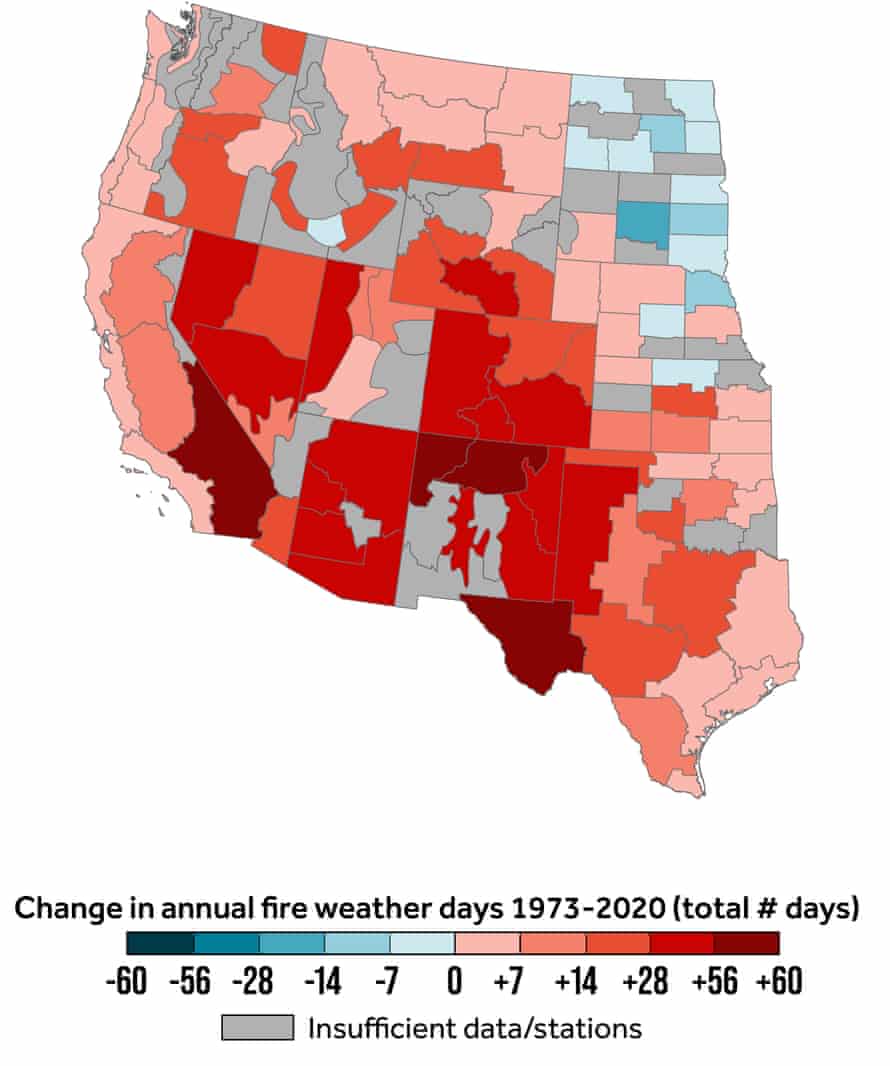
according to research by the non-profit Climate Central. It found that
the number of fire weather days increased steeply in parts of Texas and
in California’s interior, and that southern Nevada, south-east California
and swathes of New Mexico had the highest number of average annual fire
weather days – with nearly a quarter of the year in some regions being
characterized as having elevated risk.
Southern Texas,
which saw about four annual fire weather days in 1973, now sees about
15 fire weather days a year. The Sacramento region in California, which
used to experience about seven fire weather days, by 2020 was
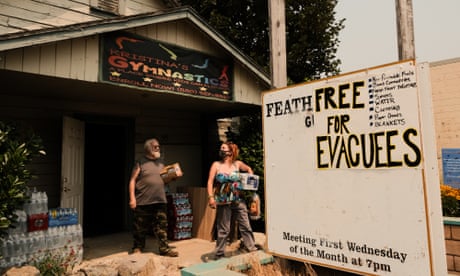
experiencing an average of 19. The latter region is where the
devastating Camp Fire leveled the town of Paradise in 2018, and where
the Dixie fire, which scorched the town of Greenville this year, was
sparked.
Illustration: Climate Central
“I
started getting teary-eyed earlier, looking at the maps of the fire,”
said Kaitlyn Weber of Climate Central, who led the data analysis. Her
family cabin in Tahoe is just miles away from the edge of the vast,
fast-moving Caldor fire, which earlier this week threatened her childhood homes in Pollock Pines and Pleasant Valley.
Even after she crunched numbers, the reality “is shocking”, she added.
On these hot, arid and windy days, a spark from a power line or a car accident could be all it takes to ignite a megafire.
The study’s findings, based on data from weather stations across the region, are consistent with other recent research
suggesting that in many parts of the west, increased temperatures from
human-caused climate breakdown are leading to more parched summers. Last
year, climate scientists also found that in parts of California, fall
fire weather days are expected to double by the end of the century and
increase 40% by 2065. Fire season, which in many parts of the west peaks
in the late summer and autumn, has been expanding.
“It’s
clear that conditions we’re seeing right now in the west are very
different from what we saw a few decades ago,” said Daniel Swain, a
climate scientist with the University of California, Los Angeles.
Illustration: Climate Central
“The increase in hot and dry conditions appears to be fueling an increase in extreme fire.”
Weather
isn’t the only thing that drives fires in the west. Most fires are
started by humans, either deliberately or accidentally. And the fires
require fuel to burn – and the extreme drought gripping the west, as
well as a century of fire suppression, has led to the buildup of dead
trees and vegetation that has helped stoke some of the largest fires in
region. Dry soils have helped flames hurtle across the terrain unimpeded
by moisture.
But the Climate Central analysis
indicates that even beyond long-term, landscape-level changes
exacerbated by the climate crisis, which have rendered parts of the west
tinder-dry and primed to burn, “there has there been an increase just
in the day-to-day meteorological conditions that contribute to extreme
wildfire risk”, said Swain, who advised Climate Central on the report.
The climate science behind wildfires: why are they getting worse? – video explainer
The
broader implications for people in the west have been dire – reshaping
their daily lives. A confluence of factors exacerbated by the climate
crisis have fueled some of the most damaging, deadly fires on record
over the past few years. Extreme fire weather has in many cases made it
more challenging for firefighters to respond to fire. They often cannot
expect cooler, more humid conditions at night to help them tamp down big
blazes.
Power companies have begun to turn off
electricity to residents in order to avoid equipment-related ignitions –
leaving communities without power for medical equipment, refrigeration
and, at times, air conditioning.
Although fire
is a natural part of the landscape in California and other parts of the
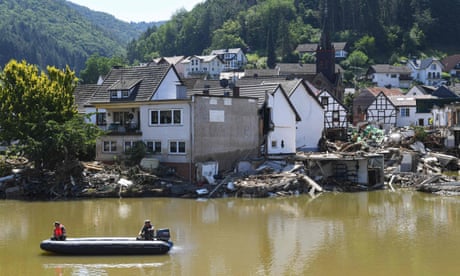
west, “it’s clear that what we’re seeing now isn’t natural”, said Weber.
The
former European Union trade commissioner, Cecilia Malmström, has warned
Australia is becoming “more and more isolated” on climate action at a
time when floods, fires, droughts, and the latest assessment by the Intergovernmental Panel on Climate Change (IPCC) shows global heating “is created by humanity”.
Malmström
told a webinar hosted by the progressive thinktank the Australia
Institute on Wednesday climate change was “the most urgent global crisis
we are finding ourselves in – and we don’t have much time”.
“I
think the recent developments of the last month – floods, fires,
droughts, huge catastrophes and the IPPC report clearly underlining this
is created by humanity – shows we all need to do more,” she said.
“The biggest economies and the biggest polluters need to do more,” she said. “China needs to do much, much more.”
“China
has committed to a vague goal, but nobody really knows how it is going
to happen. The US is getting there. Australia is a big economy, a big
emitter, you need to do more – we all need to do more.”
Malmström said doing more meant taking transformational action, not “finding one percent here or one percent there”.
She
said Australia would face sustained international pressure for
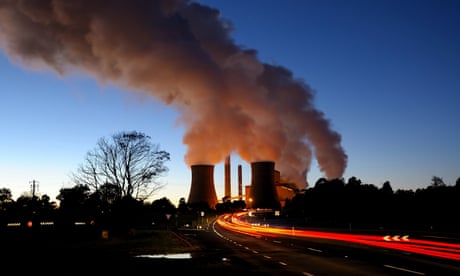
continuing to subsidise fossil fuels when the world was working towards a
goal of net zero emissions by 2050. “There is no turning back. It is
not like another election in Paris or Germany and we will change track –
no, it’s not going to go back.”
She
said the best way for governments to make the necessary transition was
to align with businesses looking for profitable opportunities in the
green economy. “It is not for me to tell the Australian government how
to do this, but [Australia] is becoming more and more isolated and we
need to work together to get this done.”
Malmström, a centre-right politician who served in Brussels for close to a decade, including as Europe’s lead trade negotiator, was Sweden’s candidate to lead the Organisation for Economic Cooperation and Development.
But Australia’s former finance minister Mathias Cormann secured the role after a significant diplomatic campaign from the Morrison government. In his pitch to lead the Paris-based organisation, Cormann talked up the importance of pursuing “a green recovery with an increased reliance on renewables”.
During
her contribution on Wednesday, the former European trade commissioner
shot down arguments from Australian ministers that the EU’s proposed
carbon border adjustment amounted to protectionism.
She
said there had been “an army of lawyers” in Brussels working on the
proposal to ensure it was World Trade Organisation compliant. The
mechanism had been designed in a way “that should not be
discriminatory”.
“I’ve heard the screams of protectionism, but the idea to tax carbon in this way is less and less contested,” Malmström said.
She
said she was hopeful other countries would adopt similar mechanisms. As
the EU proposal and a similar concept under consideration in the US, “I
think there are discussions in Canada and Japan, and in China they are
modifying their emissions trading system.”
The
proposed carbon border adjustment mechanism will require EU-based
businesses that import goods to pay a price, linked to what they would
have paid if the items had been produced under the EU’s own emissions
trading scheme.
The goal is to prevent “carbon
leakage” – or the movement of emissions-intensive industry – to
countries with less ambitious climate policies. The policy also aims to
encourage producers globally to reduce their emissions and for countries
to adopt greener policies.
Australia’s trade
minister, Dan Tehan, has characterised the mechanism as “just a new form
of protectionism that will undermine global free trade and impact
Australian exporters and jobs”.
Malmström said
the optimal policy response to the threat of global heating would be a
global carbon tax rather than jurisdictional border adjustment
mechanisms. “That would be best and most efficient, but we are not there
yet and I can imagine quite a lot of difficulties reaching that.”
Asked
whether she was optimistic that global ambition was building ahead of
the Cop26 in Glasgow in November, she said “in general I’m extremely
worried”.
“If we look out and see where we are,
we are not reaching the targets that globally we have promised, and the
events of the last month I hope has been an important wake-up call for
people,” she said.
“It’s
important not to be too gloomy. We need to make tough decisions, we
need to make difficult decisions … but you should also highlight the
possibilities.”
Malmström said business was
looking for opportunity rather than framing climate action as a cost.
She said the coming transition would generate many jobs. “I believe we
can still do this but we need international cooperation, and we need
leadership and we need to have the courage to take tough decisions for
the future of this planet and for our children.”
She
said she maintained hope that the Cop26 would move things forward “a
little bit” and “we can reach international consensus on the next steps –
that’s what I’m hoping for”.


 ‘Fire weather’: dangerous days now far more common in US west, study finds.