Monday, 29 August 2022

Poll suggests Aussies would back bans on junk food, gambling and alcohol TV advertising.

Extract from ABC News

ABC News Homepage


By political reporter James Glenday 
Posted 
Junk food
Two-thirds of respondents believed that junk food ads should be banned when children are watching television.(Getty Images: Zeljkosantrac)

A new poll suggests the majority of Australians would like to see more restrictions or bans on TV advertising featuring gambling, junk food and alcohol.

Carried out by The Australia Institute think tank, the online survey asked a nationally weighted sample of more than 1,000 people whether they agreed or disagreed with five statements about banning certain types of TV advertising.

The results suggest the current ban on tobacco advertisements remains popular with nearly three-quarters of respondents — or 74 per cent — supporting keeping it in place.

Labor, Coalition and Greens voters had a similar level of agreement about the ban, while only a slim majority — 52 per cent — of One Nation voters supported it.

A graph showing agree and disagree for different kinds of ads

Some 71 per cent of respondents agreed with the suggestion that gambling advertisements on TV should be banned. Only 11 per cent of those surveyed disagreed.

Broadcasters already have to follow rules that limit when and where they can advertise gambling or betting odds.

But the appropriateness of the rules often enters the political debate at this time of the year, as more Australians tune in for football finals.

A graph comparing the opinions of voters of different poltical parties when it comes to advertising

A proposed ban on junk food advertising during children's TV watching hours is another idea that's often floated in Canberra.

About two-thirds of respondents to the survey agreed that it would be a good idea.

Support was highest among Greens voters, 72 per cent and there were similar levels of agreement among people who vote for the major parties.

Banning alcohol advertisements was a less popular proposition. Just over half — 51 per cent — agreed with the idea.

Only 41 per cent supported banning advertisements that promote fossil fuels.

Teals pushing for more restrictions on advertising

Zoe Daniel
Victorian MP Zoe Daniel says she has seen the "scourge" of sports betting impact on teenagers.

Two newly elected teal independents are pushing for more restrictions on types of advertising.

Victorian MP Zoe Daniel would like a fresh parliamentary inquiry into the promotion of sports gambling.

She says the "scourge" of sports betting hit home during the election campaign when her 15-year-old son revealed his schoolmates had placed bets on her chances of winning the Victorian seat of Goldstein from Liberal Assistant Minister Tim Wilson.

"I told him he should certainly not join in," Ms Daniel said.

"I am deeply concerned about the normalisation of sports gambling and the proximity of gambling advertising to broadcast sport, particularly AFL and ARL football codes.

"When children are having conversations about sports betting "multis", wanting to set up sports betting apps on their phones and even betting on the federal election, we have an issue."

Sydney MP Sophie Scamps, who was a GP on the city's northern beaches, is trying to get more regulations around junk food to stop childhood obesity.

"This [survey] does show there is a lot of public support," she said.

"As a GP I want to see young children grow up healthy and strong. We know that being overweight and obese is one of the major causes of chronic disease."

Sunday, 28 August 2022

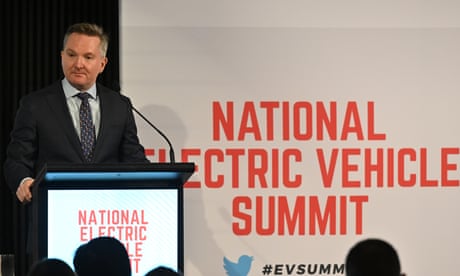
Electric car-ready homes will help firm up the power grid, Ed Husic says.

Extract from The Guardian

Governments urged to plan for emerging technologies that will allow bidirectional charging so vehicle batteries can power homes.

A JET Charge EVlink connected to a Nissan Leaf electric car
New rules to make apartment buildings ‘electric vehicle-ready’ should be extended to all new housing, science minister Ed Husic says.
Sun 28 Aug 2022 06.00 AESTLast modified on Sun 28 Aug 2022 06.01 AEST
Australia’s first mandate to make new apartment buildings “electric vehicle-ready” should be extended to all new housing, potentially turning entire suburbs into virtual batteries supporting the power grid, the federal science minister said.

Ed Husic helped helm Friday’s gathering of federal, state and territory building ministers in Sydney, where it was agreed to amend the national construction code to require new apartment blocks to be capable of charging cars in all their parking spots.

The change, to come into force by October 2023, overrode pushback by some agencies that sought to limit the mandate to an initial 25% of car places.

Husic said getting builders to “rough in” the capacity to charge vehicles in their parking bays made sense as modest upfront spending would avoid significant retrofitting costs once most, if not all, future vehicles become plug-in electric ones.

The Electric Vehicle Council, which backed the changes, estimates apartment blocks account for about 17% of the nation’s housing. Husic, whose western Sydney electorate of Chifley is overwhelmingly made up of low-rise housing, said new EV-charging provisions for blocks of flats should extend to all new homes where practicable.

“There is a capacity for the charging infrastructure to be put in straightaway,” he told Guardian Australia. “My preference would be first to explore [the extension to all standalone homes] to the fullest extent possible.”

“At some point, I think, you’ll see this huge uptake” in EVs, but planning in advance will ease the transition for some less well-off residents, Husic said.

Only about 2% of new cars sold in Australia are EVs but the share is widely expected to accelerate.

“We’re trying to send a signal [to all governments] to start thinking about it, to start planning for it,” Husic said of the potential for so-called vehicle-to-grid charging.

“There’s a willingness between all … federal, state and territory governments to work on [the wider EV uptake],” he said. “There was a great degree of interest across the country to get this happening.”

The Property Council of Australia on Friday said it supported code changes setting up 100% EV-ready apartment buildings.

“Buildings are the batteries that can provide enormous load flexibility to our energy system at little to no cost, and can soak up excess supply when renewables are abundant to store energy and provide EV charging,” Ken Morrison, the council’s CEO, said.

“There is no doubt that EVs will play a much larger role in the future, and the property industry is thinking ahead with its application of EV chargers in new builds.”

“It’s far more expensive and very difficult to do it later,” De Rango said.

Widespread bidirectional EV charging was still some way off, with only the Nissan Leaf and a couple of Mitsubishi models available in Australia with that capability for now. Most future models, though, would likely to able to offer that option, he said. It would then be up to energy retailers to develop contracts to entice EV owners to sign up.

De Rango said one scenario identified in the Australian Energy Market Operator’s plans for 2050 had the grid able to call on 1m EV owners with 7 gigawatts of storage to support the grid. That’s triple the capacity of Eraring, the country’s biggest power station.

Tim Washington, the chair of the Electric Vehicle Council and the CEO of JET Charge, an equipment supplier, has been working with the Australian National University on a two-year trial to test 51 bidirectional Nissan Leafs to support the ACT’s grid.

“Grids of the future will rely on a whole range of things,” including EVs, Washington said.

“I think we’ll all be driving EVs in the future,” he said. “If that’s certain, why not cater for that certainty?”

PS Rodney shipwreck reveals one of Australia's earliest and most violent industrial disputes.

Extract from ABC News 

ABC News Homepage

By Jennifer Douglas
Posted 
1880's photo of the paddle steamer Rodney
The PS Rodney played an important role transporting goods and wool on the Murray, Darling and Murrumbidgee Rivers.(Supplied: Echuca Historical Society)

Shipwrecks are synonymous with tumultuous tempests, fierce battles, mutinies and piracy, but the sinking of the Paddle-Steamer (PS) Rodney would go down in history as the first to be sunk in a fiery conflict by striking shearers.

It was the early hours of August 27, 1894. Under the cover of darkness, the PS Rodney was boarded by a group of 150 masked striking shearers hell-bent on the vessel's demise.

Saturday marked the 128th anniversary of the PS Rodney's sinking in a quiet lagoon on the Darling River near Pooncarie in NSW.

It marks a significant moment in our country's history, bringing an end to one of Australia's most violent and destructive union conflicts.

Paddle steamer barges fully loaded with wool packs.
Echuca Wharf was the main trade port for the PS Rodney that used barges to transport tonnes of wool.(Supplied: Echuca Historical Society)

The shearers' strike began in the early 1890s on the eve of a crippling depression and amid a scorching drought, when the country's wool growers attempted to introduce anti-union contracts to reduce shearers' pay rates and lessen the impact of plummeting wool prices.

Unionised shearers and wool workers already enduring poor working conditions retaliated at this breach of trust, triggering the start of the massive 1891 shearers' strike.

The events over the three years that followed resulted in camps of striking shearers burning woolsheds that employed strikebreakers or scab workers.

The bloody clashes that started in Queensland and spread to NSW and Victoria are remembered as the earliest and most violent industrial disputes in Australia's history.

Lady in  red shirt smiling at camera
Dot Hammond, retired president of the Echuca Historical Society, grew up on a wool property herself.(Supplied: Echuca Historical Society)

Dot Hammond, retired president of the Echuca Historical Society, grew up on a sheep station and remembers some tough times, including droughts, and understands the difficulties the wool growers would have faced at the time.

Her research uncovering how the shearers' strike affected the Murray, Darling and Murrumbidgee River trade shows that many graziers were also struggling due to the low wool prices and were forced to employ non-union shearers.

Massive timber wharf with paddle boat
Echuca Wharf was the third-largest port in Australia with 240 paddleboat river traders.(Supplied: Echuca Historical Society)

"Tolarno Station was one of several sheep stations that chose to hire strikebreakers, or non-union shearers, in an attempt to get their sheep shorn," Ms Hammond says.

Due to the looming depression and high unemployment, pastoralists had no difficulty finding men desperate for work and willing to take up work as scab labourers.

sepia photo of shearers at work in a shearing shed
Shearers at work on Blandensburg Station in Queensland circa 1890s.(Supplied: Queensland State Library)

"Strikebreakers were transported to Echuca by rail under police protection, before boarding several paddle-steamers, with 45 boarding the PS Rodney destined for Tolarno Station," Ms Hammond says.

"Unionist shearers were in hot pursuit with the aim of stopping the scab workers from getting to Tolarno.

"The PS Rodney departed Echuca Wharf with only minutes to spare, before over 100 unionist shearers raided the wharf and resorted to throwing stones at the paddle-steamer."

The unionist shearers didn't give up the fight and went in pursuit, gaining support along the hunt for the vessel, their large camps becoming a force to be reckoned with along the Murray, Darling and Murrumbidgee rivers.

1891 photo of shearers strike camp
Striking shearer camps soon ran low on food and supplies and were disbanded, but their fight continued.(Supplied: Queensland State Library)

Shearers take control of Murray-Darling trade

By 1894, the unionist strike camps were far more organised with more than 300 armed shearers taking control of the movement of riverboats and trade along the Murray and Darling Rivers.

Rod Taylor is a 30-year shearing veteran who is passionate about the shearing history of the stations along the Murray and Darling River regions.  

Man in checked shirt and cap holding a scale model of the PS Rodney
Retired shearer Rodney Taylor is passionate about the history of the 1894 shearers' strike and the PS Rodney.(ABC Mildura-Swan Hill: Jennifer Douglas)

He understands the fury that sparked the burning of the PS Rodney and the shearers' plight, having experienced harsh working conditions himself over his three decades as a shearer.

"Sheep stations were very much owned by the privileged — the 'Squattocracy' I called it. They considered the workers second-class citizens, and it was virtually a class war that became very bitter," Mr Taylor says.

By the winter of 1894, the striking shearers were gaining support and numbers along the Murray and Darling Rivers preventing the transport of essential goods and scab-shorn wool, sometimes by the use of extreme measures that seriously threatened the $5 million river trade.

The PS Rodney's final hours

Low river with party submerged wreck of the PS Rodney
The wreck of the PS Rodney, now heritage-listed, can be seen during times of low Darling River flow.(Supplied: Rod Taylor)

After failing to stop the strikebreakers at Echuca, the shearers pursuing the vessel attempted to block its path on the Darling River with barges and fencing wire strung across the river. This unsuccessful attempt made them more ferocious in their violent endeavour to stop the vessel.

The PS Rodney's Captain, Jimmy Dickson, moored the boat in a remote lagoon 37 kilometres from Pooncarie, where he thought they would be protected by the surrounding swamp.

"Under the cover of darkness, with all on board asleep, the PS Rodney was boarded by around 150 masked shearers. They threw the scabs overboard, set the barges of goods adrift, and set the vessel alight as the horrified Captain Jimmy Dickson looked helplessly on," Mr Taylor says.

The resulting fire burnt the 32-metre-long timber paddle-steamer to the water line. Its skeletal remains are still visible more than 100 years later, during low river flows and drought as a reminder of that tumultuous moment in Australia's history.

What's left of the Rodney is now heritage-protected and, despite a reward offered at the time, no-one was ever convicted over the fire.

Saturday, 27 August 2022

Scott Morrison received token payments for speeches and plans to join global lecture circuit.

 Extract from The Guardian

Scott Morrison speaks at Margaret Court’s Victory Life Centre in July. The former PM has confirmed on the register of MPs’ interests that he accepted a return business class airfare from Sydney to Perth from the centre.
Fri 26 Aug 2022 19.50 AEST
Scott Morrison has revealed he received honorarium payments for recent speeches in Japan and Korea, and plans to join the international lecture circuit through a global speakers’ agency.

Morrison confirmed on his register of MPs’ interests that he has become a director and shareholder in a new company offering “advisory services”, and that he accepted business class airfares, accommodation and incidentals for appearances in Seoul and Tokyo – the latter when he was absent from parliament during a sitting week.

Morrison was one of the last members of the House of Representatives to have his register published on the parliament’s website, on Friday afternoon. The form shows Morrison accepted honorariums from the Victory of Life Church and the Worldwide Support for Development under the heading “other substantial sources of income”.

In July, Morrison gave a sermon to the Victory Life Centre, a Pentecostal church in Perth run by the former tennis champion Margaret Court, where he told worshippers: “We don’t trust in governments. We don’t trust in the United Nations.” His register of interests notes he accepted a return business class airfare from Sydney to Perth from 16 to 18 July, attributed to Victory Life Centre.

Morrison’s office has been contacted to clarify whether the honorarium payment from “Victory of Life Church” relates to the Victory Life Centre sermon.

The honorarium from Worldwide Support for Development appears to relate to Morrison’s appearance at the global opinion leaders summit in Tokyo, which was organised and sponsored by the Japan International Forum, Worldwide Support for Development and the International Democratic Union – a global alliance of centre-right political parties.

Morrison appeared alongside the former UK prime minister David Cameron, former Canadian prime minister Stephen Harper, and Ukraine’s former prime minister Yulia Tymoshenko. In addition to the honorarium, the register shows Morrison accepted a return business class airfare from Sydney to Tokyo, accommodation and incidentals from 24-30 July, also attributed to Worldwide Support For Development.

He said last month he had accepted the invitation “prior to the new government advising the sitting schedule for the remainder of 2022” and was unable to attend the opening week of parliament.

The leader of the House of Representatives, Tony Burke, said last month “it should be revealed” whether Morrison was paid for the engagement.

If someone’s being paid to do another job, I’m not sure how they get away with the taxpayers paying them to do this one,” Burke told Radio National at the time.

Morrison also accepted a return business class airfare from Sydney to Seoul, South Korea, including accommodation and incidentals, from 12-15 July, from the Chosun Ilbo – a Korean newspaper that sponsored the Asian Leadership Conference, where Morrison also made a speech.

“In the interest of full disclosure, my attendance will sometimes be arranged by the Worldwide Speakers Group.”

That agency lists former officials from Donald Trump’s presidential administration on its books, including the former vice president Mike Pence, former chiefs of staff Mick Mulvaney and John Kelly, former defence secretary Mark Esper, and former Trump adviser and Speaker of the House Newt Gingrich. The agency also features the talkshow host and comedian John Oliver, the journalist Anderson Cooper and the NFL star Drew Brees as speakers.

Morrison does not yet appear on the Worldwide Speakers Group website.

Elsewhere in the document, the Morrison Family Trust – which was listed as “dormant” on his previous register of interests, lodged in 2019 – now lists “advisory services” as its nature of operation.

Morrison listed “NIL” as the beneficiary interest of himself and his wife in that trust in 2019, and his children as “not applicable”. The 2022 register lists himself, his wife and dependent children as “beneficiary” of the Morrison Family Trust.

Morrison is also listed as a shareholder, trustee and director of a company called Triginta Pty Ltd. This development was reported earlier this month, after Morrison registered documents with the Australian Securities and Investments Commission on 1 August, appointing himself director and sole shareholder of 10 shares in the company.

The name of the company means “30” in Latin, possibly in reference to Morrison being Australia’s 30th prime minister.

Should Australian companies make millions out of people’s unemployment misery?

 Extract from The Guardian


Next week’s jobs summit seems like an opportune time to raise questions around the effectiveness of the privatised employment industry.
People outside a Centrelink office
Unemployment has rarely been mentioned in the build-up to the jobs and skills summit, but the value and effectiveness of Australia’s system is increasingly being questioned.

The government is about to launch what it hopes will be a rescue mission to relieve an understaffed and inflation-battered economy.

Discussions on what tumbril ministry collector Scott Morrison best fits will become a diminished priority as attention turns to fitting Australians into work.

On 1 and 2 September, the jobs and skills summit will bring together about 100 people from business and labour groups, welfare organisations, at least two billionaires, and politicians.

The central subjects will be people already in work and the competing mechanisms for setting wages.

“What we are interested in is making sure we can have improvements in enterprise bargaining that we can focus there on productivity and we can focus on ways in which business and unions come together,” prime minister Anthony Albanese told Sky News on Sunday.

But there is another group who can’t be ignored.

While it might seem odd in a time of worker shortages that unemployment remains a substantial issue, it most certainly does. In July 473,000 people were out of work and the underemployment rate was 6%.

Taxpayers provide millions of dollars to companies for putting people in jobs, and the system’s effectiveness and value is being increasingly questioned.

Just short of 20 years ago – on 30 June 2003 – the last traces of the public service-operated Commonwealth Employment Service (CES) were erased and its remaining 165 offices closed.

Its successor, the privately operated Employment National ended direct government handling of job seeking that began in 1946 when the CES was created to help returning service personnel.

The 2003 move was considered a triumph by the then Coalition government of John Howard, but some observers were unhappy.

“If that’s not a core government responsibility, what is?”

The privatised jobseeking model is still there, in an altered form, and Albanese could not be expected to now effectively nationalise it, no matter how uncomfortable it still might make him.

But he could tidy things up. And there are signs that that is happening.

In 2003 Albanese foresaw the problems of privatisation: “If you have a for-profit system, it’s rational for these private providers to help those people who are easiest to get into a job.”

Elements of those problems have been addressed with varying success. For example, specialist services now help people with disabilities find work.

However, questions remain as to whether a privatised employment network gives a good return on taxpayer money, and whether it is serving the individual and location-specific needs of those wanting workers and those wanting work.

But it was not a bloodless bureaucracy. On many occasions its staff went beyond the form-filling basics to give care and compassion to struggling job seekers, as well as quality advice on work opportunities and training.

The current system is at times accused of lacking a human touch.

Employment programs have not been static since 2003. For example, 2015 saw the introduction of Jobs Active.

This allowed businesses to tender for government contracts to help the unemployed. And these payments could reach big totals.

The top provider from 2015 to 2021 was Max Solutions with $1.21bn of contracts, followed by APM/Serendipity with $667m, according to tender analysis by Michael West Media published in July last year.

Peter Strong, former CEO of the Council of Small Business and a former CES staffer, has pointed to a possible consequence.

“These businesses do what a private business must do – they make a profit otherwise they would fail as businesses,” he wrote in October 2017.

“As a result there will be cost-cutting – like a good business should do – and services to clients will probably be at the most minimum level possible – are we happy with that?”

Job Active lasted until 4 July this year when it was replaced by Workforce Australia, which in simple terms is an online hub to match employers with potential staff digitally.

Some 800,000 job seekers were shunted into the new system, budgeted to cost $1.5bn a year, and left to face its confusing system of points that needed to be accumulated to satisfy mutual obligations demands.

The employment minister, Tony Burke, told the ABC on 2 August there was scope for “fresh parliamentary review and oversight”. He questioned “a system that is driven more by the details of contracts with providers”.

“While the [Coalition] spent nearly two years designing and building the software for the new system, they did not properly explain it to the Australian people,” he said.

A parliamentary committee will report in September next year on whether “best practice” was being followed and make recommendations for long-term reforms and immediate improvements, he said.

Some still have that unease Albanese felt in 2003: Should companies make millions out of people’s unemployment misery?

Furthermore, are they good at it? And are the jobless being punished for not meeting obligations that have been piling up since Work for the Dole in 1998?

“For too long, people who’ve been looking for paid work have been blamed for being unemployed rather than actively and positively supported to find jobs,” said Edwina MacDonald, acting CEO of the Australian Council of Social Services.

We will see if this view is raised next week.

NASA's James Webb telescope just found CO2 on an exoplanet outside Earth's solar system.

Extract from ABC News 

ABC News Homepage

By Liana Walker
Posted 
An illustration of a planet with a star
WASP-39 b is very hot and is likely to be tidally locked, with one side facing the star at all times.(NASA, ESA, CSA, and J. Olmsted (STScI))

Could there be life on faraway planets? A new discovery by NASA has taken researchers one step closer to finding out. 

NASA’s James Webb Space Telescope has captured the first clear evidence of carbon dioxide in the atmosphere of a planet outside the Earth's solar system.

The finding was on WASP-39 b, a gas giant discovered in 2011 which has a mass about the same as Saturn, a diameter 1.3 times greater than Jupiter and is orbiting a Sun-like star 700 light-years away.

Its extreme puffiness is related in part to its high temperature — 900 degrees Celsius.

Unlike the cooler, more compact gas giants in the Earth's solar system, WASP-39 b orbits very close to its star – about one-eighth the distance between the Sun and Mercury – completing one circuit in slightly more than four Earth days.

Previous observations from other telescopes, including NASA's Hubble and Spitzer space telescopes, revealed the presence of water vapour, sodium, and potassium in the planet's atmosphere.

However, James Webb's infrared sensitivity has confirmed the presence of carbon dioxide.

James Webb Space Telescope (JWST) Transiting Exoplanet Community Early Release Science team member Zafar Rustamkulov said as soon as the data hit their screen a "whopping carbon dioxide feature"  grabbed him. 

"It was a special moment, crossing an important threshold in exoplanet sciences," he said. 

How do they do it? 

WASP-39 B light curves
A series of light curves from James Webb’s Near-Infrared Spectrograph give insight into WASP-39 b. (NASA, ESA, CSA, and L. Hustak (STScI); Science: The JWST Transiting Exoplanet Community Early Release Science Team)

The research team use a method called spectroscopy. 

The basic premise of spectroscopy is that different materials emit and interact with different wavelengths or colours of light in different ways, depending on properties like temperature and composition.

From there researches can use spectra — the detailed patterns of colours — to figure out things like exactly how hot something is and exactly what elements and compounds it is made of, without ever sampling it directly.

The research team used James Webb's Near-Infrared Spectrograph (NIRSpec) for its observations of WASP-39 b. 

Transiting planets like WASP-39 b, whose orbits are observed edge-on rather than from above, can provide researchers with ideal opportunities to probe planetary atmospheres.

During a transit, some of the starlight is eclipsed by the planet completely, causing the overall dimming, and some is transmitted through the planet's atmosphere.

Because different gases absorb different combinations of colours, researchers can analyse small differences in brightness of the transmitted light across a spectrum of wavelengths to determine exactly what an atmosphere is made of.

In the resulting spectrum of the exoplanet's atmosphere, a small hill between 4.1 and 4.6 micrometres (one one-thousandth of a millimetre) presented the first clear, detailed evidence for carbon dioxide ever detected in a planet outside our solar system.

What does this mean? 

A planet in the background of a graph with a peak in the middle.
This is the first detailed exoplanet transmission spectrum ever captured that covers wavelengths between 3 and 5.5 micrometres.(NASA, ESA, CSA, and L. Hustak (STScI); Science: The JWST Transiting Exoplanet Community Early Release Science Team)

This is the first time an observatory has measured such subtle differences in brightness of so many individual colours across the 3 to 5.5 micrometre range in an exoplanet transmission spectrum.

According to NASA, access to this part of the spectrum is crucial for measuring abundances of gases like water and methane, as well as carbon dioxide, which are thought to exist in many types of exoplanets.

"Detecting such a clear signal of carbon dioxide on WASP-39 b bodes well for the detection of atmospheres on smaller, terrestrial-sized planets," JWST team leader Natalie Batalha said. 

NASA says understanding the composition of a planet's atmosphere is important because it tells us something about the origin of the planet and how it evolved.

"Carbon dioxide molecules are sensitive tracers of the story of planet formation," another researcher Mike Line said.

"By measuring this carbon dioxide feature, we can determine how much solid versus how much gaseous material was used to form this gas giant planet.

"In the coming decade, JWST will make this measurement for a variety of planets, providing insight into the details of how planets form and the uniqueness of our own solar system."

The finding, accepted for publication in Nature, offers evidence that in the future Webb may be able to detect and measure carbon dioxide in the thinner atmospheres of smaller rocky planets.

Friday, 26 August 2022

Robodebt royal commission to review ‘untold harm’ caused by Coalition’s botched scheme.

Extract from The Guardian 

Inequality reporting

Anthony Albanese labels saga a ‘human tragedy’ as former Queensland chief justice Catherine Holmes set to lead inquiry into Centrelink debt recovery scheme.

Anthony Albanese announces royal commission into 'cruel' robodebt system – video

Supported by
The Green Family Foundation
About this content
Social affairs and inequality editor
Thu 25 Aug 2022 16.47 AESTFirst published on Thu 25 Aug 2022 11.53 AEST
A former judge who led the Queensland floods inquiry will head up a royal commission into the Coalition’s botched robodebt scheme, with a report due by April next year.

The prime minister, Anthony Albanese, on Thursday announced Catherine Holmes would lead the royal commission into what he called a “cruel system”.

Holmes is a former chief justice of the supreme court of Queensland who led the Queensland floods commission of inquiry after the 2010-11 floods.

Albanese said the $30m inquiry would hand down its report in April 2023, labelling the robodebt saga a “human tragedy”.

“The royal commission will examine the establishment of the scheme, who was responsible for it and why it was necessary, how concerns were handled, how the scheme affected individuals and the financial costs to government, and measures to prevent this ever happening again,” he said.

A failure as shameful as robodebt leaves questions only a royal commission can examine
Luke Henriques-Gomes

Between 2015 and late 2019 the former government unlawfully accused 443,000 people of underreporting their income and therefore being overpaid benefits. Some 381,000 people paid back $751m in debts issued by the government which were found to be unlawful by a court.

Last year the former government agreed to a $1.8bn settlement that repaid money, including some interest, and wiped any outstanding unlawful debts.

That came after Guardian Australia revealed the Morrison government had received legal advice showing it would need to repay thousands of welfare recipients.

Some victims said the robodebt process damaged their mental health, led to their tax returns being garnisheed without warning, and saw them hounded by private debt collectors.

“People lost their lives,” Albanese said on Thursday.

The former prime minister, Scott Morrison, apologised for the “hurt or harm” caused by the scheme but dismissed the need for a royal commission. Morrison was social services minister when the scheme was established.

Opposition leader Peter Dutton called the royal commission a “witch-hunt” on Thursday and put it in the same category as the inquiry into Scott Morrison’s multiple secret portfolios, which he said were signs of Albanese “overplaying his hand”.

“Clearly, the prime minister sees political advantage in this and you know, one thing you know about people like Dan Andrews and Anthony Albanese is they’ve been around a long time; they know lots of tricks in the book and you’re seeing it now with the announcement of a royal commission into robodebt … a witch-hunt ,” he said in an interview with Sydney radio 2GB.

“The prime minister is obsessing about this sort of ‘get square’ with Scott Morrison and families are struggling to pay their power bills.”

From as early as 2016 there were warnings about the scheme from welfare recipients, some MPs, advocates and grassroots campaigners such as the Not My Debt group, which collated stories of the harm caused by the scheme and continues to provide advice to victims, including those still waiting for compensation.

The former government insisted for years that the scheme was legitimate, launched vicious attacks on critics of the program and suggested some welfare recipients might be jailed.

It suddenly halted the scheme in November 2019 in response to a federal court challenge brought by Victoria Legal Aid and subsequently settled the class action led by Gordon Legal and launched by Labor’s then government services spokesman, Bill Shorten.

Shorten said on Thursday the scheme caused “untold harm”. He said one victim he had spoken to on Thursday had told how she attempted suicide, while another had been fleeing domestic violence in a refuge while she was hounded by debt collectors.

Asked if the commission might recommend further compensation for victims, the attorney general, Mark Dreyfus, said the commission had broad terms. He said the government wouldn’t preempt the inquiry’s findings.

Some victims were underwhelmed by the terms of the federal court settlement, which only paid interest on the debts they had paid to the government but did not compensate them for the effect the saga had on their lives.

“I feel like I got put back a couple of years in life because of this,” one victim, Nathan Kearney, told the Guardian in 2020 of the $6,500 he was wrongly accused of owing.

The government says the inquiry will also look at the handling of concerns raised about the scheme, including adverse decisions made by the administrative appeals tribunal.

Welcoming the royal commission, Peter Gordon, a senior partner at Gordon Legal, said the firm hoped some of those documents would now be released.