Saturday, 29 July 2023

We are watching the brutal reality of what climate scientists told us would happen. How will we respond?

Extract from The Guardian 
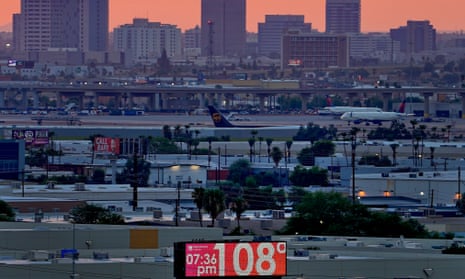
Planes taxi at an airport in Phoenix, Arizona while the temperature soars to 108 degrees Celsius

Temperatures soared at Sky Harbor international airport in Phoenix this month.

Amid the despair and doomism is a real climate emergency. We must act accordingly

How to respond to the avalanche of record-breaking extreme weather and temperatures terrorising the planet? For many scientists it is a moment of genuine despair, but also a time to resist climate doomism.

For British tourists still flying to Greece while it is on fire, and a few holdout news organisations, the answer seems to be to look away or deflect. We shouldn’t join them. Equally, as Michael Mann and Susan Joy Hassol have argued, there is no need to inflate the magnitude of what is happening. The reality is confronting enough.

Here’s some of what we know. Mediterranean Europe and northern Africa are burning. Wildfires in at least nine countries, particularly Greece, Algeria and Italy, are killing people and wrecking lives, livelihoods and nature. They follow historic blazes in Canada a few weeks ago.
There have been bad fires before, of course, but these have been exacerbated by what is almost certainly the hottest month on record due to the extreme northern summer. Across the globe, the average temperature for most days in July has been hotter than any previous day that we know of. The list of records broken is itself unprecedented. A heat dome in the US south-west has pushed the temperature in Phoenix, Arizona, beyond 43C for 27 days straight. Beijing usually has 11 days a year hotter than 35C, but has already had 27 scorchers. If these trends continue this may be the hottest year on record.

That seems particularly likely for sea temperatures, where records have already been smashed. Zeke Hausfather, a US-based climate scientist and writer, calculated that the heat in the northern Atlantic Ocean has now pushed beyond what climate models predicted. It suggests something extraordinary is happening in that part of the world. Similarly, the amount of sea ice around Antarctica continues to be far below previous record lows.

But Hausfather found for the planet as a whole – both on the land and sea surface – temperatures were within what most climate models projected, just at the hotter end of it. Put another way: this is not actually worse than we expected. It is the brutal reality of what scientists told us would happen.

A quick study published this week by the World Weather Attribution group suggests the heatwaves over Europe, the US and China would have been virtually impossible without human interference – that is, our burning of fossil fuels. The researchers found the run of extreme heat in China had been made 50 times more likely by the carbon pollution we have collectively pumped out.

This is happening when the world is, on average, about 1.2C hotter than pre-industrial times. If the temperature rise hits 2C we can expect these brutal heat waves every two-to-five years.The good news from scientists is that rapid action can still make a significant difference and limit future damage

No, this does not mean better beach days for those of us who live at higher latitudes. Even though they receive less immediate attention, heat waves kill more people than fires, floods and cyclones. A study found extreme heat killed more than 61,000 in Europe alone last year. Imagine the headlines if we knew about that in real time.

Caveats are everywhere in science, and we need some here. Climate systems are complex, and a number of factors could be helping inflate current temperatures. An obvious one is that, according to the World Meteorological Organization, the world has moved into an El Niño event, which generally makes it hotter. The last El Niño in 2016 was, for now, the hottest year on record.

Hausfather says a couple of other factors, such as a phaseout of sulphur in shipping fuels and water vapour released during the eruption of the Hunga Tonga-Hunga Ha’apai volcano in the South Pacific last year, may also have played a role (sulphur masks underlying heating, water vapour increases it).

Underneath it all is a clear long-term warming trend that is driven by us. Human emissions are permanently adding the equivalent of an El Niño to the global system every five to 10 years.

Another study published this week gives a further insight into what this might mean. It suggests the climate system known as the Atlantic Meridional Overturning Circulation could shut down faster than previously thought – by about 2050, or possibly as soon as this decade – if emissions are not cut soon.

Some scientists have responded cautiously about the methods used and pointed out it is just one study. However, many agreed with the general point, that the risk of an earlier ocean circulation breakdown has increased, with potentially disastrous and rapid ramifications for temperatures, rainfall and sea level rise. The Atlantic Meridional Overturning Circulation last collapsed 12,000 years ago.
A logical response to all this would be to acknowledge it is an unfolding emergency, and act accordingly. The good news from scientists is that rapid action can still make a significant difference and limit future damage.

It would mean ruling a line under new fossil fuel developments where there are alternatives – that is, virtually all of them – and taking a war-footing approach that genuinely prioritised accelerating the transition that every major scientific body and government agrees is necessary.

It wouldn’t mean pretending the gas industry is a climate solution, or that nuclear energy is a serious climate solution in Australia given the costs, timescales and social licence challenges. Nor is carbon capture and storage on track to be more than a niche technology, and paying for carbon offsets can’t justify fossil fuel use.

It would mean leaders acting as though they could persuade the public of what’s required, rather than living in fear of how they might respond. Polls suggest a majority in many countries are open to action. Now’s our chance.

Alternatively, politicians could continue not delivering on the commitments made in Paris eight years ago and wait for another month as devastating as July 2023 before doing more. One thing we can say with confidence: it is likely to come around soon enough.

  • Adam Morton is Guardian Australia’s climate and environment editor

Ukraine's navy is no match for Russia, but it has made waves in the Black Sea by using unconventional warfare.

Extract from ABC News

Posted 
Members of the Ukrainian Navy fire a gun during naval drills on a ship.
Ukraine has been holding up in the Black Sea with next to nothing compared to Russia's far superior naval force.()

Throughout Russia's full-scale invasion of Ukraine, battles have mainly been fought on land.

But since this month's attack on the Crimean Bridge, and the grain export agreement going from deal to no deal, all eyes have been on the Black Sea. 

An interesting power dynamic has been playing out in the maritime arena, which is usually dominated by the side with the biggest ships and navy.

Ukraine went into the conflict casting a "mere shadow" in the water against Russia's Black Sea fleet, said Alexey Muraviev, a leading analyst on the Russian military and associate professor at Curtin University.

"In terms of conventional naval warfare, the Ukrainian navy was no match for the Russians," he told the ABC. 

"The Russians have the lot."

But through "asymmetric" warfare, with the use of unconventional weapons and tactics such as uncrewed surface vessels (USV), anti-ship missiles, and sea mines, Kyiv has managed to stage significant attacks and keep Russia's superior naval force at bay. 

"Navies usually fight each other in big grey ships and now all of a sudden these little things are coming along and achieving quite significant effects," Richard Dunley, a senior lecturer at UNSW Canberra with expertise in naval and maritime history, said.

A ship launching a guided missile.
A still image from a video shows what it said to be the guided missile ship Ivanovets firing a rocket during drills in the Black Sea in July 2023. (Reuters: Russian Defence Ministry/Handout)

With the demise of the grain deal, both sides have declared the Black Sea a war zone.

Over the past week, Moscow has been flexing its naval muscles with live fire and water-skimming exercises, as well as anti-ship missile strikes at land targets in Odesa, but Kyiv remains confident.

Ukraine's Ministry of Defence says it has "the necessary means to repel Russian aggression at sea".

So, what exactly is Ukraine working with?

Big ships versus 'basic' missiles

Ukraine lost up to 75 per cent of its navy in Russia's 2014 annexation of Crimea.

And at the start of last year's invasion, Moscow set out to destroy the rest. 

"The Russians were actually hunting down every single floating thing the Ukrainians had," Professor Muraviev said. 

"In fact, the Russians have claimed they destroyed the last remaining Ukrainian warship."

In the hope of holding the Russians back at sea, in the lead up to the war Ukraine developed a home-made anti-ship missile, the R-360 Neptune.

Based on the Soviet Kh-35 subsonic anti-ship missile, the Neptune isn't considered to be radically different to what's been seen before, but it has played a significant role. 

In April 2022, Ukraine sunk the flagship of Russia's Black Sea fleet, the Moskva, with two of its Neptune missiles.

The strikes ripped through the 12,500-tonne guided-missile cruiser's hull in a devastating blow for Moscow.

Smoke billows from a tilted warship on a grey sea, as viewed from a ship nearby
 Russian authorities have refused to attribute the sinking of the Moskva to a Ukrainian attack.(Twitter: John Konrad)

Jennifer Parker, deputy director of defence at the Australian Strategic Policy Institute (ASPI), said the damage was surprising given the land-based anti-ship missiles are "pretty basic".

"It was really significant given the capability of the Moskva … Cruisers are difficult vessels to sink," she told the ABC.

"It showed that the Russian Black Sea fleet was not as capable as people had given it credit for."

Professor Muraviev said the sinking of the 500-crew Moskva was largely successful due to Western intelligence.

"The flagship was a massive blow to the Russians, but It didn't undermine the potential of the whole flagship fleet," he said.

"It was more a symbolic hit rather than anything else."

Russian authorities have refused to attribute the sinking of the Moskva to a Ukrainian attack.

Graphic of a Neptune missile and its specifications.
Ukraine's truck-launched R-360 Neptune missile. (ABC News graphic: Jarrod Fankhauser)

The Moskva was involved in the famous Snake Island stand-off in the early days of the invasion.

Officers on board the flagship vessel ordered Ukrainian border guards on Ukraine's Snake Island to surrender, to which they answered, "Russian warship, go f**k yourself".

A radio exchange of the incident went viral and Ukraine even released a postal stamp commemorating the phrase.

The Ukrainian soldiers were taken prisoner but later exchanged for Russian captives.

Ukrainian forces recaptured the island in June last year.

A man pastes a commemorative Snake Island stamps on a postcard
Commemorative Snake Island stamps celebrated the guards' resistance.(Reuters: Edgar Su)

NATO-supplied Harpoon missiles have also been effective, helping to offset Ukraine's lack of a navy. 

Ukraine claimed the land-based missiles were used in an attack which sank Russia's Vasily Bekh support ship near Snake Island last June. 

Although the use of anti-ship cruise missiles isn't new, Ms Parker says what is "surprising" is how effective they have been in Ukraine.

The threat of Harpoons continues to pose risks to Russia, deterring them from taking a more offensive role.

Evolution of 'suicide' sea drones 

Ukraine's success in maritime attacks and denying Moscow the ability to dominate the sea has reignited a longstanding debate among naval experts about just how vulnerable ships are to missiles and USVs.

Ukraine first made waves with USVs – known as "kamikaze" or "suicide" sea drones – in October last year.

Russia accused Kyiv of attacking its warships with at least seven USVs in the port of Sevastopol, home to its Black Sea fleet.

Although no ships were sunk, the drones damaged two vessels, including the Moskva's replacement, the Admiral Makarov. 

The next month, Ukrainian President Volodymyr Zelenskyy launched a fundraising campaign to form the "world's first fleet of naval drones".

There has since been an increased use of the uncrewed vessels, which carry large explosive payloads and strike at the waterline of ships and infrastructure. 

This month, Russia accused Ukraine of striking the Kerch Bridge – which links Russia with Crimea – with USVs in what Vladimir Putin called a "terrorist" attack, prompting an onslaught of retaliation.

Throughout the conflict, Russian warships and submarines have frequently fired Kalibr cruise missiles at Ukrainian targets. 

Russia has reportedly been launching the missiles from the Black Sea during strikes on Odesa which this month have damaged port infrastructure.

The Kalibr has a range of up to 2,500 kilometres and a high-explosive warhead of up to 500 kilograms, drawing comparisons to the United States' Tomahawk cruise missile.

A graphic of a sea drone pointing out its features and specifications.
A version of a typical Uncrewed Surface Vessel (USV) believed to be used by Ukraine to carry out attacks at sea. (ABC News graphic: Jarrod Fankhauser)

Different types of USVs have been used in conflicts around the world for several years, but not at this scale.  

"The Ukrainians are achieving greater effects with this type of technology than we have seen up until this point," Professor Dunley said. 

"They are managing to project power a lot further."

It is believed Ukraine may move towards using USVs for "swarm" attacks in the future, and it is currently experimenting with new designs.

Ukraine recently unveiled plans for the underwater Toloka TLK-150 drone, which has been described as a small robotic submarine.

Ms Parker said many countries are experimenting with uncrewed vessel capabilities, including Australia. 

"As technology evolves, there is this real conversation about what the increase of uncrewed capabilities mean for naval warfare and what function they might provide as part of a naval fleet structure," she said.

Australia is currently in the process of converting the ex-HMAS Maitland patrol boat into a large USV, before commencing a series of sea trials. It has also acquired a number of Ocius BlueBottle USVs.

A buckled and damaged bridge
Russia has accused Ukraine of damaging the Kerch Bridge with sea drones. (Reuters)

Sea mine threats 

Sea mines are also among the threats that have reportedly led to Moscow shifting some of its fleet from the port of Sevastopol in Crimea back to Novorossiysk in southern Russia.

"You're seeing the use of those capabilities to pretty significant effect to the point where the Russian fleet is actually standing off in the back seat," Ms Parker said.

"They're not really interfering with Ukraine because of that threat."

Water colour map of shipping port locations surround Ukraine.
Mines throughout the Black Sea have both protected Ukraine from a Russia sea attack but also prevented the export of grain.

The Black Sea is invested with hundreds of sea mines laid by both sides during the 16 months of conflict. 

Ukraine has admitted to laying the mines for its "right to self-defence", but has not specified the type of mines employed.

Meanwhile, this week the US and UK intelligence communities said they had information that Russia had laid additional mines on the approaches to Ukrainian seaports to further interfere with grain exports. 

A sign at a beach reads "Danger! Mines!" in Ukrainian.
A sign reads "Danger! Mines!" at a beach near Mykolaiv in Ukraine.(Reuters: Umit Bekta)

There are several types of sea mines that can be placed on the seabed and be activated with either acoustics, pressure or contact.

Generally they are tethered so a country will keep track of where they are placed. 

"The most dangerous type of mines are floating mines, where they're not put in a fixed position," Ms Parker said.

"They're just out in the water and float with the current ... You can't exactly locate where they are and that creates a threat to general shipping."

Professor Muraviev said although Ukraine had been successful in their coastal defence through mines and "assembling formidable forces on the shore", when it came to naval confrontations Russia still had the upper hand. 

"We need to remember Ukraine doesn't have a navy anymore," he said, apart from a naval command and some smaller vessels.

"The consequences of Russia's withdrawal from the grain deal will demonstrate how far the Russians are prepared to go and how far the West are willing to go."

Donald Trump took boxes of classified documents home and kept them next to his toilet. Here's why it could land him in jail.

Extract from ABC News

ABC News Homepage


The ABC’s Matt Bevan takes a look at the case against Donald Trump, and what motivated him to keep the top secret files.

Throughout Donald Trump's presidency, he had a reckless attitude towards documents — one that has come back to haunt him.

This week he was charged with instructing his employees to delete CCTV evidence of farcical and allegedly criminal behaviour.

They're just the latest charges in the case against the former US president over his decision to take classified documents with him when he left the White House.

So how did Donald Trump come undone by a bunch of boxes?

Trump loves his boxes

Since the Watergate scandal, laws have stipulated a president can't destroy documents. But when he was president, Trump didn't really care.

He reportedly would rip them up and flush them down toilets.

From 2018 onwards, White House officials realised what he was doing was illegal and began collecting the ripped-up pieces of paper and taping them back together.

But Trump said he thought government documents were his private property, and any time he came across one he liked, he would pop it into a cardboard box.

Aides would carry these boxes from the Oval Office to the residence, onto Air Force One when he was travelling, and into foreign hotels when he was overseas.

The boxes contained a mixture of newspapers, press photos of Trump he'd had printed out, binders, and classified documents.

Trump felt very attached to the boxes. Aides made jokes about his attachment to them, calling them "his Beautiful Mind boxes".

To him, they were souvenirs of his presidency, to do with as he wished.

The boxes move to Mar-a-Lago

A drone shot of a luxury gold club and hotel at the edge of the ocean
The boxes were moved to Donald Trump's Mar-a-Lago estate.(AP: Steve Helber)

Two days before Trump left office, "his" boxes were shipped to his private Florida club Mar-a-Lago, an apricot-coloured, beachside holiday destination.

Trump put the boxes on the stage of the club's White and Gold Ballroom and they stayed there for several months, even while events were held.

A collection of cardboard boxes sit on a stage inside a ballroom.
Donald Trump stored boxes of documents on the stage of the White and Gold ballroom at Mar-a-Lago.(Reuters: US Justice Department/Handout)

Trump's staff debated what to do with the boxes.

Eventually, they moved some of the boxes into a bathroom off one of the suites in the Members Club. Others were put in a few different storage rooms.

Trump showed the papers inside the boxes to people when it suited him — a writer who visited him, a person raising funds for his re-election — and those are just the ones we know about.

The cover-up

During this period, the archivist of the United States, David Ferriero, was compiling the documents of the Trump era for the National Archives and discovered lots of them were missing.

He opened an investigation and sent letters to Trump, asking him to give back the piles of documents. The letters got more and more insistent. The letters turned into subpoenas.

Trump lawyered up.

"I don't want anybody looking," he told his attorneys, according to the indictment.

"I don't want anybody looking through my boxes. I really don't. I don't want you looking through my boxes."

To appease Ferriero, Trump sent him 15 boxes of documents. The archivist said he was certain that wasn't all of them.

Trump had all of his boxes brought into a storage room, and invited his lawyer to review them.

But then, before the lawyer arrived, he changed his mind and allegedly asked his employees to hide half of the boxes in his residence.

The following day, when the FBI arrived to collect the documents from the storage room, they asked to review footage from Mar-a-Lago's CCTV cameras.

Trump, knowing that the tapes would show his employees hiding documents from his lawyer, allegedly asked the same employee to delete the footage.

But the employee couldn't find an IT worker who knew how to delete the files. The FBI got hold of them.

The FBI watched the Fawlty Towers-esque farce shown on the tapes, of boxes being shuttled back and forth, in and out of the storage room.

The FBI decided enough was enough and raided Trump's Mar-a-Lago home.

During their nine-hour raid, FBI agents found 102 documents marked classified, including 17 with the highest level of classification — "top secret".

What are the charges?

A stack of cardboard boxes sit on the floor of a bathroom between a toilet and a shower.
Boxes of documents were stored in a bathroom in Mar-a-Lago.(Reuters: US Justice Department/Handout)

In June, Donald Trump was charged with 37 felony crimes. Three more were added in a superseding indictment this week.

Crucially, all of the charges relate to documents that were still in his house after the initial 15 boxes were sent to the archivist, meaning if he'd just sent all the boxes straightaway there's a chance he would not have been charged.

The Justice Department alleges that he wilfully retained 32 highly classified documents, primarily relating to foreign countries and US military capabilities, for a year and a half.

They allege that he and his employees conspired to hide the documents from investigators, and that he and his employees lied to the FBI about his own efforts to locate the documents the National Archives were asking for.

And that he and the employees attempted to delete CCTV footage of them hiding documents from Trump's own lawyer.

What is Trump's defence?

Donald Trump is claiming that what he did was not illegal.

He's arguing, yes I robbed the bank — but the money was mine anyway, so there's no crime here.

"If you're the president of the United States you can declassify just by saying it's declassified," he told Fox News.

"Even if just by thinking about it because you are sending it to Mar-a-Lago or wherever you're sending it. When you send it, it's declassified. I declassified everything."

Now, this isn't true. There's a formal process for declassifying information.

And Trump knows it's not true because the FBI has him on tape showing classified documents to a writer who visited Mar-a-Lago.

"It is, like, highly confidential. Secret. This is secret information. Look at this," he said.

"As president I could have declassified it. Now I can't, you know, but this is still a secret."

The trial is scheduled for next May.