Contemporary politics,local and international current affairs, science, music and extracts from the Queensland Newspaper "THE WORKER" documenting the proud history of the Labour Movement.
MAHATMA GANDHI ~ Truth never damages a cause that is just.
Sunday, 12 February 2017
Instead of draining the swamp, Trump has become Wall Street’s best buddy
The president promised a radical overhaul of banking, but is encouraging the money men’s worst excesses
'
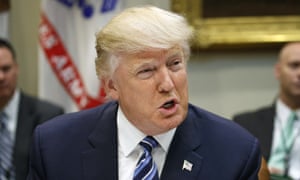
In office, Trump has proved to be a great deal friendlier to the titans
of Wall Street and their interests than he suggested he would be as a
candidate.’
Photograph: Evan Vucci/AP
President Trump was an accident waiting to happen. The US had entered
a zone of fragility: there were too many inequalities, grievances and
accompanying disillusion in a system felt not to work .
A chief reason for that economic and social fragility was the
behaviour of the American financial system. It is still astounding how
close to disaster high finance brought the US and global economy in
2008. It provoked a vast bailout, and the recovery that followed has
been one of the most anaemic sort, during which the wages of average
Americans have scarcely grown.
The hangover of debt and legacy of banks trying to rebuild their
shattered balance sheets has held the economy back. Meanwhile, some of
the weak links in the system, like the sheer scale and opacity of the
derivative markets, plus business models riddled with conflicts of
interest, have remained unaddressed. Fortunes are still being made and
very few have paid the price for cataclysmic mistakes.
On the campaign trail, Trump unfailingly tarred Clinton as compromised by, and enmeshed with, Wall Street and its mega banks. Goldman Sachs
had “total control” of her; she was in thrall to a “global power
structure that is responsible for the economic decisions that have
robbed our working class, stripped our country of its wealth and put
that money into the pockets of a handful of large corporations and
political entities”.
Trump would drain the swamp, he claimed, and reinstate a
“21st-century” version of the law separating main street banking from
Wall Street – Roosevelt’s Glass-Steagall Act – which was scrapped by
President Bill Clinton, in one of his worst decisions. Trump would throw
the money men out of the temple, he said. He would reshape finance for
the “little guy”. His audiences roared him on.
But, in office, Trump has proved to be a great deal
friendlier to the titans of Wall Street and their interests than he
suggested he would be as a candidate, although a close reading of his
speeches foretells some of what is now happening. Far from draining the
swamp, he is opening the sluicegates; the money men are not so much
being hurled out as in full occupation of the economic citadel.
Goldman
Sachs’ number two, Gary Cohn, is to be Trump’s chief economic adviser;
his Treasury secretary, Steve Mnuchin, was 20 years at Goldman Sachs
before running OneWest Bank, which made a fortune by improperly
foreclosing on mortgages in ethnic minority communities after the
financial crisis. These are not men on the side of the little guy: Cohn
has promised to attack “all aspects of Dodd-Frank”,
the partially effective regulatory framework that Obama laboriously
passed into law in 2010, in the teeth of Republican and Wall Street
opposition.
What we know from the financial crisis is that the banking system has
become a highly interdependent network in which contagion spreads in
hours – it is only as strong as its weakest link. Yet Trump, in thrall
to some of the most demonic figures in American finance, last week
demanded a 120-day review of all the US’s financial regulations to tame their alleged excesses.
His intent is clear. He has Dodd-Frank in his sights, a “disaster” on
which he aims to do “a big number”. There is only one end: to regulate
the links in the financial network so they have even less oversight than
they do now. And, if things go wrong, Trump will have no hesitation in
writing whatever cheques that have to be written to bail out the banks
again, just as he backed the bailouts in 2008/9. It is careless,
don’t-give-a-damn insouciance on an epic scale.
It seems that a 21st-century version of Glass-Steagall, the core
building block in the wholesale reconstruction of the US financial
system in the wake of the Depression, was code for doing the exact
opposite. Dodd-Frank certainly has weaknesses – in many respects, it
does not go far enough and many of its recommendations are yet to be
enacted – but it has made US banking immeasurably safer.
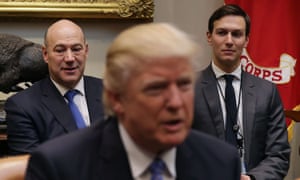
Former Goldman Sachs banker Gary Cohn, left, now Trump’s
senior economic adviser, flanks the president during a meeting with
business leaders in the White House. Photograph: Chip Somodevilla/Getty
Images
The banks now hold a third more capital than they did 10 years ago.
They are forbidden from trading in securities on their own account.
Thirty-four of them, described as “systemically important financial
institutions”, are kept under especially close watch, as key elements in
the network. The newly established Consumer Financial Protection Bureau tries to ensure customers are dealt with honestly.
You might think after the extraordinary fraud at Wells Fargo last autumn
– bank employees opening millions of phantom accounts and credit cards
in customers’ names – that a president on the side of the little guy
would at the very least not want to weaken American financial
regulation. Rather, Trump is in sympathy with the bankers, horrified at
the scale of fines they are now paying – Wells Fargo paid a cool $185m.
He is also scandalised that holding so much buffer capital and not being
able to trade in securities is damaging the bankers’ personal
remuneration.
Dodd-Frank has been under fire since its inception, but then
Republicans hated the New Deal too. Roosevelt, like Obama, was a hate
figure whose every work had to be undone. Both men represented
challenges to an idea of America as offering limitless freedom, not
least to billionaires. The accompanying social distress is a price worth
paying for such freedom – or so the thinking goes.
Billionaire Trump was right in one respect: Hillary Clinton was
profoundly compromised by her relationship with Goldman Sachs,
pocketing $675,000 for a mere three private speeches, in which she did
voice sympathetic concerns about Dodd-Frank for allegedly making banks
more cautious in their lending. She was, and is, indisputably a member
of a global elite that cannot escape responsibility for the emergence of
so many blighted lives.
But, beyond that, Trump is a phony. His economic programme is no more
than Reaganomics on speed run by a group of opportunists and
self-interested chancers. In the short run, there will be a Trump
upswing triggered by the prospect of careless deregulation, unaffordable
cuts in corporate tax and lots of infrastructure spending.
How long it will last, and whether it will be a trade war or a
financial crisis that will bring it to an end, is anybody’s guess. But
we have now had a glimpse of a darker Trump, the hypocrite for whom the
little guy is but a pawn to serve his own delusional ambitions. Pity the
US. And pity Brexit Britain, forced to bend the knee to such a man and
such a president.

No comments:
Post a Comment