Contemporary politics,local and international current affairs, science, music and extracts from the Queensland Newspaper "THE WORKER" documenting the proud history of the Labour Movement.
MAHATMA GANDHI ~ Truth never damages a cause that is just.
Wednesday, 8 February 2017
‘It was as if I had peered into hell’: the man who brought the Nazi death squads to justice
Benjamin Ferencz, at 97 the last surviving prosecutor at the
Nuremberg trials, has fought for the victims of war crimes all his life.
He talks about upholding ‘law not war’, where Theresa May is going
wrong – and how to deal with Donald Trump
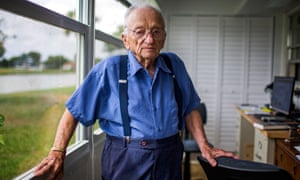
Benjamin Ferencz: ‘Brexit is a mistake, and in time they will look back at this and think: how could we have been so backward?’
Photograph: Brooks Kraft/Getty Images
It was called the biggest murder trial in history. Twenty-two members of the Einsatzgruppen,
Nazi extermination squads responsible for the deaths of more than a
million Jews, and many thousands of Gypsies, partisans and others, were
tried and convicted at Nuremberg. The chief prosecutor for the US in the
case was former army sergeant Benjamin Ferencz. It was his first trial, and he was 27 at the time.
This year marks the 70th anniversary of that case and the global
postwar order is unravelling at a rapid pace. From the UK’s vote to
leave the EU, to the election of Donald Trump; from the UN’s stand-off
with Syria and its allies for atrocities committed in its civil war to a
colossal refugee crisis, peace and security have not seemed this
unstable since the second world war. But this doesn’t dampen Ferencz’s
mood.
“I’m always doing fantastic,” he tells me with certain mirth, when I
call him at his home in New Rochelle, New York. “You know why? Because
I’m 97 years old and I’m aware of the alternatives.”
There is nobody alive in the world with Ferencz’s perspective. As the
last surviving prosecutor of the Nuremberg trials, he has witnessed
more in his lifetime than most. He was born into a Jewish family in
Transylvania in 1920 and they moved to New York when he was 10 months
old. Growing up in a neighbourhood riddled with crime, he was a studious
adolescent keen to prove his worth. He did so by winning a scholarship
to Harvard law school. After graduating he joined an anti-aircraft
artillery battalion of the US army and “received five battle stars from
the Pentagon for having not been killed in every major battle in
Europe”. He landed on the beaches of Normandy during the D-day
offensive; broke through the German defences on the Maginot and
Siegfried lines; crossed the Rhine at Remagen; and took part in the Battle of the Bulge at Bastogne.
In 1945, as Nazi atrocities were uncovered, Ferencz was transferred
to the headquarters of General Patton’s third army, tasked with setting
up a new war-crimes branch. He was present at, or arrived soon after,
the liberation of concentration camps including Buchenwald, Mauthausen, Flossenbürg and Ebensee,
scouring the barbarous scenes for evidence of Nazi wrongdoing to
present at trial. The most significants items he collected, he says,
were the death registries, kept as meticulously by the Germans as
hospital birth certificates.
“There were 3,000 men who, for two years, murdered people, including
children and infants,” Ferencz recalls with a memory that defies his
years. “One shot at a time, or, as one of my lead defendants, who killed
90,000, instructed his troops: ‘If the mother is holding an infant to
her breast, don’t shoot the mother, shoot the infant because the bullet
will go through both of them, and you’ll save ammunition.’”
The defendants, he explains, were picked on the basis of their rank
and education. “But then the decisive absurdity: why only 22? Well,
there were only 22 seats in the dock. It was ridiculous, but it was
symbolic. We were trying to show people how horrible it is if you take a
leader who’s very charismatic, and unquestionably follow him, even to
murdering little children. These were educated people; one was a father
of five children. They were not all wild beasts with horns.”
Ferencz at the Einsatzgruppen trial at Nuremberg. Photograph: Alamy Stock Photo
It was far from a painless job, and what Ferencz saw in the
concentration camps haunts him to this day. “It’s unimaginable. Bodies
lying around; you can’t tell if they’re dead or alive, pleading with
their eyes for help. Waving their hand and you see they’re alive, in
rags; rats, dysentery, diarrhoea, every disease in the camps. It was an
experience indescribable because of its horror. It was as if I had
peered into hell. That’s why I’m still fighting, to prevent that from
happening again.”
This fight includes convincing the world that countries are stronger
and safer together than they are apart, at a time when national
interests are increasingly being emphasised over international laws.
“My general reasoning is that the world is a small planet,” Ferencz
says. “We must share the resources on this planet, so that everyone can
live in peace and human dignity, and it can be done. The recognition
that we have to move as a unit gave us the EU, it gave us the US, 50
states with very differing opinions. Most wars are fought against
another group, the ‘other’. When you are a part of the other, you’re
less inclined to attack it.
“So, the movement towards unification was itself a great
accomplishment. Will there be economic problems? Of course. If one is
rich and the other one is poor, the rich doesn’t want to give it up to
the poor. But Brexit is a mistake, and in time they will look back at
this and think: ‘Oh my God, how could we have been so backward?’ Today,
some people are fleeing for their lives, other people are saying: ‘Not
in my backyard, take them someplace else, they speak a different
language, they don’t want to work’ – all that junk. But you wouldn’t
treat your family that way, I hope. We’re all brothers and sisters, and
Great Britain, with its large colonies, should certainly recognise
that.”
The European convention on human rights, he adds, is another
expression of hope, similar to the universal declaration of human
rights, drawn up following the war. “Is Theresa May doing the right
thing in backing away from the ECHR? I don’t think so; it may be good
for the next election, but it’s shortsighted. Unfortunately, the public
isn’t interested in things like distant courts in distant places, argued
by lawyers who are quibbling about obscure phrases in complex law.”
On sovereignty and nationalism, Ferencz says the popularity of
figures such as Trump, Marine Le Pen and Nigel Farage was never beyond
the realms of possibility. “People always have differences of opinion,
and when the shoe hurts the foot they’ve got to kick somebody, and
they’re not always rational. A man like Mr Trump doesn’t fit the pattern
of trained politician or international realist, optimist or idealist,
but almost half the people voted for him.”
The way to tackle politicians who peddle hate, he continues, is to
try to change the opinions you don’t agree with through compassion,
compromise and courage. “You begin at the earliest level. When little
Johnny is playing baseball with little Tommy and he doesn’t like what
Tommy does, you teach him he doesn’t hit him with a bat, he talks to him
and tries to settle it.
“My slogan has always been ‘law not war’. You would save billions
every day and be able to take care of refugees who don’t have a home,
students who can’t afford tuition, the poor and the elderly. Think of
all the money we are wasting on preserving the outdated nuclear weapons,
which nobody knows what to do with and which are obsolete.”
He
remains optimistic about society’s inevitable advancement, however.
“Fundamental things such as colonialism and slavery, the rights of
women, the emancipation of sex, landing on the moon, these were
inconceivable not long ago. But miracles can be performed.”
Since the second world war, Ferencz has stayed busy, leading efforts
to return property to Holocaust survivors, participating in reparations
negotiations between Israel and West Germany. In 1970, as the US was
embroiled in Vietnam, he decided to withdraw from private practice
altogether and devote himself to promoting peace. He wrote several books
outlining his ideas for an international legal body, which became
fundamental in the establishment of the International Criminal Court in The Hague. When the ICC came to their first case, against Congolese warlord Thomas Lubanga Dyilo in Uganda, they invited Ferencz to make the closing remarks for the prosecution.
But the US, China and Israel have refused membership, and at the end
of last year, Russia joined African states including South Africa and
Gambia in formally withdrawing its signature from the Rome statute,
just one day after the court published a report classifying the Russian
annexation of Crimea as an occupation. Even the UK has limited the
court’s funding. These are heavy blows to efforts to establish a global
legal order for pursuing genocide, war crimes and crimes against
humanity, and it is now feared that the tide of nationalist sentiment is
threatening to undermine the project altogether.
A force for good ... Benjamin Ferencz. Photograph: Brooks Kraft/Getty Images
“The Russians withdrawing is a sign of protest, saying: ‘You can’t
push us around.’ It’s a dangerous game they’re playing, and it’s
unfortunate.” The US’s refusal to commit, Ferencz adds, “would be
laughable if it wasn’t so tragic ... the most powerful nations of the
world are not yet ready to surrender what they perceive as a sovereign
right to use whatever means they perceive to be necessary in order to
protect their own interests as they see them.”
The ICC’s biggest problem, then, is that it lacks any meaningful
enforcement powers. “You need laws in order to define what’s permissible
and what’s not permissible, you need courts where people can be held
accountable if they violate the laws, and you need a system of effective
enforcement. Those are the three legs on which civilisation stands. But
we only have the two legs, and they’re both a little bit wobbly; the
third enforcement leg doesn’t even exist.”
For his work and achievements, Ferencz has received many awards, including the medal of freedom from Harvard in 2014. He continues to be a force for good, last autumn donating $1m (£800,000) to the Holocaust museum’s genocide prevention centre,
a gift he has pledged to repeat annually for up to 10 years. “I don’t
care about glory, I don’t care about legacy, I don’t care about money,
I’d give it all away,” he says. “I came into the world as a pauper, I
lived most of my life in poverty, and now I’m giving it all back.”
I ask him if he was nervous, all those years ago, as he faced the
court at Nuremberg. “No, I was confident. Was I sad? No, I was
determined. Was I worried? No, I was angry.”
If he had to give three pieces of advice to young people, they would
be: “One, never give up. Two, never give up. Three, never give up.”
These days, he spends much of his time in Florida with his wife
Gertrude; they have four children, all of whom have retired. “My wife is
a few years older than me, she couldn’t take the cold of New York at
this time of year. We’ve been 70 years wed without a quarrel. So I’ve
got to get back to Florida and continue to take care of her.”
There’s a pause, before he adds: “There are other things to do besides saving the world, you know, my dear.”


No comments:
Post a Comment