Contemporary politics,local and international current affairs, science, music and extracts from the Queensland Newspaper "THE WORKER" documenting the proud history of the Labour Movement.
MAHATMA GANDHI ~ Truth never damages a cause that is just.
Monday, 15 May 2017
'Our country will vanish': Pacific islanders bring desperate message to Australia
Kiribati and other low-lying countries are under threat from climate
change, and while their people would rather stay behind, they may be
left with no choice
The archipelago of Kiribati is the world’s lowest-lying country, with an average height above sea level of just two metres.
Photograph: Jonas Gratzer/LightRocket via Getty Images
“Like a drop of water in a bucket, on its own is small, but if there are many, many drops, soon it is overflowing.”
Erietera Aram’s water analogy is apposite. His country faces being lost under the waves of the Pacific Ocean.
The i-Kiribati man is in Australia delivering his message about the
reality of climate change in his country, and of its immediacy. Each
discussion, he says, is like a drop of water, adding to the one before
it, slowly building understanding of the existential threat to his
people and place.
“Climate change is not something off in the future, it’s not a problem for later. We are living it now,” he says.
The archipelago of Kiribati
– 33 tiny coral atolls spanning 3.5m square kilometres of ocean – is
the world’s lowest-lying country, with an average height above sea level
of just two metres.
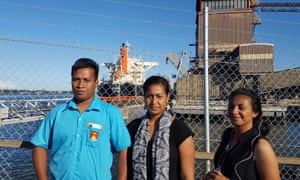
From left, Erietera Aram from Tarawa, Kiribati; Mangila Kilifi from Kiribati; and Saineta Sioni from Funafuti, Tuvalu.
Most of the 113,000 i-Kiribati live crammed on to Tarawa, the
administrative centre, a chain of islets that curve in a horseshoe shape
around a lagoon.
“My place is very small,” Aram says. “If you stand in the middle, you
can see water on both sides. We are vulnerable. One tsunami, one
tsunami and our whole country will disappear.”
Already, there is less and less of Kiribati for its inhabitants. The
coastline is regularly being lost to king tides and to creeping sea
levels, and in a very real sense, there is nowhere to go.
The loss of land is causing conflict – Tarawa is growing ever more
densely crowded, as families living on the coastline are forced inwards,
infringing on another’s claim.
The next round of multinational climate talks in November – COP 23 –
will be chaired by Fiji, and is expected to swing particular focus of
the global climate debate to the Pacific, where comparatively minuscule
amounts of carbon are produced, but the effects of climate change have
been felt first, and most acutely.
Assuming the COP presidency, the Fijian prime minister, Frank
Bainimarama, said he would “bring a particular perspective to these
negotiations on behalf of some of those who are most vulnerable to the
effects of climate change – Pacific Islanders and the residents of other
small island developing states and low-lying areas of the world”.
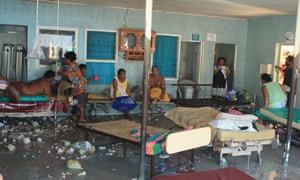
The Betio hospital in Kiribati, which sustained damage during Cyclone Pam in 2015. Photograph: Kiribati Climate Action Network
But the islands’ fight to be saved was everybody’s, Bainimarama said.
“Our concerns are the concerns of the entire world, given the scale of this crisis.”
Aram and compatriots from Kiribati and fellow low-lying islanders from Tuvalu
are travelling with the Edmund Rice Centre, a social justice group,
across Australia. They have met politicians, unions, coalminers, and
officials from the CSIRO and power stations “and we think they have
heard our stories, they understand how serious this is”.
Recent reports from groups as disparate as the World Bank, the Menzies Research Centre and the Lowy Institute
have suggested allowing open-access migration from Pacific Islands to
Australia as a more effective economic stimulus than aid, and as a
strategy for coping with the impacts of climate change, which are
already beginning to see islands across the Pacific lost to the sea.
In April, the former US deputy undersecretary of defence Sherri Goodman visited Australia, and said the Pacific was “right in disaster alley” and the region would be “on the frontlines” of widespread forced migration caused by climate.
The issue of a mass migration is a contentious one for the Pacific
Islands facing annihilation under the waves. Many islanders are
resistant, but understand it may be inevitable.
“We don’t want to leave our country,” Aram says. “We love our land,
and it doesn’t have the same meaning to be living somewhere else. We
don’t want to be migrants of climate, but if there is no change our
country will disappear into the sea.”
It feels terrible, he says, to worry about one’s country’s very existence.
“What will happen to my children’s country, that’s why I worry. What
am I leaving behind? We are the voice of the children of these
vulnerable countries.”
Aso Ioapo from Tuvalu says “migration is the last option of the Tuvaluan people”.
“Our history and our culture are very important to us, and we believe
that this is the place we are supposed to be. We don’t want to lose
that, we don’t want to lose who we are.”
Tuvalu has had an increasing number of cyclones, of greater
intensity, over recent years. In 2015, Cyclone Pam sent massive waves
washing over some entire islands. About 45% of the country’s 10,000
population was displaced, the government said.
“The cyclones are occurring more regularly, and they are more powerful now,” Ioapo said.
“We have to face that we might have to go to another place. That is
hard. But migration is the last option. We want to save our countries.”


No comments:
Post a Comment