Contemporary politics,local and international current affairs, science, music and extracts from the Queensland Newspaper "THE WORKER" documenting the proud history of the Labour Movement.
MAHATMA GANDHI ~ Truth never damages a cause that is just.
From Turkey to China, strongmen rewrite the past to suit their ends. But democracies are not immune to this revisionism
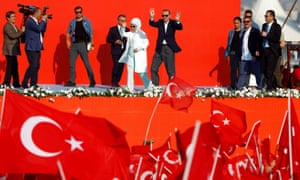
Turkish president Recep Erdoğan and his wife, Emine, attend a rally in Istanbul.
Photograph: Osman Orsal /Reuters
On 22 July, the Hungarian prime minister Viktor Orbán stood before university students and delivered a speech
titled “Will Europe belong to Europeans?” It contained rambling
passages about how a “Soros plan” was in place to bring in “hundreds of
thousands of migrants every year – if possible, a million – to the
territory of the European Union from the Muslim world”. The aim was to
transform the continent into “a new, Islamised Europe”. This, Orbán
argued, was what lay behind “Brussels’ continuous and stealthy
withdrawal of powers from the nation states”. Orbán has form when it
comes to this kind of paranoid vision. He’s an authoritarian populist
who has made a habit of stoking xenophobia and anti-Muslim sentiment. He
eagerly amplifies far-right conspiracy theories about the Christian
majority being threatened by demographic “replacement”. His message
isn’t just fake news about the present, however. It comes laced with
historical distortion.
“Not since the treaty of Trianon”, he gloated, “has our nation been
as close as it is today to regaining its confidence and vitality” – a
reference to the post-first world war treaty that deprived Hungary of
two-thirds of its territory. Orbán’s guiding idea is that Hungary
must seek redress for historical humiliations. The suggestion is that,
as his government clashes with the EU on migration quotas, it is
avenging grievances rooted in the 20th century. Orbán’s manipulations go
further, and involve completely rewriting dark chapters of the past.
He’s on the record as saying Miklós Horthy, the Hungarian leader who
cooperated with the Nazis, was an “exceptional statesman”.
Of course, he’s not alone in twisting history to further his political goals. In Recep Tayyip Erdoğan’s Turkey,
school books have been modified to de-emphasise Ataturk, the founder of
the secular republic. It’s all part of an effort to reverse that legacy
and glorify the Ottoman past, as Erdoğan carves out ever more powers
for himself.
Controlling memory is at the heart of the Putin regime in Russia. Not
only has Stalin been rehabilitated, with new monuments built to honour
him across the country, but historians and human rights activists who
work to document Stalinist crime have come under political pressure.
Some, like Yury Dmitriyev, have been tried
on trumped-up charges. And rewriting the Soviet past doesn’t just serve
domestic political purposes. Negating the crimes of Soviet occupation
in central and eastern Europe, and excusing the Molotov–Ribbentrop pact
with the Nazis, provides justification for Moscow reclaiming its “zone
of influence”.
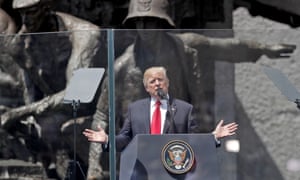
Donald Trump delivers a speech in Warsaw. Photograph: Petr David Josek/AP
In Xi Jinping’s China, any mention of the horrors of the Cultural
Revolution or of the Tiananmen square massacre is stamped out because
it’s seen as a challenge to Communist party rule. Collective amnesia is
what the regime seeks on issues that risk undermining its legitimacy.
It’s not enough to throw dissidents in prison or censor information; the
past is purged.
And while it’s tempting to think the rewriting of history is
something found exclusively in illiberal or dictatorial systems, it has
increasingly become a feature of democracies. Donald Trump’s speech
in Warsaw last month strove to cast Poland’s historical struggle for
freedom and independence as a “civilisational” battle for family values,
“tradition” and “God”, rather than an aspiration to democracy. The
narrative entirely left out of the rich and varied political tapestry
that gave rise to the solidarity movement. In a strange twist, Trump
also drew a parallel between the threat Islamist terrorism poses to “the
west” and the “danger” of “bureaucracy and regulation”. His nativist
vision of the west as an embattled fortress of Christian nations in
cultural danger reflected not only a personal political credo, but a
wider attempt to rewrite the history of liberal democracies and the
principles they are meant to uphold.
In Britain, Brexiteers have proven willing to supply their own
version of history. Nostalgia for the days of empire and their
“swashbuckling spirit” comes accompanied with the mantra that the
European project was a tyrannical straitjacket all along. Britain never
had a say in anything the EU decided, and now it has a chance to “free”
itself, so the story goes. Never mind that Britain was at the table, a
full and influential member of a club its citizens and its economy have
benefited from. Fanaticism alters not only the perception of current
realities (as negotiations limp forward), it also adjusts the past to
suit one set of beliefs.
George Orwell’s 1984 contains a well-known phrase about history and
its importance: “He who controls the past controls the future. He who
controls the present controls the past”. We worry rightly about the
impact of fake news, but today’s nationalist passions are even more
deeply rooted in the distortion of history, which citizens in many
countries lap up despite the fact it is poison. The past has always been
a battleground. The 20th century showed to what extremes state control
over memory could go. Primo Levi, who experienced the nightmare of Nazi
concentration camps, once wrote that the entire history of the Reich
“can be re-read as a war against memory”.
One of the blessings of living in a democracy is that researchers,
students, journalists and citizens at large can all access the past
without having to subject themselves to any form of centralised,
censoring control. The philosopher Tzvetan Todorov has described this as
“one of the most inalienable freedoms, alongside the freedom to think
and express oneself”. Yet the security of memory in democratic societies
may not be as assured as we think. Some politicians want to lead us in a
march towards forgetfulness. But that way lies a world of senselessness
and deceit. Learning about history, and being able to question some of
the narratives advanced in the name of politics is as important as
knowing where to get reliable news. “Can history save us from
ourselves?” asked the historian Timothy Snyder at a recent conference on the nation state and the many falsehoods politicians attach to it. Perhaps it can. • Natalie Nougayrède is a Guardian leader writer, columnist and foreign affairs commentator

No comments:
Post a Comment