Extract from The Guardian
With a 20-year development timeline, nuclear plants won’t be built soon enough to stop temperatures rising above 2C. So why are we wasting precious time debating them?
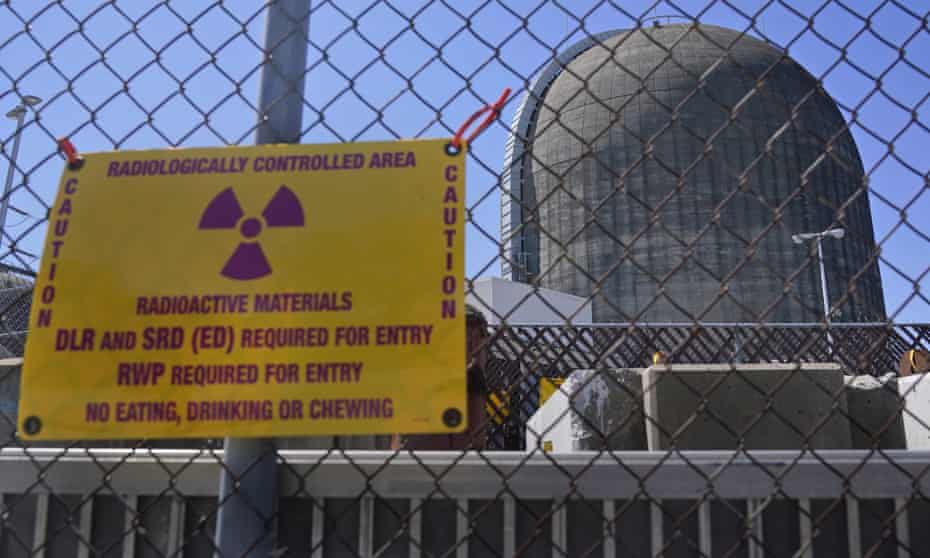
A nuclear power plant, such as this one in New York state, will take so long to build that it would have no chance of stopping temperatures rising by 2C.
Last modified on Tue 19 Oct 2021 06.31 AEDT
The catch-22 of nuclear power in Australia is that you would only consider it if you wanted to reduce emissions because of climate change, but if you agree climate change is real and we need to reduce emissions, you would not consider nuclear power.
Currently Australia burns a lot of coal – more than other comparable economies with nuclear power.
If the graph does not display click here
Even worse, Victoria relies greatly on the dirtiest and least-efficient brown coal.
But if you think climate change is a load of bunk then, as current head of charging with ChargeFox, Evan Beaver, puts it in his excellent blog post on the issue, “we might as well burn all the coal we have. And we have a lot.”
But if you do agree climate change is real then what we need to do is reduce emissions as fast as possible. As I noted last month, at a certain point there will be so much CO2 in the atmosphere that we won’t be able to limit temperatures rising above either 1.5C or 2C above pre-industrial levels, no matter when we get to net zero afterwards.
If the graph does not display click here
Nuclear power is of zero use on that score.
We know this because nuclear power has already been examined a lot.
One excellent study was in 2006 under the Howard government, by Ziggy Switkowski. It noted that “the earliest that nuclear electricity could be delivered to the grid would be 10 years, with 15 years more probable”.
Alright then. Firstly, not even the National party is insane enough to make nuclear power an election promise.
So let’s assume if the Coalition wins next year’s election, but announces a move to legalise nuclear power, that even with the best intentions, given the task of getting the votes, it’d be lucky for that to happen until the end of 2022.
Now all that has to happen is choose the type of reactor, and oh, pick a spot (have fun).
Ignore the coming election in 2025 and assume everything gets in place by 2024 (not a hope, but hey, let’s play pretend). That means at best we’re looking at 2035 but more likely 2040 before the first nuclear plant comes on line.
That is already too late to help prevent temperatures reaching 2C, and by then an overwhelming amount of our electricity will already be generated by renewables.
The CSIRO’s latest “GenCost” report suggests the capital costs of small modular reactor (SMR) nuclear power plants by 2030 and even out to 2050 will be greater than renewables, including solar thermal plants.
If the graph does not display click here
But perhaps rather surprising is that nuclear becomes even less viable when the CSIRO projects the world getting to net zero by 2050.
If the graph does not display click here
As the CSIRO notes, “a major source of discomfort” for nuclear stakeholders is that the high cost estimate of nuclear power “is of theoretical value only” because “a nuclear SMR plant is not planned to be built in Australia anytime soon”.
The CSIRO suggests “it is more likely that Australia would only take up nuclear SMR, if at all, from around 2030, after other countries have brought down the cost”.
If the world moves to net zero by 2050, those costs will not be brought down.
Even once up and running, CSIRO estimates, the price of electricity generation from nuclear power in order to meet all its costs including a return to investment would at best be little better than solar thermal, and much above wind and solar panels.
If the graph does not display click here
This is not new.
The South Australian government conducted a royal commission into the nuclear fuel cycle in 2016 and concluded that “a nuclear power plant of currently available size at current costs of construction would not be viable in the South Australian market”.
And that was in 2006.
The SA royal commission considered the case where a carbon price was implemented in 2017 designed to reduce emissions to 65% below 2005 levels by 2030 and with “complete decarbonisation by 2050”.
Even though this “significantly increased the wholesale price of electricity”, it concluded nuclear power remained unviable.
I have no problems with nuclear power. But the only way it would be viable is with an extremely high carbon price. I say bring that on!
Except a high carbon price makes renewables an even better investment, and thus nuclear less needed.
And even a high carbon price won’t get enough nuclear plants built soon enough to prevent temperatures rising above 2C.
Nuclear power: too costly, and too slow.

No comments:
Post a Comment