A governance facility in Papua New Guinea is among projects Australia claims as ‘significantly focused’ on climate adaptation.
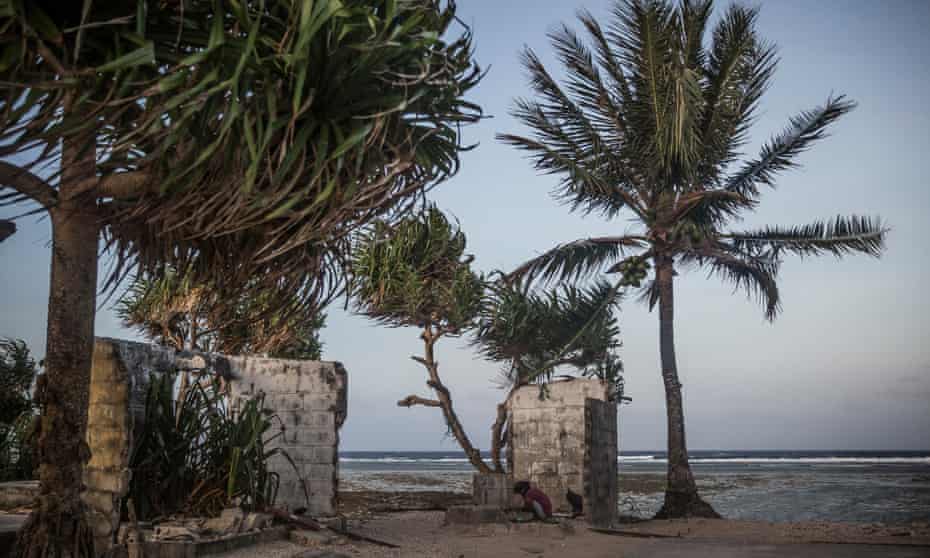
A Greenpeace analysis shows many Pacific aid projects Australia says address climate adaptation make no mention of climate change.

First published on Wed 3 Nov 2021 20.00 AEDT
Australia has been accused of “greenwashing” its aid to the Pacific, with the government claiming that major projects are significantly focused on climate adaptation when they have little or no link to climate change or the environment.
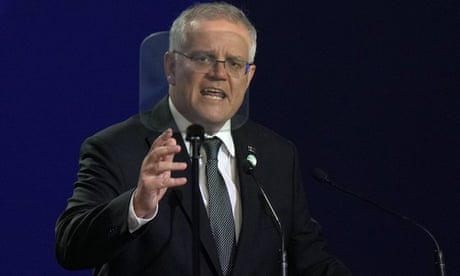
The accusations, in a new report by Greenpeace Australia Pacific, come after Scott Morrison announced an additional $500m for international climate finance for projects in the Indo-Pacific on the first day of the Cop26 summit in Glasgow.
But analysis by Greenpeace found that fewer than one-quarter of all aid projects in 2018 and 2019 that the Australian government labelled “significantly focused” on climate adaptation made any mention of climate change or environmental concerns.
“We’ve seen the Morrison government over the last few years be really loud and proud about its climate aid to the Pacific,” said Alex Edney-Browne, the investigations officer at Greenpeace Australia Pacific, and report author.
“But climate aid in the Pacific has been greenwashed. The Australian government really needs to drastically improve the transparency and the accuracy of its reporting, otherwise there’s no guarantee that this aid is actually going to improve the climate resiliency in the Pacific.”
In 2018, Australia spent US$255.07m on aid that was “significantly focused” on climate adaptation, compared to US$26.94m on projects that were “principally focused” on it, such as sea walls, cyclone-proofed infrastructure and mangrove planting initiatives.
However, the Greenpeace report found that in 2018 only 23% of the “significantly focused” projects mentioned anything to do with climate change in reports on the projects.
One of the most striking examples found by Edney-Browne was a governance facility in Papua New Guinea, which over 2018 and 2019 received more than US$80m in Australian aid.
“This was about political administration, improving political participation, decreasing corruption in Papua New Guinea, so no obvious link there to climate change,” she said.
“I even read a 113-page evaluation of the project that Dfat [the Department of Foreign Affairs and Trade] commissioned and not a single mention of climate adaptation in that whole report.”
The findings tally with those contained in a report from Terence Wood, a research fellow at the Development Policy Centre at the Crawford School of Public Policy, published earlier this year.
“If you’re a donor such as Australia, with your aid budget not going up but at the same time all these announcements about increased climate finance are being made … your easiest way out of a difficult bind might be to be … lenient in how you classify some of your projects,” Wood said.
“If you’re suitably creative as a donor, you can convince yourself at least that almost anything is associated with climate change adaptation or mitigation. You build a school and you build it a couple of hundred metres inland, and you might tell yourself, the fact we built this school inland means we’re helping this country adapt to climate change.”
But the tendency to do this was concerning and could get in the way of meaningful action on climate projects, he said, and undermined Australia’s reputation in the region.
“Australia really could be earning a reputation for itself in the Pacific as a decent friend for the region, who gave its aid with the needs of the region in mind, and when it starts doing dubious things with its climate finance or making promises that look like they’re larger than they are, that’s probably going to undermine Australia’s reputation and its ability to come across as a good friend in the Pacific … That on top of the fact that Australia isn’t cutting its emissions in a meaningful way nearly as rapidly as it needs to be.”
Edney-Browne agreed, saying it left Pacific countries in a bind.
“We’ve got to remember Pacific countries are absolute climate champions and sovereign countries, and really great leaders in the climate movement, but they’re still developing countries that are still very vulnerable to climate change, they’ve really suffered the effects of Covid-19, so that power that Australia wields over them through aid and aid dependency is significant.”
Dfat was contacted for comment.

No comments:
Post a Comment