Friday, 4 December 2015

Turnbull will pay a high price if he sticks by embattled Mal Brough

Extract from ABC The Drum

Opinion
Updated about 8 hours ago


Mal Brough's mere presence as Special Minister of State is dragging down the Government. If the Prime Minister stands by him, he will have a lame duck - indeed, a next to useless minister - on his hands, writes Barrie Cassidy.
Why has Prime Minister Malcolm Turnbull not heard the deafening alarm bells around the Special Minister of State, Mal Brough?
It's troubling enough that he failed to see the risks in bringing Brough into the ministry even though the James Ashby/Peter Slipper affair was still to be resolved.
But not understanding that the situation for Brough had this week dangerously escalated brings his judgment further into doubt.
As Laura Tingle wrote in the Financial Review this week:
They [Brough and Wyatt Roy, Assistant Minister for Innovation] are being investigated by the coppers, for goodness sake. Brough's house has been raided.
And Brough is no ordinary minister. He is Special Minister of State, prompting the shadow attorney-general, Mark Dreyfus, to ask of the Prime Minister on Wednesday:
Is the Prime Minister's judgment so bad, or did he owe the member for Fisher so much, that he gave him responsibility for government integrity?
Then to exacerbate his problems, Brough gave clearly contradictory answers to precisely the same question: Did he ask James Ashby to procure copies of Peter Slipper's diary for him?
Last year, Brough told Liz Hayes on 60 Minutes that he did, and he went on to explain why he did it.


This week, he gave a flat answer - "No" - when the same question was asked in Parliament.
Staffers (like Peta Credlin) and ministers (like Mal Brough) should think seriously about their positions when their mere presence drags down the government. But they rarely do.
Prime ministers pay a high price when they, too, resist such obvious pressures.
The unfortunate fact for Malcolm Turnbull is that he has now been - albeit unwittingly - at the centre of two of the most sordid political exercises in the past six years.
The Godwin Grech episode in 2009 was the beginning of the end for him as Liberal leader the first time around.
Turnbull staked his reputation on the credibility of a Treasury official who forged an email in an attempt to ingratiate himself with the Coalition and try to bring down the Labor government.
When the facts were revealed, Turnbull's approval rating suffered the biggest single fall in Newspoll history.
Now, in standing by Brough, he immerses himself in yet another sorry saga where plainly Coalition figures - now ministers - went to extraordinary lengths to tear down the speaker, Peter Slipper.
Undoubtedly Slipper brought some of that on himself, but he was nevertheless subjected to the kind of persecution that hadn't been seen since Labor went after Senator Mal Colston in the late 1990s.
If Turnbull sticks by Brough then he will have a lame duck - indeed, a next to useless minister - on his hands.
Useless in this sense: Brough will not be able to hold a news conference - a basic requirement of any minister - without having to tackle questions like those Mark Dreyfus asked of him on Monday.
As examples:
Does the minister ask the Australian Federal Police to investigate when staff members employed under the Members of Parliament (staff) Act provide unauthorised access to a member of parliament's official diary?
On 29 March 2012 the minister texted his email address to James Ashby so that he could be sent a better quality copy of the speaker's diary. Ashby replied, and I quote: 'Done. Coming through in a minute.' Did the Minister receive those unauthorised copies of the speaker's diary? Is conduct of this nature consistent with the standards the Government applies to this Minister's portfolio?
On 29 March 2012, now former journalist Steve Lewis sent an email to the minister which read: 'On how many occasions has Peter Slipper travelled to New Zealand since July 2010?' Did the minister agree to obtain unauthorised copies of the speaker's official diary for a journalist?
And on and on it went.
And so will the controversy - until such time as Brough is able to openly and completely answer questions like those.
***
One final note on a story that hasn't yet drawn widespread national attention, but should.
Australian Border Force has suspended a program by a group of nuns in Melbourne who routinely take children from the Broadmeadows detention centre on outings to places like the Melbourne Zoo, the Collingwood Children's Farm and various parks for picnics.
They have done this because, they say, the nuns do not provide adequate supervision and some of the places they visit are inappropriate.
They would have been better off saying nothing and putting it down to "on playground matters".
Tony Abbott was right about one thing when he said that nothing changes when you change leaders.
No matter who is running the country, the Government is still capable of being cruel to the children of asylum seekers. On that issue, we remain an international embarrassment.
Barrie Cassidy is the presenter of the ABC program Insiders. He writes a weekly column for The Drum.

Bill Shorten, Subjects: Paris COP21; Labor’s positive plan for climate change action

E&OE TRANSCRIPT

RADIO INTERVIEW
ABC NEWS RADIO
TUESDAY, 1 DECEMBER 2015


MARIUS BENSON, HOST: The Opposition Leader, Bill Shorten is in Paris for the climate conference and a little earlier this morning, I spoke to Mr Shorten.

Bill Shorten, just a general question to begin with – what’s your purpose in being in Paris when so many people are in Paris?

BILL SHORTEN, LEADER OF THE OPPOSITION: I want to understand better what the rest of the world is doing on climate change. I have had a great opportunity already to talk to leaders of nations through to businesses through to non-government organisations and it is very apparent that a lot of people throughout the world take climate change very seriously and are committed to making sure that we work together to restrict the global warming to within 2 degrees Celsius increase.

BENSON: And the people you’ve been speaking to, are they familiar with Australia’s position and are they telling you what they think of Australia’s position?
SHORTEN: Yes, Australia sadly has been quite notorious for being a climate change denier for the last couple of years under Tony Abbott. People are aware that Tony Abbott is no longer Prime Minister but what they are also telling me is when will the policies change from Tony Abbott’s policies?. They are comparing us to Canada. In Canada they changed Prime Minister and Canada has changed their climate policies. In Australia it is becoming clear to people that we’ve only changed our Prime Minister but the climate policies haven’t changed.

BENSON: Can I ask you about some of the specifics that have come from Malcolm Turnbull’s intervention in Paris – one is that the Government has opted out of signing an international agreement to phaseout fossil fuel subsidies. How do you feel about that decision by the Government?
SHORTEN: I can see both sides of that argument. For me it’s not just a question of whether or not Australia has diesel fuel rebate, which I support keeping as well. The question is Australia pretending to do climate change reform, or is it fair dinkum? This conference is about setting out the global action on climate change from 2020 onwards, post the Kyoto conference goals. And yet, today the Australian Government has fronted up and announced that they are going to implement the second stage of the Kyoto goals and Labor had announced that three years ago. My point is, leave aside the technicalities, Australia needs to be acting on climate change, gaining some of the investment opportunities and job opportunities that come with that, and we need to pull our weight. Having seen what other countries are doing, I am not convinced that Malcolm Turnbull is on the right track by keeping Tony Abbott’s policies.

BENSON: But just to clarify on that one on phasing out fossil fuel subsidies, the Government are saying it will not do that and that would endanger the diesel rebate among others, you are with the Government on that?

SHORTEN: I don’t think when you look at all the policies, I think there are other ways to achieve meaningful change on climate and that’s why we have committed that by 2050 we believe Australia can be a net zero emitter of carbon pollution. We believe that we should be guided by Climate Change Authority policies which keep temperature rises within 2 degrees increase and that’s why Mark Butler will be consulting with industry, with community on the Climate Change Authority’s proposals. The Climate Change Authority was set up to be an independent body, it was set up to do the best practice research. Ever since they have made a recommendation on what policies should be in Australia for the long term, the Liberals in power have studiously ignored it. We won’t ignore the best science. People can vote for Labor in the complete assurance that we are backing the science and that we are not interested in the short-term politics.

BENSON: Some other things the Prime Minister has announced; Australia contributing at least $1 billion over the next 5 years to help Pacific neighbours build climate resilient  and also that Australia is going to be contributing to the fund generally to assist developing nations on climate. You’d be in favour of both of those?

SHORTEN: The truth of the matter is that the Government needs to spell out where they are finding this money. If they are taking it from other aid programs which were going towards tackling infant mortality or basic literacy in developing nations, it is really robbing Peter to pay Paul. So I think the Government needs to come clean. Is this just some tricky accounting where they move money from one column to another column and nothing actually changes or is it a new commitment from the Government? Secondly, what the Government said today is good as far as it goes. But the truth of the matter is that this is a government which not showing any bravery at all. There is a real contrast between Malcolm Turnbull – insurgent backbencher chasing Tony Abbott’s job – and the person we have now got who took Tony Abbott’s job. The right-wing of the Liberal Party as far as I am concerned, are still running climate change policy in Australia. There is a better salesmen but the substance of the policies and the low ambitions and the short-termism of the current government’s statements on climate change are hugely disappointing I think for everyone who thought by changing Tony Abbott you’d become much more fair dinkum nation in dealing with climate change.


BENSON: And that is the Opposition Leader, Bill Shorten speaking from Paris.

Wednesday, 2 December 2015

Paris diary: Planet COP 21 is a strange place but it has nothing on Planet Oz

Extract from The Guardian

Inside the climate talks, even the complimentary chocolate bars carry messages of climate justice. Given Malcolm Turnbull’s challenges, it might be better to be handing them out to his ‘friends’ in the Coalition
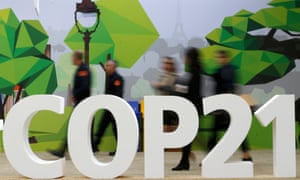
The COP 21 logo in the World Climate Change Conference 2015 at Le Bourget
Delegates walk past the COP 21 logo at Le Bourget. After 21 years, the annual climate change summits have a familiar structure. Photograph: Stephane Mahe/Reuters

In Paris it’s a sea of pillars, decorated for each participating nation. There’s always a grand entry to these climate summits – or conferences of the parties (COP) to the UN climate convention – as if to remind the thousands of delegates traipsing in each day that they are entering Planet COP.
After 21 years the annual summits have a familiar structure even though each takes place in a difference country.
There’s a similar lay-out – huge halls with little prefabricated offices for each national delegation or international organisation. Some are fancier than others. The UN usually has a relaxation lounge. Some have gimmicks. This year China has a talking robot that tells you the greenhouse emissions you have created travelling to Paris and how you might offset them.
There’s a pavilion where all manner of climate-related organisations set up stalls and a media room as big as a barn and some gimmicks to provide photographic backdrops – in Paris, somewhat unoriginally – a mini Eiffel tower.
And everything is climate-themed – from the water bottle in each participants’ welcome pack (Did you know that most of us use around 650 plastic cups each year? For France alone that’s 25 Eiffel towers of waste”) to the chocolate bars handed out on the way in (containing letters from the world’s children as a “sweet reminder” of the requests from young “climate justice ambassadors”.)

Stretching the friendship

But while Planet COP is obsessively, earnestly devoted to a global agreement on climate change – it sometimes seems less weird than Planet Oz.
Malcolm Turnbull joined 150 world leaders on Monday urging a Paris deal that locks in current national greenhouse gas-reducing commitments and then rachets them up every five years.
But at home he was being warned – in anonymous quotes to the Daily Telegraph – that there would be “hell to pay” if he even considered increasing Australia’s commitment because Tony Abbott had already “stretched the friendship” with the current 26-28% target by 2030. Apparently Australia’s fair share of avoiding catastrophic warming is to be determined by unspecified “friendships” within the Coalition.
And the same mindset inside his own conservative parties meant that – even as he pledged to increase spending on clean energy research and development, Turnbull could not say he had abandoned Tony Abbott’s plan to abolish the agencies that commercialise and fund that same technology – the Australian Renewable Energy Agency and the Clean Energy Finance Corporation.
Planet COP is a strange microcosm, but Planet Oz can sometimes seem stranger. And the gap between them looks even bigger than the gap between dangerous global warming and the world’s promised reductions in emissions. 

Kevin Rudd: 'Jury is out' on Malcolm Turnbull at Paris climate talks

 Extract from The Guardian

Talking to Guardian Australia, the former PM reflects on Copenhagen accord and an ‘180-degree’ shift in China’s position on globally binding agreement
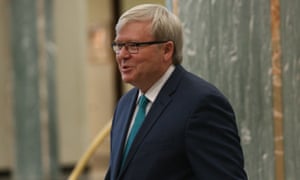
Kevin Rudd last month in Canberra
Kevin Rudd last month in Canberra. The former prime minister says there is a ‘palpable sense of relief’ that Tony Abbott is not directing Australia’s climate change policy in Paris. Photograph: Mike Bowers for the Guardian

The Copenhagen climate summit in 2009 contributed to the demise of Kevin Rudd’s first prime ministership. But Rudd, back for the Paris summit of 2015, insists Copenhagen wasn’t quite the failure it was made out to be.
He says his views on global warming haven’t changed and that unlike other, unnamed, colleagues from his time in office, his attendance in Paris proves that his interest in the issue of global warming has not wavered.
“I am a believer in climate change action. Let me say it again in print, I believe it is the greatest moral challenge of our age,” he says in an interview with Guardian Australia.
“My position hasn’t changed on that, nor will it change. The reasons I am here, supporting this process today when very few of my colleagues of five or six years ago are here, is because I attach great importance to this. That is why I continue to work on climate change projects with the world’s largest polluters in China and India,” says Rudd, now the president of the New York-based Asia Society Policy Institute.
Rudd invested enormous effort in the diplomatic efforts before and during the Copenhagen talks, and afterwards colleagues said he fell into a “slump”, missing the window of opportunity to call a double-dissolution election on his defeated emissions trading scheme at a time when the polls said he would have easily beaten the new opposition leader, Tony Abbott.
Now Rudd insists the Copenhagen talks provided an important stepping stone to the current negotiations and will be viewed more positively by history than they are now, even though they were clearly a political failure.
“If you read this draft Paris accord, its essential architecture is what was contained in the Copenhagen accord,” he says.
Copenhagen, he says, “stands up well as a major policy building block to where we are now. But in terms of the political stage management of Copenhagen, everyone knows that was a spectacular disaster.”
Like most observers in Paris he identifies India’s insistence that it needs to continue to use coal-fired power, and that its development needs cannot be compromised, as the major potential stumbling block in the Paris talks, which are scheduled to last two weeks.
“In Copenhagen, both China and India were not supportive of a globally binding arrangement and sought to reduce it to a de minimis outcome.
“The remarkable thing is there has been a 180-degree shift in the Chinese position since Copenhagen. The big question is now India’s position. The Indian industrial development curve is 30 years behind China and the most carbon-intensive part of India’s industrial development has yet to begin.
“So if we are serious about having India on board and India acting in a manner different to the China carbon explosion of the last 30 years, then this conference has to make clear how it will help India with its own rapid transformation of its energy mix.”
On Malcolm Turnbull, Rudd says his discussions in diplomatic circles indicate “the jury is out” about the new Coalition leader.
“People are looking and hoping, but suspending judgment for a while. There is a palpable sense of relief that Abbott is no longer directing climate change policy, not just because of his position that climate change is absolute crap but also his general hostility to multilateralism. But there is also a genuine suspending of judgment about Turnbull,” he says, arguing that in the end there will be factual evidence available as to whether the Coalition’s carbon policies are working.
He says he attended Turnbull’s address to the UN summit on Monday as “the respectful thing to do”, sitting with the prime minister of Papua New Guinea.
“I appropriately applauded when Malcolm announced Australia would ratify the second Kyoto commitment period. Ratifying Kyoto is useful as a baseline to Australia’s commitment to multilateral action.”

Backchannel climate meetings in Paris could decide the fate of the world

 Extract from The Guardian

Meetings of climate negotiators in ‘informal informals’ – small ad hoc groups talking outside of official sessions – could be key to reaching Paris agreement
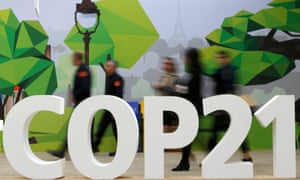
Visitors attending the World Climate Change Conference 2015 (COP21) at Le Bourget, near Paris, France.
Visitors attending the World Climate Change Conference 2015 (COP21) at Le Bourget, near Paris, France. Photograph: Stephane Mahe/Reuters

In huddles in corners, sitting on the floor in corridors, crowded around smartphones at cafe tables around the sprawling conference centre in Paris where crunch climate change talks are ongoing, a new form of meeting is taking place.
These are the “informal informals” - groups of negotiators meeting outside the conventional apparatus of plenary sessions in large halls in order to facilitate a deal.
These meetings are intended to tease out and resolve the remaining differences over the detailed wording of the text of a possible Paris agreement. Often, they will work on a single paragraph at a time, reworking the wording and attempting to forge consensus in small groups that they can then feed into the larger process of negotiations.
The informal informals are seen as a key - and novel - strand of the talks. In previous UN negotiations, proceedings have been hampered by the cumbersome process of presenting all 195 countries with long texts - sometimes scores or even hundreds of pages - every word of which must be approved by consensus.
By allowing for these smaller, ad hoc meetings, the French hosts and the UN are hoping to lubricate the process of reaching an agreement.
While these informal meetings are taking place, another strand of negotiators have broad oversight of the whole package of details that will make up any agreement, attempting to steer it through to a deal, and a third strand are working on some of the important issues that will make up the package, such as financial assistance for poor countries, commitments on greenhouse gas emissions, and mechanisms for ensuring countries are accountable for meeting their targets in a transparent way.
Negotiators say that the French, who have put a massive diplomatic effort into the last year of preparations, are acutely aware of the risk that any agreement will be foiled not by a lack of political will to forge a deal, but by being bogged down in the unwieldy details of the text. That was a key problem at the Copenhagen climate summit in 2009, and the hosts are determined not to repeat the mistakes made there.
The two weeks of talks, aimed at drawing up a new global agreement on greenhouse gas emissions that would kick in from 2020 when current commitments run out, kicked off formally on Monday. Negotiators met in back rooms while an unprecedented 150 world leaders took to the stage to emphasise their commitment to tackling global warming. In a sign of things to come, their initial meetings carried on late into the night, with some ending only at midnight.
By this Thursday, they are expected to come up with a draft text that will be further refined on Friday, then examined by the French team over the weekend. On Monday, that text should be released again for the negotiations to continue - hopefully, with the removal many of the notorious “square brackets” which denote phrases or issues over which agreement has not been reached.
At that point, the French will decide whether to entrust the ministers of each country with the task of coming to an agreement immediately, or demand further work from the facilitators before doing so.
The process of UN talks was first developed in 1992, when the UN Framework Convention on Climate Change was signed, and the emphasis is on consensus and transparency. This process can seem arcane and unwieldy, but the task of forging a lasting treaty on the climate among all world governments is so complex that little can be done to change it.
Among the remaining unresolved issues at the talks are the proposed mechanism of five-yearly reviews after Paris, at which countries would be expected to take stock of their progress towards their emissions targets, and potentially ratchet up those targets if circumstances permit.
Some countries which have set emissions targets for 2030 have reservations about the latter, though most are happy with the notion of a stock-taking exercise.
This, and mechanisms for ensuring transparency and accountability in reaching emissions targets, along with the target of providing finance from the rich world to poor countries that will be most affected by climate change, are likely to be the subject of many formal meetings and “informal informals” in the coming days.

Australia approved coalmine because it isn't a 'neo-colonialist' power, Greg Hunt claims

Extract from The Guardian

Environment minister defends approval of Indian company Adani’s $16bn Carmichael mine, saying ‘poorest should be able to make their own decisions’
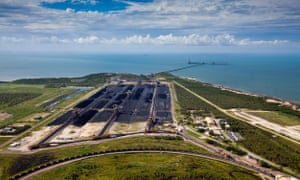
Abbot Point coal terminal.
Abbot Point, surrounded by wetlands and coral reefs, would become the world’s largest coal port should the Carmichael mine and the associated port expansion go ahead. Photograph: Tom Jefferson/Greenpeace

The Australian government approved Adani’s controversial $16bn Carmichael coalmine in Queensland because it was not a “neo-colonialist”power that tried to tell poor countries what to do, environment minister Greg Hunt has told a side event at the Paris climate summit.
Hunt was speaking about the coalition’s Direct Action policy at an OECD event on different climate policies when he was challenged by a questioner about why the government had approved the Adani mine given the huge quantity of emissions its coal would create.
“This is not an Australian government project, it is a private sector firm from India and ... I thought we were over neocolonial moment where the wealthy decide what happens to the poor,” Hunt countered.
“I hope you would agree the poorest countries should be able to decide their own energy future. I am not a neo-colonialist. I think the poorest should be able to make their own decisions,” he said.
And he said the federal environment law allowed him to judge projects according to strict criteria, but greenhouse emissions weren’t one of them.
“It is not our project, there is no federal money, the federal government of Australia acts as a judge not as an advocate and I think it is very important that individual countries set their targets and make their own decisions,” he said.
Conservation groups have asked the federal court to overturn the Hunt’s approval Carmichael because he did not take into account the impact on the Great Barrier Reef of the greenhouse gases emitted when the coal is burned.
A recent report designed to highlight the quantity of emissions that would be created by the coal from the mine found that it would create annual emissions similar to those from countries like Malaysia and Austria and more emissions than New York City.
Others on the panel, including the head of the renewable energy division of the International Energy Agency, Paolo Frankl, said “reverse auctions” like Australia’s Direct Action scheme were proving very efficient around the world, especially in financing renewable energy projects. (Australia’s scheme has not been used for this purpose, but has mainly financed land use, waste and energy efficiency projects.) But he said a carbon price was usually also needed to drive a long term price signal.
Asked if reverse auctions could be used on their own to give business the long term price signals, Frankl said “it can but it would not be very useful. If you look at Brazil and Australia that is exactly what they are doing now, but in addition to that there should be a carbon price which could give an additional signal ... we need some long term price signal but also some short term signals.”
Hunt is leading Australia’s delegation in the first week of the two-week Paris climate summit which aims to reach an agreement to progressively increase the ambition of global efforts to reduce greenhouse gases out to 2030.
The foreign minister, Julie Bishop, will take over the negotiating lead next weekend. The talks began in earnest on Tuesday after a day of speeches by 150 world leaders designed to give them purpose and momentum.
Over the two weeks delegates will seek to overcome deep divisions over issues including whether rich and poor countries must face the same rules for reporting and checking their emission reductions and the amount of financing developed countries will provide to help poor nations reduce their emissions and deal with the impact of climate change.

China blamed for 'massive' cyber attack on Bureau of Meteorology computer

Extract from ABC News

By political editor Chris Uhlmann
Updated about 3 hours ago
China is being blamed for a major cyber attack on the computers at the Bureau of Meteorology, which has compromised sensitive systems across the Federal Government.

Key points:

  • ABC told there is little doubt the "massive" breach came from China
  • Motivation for attack could be commercial, strategic or both
  • Bureau provides critical information to a host of agencies, including link to Defence Department
  • Could "take years and cost hundreds of millions of dollars to fix"
Multiple official sources have confirmed the recent attack, and the ABC has been told it will cost millions of dollars to plug the security breach, as other agencies have also been affected.
The bureau owns one of Australia's largest supercomputers and provides critical information to a host of agencies.
Its systems straddle the nation, including one link into the Department of Defence at Russell Offices in Canberra.
Cyber attacks on government agencies are routine and the "adversaries" range from thrill-seeking hackers, through to criminals and foreign states.
But the ABC has been told this is a "massive" breach and one official said there was little doubt where it came from.
"It's China," he said.
The motivation for the attack on the bureau could be commercial, strategic or both.
The bureau is a critical national resource and another state would place a high value on its intellectual property and scientific research.
In the event of a conflict, compromising Australia's ability to accurately forecast weather would affect the operation of military and commercial aircraft.
Beyond that, the bureau provides a gateway to other agencies.

'Range of adversaries' motivated to target networks

A spokesman for Prime Minister Malcolm Turnbull said a range of adversaries, including "state-sponsored actors and serious organised criminals", were motivated to attack government networks.
"The Government's aware of a press report that the Bureau has been the subject of a cyber attack," the spokesperson said in a statement, adding the Government would not comment on specific cases.
"The Government takes any cyber attacks seriously and is currently reviewing its cyber security policy."
The bureau did not deny the attack, and said its systems were working.
"Like all government agencies, we work closely with the Australian Government security agencies," it said in a statement.
"The bureau's systems are fully operational and the bureau continues to provide reliable, ongoing access to high quality weather, climate, water and oceans information to its stakeholders."
In March the Bureau's chief executive Dr Robert Vertessy told Radio National that his agency had evolved "from what was once just a straight weather service to what I would call now a more broad-based environmental intelligence agency".
It provides weather and climate forecasting, tsunami warnings, tide predictions, water resources and even space weather.
There is no clear picture yet how much the breach will cost to fix or how long it will take but the critical nature of the bureau's services means its systems cannot be switched off for repair.
In the words of one source: "It could take years and cost hundreds of millions of dollars to fix."

Cyber attacks traced to Chinese army building in Shanghai


The United States has repeatedly blamed China for cyber attacks on its agencies and American businesses. At a meeting in September, US president Barack Obama raised it with his Chinese counterpart Xi Jinping.
The Chinese president warned against politicising the issue and said China had a lot to lose from cyber crime.
China has noted that America also devotes a lot of resources to cyber warfare, as do many other countries.
The most detailed publicly available study of China's capabilities was published by American computer security firm Mandiant in 2013.
Mandiant tracked dozens of groups around the world but focused on one of the most prolific, which it traced to a People's Liberation Army building in Shanghai, Unit 61398.
The report said the reason the unit was "able to wage such a long-running and extensive cyber espionage campaign in large part because it receives direct government support".
In its first unclassified threat report this year the Australian Cyber Security Centre said the cyber threat to Australia is "undeniable, unrelenting and continues to grow".
The Centre said it "sees daily cyber espionage activity targeting Australian Government networks".
"Cyber adversaries will target the weakest link; if the network security of their primary target is robust, they will move to secondary targeting of other networks that may hold the same information but are easier to compromise.
"A cyber adversary is an individual or organisation (including an agency of a nation state) that conducts cyber espionage, crime or attack.

"Foreign state-sponsored adversaries, including nation-states, seek economic, foreign policy, defence and security information for strategic advantage. Such adversaries have traditionally possessed the most advanced and sophisticated tools to conduct their activities, sometimes maintaining access to an organisation's network for years at a time to steal the information they require. These adversaries are most frequently identified as Advanced Persistent Threats (APT)."